







First Impressions Review: XF16mmF1.4 R WR
Talk to Rico (open forum for questions & feedback)
Rico’s Books at Rocky Nook – Fuji X Secrets Workshops – Rico’s Flickr Sets
Specs – Rico’s XF16mmF1.4 R WR Sample Images – Deutsche Version
—
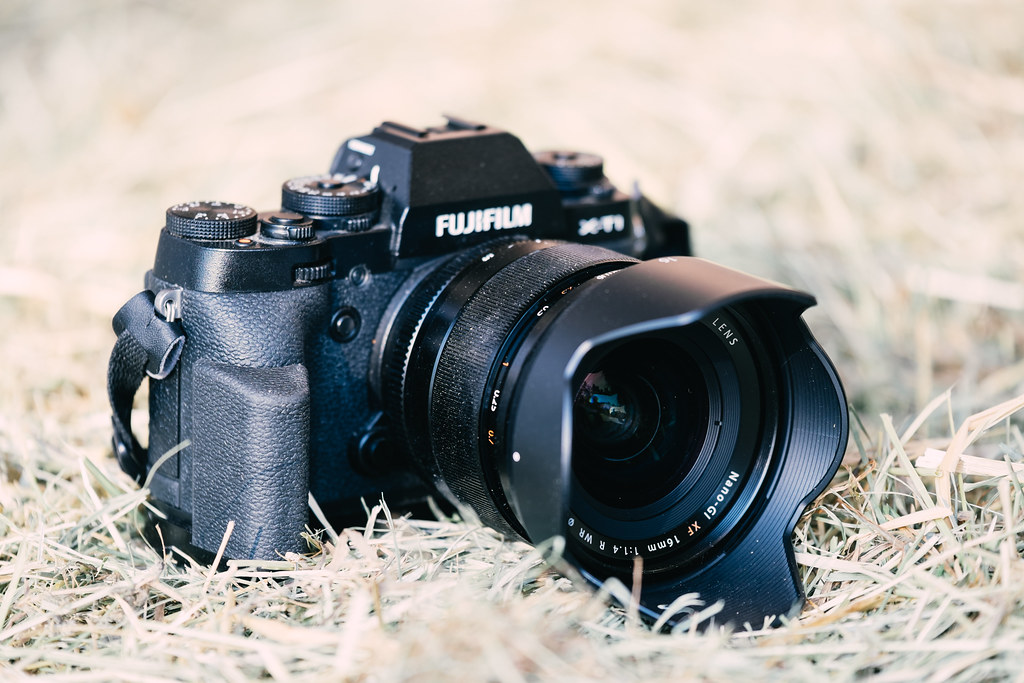
^ X-T1 with XF16mmF1.4 R WR
As you might already know, my new book featuring 111 tipps for X-T1 users is now available as an eBook and as a conventionally printed edition. If you are still undecided, click here to download 47 free sample pages. If you like my book and can afford the time, please leave a review at Amazon.

^ X-T1, XF16mmF1.4 R WR, f/1.4, Capture One Pro
Fuji’s latest lens addition has “high-end” written all over it. The XF16mmF1.4 R WR is a fast, weather- and dust-sealed wide-angle prime lens with Nano-GI coating (to eliminate flare and ghosting), a 0.21x magnification close-up capability with a minimum focus distance of only 15 cm (thanks to two floating focus groups) and nine aperture blades for a smooth bokeh with circular blur discs.

^ X-T1, XF16mmF1.4 R WR, f/2.0, SOOC JPEG (Pro Neg. Std)
The lens also features two aspherical elements and two ED (extra low-dispersion) elements that minimize spherical and chromatic aberrations to surprisingly low levels and deliver corner-sharp images even at the widest aperture setting of f/1.4:

^ X-T1, XF16mmF1.4 R WR, f/1.4, SOOC JPEG (Provia)
The XF16mmF1.4 R WR appears to be slightly larger than its XF23mmF1.4 R and XF56mmF1.2 R siblings. The “naked” lens weighs 375 grams, making it little bit lighter than the XF56mmF1.2 R (405 grams), but heavier than the XF23mmF1.4 R (300 grams). Combined with the included plastic lens hood and two protection caps, the XF16mm lens weighs 425 grams.

^ Size Does Matter: XF56mmF1.2 R, XF16mmF1.4 R WR & XF23mmF1.4 R
Come September, Fuji also plans to offer an optional metal lens hood. Click here if you want to see how the prototype looks like.
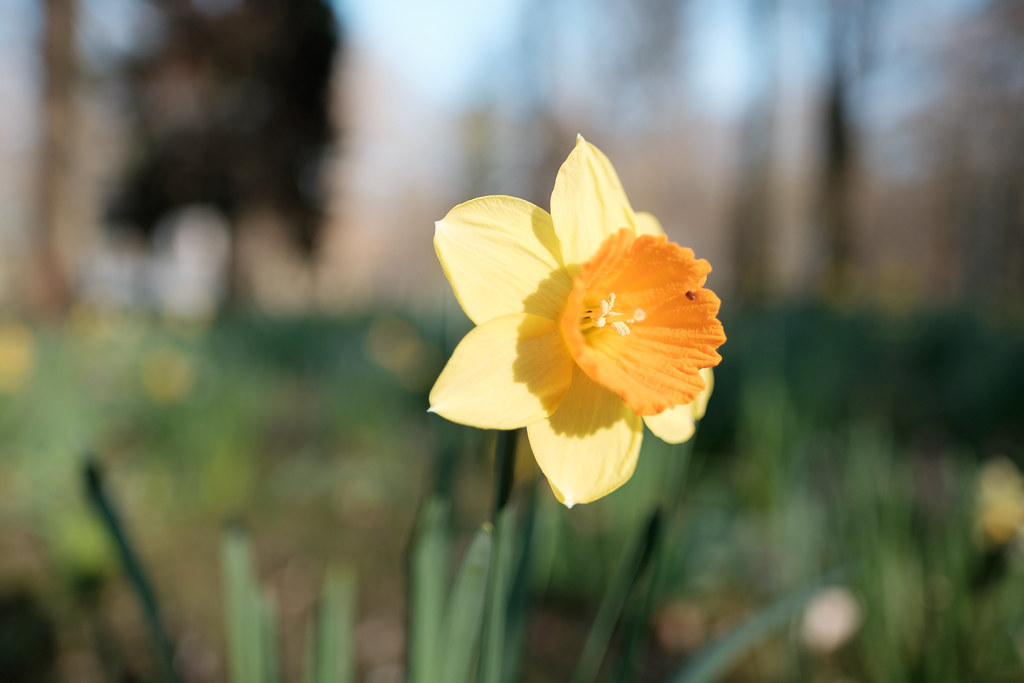
^ X-T1, XF16mmF1.4 R WR, f/1.4, Lightroom (Classic Chrome)
Like the XF14mmF2.8 R and the XF23mmF1.4 R, the new XF16mmF1.4 R WR uses a clutch mechanism to switch between manual and automatic focus. By pulling the focus ring towards the camera, the lens is set to manual focus, revealing analog distance and depth-of-field (DOF) scales in the process. As usual, the engraved DOF scale is of limited value because its readings differ from the camera’s own electronic DOF scale, which is about two stops more conservative and represents pixel-sharp settings based on the sensor’s pixel pitch.
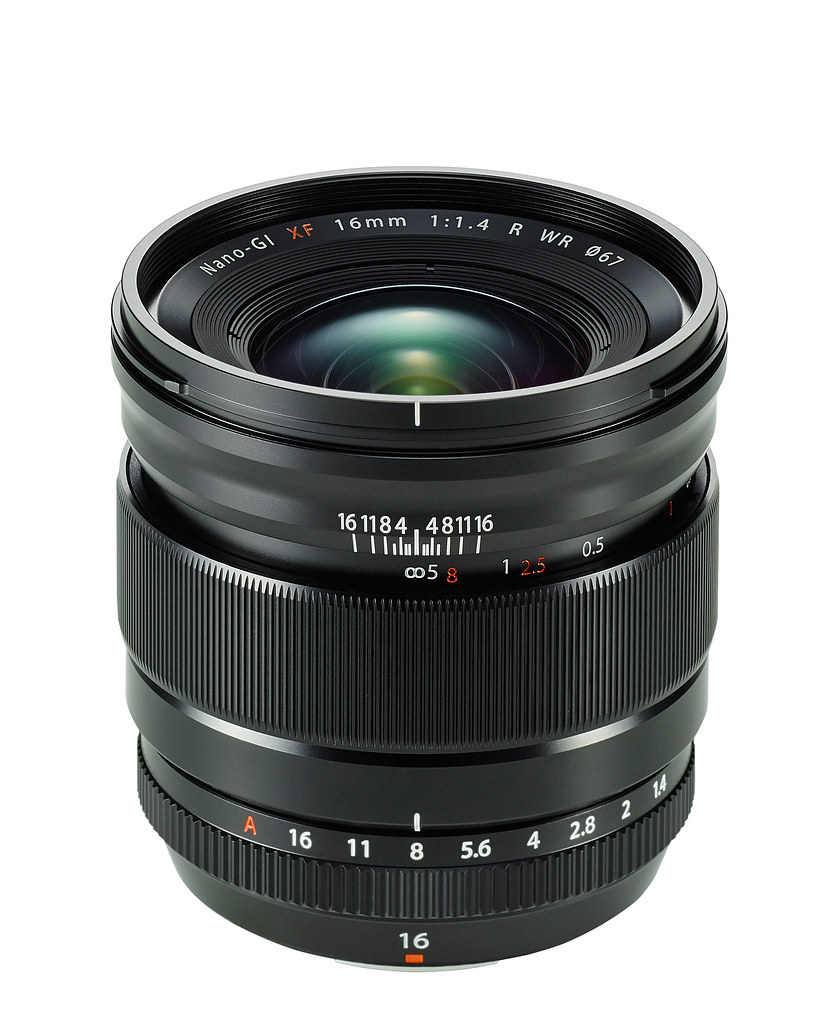
^ XF16mmF1.4 R WR with manual focus clutch mechanism and engraved analog distance/DOF scale
Sadly, the more accurate electronic DOF scale is disabled when the lens is set to manual focus. To overcome this limitation when you are setting a pixel-sharp hyperfocal distance (or another focusing zone), you can simply use the engraved scale on the lens with an offset of two stops. Example: If you want to set the hyperfocal distance for f/11, use the reading that is engraved for f/5.6 instead.
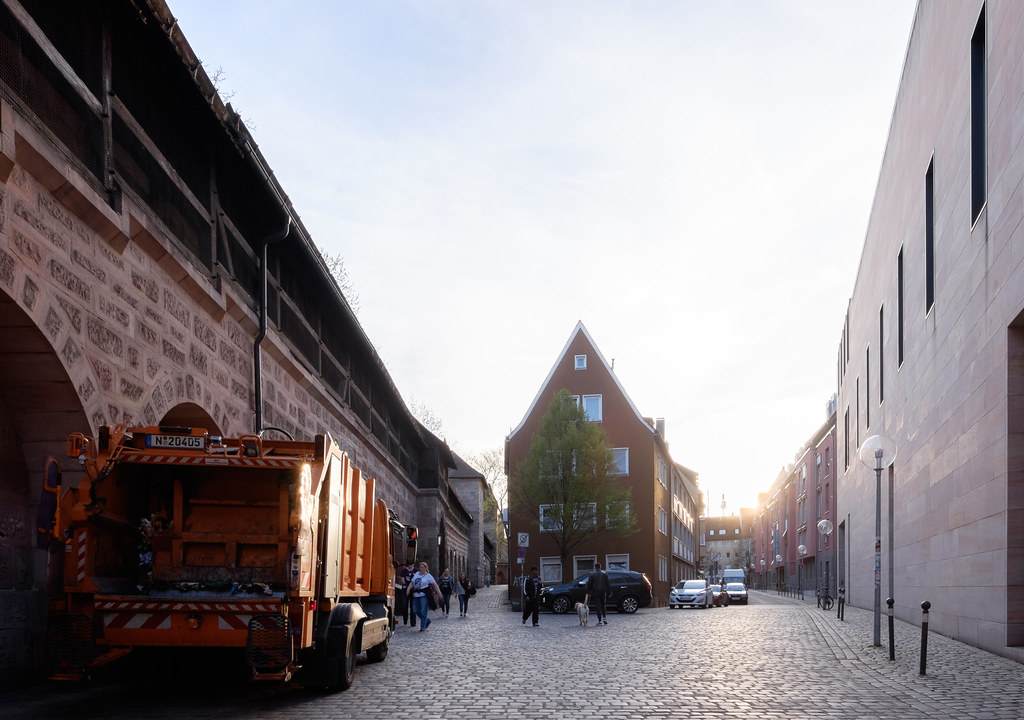
^ X-T1, XF16mmF1.4 R WR, f/11, Lightroom (Astia), perspective correction
Alternatively, you can use the camera’s AF+MF feature to enable the electronic distance/DOF scale and to manually change the distance according to your hyperfocal needs.
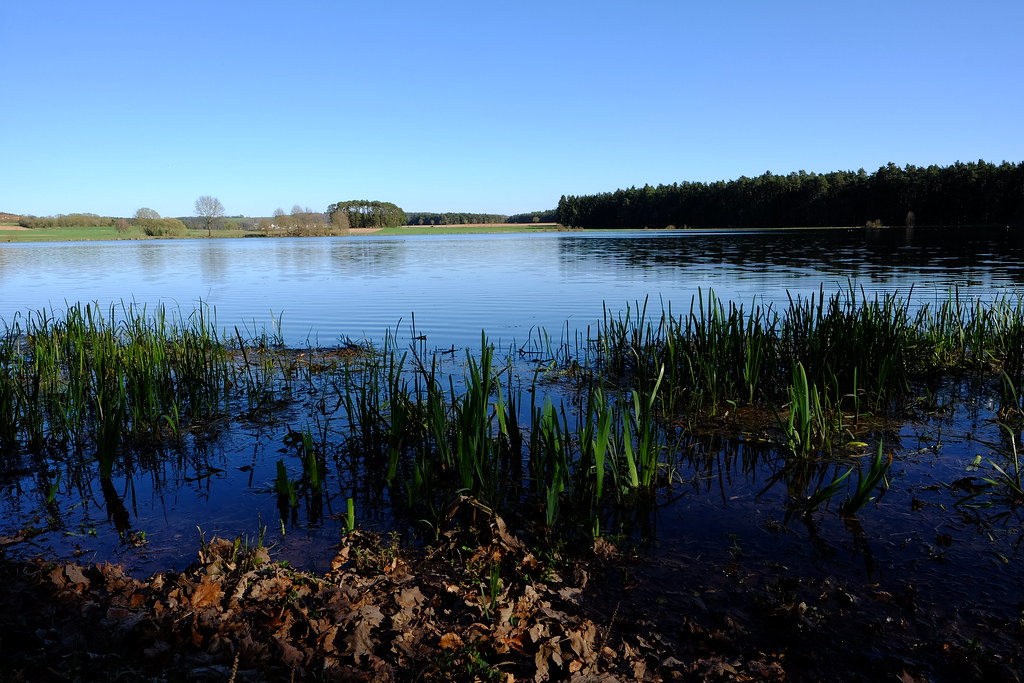
^ X-T1, XF16mmF1.4 R WR, f/16, SOOC JPEG (Velvia)
For example, the hyperfocal distance setting for 16mm and the smallest aperture of f/16 is about 5 meters. However, aperture settings beyond ca. f/9 lead to diffraction blur, an undesired effect that is somewhat counteracted by the camera’s built-in Lens Modulation Optimizer (LMO).

^ X-T1, XF16mmF1.4 R WR, f/16, SOOC JPEG (Monochrome)
Also, lens flare (though extremely well contained) will be more obvious at such extreme aperture settings.

^ X-T1, XF16mmF1.4 R WR, f/5.6, SOOC JPEG (Velvia)
The XF16mmF1.4 R WR is optically corrected for distortion, meaning that no additional digital distortion correction is required during RAW conversion. As usual, chromatic aberration and vignetting are digitally contained based on RAW metadata that is transferred from the lens firmware. To benefit from this, your RAW converter must be able to apply Fujifilm lens correction metadata. Examples of RAW converters that support such metadata are Adobe Lightroom/ACR, Silkypix & RFC EX 2, Capture One Pro, Iridient Developer and (of course) the built-in RAW converter. Examples of RAW converters that ignore lens correction metadata are Photo Ninja, AccuRAW and RPP 64.

^ X-T1, XF16mmF1.4 R WR, f/10, Lightroom, perspective correction
Thanks to its design and optical distortion correction, the lens renders eminently sharp results not only in the center, but also in the corners of an image. This leaves ample headroom for digitally applied perspective corrections that can be useful when shooting architecture.

^ X-T1, XF16mmF1.4 R WR, f/11, Lightroom (Astia), perspective correction
Thanks to the minimum focus distance (MFD) of only 15 cm, you can get close to your subjects. Indeed, the lens offers a magnification 0.21x even without attaching a macro ring.

^ X-T1, XF16mmF1.4 R WR, f/1.4, SOOC JPEG (Astia)
Apart from the limited depth-of-field, it’s perfectly possible to shoot wide open at the minimum focus distance of the lens:

^ X-T1, XF16mmF1.4 R WR, f/1.4, SOOC JPEG (Classic Chrome)

^ X-T1, XF16mmF1.4 R WR, f/1.4, Capture One Pro
The XF16mmF1.4 R WR is well-equipped for reportage and editorial applications that require a good subject/background separation or fast shutter speeds to avoid motion blur when shooting moving subjects:

^ X-T1, XF16mmF1.4 R WR, f/1.4, Lightroom (Astia)

^ X-T1, XF16mmF1.4 R WR, f/1.4, Lightroom
Autofocus performance is perfectly okay when the camera is able to use phase detection autofocus (PDAF), but could be snappier when only contrast-detection autofocus (CDAF) is available.

^ X-T1, XF16mmF1.4 R WR, f/1.4, Lightroom

^ X-T1, XF16mmF1.4 R WR, f/1.4, Lightroom
When you are shooting portraits at wide-open aperture, make sure to use the smallest autofocus frame size, then position the frame over one of the eyes. Alternatively, set the camera to face-detection. Do not focus and reframe.

^ X-T1, XF16mmF1.4 R WR, f/1.4, Lightroom (Astia)
While this is a matter of personal preference (and hence not really open for discussion), I personally like the way the lens is rendering out-of-focus areas and blur.

^ X-T1, XF16mmF1.4 R WR, f/1.4, SOOC JPEG (Astia)

^ X-T1, XF16mmF1.4 R WR, f/1.4, SOOC JPEG (Astia)
To be honest, when I first got my pre-production copy of this lens, I wasn’t quite certain how it would fit into my existing lens lineup. After all, the 16mm focal length is already covered by no less than four different XC and XF zooms. However, the XF16mmF1.4 R WR not only delivers ultimate sharpness near the edges, it also offers close-up and portrait capabilities that I found very useful and attractive.

^ X-T1, XF16mmF1.4 R WR, f/5.6, Lightroom (Classic Chrome), perspective correction
As should be expected in this class, the lens is built in a solid fashion and has a premium feel to it. The aperture ring clicks nicely in 1/3 EV steps, and the focus clutch mechanism adds an analog retro touch.

^ X-T1, XF16mmF1.4 R WR, f/3.6, Lightroom (Classic Chrome)
Please click here if you are interested in browsing through my set of sample shots featuring at least 40 full-size images from Lightroom, Capture One Pro, Iridient Developer and the built-in RAW converter of my X-T1.

^ X-T1, XF16mmF1.4 R WR, f/4.0, Lightroom (Classic Chrome)
Here’s a quick summary of what I particularly like in the XF16mmF1.4 R WR:
- solid dust- and weather-sealed build quality
- optically corrected for distortion
- very sharp at all apertures (even wide-open and in the corners)
- very little chromatic aberration, even at f/1.4
- minimum focus distance of only 15 cm (great for close-ups)
- attraktive bokeh (9 aperture blades)
- flare-resistant thanks to HT-EBC and Nano-GI coating
- compatible with the OVF of the X-Pro1

^ X-T1, XF16mmF1.4 R WR, f/4.0, Lightroom
PRE-ORDER XF 16mmF1.4 WR ($999): USA: BHphoto / AmazonUS / Adorama / EUROPE: WexUK / PCHstore /
For your convenience, here’s a TOC with links to my previous X-PERT CORNER articles:
- Film Simulations in RAW File Converter EX Version 2
- X-T1: Tethering with Adobe Lightroom and Fujifilm HS-V5
- First Look: Fujinon XF16-55mmF2.8 R LM WR
- XF 56mm APD vs. XF 56mm
- New Firmware Features (3): X-T1 Firmware Version 3.00
- New Firmware Features (2): Using Camera Remote
- New Firmware Features (1): Using AF+MF
- First Look: Fujinon XF 50-140mm F2.8 R LM OIS WR
- Using the Fujifilm X100T
- First Look: Fujifilm X30
- First Look: XF18-135mmF3.5-5.6 R LM OIS WR
- X-E2: Behind Firmware 2.00
- First Look: Fujifilm TCL-X100 Teleconverter for X100(S) Cameras
- First Look: Fujinon XF10-24mmF4 R OIS
- First Look: Fujifilm X-T1
- First Look: Fujinon XF56mmF1.2 R
- Exposing Right
- Using Auto-ISO
- Using Face Detection
- First Look: Fujifilm XQ1
- PDAF & LMO Lens Firmware Updates Coming in November
- First Look: Fujifilm X-E2
- How Fuji could save the X-M1
- X-A1 vs. X-M1: Photo Ninja Edition
- X-A1 vs. X-M1: the Shootout
- Using the Fujifilm X-A1 [& X-M1]
- First Look: Fujinon XF23mmF1.4 R
- RAW Converter Shootout Results
- Ultimate RAW Converter Shootout
- First Look: X-M1 with New Kit Zoom and Pancake Lens
- Zeiss Touit vs. Fujinon XF
- Remote Shutter Control for X Series Cameras
- Apple Camera RAW, X-Trans and EXR
- First Look: XF55-200mmF3.5-4.8 R LM OIS
- Studio X
- Using the X100S
- Using the X20
- X100S vs. X100
- X20 vs. X10
- RAW, JPEG, Silkypix and “Fuji Colors”
- Adapting Third-Party Lenses (updated with Speed Booster)
- RAW for JPEG Shooters…
- Tips for Updating your Firmware
- How to Clean the X-Trans Sensor
- Using the XF14mmF2.8 R
- Decoding XF18-55mmF2.8-4 R LM OIS
- Comparing RAW converters: JPEG vs. Lightroom, Capture One, Silkypix & RPP
- XF14mmF2.8 R appears to be almost distortion free
- How to Expand Dynamic Range
- How to Use Extended ISO
- EXR, anyone?
- Capture One – When the Going Gets Tough…
- Using Shooting Profiles and the Quick Menu
Rico Pfirstinger studied communications and has been working as journalist, publicist, and photographer since the mid-80s. He has written a number of books on topics as diverse as Adobe PageMaker and sled dogs, and produced a beautiful book of photographs titled Huskies in Action (German version). He has spent time working as the head of a department with the German Burda-Publishing Company and served as chief editor for a winter sports website. After eight years as a freelance film critic and entertainment writer in Los Angeles, Rico now lives in Germany and devotes his time to digital photography and compact camera systems. His new ebook The Fujifilm X-T1: 111 X-Pert Tips is available at Rocky Nook.
70 Responses
Perhaps all those who were complaining about the rumoured cost of this lens can now see why it is the price it is.
No I can’t. The Sigma 24mm f/1.4 Art do all the same but on a full frame sensor for 2/3 of the price.
I’m out.
the Sigma isn’t weather sealed
You have a point if the sigma 24mm can be shared with a FF camera you already own. Let assume the rumor price ($1150) turns out to be final price. For $300 more, you get weather resistance, 43% lighter (665g vs 375g), physically smaller and native AF performance. I would pay $300 extra for all these advantange over Sigma. Besides, B&H already taking pre-order for $999.95. http://goo.gl/fZCeV4
Exactly. M & Alex, like many others, cannot seem to understand that any item is offered for sale at a price which reflects both it’s quality and perceived value. If you want it, and can afford it, you buy it, if you cannot afford it then you cannot expect the manufacturer to sell it at a lower price to enable you to buy it.
I think M was considering the intrinsic value of these objects. The same reason for wich Nikon people complain about the big price difference between the Sigma 24 and the Nikon 24. In that case it is even more unacceptable considering that both lenses have grat build quality, similar dimensions, excellent IQ, fast and silent autofocus. Why i have to spend more than double for having a similar product (or even worse) only because it is Nikon?
In this case the low weight and the small case are not miracles, but the advantage of a smaller sensor. The products are comparable in relative terms and the Fujinon is not cheap for sure! But a street price around 1000$ is quite normal for a f1.4 wide angle.
There is indeed only a $150 price difference between the two. For all the added benefits you list – it does not sound that expensive. And once the first batch is sold, in a few short months the price will start going down, making the decision even easier
Sad but true.
You could always see if there is a suitable adapter out there and then buy the Sigma if you find one.
My best wishes for you and your Sigma then 🙂
Sigh. Where’s my wallet
Thanks Rico! Very nice and useful test.
And a very tempting lens 🙂
But “they” should deliver it together with the pretty lens hood
No default metal hood for me. I want my light and small plastic hood for travel. The metal hood might be a nice addition when I am shooting at home, though.
This metal hood looks like to be designed for front element rain protection.
Is the plastic hood same as for the 18-135. The two lens sharing the same filter size could make a nice all weather travel set for 16-135 and the 16/1.4 would allow for dark indoors as well.
The hoods are different and don’t fit on the other lens.
Thank you for another great review. Your efforts are well appreciated.
any pre order links for the UK
High end, quality, fast lens. Fuji made another step to bring to users full set of fast lenses. I do not see the price around $1000 too high for high end prime and sure many photographers will love it and buy it. For me the main downside is the size of the lens – it’s even bigger than 56/1.2 – probably not a problem for many users, but I moved to Fuji from Canon DSLR because of the size benefits and look for smaller and resonably fast primes around f/2. I would love to see one day Fuji 16mm f/2.
I agree with you. thats why I have not bought the 16-55 and the 50-140, just too big. However the 24mm F1.4 equiv, will allow me to work at 3200 and not 6400 at weddings which can make a big difference. otherwise the 18mm f2 is a great lens
Hi Nobby, not that I shoot weddings but so far I would carry this 16/1.4 over the 16-55. Shouldn’t it let you set your ISO under 1600 in most of situations? What minimum speed do you work with?
i only shoot weddings but depends really where I am. Churches in the UK can be difficult and dark!. Im often at 6400 but would rather be at 3200. I’ve been down to 1/30 but keepers are difficult at that speed
my wedding kit will be X100T 35mm X-T1 85mm X-T1 24mm with a X30 in my bag too. Love Fuji stuff. I have 10-24mm too.
My thoughts exactly! This highly capable lens seems well worth the cost in dollars, but whether it is worth the cost in weight I don’t know. I already don’t carry around the 56mm that often because of its mass. I only take it with me when I contemplate taking many posed portraits. That is fine for events etc. but the 16mm focal length is more suited to walking around where the weight becomes the issue. Still, probably lighter than walking around with the full frame equivalent of a 24mm f2 or so (at least as I see it at DOFMaster.com), but not by much. I came to Fuji by way of the X100 and I still love how such a small and light camera can produce such high quality photographs. I love the Fujinon 35mm f/1.4 lens. It embodies the philosophy of small and inconspicuous yet powerful that Fuji first seemed to be pursuing with the X line. Most of the latest lenses though have been bricks, beautiful and elegant bricks, but bricks nonetheless. They have their place and I am glad Fuji made them, but I am hoping for some more svelte offerings going forward. The latest lenses are big heavy chunks of glass that match up with the even bigger and heavier chunks of glass so popular with wedding and event photographers using full frame DSLRs, but I am hoping to see some of the more svelte glass beauties that match up more to the Leica line for the highest quality in portable photography.
I’ve been thinking about getting the XF14mm for a while, but I’ve been holding back on it because of the cost. (it never goes into promotion like the other lens). Then comes this beauty here. So I’m wondering. Apart from the obvious differences like the 1.4 and 2.8 max aperture, weather sealing (which I don’t care much about since I own an X-E2) I wonder if I should save up more cash to get the 16mm or if the XF 14mm would be good enough. It even gets 2mm more wide? Thoughts please 🙂
You have all the information, only you can decide. But don’t underestimate the 2mm difference, it’s quite a large difference. If wide if more important to you than F1.4 (and you’re on a budget) the Samyang/Rokinon 12mm F2 is also to be considered. Great for normal use, but you’re probably better off with Fuji for night or astro photography. (coma, sunstars, flare, corners etc.)
Thank you for the reply! Yes, I’ve also been considering the Samyang 12mm. But maybe sticking with the Fuji’s is not a bad idea, just need to save up more. I don’t do astro photography, but I did read reviews on the Samyang saying that it is pretty good for that. Anyway, thank you very much.
Sounds like it’s a fantastic lens. If I didn’t have the 14mm already, I’d definitely consider it. And hell, I might even swap out, we’ll see.
thanks for the UK links I have pre ordered using them and thanks for the review too
Don’t know why people are complaining that it’s too big or heavy; it’s still smaller and lighter than the very plastic, not weather-sealed cheaper lenses from Canon and Nikon. Looks like it matches the Pro and T bodies very evenly and the weight barely being any different from the 56, which is a hilariously light lens for its build quality and performance, I can’t imagine size or weight actually being an issue.
Nice to hear it’s sharp across the frame wide open. That was the one thing that could break this lens. The price is pretty high, and if the corners aren’t clear at the wider apertures then you might as well just stick to the existing lenses. If the images truly are sharp corner-to-corner at f/1.4 through to f/2 then brilliant, the price is absolutely justified.
Seems like this + the 56mm will make a fine two-lens kit. Now if they can hurry up and get that 100-400 out and make that good, and give me a body with faster AF and a little bit more resolution, I can finally completely ditch my DSLRs. Work still dictates 20mp+ and I like wildlife shooting which dictates a longer lens and better AF; upgrade those, Fuji, and along with this 16mm you’ve completely converted me.
The metal hood is intended for ”rangefinder” work with the x-pro series, it covers less of the optical image. The idea is that if you can afford a x-pro you can afford spending 100 bucks for a metal hood:-) Just wait for the OEM versions and order one of these
This lens compares to FF 24/2.0 not 24/1.4 … in terms of DOF equivalence. I mention this because of the statement below “However the 24mm F1.4 equiv, will allow me to work…”
Please, not again ….
in DOF but, in light gathering ability f1.4 = f1.4
Where is the equivalence police ?
Right, just shoot back!
Well… not quite. When you’re talking about actual light gathered you should really use T-stops, not f-stops. Now, this lens isn’t very long, so there probably isn’t that much light lost, but it’s very, very rare to see any lens other than a pancake which doesn’t lose any light at all. So it’s most likely that f/1.4 = t/1.5-1.6, in this case.
Then of course there’s the problem of whether you’re tlaking baout the amount of light that comes through the lens or the amount of light that actually hits the sensor, in which case you are talking more along the lines of f/2.1-2.2. (Further complicated by Fuji not naming ISO correctly while at the same time using an ISO-less sensor.)
So, really what you should do is stick to saying ’16mm f/1.4′ and avoid talking about equivalents unless you absolutely have to. Keep it simple. Only if someone insists on talking about the 35mm equivalent then you say it gives the same results as a 24mm f/2.2, but remind them that equivalents don’t really mean anything because it’s not like you can just pop this lens on a 5DmIII anyway.
I’ll acknowledge you’re right but another part of me is reluctant to feed the trolls.
Nailed it! Too bad 90% won’t admit it.
It’s like global warming. “but it was freezing today!”
2.1, if we are nitpicking.
As I said, 2.1 mathematical (f-stop), more likely to be 2.2. actual (t-stop).
Now we are mixing up depth of field equivalence and light transmission. T-stop will still be around 1.5 or 1.6, there is no equivalence to that.
Well, no, because light transmission as a measurement has to be how much light will actually be hitting a sensor, and with a smaller sensor you’re inherently going to gather less light. (By the same factor we deduce equivalent focal lengths and f-stops, as it so happens.) Light lost across the length of the lens is multiplied, as it’s all relative to the sensor.
Let’s say, for sake of argument, you have a 35mm sensor and 100mm lens at f/2 which is giving you t/2.1; I’m picking that example because it’s a lens literally sat 2 feet away from me on a shelf.
Now let’s take that lens and those settings but with a crop sensor. The lens in this case is Canon, and Canon’s crop sensors are a 1.6x crop, so let’s look at what we’ve got with the basic, common equivalent maths:
Focal length x crop factor = 160mm
F-stop (focal length divided by the diameter of the pupil, where the diamater is not different relative to the sensor) x crop factor = f/3.2
So now that t-stop. Well, we already know that the equivalent light coming through the lens is much less than f/2, so you’re sure not going to get a t-stop of t/2.1 anymore. The t-stop can’t be any larger than the f-stop; the light can’t multiply as it moves through the lens. So right away we have a t-stop minimum of t/3.2. But wait, when we had f/2 we lost some light to bring us to t/2.1, so surely if f/3.2 is now our theoretical maximum, shouldn’t we also be losing the same amount of light to bring us to t/3.3? Well, not quite. We’re actually getting t/3.36, commonly rounded off to t/3.4, because f-stop and t-stop numbers come from a relative equation, not an absolute. As the relative length of the lens increases compared to the sensor size and position, the relative light loss also increases; f-stop and t-stop are both numbers base dont he focal length, so if you increase one, you have to increase the other. As the sensor gets smaller, more light is lost (or rather, simply fails to hit the sensor), to the same degree that the focal length increases (and thus the f-stop and t-stop numbers).
To use the Fuji lens as an example (I’d rather not because we don’t have actual tested t-stop numbers for it, so this is all still just educated guesswork), we have 16mm f/1.4, with a possible—but very unlikely—maximum t-stop of t/1.4. Considering how rare it is for anything other than pancakes to not lose any light at all, it’s most likely going have a maximum t-stop of t/1.5, or at best something like t/1.45 which we generally round up with digital to read as t/1.5 anyway. (Shooting film you typically round down; just the nature of the mediums). Attach it to a 1.5x crop factor sensor and we’ve got:
16mm x 1.5 = 24mm
f/1.4 x 1.5 = f/2.1
realistic best-case-scenario t/1.45 x 1.5 = t/2.175, which we’ll round up to t/2.2
Common use t/1.5 x 1.5 = t/2.25, should really round up to t/2.3 but an argument could be made to not round it off.
Because remember:
– t-stop can never be larger than f-stop; light can not increase as it moves through the lens.
– The relative distance from lens to sensor is changed as the sensor become smaller in relation to the lens which is unchanged. (Focal length equivalence.)
– The diameter of the pupil is not larger in relation to the sensor as the diamater only matters to the lens itself. (In the same way things like pixel pitch do not matter to the lens, only the sensor.)
– f-stop—our maximum t-stop—is relative to the focal length, therefore our maximum t-stop is also relative to the focal length.
– Any light lost normally is multiplied by the same degree when using a smaller sensor by the simple fact that the smaller target gathers fewer photons. (Which is also why crop sensors seem to have more noise.)
– If a t-stop can be no wider than the f-stop, and the f-stop has to increase relative to the focal length which has to increase relative to the sensor size, and the sensor size also means light is lost to the same degree, it follows that the t-stop can and should be multiplied up by the same method as f-stop focal length.
… There’s probably a shorter and clearer way I could have explained that, but I’ve not had any caffeine yet and we’re dealing with a lot of theoreticals until the lens is actually in our hands and can be tested properly.
tl;dr version: t/1.5 with f/2.1 can not happen, both physically and mathematically. t/1.5 can only happen so long as you talk about this lens as a 16mm. The moment you talk about 35mm equivalents, t/2.1 becomes your (improbable!) minimum.
I’ll only respond to the tl;dr and only once more:
Depth of field equivalence only depends on the numeric aperture, not on the transmission.
If you want to calculate t-stop equivalence with the crop factor you have to scratch the currently used photometry standards completely, especially the independence of lens and film/sensor. Don’t screw up photometry.
And this does not have anything to do with possible slight deviations of sensitivity/ISO-values between cameras of different manufacturers.
You’ll notice that at no point did I mention equivalent depth of field. So there’s your first remark.
Second up, you are simply wrong; re-read and research.
Finally, regarding how Fuji rate ISO and their ISO-less sensors, I simply mentioned that in the previous comment because it’s something to be conscious of when trying to evaluate exposure across multiple brands of camera, when actual lab testting is not available. (Or if you choose to not use it.) At no point did I say it had anything to do with the measurement of light transmission and the equivalent light for any given gathering surface; a simple reminder to not trust Fuji’s numbers for comparative mathematics was all was intended.
We needed a visual meme for this, so I made one.
That’s awesome!
I know there is a superhero in there somewhere…
this is actually better. I just want this lens for astrophotography. As long as I have the speed of f/1.4, The deep DOF will not blur my foreground while focusing on the milky way. I even hope it’s f8 equivalence lol
Great fast speed-, short distance focusing wide-angle!
Haven’t made up my mind choosing this one over the 10-24mm f/4 zoom. Latter is very sharp too, with (some) less shallow DOF options. But it has about the same weight, has max. 3 stops IOS and is much much more versatile….. but ugly.
I’ve had the 10-24mm f4 for about 6 months and absolutely love it! I love shooting wide angles (even people and faces)! This new 16mm looks awesome so my dilemma is justifying having both. G.A.S. is impairing my judgement! Like you said the 10-24 is more versatile and you can shoot ultra wide.
Zack Arias got it all wrong, it’s impossible to cure GAS with Fuji.
Lens looks good, but images lack life and pop way too flat to me.
You probably love HDR too?
Great review, lovely shots.
I don’t need it
I don’t need it
I don’t need it
…
Must repeat.
Any comments or observations about the Nano coating?
Am I misunderstanding your hyperfocal distance calculation? You say that 16mm @ f/16 on a Fuji X gives a hyperfocal distance of 5m. The calculator at Cambridge says 0.8m:
http://www.cambridgeincolour.com/tutorials/hyperfocal-distance.htm
http://www.dofmaster.com/dofjs.html
One of the great things about a wide lens is just set it to f/8 and (for 16mm/fuji at least), everything from five feet or so is in focus.
Great review! One question though, why not use focus and reframe for shooting portraits?
You change the focal plane, so it’s possible to get the Eye (which you most of the time want to be in focus) out of focus (only due to moving the camera.
That goes for all really fast lenses.
Especially fast wide-angle lenses. Telephoto lenses aren’t much of a problem, even when they are very fast. But a fast wide-angle lens used at short distance (and the 16mm can be used as close as 15 cm) is very susceptible to misfocus due to “focus and reframe”. Why? Because angle change (for example when you move a subject’s head from the center to the edge of the frame) is much larger with wide-angle lenses at close distances than it is with telephoto lenses.
The difference in the hyperfocal distance calculation is due to different interpretations of what is “in focus”. Rico referred to pixel-level sharpness, meaning the circle of confusion from a point source is smaller than the pixel pitch.
Yep, pixel pitch is essential for a pixel-level sharpness. That’s why Fuji’s 16 MP APS-C cameras and the 36 MP full-frame Nikon 810 / Sony A7R require the same DOF settings for pixel-level sharpness. All these sensors share the same pixel pitch, and looking at the results with 100% magnification, sensor size doesn’t matter.
Of course, diffraction also plays a role, so in reality, the electronic scale is overly conservative, as it doesn’t include diffraction effects in its calculation. Obviously, at f/16 or f/22, an image won’t be pixel-sharp no matter what, as the airy discs are already larger than the pixel pitch at such small apertures. The LMO can counteract this effect to a degree, but only in SOOC JPEGs.
These effects will all intensify with the introduction if the 24 MP APS-C sensor.
“These effects will all intensify with the introduction of the 24 MP APS-C sensor.”
what sensor are we talking about? 😉 😀
The next sensor generation. Fujifilm has already disclosed that the resolution will increase. However, this also means that DOF scales would have to be even more conservative for pixel-sharp results. And diffraction will kick in even earlier, so f/8 would probably be the critical aperture.
I hoped you had some more infos on the upcoming sensor.
Personally I really enjoyed the rumor about the bigger (multi aspect ratio) sensor. I’d start saving money for it, but I am still saving for the 50-140 (and ALL fuji cameras deliver outstanding pictures thanks to the wonderful lenses)
Higher math here for me! I’ve to dive further in theory I think.
I think that metal hood with the 16mm lens will look great on the X-PRO2 !
I mean the hood for the first generation lenses for the X-PRO1 like the 35mm f/1.4 and 18mm f/2 has the same design characteristics, which looked so good. So yes another clue for the RF style of the X-PRO2 (of course I know function over form here).
Wonderful lens, I hope to see an awesome x-t2 (or x-pro2) soon.
Regarding Chromatic Aberrations… I’m not super happy with the XF23 on this front. Is this lens better?