







[shoplink 43564 ebay]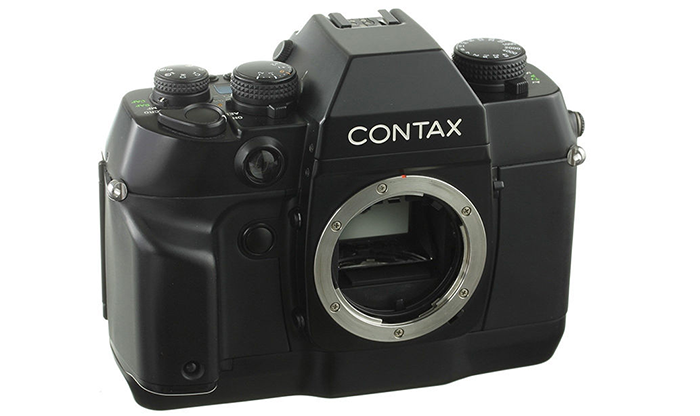 [/shoplink]
Last week a Sony manager said: “E-mount won’t replace (and kill) it since there are things you can do with the longer flange distance in A mount that you can’t with E mount” (article here).
I tried to figure out what the possible A-mount flange advantages could be. What came to my mind is the following list:
- SAR reader Rick Rupert suggested that Sony could use the “space” to AF with manual lenses just like the [shoplink 43564 ebay]Contax AX[/shoplink] did. But I think that’s highly unlikely. Complex to build and not sure it’s really a highly requested feature. By the way Sony already patented this in 2014 (article here).
- Better heat management and higher video performance. With more space in the camera higher bitrate and maybe even 8K recording could be easier implemented on A-mount cameras. That yes could work out…a real very high end A-mount camera with no compromises.
- Better ergonomic and button layout. Well, Sony could also do a sort of A9 E-mount camera with bigger body too.
- Make it hybrid mount. Capable of using both A and E-mount lenses without adapter. One camera to rule them all. That would be nice 🙂
Please let us know if you have some more points! Thanks!
Sony ILCA a9x Mirrorless Apha, Global Shutter, Z Shift User Concept:
–
Reminder: Recently Bruno from Lesnumeriques told us about Sony’s A-mount strategy: “They focus on FF lenses for A-Mount and consider that their APS-C line up is enough for now.” (article here). This sorts of confirms A-mount could continue as a “premium” system.
314 Responses
Hello
..
Not familiar with how the A and E mount are designed but I’m interested to hear how you could use 2 types of mounts on 1 camera without an adapter, mechanically those mounts must be different right? and wouldn’t it have to move the sensor back and forth when using different lenses?
“and wouldn’t it have to move the sensor back and forth when using different lenses?”
Watch the video above… 😉
skipped the video lol, it seems fine in the video but making it work in real life (probably with the 5 axis stabilization) would be a little to complicated I presume?
Yes. It will always be easier to simply have two different cameras or an e mount +adapter. Why this idea still gets so much attention, I have no idea.
Yes its way too complicated and will never actually happen.
A hybrid mount that could adapt to two confiqurations would not be too difficult to engineer, and Z shift would adjust the flange distance, as well as being usefull for other purposes.
To the non-engineer, nothing seems too difficult to engineer.
8k, SMH.
It would be a major leap forward to get an aliasing and moire free 10-bit 1080p.
1 – Sensor focus MF lenses: no thanks, more moving parts for fragility, dust sucking & more expensive repairs for little gain
2 – Heat management can just as well be done from the back and as for video the fact that E-mount has become Sony’s main video camera mount proves this notion that it is inferior to be false. The FS5 and FS7 have better video performance than any a-mount body. For cinema thee flange depth of a-mount is a huge disadvantage for adapting lenses.
3 – The body size is not determined by the lens hole. The FS and VG cameras with emount are larger than any a-mount bodies.
4 – Maybe a mirrorless a-mount body could be engineered (with an internal screw drive) that could have a subtractive adapter that is removable from the body to allow E-mount lenses to sit further into the body (versus an additive la-ea + a7 approach). A transformer-style mount that expands and shrinks like an aperture would probably leak light, be less stable and may just be fantasy (plus the sensor would have to move).
The only advantage of the SLR/SLT body is potentially top notch AF performance for the current to near term – if Sony would leverage this ability. There is no IQ advantage (except maybe for extreme wide angle). The ergonomic advantage is an intentional design choice of the body and not mount dependent. Only speed and performance give a-mount a technical reason to continue for now (excluding a market based reason).
Spot on, especially points 1, 2 and 3!
Not to mention that the e-mount on the FS series can support the PZ/PL mount, so it is easily much more stronger than any A-mount ever made.
You can fit a semi-translucent mirror in that extra flange distance, and redirect some light to a dedicated, off-sensor phase detect system that provides more efficient focusing, especially at longer focal lengths… that’s really the only remaining advantage of the SLR/SLT architecture, but it’s a big one for some photographers.
Hello Tony!
Hi Tony!
On paper yes that should be the reason why A-mount still makes sense. But:
1) E-mount autofocus system and on sensor PDAF is getting better and better
2) There is a small light looss (1/3 stop) because of the fixed pellicle mirror
3) From a marketing point of view it doesn’t look like SLT cams did sell well. I am not sure pelllicle mirror is really “perceived” as a major advantage
So maybe there is some need of some major real innovation to keep A-mount attractive?
Tony is right, ” especially at longer focal lengths”, that is big true. And i will add to that, in dim or low light, AF with OSPDAF is really worse than with dedicated PD sensor.
I have had tested A7RII against A99 and A77M2. For focal length from ultra wide to cca 100mm in good ligth is AF on par with A99. But if you go for longer teles (specially if you want AF from really near object to really far object) then AF on A7RII hunt and if it will lock it takes some seconds.
In dim or low ligth, A99 is much more better.
If you compare AF A7RII vs A77M2, A77M2 win on all possible situations.
I agree. The A99 and A77II have a more robust and faster auto-focus system than my A7RII, and the SLT AF system is also getting faster with each successive generation. The AF performance increase from the A77 to A77II is substantial. I bet the A99II AF performance will be amazing.
The A7rII evolved much, much faster than the SLT.
And combining the -4ev from A7sII and stacked sensor tech from RX series it will easily destroy the SLT/SLR performance.
…if they’ve bothered to continue to develop it. The A99II, if it ever actually materializes, will likely have the same AF module as the A77II, and that’ll probably be the last we ever see of the SLT AF system, as A-mount is then shown the door.
I don’t know where that myth came in, but the light loss is not a 1/3 of the light.
Also, 1/3 with today’s sensors is nearly insignificant.
Not nearly- it is actually, in real world circumstances, totally, fcking, insignificant.
Exactly. Those who complain about the light loss have probably never actually used one of these cameras, because in practice, it’s not even noticeable. It’s just something for those who like to focus on tech specs (instead of photography) to complain about.
Is 30% not nearly 1/3?
It actually equates to around 1/2 stop, not 1/3 as Admin says.
http://www.dpreview.com/reviews/sonyslta55/2
Thanks, detective
Ah! Thanks for the clarification.
Still, that 1/3, or even half, is really not that significant today.
When the first A77 and NEX 7 were out, that half lost was somewhat significant (somewhat being the key word) but today…
#1. You are talking about potential versus present reality.
#2. Light loss is negligible and a virtual non-factor in most photographic situations where SLT really excels, e.g., sports photography and video.
#3. This is a Sony marketing/PR problem. Sony needs to win the battle against those who try to run down SLT for its pseudo-disadvantages versus it’s real world advantages
Was there any marketing?
I agree that on sensor pdaf is getting better, but as on today, can it match off sensor pdaf in low light and sport?
As for the 1/3 light loss (or read:slightly less high iso performance) it can be compensated if sony brings out sensor’s with bettr iso performance.
Sony does not advertise their kamera in the place where i live. I see Canikon advertisements every day, but have never seen a Sony Alpha advertisement in my whole live. When you go to a kamera store and you ask for a Sony kamera, they give you a strange look and try to sell you a Canikon kamera. So i am convinced that the pellicle mirror is not the only reason why A mount is selling bad.
But i agree that Sony has to differentiatie more and be less conservative then Canikon to be able to mean something.
Exactly… as the “only” advantage of A-mount becomes some AF ability at longer focal distances, combined with the disadvantage of the light loss…. At some point, the advantages aren’t big enough to justify the product.
That’s the big challenge for Sony – the A7rII and the A6000 have been top sellers on Amazon for months, something no A-mount body has done for a long time, and will never do again in a declining market where they have zero presence compared to CaNikon. A-mount bodies are DOA. Why would Sony continue to invest in a segment that just creates more losses? They aren’t, hence the A68.
What I think could work – and would certainly get far more press/review coverage – would be to make a A99II with class leading stills capability, 5-axis, and a unmatched video spec – FF 4k, 10-bit internal and high frame rates. Basically a love child of the A7rII and the FS7 priced at the same level as the A7rII.
4k DSLR’s at lower price points than the 1dc are coming from CaNikon, the only way for Sony to get any attention in that space is to beat them to market. But Sony has shown absolutely no willingness to let its ILC’s encroach on its high end video line, so its highly unlikely we’d ever see a truly great all-in-one camera from Sony.
I would love my A7rII (and A7s) in the A99 body, sadly I don’t think we’ll ever see it.
What about the difference of angle of incidence? Wouldn’t that be a disadvantage of e-mount? More vignetting and softer corner.
Sensor panning to emulate video rail.
BEst of boTH worlds. Short flange for EMount lenses. And adapters for Medium Format lenses.
Andrea, for the record, it was the Contax AX that had Z-shift AF. The Contax NX used NX AF lenses and focused in a more traditional manner.
@SAR_Admin:disqus ^ ^ ^ ^ This
Corrected!
Only if they got rid of IBIS.
This is the size of the IBIS module alone, now add the rail and all the empty space that the Z-shift requires, the body itself would be almost as big as a Pentax 645Z.
http://www.sonyff.com/wp-content/uploads/2015/02/sensoroff-a7ii.jpg
‘A mount is better for native looooong lenses, more fps, better autofocus, better cooling, better handling etc. etc. etc. etc …….
Come on folks, you all must know by now that ‘A’ mount cams are better at just about EVERYTHING rather than the limited uses of ‘E’ cams!…..and without expensive adaptors.
Yes, I know all the studio, wedding, scenery and still lifers will disagree but the ‘A’ mount will do all that quite easily for you and as a bonus it will also do much better at sport, wildlife and anything that moves faster than granny in her wheelchair.
What DSLRs can do that E-mount can’t is, nothing, except for the benefits ergonomics and UI that come from the inherent size.
More space for buttons and dials.
More grip.
More balance with larger lenses.
Bigger batteries.
Better heat dispersion.
Larger screens.
I still don’t know why there is a continual obsession with a Z shift mechanism.
In the film days (The Contax AX that Admin is not showing) film was not expected to be 100% perfectly flat on the film plane. Contax had developed a vaccuum system which sucked the film to the film plane and achieve better flatness, but today and perfectly flat sensors, any shift in the sensor plane will be easily noticeable.
Think about it. Decentered lenses were not as frequently noticed before as they are today.
There is shimming to optimise the sensor positioning to the mount.
Sure you can make a Z shift moving mechanism, but I think that adds another layer of tolerance compromise that people have to face.
Also, I don’t know who would buy FE mount lenses to be used on an SLR body when A-mount is already well catered for…
All the reasons you stated are non related to the mount. See FS7 and FS5 claimed as “ergonomic marvel” in any review.
The FS5 is even lighter and well balanced than a 5DIII despite its size.
Don’t you think the points you are mentioning above are also applicable to the efficacy of lens-mount adapters? You are introducing another joint of play/weakness, especially with large A-mount lenses for example…
It’s widely known that adapters do add some play between lens and mount ,so yes, they add the risk of non-optimal lens:sensor alignment.
However, the solution of Z shift, as I understand it, means that there would be a form of hybrid mount, not a mount plus adapter…as, say, E mount SLR combined with one of the current adapters.
I don’t really agree with the z-shift solution either just FYI, but I’m just sick of certain e-mount shooters thinking we should be satisfied with such a compromised solution for using our lenses on their bodies (not including current absences of professional features on those bodies in the first place).
Honestly two different camera systems, apples & Oranges, I don’t see any advantages to combining the two- a mount lenses on e mount cameras? Silly. E-mount lenses on Amount bodies? What? Two separate systems!!!
Also your last point regarding why anyone would buy FE mount lenses for the A mount system- you’re right, that’s idiotic. The point would be to introduce the same flexibility of the e-mount, using old leica lenses, etc, on the a-mount. In this case sure you COULD use an FE lens for this z-shift camera, but it would obviously make more sense to buy the native equivalent for amount instead.
Instead of making an amount body, Sony should just make an LAEA5 adapter that is weather proof, professional build, compatible with old screw drive amount lenses, no slt module so no loss of light and iq degradation, and blazing fast on sensor pdaf with a7rii, a7ii and all the new gen 3 Sony a7 bodies.
This way you have the benefits of amount in an adapter and are still free to use emount lenses, Canon and Nikon lenses with AF and every other lens available.
Having an amount body has zero advantages over an emount body.
If youre going to say there is ergonomics and a size advantage, that has nothing to do with the mount. Look at the a3000 for example.
Sure. That’s a great idea! People will line up in droves to purchase an $8000.00 a-mount lens, handicap it with a $300 adapter, and then mount the whole thing on a $3200 mini-studio camera that takes beautiful pictures of things that don’t move very fast. Sony will make millions with just that kind of brilliant marketing strategy!
Laea3 and amount SSM is already very useable. A few more generations and it will definitely surpass amount PDAF.
Sony has a current patent for 3d pdaf…2 layers of pd pixels on a 4 layer sensor.
This will definitely exceed the AF performance of current dslr/dslt cameras.
Patents vs reality doesn’t always give the patent holder the favourable outcome.
Nikon had patents on Electronic Variable Low-Pass Filter in 2013, but reality didn’t play nicely with their scientists and engineers. Sony beat them to the punch in reality with the RX1Rii.
Yes a few more generations it is expected to outperform SLR / SLT focusing. Clients tend to not want to wait a few years for a photographer to obtain the right tool for their job. The current to near term still has a spot for high performance a-mount bodies like the a77-2. A full frame version with full frame coverage that can do 10fps would give Sony a leg up on the future 5d4.
armchair photographers don’t understand.
Pros tend to go with canon and Nikon right now. Sony ff mirrorless is something that cant be offered by anyone else. Financially its time to abandon amount for good.
Do you have the numbers broken down by lineup where it shows that Sony is making higher returns on a7 bodies versus SLT? I have been unable to find such a breakdown. Sony is certainly pumping a lot more r&d money into E-mount bodies & lenses. The (woeful) accessories are universal. Releasing new a-mount bodies requires a much lower investment since they are recycling the bodies and re-using AF and sensor parts. There is an established user base and there still exists a technical reason in the near-term for its existence (AF performance).
Financially it’s time to abandon it?
Sony currently has 24 a-mount lenses for sale and accessories are universal for both a and e. The real money is made on lenses & accessories not cameras which are priced aggressively. For instance, flashes are sold at about 5 times the cost and lenses 2 to 3 times. If Sony drops a-mount, sales of those 24 lenses will disappear and for much of them there currently are no E-mount equivalents. Financially it would simply be dumb to discard a-mount until there are equivalent lens offering and mirrorless AF equals SLT AF, which means at least one new generation of a-mount bodies (which have lower R&D costs than a7 bodies st this point).
Ever heard of the FS5 and FS7?
People are more than happy to be able to handle properly PZ and PL mounts (is that heavy enough for you?) not to mention every other legacy lens system.
It is pretty cavalier to say it has “zero advantages”
You really believe the e-mount is superior in every feasible possible way? If you think so then I’m not going to go ahead and waste my time educating you.
Yes, emount is the future. Amount is a financial dead end for Sony. There is no way they can compete with Canon and Nikon. There is just no point in trying. Might as well throw all the resources into emount, which is exactly what theyve done, and it is has definitely worked out for them. Even if they made such an adapter, not many people would buy it once the f/2.8 emount zooms get released. Emount users easily outnumber amount users, and Canikon users outnumber emount users even further. Emount may not be perfect right now, but is the best chance Sony has of expanding their marketshare. Sorry but that is the reality.
Loving your post that is basically completely contrived out of your own biased assumptions. I also love the dramatization of this war on canikon, like we all want canon and nikon to fail and want Sony to only approach their cameras with a strategy that does so… what’s with you people lol
I am curious- what e-mount system do you currently work with? Is this the opinion of an enthusiast, hobbyist, entry-level, or professional? What is your subject matter? Do you have clients that rely on your work out of this system, or do you take pictures free of pressure, just for your own enjoyment? This isn’t a stab, I am honestly curious.
I appreciate your opinion but it’s difficult to take seriously when it is so passionate and based 100% on your own conjecture. | http://www.frankwithersphoto.com, http://www.myparadisephoto.com
Do you really think its wise for Sony to invest more money in an outdated dead system that cant compete with its competitors and has an extremely small userbase, not including those that have already jumped shipped? Sony has already abandoned amount cameras by discontinuing them in some regions. I do admire your perserverence though, even though it does borderline delusion.
And do you think it’s wise that they just “abandon” their investment all together? Are you not creative enough to imagine alternative potential for this mount that doesn’t make sense for the e-mount system?
Way to dodge my question, I am going to assume you are an a6000 cat-photographer, your opinion has about as much stock as the mud under my shoe, and thus irrelevant to what will actually happen to either system.
I’m guessing you’ve never actually shot with an a6000…
Fonk, I own an a6000 and an a7, 2 a99s, and an a900. Good guess though?
I find the “cat-photographer” dig odd then, as you should know it’s a very capable camera.
I wasn’t insulting the camera. I was insulting the photographer, and insinuating that their subject matter is probably covered fine by e-mount offerings and focus tech, whereas other photographers may demand a little more performance. I think it is very easy for someone who doesn’t have paying clients to preach how a company should progress their camera line with no regard for the needs of other artists, particularly a professional system with as much merit as the a-mount system. Just because on paper an A7RII is fcking amazing (it is), doesn’t suddenly discount the photographer who would rather use a Nikon D4S for his work. It is naive to say the e-mount is superior in every possible way, and when people present such extreme views, I like to know they have a considerable investment in their work to back up such bold claims. When they can’t give me a portfolio link, I assume their experience lies mostly in reading dxo mark articles and shooting flowers in their backyards. i.e. I don’t take them seriously.
Ah, fair enough. I just misunderstood. Good points, actually.
And Fonk, as capable as the A6000 is, its completely outgunned by my A99 and even A900 for most work that I do.
As far as that goes, I just find them different tools for different jobs, no one really better at all things. When I shoot a wedding, for example, I’m usually armed with my A99 and A900 for the ceremony and portraits, but I’ve switched to using my A6000 with a flash for the reception (and on my last wedding, I actually used it with a wide-angle lens in place of my A900, combined with my A99 and a telephoto). For receptions, it’s great for remaining more incognito, being able to get in closer, unnoticed, for those fun candid shots. It’s also a great street camera because of this. When wanting to use larger lenses like a 70-200/2.8, though, it’s just too ridiculously small, and I’ll grab one of my larger bodies then. Thatt has more to do with ergonomics than functionality, though.
Fonk, I agree- and that’s always been one of my points- each system has unique strengths. I personally am unable to deal with the A7/A6000 for reception work. I am always using a speedlight in concert with off-camera lighting. Since the A7/A6000 does not have a pc sync port, I am forced to use a complex setup involving brackets, sync cords between transceiver and flash, etc. Couple this with a 2.8 zoom, and the setup is just laughably clumsy. The AF on the LA-eA4 is awful in lowlight or when I am working with videographers who are shining video lights into my line of sight. The A99 and A900 CRUSH e-mount systems in these scenarios.
I agree they can compliment an a-mount system, but I personally would negatively affect the quality of my work if I were to eliminate my A99s and A900s and only shoot with e-mount bodies, and vice versa- I appreciate their strengths, but unlike many e-mount pariahs on this forum, will not negate their many weaknesses as well, i.e. the original poster stating that the e-mount is superior in every way- it’s just foolish and outright stupid to make such a blanket generalization across a line of work that is incredibly subjective and specific to different genres and scenarios
I hear ya. I agree on the LA-EA4 adapter, too – they should have put a more robust AF module in that thing.
Ive owned all the emount bodies and an a77 and a99. Im not a fanboy like you. There is no creative alternative solution to not abandoning amount. You are delusion. Business wise, amount is gone after sony releases the f/2.8 emount zooms. Enjoy the last days with amount my friend.
Still awaiting the link to your work 🙂
Sincerely, delusion
Why do you want a link to my work? Creep.
The reason is just basic math.
And an engineer motto, K.I.S.S, “keep it simple, stupid”
SLT means more components, more things to measure, things that break.
What’s the camera tha Sony rates to endure over 500K shots again, I’ll give you a hint NOT A-mount.
2 and 3 can be do with E camera 😉
It will be great if you can do an tc1.4 or nd filtre in front of the sensor. Somthing like the 200-400f4 canon lens. You puch a buton and you have a TC1.4 for every lens directly build in the camera 🙂
Lets face reality…except for a decreasing userbase of current A mount users no one will even consider buying A mount.
Sony is clearly unwilling to produce a versatile lens system to match Canikon, and third partys will not risk failure with A mount lenses.
So what can Sony do if they are serious about keeping A moun ?
Only on thing…make the lens mount com ok atable with other brands of lenses.
One way to make this happen would be interchangeable lensmount plates.
An oversived lensmount plate could be secured to the camera very securely, since it would not have to be changed constantly.
Differrent lens mount plates could be built for Canon or Nikon or others that would be secure and function just like native cameras.
Alternatively an A/E mount hybrid would allow use of various E mount adapters already available.
I see no other solution that would keep A mount alive.
There is no free lunch…
http://www.lensrentals.com/blog/2013/09/there-is-no-free-lunch-episode-763-lens-adapters
This is just another reason why I scoff at adapters as a solution to use my a-mount lenses on e-mount bodies. Stick to native mount.
Native mount is dead. The only way amount can exist is through an adapter. Its that or nothing. Take it or leave it. Beggars cant be choosers lol.
It’s weird how the work produced by these native dead mounts just keeps getting published. so odd!
Obvious troll is obvious. Do you even shoot with a Sony camera?
A goot article…but note the frequent clarifications that this is bench testing, not real world.
Also bear in mind that cameras for multiple lens mounts are sort of a new thing, and the use of adapters, like everything else will improvevin time.
But when it comes to Sony there is so little available that use of native lenses is simply not an option.
Ming Thein 2013: “Don’t think you can get away with adaptors: the planarity of such adaptors is going to be absolutely critical, especially with such short flange distances and resolution numbers. You’ll actually be able to see the effects of a cheap, out-of-plane adaptor – it looks a little like a tilt. (I know this because I tried Hasselblad lenses on my D800E; none of the three adaptors I obtained had sufficiently tight tolerances to avoid this problem.)”
Ming Thein 2015 Testing Loxia and Milvus on the same body using adapters. On a even higher MP camera that should generate more issues.
Your “reality” is your reality Barry, so wallow in it all you want. And your “solution” is no solution to anything.
Another meaningless mindless insult…is this really all you are capable of..I have seen no other worthwile comment from you..so will you answer me again with another insult ?
Neither “meaningless” nor “mindless.” No one likes a know-it-all troll, who knows nothing but keeps repeating the same blather over and over again. We get it again for the 1000th time Barry. You think a-mount is dead. Move on with your life. Bring something, anything, worthwhile to the table.
Another of your meaningless mindless insults.
Since you have proven yourself incapable of making an inteligent or worthwile comment to me, pernaps your efforts would be better spent responding to someone else…or better yet go somewhere else.
By the way
If you think you meaningless mindless insults will distract me from telling people that A mount is dead…they will not, because A mount is just as dead wiylth or without your insults
In fact if I were Sony I would shut down A mount just to get rid of ****s like you…maybe thats why A mount is dead
Mindless, meanindless and dead.
Just to clarify though..A mount is dead
You are mindless and meaningless
By the way…
A mount is dead
You are mindless and meaningless
I just did not want anyone to confuse the two.
I don’t think any of the mentioned points 1 – 4 is a real selling point for a bigger flange distance.
But what about softer corners and more vignetting on E-mount? The light is more uniformly distributed on a A-mount camera due to the longer flange distance and the resulting angle of incidence.
wait for people to tell you all it takes is a magic tube to add to emount lenses lol
ZEISS MILVUS 21MM 2.8
82mm filter thread
95.5x95mm
851g
ZEISS Loxia 21mm 2.8
52mm filter thread
62.1x72mm
394g
So you are saying that you know more than Samyang’s engineers?
I think you’re onto the right answer.
A lot of the FE lenses have issues in the corners and on the borders. Vignetting and that swirly cats’ eyes bokeh pattern. The image plane is more uniform on the corresponding A-mount lenses.
Optical theory is completely counter-intuitive for me, but there seems to be some form of compression issue from the width/length ratio on FE-mount.
E-mount was designed for APS-C. Using a FF sensor was an obvious afterthought on Sony’s part. Successful, but not without issues.
Yeah the e-mount is sooooo “inappropriate” that Leica just made a FF mirrorless with roughly the same specification.
how about using curved sensors in Amount bodies
A mount can accodomate 2 CMOS via color splitter mirror
At least one suggestion that makes sense.
What could be a 899,- Fullsensor 4k never heatagain camera?
make that say 899 and i will come and buy.
if not..fuck off!! ( if intern not 10 bit fuck your asss.)
In Times of adapters and all this shit this old mount shit is stone old..
# MULTIMOUNT-tool.. okay is it so hard in Japan to think in 2016
1969 men were on moon
we have now comuters so tini called smartphones
so waht is this do y stick in las vegas in a cementaryhole…. 🙂
I just don’t buy it…. The flange distance can have some slight advantages, making it a bit easier to design wide angle lenses, etc. But it seems to be that the advantages of the greater flange distance are pretty minimal, and more importantly — Sony has a marketing reason to DOWNPLAY any such advantages.
They NEED to come out and say, “forget your Canon/Nikon DinoSLR”…. they need to come out and say, “our FE cameras can match and surpass your old Canon/Nikon dSLRs”
They would be undercutting their whole message if they came out and said, “yeah… the flange distance on the mirrorless is a real problem, so we will continue to offer A-mount for more serious photography that we can’t do with E-mount” — They aren’t about to admit that there is anything they can’t do with E-mount.
Sony may release more A-mount bodies, but I suspect they will follow the route of the A68 — A “here is something that you can natively mount your old A-mount lenses on”
Not, “here is an exciting new product that is even better than the E-mount cameras”
Same thing with a hybrid mount. Sony would just be advertising the A mounts demise. It simply states the A mount itself isn’t enough to entice consumers.
Look at the first sentence of the press release for the a68– they clearly aren’t trying to attract new customers. Their lead point is something like, “a new camera for you to put your cherished old lenses on.”
That’s the lead, that’s the main selling point — “Attention a-mount die hards, here is a mediocre camera that’s still compatible with your lenses”
They are milking a few last dollars out of a-mount owners, but I have trouble imagining many more a-mount models for too many future years. If there is a new a99ii, I suspect it will be like the a68. A thrown together update. I think the a77ii was the last boundary pushing a-mount we will see, and that’s likely because it was designed before Sony went all-in with e-mount.
Exactly. So many have used the A77II (a camera I love, BTW) as proof that Sony is still all-in on A-mount, but as you said, that camera was developed *before* the E-mount popularity explosion happened. The more accurate picture is painted by what they’ve done since. The A68 is the only thing to come along since, and it’s a pretty lackluster update, despite the die-hard hopefuls trying to declare it some amazing thing; and you’ll notice Sony hasn’t exactly been doing a full-court press on the marketing for it. I think I’ll hold onto to my A77II and a couple zooms for sports/wildlife stuff, but other than that I’m selling all my A-mount gear this year; get out while it might possibly still hold some value.
But an a99ii with the 42 mp sensor and the a77ii af module and modern processing power would be a worthy update over the a99 in my opinion. And then some software improvements such as better auto iso mode on top of that. They really don’t have to develop a lot to release it.
When you write your paraphrases in quotes as if this is what was written or said, it is disingenuous and deceptive and your arguments come across as desperate. You are not quoting, you are interpreting yet presenting these things as [false] factual quotes.
How am I misleading? I said: lead point is something like, “a new camera for you to put your cherished old lenses on.
“something like” — I made it very clear I was paraphrasing.
Now, let’s look at their exact words:
“The new α68 (ILCA-68) camera from Sony lets enthusiastic photographers discover even more creative opportunities with their precious collection of A-mount lenses.”
Hmmm, I used the word “cherished” and Sony actually used the word “precious” — Dang, I guess I was totally deceptive?
How dare I paraphrase the word “precious” with “cherished” Dang, you caught me.
When you put something in quotes, you are claiming it is an authentic statement. You know this. Your post was full of quoted false statements. Tell me, did the Sony rep call their lenses, “Old?”
Anybody who read my whole post understood I was paraphrasing and providing my interpretation of the statements. That was very very clear from my post — Did you think I was giving exact quotes? If so, you are probably the only reader who thought so.
Using quotes indicates…wait for it…a quote of someone else’s statement. Change one word or punctuation and it should not be in quotes.
You want to provide false quotes to support your personal beliefs and statements and I’m calling you out on it. When you put something in quotes that is a paraphrase or interpretation than you are lying. Your post is complete BS because of it. This is grade school level english, I suspect you know better. Continue on with your editorial rant but you provided nothing but your personal speculation and none of it is factual, whether you want to play pretend with quotes or not.
Haha. I am quoting myself. I am making a “statement.” Wow, did I just misquote Sony, since I used quote marks??? No… Because I never claimed I was quoting Sony. And it was just as clear to anybody with reading comprehension originally, I wasn’t quoting Sony. I was providing my paraphrase and my interpretation… Mine. Anybody with a second grade reading comprehension would have understood it.
Even you knew I was paraphrasing and it was a pretty darn accurate paraphrase.
And yes, I provided my personal opinions!!! I never claimed to provide anything more or anything less then my personal opinions. Sony could go the next 30 years without producing another a-mount camera, and you could still have your own personal opinion that A-mount is alive and well — but that opinion would be absurd. And Sony could release 5 new a-mounts in 2016 along with 10 new lenses, and one could still hold the opinion that a-mount is dead — but that opinion would be absurd.
I simply provided my opinions, along with citation to evidence supporting the opinions.
It is not a citation or evidence when you change, forge or add words.
In this case you changed the intent completely by adding the word, “old.”
You lied and your point is BS.
lol.. You are committing slander. I never lied — Everyone who read the post — including yourself — Understood I was paraphrasing. I didn’t change any meaning — Sony is their press release, targeted people who already own A-mount lenses — ie, “old lenses”, as opposed to buying “new lenses”. “old” is something you bought previously, “new” is something you are buying presently, or in the future. Very simple definitions.
Sony said (this is exact words, just so you don’t misunderstand): “discover even more creative opportunities with their precious collection of A-mount lenses”
“their precious collection” — What is a precious collection??? Should we look up the definition of collection???
According to dictionary.com, a collection is (again, exact words):” a group of objects or an amount of material accumulated in one location”
So putting it together, what Sony said (now paraphrasing, using the established definitions) “their precious amount of A-mount lenses that they have accumulated.”
Now, you take great offense that I said, “their cherished old lenses” — But you are probably the only person on earth who thinks that “cherished old lenses” is meaningfully different than saying “their precious collection of lenses.
Educate yourself:
https://owl.english.purdue.edu/owl/resource/563/01/
Your grade school teachers weep with the tears of you ignorance.
Yikes Adam. You misquoted. Get over it. You’re making a complete ass of yourself.
It is impossible that I committed slander. Can you tell me why?
See: http://legal-dictionary.thefreedictionary.com/slander
Let me add… while a hybrid would be advertising the demise of the mount, it would also make an even smoother transition for long standing A-mount customers. So it wouldn’t be a bad thing necessarily.
But the death of the A-mount is an unavoidable destiny. It’s chicken/egg in terms of which came first…. They started reducing the A-mount, leading to reduced demand, of the reduced demand is the reason for reducing the A-mount.
Sony may not have an intent to kill the A-mount, but the fact is: As long as they don’t market and develop for the A-mount, it will lose customers and demand will decrease. As long as there are fewer customers and lesser demand, there is even less reason to market an develop the A-mount.
This will inevitably lead to a spiral to the point where there is no meaningful market for A-mount, and no real profitability in further A-mount product development. The only question is where we currently stand at that spiral. We clearly aren’t at the very beginning — that was a few years ago.
We may be in the middle, where we will continue to see occasional new A-mount bodies for the next few years… maybe 1 new body every 2 years, some minor refreshes to lenses. Or we may already be nearing the end of the spiral, where A-mounters will be told how great their lenses work with adapters and how all A-mount and E-mount is really one Alpha system.
The future of the A99ii, A9, will tell us a lot.
I suspect we will see 1 of 3 cameras in the next 6 months, and it will give us strong evidence of the A-mount future.
1 — A99ii — An innovative product, immediately becoming one of the best full frame dSLRs on the market, suggesting lots of life left in the A-mount line.
2 — A99ii, A68 style — Ok, here is a full frame camera with some updates taken out of the A77ii, which is now two years old in itself. This is the stringing along, just milking a few dollars out of a dying mount.
3 — A9 — A new flagship, maybe A99 style body, but in E-mount. This would be the death blow, or near death blow, of the A-mount.
….. and on the side, do we see FE 2.8 zooms? And FE long telephotos? If we do, it’s more nails in the A-mount coffin.
Silent phase outs are the norm going back 30 years. Minolta did it with their MD line- took six years though. Olympus killed four thirds silently and were pushing adapters since day one. No one should expect anything less than silence- that is your answer:)
1) No idea- I couldn’t guess either way at this point but of course it would be nice. I just completely doubt it. to much of a risky proposition.
2) A68 does offer quite a lot for the money. New advanced exposure metering, very good AFand other features not commonly seen at that price point.
3) You have two FE cameras hitting above 3k right now and a modestly priced A7 (albeit outdated sensor tech at this point). It is my opinion that a “pro” body FE would undermine Sony’s recent efforts and erode traffic to their current line-up. FE sales figures are over stated and I just don’t think Sony’s successful enough to drop yet ANOTHER body without negatively impacting their current line up.
2.8 FE lenses in the next year? Then where does that put the A mount refreshes- each might I add- over 2k! If no A mount body, then talk about the greatest money grab in history. Sony- you will certainly be out doing yourself.
Even with the overcrowding of a7 full frame bodies, they have gaps for enthusiasts and pros:
– No responsive fast camera. The a7 cameras top out at about 5 FPs, they don’t have great buffers. And the only super advanced AF camera — the a7rii — is 42mp, which isn’t well suited for a lot of action.
– fuller weather sealing
– dual card slots
I can imagine an a9 — about the same price as the a7rii, but no a high resolution niche. Large body with great ergonomics, deep buffer, big battery, a7rii AF system in a 20-30mp sensor, 8-12 FPs. Priced around 3k. It would occupy a very different market spot then any of the existing a7 cameras.
As a former a99 shooter — I don’t see any of the a7 cameras as a natural replacement. As a current d750 shooter, I don’t see any of the a7 cameras as a natural replacement. Same if I was a 5diii shooter.
Check out the A68 Sony spread…I don’t get the impression they’re targeting nastalgia with it.
http://www.sony.com/electronics/interchangeable-lens-cameras/ilca-68-body-kit
Saw it, looks pretty slick. The question is whether they do more than put together a web page to market it.
The flange distance is not affecting anything.
It is up to lens designers to use the flange distance as wanted. That is very simple thing to do, they simply increase the length of the mount (mount is the plastic part between lens barrel and metal bayonet) that will increase the distance between sensor and the rear lens of the lens. The flange distance is just for thinner body, nothing affecting to lens designs.
The flange distance real problem is that when body goes thin, there might not be space at all to make bayonet structure so strong that it can hold longer lenses without breaking up.
I suspect you are right in your first point. As to the mount “breaking up” –lots of people are using adapters + large lenses on their Sony mirrorless, and I haven’t heard tales of the lenses breaking or the mounts breaking up. The thinner camera body isn’t forcing the bayonet structure to be any thinner than a dSLR.
It’s the precise wording that I find difficult to judge.
I can see the greater flexibility afforded by a bigger body (better heat dissipation, more room for everything!), but I don’t see the ‘flange distance’ being the source of the advantage.
Certainly having more perpendicular light will help with corner softness and vignetting, but the design of ‘A mount’ (or any SLR) lenses is complicated by the flange distance.
Perhaps I’m too blinkered, or limited in my knowledge, but I think a whole new approach is called for. Unfortunately, the world of technology is littered with the bones of radical new designs, even if they had huge benefits, simply because people find it hard to adjust sometimes.
Most advantages cited by admin. are advantages that come with a larger size body and not specifically having a specific mount. I own 5 Contax cameras, but the AX is not one. If Contax had such a good idea with the moveable focus plane, then why did it end with the AX?
Yeah, i think admin has lost it. Really wish this site would post more real rumors and not this made up clickbait blog posts…
The moveable focus plane on the AX wasn’t just the focus plane resp. “sensor” – they had to move the whole backside of the cam including not only the film plane but also the complete viewfinder system…
It was an experiment to get autofocus with non autofocus lenses – yes! But the disadvantage was slowness because of the heavy weight of all components they had to move!
Nowadays with EVFs and sensors with IBIS it could be different – but it hasn’t to be!
You still have a big IBIS module that must move with the sensor, so it isn’t practical too.
I see absolutely no point to an A-mount mirrorless. Just glue an adapter on an E-mount body, and bam, you can get your A-mount mirrorless today.
Might as well just work on improving the adapter rather than releasing an entire camera that doesn’t work with your new lenses, and has limited marketability do to its technology’s limited future.
Thats how it will go down. Amount will live on through the adapter. There will be no more amount bodies. And eventually Sony will stop making adapters and finally discontinue all amount products in a few years.
It would make no sense for Sony to throw away a very valuable business asset.
A few years ago Sony was looking for its identity as a camera manufacturer. Now, they found it.
They always had the technology, but needed to improve the implementation, presentation and marketing.
There have been small cameras with exellent image quality for 50 years, still the full-size SLR survived.
Don’t forget that you can shrink the camera body to the size of a lens cap, but you can’t shrink the lens by the same factor.
I think we’ll still be shooting SLR type cameras for a long while.
“I think we’ll still be shooting SLR type cameras for a long while.”
SLR type cameras are more marketing than engineer reasoning.
If you see the Mamiya 6 and Bronica RF645, both are smaller than a 5D, but much better frame for digital photography, a gigantic flat back (perfect for a big LCD), corner VF, and much slimmer body.
Thanks. I am an old MF film shooter. The best MF camera is the classic Mamiya/PhaseOne AF 645. Because it’s shaped like an SLR.
Yeah, it would make more sense to have a bigger dslr like camera for those that need that size and just use a better adapter, problem solved. Its not like the adapter will make the camera any bigger since it will only add size to the part of the camera that would have had the mirror anyway.
Some people might only understand that when it happens. The same people might have thought that third party lenses AF was impossible and Sony would never be able to put IBIS on that body.
In a single generation of adapters that uses the sensor PDAF we already came that far, the next ones that are engineered with that feature will perform even better.
Admin, don’t forget your old rumors.
http://www.sonyalpharumors.com/sr4-first-few-hybrid-a-e-mount-model-details/
Even though it was 2013, hybrid takes time to developed. 🙂
I thought the advantages of a longer flange distance were common knowledge, but apparently not.
Here’s a blog post that talks about it: http://ilovehatephoto.com/2015/02/23/3-detailed-reasons-not-to-switch-to-sony-full-frame-mirrorless-system/
In short, the short flange is the main reason why there are so few fast native e-mount lenses. The short flange distance introduces problems with vingetting, colour shift, and barrel distortion. These problems are caused primarily by the angle of light hitting the sensor, especially in the corners.
Making a fast lens makes these problems worse, and very difficult to deal with for the engineers. Otherwise we would see more fast lenses from many different makers.
Even once we do get some real nice fast e-mount lenses, they are going to be more expensive than other brands equivalents, for a long time.
The RX1 sensor demonstrates the opposite, and the furthest back lens elements sit right up against the sensor surface. It doesn’t have the issues you talk about.
It’s also fixed lens camera. You are comparing apples to oranges here.
The point is it effectively has smaller “flange” distance than the E-mount. So your argument completely goes into the wash.
No it doesn’t, the point is this is a specific sensor/lens/body design. The sensor has specifically designed microlenses. You can’t compare that to the performance/configuration of a body designed to work with all different kinds of lenses, from 8mm to 800mm, from f1.0-f36.
This isn’t really that hard of a concept to grasp is it?
Gosh having discussions on this site is exhausting when you are constantly educating people who don’t know wtf they’re talking about
Those lenses could just be designed in a similar fashion, to accommodate for the close proximity of the sensor. Problem nullified.
Saying that lenses that are designed for flange distance A doesn’t work with flange distance B is just stating the obvious.
“problem nullified” THANKS PROFESSOR.
Why bother? You’re clearly the expert of lens design here.
I’m filling a patent on that right now:
ABSTRACT
Camera Lens system to accommodate for the close proximity of the sensor. Just designed in a similar fashion to a Sony RX1. Problem Nullified.
You’re not making any sense. You will gain nothing by taking away a lens designer’s freedom to place lens elements in close proximity to the sensor.
All you’re doing is obligatory forcing them to place lens elements far away. That’s not a good thing.
There is no indication that RX1 sensor uses special microlenses; you just made it up. Of course, RX1 *could* have it, but it doesn’t.
with 42mp BSI sensor the problems are COMPLETELY SOLVED
Ok then, Loxia and Milvus 21mm f/2.8 both distagon design.
The furthest back lens element is irrelevant. What matters is the “point of convergence”, which is going to be somewhere further away from the sensor than the rear element is.
Also, that lens is only an F2, which isn’t really that fast. As truly “fast” 35mm, is 1.4 or faster. And just look at the SEL35F14Z, it’s sharp in the center but even that lens still has some issues with Distortion, Vignetting and Chromatic Aberration. source: http://www.dxomark.com/Reviews/Sony-Carl-Zeiss-Distagon-T-FE-35mm-f1.4-ZA-lens-review-Razor-sharp-German-precision/Sony-Carl-Zeiss-Distagon-T-FE-35mm-f1.4-ZA-Measurement-Top-Sharpness-and-Transmission At the price of that lens, for a prime it should have no issues at all. It’s a perfect demonstration of how difficult the e-mount system is for engineers to work with.
Also a fixed lens camera can’t really be compared. Because it’s a complete system, lens, camera, sensor, all designed as one to work as one.
An interchangeable system has to worry about the working with different lenses, different cameras, sensors, the physical mount itself… and so on
So all your nonsense arguments were based on how well the SEL35F14Z performed. You might be interested in knowing the FE 35mm F1,4 has superior vignetting characteristics than the Sigma 35mm F1,4. Did you ever consider that the Sigma lens is simply a “better” optical design and that this doesn’t necessarily have anything to do with flange distance?
In short, you’re grasping at straws to imply longer flange is better.
Wait what?
“the FE 35mm F1,4 has superior vignetting characteristics than the Sigma 35mm F1,4”
“the Sigma lens is simply a “better” optical design”
Those seem to be conflicting statements you’ve made there.
In any case, the FE 35 is made by Zeiss, and is nearly double the price of the Sigma, and it still couldn’t eliminate the corner issues. The point is if they had tried to build the same lens for A mount, maybe they could have done a better job.
“Those seem to be conflicting statements you’ve made there.”
Not conflicting at all. One is a small aspect of a lens performance, the other is an estimate of the lens’ overall performance.
I could point you to a 35mm F1,4 A-mount lens which performs even worse than the E-mount lens, but you would rightfully shrug it off as two different optical designs. Because you know your argument doesn’t make any sense.
FE 35 is made by Sony. Sony Zeiss = Sony. Zeiss is the branding of the line, much like Otus is a branding for a specific line but is made by Zeiss.
I thought “Sony Zeiss” was designed by Zeiss but built by Sony (or whoever Sony contracts it out to)
Sony Zeiss is designed by Sony (according to their lens patents) and manufactured by Sony, Zeiss performs quality controls on them and the lens use the Zeiss t* coating. Any input they have on the design is left intentionally unknown. It’s basically Sony’s L line – substitute the word, “Zeiss” for “L.”
“if they had tried to build the same lens for A mount, maybe they could have done a better job.”
No. Restricting their freedom to place elements closer to the sensor would not have ensured them a better lens.
what matters is “exit pupil”, you illiterate….
Except that the article you are linking relies on the assumption that the rearmost lens element must be a fixed position in relation to the flange – which it isn’t.
It can be sometimes behind the flange (but not by much) however it can be anywhere in front of the flange.
I thought people would stop spreading bullshit after voigtlander announced the widest rectilinear lens ever made for FF on a mirrorless system.
Do we know how well it will perform already? Announcing s.th. and showing a good performance are two different things.
I knew someone would change the subject. The guy is talking about the possibility of making such lens.
Now, how about a Loxia and Milvus, both 21mm f/2.8 both distagon design? Stellar IQ, much smaller form factor…
Not to mention that Leica must know nothing about lens design to follow Sony on the short flange “impossible to design” mount, right?
I didn’t argue against the flange distance. Basically I don’t care. It is just not possible to use an announced lens as an argument without knowing its performance. The Loxia is a fine lens, indeed.
The article seems to ignore the fact that a lens designer can choose to increase the distance of the rear of the lens to counter the problems you mention. A shorter flange distance is not a negative, on the contrary, it allows greater flexibility in lens design.
Keep reading. Even adapted lenses at their native flange distance, still have the same problems, more so than the same lens on its native camera system.
So just making a lens physically longer to simulate a longer flange is not the solution.
So why would that be? I’ve never heard of A-mount lenses suffering when using LA-EA adapters. Any specific examples?
These ppl must be mistaking thick sensor cover glass problems with flange distance issues. I totally agree with you that a shorter flange distance does only give lens designers more options with no drawbacks.
Exactly.
If one problem exacerbates the other, then that proves that both problems exist.
You haven’t proved anything. First, prove that an A-mount lens will have its performance worsened being adapted to the oh so inferior e-mount.
Nobody said inferior. It’s just that you can never get anything for free. There’s pros and cons to everything.
You still haven’t explained the disadvantage in any real manner yet.
It’s commonly accepted that the disadvantage is the lack of dedicated AF sensor, but this has nothing to do with optical performance of the lens.
The disadvantage is clearly displayed in this diagram: http://ilovehatephoto.com/2015/02/23/3-detailed-reasons-not-to-switch-to-sony-full-frame-mirrorless-system/flange-focal-distance-and-angle-of-incidence-compared-2/
E-mount has the freedom to do both A and B. There is no disadvantage for E-mount here.
The only disadvantage lies with the longer flange mounts which have no freedom and can only do A.
A-mount can accept M-42 (to be technically correct)!
Using Leitax adapters, you can also mod Nikon-mount MF lenses to A-mount. I have a Leitax modded Zeiss ZF.2 35mm f/1.4 mounted to an A99.
All this diagram shows is that if you design a crap lens the output will be crap. All digital sensors suffer under non collumnized incident angles. If your lens design does not consider this it does not mean that a shorter flange distance is in any shape way or form a trade off. A long flange distance forces a lens designer into a design that has less chance to produce these undesireable incident angles but that also does not mean in a vice versa manner that the designer is forced to chose a dumb design for short flange distances.
The diagram is flawed. For a start, it shows an identical lens using different flange distances.
It doesn’t even begin to illustrate the flexibility a short flange can give designers. It attempts only to show the short flange as a negative.
It’s not an identical lens. Note that the rear element distance is ALSO different, which means a completely different lens design.
I’m not sure if you’re actually agreeing with me, but the diagram shows identical lens designs in terms of both the placement and size of the elements within the lens.
The only difference in the diagrams is that they have placed the lens closer to the sensor for mirrorless, which obviously isn’t going to work in the real world.
The lens diagram appears to be a cross section of an old Minolta DSLR design.
I think we’re agreeing that the diagram is horrible but disagreeing on exactly what it’s errors are.
It could be the same optical design at vastly different subject distances (your interpretation) – obviously a bad diagram.
Or the author was lazy and copypastaed the image and is representing different optical designs with the same image. If you read the author’s words, he is asserting that the optical designs are different, but yet the rear element is always co-located near the flange… Which is also bad, also the use of identical-looking optical arrangements to represent what he is asserting are very different optical arrangement is confusing at best and intentional misdirection at worst.
That diagram is completely bogus, as it is comparing lenses of obviously different optical designs, since the author of the article is unable to comprehend the fact that the rearmost lens element can be in front of the flange if the optical designer deems it necessary for a given optical design.
It doesn’t though. Cover glass thickness resulting in optical issues is related to adapting lenses from other systems, rregardless of flange distance. If you design for a specific system, it’s not an issue but rather another design parameter.
Exactly!
The flange distance is nothing more than body thickness mattering ruler.
Lens designers can choose what ever sized mount between barrel and the bayonet they want.
The sensor micro-lenses and the sensor cover glass are different between manufacturer bayonets. So it is the only mattering factor.
The sensor size is the other problem, larger the sensor, more difficult it is to design fast lenses. This is example 4/3″ benefit that fast lenses can be designed far more easily than for 35mm sensor.
Example, m4/3 has now 7 f/0.95 lenses, there is few f/1.2 and coming is whole set of f/1.0 and f/1.2 lenses from Olympus.
And how many f/1.2 or below are available for Canon/Nikon etc that are optically as good as Voigtländers etc?
HAH!
Actually no, if you remove the mirror in a mount with long flange range(like Pentax’s K-01, otherwise a failure but at least it’s made like that), not much prevents you from moving the rear element closer to the sensor.
I don’t claim to have all the answers. My main source is the blog post I linked initially. It does provide some image samples of adapted lenses.
Well unfortunately the article appears to be both one-sided and/or misinformed.
The adapted Olympus 21mm lens in that article shows issues that aren’t even a consequence of the short flange distance.
Your only source uses, as its foundation, a definition of flange focal distance that is unambiguously wrong.
Funky reasoning. The main reason why we see few very fast lenses within a few years is priorities for the system. Whatever fast lens exists for other systems can be matched with MORE design flexibility (as much distance between sensor and rear element or less). More choice for engineers is never a downside. A shorter flange and at worst a slightly longer lens tube will not be a decisive cost addition.
There it is! someone who thinks its as simple as using a “slightly longer lens tube”
not like light doesn’t still have to travel in a controlled manner through that extra fcking space. You are not a lens engineer.
“light still have to travel in a controlled manner through that extra space”
In a DSLR the light travels uncontrolled through the mirrorbox area, it’s just regular atmospheric air once you flip up the mirror, no magic.
Eh? And you ARE I take it?
There is no difference in light travelling either through a longer lens tube or a mirrorbox within a long flange distance DSLR.
Empty space is empty space.
Speaking of empty space…
I think that guy never saw a film camera in his life.
But he has at least a brain. Not sure about you after this post.
A myth that’s been repeatedly debunked yet keeps coming back.
Source?
I’m just regurgitating third hand information from a misinformed blogger. Hey; isn’t that what you’re doing?
Wikipedia lets you type anything you want as fact, as long as you have a source to back it up.
I searched for debunking articles but couldn’t find any.
You can look at the FE 70-200mm lens as a source. Its rear lens element is displaced far away from the sensor, and there was no problem, it’s a superb lens still.
Sure it is a great lens. But that doesn’t mean there were no problems.
It’s only an F4, and it’s priced like a 2.8 from other brands. Indicates they were able to overcome the problems, but it comes at a price.
Re-read my original post. My main point was never that e-mount made things impossible or worse. Just that it made some things more difficult/expensive.
The retail price of that lens has nothing to do with the flange distance. the flange distance is irrelevant in this case.
Look up the cross section image of that lens. It consists of incredibly small and lightweight glass inside it. So if anything, it would be cheaper to produce than the ones with heavier glass.
You’re agreeing with me, but making it sound like you’re disagreeing with me.
Yes if it should be cheaper but it’s not. Then either:
1. Sony is gouging just because they can.
Or
2. There are other technical hurdles that drive the price up
If it’s 1, then I don’t want to be part of this system anymore. If it’s 2, then I’m cool with that, as long as prices come down someday.
I’m not agreeing with you at all. The retail price of that lens simply has nothing to do with the flange distance.
It’s just a damn good lens which has no problems on the E-mount, despite having lens elements far away from the sensor.
The problem is its price
The retail price proves absolutely nothing about the mount. The price is just the price.
You can’t dismiss that. Prices are set very deliberately, it’s not something that just happens magically.
You said yourself that it should be cheaper to produce. Which should bring the price down. But that’s not happening. So what’s driving the price up?
My theory is that technical complexities caused by the the mount design force a higher price on e-mount lenses.
I don’t really know anything about lens design, except that it involves a lot of compromises. Impossible to gain one thing without sacrificing something else. On their good lenses, Sony seems most willing to sacrifice affordability.
You don’t know anything about lens design, and it seems you don’t know anything about business either.
Pricing can simply be the reflection of supply and demand. If you have a desirable product that’s better than everybody else’s in your niche, you can turn up the pricing regardless of how much it cost you to develop or produce the product.
Wow you need to just stop spewing nonsense.
It’s made in low numbers, that’s what drives the price up. If 10x of them were made it would be 2/3 the price, or lower.
But it isn’t a problem, is it? You claimed it was priced as high as the competition’s f/2.8 versions, but it isn’t.
Thing is, the article he linked argued that having lens elements close to the sensor is the challenging thing, not farther.
For a telephoto lens, elements far from the sensor is no problem, if anything it is advantageous. But there is NOTHING about a short flange focal distance that forces the lens elements to be close to the sensor. Nothing prevents you from recycling a legacy 70-200/2.8 optical design on a mount with a short FFD.
It’s only for wide-angle lenses where having lens elements far from the sensor is a challenge, as when the lens elements are farther from the sensor than the flange focal distance, you need a retrofocus design to produce a wide-angle lens. As a result, for legacy mounts, anything shorter than 44mm or so needs to be a retrofocus design (significantly larger). Meanwhile, on a short FFD mount like E-mount, a wider-angle lens (such as, say, a 35mm focal length lens) can use one of the more “traditional” optical designs such as those used in most 50mm lenses for legacy SLR mounts.
In fact, the mere existence of that lens (with optical elements far from the sensor despite a short FFD) shows how unambiguously wrong the linked article’s definition of flange focal distance (which is the foundation for nearly all of the article’s arguments) is.
I don’t know where you shop, but I can’t find a Canon or Nikon f/2.8 70-200 for anything close to the FE 70-200.
It’s been debunked ad nauseam on this and other blogs, you have already received a dozen responses today and have not been able to refute a single one.
You have one and only one source, nobody else talks that kind of BS anymore.
Specially after Voigt 10mm and Leica 28mm 1.7 IS (Leica Q)
Source: Actual definition of flange focal distance. (The definition used by that article is WRONG)
Source = brain
If you read the article and use a brain, you figure out that the author equals flange distance with “point of convergence”…
Nonsense, it the sensor design that has to evolve here, Sony are well aware of that fact, as they are about shorter flange advantages. For optical designers a shorter flange distance helps do away with retrofocus design kludges. Google “retrofocus lens design.”
ZEISS MILVUS 21MM 2.8
82mm filter thread
95.5x95mm
851g
ZEISS Loxia 21mm 2.8
52mm filter thread
62.1x72mm
394g
Stop quoting an article that is BLATANTLY WRONG.
The flange focal distance is NOT the distance from the rear lens element to the image plane as that article asserts. The flange focal distance is the distance from the MOUNTING FLANGE to the image sensor. This is an important distinction that completely negates nearly all of that article’s arguments.
NOTHING PREVENTS YOU FROM PLACING THE REARMOST LENS ELEMENT IN FRONT OF THE FLANGE. Just look at the majority of Rokinon’s E-mount lineup – no challenges from the short flange focal distance here. Just take the exact same optical design (the hard part) and move the mounting flange back in relation to the optical elements (easy peasy)
However, in most systems, things (typically a mirror) prevent you from placing the rearmost optical element behind the flange. (It’s possible, and in fact this is the whole idea behind Canon’s EF-S – by preventing mounting of EF-S lenses on FF bodies, Canon got the ability to place lens elements behind the flange to facilitate a more compact system.)
In short, a shorter flange focal distance provides MORE flexibility in where to put the rearmost lens element, which offers an optical engineer more options when choosing tradeoffs.
The best place for the flange is, of course, on the front of the body. A longer flange distance places the image plane deeper into the camera body, making for a more compact system and mostly shorter lenses.
Compare A7 vs RX1R: http://camerasize.com/compact/#638,624.410,ha,t Yes, I know that the RX1R is not ICL.
Huh? If you make any sensible assumption about the position of the “flange” for the RX1R, it’s shorter than that of the A7, and as a result provides for a more compact system.
Aside from the ergonomic advantages of a larger camera body, the one key direction that A-mount can go (and E-mount cannot), would be to incorporate a larger sensor.
We already know that Sony manufactures the 33×44 CMOS sensor used by the 645Z, IQ250, etc. What is to stop Sony from dropping that sensor in a future a99 alike body, but fully mirrorless.
Sony/Zeiss could develop new A-mount lenses, designed to cover the larger sensor. And of course existing A-mount lenses would still work in a (36×24) crop mode…or, as I would prefer, Sony could offer a multi-aspect ratio crop mode that makes better use of the oversized sensor (similar to what Panasonic did with the GH2).
Ooooo…I like the sound of that.
If actually possible, that would be awesome.
Mamiya already did a SLR size camera with MF sensor. It didn’t sell well and you can get them cheap on the used market now.
Also, it would require a completely new lens lineup with similar issues as FE mount.
MF cameras are a niche product and it will be very hard to challenge Phase One or Hasselblad.
35mm is the optimal size for the small frame format of camera. With it, the traditional logic of photography works, and there is still a lot of room for technical improvements.
Which Mamiya model is that?
Mamiya ZD. It cost $10K new. Now you can get it for $1K used.
Wow, lucky you, I found no such offer at that price!
Well, I passed it up. Too much gear akready 😉 But it illustrates that what seems like a good idea on paper, isn’t always so in real life.
We are splitting hairs of hairs here. The real game in town is the next manufacturer to get in on the FF mirror less train. Now who would that be? Surely we don’t go another year without Sony being challenged. Mirrorlessrumors wrote this back on the 3rd:
“Our very top Samsung sources confirmed they successfully developed a production ready mirrorless full frame system camera,” mirrorlessrumors
Something fishy going on with Samsung and Nikon. I suspect their arming a spank attack on Sony. WE SHALL SEE!!!
Hopefully the Samsung-Nikon buyout/partnership rumors are true. Whereas Samsung may not have made as huge of a splash as they were hoping in the mirrorless world, they were actually producing some of the best quality products out there. I think Nikon knows – especially after watching Canon’s tepid entry into the market – that when they jump in, they need to “go big or go home” if they want to challenge Sony (and for that matter, Fuji). It’ll be interesting to see what happens.
p.s. I’m not considering Nikon’s 1 system as its real entry into mirrorless, as with it’s tiny sensor, it hasn’t been challenging anyone.
A Samsung designed full frame mirror-less system marketed under the Nikon name could easily reverse Sony’s recent gains. I think this is the reason that Sony has been rapidly pumping out new lenses and bodies, because if they don’t Nikon will.
competition is good. While I agree that it would be a worthy competitor, Sony has established itself. A good comparison is Sony’s action cam trying to take on Gopro- doesn’t even matter that it’s superior tech.
The Nikon 1 is indeed Nikon’s entry into the interchangeable lens mirrorless camera arena. It is a fact so why should this be discounted ?
This is a great point. I also think things are going to get really interesting on the FF front in 2016! Exciting times we live in guys! :))
The new Sony alpha A+E mount system completion ETA: 84 years
Meanwhile
Fuji completes ENTIRE LENS LINEUP and releases 2nd gen flagships
M43 completes ENTIRE LENS LINEUP and releases 4th gen flagships
dSLR have fixed their weight issues, upgraded to modern lenses and old awesome lenses have become affordable.
That’s why this is their last year for killing the A-mount and getting the E-mount line-up as their one dedicated system, to not send any wrong message to people who want to switch.
We all know that even half-baked the Canikon FF mirrorless system will have a faster adoption by far compared to Sony ones due to that A/E mount hesitation.
I’m sure Sony is still hellbent on max profits through obliging it’s userbase to purchase premium consumer lenses at new full prices. Economical turmoil in the motherland…
Canon’s mirrorless system isn’t that half-baked… Canon’s been quietly developing the technologies needed for a solid mirrorless system for a while, they just market the products as being for videographers and not for mirrorless currently.
The impression I have from the technical description of Dual-Pixel AF is that it’s a more sophisticated OSPDAF system than that of the A7RII – EVERY single photosite is also an AF site. Canon’s Hybrid CMOS AF III appears to be roughly the equivalent of Sony OSPDAF – it appears that the AF sites are roughly the same as Dual-Pixel AF, but instead of all photosites being AF sites, only some of them are just like Sony’s OSPDAF.
A large portion of Canon’s lens lineup from the past decade is compatible with their OSPDAF systems. This is the benefit of having a fully electronic mount – many upgrades can be made with protocol extensions.
The killer is – their mirrorless mount is electrically identical to their SLR mount. An adapter from EF to EF-M is effectively just a cheap passthrough. This eliminates the majority of the disadvantages of adapters that we’ve seen for E-mount.
Canon has all the pieces in place to make a major push into mirrorless.
Even for native mirrorrless lenses (compact), Canon has far more lens design resources than anyone except maybe Nikon, which is how they can afford the insane amounts of overlap across their entire lineup (multiple 70-300 variants, two ultrawide angle L lenses with mostly overlapping focal lengths – 16-35 and 17-40 I believe?, multiple 70-200 options, etc.)
Edit: The one hole I think Canon might have at the moment is I’m not sure if they have any Dual-Pixel or HCAF III sensors in full frame…
OT but have to say that I really miss Contax, wish they didn’t go under.
If the a68 is any indication of where a mount is going, it still is an slt and no fancy tech everyone is discussing here.
Do you expect a manufacturer to debut new technological innovations on an entry level product?
Not really but I expect the family of cameras to be similar. Coming from Nikon, thats how I see it, just slightly lower performance in the entry levels compared to the high end ones.
My point is the new technology flows from the top down, not the other direction.
I agree that technology flows from the top. Maybe Sony is just wanting to release a low end first. If the a68, at the bottom of this tech tree, spawned from the a##. Its internal components should still be an indicator of what its higher end brethren can potentially be.
I believe you’re also making an assumption here that isn’t borne out by history. The SLT started on entry-level products before it ever went into higher-level products. Sony does have a track record of trying things out on cheaper models before taking a risk on the more expensive products. The fact that they haven’t introduced anything new on the a68 doesn’t mean they won’t on the a99ii, but based on their past examples, it’s less likely.
In this case, I think Sony is already using their RX10, RX100 as the lab rats. Those are the camera line-up that receives the new experimental stuff.
Which entry level camera did Sony first introduce SLT tech?
a-33 in 2010
a-99 in 2012
Thought it was the A65 & A77, I stand corrected. But the technology being discussed today is the Z-shift sensor which will likely be released on a flagship model.
lol… straight to the point!
Again, no precedent for that other than your assumptions. In the Sony world, innovations start from the bottom:
Alpha 33 and Alpha 55 = SLT tech, EVFs
Alpha 33, 55, 560, 580 = video recording
NEX-3 and NEX-5 = MILC
Alpha 350 = articulated screen
Alpha 300 = live view
All of these appeared on lower-end cams before moving up the ladder. So why do you say it would be “likely” that Z-shift would appear on a flagship, other than your own assumption that it SHOULD be?
NFC-Wifi started with the NEX series.
Playmemories App ecosystem too.
Yep, yet more proof.
I don’t see the demand of such a feature asking for it to be implemented on more than a single model that may not even get updated.
Oh no, I definitely agree and don’t think it’s going to happen. I’m just taking issue with the statement that Sony’s innovations flow from top models to lower models. Clearly it doesn’t.
Alpha 33 and Alpha 55
Umm, isn’t that how the SLT started in the Alpha 33 and Alpha 55?
We’ve seen that from both Nikon and Canon over the tears, it wouldn’t be anything new if Sony did the same.
http://www.dpreview.com/reviews/canond30
why not?
E.g. BSI sensors appeared earlier in small formats and FF the latest
The BSI technology originally was introduced on smaller sensors because it was claimed they were benefitted more from this type of sensor construction, I don’t see a correlation attributed to the sensor shift technology.
more moving parts = higher possibility of failure. The SLT could be slightly out of place, now with this, the sensor as well.
Yeah. BSI benefits high-density sensors the most, which is why it appeared in mobile phone sensors first.
It wasn’t until 42MP FF that BSI made sense in a larger format. It is a bit odd that Sony hasn’t released a BSI APS-C sensor camera yet, as Sony’s APS-C products have been significantly higher in density than the A7RII for a while. (APS-C crop of A7RII is 18MP, all of Sony’s APS-C cameras have been 20MP or above for nearly 2 years now.)
actually, flickr has a camera statistical page. It gives a good idea which are popular among active photographers.
as you rightly said A68 shows where a-mount is going; that is offering great auto focusing in entry level camera. Its about perspective, to see whether glass is half empty or half full. A68 offer some of the best features in its category, if one is ready to look beyond the plastic mount
Bigger flange allows for that SLT mirror to sit in between, which allows for faster phase detection autofocus. On sensor phase detection autofocus has gone better than what it was, and so has the contrast detection autofocus as seen on Olympus cameras. Combine all 3 in to one hybrid focusing system, with amazing focus tracking as Sony originally intended with A99(combination of separate phase detection sensor and on image sensor tracking points). Imagine what a scaled up A77ii phase detection sensor with all cross type points and the spread across phase detection points of A6000 working together in tandem on a full frame BSI sensor can achieve.
<— This is what I have been BEGGING Sony for! A new version of the AF system debuted on A99 combining a refined version of the A77II module (all cross) with on-sensor PDAF like the A7RII working together! Would be a dream to work with!
Panasonic DFD already surpassed DSLR in AF-S mode, as we see on theirs and Leica cameras. We only need is a stacked sensor for faster readout and low-light capability of the A7s, DFD combined with OSPDAF is the best route by far without the need of clunky mirror an waste of money in extra sensor.
DFD works with native Panasonic lenses alone as it requires to store the whole bokeh characteristics of a lens for it to work. Which means if this is put on e-mount cameras it will work for e-mount lenses alone. So all those adapted of lenses from other brands won’t benefit from it, and hence losing the versatility that e-mount is known for
Panasonic already said that it can make it compatible with any lens, and with all new adapters being firmware upgradable I see no issue whatsoever. Just like it happened after the A7rII, the adapters keep improving and getting better compatibility everyday.
lol as if A mount had any of that versatility in the first place.
I imagine what non-camera people must think when they read these comments. Short and long flanges. Hand grips and sexy camera angles. The best place for a flange on a body. I don’t know man, must seem weird.
Ooh er…
I remember when “flange” was auto-banned on this board.
All this talk of mounting things….
At this point in time a-mount/SLT has some clear advantages over a7s for some applications. Recognizing that apparently, Sony is continuing a-mount.
The only reason to discontinue a-mount is to lose a-mount customers and a-mount lens sales. As Samuel Clemens (aka Mark Twain) once famously proclaimed on learning of a newspaper obituary reporting his death, “Reports of my death are greatly exaggerated.” And so it is with a-mount.
I will not buy an e-mount camera, nor will I ever handicap my a-mount lenses with an e-mount adapter. And, according to Sony, they are not going to try to force e-mount on me.
I am very happy for those of you who love your a7 cameras. I need a camera that does not feel like an unbalanced toy on the end of a long lens, that can focus upon and shoot things that move fast, that has decent battery life, that doesn’t have to hide from bad weather, and that can mount a-mount lenses without the crutch of an adapter. A-mount presently does all of those things, and the a7s do none of them. There is no reason to believe that the soon to be announced a-mounts won’t be even more capable than the present a-mounts.
The problem is though that a vocal minority of e-mount users suffer from a condition called SMS (Small Mount Syndrome) and don’t want there to be any Sony camera more professional than theirs, to help with purchase justifications and to quell the dread of pro shooters using a normal SLR sized camera. Also they feel that if sony concentrates precious resources on developing the A mount line further, their needy little e-mounts won’t get any attention (another symptom of SMS) , which is far from the case. Observe release cycle of Emount. Ps I think E mount is great also but a7 users on this site need to calm down aboat wanting to kill a-mount.
It seems that the A-mount syndrome of compensation is true then.
You pretty much nailed it.
You have it backwards, I’m seeing lots of new E-mount product, and crickets from the A-mount.
I guess just re-read what I wrote. I was talking about the the misplaced fear on this forum of A mount development taking away resources from Emount.
The fear and whining is from you, the A-mount people. The future of A-mount? I couldn’t care less.
you cared enough to reply on this A mount related post 🙂
I care about stupid remarks. I’m pretty sure the absolute majority of the E-mount users doesn’t care if A-mount dies or stays.
PS I’d rather have SMS than SPS.
Why killing a-mount ? A-mount and e-mount lead to choices and it is good to have choices, right ? I have e-mount cameras, I am not interested in large, bulky and heavy cameras but if some others are then why not ?
In fact I could not care less about other people cameras / equipment as soon as I am happy with my own choice of camera and equipment.
Stop compensating other things with the size of your flange, that it’s not an excuse if you’re bad photographer.
I don’t need an a7 to make great photographs. In my case, it would be a hindrance. If I was a studio photographer, I might feel differently.
everybody wants A9 with bigger body and bigger battery – that’s A99
everybody wants f.2.8 zoom lenses – that’s SAL2470Z, SAL16-35Z and SAL70200G2
everybody wants longer lenses – that’s SAL70-400G2, SAL70300G, SAL500F40G, and SAL300F28G2
everybody wants faster primes – that’s SAL50F14Z, SAL85F14Z, SAL24F20Z, and SAL135F18Z
everybody wants weather sealed fast focusing APS-C – that’s A77ii
every e-mounter’s wet dream – “A-mount”
Well said
Yes but a-mount is too large for me who travels permanently…
Not everybody! I most definitely do not want a bigger heavier body or really any of those lenses 😉
Yes of course. I would like to say more. I still use only A700 and A900 cameras as they fullfill all my photographic needs with superb A-mount lenses that are far better in every photographic aspect from their E-mount counterparts.
🙂 Admin…you make me smile… “Make it hybrid mount. Capable of using both A and E-mount lenses without adapter. One camera to rule them all. That would be nice ”
How can you merge A and E mounts? I’m not talking about the flange distance here but about the actual mount… it has to go from large to small. You still need some sort of adapter from A to E. This is just ridiculous…
And what point would that have? Other than increasing the range of lenses for A mount.
I hope Sony never puts any interest in this mutant abomination of a theory.
I wonder if it would be possible to launch two identical
models one with a built-in A mount and one with a native e-mount. Both being mirroless,
for me personally the size advantage of mirrorless bodies doesn’t really matter.
I like the advantages of the ever improving EVF’s and the ability to have good
video functionality at eye level as well as LCD. This would instantly enable
full utilisation of both Sony A mount lenses along with several gems that are
natively available for A mount. While the A99 et al are a step in this
direction the slt scenario is not a winner and it lacked the utility of true
mirrorless while compromising some of the DSLR features.
Though I am mainly a Nikon FF user I do have an A7r and the first of these companies to offer the best solution to using native DSLR mount lenses will get my cash.
Yeah. Also, physics dictates that a hybrid approach that uses A-mount’s flange distance is impossible, since A-mount’s flange distance makes infinity focus of E-mount lenses impossible.
http://www.sonyalpharumors.com/sr4-first-few-hybrid-a-e-mount-model-details/
:))) Fake
If it is SLT…It will be DOA.
i like a lot ILCA-Z concept 🙂
There is nothing a-mount can do that e-mount cannot. That’s simply silly.
Come on… We need to come to terms with the fact that a-mount is fading away, along with the dinosaur DSLR CaNikons. Sure, there will always be a niche for the old tech… Heck, some old schoolers still won’t shoot with anything but film SLR and full manual vintage glass. That’s okay! But let’s be realistic… e-mount and mirrorless is the future. 😉
While mirrorless may be the future, many (all?) people live in the present, and they need tools that work. Mirrorless or not, who cares?
Well, if you’re not looking forward…you’ll be left behind 😉
Tell this to people who still shoot film and produce magnificent images. In photography, inspiration is much more important than the tool you use to achieve the result.
Well it’s only normal for technology to progress, and you’re the one asking to go against that trend. Of course inspiration is more important than the tool, but then if you’re saying that A mount gives you more inspiration than E mount, then it’s clear who’s being unreasonable here.
I myself shoot mostly MF lenses, but I acknowledge that there will only be more and more AF lenses made with more and more cheap plastic, and the brass shelled lenses made like clockwork only belong to a time past.
I think you’re missing the point that while E-mount may eventually be able to do everything that A-mount can do (low-light focus speed, long telephoto AF) sometime in the future, people have needs for these capabilities NOW. So what’s the harm in making another A-mount cam or two to satisfy the needs of those shooters until E-mount is advanced enough to fully take over? That’s not looking backward; that’s covering your bases.
Sure, so long as we’re being honest… a-mount is on it’s way out; e-mount is the future. This is important because new photographers should not be encouraged to invest in a-mount; they should be encouraged to invest in e-mount.
I think one update is coming no matter what, Sony already got the message.
“There is nothing a-mount can do that e-mount cannot.”
A-mount can have a dedicated AF unit. On sensor phase detect autofocus can’t match the tracking speed of dedicated units yet.
Why can e-mount not have a dedicated AF unit?
Answer: e-mount can.
No it can’t, there isn’t enough space between the lens and the sensor.
Matthew, you can add as much space as you’d like to an e-mount design. What you cannot do is subtract space from a-mount.
#Checkmate
Jesse… An adapter is NOT a “dedicated” AF unit. It’s an adaptation.
Jesse… See the Contax above? It “subracts” space from the image plane to the mount, without using wobbly adapters to make it happen. AMount longer flange could incorporate the same. That’s why the camera is shown above, to illustrate that point… which you missed.
#Check your facts mate.
What? You can’t “add space” to the e-mount, without breaking compatibility with existing e-mount lenses. You’re aware the AF unit is part of the camera, not the lens right?
There is simply not enough space between the flange and sensor to add a mirror and dedicated AF unit. You can’t change the flange distance without creating a new “mount”, and you can’t have any part of the camera protrude past the flange as that would be the most ridiculous design ever an d break compatibility with existing lenses….
That a-mount e-mount hybrid mount is a very good idea.
There is only one advantage of A-Mount over E-mount: it is built mechanically more robust.
Ooops: forgot about A68
That’s a pretty considerable advantage, but not the only one.
Stand next to me on the sidelines of any sports event and lets see how you do against the a77mII or a99 shooting action. Good luck! As for “robustness,” the advantage of the current crop of a-mount cameras over e-mount increases exponentially as the shooting conditions deteriorate (if you can avoid putting your e-mount away).
We don’t have any specs on the a99 replacement, but expect the performance edge of a-mount over e-mount to grow even wider.
1/ Unlikely, and probably not requested by many
2/ Not true at all. The larger flange means that you REQUIRE more space, but there is nothing preventing Sony from adding a “void” to the e-mount cameras. The e-mount even has an advantage here, with the larger flange distance of the A-mount the additional “void” has to be in the front of the chip, between chip and lens. With the e-mount cameras the additional void can be anywhere. Obviously you can add empty space to an a-mount camera as well, even elsewhere than between lens and chip, but the extra space will come in addition.
3/ Same as 2, can be done on e-mount cameras too, and they also have the advantage that the smaller “bits and pieces” of the camera allows for more flexibility in the design when adding more bulk for better ergonomics. Quite frankly, I think the A7 for example would benefit from a little extra bulk. Size matters and smaller is not always better.
4/ I think this is close to impossible. A hybrid mount would, by necessity, have a long flange distance and the e-mount optics would not work. You’d have to have a removable lens element in the camera to make up for the extra flange distance and that could impact image quality.
Re: 2/: The E-Mount flange to focal Plane distance is fixed; space can only be added to the lens itself. (A-Mount also.) The body of either can be bigger *behind* the focal plane, though, so, yeah.
I wondered about that sentence by sony manager as well. But contrary to you Andrea I think the possibility to AF with manual lenses would be THE marketing big bang. It’s not “a highly requested feature” since not many people even know that such option could exist, but if Sony manage this… it will be a real blowoff – AF with everything you put on body – and you will be able to put really almost everything on it since Z-shift is a primar requirement for hybrid mount as well. No more overpriced bulky adapters but only tiny exchangeable mount-plates with contacts. It is possible that AF from the Z-Shift would be not so fast (which I actually don’t believe). But anyway this feature will surely dethrone E-Mount system as adapting king and I would definitely jump back to A-Mount only because of this!
Edit: Even without AF – it would be like a in body integrated bellows, add sensor tilt-shift and I am absolutely happy. I can get rid of so many hardware chaos in my photo-backpack, it would be a dream!