







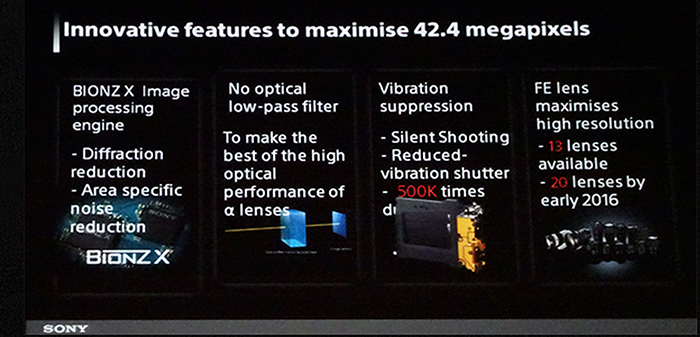
Sony slide via DSLRmagazine.
Hot reminder: Today at 11:00 London time be sure to be online on SAR! A7rII preorders will officially start at that time…wordlwide! And SAR will give away an extra $100 discount on four A7rII cameras!
–
Sony Artisan Thibault Roland has a short Question and Answer session with Sony Tokyo. Here is some answers (full text at Thibault Roland’s blog).
Question: Is the Dynamic Range better and noise level lower than that of the a7R?
Answer: Yes! No formal test was done (it’s coming), but they confirmed that they were very impressed by the quality of the system
Question: Is the higher sensitivity going to be detrimental to noise level?
Answer: No! 1/ In the new design, the photodiodes are closer to the surface of the sensor, and that allows them to detect more light, hence a higher sensitivity. This sensor has a better detection rate in low light conditions than a “regular” sensor. 2/ The change of materials to connect the diodes to the rest of the electronics ensures a lower noise level as well. They did not go into specifics but these seem to be a two key points.
Question:Will the a7R II replace the a7S in terms of image quality at high sensitivity?
Answer:No! We were told that at the same high ISO number, the a7S will outperform the a7R II. The a7R II is “ideal for mostly still photographers who want to shoot videos and 4K from time to time, but videographers will still want to use the a7S in low light conditions”
Question: What about hot pixels?
Answer: They came up with an internal method to make them “not a problem anymore”
Question: Life expectancy:
Answer: I was absolutely amazed to hear them say that the shutter of the a7R II is expected to last more than 500K cycles!!! Yes, you read it right: 500K as in more than HALF A MILLION CLICKS!!
Question: Is the new build more resistant?
Answer: Yes! Because it is now made entirely of magnesium, the body is stronger and more resistant
Question: (LCD screen) Is it still going to be on all the time during long exposures?
Answer: Yes, but they are working on it to eventually turn it off
Question: (Lenses) Performance and resolution:
Answer: Some have raised the question as to if Sony lenses are build to provide a high enough resolution for high density sensors. We had the confirmation that the lenses had been designed with this particular aspect in mind. The engineers are confident that the optical quality of the lenses is more than sufficient for high resolution sensors.
Question: Autofocus performance:
Answer: We were confirmed that AF of Canon lenses was “much faster than before. With adapters (and in particular with a firmware updated Metabones mark IV) Canon lenses are almost as fast as on a Canon body“.
We were also told that the adapter for Sony A mount lenses made the AF very fast, but slightly slower than on an A mount body. We were told that “A mount lenses will find another life thanks to it”.
Question: What about the battery life?
Answer: It will be “slightly better than that of the a7R
–
Time zone reminder: The preorders will start on June 17 at…
8am Los Angeles time
11m New York time
16.00 London time
17:00 Berlin time
24:00 Tokyo time.
Store links:
In USA:
A7rII at Amazon, BHphoto, Adorama, Uniquephoto.
RX10m2 at Amazon, BHphoto, Adorama, Uniquephoto.
RX100m4 at Amazon, BHphoto, Adorama, Uniquephoto.
In Europe at:
A7rII at Sony DE, FR, IT, ES, NL, BE, CH, AT, SE, FI, NO, PT. Wex UK.
RX100m4 at DE, FR, IT, ES, NL, BE, CH, AT, SE, FI, NO, PT. Wex UK.
RX100m2 at DE, FR, IT, ES, NL, BE, CH, AT, SE, FI, NO, PT. Wex UK.
In Asia at:
A7rII at Digitalrev, CameraPro.
RX10m2 at Digitalrev, CameraPro.
RX100m4 at Digitalrev, CameraPro.
124 Responses
Poor Canon. Now that they were expecting to trick some sucke^H^H^H^H^H^Hcustomers with their 5DSR SoS edition (same old sensor), here comes Sony again raining down their parade.
Were i a pharmacist near Canon’s headquarters, i would be a millionaire by now thanks to Sony and a steady supply of salts and Rennie. If Sony keeps the A7SII under a veil of secrecy until Canon announces the 5DIV and 1DXII, expect the stockpile of katanas and harakiri video tutorials to decline sharply in that vicinity.
5D was a great camera, mk2 was a huge update, mk3 was a small update and therefore already “kind of outdated” at its release time.
I expect 5Dmk4 being a huge update again. Let’s wait and drink a cup of tea…
Small update? The sensor was better in low light. It outperformed the same generation sony sensor in low light, and the auto white balance (this doesn’t matter too much, since a lot of people won’t use it) was far superior, The dynamic range was also superior at higher isos. The dynamic range at low iso was inferior.
The autofocus was a complete upgrade compared to the old model.
The shutter was superior too.
Those three things make a big difference to people that actually take photographs
um it was better in low light mostly because of more transparent CFA
huge update? 🙂 do you mean they will buy Sony sensors? Canon’s own sensors fabs are far behind. Maybe they’ll add DualAF. What else can they add?
I really don’t know what they add.
But the fact alone that they have not already leaked the specs and announced it half a year before you can actually buy it, tells me it is getting big.
What will Canon add? We will see…
Two weeks ago we all were convinced A7R-update is similar or maybe only a little better than A7 update. Nobody thought of a 42 BSI-FF-sensor with a global-video readout in crop-mode. Or OSPDAF for adapted lenses. We all thought it is only IBIS, a fix for the shutter-shock issue, a small AF improvement and maybe one or two other minor goodies.
Actually, a lot of people were asking OSPDAF with non-E lenses since the first NEX with OSPDAF.
Or they are are afraid that shooters are being tempted by other brands and so trying to dangle a carrot to keep them faithful…I imagine Canon were having kittens in the boardroom when the A7RII was announced. Outclassing the 5D mark 4, 6 months before it is even announced will be another embarrassment…I would expect the rumours to go quiet about the 5D and then the release date to be pushed out as Canon go back to the drawing board…
Yeah the mark 3 had good AF…everything else a serious disappointment. Canon will give consumers 4k. But not full pixel read out. Or XAVC …Their current mediocre releases show they are scrambling to try and keep up with Sony…
True and Nikon needs to pull its laces up as well; Canon should have added 4K to their recent 5DS & R Mk 1 in this day and age – > same applies to Nikon D7200 and D810.
The canon is too heavy for me but it’s likely sealed a lot better (although not perfectly). Most likely the build quality is better. The battery life is also probably better. These are assumptions but so is your post.
In certain environments, you can’t always change battery.
The 6d has great manual focus with a split prism, superior weight (when you think about how long the battery lasts), and a GPS. The sensor is old tech but I think if canon upgrades that and keeps it lightweight, it could be quite good.
The new canon 5d also has superior dynamic range to the old model. It’s not as good as sony’s but they do have a decent flash system which is far more useful for most photography.
The autofocus humiliates any of the sony mirrorless cameras too
1, In terms of build quality, I think nikon and pentax is at the very top. pentax doesn’t have full frame, but why not nikon if you really care about build quality.
2, the A7 series has battery grip, cheap third party as well. so you can have two options, light and short battery, or much heavier but more battery, DSLR doesn’t have the first option.
3, in terms of manual focusing, I suggest you to try focus peaking once. and come back re consider your comments
4, sony already changed the flash system on A7 series, there’s selectable third party cheaper options, I don’t see any inconvenience compare to canon nikon, and many sony flash also have a LED under flash light, you can use it as a modeling light. a better design as well.
5, My experience on Auto Focus, canon 6d and A7 side by side under city light condition, focus on stars, A7 was a bit hesitate at first but it succeed,6d doesn’t even know that it was doing, totally screwed.
and this was only A7, have you ever try A6000? I would say sony humiliates most canon cameras except those use 61 points system.
3. it su**s — highlight depends on constrast seen, not defocus amount. constasty OOF details may be highlighted more than smooth details in focus.
That’s why Sony still has A-mount. A77II rivals 1Dx tracking performance (I’ve used both), and their new A-mount SLT Full Frame will be even better!
>We were also told that the adapter for Sony A mount lenses made the AF very fast, but slightly slower than on an A mount body. We were told that “A mount lenses will find another life thanks to it
So, still “legacy support”, not a solution… and probably AF-S only?
I don’t think I’d want to buy a new lens to use with an adapter even if it worked perfectly.
This is probably mostly for existing A-Mount glass owners.
A7Rii is looking really good. Some things I’d love to see:
Side by side shots taken with an a7r2 and an a7s. Same lens, same scene, same time. Series of shots at increasing ISO so we can see the noise comparison.
Timed videos of autofocusing with a canon lens on the a7r2 vs the same lens on a 5Dm3 or 4. Again would need to be the same time, scene, lighting.
Similar tests done with an a-mount lens on the adapters. Both the one with a translucent mirror and the one without. Vs autofocus time with a native FE lens of similar focal length, speed and quality.
Should an a-mount lens on an a7r2 with translucent mirror adapter focus faster than the FE lenses? I’m seriously unclear about that.
Utopia.
As per my comment in the other news article, pre-orders will not start “worldwide” officially. No price has been announced in the UK (for example) and the two biggest retailers have both confirmed they have had no information from Sony as yet.
Lots of people in the UK confused by this due to the statements made on here and assuming they can pre-order from UK retailers at 4pm today, but this is not the case.
And I will re-answer your question:
1) Sony will alow worldwide preorders to start at 16:00 London time. The info is official and posted by BHphoto.
2) I use London time only as reference because it’s GMT time.
3) UK stores like any other store will get info from Sony today
Hi Admin;
you wrote 11 in this article… helps to confuse people even more 😉
He’s using a 24 hour clock. Subtract 12 if above 12. If this is too difficult and 24 hour clocks are too hard to understand, might I suggest you use a calculator? Failing that, try google
What? 11:00 London time is not 16:00 London time (as posted earlier), no matter what you subtract.. subtracted you will get 23:00; by your theory, we would already have that link since 4 (am)…
so, try to use a calculator…. or shall I google that for you?
It’s not my theory. 14 – 12 = 2pm for example. Very simple
well.. 11 GMT isn’t 16 GMT… maybe you got my initial point now… just read the headline and SAR_admin’s comment and try to compare
– DONE –
When B&H Photo says World Wide Pre-Orders start today, I think that they mean that you can order from B&H for World Wide delivery. Not that all major retailers around the world will be excepting Pre-Orders from today onward.
it seems that no one in Europe will be able to pre-order today? Some German e-tailers do have the A7RM2 listed, but the price of EUR 3.5k seems to be a place holder.
Yikes if that’s true a very expensive price over the previous model – time to wait a bit until prices fall down – would have thought a price nearer between the D750 and D810 would be ideal.
“A mount lenses will find another life thanks to it”
so A mount is dead… It is like the Millennium Falcon just blows up the Death Star~
Pretty much how I read it. To be fair, with a weather sealed la-ea5 it could be a good package.
Indeed!!! Because I can’t get the LA-EA3 in my country anyways, so hopefully the LA-EA5 with weather seal and maybe full metal built? Will be the next adapter ideal for the combo~
Oh, and also a lens lug on the adapter, that will be a very useful for my need~
If Sony were to cease A-mount development they would make an official announcement with a plan for the massive A-mount user base. Sony just started shipping two new A-mount lenses this Monday (Zeiss 24-70/2.8 II and Zeiss 16-35/2.8 II), and recently said they remain committed to SLT and development will continue. I expect we’ll all see a major A-mount refresh in September targeted towards professionals — particularly sports photographers.
All I can say Sony really likes to strip tease A mount users… It kept us hoping and disappointing at the same time…=(
But they aren’t – Sony A-mount full frame has always had a 3 year refresh calendar. September is not behind schedule.
And nowhere to preorder a7000 or whatever is called when/if it’s announced… 🙁
There seems to be a mistake in this article if the A7RII is meant to have better battery life:
“Question: What about the battery life?
Answer: It will be “slightly better than that of the a7R II”
So the A7RII battery life will be better than tha of the A7RII??????
fixed.
Preorders in a few hours, no full sized samples, no UK pricing. Helloooo Sony?
Posted one single full size sample last week 🙂
Thanks, I know. Much appreciated. But it’s not a sample that you can judge and justify such an expensive purchase on for a pre order. The camera’s strengths are buried in distortion. Sony should have at least one shot like that low res of the portrait with the flowers or something similar that displays the camera’s strengths. It’s a baffling and, IMO, stupid move. They are out there, why not show them?
I have a sneaky felling the UK price is going to be well out of my budget!
If the UK price is too high, there’s always the grey market price.
True, though I’m always dubious about whether a 20% discount is worth having to take a digitalrev warranty… I was thinking about using amazon.de to source the 90/2.8 though – worst case if I do have issues it’s not to far to send it back.
I have a feeling it’s going to be as high as the USD price.
The a7r is also made of magnesium unlike the a7. The body is bigger because the IBIS is in a separate assembly (if it was made part of the body rather than a separate housing, then the body could be slightly smaller). By making the body bigger, you have to add more materials, which adds weight. Why am I spelling this out to you? Quite simply because people are confusing build quality with weight. Adding metal does not necessarily give a greater build quality. Sandblasting metal and painting it differently also does not give a greater build quality. It’s no good saying “you only have to feel it to tell the build quality difference!” because “feel” doesn’t tell you anything. You could feel a brick, it feels heavy, strong, and powerful right? A diamond might feel fragile (with no knowledge about how strong diamonds are) but when those two items collide, I’d hedge my bets on the diamond.
The larger and heavier something is, can in fact cause more problems when dropped.
Some lens hoods are made of metal, including the mounting point. This means that any shock, transfers through the metal (instead of flexing or snapping like plastic) and causes problems further down the line. This is why certain parts of cars are built PURELY to flex, crumple or snap. Slightly off topic but it always pains me when people complain about plastic lens hoods in their review.
It always pains me when I read about “build quality” because 99% of the comments suggest people don’t know what it is. How can you judge it if you don’t know what it is? People go crazy about leica, but if you actually visit their factory, you will see a lot of the handmade assembly is done with a person holding a regular screwdriver and relying on feel for torque. Rather than a torque gauge screwdriver! That’s abysmal build quality and leica is known for its build quality.
About “resistance”, resistance to what? A tank that holds or prevents water is only as strong as its weakest point. I’ve seen some of sony’s gaskets, they aren’t even full circular gaskets like canon, and they might protect from one area but not another. Perhaps he was talking about resistance to the elements, I don’t know. It doesn’t specify.
“They came up with an internal method”
Hopefully it’s not simply cloning out the pixel with the one next to it. That’s on par with sony’s distortion fix to their lenses.
“It will be “slightly better than that of the a7R II”
It’s actually extremely good considering the archaic 1,000mah battery in the device. Perhaps if they made a battery in the same housing with the same voltage, modern materials and a 2,000mah battery, they would satisfy people a bit more. Perhaps this is a bit too obvious though.
I’m definitely buying this camera. It says more than anything written above, but please stop with the nonsense
The most surprising line
“A mount lenses will find another life thanks to it”
Looks like THIS is the A99 successor. But it looks like many of the concerns A-mount users had were addressed with the A7rII
If Sony ever develops and releases an A9, that will probably be the conclusive end of new A-mount cameras.
And that may be good news for those invested in A-mount. In fact, I may now finally start considering some A-mount lenses. Let’s let Sony focus on pushing forward into the future.
The AF speed of A mount lenses are still slower than on an A mount body.
Personally, I won’t sacrifice the speed & accuracy to get slightly better high ISO.
what do you mean by ‘soon’? I thought it would be years before BSI comes to FF.
if A77ii wasn’t major financial success, why would Sony try pulling same trick again?
Exactly! Why do I want to go backwards in battery life, why do I want to go back to the flip screen design that was design 10 years ago for the Minolta Dimage A1 when the screen design on the A77,A99 is so much better and the ergonomics of the A77,A99 and battery grip are also much better. How am I going to focus my screw drive lens on this E-mount junk. I’m glad Sony cares more about Canon users than A-mount users who supported them from 2006 when no Canon shooters gave a hoot! Thanks Sony!
Totally Agree.
The screen design, ergonomics, and vertical grip of the A77ii & A99 is so much better than the pitiful battery life e-mount camera.
Sony has made no such statement, and that quote doesn’t mean anything.
Sony just started shipping two new A-mount lenses this Monday: Zeiss 24-70/2.8 II and Zeiss 16-35/2.8 II and said in a press conference two months ago that they remain committed to SLT & A-mount.
I understand it’s hard to be patient seeing E-mount getting such a heavy push and multiple releases, but the A-mount user base is massive. Sony isn’t just going to throw that away because it’s virtually a guaranteed customer (if they build they will buy).
I’m fully confident A99 replacement is coming on schedule & being announced in September. I suspect there might be more than one body, but the flagship is not going to be cheap, so start saving!
There is no longer any function at all to slt, and we will never see another slt camera.
Sony has carefully worded thier claims to say they will continue to support A mount but has definitelynot claimed it will ever make another A mount cameras.
The claim to add new life to A mount lenses is as clear a statement as sony is willing to make that A mount cameras are dead , but they will continue to support A mount with full compatability.
Another very clear indication there will be no more A mount cameras is the very prominent claim that the A7Rii camera has a new sturdy mount to support long lenses.
SLT provides the only full-time continuous AF tracking because there is never any loss of light to the dedicated PDAF sensor and this tech is not available in any other camera system. Even Sony would not claim A7RII is on par with A77II because it’s not. Put A7RII’s AF against a 1Dx and it’s even more of a joke. There’s a good reason A7RII isn’t marketed as a Sony 4D AF camera.
Believe what you want, but as long as there are long lenses and sports photographers, like myself, and until they have a legit native replacement, A-mount and all DSLRs have a place.
We’ll definitely see a new A-mount camera this fall, if not more than one body, but they aren’t going to be targeting amateurs with them.
What’s the market? Sony can’t make a high end A-mount body that will attract already Canikon users, and newbies will probably want to go to a booming ecosystem, not a dying one. Thus, a A99II will only pander to the current high end A mount users. So which seems to be a good idea? Develop a A99II with better PDAF? Or keep developing OSPDAF in hopes that it can match/beat normal PDAF some day in the future? Not an easy answer.
Unless Sony’s changed the design of the FW-50 I really can’t see how the A7rII will use less power than the A7r.
They should be able to fit 1300-1400mAh into that battery case by now. Wasabi has been selling 1300mAh after market batteries for quite some time now. Need to get Apple to help out with the battery design maybe.
I hardly think Apple is a poster boy for battery endurance!! Have you not owned an apple product?!?
Many. Best battery life of any equivalent product, with very few exceptions.
They told they had replaced aluminium with copper on the sensor… less resistance
I’ve no idea what was meant by the question “will the higher sensitivity be detrimental to noise levels” means. In general, sensors which are more sensitive have lower noise levels. In many cases the ultimate sensitivity of a sensor is not defined by how few photons it can detect, but when the detected signal disappears below the “noise floor”. Ok, there is an effect from improved QE (quantum efficiency, or the percentage of photons detected), but that’s likely to be relatively minor given QE is already high for modern sensors. The important factor is the control of read noise.
The A7S isn’t more sensitive than other cameras because its sensor is capable of detecting more photons. It’s more sensitive (at high and very high ISO) because it has exceptionally low read noise, which is perhaps 6-4 times lower than the sensors in the A7 and A7R.
Don’t think the A7s is capable of “detecting more photons” (as opposed to “holding more electrons,” which is a different thing). It’s efficiency seems to be about the same as other Exmors. The A7s is tuned to use its data differently, with a pre-ADC amplification, apparently.
Isn’t that what I said? The QE of the A7S isn’t much different to that of other sensors of this generation. What is exceptionally low is the read noise. At very high ISOs statistical analysis indicates it’s of the order of 0.5 electron charges. Combine that with the relatively large pixels, then that explains why dynamic range is kept relatively high at higher ISOs, although the design seems to sacrifice this at lower ISOs. It also means it doesn’t (at least at the lower ends) behave in an ISO-less manner, unlike most of the mainline Sony sensors.
When people talk about the A7S being 2.5 stops better (or whatever it is) at common output size, they really ought to have a target DR in mind. It’s certainly not 2.5 stops better at moderate ISO. That comes later as the DR curves diverge. The D4S seems to have rather similar optimisations, but not as extreme.
A lot of people don’t seem to realise that the current generation of sensors already detect perhaps 60% of photons (after passing through the filter array that is). I’m sure there’s a small increase in QE with the BSI sensor (and it ought to be more tolerant of the angle of rays). However, reading between the lines, I’m expecting read noise to be notably reduced on the BSI sensor. Hopefully this will be maintained throughout the ISO range (unlike the A7S) and that would increase DR at both base and high ISOs. It would also includes definition of what more sensitive means, which is maintaining a give DR into higher ISOs.
Note that this game of reducing read noise still has its limits. Even if there was no read noise, unity SNR would be reached for any pixels only being “illuminated” by a single photon (on average) at 100% QE. At that point camera sensor technology reaches its limits, which is the nature of light. We are, possibly, a bit closer than people think.
isn’t low DR at low iso of a7s due to 14-ADC being not enough rather than pixel architecture??
I don’t think so. Other Sony FF cameras with 14 bit ADC have higher DR at base ISO (at common output size). I suspect it’s due to the detailed design of how the charge-to-voltage and analogue amplifiers work.
This is a statistical analysis of the sensor read noise for the A7S.
http://www.sensorgen.info/SonyA7S.html
Note that read noise is estimated at about 0.4 electron charges at the highest ends, yet it’s about 20 electron charges at base ISO.
In comparison, this is the A7.
http://www.sensorgen.info/SonyA7.html
Read noise is much more consistent across the ISO range (which is largely what’s required for “iso-less” behaviour.
Of course bit depth does, ultimately, limit DR on a linearly encoded system, but I don’t think that’s the cause of the A7S not matching the A7 for DR at base ISO. The latter is even slightly better on a “per-pixel” basis than the A7S, without even taking into account output size equalisation.
At sensorgen, they don’t make difference between read noise and ADC noise. so these “20 electrons” are meaningless
>The latter is even slightly better on a “per-pixel” basis
is it more than measurement error?
Like some Canon and Nikon cameras, the A7s sacrifices low ISO dynamic range for high. Indeed, the A7s approach is pretty much the D3 approach.
Basically, read and electronics noise are the gating elements at low ISO values, but not at high ISO values. What my friend Iliah calls the “ISOfull” approach. Most digital cameras use the ISOless approach, where the base ISO is optimized so that photon shot noise is the gating element, not read/electronics noise. However, as you amplify that signal for higher ISO values, you get a fairly predictable drop in dynamic range with the ISOless approach.
Coupled with the big saturation numbers for larger photosites, the ISOfull approach is definitely the proper approach for a low light camera at present. But you give up dynamic range in the lower ISO values to obtain it. For example, with the D3/D3s/D4/D4s I have long recommended that you just shoot with Auto ISO set to a max of 800 (or just set 800). That’s because there’s no real benefit to shooting below that value in terms of dynamic range. I didn’t fully test that with the A7s, but I suspect I’d make a similar recommendation if I were doing a book on that camera, I just don’t know exactly where that auto ISO break point should be set for sure.
That’s pretty well what I’d conclude. It will be very interesting to see the A7R II figures when they come out. There’s clearly a lot more side-benefits from BSI than I first thought. It means there’s not the competition for silicon “real-estate”. We’ve seen some of it already with the simply enormous increase in read speed (I’m not sure that the scale of that has really sunk home to people – and it’s not being on some hot-rod video camera with active cooling, but a small consumer camera running off a tiny battery). We have copper replacing aluminium too, but I wouldn;t be surprised if the extra silicon space allows for scope in reducing electronic noise.
In all, I think this new sensor will be seen as a defining point. A bit like when DSLR sensors moved from CCD to CMOS.
“A mount lenses will find another life”. -_-“
sounds like the official end for A-mount bodies….. 🙁
They can make A-mount body with color splitter and 2x high ISO
Maybe they could bedazzle them with jewels, and sell them for 10x the price to stupid wealthy people…….damn!……hasselblad beat them to it!!!
First time I’ve seen “wood” being described as “jewels” 🙂
I’m confident we’re going to see a new Pro A-mount body (or bodies) announced in September, but if this 7-series camera is any indicator, it’s not going to come cheap. I’m guessing in the $4,000-$5,000 range.
Sony needs a mirrorless A mount with ~18 MP, a7s high ISO like capability, and 20 FPS to go after the 1DX.
Get ready to see a mount rejuvenated and your first $6000 Sony a mount camera.
I agree mostly, but you are mistaken that they need to step down to 18 MP. They could do 24 MP with near A7S sensitivity by utilizing BSI tech.
I’m actually a sports photographer and don’t want 20 FPS. 12 FPS with 16 FPS burst would be perfect. At least 500K shutter as on A7RII and the new .78x T*-coated EVF. Buffer to shoot continuous to the length of your card would be nice too!
AF should be all cross version of A77II PDAF with the addition of wide coverage focal plain OSPDAF.
I suspect we’ll see something similar to this, but again, it’s not going to be cheap!
I am a sports tog too. I was just throwing out some numbers. I’m good with the 18MP my 1DX gives me. Sony just needs a serious competitor in this field with usable ISO above 12,800. 12 FPS is fine with me too but the rumors for the next 1DX are 20 ish FPS and obviously more MP.
I find that tough to believe with a flipping mirror, but it was rumored 3 years ago that Canon was developing their own SLT digital camera with a new tech where the pellicle mirror utilized an electrical current to adjust the opacity. You never know.
Regardless, the only thing I feel A-mount has a leg up on vs. E-mount is sports photography. This being said, Sony does currently not have a serious competitor to 1DX. Considering every A-mount update has been sports-targeted from all recent SSM II lens updates for AF speed, reduced ghosting & weather sealing to all the R&D spent to develop a the new PDAF module in A77II and an entirely new AF algorithm to work with it — tells me future A-mount bodies will be prioritized for pro sports photography.
Personally, 12 fps huge buffer FF will be good enough for me. 🙂
I didn’t know that about OSPDAF. Good to know.
When you looks at the a7rII and considering a7r —>a7rII period of time, then you probably can imaging what Sony can bring for the longest waited a niche a99II !
No more entry and mid level for amount! Of course, Sony said if you wanted 14bit uncompress RAW, they can deliver, that means you can begging Sony to release cheap amount body.
But seriously as amount lens gain fast AF in emount, emount likely the future.
I’m not, but I don’t care anymore. Knowing that I can still use all my A-mount glass with similar performance on the E-mount bodies is good enough for me; they won’t feel like wasted investments anymore. I agree with @disqus_6eTHYDYiSR:disqus: looks like the official end for A-mount bodies.
Believe what you want, but Sony says quite the contrary and, again, just shipped two new A-mount lenses this week.
They aren’t going to be targeting amateurs with any future A-mount releases though — THAT I am sure of.
Lenses updated to work better with OSPDAF, like on this new A7rII…
Actually, these are updated to support split-second sports tracking (4DAF) as debuted on A77II which will be approved upon in the next A-mount flagship.
We can hope. If they do, great. If they don’t, though, I’m OK with the direction E-mount is going, as it looks like we’ll get nothing but improved performances with our lenses on that platform, too. Win, win.
If you don’t shoot sports, you won’t miss a thing at present.
New A mount bodies will have a detachable A mount which enable user to use E-mount…also called the E-mount camera with LAEA adaptor.
So Sony officially confirms that A mount was dead but now gets revived.
I wonder if the sensor cover glass is less thick for better performance with [Leica] wide angle lenses; and if the photodiodes being closer to the surface of the sensor helps in this regard.
If they make cover glasser thinner, their own lenses performance will be compromised (FE lenses are designed to include cover glass in optical formula)
I’m hoping for better performance with Leica lenses too. If not, I’m almost ready to dump my Leica gear and replace it with Zeiss + Sony or Canon. I’m tired of waiting for Leica to wake up.
Why not just get your camera modified then. not sure but I don’t think its extremely expensive to have the sensor glass swapped for thinner.
Yes, true. I would imagine it would kill the warranty though?
Can’t wait to see the next model! 😉
ironically the smartphone with supposed best battery life is xperia z series
Where Apple excels is not having the smartphone with the best battery life, but at getting the highest mAh per volume. EG: The most power into the smallest space.
I am not sure you understand the meaning of the word. As I said, there are a few exceptions here and there, but very few. You found one, good for you.
I had an xperia z1 and it had very very good battery llife.
My Z Ultra’s battery life is awesome~
You said to be on here on preorder day for the a7r. What are we looking for?
Sony is making a lot of money today.
Now we need more native lenses. Sony plans 7 new lenses for early 2016. I really hope they will give us FE 24-105mm F4 and 135mm F2. Do we have something about them ?
I think proper RAW converters that get better with hot pixels than in-camera masking. Can someone clarify if it’s defective pixels marked in raw file or they are just replaced with interpolated value?
I get it can do 500k. Can the rest of the camera hold up to that abuse?
500k is marketing BS since the camera is only going to get a 1 year warranty what is the point of claiming the shutter is test to 500k…. that would be almost 10,000 photos a week which is way more than most of the people that buy this camera will ever do in a year.
Frankly the service side for Sony is what I consider to be their biggest weakness. I’ve never had an issue getting a Nikon serviced or getting part for them even when they are discontinued products… shoot I’ve even had them send me part for free.
But I can’t say I have had that same level of service from Sony, and when a product is discontinued they pretty much walk away from it as quick as they can.
In a large part of the world, it gets 2 years warranty, standard.
Personally, I like the idea of having a shutter that will outlast the body, even with lots of use. My A500 is well past 150k actuations, the shutter was rated to less than 100k iirc. It’s not a comforting thought but a 500k rated shutter, surely would be.
The a7rii is desighned for good 4k video capability.
It is clear from this interview that many important decisions…such as resolution were specifically determined with video in mind, and some consideration for increased sensetivity.
The result is a wonderfull camera and I want one.
But many of us care only about great still pictures and care nothing about video, still others will on occasion care only about the ultimate still pictures.
For this I would like the ultimate picture mschine…of the highest resolution and all features optimized only for the best possible still pictures.
I sincerly hope the new A9 will be such a camera with much higher resolution and no compromises made for features that are not of direct importance to producing the best still pictures.
The A 7Rii seems to be a great camera and I would like to make use of both of these new cameras.
So I anxiosly await the coming of the ultimate picture machine.
“We were also told that the adapter for Sony A mount lenses made the AF very fast, but slightly slower than on an A mount body. ”
Which a-mount body? a77 II? If it’s slower than the molasses of the a99 than it’s not particularly good.
A99 is much faster with the SSM II lenses using AF-D. I have 70-200/2.8 G SSM II, 300/2.8 G SSM II, 24-70/2.8 ZA SSM II, but you are absolutely right in that A-mount is still faster (and more accurate at tracking) and the next SLT Full Frame will likely boast Sony’s fastest, most accurate AF to date.
You just bought the 24-70 2.8 SSMII and already received it? How is that working out.
I pre-ordered in April. Like my 70-200/2.8 G SSM II and 300/2.8 G SSM II, AF performance is night-and-day faster from V1 — unquestionably huge improvement there! Optically, V1 was already incredible, but they really did improve this one where it counts! I see less CA and much improved sharpness in outer edges/corners at 24mm and improved sharpness in the middle as well. The build quality feels slightly improved (possibly from the weather sealing). Lastly, they even improved the leather carrying case and removed the plastic clip in favor of draw string on each side so its easier to open and close.
I might sell my 16-35 and update that to V2 as well since as this one was definitely worth the upgrade, but I’m waiting for the A99 announcement as I need to buy two of those and do not have unlimited funds! LOL
Faster is relative. The a99 is woeful with SSM lenses in anything but extreme light.
Is the 24-70 worth the upgrade to the mark II? Didn’t they start shipping only a day ago?
What SSM II lens have you worked with on A99? I would agree with original SSM to some extent, but only in certain situations. SSM II lenses, however, are not only blistering fast, but also much more accurate than their predecessors, even on my A99 — meaning the limitation appears to have more to do w/the lenses than the camera! This is probably why all the development in A-mount lately has been updating the SSM lineup to SSM II.
Yes, the new Zeiss just started shipping on Monday — right on schedule! If your read my post below, I feel it was worth the upgrade. It’s significantly improved!
They did no such thing and just shipped 2 new A-mount lenses Monday.
Why doesn’t ask them about the, still, dire lack of affordable quality lenses for the whole e mount series ? Its quite a few years now and its still a blocker for many people
Well, we’re going to have the “To Be” 3rd party lens manufacturer called Canon which you can get affordable quality lens, if they have any (Sorry, not sure about canon line up of lenses~=P)
I have a Sigma 105mm macro (canon fit) for my A6000. Problem is for macro the bigger lens is fine but the other prime lenses in Canon fit or A are simply to big for a CSC body like the A6000 and I would argue the A7 series. This has been a contentious issue since the Nex range started and its got a bit better but people investing serious money for the A7iii are simply going to buy a Nikon D750. Sony’s lack of a comprehensive e mount range is appalling. I’m a huge Sony fan but I will buy an A7rII when they have a range of that affordable, compact, and not overpriced, e mount lenses. Both CSC and FE. Its unbelievable that they drip feed the odd expensive and not great lens rather than develop a reasonably comprehensive range to pull Canikon users away…
You forgot one question in the interview : slow mo. The guy answers that there is 240fps at full hd. But it is probably an error, I bet the A7S II will actually have 240 fps full hd.
I wonder what diffraction reduction is… diffraction is a pretty fundamental problem. Even a small improvement on diffraction from a camera rather than a lens would be a fascinating new thing.
It’s just a deconvolution sharpening algorithm that takes F stop etc. into account and tries to compensate for it. It’s not bad, almost free from halos, contrary to the Canon (this one is bad in this respect…) and Nikon sharpening algorithms. But does introduce artifacts at higher ISO’s when noise levels increase.
It’s already present on a few Sony cameras.
Zombie A-mount confirmed.
There’s a question unanswered, if even Canon focuses pretty fast with third party adapters, does this mean that A-mount lenses with supersonic motor would focus much faster using the adapters without SLT? They are smaller and cheaper after all.
”
Sony Q&A with Thibault Roland! A7rII has better battery life”
No it does not have better battery live. 290 shots on A7RII vs 340 shots on S7r according to objective CIPA-method testing. And both cameras have no flash, so these numbers are even lower compared to cameras with flash, like D750 with its 1230-shot CIPA rating, where half of the shots were done with its pretty powerful (for a built-in) flash – 12m at ISO100.
“Question: Is the new build more resistant?
Answer: Yes! Because it is now made entirely of magnesium,”
Just as it was in A7r.
” the body is stronger and more resistant”
More than what?
Sounds like some dishonest marketing BS. Thibault Roland just sold his soul and lost all credibility, if he had it to begin with.