







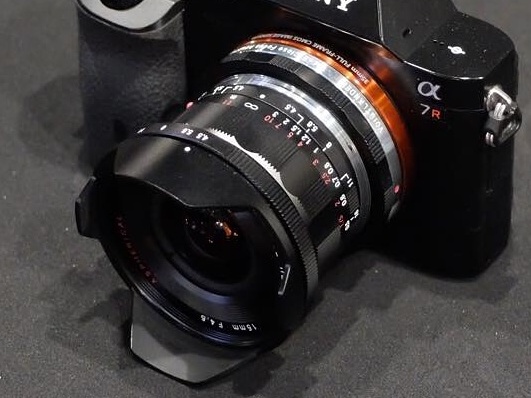
Image courtesy: DC.watch.
Last week I told you how the new Voigtlander 15mm f/4,5 Super Wide Heliar III has been designed to get rid of the usual corner issues on the A7 cameras. And it will cost 749 Euro. Today at CP+ Voigtlander is showing that lens for the first time on the Sony A7r.
UDPATE: Another image by Matthew Allard (Thanks!):
@SonyAlphaRumors this one. pic.twitter.com/6Ho9QsTk6P
— Matthew Allard ACS (@mattallardACS) 12. Februar 2015
28 Responses
Wonder what kind of compromises are made compared to the film version when shot on film.
A while back Roger Ciala from lensrentals said that the drawback of using filter-stack optimized lenses without a filter stack is only visible at large apertures.
The optimisations necessary to get such a lens to work better on say an a7 arent really all about the filter stack. Stack depth affects the back focal length of the optical system. Since a lot of these lenses unit focus, corners would then only be a matter of refocusing for them. But it’s not… the issue is in the so called telecentricity.
In the past, when lenses were optimised for digital, you could see a clear change in the MTF… generally towards the center where the quality is sometimes compromised for improved corners. Not sure if this update has the same outcome.
Is there anyone at CP+ that can get a sd card in this puppy and post some sample shots!?
It’s not clear that this is a new “version”: more a complete new lens. It’s much longer (presumably for tele centricity) so it must have been computed from scratch. I’m quite excited; as pretty slow prime that is well built and not too tiny, it may give amazing perfomance
Also released details yesterday on their Japanese website – http://www.cosina.co.jp/seihin/voigt/v-lens/vm/15vm3/index-.html
the design used for rangefinders looks to be a third the bulk of this lens …..the only digital camera besides film rf the the orig cv 15mm 4.5worled well on was the ricoh gxr where it acts like a 24mm lens ,……………………………..i love it on my gxr but now mostly use i t on my fuji……where its ok for bw work………kudos to c v for this new effort …….the orig. cv 15 rf lens was atrocious on sony
Its Sony users will definitely help Cosina move units faster than its Leica users. Smart move.
The old one didn’t work so well on Leica either.
I use the very small 12mm voightlander LTM version (and crop of the smeared and colored edges). This one is very expensive and rather bulky (compared to the ltm versions)
But you get the full original with the proper lens.
Can’t wait to know how is the vignetting and colour shift when used on a A7, and if it makes the job better than my Zeiss 18/4. Additionally it has a thread for filters that makes it even more attractive!
A series of private test shots published during Photokina did no show any colour shift when used on the more critical A7R. The Heliar III is a most interesting lens and the exposure samples were pretty sharp as well in the corners. In depth reviews most welcome.
Test shots from Photokina with A7R:
https://www.flickr.com/photos/martinstelbrink/15887623284/
https://www.flickr.com/photos/martinstelbrink/15890033503/
Damn, these aren’t bad. Come on man, here goes another 1k of my freaking money.
I had this lens on my nex 6 in september at photokina, i will try to post my sample images when i et home
German Digicamclub ABIS showed photos of the A7+Heiliar III set-up including quite promising
test shots in Sepetember 2014. No Colour fringe as known from Heliar II espcially on A7R. Still weight is open for me. It is bigger and might heavier than Heliar II. Further comparison of achievable IQ to Sony Zeiss SEL1635Z would now be of major interst.
.
For a prime, beating the 1635Z shouldn’t be too hard. The cheaper Tamron is a full stop faster and still sharper.
I hope this lens can live up to the expectations.
Weight is 247 gr or 8 oz.
correction: ABIS had the Heliar III on an A7R.
I like the look.
Kinda ironic that these “primitive” lenses are the most future-proof lenses that you can buy today. No AF motor that breaks, no OSS that goes out of alignment, no pins that bend and no circuit boards that corrode. As long as you don’t smash them against a wall, they’ll be serviceable even in 50 years.
Glass is a liquid though. It doesn’t keep its shape forever
That’s true but totally irrelevant. I’ve yet to see any lens that’s got runined by creeping glass and I own some that are more than 50 years old.
I do not believe you’ve a method to test the performance of the lens 50 years ago and the performance today. However, there are methods to test how much glass changes shape. There are new methods to create glass and lenses; in addition, 50 years from now, glass is likely to be manufactured in a completely different way, in a better, more precise way, and in a way that shows more detail.
It is naive to think anything is future-proof. If you had of said future-resistant, perhaps we could come to some agreement, but even this remains unbelievable as there are very old AF lenses which remain used today
Sounds like someone doesn’t store their cameras upside down.
From a practical perspective glass is a solid, and will keep it’s shape for all intents and purposes much longer than you will have a camera to mount it on.
Neither do most chicks, but I’m not complaining. I’ll take what I can get.