







PREFACE
1) Current APS-C Fuji cameras feature a Sony sensor (with special Fuji X-Trans design).
2) Fuji can use the latest generation of Sony sensors only about half a year after Sony itself implemented it in one of their cameras.
3) Therefore, any Sony A7000 sensor rumor could potentially be interesting also for the X-PRO2
4) No rumor until now says, that Fuji is going to use the Sony A7000 sensor for their X-PRO2
The Rumor
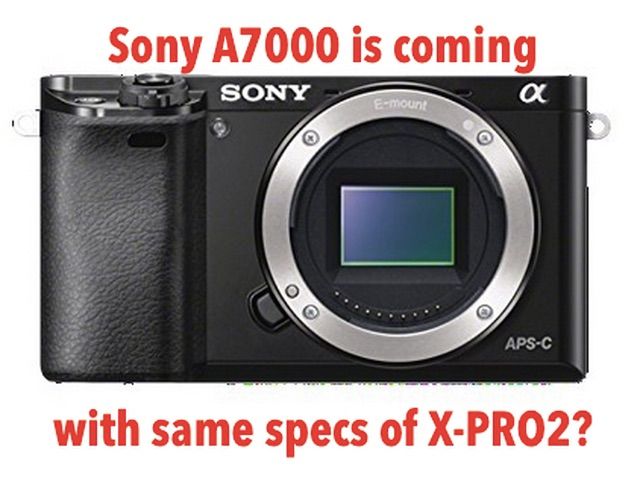
Ok, then let’s talk about the rumor SonyAlphaRumors just shared. According to the rumor of SAR, the Sony A6000 successor will hit the market soon…. very soon, maybe on the first half of September.
And here are the sensor specs:
– Best in class low light performance (backlit sensor and RGBW pixel array)
– internal 4k video recording with full sensor readout in 60fps
– extremly fast autofocus system
There is a Sony press-release of 2012 that explains how the RGBW Coding works.
The built-in “RGBW Coding” function which adds W (White) pixels to the conventional range of RGB (Red-Green-Blue) pixels has realized higher sensitivity, enabling high-quality shooting with low noise even in dark indoor or night settings. While the addition of W (White) pixels improves sensitivity, it has the problem of degrading image quality. However, Sony’s own device technology and signal processing realizes superior sensitivity without hurting image quality.
Also a Fuji patent of 2012 shows a sensor with enlarged green and white pixels (see here). So Fujifilm at least investigated the possibility to make it. If it will become true soon, we will see.
CONCLUSION
– If it’s true, that the X-PRO2 will feature the same sensor of the A7000 (just with special X-Trans array)
– If it’s true, that Fuji has to wait about half a year before being able to use that sensor
– If it’s true that the A7000 will be announced early September
then this means that the Fuji X-PRO2 could hit the market around February/March.
stay tuned,
 Fuji X Forum, Facebook, Google+, RSS-feed and Twitter
124 Responses
Patrick, I told you so! 😉
Good luck in finding confirmation with the rest! (Thumb Up)
Due to X-trans can we talk about the “same” sensor?
And with the new white pixel of RGBW Fuji will need to modify X-trans and therefore the RAF conversion algorithms, right?
How will this influence the moire in video recording?
What will be the impact of that on third part software and the time for them com come with updates, namely Adobe?
Considering these aspects, will this new sensor be the most probable choice of Fuji to use in a camera that was already foreseen to be released before the end of the year?
No need to worry.
Fuji patented their own X-Trans version of the RGBW array already.
Japanese Patent Publication No. 2013-258168
Published 2013.12.26
Filing date 2012.6.11
https://translate.google.nl/translate?hl=nl&sl=ja&tl=en&u=http%3A%2F%2Fegami.blog.so-net.ne.jp%2F2014-01-06
No need to modify. They could use the same old x-trans CFA.
I wonder how the chip being changed for Fuji affects the specs, i.e., X-Trans vs RGBW. May no longer have class leading sensitivity since that is a byproduct of the W that Fuji may not get. Video is difficult with X-Trans readout. Focus? Well, we already know how Fuji can compromise auto focus. Regardless of which Sony chip the X-Pro 2 is based on Fuji will need to step up it’s game in the processing department to compete with the next generation of mirrorless cameras. Look at how much more image quality Nikon has been able to pull from a sensor than Sony with the same sensor, and that doesn’t even change it from a Bayer array pattern which complicates things.
Lots of assumptions of which you do not know if they will have a negative impact or not.
Instead of a wait and see attitude you already need to be negative about something that has not even be released and is still in development.
No need to worry about RGBW color array.
Fuji has thought of it already in combination with their X-Trans demosaic.
Here you’ll find your answer.
Japanese Patent Publication No. 2013-258168
Published 2013.12.26
Filing date 2012.6.11
https://translate.google.nl/translate?hl=nl&sl=ja&tl=en&u=http%3A%2F%2Fegami.blog.so-net.ne.jp%2F2014-01-06
How much more?
I haven’t figured out how they could improve demosaic better with rgbw.
I hope x200 gets released by the beginning of summer of 2016.
Me too. As much as I love the ergo of the XT1 I tend to shoot 90% with the 23mm and like Street so going back to the X100 format works for me. Just drop the XP2 guts in and add the multi-function ISO dial and that may be the last camera I ever buy
Adding an ISO dial would be super-cool, I’m just not sure where it goes. Without the “hump” of the XT-1 the dial will stick off the left side of the top plate and add size to the camera. It also can’t really be recessed, as that’s where the viewfinder is… in fact, putting on that side in general doesn’t work or that reason. It would have to either replace or stack in with the exposure compensation dial, and I’m not sure I see that happening.
Never said it would be easy. But if you really think about it and get creative there is room. It could come down to a 1/4 change in hight or maybe a window on top with a scroll wheel… just sayin… as it is the guts may require a new body all together
Frankly, I’d be happy simply to have the latest Sony sensor in there without any special Fuji modifications. Compatibility with software developers seems to be the biggest limit in X-Trans image quality. Unless Fuji dedicates a team to work with all RAW developers to squeeze out the benefit of “being different.”
Fjifilm want to stay away as much from e.g. the bayer color filter array or its derivatives is because, this color array was an invention of the Kodak Eastman company by a former Kodak employee Mr. Bayer.
Therefore Fuji developed and will keep on developing their own color array to distinguish themselves the same way as they did with the development of film.
Patrick Is the processor the same? If I understand the tech correctly then that will affect AF more than the sensor. I really hope this will hit one out of the park for Fuji.
As already rumored, the X-Pro2 will have a much faster processor, EXR III.
Combine this with the phase detection pixel all over the frame, and we should have a noticable AF improvement
You’re assuming it will actually be released.
This sensor will apparently improve noise performance. However, will it improve resolution and dynamic range? The addition of white pixels may degrade image quality, as they mentioned, which perhaps would be a result of a more complex algorithm for interpolation.
Personally, I would prefer greater dynamic range and resolution over high ISO performance. If the colour filters are becoming even more complex (further away from 1:1), I am afraid it is a step in the wrong direction. The DP Merrills, which have a 1:1 15 or 16 mp APS-C sensor, have exceptional image quality at lower ISO settings – arguably better than full frame 36mp bayer sensors. if Fuji could use the DP Merrill sensors, but somehow improve the noise performance so that it is useable up to ISO 1600 or ISO 3200, that would be interesting and sufficient. I don’t need to shoot at ISO 10,000 or greater. I am more interested in obtaining more pure image quality at lower ISO settings, which will require 1:1 sensors.
The colour filters still remain the weak link in digital sensor technology. However, it seems they are making the filters even more complex, perhaps sacrificing resolution for noise performance. Thus, I am not sure whether this news is exciting or not.
And, Fuji will likely make the algorithm even more complex with some version of the X-trans sensor, which is unnecessary.
Remember, too, that this will almost certainly be a 24mp sensor, or possibly even 28-30mp, so you will see a net resolution bump either way. Can’t comment on DR as we simply aren’t in possession of all the facts yet.
A camera with a 1:1 sensor (DP Merrill sensor, or something similar), Fuji colours, and decent ISO performance up to ISO 3200 would be exciting. Unfortunately nobody seems to be considering that.
Fuji developed and will keep on developing their own color array to distinguish themselves the same way as they did with the development of film.
Another reason why Fujifilm want to stay away as much from e.g. the bayer color filter array or its derivatives is because, this color array was an invention of the Kodak Eastman company by a former Kodak employee Mr. Bayer.
I thought the x-trans minimizes moire effects. I don’t think it has much to do with color rendering.
Fuji’s rivalry with Kodak as a motivating factor is an assumption on your part. There are no facts I’m aware of to back this up.
That’s an interesting coincidence but highly speculative and unlikely as an actual motivation.
Fuji should buy sensor and processor from Samsung (the same as in NX1), without any suboptimal X-Trans modifications (the same simple, sharp and processor-efficient Bayer).
Samsung sensor and processor + Fuji ergonomic bodies (X-E) and lenses = win.
And add IBIS.
You forgot to add a processor-efficient 12 bit RAW to your wishlist.
Yeah… but I don’t care that much, as I shoot 99% JPEG for many reasons (mostly for buffer/speed for sports and to save my time). In Sony JPEG might be even better than their RAW as it could save up to 12 bits per pixel before lossless compression instead of 8 in ARW.
Of course I would not mind if they stopped fking around and just switched to lossless DNG, 12 or 14 bit (or even 16 bit for their A7s line if the sensor allows 16-bit A/D conversion).
I have not seen any proof anywhere that Fuji is using Sony sensors. Anyone who would care to share such proof? For example, an interview with a Fuji sensor engineer saying exactly that, or a picture of the sensor with Sony written on it, or a invoice to Fuji from Sony for 20,000 APS-C sensors. If there is no scientific proof, then it is only a rumour, and cannot be assumed as true.
X-trans II is using a $50 sensor adapted from the one used in Nex-5r. Fuji put a custom color filter array on it. X-trans I is made by another company.
Not sure where the proof is, but FujiRumors and SonyAlphaRumors are pretty convinced that Fuji will be using a newer Sony DX sensor.
Over and over again people are shown that the “Same Sony Sensor” performs very differently in different cameras, yet somehow the crowd always jumps to “Same Sensor, Same IQ” conclusion.
Sony Guts, Sony Guts, Sony Guts!!!!!!! Everything is Sony guts. I get my information from the movies 🙂
Not to mention people keep saying ‘another Sony sensor’ like it’s some sort of insult when in fact they currently make the best sensors in the world. I would rather Fuji used ‘another’ Sony sensor then to come up with some inferior design on their own. (Cue the comments on the Organic Vapourware sensor)
http://image-sensors-world.blogspot.com/2013/07/aptina-explains-clarity-technology.html
Wow. Fuji’s ‘pro’ camera gets another brand’s consumer sensor. Way to push things forward (i.e. cut costs).
What’s the difference between a Pro and Consumer sensor?
They’re not miniature format for one thing.
Oh look, another PhaseOne user among us!
Psh, overpriced. I’ll stick with my Rolleiflex and my Deardorff. Unless Fuji were to finally make a FF X100, in which case I would love to get back into the Fuji system.
By FF you mean 4×5″? That’ll be the fullest of all full frames!
(but then again, whatchagonnado when 8×10″ users come to town?!)
I mean 24×36. I shot 8×10 up in Maine this year and it was a lot of fun, got some great images. 4×5 and 6×6 too. So you can see why I might be resistant to use a format that used to be reserved for consumer point and shoot film cameras. It was introduced to cut costs in film, and it sustains as a way to cut costs in camera design. Canon Powershots should be using this format by this point, but Fuji is trying to tell everyone it’s jusssst fine, like Nikon did until they decided to play pro ball with the D3.
Current Fuji’s IQ easily surpasses digital medium format cameras of 10 years ago. It beats all 5 year old FF pro cameras, including D3s. Comparing Fuji X sensors to APS film cameras is an insult to your own intelligence.
That’s an easy thing to type. It’s not actually true though. If YOU can’t see the difference, then fine. But it’s there. And you can’t get over the effects of rending due to longer lenses covering the same angle of view. Not even with aperture.
And even if what you said was true, why would you want to use a camera who’s claim to fame is that it’s better than 5 year old tech??? Self defeating argument.
Something like 3-5 years old is good enough for him to use, I guess.
Good enough for me. Even my car is 6 years old!
Well, do you pay full price upon release today for your car?
Actually, 3-5 years old is how everyone seems to be acting in this thread! Everyone’s fingers are flying faster than their brains can comprehend what’s been said.
I didn’t say that I can’t see the difference, quite the opposite – I said that Fuji is better. There is a difference indeed.
I’m getting paid to create photographs, not megapixels or focal equivalents. Yes, any member of the glorious online photographic community can do a comprehensive forensic analysis at 200% pixel size and spot that uniquely artistic look of medium format. And they’ll be right in almost 50% of the cases.
Also getting paid to talk? I know Fuji hires endorsers like every other brand. Looks like you enjoy their product release events.
Nope. Never got paid by Fuji to do or say anything.
By the way, your linked Tumbr profile is full of “I made $300 yesterday by Internet marketing”, and your avatar is an ad for Audio-Technica. Projections, projections…
I haven’t even registered Tumblr. It must be your daily activities resulted in those being pushed to you as an ad.
My avatar is cropped from a photo I captured for one of my old reviews in an audiophile forum. No one ever used it in any ads.
But I do see you shared some photos as an active participant in Fuji’s exclusive commercial activity. https://www.flickr.com/photos/trentontalbot/albums/72157649346260614
Come on, it’s common practice. There is nothing to be ashamed of.
You mean that this – http://chrisclemens.tumblr.com – isn’t yours? It was linked from your Disqus profile just before you made it private a few minutes ago.
Oh, and yes, I went to the presentation of new Fujifilm gear in Belarus as a regular visitor, mostly to meet with the local Fuji community. How exactly does it prove your point?
No… My last name starts with W. I really used to though people are mature enough not to link web-name with real names….
I made it private a few month ago due to one guy keeps searching my posts from Sony forum. The only thing I remember is I mentioned something like I dumped Geico and someone replied something like a scam.
If true, it must be another hallucinogenic javascript on FR. Sometimes the links here are not what they seem.
Oh, and you should be careful when mentioning shady insurance companies, especially the likes of Geico and Allstate. It seems that they employ disgraced debt collectors for their PR management.
I have ad block so normally I don’t see ads.
I use an adblock too, but occasionally some pesky javascript from an unscrupulous advertiser makes it into web render and redirects to the wrong link (since the “right” one has been blocked).
For your information. https://uploads.disquscdn.com/images/bc35e323a3e45a8d2e83823e61b6fa5a15d5fb2b3ff6ba0590cad060a6f6d351.png
I believe Fuji will use the older 24 MP sensor from Sony.
24MP, I think, is a sweet point. Sharp enough, low noise floor, and doesn’t require stabilization.
You clearly don’t understand the difference between using a 35mm lens to take a portrait and a 50, 80, 150mm lens. It has nothing to do with pixel peeping. Fuji’s images are flat flat flat, and that’s when XTrans isn’t ruining all the fine detail. There is a reason why even Pentax is going with larger sensors now.
I prefer 300mm lenses for portraits. But Fuji doesn’t make one yet, so I have to work with what we got. Flat? You just don’t know how to cook it.
I prefer a 300mm too, and mine is made by Rodenstock and has a slightly widened field of view. Because it’s not practical to use that indoors when shooting a wedding, I have to make compromises. So now I use a 58mm 1.4 which is a good balance of compression, angle of view, and speed. The best Fuji can do is match a 50mm 1.8 in those regards. I love fuji camera design, but I hate that they decided to not fulfill their vision of focusing on quality above all else. They were supposed to knock Leica, instead they are just slightly more compelling than micro 4 turds.
Looks flat to me.
Flat? Really… never would I use anything other than my X100s oder X-Pro1 (well, only till the x200 and x-pro 2 are out, of course). But to say Fuji’s images are flat? You’ve no idea, my friend.
by the way, that one was shot with the x100s.
Yup, lacks the dimensional characteristics you’d see had the image been taken with a 35mm lens.
That comment makes no sense from an optics point of view.
Oh do elaborate.
Looks pretty flat to me.
I love that image, flat or not.
Thx, Lumen!
Perhaps learning what makes a compelling photograph would behove you more than worrying about all this technical minutia?
If you can’t make a good image with a Fuji X-Series camera, a full frame or medium format camera isn’t going to help you one iota.
Gear is good. Vision is better.
Oh my gosh you’re right! I’m throwing away all my cameras and just using my iPhone!!!
Perhaps if you threw away your negative attitude instead, you could make better images no matter what imaging device you used.
the absolute focal length has nothing to do with the perspective. it’s only a meaningful number in this discussion when it’s paired with a sensor. it’s not like the lens distorts space around it, perspective is all to do with where you’re standing. The ‘medium format look’ is nothing more than a very sharp image with a shallow depth of field.
Printed film pictures are flat, my PC screen is flat. So do my Fuji pictures.
I agreed with you 100% right up until you brought up the D3s. No way does the Fuji X-Trans sensor beat the D3s. Comparable in many key respects, yes, but the D3s renders wonderfully, and still beats X-Trans for high ISO by at least a full stop.
I know, because I use the D3s, X-Pro 1, and X-T1 on a regular basis.
But I will concede that the X-Trans is fully competitive with the D3s in several respects … as it is with a number of full frame sensors from a few years ago.
Well, that’s me (without the beard!) with my old spare camera, the D700. D3s was my main workhorse. Ditched them both and switched to Fuji years ago, but used them simultaneously for quite some time before that…
As opposed to Nikon, Fuji’s handling of difficult lighting scenarios (extremely low CRI, for example, with high contrast and mixed color temperatures), especially in low light, is epic. Since I’m an event photographer in the first place, that sold the whole system to me.
There’s a lot D3s can do as a system that Fuji X can’t… But if you look at just the sensor, the situation is completely opposite. Not on paper, in the real world.
By the way, try this experiment… Get out at night with your cameras equipped with similar lenses, turn off AF assist lights, and then try to focus on something in the darkness. I think you’ll be surprised at what your X-Pro1 is capable of. Yes, D3s can move big bright glass really fast in broad daylight, but when things get dim, it just can’t cope without an AF illuminator (or Lv, but that’s even funnier).
https://uploads.disquscdn.com/images/58c6f41637ed7d969ea178de71f3ad95016e36e546d84da6e62e9b38a6605e33.jpg
Interesting. My experience has been that the D3s will wipe the floor with the X-Pro 1 for autofocus … under absolutely ANY conditions. I often shoot under very challenging lighting situations, and if I absolutely, positively have to get the shot, its the D3s that gets tossed in the bag, as I know it will handle any assignment (short of high resolution fine art work).
The D3s had a very special sensor; I don’t just mean its low light performance, but the way it rendered tonal gradations. Quite lovely. That the Fuji X-Trans sensor can produce a similar result [with a slight resolution bump to boot] is actually quite impressive.
Frankly, I do use the Fuji gear mostly now, and I do love the way it renders colors. And the weight advantage … well, say no more.
But for action, or action in low light, or horrendously inclement conditions — or if I want to leverage CLS with multiple speedlights — I still reach for the D3s. I tend to avoid either/or comparisons, cause they’re a bit silly. It’s a matter of the right tool for the right job. Which, of course, you already know.
I didn’t say anything about low light action! For that, D3s is a better choice. But when it comes to static subjects (in wedding photography that would mean reaction shots during the slideshow, when all lights are off and people feel that they can express their emotions freely), Fuji wins. You don’t want to use AF illuminator and make people camera aware, and you want to see what’s actually happening in the dark? Fuji has a night vision.
As for D3s special sensor, I wholeheartedly agree. By Nikon’s standards it’s really special indeed, so when D4 came out, I’ve decided not to upgrade. But then came X-E1, and I liked it almost as much as D3s. Two short upgrades later (X-E2 and X-T1), and I sold all of my Nikon gear.
…Not all of it, actually, one lens is still waiting for a new owner. Anyone in the ConUS wants a 300/2.8G VRII in mint condition? 🙂
Let’s see what Fuji cooks up for the X-Pro 2 with its X-Trans III sensor. I have a feeling it will be at least 24mp [might even push to 28-30, I dunno]. Can’t speculate with any accuracy or foreknowledge about low light performance, DR, autofocus speed improvements [especially in low light], though I remain hopeful.
Hmmm yes
24×36 also was introduced to cut cost.
So why would you want to use anything smaller?
Why would you want to use 24×36?
For the same reason as any system: the particular compromise between system size&weight, cost, and image quality suits your needs.
Too many compromises for a system camera that aimed to take on Canon or Nikon.
? 24×36 aimed to take on canikon? I’m lost.
Same applies to the whole history of photography. Pretty much everything has been introduced to cut cost, bulk and weight: plates, sheet film, roll film, 135…
In short: if someone wants an uncompromised quality with uncut costs to boot, they should shoot daguerrotypes.
That makes no sense…
If, as you say, have actually shot 8×10 than you would know that the difference between APS-C and FF is mice nuts….
I’m afraid there was a time this statement of yours would be questioned with a big, big smile from the ones using the “real” full frame formats.
By 1906 9 x 12 cm , even if slightly smaller than 4 x 5″, was considered as a “miniature” format in Europe.
Shouldn’t you reconsider that “fullest of all full frames” format concept? LoL
11×14 or bust
I happen to think a 4×5 digital back would be awesome. Even if were modest resolution – say 16-24mpx. I suspect it’d be a lot of fun.
There are scanning LF backs out there. They are cool (at least on paper), but… The actual 4×5 field camera, few lenses and supply of film for the weekend of relaxed landscape shooting weights similar to the pro DSLR kit, maybe even less. Digital LF weights much more, especially batteries. Guess the technology just isn’t there yet.
True! Which is why I don’t own one – but I have such nostalgia about developing 4×5 film and remember the awe at the image quality. Contact prints that were breathtaking. Part of what drove my comment is the thought that a lower mpx large format sensor could/might be affordable, offer some large format fun, but without the cost. I’m thinking fun/interesting more than making any image quality argument. No one would make money selling these though….
Wake up! Fuji has been telling us no way they are going to do any 135. Time to move on and choose another brand. You ain’t get the answer here cos this is a forbidden topic.
Trenton Talbot… I came from a Nikon D700 and sold all stuff for a X-T1… Always thought a D3s was better then the D700. Anyway. Saying the X-T1 has a better sensor is something I’d like to do. Color at higher ISO in my eyes is better on the X-T1, but I always take in account that Fuji ISO 6400, is not ISO 6400, and with the same aperture, and shutter speed, and exposure, the photo I could take on ISO 3200 with the D700, must be taken at ISO6400 with the X-T1. So I’d say they are on par, exept for the X-Trans delivering more detail (if you use the right software)
lol
Lol if sony ditch the bayer array they’ll be in the same place with raw file demosaicing as fuji did 3 years ago. On that same point, i hope if Fuji aren’t going with a regular bayer CFA they at least stick to the same X-trans pattern we already have, it was hard enough finding software that actually worked for this one, i don’t really want to do that again.
Don’t worry, Sony knows their market all too well. They’ll demosaic the non-standard output onboard, writing down normalized, Bayer-compatible RAWs. In 7 bits.
don’t give them any ideas
Although I’m sick of that stupid 14bit debate, this was pretty funny. 😉
Technically, the RGBW filter is in fact a bayer array.
From some of the conversation, I get the impression that people don’t understand that Sony’s RGBW is merely an overlay on the sensor. Fuji need not use that overlay; as with X-Trans, they can place a different one on there if they want.
By contrast, the 2012 patent linked to here would require different circuitry. They could still get Sony to make it for them, but unless Fuji’s patent is at the root of “Sony’s own device technology and signal processing,” it would be more complicated than just slapping a different CFA on top.
IMHO Fuji either uses Sony’s RGBW CFA or sticks with X-Trans. The 2012 patent won’t be used unless Sony is using the same thing; it would be too expensive to pursue even as a niche product. My $.02.
It could be Fuji lets Sony use their patent traded for undelayed deployment in their products, or similar arrangement. (ie skip the 6 month wait)
That could mean new x-pro camera this fall, along with the new sony device.
Until someone shows me the proof, the “6-month delay” meme is nothing more than a myth.
Fuji have to come with some extraordinary sensor i think its gonna be sony senor? yes i think so, do i care who make sensor no…. x-trans on the top ? yes i like it but improve some minor details … fuji have to make amazing sensor and camera for outstanding lenses they producing. with sony a7rII ,fuji might loose lot of users , they have to offer outstanding APSC sensor to keep people happpy(x-transII is amazing too but times go on and competion is moving forward fast…) i m hpoing for 24mp BSI sensor made by sony X-trans III on the top , 14bit .raf files better dynamic range and im more then happy … looking forward
I will never switch to another brand again unless Fuji is going to deliver crap, but I doubt that. Not worth paying 3400 euros for one camera. Would be happy to see that the X-trans III Will be the new sony based sensor.
IBIS please Fuji.
so this Sony A7000 probably will be like 999$ and have IBIS, and I have to wait Fujis no-IBIS X-PRO2 for a half a year, and it will cost ~1500$ , okilly dokilly
I would go for Sony, but they are sooo butt-ugly and annoying to use
And Sony’s APSC lens lineup doesn’t exactly excite.
This camera will no doubt set the world on fire. But that fire may come from its overheating sensor. My NEX7 could never handle 6 continuous minutes in HD without overheating and shutting down. I can’t imagine what 4K and IBIS and weather sealing will do.
But like all Sony products, it will have mind blowing specs on paper, an enticingly aggressive price, shit menus and user experience, and quirks that will never be addressed or acknowledged by Sony until they’re part of the next model.
What interests me far more is the rumored Leicasonic interchangeable lens camera based on the Q. That is said to be FF with great autofocus, great video, and Leica handling and style. So basically, all of the things Fuji does best (user experience) and excels at Fuji’s weaknesses (video, autofocus). Yeah, I know. XT is getting there.
If this doesn’t cost a small fortune and leverages Panasonic’s ability to mass produce, it could be a real game changer. I’d imagine it will fit both M glass and the new autofocus lineup, and support both with IBIS.
If the new Leica is even remotely affordable (probably a long shot), it is going to pull a lot of focus from Fuji, particularly from XPro.
No way will it be affordable…that’s not how Leica rolls. I predict at least $5k for just the body…and that’s wishful thinking, probably closer to $6k. I don’t see most Fuji guys springing that kind of money…
Leica shot its own foot with the Q pricing. If the rumoured body is almost the same as the Q only without the lens it should cost less. Which means it should come in at like 3500$. Highly unlikely but who knows, maybe Leica wants to expand its potential market and selling the camera at that price would put it right beside the Sony A7R II. Pair it with a few nice AF primes and it would make many Sony buyers reconsider their choice.
It may be counterintuitive but they aren’t going to charge less for an interchangeable lens Q….look at Fuji and the X100 vs the XPro1
Agree, but that pricing doesn’t make any sense and is in no way related to development / production costs. Imho that is not good / fair pricing policy. All the products of one company should aim for a similar profit margin.
X100 vs. X-Pro1 is a different thing. X-Pro1 had a new sensor, bigger and slightly better built body and a much more complex HVF. Those are reasons for it to be somewhat more expensive, though the difference is a little too big for my taste.
Fine, gentlemen’s bet…bragging rights only….but I say the new Leica will be more expensive than the Q….assuming it is a new interchangeable lens camera with FF sensor.
As I said I also believe it will be more expensive. But I don’t believe they can price it at $6k without people asking what makes it so much more expensive.
And I believe pricing it at $4k to $4.5k would gain them a lot of customers that would otherwise choose an A7RII. Since Sony/Zeiss lenses really aren’t cheap Leica could have a real chance to make an impact in this market.
From MirrorlessRumors ( 28th of august) it’s the A6100 , not the A7000 that will come first, so we’ll have to wait much much longer !!!!!!!!!!!!!!!!!!!!!!!!!!!!!!!!!!!!!!!!!
The advantage of Fuji over Sony are the lenses. So it could be right waiting for the X Pro 2; Sony a7 cameras are very attractive, but, for example, a 18-55mm doesn’t exist in Sony system.
I´m saying that for example a 18-55mm f/2.8-4 so good like the Fuji’s doesn’t exist in Sony system…