








Fujifilm has been at the “forefront of sensor innovation” thanks to the X-Trans sensor (technology of the year award 2012 at imaging-resource here). The company is also working with Panasonic on the organic sensor (press release). And if I remember well, a Fuji manager said that Fujifilm wants to have the best sensor on the market, focussing more and more on the pixel quality rather than simply on pixel quantity.
And indeed, Fujifilm is not resting on its laurels: egami spotted one more Fuji sensor patent here (translation).
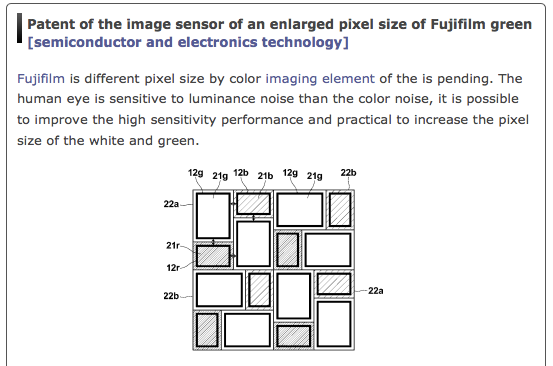
„Fujifilm is different pixel size by color imaging element of the is pending. The human eye is sensitive to luminance noise than the color noise, it is possible to improve the high sensitivity performance and practical to increase the pixel size of the white and green.”
Explanation and self-interpretation of patent literature
- Patent publication number 2013-258168
- Release date 2013.12.26
- Application date 2012.6.11
- General theory
- Brightness noise is the noise shown in the image
- Color noise is color separation and color reproduction
- Human vision is sensitive to brightness noise
- Green and white have high visual sensitivity and have a great impact on brightness noise.
- Fujifilm’s patent
- Increase the pixel size of green or white in RGBW
- Optimize the area of the readout circuit
[Claim 2]
The solid state image pickup device according to claim 1 with which the aforementioned predetermined color is characterized by being a color with the largest contribution to luminance S/N most highly [ spectral luminous efficacy ] among the aforementioned multiple color.
[Claim 3]
the aforementioned multiple color — red — green and blue
The solid state image pickup device according to claim 2, wherein the aforementioned predetermined color is green.
[Claim 4]
the aforementioned multiple color — white and red — green and blue
The solid state image pickup device according to claim 2, wherein the aforementioned predetermined color is white.
Essentially, the sensor would use bigger white and/or green pixels, since those contribute most to luminance noise — the kind our eyes pick up on most easily. Making just those pixels larger could meaningfully cut noise without bloating the sensor’s overall size or enlarging every pixel. Of course, fitting different pixel sizes together cleanly is no small engineering puzzle, as the patent image suggests. Still, it’s a good sign that Fujifilm keeps pushing on creative ways to squeeze more performance out of its sensors.
Looks like an X-Trans evolution to me.
Fuji’s birthday tomorrow
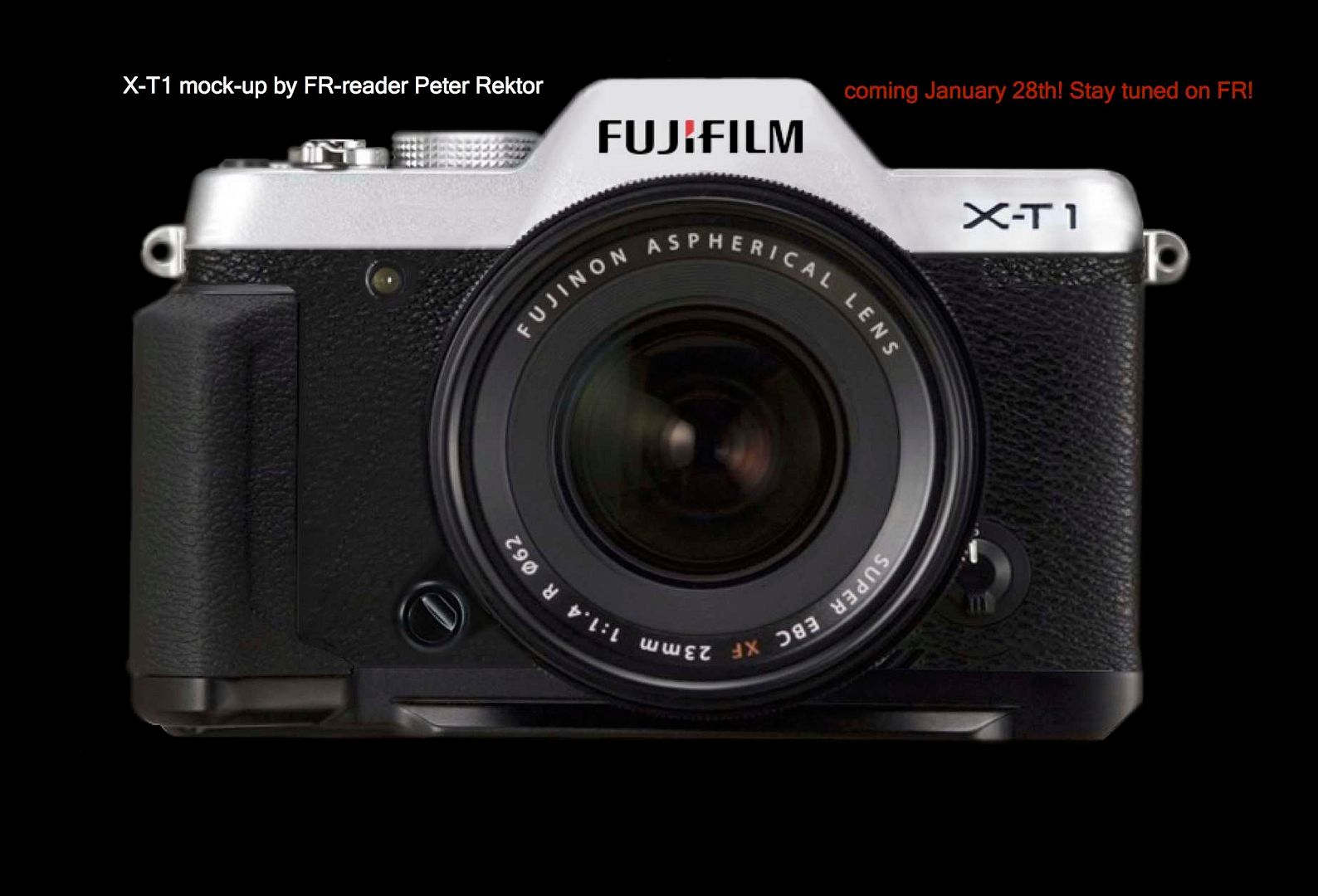
NOTE: Tomorrow it’s Fuji’s brithday! According to the information I have, the X-T1 should be announced on the 28th. But I wouldn’t be surprised to see other products coming on the 20th in order to celebrate Fuji’s birthday. So stay tuned, I’ll keep you updated with the latest news.
enjoy your Sunday,
Patrick
.
46 Responses
Fujifilm on the hump? So unnecesary & tacky.
….and the complaints have already started!
It really is PATHETIC is it not?
You do know it’s a mock-up right?
Really… Please let us know why the hump is not necessary?
We already know this camera is slated to have a substantially larger EVF. Where exactly do you propose they put it?
It has to go somewhere…
I think Sparta was whinging about the labelling that Fuji have put on the hump on a Fuji Rumours reader’s mock up!
Food point… I misread that… 😉
Yes. Because, in the world where marketing is king, no one ever labels their products in a visible place anymore. I’d rather have the name on the bottom, as I don’t want anyone else knowing what I shoot…:)
I would just cover it with a label that says “smile”
The hump on the X-T1 is bigger than the one on this mockup (see latest news on this site). If you don’t like it and don’t care for the bigger and better viewfinder, just don’t buy the camera.
Really strange how poeple complain about the looks of a camera all the time.
It may be dangerous to play with colors…
What if I shoot a red scene ? It will capture certainly less light, if my understanding is correct.
I hope Fuji will improve its technology but not at the expense of the color rendition.
Bayer sensors also have twice as much green pixels than red or blue pixels and the same holds for Xtrans.
Not exactly. X-trans has 8 red, 20 green and 8 blue in a 36 pixel grid.
And in this new grid the green pixels take up 4 times as much surface area as the red and blue pixels.
Right, I totally missed that one! I just compared the subpixels and did not account for their respective numbers. Thanks. 🙂
Correction. Every second ‘green pixel’ is in fact a white pixel.
Every sensor, bayer, xtrans, foveon, except for monochrome ones are already playing with colors each in a different way. It’s never perfect .. just like film wasn’t, but that’s how it is if you want color. Each their own advantages. I’m glad they’re still trying new things.
Looks interesting. Bigger pixels, less wasted space in between.
Does this mean a new chapter in the book of demosaicing woes?
This would mean that yes. But i’m sure they’ve learned how to share their technique with third party software sooner this time. Certainly no reason to stop innovating!
You think? I’m not that much of an optimist.
And it’s just a patent, research, an idea, doesn’t mean anything will happen for real.
Arca plate built in! Now that is something I would like to see on a camera.
+1
Yes, fantastic idea. While there at is, need an arca swiss plate on one side as well for portrait shots.
Let’s not get carried away…:)
what hump ?
Lol, I don’t think Young Frankenstein is a favorite around gere .
… Blucher!
+10!
Other than bigger green pixels, I would have made the red pixels smaller and the yellow ones a tad larger. There is always too much red and very little yellow in my X100S pictures.
??? Yellow pixels in an RGB mosaic?
Oh … this must be why my pictures are all lacking some yellow … If there isn’t any need to add some yellow pixels instead of making them larger then …
Are you being serious?!?
Just in case you are…. you mix green and red to get yellow (for light anyway).
A bit on light primary colours.
http://en.wikipedia.org/wiki/RGB_color_model
If you were painting, your primary colours would be red, blue and yellow but this is not the same for light.
For painting you need eight colours: Yellow, Red, Margenta, Blue, Cyan, Green, White and Black.
Luzid, not quite. For light (photography) most stick to the RGB color space since they are additive primaries.
For print (painting) cmyk (cyan, magenta, yellow, black) colorspace is sufficient since they are subtractive primaries. Some printers will use two different tones for cyan and magenta as well.
Joshua probably is trolling everyone or has his jpg film simulation set to velvia.
Print and painting are different. Your primary colours are red (Magenta), blue (cyan) and yellow. If you tell your Art lecturer you need a tube of black paint he is liable to hit you over the head with something heavy 🙂
He should, if he knows his stuff, explain that pure black (manmade) is never seen in the natural world as there is always some source of light (otherwise you wouldn’t see anything to paint) and as a result, will be an extremely dark shade of grey. A mix of all colours will give you near black colours and will look more natural.
The reason why a separate black ink (k) is added to the three primaries (CYM) is due to the mix of these three in the commercial litho process producing an inadequate intensity…. if only a printer could use high grade oil paints! As a result, a separate black is produced that gives an adequate intensity
Remember separating black ink at school, it’s a combination of colours.
green is a mixture of yellow and blue, white is no colour, blank canvas…. but in photography (light), it is a mix of all primaries (RGB).
The thing that will really bake your brain is that objects (anything) have no colour at all and just the ability to absorb differing amounts of the light spectrum. What it can’t absorb is reflected back and that reflection is the colour you see 🙂
Maybe I’m confused but I thought the problem with reds in all digital sensors was that the filters for the red pixels resulted in less light collected for those pixels. The signal generated for each colour has to be increased by some factor to be useful, and in the case of red, because it’s less sensitive there are less shades and larger gaps between them in the usable image information.
If this is correct then it seems more logical to increase the number of red pixels, perhaps doing something like separating them into them into dark red and light red pixels so that each can detect a narrower, but more subtle range of colours. Of course this would mean a new type of non-Bayer CFA and potential issues with RAW conversion such as X-Trans initially suffered.
However, since no camera or sensor manufacturer has done anything like this, and indeed Fuji have increased the amount of green surface area, I wonder if either: I’ve got bad info about the sensitivity of red pixels (very possible) or it’s more valuable to increase the number of green pixels for some reason, perhaps to do with the wavelengths in natural light or just that there is much more green in the world than red.
..or maybe Fuji know what they’re doing?
Many has tried to make an RGBW sensor though, Kodak as early as in 2007. Sony laid away their RGBW attempt only a year ago because the sensor didn’t live up to their IQ standards. Motorola has recently put a RGBW sensor in one of their cell phones.
Maybe Fujifilm has an idea of how to overcome the loss of color resolution, which is the big tradeoff with RGBW? Maybe the enlarged pixels and random pattern does the trick? Let’s hope they know what their doing. 🙂
That mock up is a bit mouth-wateringly sexy. If it looks like that with all the rumoured speed improvements it’ll be (for me) the most anticipated fuji release since the X100.
Why not just make all the pixels bigger and keep the simple, well supported, Bayer pattern. That is one reason FF sensors out perform APS-C, and APS-C outperform 4/3 … and so on.
It sounds novel, but really there are probably better ways to achieve the same effect that does not make processing RAW files the same mess that is was, and still is to some degree, with the XTrans.
DxO doesn’t support X-trans RAW conversion arguing that it would require a full set of new algorithms and that would be rather expensive to justify the effort as this is a proprietary technology and they can not be sure Fuji will continue to use it in the longer run.
This patent and the news about the “organic sensor” Fuji is said to be developing with Panasonic seem to grant dean some credit.
Please read “seem to grant them some credit” at the end of previous post.
The patent calls for an “Enlarged” white and green pixel layout not just green….
http://image-sensors-world.blogspot.ca/2014/01/fujifilm-proposes-rgbw-pixel-scaling.html
I hope Peter Rektor had a part in the design of the XT1,very well done, especially the acra base
Hm.. do we really need more green? I always have to de-saturate the greens about 70% to get natural looking greens.. But maybee thats because I have never used an X-trans sensor? 🙂