







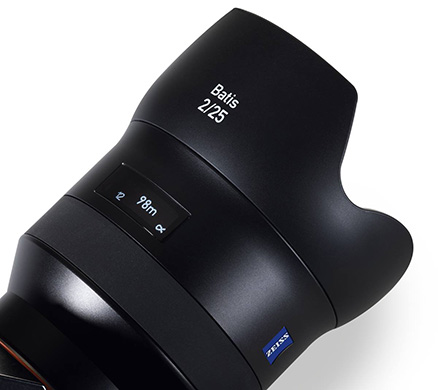
On Facebook Zeiss explained why the new Batis lenses have that unique OLED screen:
Our new ZEISS Batis lenses feature an OLED display. We decided to integrate it in response to many customer requests that we received after the introduction of previous ZEISS lenses. The display shows the focus distance and depth of field and can be reliably read in poor ambient light or in the dark. By the way, the distance unit can be easily changed from meters to feet.
UPDATE: Right now Zeiss posted a full Q&A about the new lenses: blogs.zeiss.com/photo/en/?p=5983. Here are a couple of tidbits:
The ZEISS Batis lenses are protected against dust and splashes (not waterproof) and are therefore suitable for use in everyday weather conditions. They are designed for use at temperatures ranging from -10 °C to +55°C.
ZEISS Batis lenses are designed exclusively with E-mount for use on mirrorless system cameras with Sony E-mount.
Additional focal lengths will follow. Right now, we do not wish to publish any further details.
One more thing: A couple of new Batis image samples can be found on SonyAlphaForum (Click here) and by Michael Kormos (Click here).
Both lenses are now available for preorder in USA and Europe (UK/Germany)
Zeiss Batis 85mm f/1.8 lens in US at Adorama, Bhphoto. In Eu at Amazon DE, WexUK. In Asia at Digitalrev.
Zeiss Batis 25mm f/2.0 lens at Adorama, Bhphoto. In EU at Amazon DE, WexUK. In Asia at Digitalrev.
Lens shade for 85mm at Adorama, Bhphoto.
Lens shade for 25mm at Adorama, Bhphoto.
67 Responses
I’d love to buy the Zeiss 85, but somehow, I can’t close my eyes on how stingy Zeiss is… You have to buy the lens shade separately, on a $1200 lens ! I know it’s not that much compared to the lens price, but seriously ?
The lens shade is included! But you can buy it as spare part, too.
Was liking the idea of this for street photography, even more now if it will give me DOF calculation.
Well, if they need to explain it…
It was a response to someone’s question.
No, it wasn’t. Looks like just a post.
Many customers asked for the feature and now they are explaining to the customers why they put it there, lol.
Yeah, seems to me that they’re just justifying why they’ve put it there. I’d say it was a marketing/engineering decision and customers are now asking “why”.
‘some’ are asking why.
Whichever it is, the customers weren’t the ones asking for it.
And you have checked this with all customers I presume? I was asking for it… so there goes your theory. But I’m sure you will come back with many more ‘expert’ opinions.
You were asking for it – good for you. You’ve got what you were asking for. You need to cool your temper. Just like last time you’re beginning to read whatever the heck you feel like reading, without even trying to understand someone else’s point.
It makes more sense to implement it in-camera, rather than on the lens, because in-camera you suddenly have this feature for every lens you have in your stable.
But please, feel free not to ever reply to anything I say. I could care less what you think, since all you seem to do is lash out at people for no apparent reason.
There is a distance scale in camera which works for all E-Mount electronic lenses, including Loxia and even for Canon EF lenses with metabones adapter.
Maybe you could have said that in your first post rather than make spurious claims talking for all of us?
I am talking specifically of an OLED display on the lens. The DOF feature itself was asked for, sure, but not in an OLED-on-lens implementation. If you asked exactly for that, then good for you, you are a mechanical/electrical engineer and you get these type of ideas.
But most photographers would first ask for in on the LCD display or in the viewfinder, as that’s what they are looking for most of the time. Which is why i’m saying, that it was an internal idea, and now they are justifying it.
Edit: I don’t have an E-Mount camera, and don’t know of that feature(in-camera).
I know that older ones didn’t have it. If recent ones do, then Sony has finally listened to customers.
See I told you it wouldn’t matter what I say, your preformed opinions are all that matter. I’m sorry for you. Have a nice day, hope your life gets better.
Edit: it seems you edited your post and yes it has been implemented on all newer E-Mount cameras. I have a use for both and am glad that both have listened.
I specifically said in my first post “seems to me” and “I’d say”. So yes, it was my personal opinion. We are all entitled to one, whether it’s correct or not. For some reason you decided to read it as me speaking for everyone, which brings me back to the point of you reading whatever you feel like reading.
Is this the distance scale you were talking about? Seems to be missing the key information of DOF. Which means that we’re back to square one…
https://jamestanphotography.files.wordpress.com/2015/03/indicator.png
Though it doesn’t tell you the DOF, it does something pretty remarkable. It SHOWS you the DOF, in real-time. 🙂
Umm, not following, please explain. All I see is a focus distance bar and a number below it. Can’t quite tell what that number means, but it doesn’t look like the depth of field in meters. Doesn’t look like the focusing distance either. Although could be the focusing distance, if different lenses are depicted here.
So how can you tell from those 4 photos, which is which? And where does it show you?
It’s just a focusing distance indicator and, as shown on the photo, pretty imprecise. No DoF, no nothing, I have no clue what the others are talking about.
One day Sony will introduce something similar to Ricoh’s snap focus and these Batis screens will become entirely useless.
It seems you are not a Loxia or manual glass shooter like me. I’m saying instead of hunting to find DOF information in the viewfinder periphery, you actyally see it in real time on your subject, the thing that actually counts. The thing that is the biggest difference between EVFs and OVFs today.
Umm no you don’t, it’s included. Just like the Loxia line.
Mea culpa 🙂 Happy to read it !
Admin here lists every purchase link he can find – the more purchase links that are listed, the more chance of earning a referral fee. But just because you can buy it separately doesn’t mean it’s not included with the lens in the first place. The same confusion arose around the Loxia de-click key.
I like the idea very much.
I can see the use for it for people using zone focusing (common in street photography) and some tripod/studio work. In the absence of a mechanically coupled focus ring, this might not be a solution, but a nice alleviation. And to be honest, it looks pretty badass. 🙂
For zone focusing display of this information in the flip LCD and EVF would be sufficient from usability standpoint.
It does look badass, however, and unlikely does not add much to the cost. Unless it is prone to failure thus adding to maintenance costs, but only time will answer that.
I hate using the camera readout, you can’t see the values unless you move the focus. It’s also not accurate enough for 1-2 metres where I normally like to zone focus.
Also the DOF calculation will be an added bonus! no more having to remember
I think what Jekabs meant is that it could be implemented in the EVF-LCD, rather than having it on the lens. Such implementation already exists, Sony just needs to copy it.
Regarding how the values are displayed – that is camera firmware implementation detail, and hopefully will be improved with new cameras. As for precision – that is entirely up to how precisely the lens reports it’s current focusing distance. For the Batis line, it is very likely that precision will be same for both camera display and in-lens display because both rely on the same information from the focus distance encoder.
My previous Sony camera, Sony R1 had a distance indicator as part of the GUI and since I use a Sony Nex 7 I miss it extremely because of the slow and unreliable manual focus – having a distance indicator allows to preset focus to a given distance. I don’t understand how this basic feature is missing from all E-mount cameras (that I know of) and wish it would be included, and if they did they could implemente DOF indicator too, at least on Sony lenses.
The A7 cameras DO have a distance indicator in MF mode.
That’s good news, I hope all new E-mount Sony cameras have it and could include DOF indicator.
All new E-Mounts have it with the ‘Alpha’ style UI, though I haven’t tried it on the A5100. It doesn’t have DoF but DoF is subjective anyway.
The OLED idea is awesome, but why rubber rings, especially it is silky smooth without any ribs? It is a scratch paradise~ should have gone with metal or any harder materials~
Trying to be modern too hard. 🙁
i wonder if the oled displays infinify focus dead on. that would be nice for astroers…
I have no use for an oled display on the lens. However, I have been asking Zeiss for autofocos for many years now.
That was my first thougt, too when I look th B&H and I saw the lens and the hood listed separately…
I only wonder if the hood can be attached upside down for compact transport size, like all other lenses on the planet do.
I think the hood is included in the price. I was confused initially as well since they were both listed, but the lens comes with the hood.
I welcome this feature, but I wish they could put this in the EVF like Fuji. I do prefer the simple 3 number approach Zeiss is using. Fuji shows a scale graphic from 0 to inf which sometimes makes it difficult to figure out where you’re really at.
Seems like this would have been a good opportunity to have an aperture ring on the lens.
Since Zeiss seems into new things lately I wonder if they’ll try their own zoom.
Yes they could but the firmware is Sony’s and they will be probably unwilling to change it. (it can do that somewhat, but it sucks)
What ‘somewhat’ feature are you referring to? I’m not familiar with it.
There is a distance scale in the viewfinder / LCD.
You could just memorize this chart for each of your lenses. Whatever happened to a challenge.
You know, you can develop your memory and artistic skills and make pictures without a camera at all!
I just use a smartphone app, called “DOF Calculator”. This way it works for all of my lenses, not just on an individual basis like in the Batis case.
oh you could just… I don’t know… quickly look at your clear new OLED display and be done with it.
Or imagine that there’s no spoon.
Sorry, just couldn’t help it 🙂
Only if it displays the following DOF messages:
1) Really thin
2) Stupid thin
3) Ok, now your just being ridiculous
Don’t forget Ludicrous thin 🙂
I like the display, but would have preferred an aperture ring. I zone focus my wide angle lenses, but does anyone regularly zone focus a telephoto lens? Obviously, someone does..
Answers to the new ZEISS Batis Lens Family
http://blogs.zeiss.com/photo/en/?p=5983
“I would have prefered [to] get a proper aperture ring like you have on the Loxia series.”
This doesn’t make sense, to me at least. An aperture ring is for selecting aperture. The OLED display is for display of focus distance and depth of field. The two are not mutually exclusive, so why “prefer” an aperture ring over a digital focus distance readout?
lol. I just can’t.
High on the “cool” factor, but you get a good at estimating DOF when you shoot a lot. For critical applications, there’s the DOF calculator app.
I wonder when Sony camera users will demand from Zeiss a lens with feature, which will allow user to “milk” Zeiss lens for cup of Starbuck Coffee.
I have been a Pro for 40 years and just about every system. I never looked at a DOF scale on a lens. Digital is pretty easy folks you chimp and see what you have. End of day all that matters is the image , if the lens produces exactly what your after than its a done deal. If not buy something else that does. I have put on 27 workshops and the first words out of my mouth are forget the gear and concentrate on the images. Far to often you see people missing shots because there being geeks. Be a shooter first
Even if you’ve been a pro for 40 years and have never looked at a DoF scale you should be able to see how useful they could be to others. These things are not gimmicks and they don’t stop you taking shots and indeed they actually help.
When using zone and hyperfocal focusing for example, you set the lens up and shoot and the gear gets out of your way completely.
Why waste time chimping and deleting and reshooting when you can up your chances of getting the shot right first time with the help of a DoF scale.
Never said it was not useful and of course for some it’s a benefit but seriously some folks are way to dramatic over it. If you know your gear well enough this stuff gets embedded into your head. This is really no different than knowing what aperture and shutter speed do for you, this stuff becomes second nature as soon as you lift the camera to your eye. Of course this comes with experience and knowing what your gear does. Like I said I see way too many hobbyist on workshops just being way to techie and losing images over it.
I’m happy it’s there regardless if I use it or not. Big part of photography and getting good at it is knowing when to turn some features off and not relying on camera to make your decisions. You don’t learn like that.
Distance scale alone, for video, is priceless, many of us shoot motion in conjunction with stills and the lack of a distance scale is a major PITA.
Good point John I’m not shooting video myself. Maybe it’s far easier for me since I have a lot of experience too. The last couple years working with MF backs and tech cans there just is no free lunch if you know what I mean. Everything I mean everything comes down to guess work even focusing since no real live view was in place with CCD sensors but now there is a CMOS back that does. Getting OT here but my point really was about learning a lot of this as second nature per say.
That’s nice for you, but some of us pros that have also been shooting for decades use them daily. Just because you don’t find it necessary in your photography does not mean that it is useless or that others don’t find it useful.
If you don’t care about the DOF scale, then I suppose you would set the intended DOF in other ways:
1. It is all in your memory after taking a lot of shots at different settings.
2. You use trial and error approach by testing several apertures (I read this in a famous photography book). Really??
3. Use aperture bracketing.
4. You can calculate that from tables, smartphone apps, etc.
I always wished that cameras showed DOF in the viewfinder until I would memorize them, so this Batis showing DOF is one step forward.
For me Focus peaking shows you where your DOF limits are much better than any scale.
Sure, with AF lenses came camera knows both the distance and the f-stop so it should be able to display a scale just like those phone apps do.
Having a dof scale there on the lens when I’m looking in the viewfinder does not seem very useful to me.
Also I’ve found the actual DOF markings on old manual focus lenses to be way too optimistic on a7r (but migh be because of the adapters).
An other gadget failing on you.
The Batis lenses feels like made for a a7r II with the distance scales and all.
The biggest Achilles Heel of Sony’s A7 platform, is reference stills, it often gets in my way. With the 5D3, it was pure muscle memory where stills shooting was concerned. Having said that, the A7 platform is the opposite where motion is concerned, whereas the 5D gets in the way there. There are no absolutes, whatever you choose to do, there are almost as many ways to do it as there are pixels. You’re lucky not feeling the siren call of motion, out here, in the trenches, it’s evolve or die time……….as it was back in the 90’s where digital capture was concerned (still dealing with that one).