







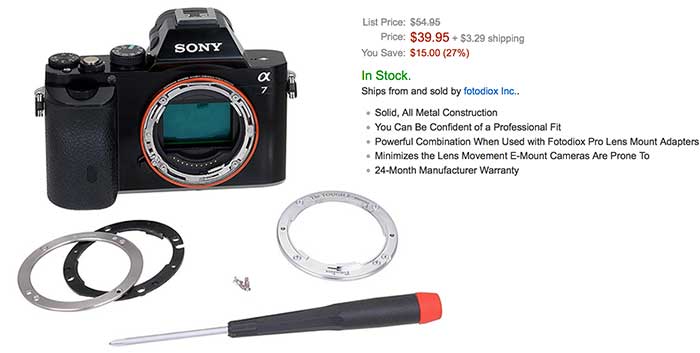
Maybe not all of you know the E-mount is made of an outer metal and inner plastic ring. Fotodiox writes:
The lens mount is a two part construction, with the critical component that holds the lens in place made of plastic. This is why any lens you attach to an E mount camera is prone to wiggling, especially longer pro lenses.
That’s why Fotodiox came up with a solution to entirely replace the ring:
Anyone can replace the original 2 piece NEX mount on their camera with an all-metal one in about five minutes. All you need is a jewelers screwdriver (phillips) to remove and replace four little screws.
The Fotodiox full metal E-mount ring can be bought now at Amazon US (Click here).
Here is a video to show you how easy it is:
via MirrorlessRumors.
0 Responses
Cool. Will be picking up this guy in a few days. I hope I’m not disappointed man. This will be my first upgrade.
Suddenly, I feel cheated…
Why no all metal mount from the start~!?
Sony designed this to have a failure point being a cheap, easy to replace plastic part. Now if you overstress the mount, the lens our camera frame will likely fail, destroying it.
And the A7 has a plastic front chassis panel as well (with other models this is metal too) so that is why it also has a plastic-metal hybrid mount. And this might also be a reason why it might not be such a great idea to replace that part.
It is a bit disappointing that my 5N seems to have a sturdier mount with much less wiggle than the A7 (now sold).
but remember that A7s is full metal, don’t need this if you have an A7s
This makes no sense. The plastic ring isn’t load-bearing, its a spacer…. The metal ring connects to the plastic spacer which connects to the metal ring in the body (see picture). This isn’t going to do anything.
Actually, the plastic is load-bearing. The part the lens hooks into is the plastic bit, not the metal bit. The metal bit is just the outer flange. Check out the video and you’ll see. My NEX-6 has a lot of wear marks on the plastic, but so far no wiggling. I don’t use heavy lenses, though.
It does make sense if it tightens the mount up.
is not only a spacer; for cameras like nex-5 or nex-6 is a must, because the plastic part is the one to hold the lens
I have no idea about the NEX’s, but on my a7, the plastic is part only a spacer. If you look at the picture and video, the screws simply go through the plastic into the mount itself. Now, if you trust Fotodiox’s manufacturing, then it may help you… I am not sold on their QC being good enough.
You are totally wrong. the plastic ring IS the load bearing component. It is not a spacer. It is what locks the flange of the lens to the camera body.
You are totally wrong. the plastic ring IS the load bearing component.
It is not a spacer. It is what locks the mountflange of the lens to the
camera body.
Just noticed Roger Cicala’s post at fm.com. He puts it better than I didhttp://www.fredmiranda.com/forum/topic/1324124
“Guy” is right.
Please see this –
Roger must be mistaken. It is not JUST a spacer. It’s primary purpose is to lock the lens in place.
Will this work for FS700??
FS700 is full metal mount as th A7s, so this is not for the FS700 or A7s
What about fs100 ????
fs100 is full metal too, but the problem with fs100 is the internal union betwen metal and plastic body, so when you use big lenses you need a lens support
I just sent my A7 back for a loose mount. I’ll see what they do, hopefully the a7s mount for a replacement. This being one piece might also fix the light leak?
Curios if the sony’s original plastic/metal sandwich served a purpose and maybe was solving another engineering challenge. I’d assume that sony’s R&D is much more involved than that of Fotodiox. Would love to hear people’s thoughts on this more.
On a side note… the douche in the video: c’mon man, at least have your camera sitting on it’s base when doing this replacement. The spit from all the rambling right above the camera, the accidental slip of the screwdriver, the high probability of dropping the screws inside… Amateur.
I think Sony place it there so that if there’s a chance of someone tried to fit an over weight lens to the camera while carrying the system on the camera body instead of the lens the plastic part would break instead of the whole body. It’s something like those tiny screws that hold a street lamp post in place. They are meant to break when subject to great force. But that’s just my assumption
Scroll up for Guy’s point of view.
it was easier to show the operation at that angle.
also the shutter release button and other components may fall out if the camera is vertical. he talked about that.
anyway it’s really not that risky an operation.
This is why I will never buy a Sony camera. Light leaks, massive shutter shock, plastic mounts that easily wear and result in loose lenses, etc. All on camera bodies with premium costs. Good thing Sony sources its great sensors to other proper camera companies like Nikon and Olympus.
You mean Olympus which also has shutter shock and Nikon with oil spots, etc.? Good point.
Wow, all these Sony fanboys…. trying to justify their shady built premium priced cameras by attacking other camera companies hahah
what are you trying to proof here? that you are a simple minded idiot?
Boy oh boy, Martin is SOOOOO right!
Come on boys and girls, lets all dump our Sony systems and switch to Canon!
What were we thinking buying Sony? With their modern mirrorless cameras and far superior image quality. Small, light form factor, and feature rich technology like EVF? Who needs it?! I mean, with an E-mount camera, you can use practially any lens ever made, and I just dont need that kind of stress, trying to decide. Not for me.
I’m just a simple guy, like Martin. I stick to the old tried and true, 19th century technology. I like the sound of the big flapping mirror. I like the giant, heavy camera bodies. I like the optical view finders; they remind me to slow down and chimp. I like the slow, tenative constrast detect autofocus in video mode. I’m a simple minded guy, so I want a simple camera.
Canon.
Yeah, we can use any lens ever made, in manual focus, without image stabilization. What we cannot get is a variety of lenses with autofocus and stabilization designed specifically for the model we bought. You know: a cohesive camera system. Not Sony’s bag.
Pretty sure it’s happening right now. Your comment would have made sense if it was 12 months ago.
A little bit too much exaggeration?
Wow, all these Sony haters who waste their time filling Sony related posts with the same comments over and over and over again. We get it, you hate Sony. Move on.
Martin, who see impossible…
This guy is Troll.
This begs two questions:
Why are you visiting this site and what infallible camera brand are you invested in?
Oh yea forgot to mention, like before with Sony, the FE cameras will probably also get abandoned in like 2-3 years (similar to what is happening with the A mount), leaving people heavily invested in the dirt.
Trolling hard today, are we? Its bad when you have to resort to making up stuff.
The a-mount has been going for nearly 30 years.
Even your trolling is weak. No effort whatsoever.
Actually, talk to any APS-C NEX owner – we’re heavily invested in cameras that they no longer plan on making lenses for. And no, FE doesn’t count. Abandonment is Sony’s SOP. Thank god I hung on to my Nikon.
I am a NEX owner. Whatever Sony promised, it delivered, so what did they abandon? Sure, it could’ve been better, but there was a roadmap to make an informed decision; after that it is just our expectations, which every brand will fail to satisfy in some way or another.
Also, I don’t understand what “heavily invested in cameras” means, when the most expensive body was 1200 dollars. And why not count FE lenses?
They abandoned a whole camera line. You know, $1200 is a whole lot of money for a camera to some of us: I am glad it’s pocket change for you, you’re very fortunate. And FE lenses don’t count because there is not one, none, nada under $600 and they’re not designed for an Aps-c camera. We’re asked to buy far more lens than we can afford or need. Again, if you’re fortunate, such as you must be, you can afford it. But then you just buy an A7r. So yes, the aps-c line had been abandoned. Anyone who buys an a6000 is just fooling themselves. The lenses designed for our cameras will cease to be made soon, and there will never be a new one released.
If 1200US is so much money for you, maybe you should’ve thought that decision through. As I said, there was a roadmap. Also, I quoted the most expensive camera’s price at release, it strikes me as highly convenient that you own exactly that one. There are models at 400US.
And it is not about whether it is pocket change for me (which it isn’t), I simply meant that unless you have something like a D4 with a 500mm lens, you can simply resell and move on, if it is such a huge disappointment.
Would you buy a three year old camera that they stopped making new lenses for? And I don’t recall ever mentioning which model I owned, only that $1200 for an abandoned system is a lot of money for some people. A roadmap, for most real camera manufacturers, is a 2 to 3 year timeline. It gets updated with new models. It’s not the entirety of their line for evermore. It’s a reasonable expectation that a reputable camera company will support a lens mount- an expectation that Sony has failed to live up to twice.
Fair enough, it is a reasonable expectation, I’ll give you that.
As to your question, yes, I will, as long as the lenses I need/want are available.
You must be as well disappointed with Canon who use cheep black tape to hold wiring in place ….
By the way. Sony cams are very well build check YT video from Sony production line that may help you to open your eyes …
If you will never buy a Sony camera then why on earth are you here? Just to rage over your Sony hate? That’s just pathetic.
I think this is more a QC problem. My first A7 mount creaked, wiggled and clicked when pushing gently on the side of the lens, so it went back. Replacement was fine.
Good to know. I imagined you wouldn’t have an accordion for a mount purposely anyway.
You must be as well disappointed with Canon who use cheep black tape to hold wiring in place ….
By the way. Sony cams are very well build check YT video from Sony production line that may help you to open your eyes …
You had a warranty, aaaaand its gone…
Save the OEM parts, reuse for warranty repair. Simple
NOW in THREE EASY steps you can STAB your sensor with a screwdriver for the LOW LOW price of $39.95 *
Man I am not sure If you are allowed to play with screwdriver not poking your eye …
If you want one of these… Wrap camera with plastic sandwich wrap. Cut four holes over the four screws. Proceed as indicated in the video.
it was moreso what was going through my mind while watching the video. made me paranoid so i checked my a7r for wiggle and i didnt notice any..i also have not experienced any of the shuttershock people talk about..but..who knows.
Interesting, I just came from two overseas trips (from US) and shot with manual focus lenses with adapters and noticed no shuttershock or wigglies. Perfect focus every time…at least when I was paying attention.
My A7s mount is perfectly tight. Anybody noticed their A7s with this problem?
The A7s mount is constructed of all-metal already. It is designed differently than the A7 and A7r.
Just curious, if the plastic flange is a good thing, why don’t they also put it in the A7s?
Sony designed this to have a failure point being a cheap, easy to
replace plastic part.
Almost all other cameras have one of two things going on:
Either the mount has plastic flanges (like the A7 and A7R) as an intentional break point if the system is overstressed,
or
The All-metal mount actually screws into a composite block in the frame of the camera (like A-mount cameras). So if this system is overstressed, the mount block fails (stripped threads) and can be replaced.
Now, with this mod, if you overstress the mount, there is no intended failure point, the lens or
actual camera frame will likely fail, destroying the lens or camera. The A7s mount is dangerous as well…
Any smart photographer will not “hang” on camera body heavy lens with out tripod-lens-ring … regardless if using SONY A7r or Hasselblad.
This is very true, but there are a LOT of photographers who do just this. Just this morning, I saw one of my collegues with a 5DIII and 300/2.8 lens, holding it with one hand by the camera grip. DOH!
I always support the system by the heaviest part first.
You see? I was asking this question in the previous post. You do give a good explanation of the potential valid point to have a plastic part in the mount module.
While I clearly understand this, I suspect many would still want the full steel mount in order to “feel safe”.
I do not know, however, whether the stress element really does have merit since I have yet to see another system/mount with such an element embedded.
I have seen plenty of bent mounts due to overstress/improper lifting of heavy lens/camera combos. I’ve also seen mounts completely torn from cameras when there’s no failure/shear point. I used to work in a popular camera rental company.
Most Nikon lenses have metal mounts, but the frame is plastic. So the entire back end of the lens will rip off… Canon doesnt use shear points often. Here’s the result.
So, you saying…this mod is actually counter productive if you use your cameras properly and that this actually has a positive function and is not a cheap-out move.
I have seen Canon lens mounts broken because of overstress (long lenses and extenders)
You said it well. In most circumstances of normal shooting, if you support the gear properly, the plastic makes sense. I would much rather have that plastic flange break than tear my camera apart.
This is also why most of the LAEA A to E adapters have tripod mounts on them – it is dangerous to use the camera tripod mount with anything other than small primes.
You said it well. In most circumstances of normal shooting, if you
support the gear properly, the plastic makes sense. I would much rather
have that plasticflange break than tear my camera apart.
This is also why most of the LAEA A to E adapters have tripod mounts on them – it is dangerous to use the camera tripod mount with anything other than small primes.
So yes, it makes sense.
It would be good if @Admin can update the post with this information.
EDIT: I also meant to thank you for the thorough explanation and that self explanatory photograph.
Admin wants you to buy the adapter thru his link.
So it appears…
You are welcome! I guess if you never have an accident with your camera, one might be fine with the all metal mount. Personally….I’ll stick with the plastic. It works just fine, even if there is a tiny bit of play in some situations. It’s engineered that way.
i agree with you guys this info should be mentioned by the admin.
but this product appeals to me as a manual lens shooting. the play in the mount is too annoying in manual focusing.
Then how would admin get referral fees?
but in most normal circumstances, this metal mount is not going to break is it? you’d really need to mount a very heavy lens and swing it like a baseball bat
That’s the point! The metal mount wont break, the frame of the camera will. Or the lens. The plastic is necessary to prevent further damage.
Yes. Also, people slam manufacturers like Sony and Metz for making some of their flash feet out of plastic – but its for the same reason. It’s FAR easier and cheaper to replace a flash foot than to replace a hot shoe that’s been ripped out of the camera.
I have now come to appreciate the plastic shoe of the EVF on my RX1!
I use the LA-EA adapter with one of the old Mamyia Pistolgrips made for the C330 when I shoot with tele lenses, it will not stress the mount and body then.
right now i have a Novoflex adapter and Leica R lenses (max 900 grams). for manual focusing the play in the mount is an irritation and i’d really like to get rid of it.
novoflex adapter + lens is about 1kg at most. i hope the fotodiox mount can handle that…
Most of the sheer points (both Canon and Nikon) are in the lenses, though this changed recently with Nikon FX DSLRs (e.g. D810). Very short screws are often used in conjunction with a plastic breakaway layer so that the frames of the camera/lens aren’t displaced.
The 5DmkIII mount is also attached to a plastic layer from the sub chassis.
This is correct. A very good move IMHO.
That looks quite extreme. I don’t think the original plastic plate would save the camera from a situation like this.
I remember seeing other pictures of this camera. If I remember
correctly it was dropped from shooting height with a 500/4 attached. It
hit body first, and this is what happened. Had the mount had shear
points, or the chassis had shear points, this wouldnt have happened. It
would have just been some body scuffs and a flangepoint replacement. Not a
totaled body.
This is more common than you think.
I remember hearing a slightly different story on it – but yes, it was due to a fall and a torque caused by a large lens. Something had to give, and there was no sheer point on the mount. This disemboweled camera is painful to look at even now!
Well, if I drop the 500/4 the next moment would get a hart attack, so the broken camera won’t matter 🙂
The good point of such wrecks is that the owner would have to buy a replacement which supports the industry.
I remember seeing other pictures of this camera. If I remember correctly it was dropped from shooting height with a 500/4 attached. It hit body first, and this is what happened. Had the mount had shear points, or the chassis had shear points, this wouldnt have happened. It would have just been some body scuffs and a flange replacement. Not a totaled body.
This is more common than you think.
That looks bad. I once let my Dynax 7D fall on the floor with a heavy Sigma 15-30 attached on it. It completely teared the lens apart, but the body was absolutely fine – thanks to its all metal frame.
I think this camera is good for the repair / service department to replace its case unless it’s a total wreck…
So, what you are saying is that the A7 bodies are cheaply built and that is it? They should be then pricing them accordingly, won’t you agree?
The A7 bodies are built very efficiently (i’m not sure “cheaply” is the right word). There’s only a few large, simple components inside the camera, held together with a handful of screws. The average DSLR has dozens of components and hundreds of screws. Compared to a DSLR, they are FAR less expensive to design and manufacture. So…yes, I would expect prices to come down.
How did you come to that conclusion from his post? “Cheaply built and that is it?” Guy explains why the plastic component is implemented. It’s there to act as a form of leeway, or “elbow room”, to relieve stress from the camera body when the lens attached is heavy. It’s like the common error of over tightening a screw to the point it breaks the head or ruins the tread.
Also, last i checked, the A7 series are a great price for what they provide in such a small package. But price is a personal view!
My guess is that this plastic piece might be a shim to fine tune the distance between the sensor to the lens to account for manufacturing torrances?
The mounting screw goes through the plastic pieces, so what ever loads that the lens see will pass through those screws into the body, because the plastic spacer is sandwich between 2 metal pieces that won’t shear off or break.
It is not a shim. All you have to do is open your eyes and look inside to see the flanges made of plastic that connect with the lens mount.
People claiming it’s a shim – please open your eyes and use your brain. It’s not hard.
as im not using heavy long lenses im not going to buy it. also im not forcing my lense to move on the mount like he does…
Partially disassembling the camera, and replacing a Sony part with a non-Sony part seems like a good way to VOID the WARRANTEE.
won’t be noticeable unless you strip the screws. there’s no removal of glue or anything permanent.
i mean you can restore the original mount easily, if / when needed.
True. But quite a few who did not buy extended plans are closing in on the end of their one year warranty.
I have done the same upgrade to my a-mount camera by simply using the all-metal mount from an old Minolta 5000. The result was a night-and-day difference – tight fit with the Minolta, no gap, no play, just plain solid. I can not understand why SONY cheaps out like that, knowing that they are perfectly capable of manufacturing a solid metal mount ring.
@Admin, Please scroll down to Guy’s explanation because this mod can be counter productive and possibly “help” damage the camera when in use with long/heavy lenses.
What about sony fs100 ????
Most camera manufacturers use such sheer points to protect more expensive parts of the camera from damage when the mount is overloaded. So this full metal mount is more of a downgrade!
Also isn’t changing of the mount supposed to be a delicate operation requiring fine adjustment/shimming?
Anyway, for all of those that still insist on the full metal mount without absolutely any creaks and squeaks, the really hardcore solution ofcourse is welding in place 🙂
(just kidding, don’t do it)
http://upload.wikimedia.org/wikipedia/commons/a/a5/SMAW.welding.navy.ncs.jpg
If what you say were true Sony wouldn’t have upgraded the mount of A7s to all metal.
There are MANY things Sony does incorrectly…
Just recently, think of the F60 flash overheatings, the MIS to Minolta hot shoe adapter failing, and the A77II SSS errors.
All things that are very widespread and bad.
Just cause they went with an all metal mount, that doesnt mean they thought it out properly…..
Thanks for the support, but I’m not sure that’s entirely fair. Sony, like all companies, does intelligent engineering and testing.
But, plastic components, often seen as “Cheap” are very good sometimes. Just like the plastic mountflanges, people slam manufacturers like Sony and Metz for making some
of their flash feet out of plastic – but its for the same reason. It’s
FAR easier and cheaper to replace a flash foot than to replace a hot
shoe that’s been ripped out of the camera.
Seriously? Are you “Elpha Ain’t Alpha” again?
If you don’t like this…why bother coming up here?
Try addressing his comments. They arent’ mine. But I agree with them. What do you think he said is false? Why do you hound me instead of addressing the real issues people are SUFFERING from their Sony investment?
Hounding me doesn’t change the fact that you avoid addressing the comments.
They probably moved the sheer point somewhere else in the design, since the plastic ring was causing these ‘poor poduct presentation’ issues
The initial production run of A7s cameras did not appear to have a sheer point in the design. Hopefully they have corrected this as you suggest.
Guy, it’s SHEAR point. 😉
Guy, it’s SHEAR point.
Welding in place ! That’s definitely the very best idea to wreck the camera FAST !
OMG…this has really put me off buying any E-mount camera. This is terrible quality. What is the point in making the body out of magnesium and then making parts of the mount out of plastic?!
Terrible!
Why are you people buying this rubbish and accepting a wobbly mount?!
They also tell you to stick an adapter in there, mount your A-Mount telezoom on the adapter, and they tell you that this construction is just as good as an actual Alpha camera.
Paid troll?
Let’s hope so, the alternative would be very sad.
So has anybody every established there’s a significant problem unless the fit is very loose? I can only think of the potential for light leaks or the image plane not being flat. The light leak issue has been done to death and that has only been shown to be an issue when a camera is in very bright light and there’s a long exposure (which means using an extremely dense neutral filter). In all other circumstances, where a long exposure is used, the the light level is very low and, conversely, when the light level is high, exposure times are short. Other reports I’ve seen all point to other issues (flare, internal reflections etc.).
The other potential problem is the flatness of the focal plane. That may be an issue when taking a photo of something very flat (like a painting) in combination with a very shallow depth of field (but why would you do that?) and with the camera set-up extremely accurately on a tripod. Performing optical tests using charts can show such things as lenses often have minor flaws, but the applicability to real-world photography is debatable. For the most part, people are photographing 3D objects, not flat planes in a geometrically precise environment. Where such technical photography is performed, I’m sure the practitioners are well aware of what’s needed.
In any event, I’m sure somebody could devise a test by using a test chart, a rigidly mounted camera and applying stresses to move the lens to the limit of the tolerance provided by the mount. The flatness of the focal plane could then be examined. However, this is far from an easy thing to do, and would require incredible care (which rather indicates to me it’s probably of little importance in the real world).
Of course, some might be worried about strength, but properly engineered plastics can be excellent as well.
So I wonder if this is more of a solution looking for a problem. It’s no doubt nice, and feels good, but does it matter?
“so has anybody every established there’s a significant problem”
BAM, common sense arrived.
Loads ‘a’ money for a body which may take decent pictures but has no IBIS, slow autofocus, a wobbly lens mount, needs a £300 mount to use anything like decent lenses, native lenses that are useless on any other camera and a design that looks like it’s been thrown together by a kiddie with a box of ‘shapes’…er…no thanks. I’ll take the A77ll…if Sonys marketing strategy will allow me, of course.
£300 mount?
Yes, Sorry, did mean to say Adapter, my bad. (no one would pay £300 for a wobbly mount now …………… would they???)
Are there any documented cases of lenses wiggling on the E-mount, as the advert claim? Curious mind wants to know. This feels like a product that promotes increased safety by making dubious claims about the quality of another product.
The 70-200G wiggles on my A6000. I thought I had a defective camera, but no, it’s a feature 🙂
That’s nice. Go buy it then.
At least it’s not a sheep (sorry …. goat) in wolfs clothing. The A77 looks good, performs good, and does so much more than what is now becoming the laughing stock of the camera world. Sorry E mounters, you jumped MUCH too soon. Should have got a proper camera, not a pointy shooty with (what was) street cred.
Are you srs?
Does anybody have the A7s’ steel mount plate part #? I’m wondering if it fits into the A7r… If it does – it’s probably a better solution.
Part # of the plastic plate is 418596201. https://www.servicesplus.sel.sony.com/PartsPlusResults.aspx?stype=parts
That’s the best idea !
I have no idea what you people are talking about.
I use an A7r and there is absolutely no wobble.
On to some real issues…
What lenses have you tried? Mine wobbles with everything except of the 35mm Z.
I only shoot with A-mount Zeiss primes:
135mm, 85, 50… ect.
Maybe the LA-EA4 makes a difference.
Hm… mine EA4 still wobbles quite a bit, especially while MF (annoying!!!). Maybe I’m just abusing the poor little camera with heavy lenses – the biggest I tried was the Bigma 4.5 lbs 🙂
I also tend to think the manufacturing tolerances are quite random for Sony lenses. The 55mm wobbles a lot on the A7r and the A6000, while the 35mm is perfectly stiff on both cameras.
The adapters are ok-ish (tried the EA3 and EA4), the most stiff is the Metabones MK4. The lens mount on the Metabones was extremely stiff (on purpose – according to the manufacturer), so had to bend the spring plate leaves a little…
P.S. Never noticed any wobbling on the A99 with a bunch of Sony/Sigma/Tamron lenses.
The mount has a little rotational wobble but nothing that would affect your photos. It’s a non issue and this product is unnecessary and may have unforeseen consequences.
Rotational ‘wobble’ is very significant if you shoot large Pano’s as I do. Also there is significant ‘angular’ wobble with longer / heavier lenses which significantly can change your focus plane and depth of field
Define a longer heavier lens. 1kg 70-200 or 135/1.8 has no wobble.
May be 70-400 or 300/2.8 has some but then 70-400 and 300/2.8 have a tripod mount itself – only a moron would attach the tripod to the camera base on such lens.
Even the A mount adapters have a bigger better tripod mount as most A mounts lenses are heavier….
For most if not all DSLR mount types there are adapters with tripod mount….so no issue.
Though I must say I like the accessory and may even consider replacing my mount if people feel happy with it and no side effects appear e.g. internal reflections or light leaks.
Do you think this adapter fixes the light leak that appears on some cameras?
“Do you think this adapter fixes the light leak that appears on some cameras?”
Yes, it would.
But….
Both my A7R, A7 and NEX-7 all show a significant amount of ‘play’ or ‘wobble’ with all E and FE mount lenses. Just take any E-mount lens and twist it back and forth and then up and down and you will see that there is a very ‘sloppy’ tolerance in the E-mount interface. There is much more ‘play’ in the three E-mount bodies I own than in any Nikon or Cannon system I have ever owned or used. Don’t get me wrong, I am not bashing Sony, but you have to admit that the other two big competitors have much tighter mounting tolerances than the E-mount system. That being said I have never noticed any significant issues do to the ‘play’ in the mounting system except when shooting very large multi row Pano’s, the rotational sloppiness has caused me issues when trying to get a perfectly level horizon, which causes havoc when stitching the images together in PS6….
My new FE 70-200 f4 definitely shows a significant ‘gap’ of light on all my the E mounting interfaces on the opposite side of the load, when the lens is not supported. I do use the tripod collar mount when taking critical shots but the lens is also designed for shooting hand held which is why I bought it but the ‘wobble’ concerns me. I will see how much improvement I get after I install the all metal mount which I ordered today and report back if there is a significant improvement.
I own a NEX-7 an A7 and a A6000 and really have no issues with wobbling of any kind. This said with heavy lenses as described above I prefer supporting the lens.
I crave the 70-200 f4 too and hope to soon get one. How do you find focus tracking with this lens? I had it for a week and have some mixed feelings. So I am not sure if I want that lens or the 70-300 SSM A mount
The 16-35, 90 macro, 24-200 and possible bright telephoto for portraits seem very interesting too.
“My new FE 70-200 f4 definitely shows a significant ‘gap’ of light on all my the E mounting interfaces on the opposite side of the load, when the lens is not supported”
There are no circumstances where you should not be supporting the 70-200 FE lens on this camera.
“That being said I have never noticed any significant issues do to the ‘play’ in the mounting system except when shooting very large multi row Pano’s, the rotational sloppiness has caused me issues when trying to get a perfectly level”
Rotation slop will not cause changes to level. And if you’re supporting the lens like you’re supposed to be there will be no other wobble.
I’m not sure how rotational wobble has any impact on panoramic photos. Rotating the lens slightly does not, of course, rotate the image. I suppose if the mount is on the lens, the body might be rotated slightly, but it’s by very small amounts, and easily corrected in software. Stitching software is also designed to compensate for minor misalignments. (Of course, large lenses should not be supported by the camera body anyway).
In any event, the rotation of the lens isn’t controlled by the lugs on the metal mount. Look at the flange of your lens, and you’ll find a small hole. That mates with the small locating rod (which the video misleading calls a button), and it is that which locates the lens rotationally. Depress the release button, and you’ll find the lens will go slightly beyond the locating point before it hits the flange stop.
So what actually controls the “rotational wobble” is how tight a fit that rod is in the hole in the lens flange, and just how much “wobble” there is where that locating rod comes through the flange. There is necessarily a small amount of tolerance or some lenses might not lock in place. I suppose it’s possible this third-party flange has a slightly tighter clearance on hole for the locating rod, but that’s really nothing to do with the plastic element as it’s the metal part that provides that.
You either must not change lenses very often or you don’t shoot any ‘heavy’ lenses. Just mounting the FE 70-200 f4 on my A7R or A7 will cause a visible gap of light to show on the top side of the e-mount if I don’t support the lens from underneath, and I mean a significant ‘gap’ which shows light all the way down to the inner flange ring. Same on all my e-mounts– A7, A7R and NEX 7
I ordered the metal mount as soon as the video finished!
I have no issues with my A7r mount but I have only used 35-2.8 and 55-1.8 lenses. The only things I am not pleased with are the shutter’s noise and vibration.
Knowing me I would probably slip and have the screwdriver go straight into the sensor…no thanks.
Don’t worry folks..the camera mounts are perfectly fine for the 16-100mm lenses Sony knows most of you will use for your street/food shooting. Anyone who does proper photography with bigger lenses wouldn’t have bought the camera anyway.
What is “proper” photography anyways?
I shoot with bigger lenses, and I wouldn’t exactly describe my photography as “improper”
Read what I said! “Anyone who does ‘proper’ photography with bigger lenses”
I actually said that using bigger lenses IS proper photography, not just foody/streety/ snapshotty stuff!!!
Maybe English is not your first language, if so, then I apologise for misunderstanding your lack of reading skills.
Perhaps English isn’t YOUR first language… but when I’m replying to your post I’m obviously implying that I’m using these cameras.
So, when I say I’m using bigger lenses it’s in reference to these cameras… not just bigger lenses in general.
Ahhh, then I apologise for misunderstanding you. I got the impression you were talking about the use of big (300mm+) lenses (which, again, I did not make myself clear about) rather than using the camera itself.
Night night.
Duhhh I use 135/1.8 and 85/1.4 on the A7 on regular basis. It is just so much better than D610 and D750
And maybe Sony could build future LA-EA adapters out of metal instead of plastic!
And maybe Sony could actually get it all right first time for once instead of trying to push new stuff out before it’s really ready.
The solution could be to make all mounts plastic and “engineer” (as some claim) to breakaway while hiking the price tag. 😉
Just do not use any Chinese made adapters as they all are made of metal.
Cool thing!
Do you think Fododiox or alike can make exterior shell for A7 series from one solid aluminum piece like Macbooks?
That grip can have bigger grip. They can even make a version that is about 1cm taller than the current shell so it is easier to hold the camera with heavy lens. Or they can make a shell that is “full size” making A7 look like smaller D4 and takes two batteries in the bottom grip. Would be awesome to replicate the controls on the current plastic grip but make them permanent.
Not 100% cool. Scroll down to Guy’s comment.
Yes there is good point. I am not sure he is right though. As the plastic only seems to act as spacing between the metal parts not as a point that will absorb damage from over-stressing the system.
I rather buy the arguments about need for very fine adjustments of the mount i.e. even slight displacement in the mount may result in tilted lens and poor focusing performance.
You didn’t get it. Even the Fotodiox guy is speaking about it. The plastic IS what holds your lens because that is the bayonet connection. So, lens forces, plastic breaks tearing out the plastic bayonet.
I guess the best way to explain this is that the mount is metal (where the lens and body meet) but the bayonet (which holds your lens in place) is plastic so if there is too much force applied, the plastic breaks saving the lens and the camera.
I got blocked by the moderation so posting again.
There is no way I would buy this. Its a great way to make the tolerance of the flange distance to be wrong or make the mount lop sided just like an adapter to make e mount lenses worse wide open.
There is no way I would buy this. Its a great way to make the tolerance of the sensor to mount (moderation blocks the correct word) distance to be wrong or make the mount lop sided just like an adapter to make e mount lenses worse wide open.
If you don’t use adapters how on earth do you use the cameras?
Adapters are great and it’s really a minor issue with them. But I don’t understand why anyone would play around with the mount.
To get tilt ability with AF?
I think the fotodiox mount is great at least for higlighting the plastic nature of the Sony mount.
I would expect Sony to respond to this and explain what they intend to do with their future cams, all called “Alpha”. It is not enough to change the name from NEX to “Alpha” (because NEX sounds “cheap”).
That’s untrue for a couple of reasons. Firstly, getting the tolerances right is easy. However, at a more fundamental level, it wouldn’t even matter if it was out by a few tenths of a millimetre. That’s because focussing is a closed-loop system. Provided that the registration is not pushed out so far that the lens can still focus at infinity (and pretty well all modern lenses have focus mechanisms that go beyond the infinity mark. Among other things, it makes lens production cheaper and means that focus motors don’t hit a stop when infinity is reached.
Of course , in the past, rangefinders (and other non-TTL designs) had to have accurate infinity marks, as there was no way of checking focus directly (and coupled systems had to have accurate calibration of course). However, anything that uses TTL focussing systems are inherently self-correcting for minor differences in registration distance.
Of course, manual focussing using things like “focus peaking” or image magnification is also inherently closed-loop in that it reacts to what’s seen through the lens.
nb. PAF still has some elements of “open-loop” focussing, but that’s
only when close to the focus point, the final part being by “dead
reckoning”. However, the PAF module itself assesses how close something
is to being in focus by detecting phase difference through the actual
lens so it too compensates for minor registration distance differences.
I believe if you get it wrong it will affect the mtf, whether it is minor or a big difference. I don’t see what is untrue in my statement above
I don’t see why. There are issues with some sort of lens designs and MTF involving the thickness of the glass over the sensor, but they aren’t caused by minor differences in mounting difference.
Bear in mind that extension tubes have been used in macro-photography since time immemorial, and all those do is effectively push the registration distance out by 10s, or even 100s of mm. In comparison, with anything remotely well machined will be able to achieve tolerances measured in a few 10s of microns. A tolerance of 100 microns would be considered enormous and I can’t see how that would have any significant impact.
If you make it lop sided it will affect the corners. There is an often misrepresented and misquoted post about this problem with adapters at the lens rentals blog.
That’s certainly true. The sensor & flange surface plane have got to be exactly parallel. However, even then, provided it isn’t extreme, it’s only really visible when shooting test charts and (unless significant) is of no significance to the vast majority of real-world photographers dealing with 3D subjects.
To quote the article when asking the question “What Does It Mean in the Real World?”
“Like a lot of laboratory testing, probably not a lot. Adapters
couldn’t all stink or people wouldn’t use them. Like a lot of tests, you
can detect a very real difference in the lab that doesn’t make much
difference at all in the real world.”
I’m not even sure they are right about landscape photographers seeing some effect. How many landscape photographers shoot wide-open. I would have thought DoF would be sufficient, although I suppose if you go for hyperfocal settings you might just see something at the edges. I have my doubts that it’s a real-world problem rather than yet another of those theoretical problems that seem to obsess photographers.
It will not. You are confusing being out of focus with lens alignment.
My 4×5 would assume pretty extreme positions and deliver very sharp and well focused images from that pretzel configuration.
The tiny differences make no difference at all, none that one could easily measure anyway. It can make a difference to a rangefinder camera that relies on the lens’ markings, infinity etc but only in that it might not focus quite where you think it is. On our digital EVF cameras it makes no difference even there.
I agree.
Oh my god. A *high end camera* using a mount that is known to be of low quality? No thanks, seriously. I don’t want to have to mod a X000€ camera because the manufacturer decided to save a few euros at the wrong spot.
Their next product is a Sony replacement sensor exclusively for Canon.
Who says it is a wrong spot? Maybe it has a reason to be that way. Guy gives a good explanation to that. Now, for me, I use short lenses only, seldom you will see me with a tele lens. But, I will try this Fotodiox part since the mount of my NEX-7 has to much rotational play, no side play can be found yet.
would it be – at least in theory – possible to develop a Leica (or Canon/ Nikon) ring for E-mount cameras for people that use only these type of lenses?
You would still need the spacer to occupy the space that an adapter supplies since those lenses are made for a different flange to sensor distance. DSLRs have a mirror box so the lenses are designed for that extra depth. You would need to accommodate for that extra distance – that’s why the Sony and most other mirrorless cameras are so easy to adapt to other lenses.
Nope, sorry… Those lenses need to be spaced properly from the sensor in order to maintain focus. That is why the adapters are designed as they are.
Yes. It would be possible. This would be a good solution for video shooters shying away from e-mount because of double bayonet adapters (body to adapter, adapter to lens).
Hmm .. So you are trying to convince me that Fotodiox is better than Sony… hmmm
Even if they do I won’t buy this thing :/
Scroll down to Guy’s comments on why this is not such a great idea.
Thank you Hendrick , I knew it wasn’t a good idea
No worries.
Holy ****. Thanks for the heads up! I wondered about that!!!
No worries. @Admin isn’t updating the info on the post for some reason. It is definitively worth knowing all aspects of this before one goes ahead and plays with the mount.
This reminds me of when I worked for United. We used to always push planes back from the gate and the towbar had a sheer pin in it that was designed to break off before the plane would break if steering limits were exceeded by the tug driver! We broke a few pins and were SOOOO glad the were there. A $2 part as apposed to millions of dollars of potential damage!
After research I made this afternoon, I have purchased two sets for my A7r and A6000 with one thing in mind … WHY NOT.
The A7s doe’s not need it.
When I install these on my Sony cams I will post here my thoughts about usefulness of this addition to my Sony tools.
Since you have chosen to go ahead with the purchase. FYI: scroll down to Guy’s comments below where he explains why there is a plastic element in the mount.
I am not saying “don’t buy” or “return” but I think the Fotodiox man may have exaggerated the effect a bit with a short, small lens. The plastic makes sense to avoid further camera damage under great stress.
I do agree with Guy comment 100% … BUT … this situation will apply to brainless photographer who may attach for example 70-200mm zoom without collar support …. under normal cercumstances, handheld or properly attached to lens I see no point for problems to occur.
If I remember correctly, my first 35mm Asahi-Pentax Spotmatic did have a metal body-lens combination rings made out of metal and I can tell you, that this APS was simply just supper tool. Working hard No problems what so ever …
P.s. This “Bohus” guy from Fotodiox is full of beans no question about it, however this product as I have find out is pretty good.
You aren’t native English speaker, are you?
No I am not, I am from Europe living in N AM.
No I am not. I am from Europe living in N-AM.
i agree with you and derek’ comment ( it’s a good hypothesis). Moreover, i wonder how people hold their camera to not support the lens with the second hand while the first one is holding the camera? A camera is not a handgun it s a two handed “weapon” , like a crossbow, to shoot pictures with 😀
A couple of points to note is that it’s the locating rod which is responsible for rotational locking (what is called a button on the video). It fits into a hole in the lens flange, and any rotational wobble comes down to the tolerances of the rod in that hole and any tolerances where the rod passes through the metal part of the mounting plate.
Secondly, the lens is held flush to the front (metal) part of the mounting lens by three leaf springs (clearly visible on the video). Those bear against the lens and the back of the mount and, of course, the flanges on the lens. I think when you rotate the lens to lock it, most of the “wear” will be against the surface of the three leaf springs, rather than the plastic.
nb. if the plastic wore a lot it would not be good as some of that would surely end up on the sensor surface.
You guys who claim Sony designed cheap lens mount for breakage safety are full of it. Any repair Sony will charge crazy prices close to new for, just like they do lens repairs. It’s highway robbery. Have you experienced Sony ripoff repair? Odds are they design cheap mount BECAUSE they want it to break, to get repair fees… Just like they design cheap no lock hot shoe adapter BECAUSE they WANT it to break your adapted iISO flash.
Besides, the cheap Sony mount doesn’t explain the lateral wobble when focusing. It explains the body flex though, which causes every lens to act as de-centered.
Give me an example of another camera manufacturer that makes CHEAP mount for the benefit of the customer. Where is the precedent?
Give one example where Sony does ANYTHING for the benefit of the customer. One example!
Are you kidding me? What a bunch of cr@p.
Pricey quality cameras have robust lens mounts… PERIOD… Name one other that doesn’t.
Thank you Fotodiox. Shame on you Sony.
Compare what Microsoft tried to do with XBox One used game sales and transfers, with what Sony did. Microsoft got so much pressure that they had to backtrack. Also, it’s really lame to upvote yourself.
Lame if I’m the only one who does it. I’ll care what MS did when they start making crappy E-Mount cameras and calling them Alphas to make them seem higher quality.
Upvote THAT!
Why are you here?
Multiple reasons. One of which is to set the record straight against comments like yours.
Another of which is to set the record straight about my having a tiny pen’is and needing to overcompensate for it. It’s true.
Impersonating me justifies my user name.
Insults don’t address the comments.
My 24-70 f/4 focus gets stuck because of the loose fit. When I twist the zoom back down to 24mm with some torque while trying to focus (in those quick shot moments in the street), the focus will jam up, I believe because of the contacts losing connection briefly.. And the focus can’t get unstuck unless I turn the camera off and back on. LAME.
Yep, my a7R with LAEA-4 adapter loses AF and Aperture control all the time. F-Stop reads “–” until I wiggle it, sometimes having to remove and re-mount, sometimes having to turn camera off/on, and sometimes having to remove battery and reset altogether. Such an embarrassing camera to use in front of clients. No way deserving of being called an Alpha.
Before anyone accuses me of trolling, try addressing my real experience comments first. I’ve spent thousands on Sony, nine Alpha’s and three Elpha’s in the past five years. Plus recommending to friends out of loyalty to the Minolta flavor I love. Sony is killing me with their insidious abandonment and betrayal.
That could be due to the NEX type cheap lens contacts. They are so cheap that it will be difficult to find such bits even in a cheap extension tube.
It does not bother me one bit as I stopped using the fly by wire lenses altogether.
I have this issue with my LA-EA4 as well. Even though it’s mounted it says “–” like you said and you have to wiggle it back and forth or reset the camera. It’s an absolute joke.
What a joke
My guess the plastic might be a shim to fine tune the distance between the sensor to the lens?
Finally people stop denying that the plastic’s there. Now people start looking for excuses for it. This is like a badly designed fuse that grows thinner slowly under a slightly higher load, and messes with the circuitry, while it should be designed to melt instantly under a surge only, and conduct current without issues under normal circumstances.
Was not aware that Sony is trying to push a cheapo mount on us. Thanks for the info! I will certainly not buy an A7, now.
You weren’t going to buy one anyway.
hahaha that was funny.
Well this sounds like a good way to void your warranty and screw up a perfectly good camera in the process. It’s a solution to a problem that doesn’t exist.
you can put the old one back in 5 minutes if there is a problem
and its a good way to stay at home with a screwdriver and avoid actually going out and shoot with your “terrible” A7…
Right, and the time spent buying the camera could have been better spent taking pictures. Your logic man.
It takes literally 2 minutes to switch it out. Switch it back in under 2 minutes and WAMMO..l.warranty back in affect.
Derek’s comment is the reason why u better not do it ;)….
That’s the best or more convincing answer for this topic
Good , I had 2 nex cameras , lenses wobbled in rotation and now an A7 and lenses wobbles on the mount as well. I never liked that cheap feeling , I m glad to know that it can be now addressed.
But , dear mr Sony , I would have liked you adressed that in first place .That said i like your cameras a lot.
Seems like a good product I have an A7 with 24-70 and 70-200 and there is noticeable play in the mount.
As an engineer I find some people who dislike this products’ comments laughable.
Some people have suggested that the plastic is there as a failure point, I would be intrigued as to why they would think this is case, when the screws clearly pass through the plastic and into the camera i.e. it IS NOT a failure point!! For it to be a failure point/saver you would need screws from the plastic too the camera and from the metal mount into the plastic which is not the case!! I would guess it is there to save a few pennies.
Also some people suggest that the tolerances of the plastic will be higher than that of a precision milled part…… WTF… plastic is notoriously difficult to precision engineer where as metal is relatively easy. I would suggest that the metal part will have a higher degree of accuracy and it will stop the play that causes a greater degree of inaccuracy!
I am also an engineer and have been laughing so hard at this debate!
As someone who designs and manufactures mods for my A7 after hours at work(I have access to CNC and Injection Molding). I have found on the internet a contingent of “experienced” camera customers (consumers really) who believe they are engineers and can tell you WHY a manufacture chose to do something- 9 times out of 10 they are talking out of their ass! Good laughs! Great things to share with my coworkers over lunch.
Before this “Upgrade” came out, noone complained about the terrible build quality of E-Mount cameras, but now suddenly this is a huge, widely spread issue.
I own/owned several E-Mount cameras. They have rotational play in the lens mount like many other cameras. My trusty Leica M4-P had it for example. And I never had a problem with that. No missed shots. No bad image quality.
If the electric contacts between lens and mount do not function reliable, the camera or/and lens are faulty and are a case of warranty.
And there is another thing I don’t understand. Implementing “weak spots” in the lens mount that break in that rare case when someone is caring your big tele lens with a sledge hammer, does not make any sense to me. A camera body exposed to such high forces (see the nice EOS1 picture that “Guy” posted earlier) would very likely be distorted and totally dejusted. I even do not understand how can a plastic spacer between mount and body frame act as a “weak spot”.
I can’t help, but all this buzz seems to be based entirely on half knowledge and wild guessing.
Sony is possibly the greatest innovatior in camera land today. I never had bad experience with their build quality. So, no shame at Sony at all.
Your first sentence is a bold faced lie, preventing me from reading the rest of your comment.
Derek’s comment is maybe the best answer for this post.
That mount is just as shakey as Sony’s future. I have to put sandbags on my ankles to stop the shaking from making my eyes jiggle. It’s like a train of shake and bake and I helped.
Sorry Sony. Trying to make a small camera to do a big job just isn’t working is it?
Why don’t you do what you know is right……..Make amazing small cameras for people who want them and who want to use short lenses…and continue making amazing SLR type cameras for those who want a bigger camera and for those who want to use longer and heavier lenses. Two very separate and different markets and they are used for very different types of photography. Using adapters on bodies which are too small and flimsy to take the added length (= added leverage, making a longer lens even heavier) just will not work unless you add weight to the bodies, thus defeating your goal.
Stop alienating your existing and prospective customers by trying to push one camera range which you think will solve everyone’s needs, which it obviously doesn’t (and they are quickly finding this out). It will only be a matter of a couple of years when many of the small camera users will want to upgrade to a DSLR type camera which will shoot everything and anything and will cope with lenses from 12mm to 600mm and above, and if you do not provide these cameras, someone else will!.
Ignore the DSLR market at your peril.
Yeah, no. DSLRs are dying. While it is true that Sony needs to consider the needs of folks who want longer and heavier lenses, we are at a point where the only true advantage that DSLRs have are in the electronics. There are now Mirrorless cameras that have AF that is just as fast, and buffering that is just as fast. There are some things like multiple cards and better batteries that need to catch up, but that’s coming soon.
As far as big lenses, those will come, as will larger bodies with grips and the bulk needed for wildlife and sports shooters.
Mirrorless Digital will replace DSLRs the same way that DSLRs replaced Rangefinders and those replaced view cameras. Hang on to older technology if you like the feel or weight, but the simple fact is that the same sensor in a mirrorless camera yields better IQ than in a mirrored design. The mirror has to go. It gets in the image path and serves an obsolete need now that we have EVFs at resolution that are pixel-less. It also necessitates bigger lenses because of the additional distance to the sensor.
“Mountgate” appears to be just as heated a debate as bendgate. Clearly the division here is between the fearful and the fearless. I am of the latter and have spent the $40 to hopefully fix what I’ve determined as a wobble/rotation issue with the mount on my A7 when used with adapted glass. Not owning a single E-mount AF lens, I always have a hand on the focus ring, thereby properly supporting the camera at all times. If the problem of excess rotation goes away with this mod, then it will have been worth the risk. If I f-up my camera, then no big deal…work and save up for a new one. It’s just a camera. Some people here act like we should live in absolute fear, store our cameras in oxygen chambers and never touch them.
Next up…fotodiox gold mount edition.
How about a ring cut from a whole diamond “F” clarity?
Great idea. But, didn’t they decide to use plastic as the mount to allow the lens to break away incase it was dropped or knocked hard?. With the new mount that will not happen and there could be more extensive damage to the camera.
Any repair Sony will charge crazy prices close to new for, just like they do lens repairs. It’s highway robbery. Have you experienced Sony ripoff repair? Odds are they design cheap mount BECAUSE they want it to break, to get repair fees…
Quality cameras have robust lens mounts… PERIOD… Or you can provide a precedent which demonstrates another quality camera that uses same logic as you present.
Is Nikon or Canon any different? Not from what I’ve heard. If you don’t want to worry about getting your lens fixed then buy all manual lenses. Worried about cost of camera repairs? Shoot film. It’s unfortunate but it’s true.
Wouldnt this throw off the AF ? mm plate makes tons of difference
You better call Fotodiox and explain your theory. I’m sure they never did any R&D on this devise.
“support the lens from underneath”???
You mean, you normally don’t do that?
These cameras aren’t built to hold large lenses on their own. You have to support the lens. In fact, when I use the 135 f1.8 I just hold the lens, I don’t even bother holding the camera… no point
It even says that in the manual. It’s not like the old school DSLRs. Mirrorless cameras are pretty fragile. Just look at the screen connection when you pull it out… one wrong move and that thing will snap off.
They’re amazing cameras, but that’s the trade off for making them that small.
So has anyone even sent a camera back because of this “problem” or had any breakage? Sadly I think this is a bunch of BS. I’ve not experienced any of this.
If you ever put a big lens on this – it wiggles like a 4 -year-old dancing.
(CAPS for keywords, sorry)
The reason there is a PLASTIC BUSHING between TWO METAL SURFACES is to prevent ELECTRICAL CORROSION. When two metals of similar chemistry touch they corrode together under electrical current. Since the internals of the A7 are stainless and this new mount is stainless… well… not great.
This is why cars use multiple metals for parts of the power train. i.e. Aluminum Engine Block, Steel Transmission Housing, Stainless Coolant Parts- All spaced apart with Rubber or Plastic Bushings. It they were all the same metal the whole thing would corrode together in 10 years and be impossible to work on.
By removing this plastic bushing you now have METAL on METAL contact. Which is bad for one reason, abrasive. If it does develop wear, which it will, you will now start wearing the metal cams under it. ALSO- you now introduce the ELECTRICAL CORROSION possibility. So when you go to remove this new metal mount to put the old one back on, it may be IMPOSSIBLE.
Like when you open an old flashlight and everything is corroded and impossible.
I would suggest you all order replacement OEM mounts to keep as backups and replace them when the wear has become too great. This is what I have done, I actually purchased 3 sets of E-Mount OEM parts and keep them as spares.
It’s not a fail point. It’s a corrosion resistance bushing designed to not wear out the metal under neither it.
YOU ARE WRONG!
All it takes is a look inside the mount and a little common sense.
HAHAHAHA
HAHAHAHAHA wow- I am wrong solely based on “common sense” – That is the saddest response ever. EVER.
http://en.wikipedia.org/wiki/Galvanic_corrosion
https://marine.cat.com/cda/files/949222/7/Corrosion.pdf
http://www.stabiloy.com/NR/rdonlyres/E5F38E54-48BF-43C1-9415-865B903605EE/0/CorrosioninElecApplications.pdf
http://www.mdpi.com/2075-4701/2/4/450/pdf
http://www.stopaq.com/cms/upload/documents/398_why_metals_corrode.pdf
That’s just page 1 of Google Search… Want me to keep going?
and I’m not wrong- It’s not my theory…. It’s fucking SCIENCE!
Your knowledge of materials seems limited. Corrosion is a problem when dissimilar metals are in contact and can create a galvanic cell. Stainless steel against stainless steel will not corrode. Abrasion is only an issue when parts move against each other which the parts of a mount should not do. Lots of assemblies have metal on metal contact. Anything designed to last almost always does.
“Abrasion is only an issue when parts move against each other which the parts of a mount should not do.”
^ You as basing this off the assumption that wear does not happen. Wear happens, a mount is particularly prone to wear from attaching/detaching a lens continuously.
I am also not trying to say that this why Sony did this! I am only suggesting that it could be a possibility. Look at a Canon mount, it has plastics behind it too.
Nonsence. You absolutely don’t know what you are talking about. Please study first, at least the basics.
If majority of you are so against this mount, then why the hell is it sold out?
“We are sorry to inform that the item you ordered is currently sold out. The estimated shipping date is 10/24/14. We sincerely apologize for the delay.”
Plastic has a bad reputation with many consumers … but there is Nothing Wrong with Engineering Plastics used in Motorcycle Helmets, Skis, Auto Bumpers, Cameras, etc.
BTW Digital Cameras are Throw-Away items, Not Investments. Ten years from now no-one will be using a Canon 1Dx, a Nikon D810 or a Sony A7.
Ever heard of a short term investment? I purchase a three year camera as a short term investment in my business. I expect quality return relevant to the cost of that investment, regardless how long I own it.
All you haters ordered one. Don’t deny it.
“We are sorry to inform that the item you ordered is currently sold out. The estimated shipping date is 10/24/14. We sincerely apologize for the delay.”
http://www.lensrentals.com/blog/2013/12/assumptions-expectations-and-plastic-mounts
For some of you folks may be a good idea to visit this link ::: http://www.lensrentals.com/blog/2014/01/the-a7r-teardown-a-look-inside-sonys-awesome-full-frame-mirrorless-camera
Link 2 ::: http://www.fredmiranda.com/forum/topic/1300407/1
You just proved you don’t understand anything. Only different metals can create the galvanic cell. Elementary school.