







[shoplink 34274 ebay]
 [/shoplink]
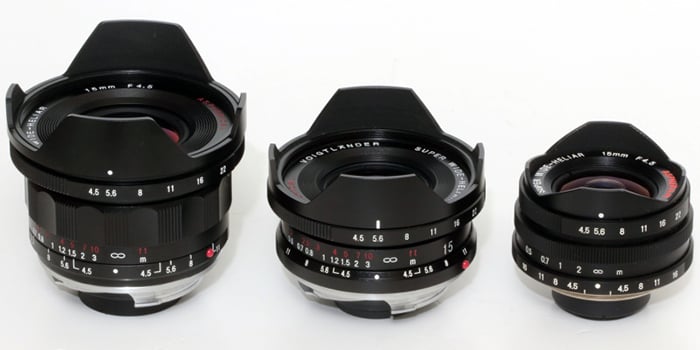
The new Heliar III on the left. It’s larger than the II and I versions because it has been optimized for the use on FE cameras.
Voigtlander really sees the importance of their M-mount lenses for the Sony FE system. That’s why the new Voigtländer 15mm f/4.5 Heliar III has been designed with the Sony FE cameras in mind. It means the light hits the Sony FF sensor in a more “favorable” way. And this should bring a considerable improvement on the corners. The lens is already shipping in [shoplink 33949 ebay]Hong Kong (Here on Shenikon)[/shoplink] and will ship the next week in [shoplink 34274 ebay]Germany (Here on Fotomundus)[/shoplink].
And at last we can see a first review with plenty of full size image samples at DC.watch (google translation here). As you can see from the image on top the lens is much larger than the first and second generation Heliar 15mm lenses. But the really important part of the review is that one. Click on the images to enlarge:


The difference is really big! Here are the enlarged bottom left and right corners:
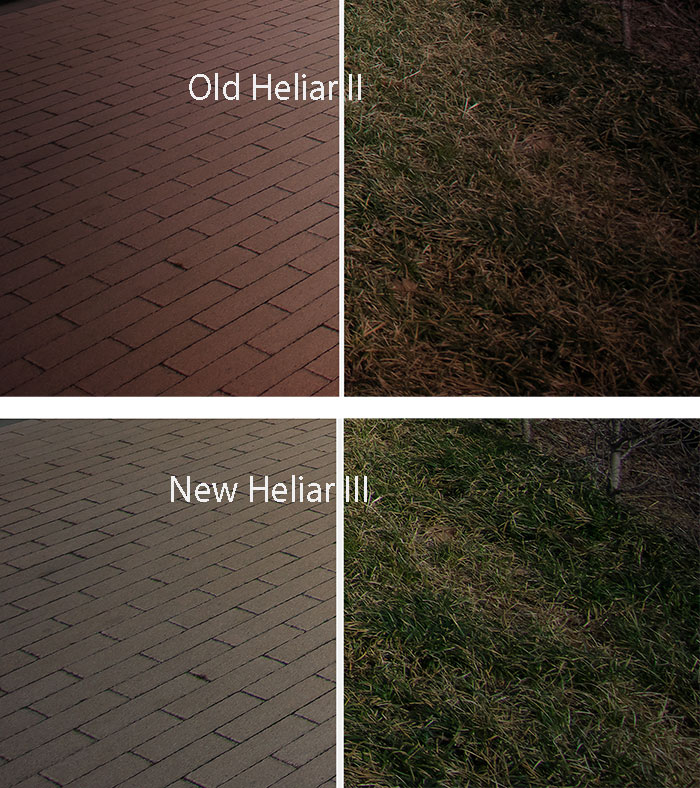
As you can see there is more detail, less vignetting and less color shift on the new lens.
I do not mind using an [shoplink 34266 ebay]M to E-mount adapter[/shoplink] to use that Voigtländer lens. But I still hope that in future Voigtländer will design proper native E-mount lenses. That would be great!
54 Responses
The new lens length is 55mm, before it was 38mm.
You made a mistake in the article, you wrote “the lens is much smaller” and it’s bigger.
Cheers 🙂
damn it. I was actually thinking at how small the first generation was. And my mind turned up side down the the words 🙂
Much-much better, but still a lot of vignetting and some colour shift in the corners (e.g. look at the grass). Center sharpness appears to be good, though. I’d be interested in a compison with the 20 f3.5 SL and the old Nikon 20 f3.5 and 2.8 manual focus lenses (they will probably have much better corner sharpness) or the Minolta / Sony AF 20 f2.8 on LAEA4.
Because this is much wider?
Yes, this is wider, but it is nowhere near the performance of my Min 20/2.8 on my A900, except maybe in the contrast department.
”As you can see from the image on top the lens is much smaller than the first and second generation Heliar 15mm lenses“…
sorry other way around.
to be honest, for a lens designed especially for the a7 series, I’m not impressed at all. Especially the vignetting is really heavy… nothing I would give more than 50€… sorry…
for less money you will get a 12-24 Sigma A-mount… less vignetting and more wide angle as well as AF…
But much bulkier (and poorer resolution). Also, the need for AF is much reduced on wide-angle lenses. Just one of those compromises. It will suit some people, and not others.
absolutely right.
It’s not designed ‘for the A7 series’….it’s designed for the Leica M series, hence the M mount. However, the changes to the design were to deal with the short flange to sensor distance and that will benefit both the Leica M series AND the Sony A7’s.
Why can’t the Sony A7 do what the Leica can? Why can’t we have the same small lenses?
I couldn’t agree more , the whole point of mirrorless is the reduced size and weight but as with cars it all seems to be getting bigger and bigger. the new 35mm 1.4 looks like a stunning lens but have you seen the size! I have been waiting a long time for this 15mm and am looking forward to it .
Regarding this 15 though, the super small version as designed for Leica M film cameras so a) it sat further from the film/sensor (Leica M mounts are deeper and therefore cameras thicker than Sony FE mount) and b) film is happier with extreme angles of light than digital sensors.
Put the new lens on an A7 and compare to a Leica M9 with the old one and the size difference will be less than you might anticipate – Sony really made an extremely tight mount.
Poor sensor angular response has nothing to do with mount size
Indeed. It depends totally on the lens design. The short lens register just provides for more design options and flexibility.
Whenever lens design is mentioned, people mention autofocus but actually if you look at all zeiss lenses, they are usually larger than leica, especially If you look at the diagrams posted on this site. No one has mentioned AF yet but give it time, someone will offer it as a counter argument. Price is another counter argument. If someone says all swans are white and I say I have found a black swan, their counter argument is “that swan is expensive”. Sure, but it wouldn’t disprove there’s a black swan. Of course Leica’s going to be expensive when no one else does what they do, lol. Unfortunately the average person here has the intellect of a crushed carrot and is likely going to say “we aren’t talking about swans”, thereby completely misunderstanding my point
Don’t forget about “autofocus.” I am just offering it as a counter. Also, “we aren’t talking about swans.”
where do you want to put the focus motor and OS system?
these things influence lens width and weight, but not length
Fast AF requirements can have wider impacts on lens design than just width. With AF you want a design that minimises the mass that has to be moved for instance as that saves power and allows for quicker reactions. That’s not much of a issue for manual focus. Indeed, if you want a nice, smooth “feel” it’s probably desirable to have a bit more inertia. Many AF lenses feel horrible when manually focused as there’s little feel and the movement has little damping, very possibly because it’s just a coupling to a very low mass internal element without thought to adding “feel”.
That need for minimising the mass that has to be moved often means designing the lens so there’s a relatively small internal element that has to be moved. So it’s not simply a matter of picking up a lens designed for manual focusing and adding a motor. To optimise a lens for AF, it might well require a wholly different design.
of course AF is harder to design, but it’s not like it adds 50% to length
Maybe not, but when people start demanding corner performance comparable to the centre, 50MP resolution, image stabilsation, better AF, fast apertures and the like it starts to all add up. Things rapidly get bloated.
It’s what happens when an attempt is made to satisfy so many competing demands.
Personally I’m not sure why AF is needed on a 15mm lens on a mirrorless camera, as it’s not really necessary for most of the subject matter and there are good focus aids available.
You are in luck. There is the Loxia line which is exactly what you are asking for.
are you talking about wide angle lenses or lenses in general? as this topic is about a wide angle lens go and find out how good they perform on a digital leica sensor and what problems occur.
I doubt very much that the lens has been optimised solely for the Sony A7 series. It’s clear from the examples posted in the tests that the lens has substantial vignetting on Leica cameras too, albeit less than on the Sony A7R. Wide angle lenses like this would also vignette on film too, albeit not as much as on electronic sensors.
At heart, this all comes down to compromises. Vignetting can be greatly reduced, but only at the expense of lens bulk. Fortunately vignetting can be compensated for, provided it’s not too severe. Colour shifts and other aberrations are more troublesome.
The lens has clearly been optimised for ‘digital’ cameras…so all will benefit but obviously the M240 will still provide the best results as it is designed to do so.
Wow, the new one has so much CA on the sides of the frame, quite disappointed here.
Since I have the 7s, I can choose the smaller one
A very smart move from Voigtlander. It’s a pity it became a bit bigger but that was inevitable given how close the mount is to Sony’s sensor – it’s still very small for a 15mm and an all round better package than a Leica M plus Voigtlander 15 II.
I was amazed that Zeiss didn’t make their recent ZM 35/1,4 work better with Sony sensors. I think in future more and more third party manufacturers will at least have to keep an eye on FE mount compatibility of their M mount lenses given how many more people buy A7 series cameras than Leica M cameras and the gap in numbers will grow with every passing year.
Zeiss made the Loxia 35mm specifically for e mount so I could see why they didn’t feel compelled to optimize the ZM.
improvement yes, but vignetting is still very strong.
Actually, I hope Voigtlander never creates proper e-mount lenses. I love using helicoid macro adapters on my m-mount lenses with my A7s to get even closer minimum focus distance. Unless Voigtlander starts incorporating a helicoid adapter as a second focus ring on an e-mount lens (I doubt that will ever happen), then the versatility of the m-mount for adapter choice and camera choice wins!
In fact, I also buy Rokinon lenses in Canon mount and use a cheap $35 helicoid macro adapter to focus closer. And you’re able to get the Canon mount versions for more than $35 cheaper than the e-mount versions. My Rokinon 85mm f1.4 simply does not focus close enough for me (1 meter). But with the helicoid macro adapter attached I can get a lot closer. Thank god I didn’t buy the e-mount version.
Lol… if they make lens in E-mount, it’s extremely likely it will focus closer than M mount — since rangefinder coupling was the reason M mount lenses cannot focus close.
i could imagine buying the 5th version of this lens when the vignetting gets less and less prominent 😀
Who cares about the vignetting, that’s an easy fix. The colour casts and smeared corners were the real problem and that seems to be a non-issue with this lens.
Corners look the same to me besides the colour casting.
I would love E-mount Voigtlander lenses, too. But considering this is the second lens they’ve made “specifically for the A7 series” that still requires the adapter, I’m guessing native E-mount lenses are not a big priority.
I prefer SEL1018 it has OSS and zoom and F4 constant and full frame coverage down to about 15mm no adapter needed – oh and autofocus
Agreed. This lens can’t even take filters properly. Aside from the size and looks it really doesn’t have anything going for it.
The original still gave you decent corners. You just had to run it through cornerfix and I can see you still have a fairly decent falloff. If the price didn’t get jacked up I’d be all about it.
I wil be sticking with my V1. Love the small size and it works ok on an A7s.
I will definitely be buying this lens but I’m disappointed at the huge price increase….hopefully that drops over time.
For the money you have to shell out for this thing, it doesn’t seem that impressive to me…
Sorry guys, where are you getting the price from? I work at Robert White in the UK and I haven’t released a price yet
Still, ugly color rendition
I hope they update the 12mm lens in the same manner.
Okay, so the message I get here is that Voigtländer lenses are untrustworthy.
Because I sure as heck wouldn’t trust a brand that makes those kinds of colour errors to begin with.
I think I will just stick to Zeiss lenses.
It wasn’t designed for Sony a7, you can’t blame a company whos product dosent work flawless on something it wasn’t designed for
I agree, I had a Voigt 15mm aspherical from film camera use which was interesting, producing non-fisheye, but still with significant angular distortion super-wide angle photos. I finally found a reasonably priced Contax Zeiss 18mm f4. Comparing the 2 with the same Nex lens adapter was no contest. The Zeiss provides near anamorphic looking high contrast super clean digital images especially good for video in 16:9. Sold my Voigtlander.
I am very confused about the use of classic lens adapters with Nex mount cameras. I have been using a full range of Contax Zeiss primes on my Nex-6 with a metabones speed booster adapter to emulate the lens original full frame equivilant focal length, and a Novoflex (non-optical) adapter to provide a 1.5x focal length. Works perfectly with no vignetting or setting mystery.
I would like to get either an A7S or A7II in th near future, but I am confused as to what will happen using my current approach and/or what do I need to do to maintain this Focal Length flexibility with the new FF bodies.
I assume if I use the Metabones APS-C condensing adapter I will have a smaller image on sensor and camera will auto crop to lower undesirable mpix level. But will my Novoflex be accepted by the notoriously proprietary Sony, yielding FF equivilence with no problem or drama? If not what type adapter do I need to use to get My Contax Zeiss 18mm -200mm lenses to be just that on a new A7?
Since the Sony a7 series have the same E-mount as the NEX series, your Novoflex will work just fine, providing the “true” focal length of your Zeiss Contax lenses.
It makes no sense to use the speedbooster on the a7 bodies, Since the Novoflex has that role now.
There is no need to be confused. Basically, an a7 body replaces your speedbooster but with superior quality and ergonomics.
To maintain flexibility, you can keep using the NEX bodies with standard adapter, or select in camera APS-C crop in the A7’s, resulting in a resolution of 15, 10 or 5 mp for the a7r, a7/II and a7s respectively.
Personally, I don’t see the need for that since you have a range of Contax Zeiss lenses from 18-200mm. Just select a longer lens instead of cropping, or use a 2 body setup.
Whell definatelly hang onto your speed booster if you buy a7s. If you want to have fun with 120 FPS video, for smooth slowmotion, you’ll have to do it in 720p witch is cropped from full frame. so to keep the FF look, and to get 1 more stop of light i’d keep it if i were you. Also rolling shutter is quite smaller in crop mode, so you could use it for action two
Bought one last week from Cameraquest, and I love it. It requires about +50 to +60 in LR5 to fix the vignetting on my A7, but it its sharp to the corners, even at f4.5. I might add it weighs a LOT despite its small size. See https://www.flickr.com/photos/melsnyder/sets/72157651477410621/ for test images at f4.5-f11