







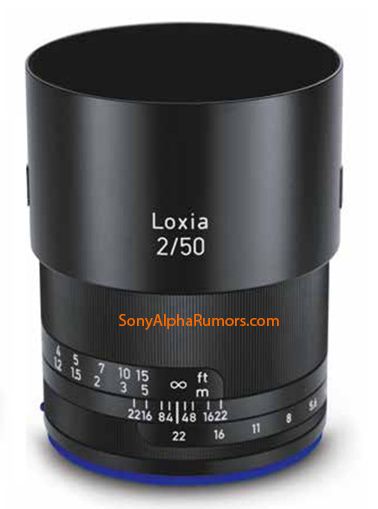
This is the worldwide first published image of the new Zeiss Loxia 50mm f/2.0 Planar E-mount Full Frame lens. Like I told you before Zeiss will soon announce a new line for Full Frame E-mount which also includes the Zeiss 35mm f/2.0 Biogon. These lenses are just like the Touit for the APS-C E-mount system: Made by Zeiss itself (not Zeiss branded Sony the Zeiss 55mm f/1.8 FE). But the Loxia lenses will be manual focusing and with electronic aperture control. And unlike current Sony FE lenses the Loxia comes with a handy physical aperture ring.
The 50mm you see on top has a Planar design just like the “original” [shoplink 9809 ebay]Planar T* 2/50 ZM (here on eBay)[/shoplink]. These are the full lens specs of the Loxia 50mm:
Planar® with 6 lens elements in 4 groups
Focal length 50 mm
Aperture range f/2.0–f/22
Elements/groups 6/4
Focusing range m/ft 0.45–∞/1.48–∞
Field angle* (diag./horiz./vert.) 46.78°/39.38°/26.70°
Coverage** mm/inch 255.1 x 168.3/10.04 x 6.63
Plenty of rumors and stuff coming the next days! Do not miss any rumor and join us here:
RSS feed: http://www.sonyalpharumors.com/feed/
Facebook: https://www.facebook.com/sonyalpharumors
Twitter: https://twitter.com/SonyAlphaRumors
GooglePlus: https://plus.google.com/104216500156717934391/posts
Source can send anonymous messages here:
[contact-form-7 id=”14822″ title=”Share”]
——–
Reminder (SR = Sonyrumor):
SR1=probably fake rumor
SR2=rumor from unknown sources
SR3=50% chance it is correct
SR4=rumor from known sources
SR5=almost certainly correct!
0 Responses
They are much prettier than Touit/Otus lens line. But I am happy that this Planar 2/50mm has minimum focusing distance at 0.45m. It is much better than original one 0.7m.
One more correction, ZM Biogon 35mm are f/2 and f/2.8 (not f/1.0) :))
Come on… I wanted yo believe it’s 1.0 🙂
lol. Sorry.
I guess they are releasing what’s ready. An amazing wide 21mm lens will take longer to design and test… The problem is that’s what most people are waiting for…
I was against the idea of these lenses, but honestly this one looks very nice, kudos for the designer.
I had the exact the same feeling like you. Now that I see them I start to like them!
Can’t wait to see how it perform!!
should have top notch quality. Certainly better than the Touit series 🙂
Admin, why have You changed image to Planar 2.0/50 solo, without Biogon one?
I am checking the second image. Wans’t sure about it if it was the 35mm Biogon!
I read the front side markings, there is written it is a Biogon one. But it could make some doubts. Thanks You very much for for sharing this images :)))
This seems to break with all design guidelines Zeiss has been pushing forward since 2012 with the Touit and Otus lines. Even the font – and especially the font size – are different. Admin, are you absolutely sure that this is a true image of the final lens design?
100% sure. Really. This would be a classic SR6 🙂
Thanks for replying. Interesting that they chose to change their design language yet again – if the image indeed is genuine. (Sorry, I’m a little skeptical about this one)
No, they did not change, they design Loxia to match the Sony A7 series cameras.
Changing your own design language to match the design language of another company? Not a very wise move in my book. But it’s less than three weeks to Photokina now, so we’ll see then anyway.
Loxia is solely for Sony A7 series and nothing else.
I never said it wasn’t. But that’s the same as building a headphone solely with an MFi cable (so it’s only compatible with iPhones & co.) and ditching your own design for going with one that fits the iPhone. You need to get your corporate design out there, not support the design of others, no matter for what purpose a device is built.
I guess you are unfamiliar with Apple product accessories. There are numerous companies that design their gear to match the look and feel of Apple designs. If the design is complementary, it can work out better than if they clash.
That could change as other companies eventually release full frame mirror less cameras.
Perhaps. However, these lenses will look stunning on any types of designs of camera bodies, it has the ‘universal looks’.
Would argue that this design language is quite similar to the Zeiss lens on the RX1.
The RX1 lens is a Sony design. Just like all Sony Zeiss lenses, Zeiss is responsible for the optics, while Sony designs the AF module and lens barrel. As these are Zeiss lenses, not Sony branded ones, I’d expect them to mirror Zeiss’ own design language.
Nice design. The lens is shown with lens hood? So it is smaller than Sony FE 55mm f1.8?
yes smaller. Looking to get more pictures now…
Thanks, SAR is the best!
Cheers!
look like a little bit longer than the FE 35, probably 2/2.5cm shorter than the FE 55.
Yep, it does look smaller.
wow, a Zeiss with Porsche Design
oooohh!! I take it all back, this looks really nice! Want. Need!
Yesss preciousss.. we wantsss it…
Didn’t know Gollum was a SAR reader…
🙂 Lord of the Blue Ring
Pretty. I prefer the ZM style a little more than the Touit style, and I hope that blue line isn’t actually visible — it’s a little Pentaxy, haha. But still, nice lens.
We are the slaves of ‘good looks’.
Even I’ve missed the film slr days (only had a compact automatic film camera), I like a lot the lenses that have aperture rings…Zeiss or Fujifilm ones are the present ones using that. I don’t know why Canon, Nikon, Sony, Pentax or Olympus aren’t designing those kind of lenses. They are better from an ergonomics pow imo…
http://photobyandrei.wordpress.com/
Kinda looks like Contax Yashica Zeiss 50mm, with internal focus
Me thinks me likes this lens.
It will no doubt be a great lens, but is there much point considering the 55 1.8 already exists and is known as the sharpest AF lens already?
typical zeiss tone deafness. Same thing with the touits for APS-C. fill some gaps, zeiss. please!
If this is as sharp and costs roughly the same, I would prefer it for the size reduction and the mechanical focus.
Sigma 50 Art is sharper
is that for portrait?
Half-body portrait and many other uses.
If this is a rehoused/rehashed (looks like it from the specs) ZM Planar and ZM Biogon, I will pass, The ZM Planar 50/2 with a macro focusing helicoid is far more verstaile than this would ever be. Disappointed. 🙁
I mean, did you think they were going to be the first small 50mm lens to focus closer than 1.5ft? Other than macros, every 50mm lens ever focuses to 1.5ft.
You missed the point. Oh well.
Vivek, you’re my idol. Focusing helicoids FTW
Alright, for the sake of my understanding (and so I can continue to not get work done, haha), what did you mean? To me it sounded like you were bothered that it only focuses to 1.5 ft. If there were a bunch of fast 50s out there that focused to .8 ft or something, that would seem reasonable. But to say you’re disappointed in a lens for having the same close focus range as every other lens one would compare it to seems silly. But, I’m here to learn.
Primarily this- If the rumored specs are correct and if it is a rehashed ZM Planar in a new housing then I do not see the point at all. ZM Planar 50/2 prices have stabilized because they been around the block for a while. Very nice construction (“all metal”). In addition, they can be used with a close focus adapter (focusing range with a close focus adapter +ZM Planar and the rumored 0.45m close focus of Loxia are ~ same).
Right on. That makes sense. I imagine it’s just that some people don’t want to use adapters and Zeiss wants to capitalize on the success of these cameras. But you’re right.
Wtf are you even talking about? Pentacon 50mm f1.8, focuses to 0.33m. Photographers on the web, think they know everything. Vivek is right, you’re a newb. Grab a tiny M-glass and focusing helicoid, way more versatile than this rehashed zeiss crap.
Don’t be ridiculous — that’s obviously an exception. I suppose I meant every fast 50mm made in the last 20 years. I’m with you, I think a current ZM with a Voigtlander adapter could be more useful for a lot of people. But to call this lens “crap” and to say you’re “disappointed” is silly.
Buddy, ever heard of a focusing helicoid? Simple adapters are so 1950s.
Yes — I said Voigtlander adapter in reference to the close focus version with a helicoid.
I do wish that the focus and aperture rings were a little more… gnurled? If it’s built like the Sony Zeiss 50mm 1.4 ZA, the focus ring is decent, but not perfect. (Still, not complaining — ILY Zeiss)
I absolutely love my Zeiss 50mm 1.4- great lens except for the stupid hood. But in every other way it’s a stellar performer and built exceptionally well. Ok, maybe one gripe….I wish the focusing distance was a bit shorter.
Oh, I’m totally with you. I use the Sony Zeiss 50mm 1.4 ZA for 90% of what I shoot. But that focus ring can be a little slick and doesn’t exactly focus with one finger. Minor nitpick, for sure. Amazing lens.
Agreed, 1.5k yet a plastic hood.
Kind of a disappointment. The Voigtlander 50mm/f1.5 on an A7 is effectively identical to the ZM 50mm/f2 @f2, but can also open up another stop… and the 55mm FE is better than either, and only a little larger…
Design does look nice though.
Cute. Much better taste than the Touits. But could sell even worse?
At least the Touits have Autofocus
Exactly…we know it’s not gonna be cheap, we know there’s tons of alternatives, and we know there’s nothing really special to this lens…except that it’s cute, haha.
Or, basically, we don’t know squat about it, except how it looks.
And are ugly as sin and APSC.
The AF is slow, noisy has hell and you feel the elements moving inside the barrel everytime it focus, very annoying.
Very nice, I like the look- nailed it. Now, please for the love of Sony I hope the performance is class leading.
THE TOUITS ARE AUTOFOCUS!!!
The AF of the Touit are slow, noisy has hell and you feel the elements move insisde the barrel every time it focus, very annoying.
Zeiss AF is not very good so it’s better if they stick with what they know best:MF.
ops error. Corrected!!!
I did not want you to correct the text, I want Zeiss to correct the lenses! We already have fantastic manual lenses (zeiss, Leica, Contax). We need more quality, AF, small lenses. First of all loumimois zooms, and wide angle primes.
NICE!!!
Banging look. Very modern.
Oh Please let that 35mm be as good as the RX1’s…please!
No way. But maybe almost as good.
I can hope, pray, cross fingers and touch wood…
I think the 35 will be close to the RX1 lens. Hopefully someone can find the mtf for this lens.
Wait a sec…why did they invert the aperture ring? Old Contax and almost everybody else had it the other way…
Nikon is completely backwards, but that’s along with the focus too…was it Olympus that had the turn directions of the rings this way?
RX1 design is this direction as well as the Touit for X mount and ZF lenses so this is the new normal from Zeiss.
I already said Nikon was backwards from the start so it doesn’t count, ZE doesn’t even have an aperture ring and it’s only because other Canons don’t either, ZK did have the ring turning in the right direction and it’s because Pentax originally had it that way, RX1 is strictly Sony so it doesn’t say much, as for the X-mount Touits, it’s also probably in line with Fuji’s own lenses.
Still weird…unless Minolta had it this way? Couldn’t remember.
Nice. How does it work: El. Aperture control yet manual ring. What happens with the ring when you set the Aperture on the camera? Or do I have the wrong impression as to what el. Ap. Ctrl. means? Thanks
Probably a separate step for “auto aperture” on the ring beyond F2.0.
Electric aperture control means the lens aperture can be set by electronic signals from a compatible camera.
Could be there is a Auto-aperture switch on the lens so you can use Aperture Priority mode on Sony A7 series bodies.
This is so much nicer than the Sony 55 1.8
i don’t know how much better can it get than the 55 1.8???
55 1.8 is already a beast
You guys make me laugh! They give you a 50mm manual focus prime lens…that you already have a choice of and you guys are happy just because it looks good?!
Instead of bringing out more lenses…they should bring out the same lens but in different colours so you suckers could be even happier…!!!
Get a grip!!
I should be able to get a grip…that focusing ring on the 50mm looks stellar.
Lol…nice one 🙂
Zeiss is not Sony. If Zeiss wants to release their own line of MF e-mount lenses, it’s much easier for them to release the easier ones to design, and the ones that are more common focal lengths. And then release wider lenses and such. But you can’t give them a hard time like they make all of Sony’s lens decisions.
The more lenses, the better…and i realise this is a 3rd party manufacturer…
But it just goes to show that you guys have been going too long without a choice of lenses when SAR readers get excited over a lens that is almost identical to another…but in a slightly different design…
Uhmm, we only have a picture of the lens, so, consequently, we are discussing the looks. What’s so strange about that?
OMFG thats outreageously humongous! No thanks.
What are you talking about? Ever see a lens hood? The lens itself looks to be very small – maybe the size of the RX1 lens or a bit longer.
Based on the e-mount throat diameter, this thing may be, what? 2.1in wide?
I prefer my planar 50mm F2 ZM….
plus focusing helicoid to nex. =)
That focusing scale will be amazing for zone focusing. I’ll buy this if the price is right. Shame about the electro-manual aperture ring.
why do we need another 35mm or 50mm?? Bring me a 85mm!! that is what we really need!!
So many choices, so little money… decisions… decisions…
why should anyone buy the 50 2.0? the FE 55 1.8 is as good as it gets optically, and it even has autofocus. presumably the new manual stuff isnt even cheaper….
for those who like to use zone focus and hyperfocal settings manual lenses is to prefer. If this lens carry the expected Zeiss quality, it will sell.
Well, that is a dilemma for sure. The way I look at it is the 50mm F2 appeals to those looking for a very specific user experience. It’s a niche product for sure, but if there is demand for it than I applaud Zeiss for tapping into it. It’s definitely a tough call though I have to say…this one looks ten times better.
1. Focus by wire disallows you from prefousing or zone focusing
2. Focus by wire makes precise manual focusing twitchy and irritating
3. Manual aperture ring (yes!)
4. Unless you’re a CHARTS & GRAPHS™ photographer, you’ll likely notice a rendering difference between the lenses. Pay close attention to the out of focus areas and transitional zones
There’s a few reasons why someone may choose one lens over another.
It really needs to have a lot of character to make it the preferred choice over the 55/1.8 in my opinion, especially if it is more expensive. Point 4 is the only one which could make me choose it. I think a closer focusing distance would have made it much more interesting, too.
Prefocusing and zone focussing are both totally possible with the FE’s. The rest I agree with.
If the 35 is on par with Fe 55, I have some interest. Agree with those who ask why 50 when fe55 is so good? It is redundant.
If they are Otus quality then…. Whoa! We are not worthy…bowing! 🙂
Good is relative. Just because it’s sharp doesn’t make it perfect. I used the 55 for a few months and after trying to fall in love with it, it just never really grabbed me. It lacks any character (as Steve Huff would say).
It isn’t redundant to Zeiss as the 55 is not their lens and neither is the current 35.. The fact that thy are both Zeiss designed lens makes this point easy to overlook, but this hasn’t stopped them with the Touit line which also doubles up on focal lengths already covered in the native E mount line up.
Hey Dan, if it falls in with current Planar lens quality(I’ve got the 100, ZF.2) you are spot on. Even though it’s labelled a Sony/Zeiss, the 55 is one of the best lenses made optically. So if Zeiss can give Loxia the quality of the Otus or the feel of the Planars, it’s not redundant. The 35 FE is a good lens, but not great like 55. Native mount 35mm manual focus at that quality, I’ll sell my Sigma. Can’t wait!
I’m kind of bummed they didn’t go with the ZF/ZE Planar design and allow that delicious close focus. BUT that’s fine.
What’s great is that if this is like the ZM 6/4 design, it’ll be really beautiful. It’s nice to have a choice between the very transparent and clinical FE 55mm design and something that (we hope) has some character and offers a different user experience.
+1!
The 50mm ZF/ZE is an expensive macro lens (around $1200). This is probably like the ZM version that costs $860.
…but you are right, the macro capability and still relatively large aperture could make it interesting over the FE 55mm.
Admin, do we know anything about filter thread? (I hope it is 49mm, not anything smaller)
How about size?
I’ve been told it doesn’t matter as long as you know what you’re doing. 😉
I size didn’t matter I’d be shooting a cheap FF DSLR with tons of available lenses…
That phrase is generally meant to justify smaller things.
Just look at the mount and use your imagination ..
Imagination can lie. Especially when there is a hood in the picture 😛
Definitely looks like it’s tiny without the hood.
Like two 16/2.8 pancakes stacked on top of each other, or less.
perfect size, can wait for 35 looks like,
Reality lies. Imagination is the truth.
Nice, it’s a 50mm Loxicron. 🙂
Here’s hoping for a Loxilux asap, and possibly a Makro-Loxmar while they’re at it ..
nice! at least $2,000.00! or maybe much less… something like $1,999.99? just can’t wait to skip it (on such a nice price)!
it won’t be nearly that expensive.
they have FE55 to beat, if it can im sure $2000 will be fine, and this have to have magic to beat FE55 with AF
Too bad we only have creaky toy cameras to put it on.
yeah,.. creaky toy with big IQ
go play with your 5 years old sensor, im sure they have grown up and now didnt use diaper anymore
Are you saying the A900 requires a diaper? As with most accessories, I’m sure Sony will charge top dollar for that one as well.
LOL, its not for sony sensor, its for fu<k1^9 …. C@^0^
My A7 was super creaky, but the A7s is beautiful and solid.
This is exactly what I was hoping to see. Assuming these new lenses are optically great (presumably so), this really cements the FE system for me.
Same here. The rumour spoke about 5 lenses, so if they cover the essentials – wide, 35, 50, 85 and some macro above 100, then this is all I need.
To bad the A7 bodies are ugly. I’m afraid if I stick them together they won’t play nice.
The A7 is not ugly. There is no way you can say that.
It’s not a camera you want to pick up because of how it looks or feels. It’s got that refrigerator like design- functional appliance but not engaging.
Sexy like a plastic hockey puck.
Interesting, I find the grip to be great and certainly way better than my NEX-7; and I also find Sony cameras to look better than anything from the competition (with the exception of some Pentaxes).
a7R is so ugly my wife left me over it.
My loss. The camera fusses more than she ever did.
So this time ZEISS uses the name of a small breed bird Crossbill (Loxia) to emphasized its small size and nimble versatility?
very nice mr. ZEISS, is this your win-win solution in long term relationship with sony?
c’moon,.. i know its not that hard to built this after ZA50f14, FE55f18, ZA35f2(rx1) FE35f28(im sure you helped sony with your formula with this), i mean its just a little tweak here and there and,… WE HAVE A BRAND NEW “same” 50 & 35, although its a very2 good lens but, why can you bulit us a 85/90?
im hoping that zeiss are more commit with FE, and develop a new “surprise” just like we’ve seen on ZA135f18,
BUT then again sony moving toward to curved FE,.. and we’ll see another 35 and 50 FE-curved are on the line,.. well another long term commitment have to reconsider,
The real show stopper here would be a 135mm F4. To me that’s going above and beyond. I doubt will see an AF FE anywhere near 135mm from Sony anytime soon- if ever.
for 35 im fine with MF but for 135 i will need AF, or i need focus peaking generation third
I agree, in general, with the “slower-lens-better-lens” concept – but at 135mm, trying to get a steady and sharp image with a 36MP sensor, with f/4 and a sufficient shutter speed (1/250 – 1/500 in reality), the speed would really be a problem, no?
No doubt about that. The question is how much of a problem will it be?
Curved sensors really don’t lend themselves to interchangeable lens cameras. Every lens, regardless of focal length, would require the exit pupil distance to focal plane to be identical.
I doubt we will see them in anything other than fixed lens systems for a good while. So the RX1 replacement and mobile phones then.
let say it’s impossible for zoom lens, but not for primes,
but aren’t people said that impossible to put a FF sensor on e-mount?
I never said it was impossible. It’s improbable, for the reason I’ve already stated.
Re-read what I wrote. I never said it was impossible. It would however, require a new set of lenses, designed within the parameters I have already outlined. This alone makes it improbable for the foreseeable future.
With auto focus the lens would be bigger, so im glad its not. Nice to have lenses to choose from that are smaller.
Some people might like to use the lenses they have for both A7/r and the nex line up that is now alpha. I can imagine that with this lens on say a5000 or a6000 space is less of an issue even if its not pocketable.
And character is important and I think we will see a lot of character in these Loxia lenses.
And if im not mistaken they are bringing out 5 manual lenses so surely one of them will be 85mm or maybe more.
Also previous leica users can now get similar experience with the sony system as they had with their leica system, now for a cheaper price since i doubt these lenses will cost 8000$.
I’d rather see Zeiss rereleasing old Contax G AF lenses with E mount.
You could just get the actual ones though..
http://youtu.be/hn75Ega35WY
Contax G lenses wider than the 45/2 don’t work so hot on the A7 or A7r. I’m not sure how they’ll do on the A7s but generally speaking most RF are hit or miss wider than 35.
My guess on price….1299.00. Who’s with me?
its all about character,
for $1000 FE55 are almost on par with mighty otus, 1/3 stop advance and AF, its hard to beat that..
That’s what I’m saying. I believe the 50mm F2 ZM is around 1300.00 dollars. There is no way this guy is coming under 1k. I would love to get my hands on it but dang…for that kind of coin there seriously is a lot of manual lens options on the market right now for way less scratch.
The 50ZM is 860. I think this new lens will be priced similarly to the FE 55.
I bought my ZM50/2 about 5 years ago for $600 but they were $700 (MSRP) new at the time and selling for about $650 (street.) One of the reasons Zeiss jacked up their prices was the lens shortage associated with all the people buying M9’s and Leica not being able to keep up with lens demand. Zeiss and Voigtlander cleaned up during those times and manny found out certain Zeiss lenses were “superior” to their Leica counterparts.
So that being said I believe this lens will sell in the $700-1000 range but if it’s as good as the ZM50 it wouldn’t be a ripoff at $1500 even with how good the 55FE is.
for 450-600,- Euros i would buy this lens. If it’s around 1000,- Euro – as the 55/1.8 is – id stick with the 55.
Looks good! and DOF Scale! 🙂
new manual focus lens 2014, are you kidding!?? aren’t there already milions of quality lenses from the old days if you wanna focus manually?
but many don’t have the resolving power for the new sensors. Hopefully they will increase the lens quality to make up for the lack of autofocus.
Indeed, they are. But the good ones are not that cheap, require adapters and don’t provide EXIF data. Also, they don’t come with a warranty.
Someone at Cosina must be fan of old Tamron Adaptall lenses.
http://adaptall-2.org/lenses/52B.html
We’ve come full circle folks. Back to 1979 looks and function.
POP… has officially eaten itself.
My exact first thought was that it looked like my old Tamron 90/2.5
I just figured out what this reminds me of. It looks like my 25mm 1.8 olympus lens in black- except it’ll be 4 times more expensive. I’m cool with that as I’m a sucker for an all metal build.
This is an all manual lens, right? They should also make a cine version that has built-in lens gears on it for videography use. Come on Zeiss, it’s only natural to want to use this for filmmaking as well.
They already have top notch cine lenses. One of their core business. Check it out.
Exactly. Or buy Contax and mod them.
As Vivek and Vlad pointed out Zeiss has all of their Cine lenses available in E-mount and they provide FF (24x36mm) coverage. If the price of the Loxia line will more than likely give you sticker shock then don’t even bother looking at the Cine lenses.
It’s not stupid at all for Zeiss to reissue their existing, excellent ZM lenses for E-Mount, and what’s happening here is nothing but exactly that. There was no need for any of these new E-Mount lenses to get a new lens design, it’s all been there already. These are just ZM lenses with a new exterior, a new name and a new mount.
May not be important to you but anyone shooting wider then 35 will surely be excited to not have to deal with the magenta shifting and loss of detail in corners. I’m sure this is being taken care of by Zeiss.
Absolutely. With the proper software.
I think that being an FE mount made specifically for this line of cameras, it will be free of those problems without software. Just my speculation though.
Possible, but I doubt it. Even Leica corrects in software. Still better than having to make profiles by yourself.
Leica’s lenses were not designed for sensors, but for film. The Loxia is a new optical design (look at the specs), very familiar to the ZM line (the right choice!), but optically reworked for the mirrorless bodies. It will be close to perfection.
Could be both. Zeiss will improve the optical design to reduce or eliminate the corner’s problems that cannot be removed by software (e.g. smearing), and apply software corrections (rather than more glasses) to keep the size and cost of the lens down. By the way, Zeiss is already using software corrections for their Touit lenses – distortions is one of them.
I’m surprised that they have launched with roughly the same focal lengths as the Sony/Zeiss. What’s needed is the Plannar T 85mm 1.4 and a 21mm/24mm to give the A7 users freedom. As it stands, 2 native primes, no options for portrait or landscape and we’re a year in from the release of the A7 debut.
I’m hoping that when they finally release a portrait lens, it’s going to be faster than f4.0 but as they seem to want to keep this range small, maybe no fast primes from them.
This is a hoax…it’s just a travel cup in the design of a lens. Nobody in their right mind would design a 50mm lens with a lens hood bigger than the actual lens….or would they!?
Hood never harms. It should be as long as possible but no longer.
Hoods are kind of like a lenses manhood.
Could be pretty nice for about $100. Of course, still much more than all those $15 50/1.7-50/1.8 you can adapt as cheaply as $5 between all lenses of those systems, but extra $85 might be worth it. 🙂 Let me guess – they will add a zero at the end of that $85. 🙂
Drugs are bad….
It is looking good, and with the aperture coupling it will be really practical, too.
I wonder how the aperture coupling will work with on-camera aperture control?
Maybe like Canon FD where the the manual aperature ring has an ‘A’ for auto.
Any rumors about entry level SLT? Sony a6000 looks tempting but i’m not keen to sell lenses
35 and 50mm? As an addition to the only FE prime lenses at the moment with focal lengths of 35 and 55mm? Well, awesome…
There are still at least three additional lenses on the way as well.
Well, the lens is actually quite compact and good looking! If it is cheaper than the FE 55 and has same or superior optics, I’d be quite interested!
thats one sexy looking lens!
oh my goodness…look at the size! More compact than the 55mm f1.8 ZA
A 50 f2 planar? Is this an old ZM lens design being repackaged? I find it hard to imagine this old 6 element double-gauss design can exceed the sharpness of the current Sony Zeiss 55 1.8. I’m disappointed.
If sharpness is what you’re after, get the 55mm. No need to be disappointed.
Have you actually used the ZM50 Planar before? It out resolves the A7R sensor. I’m sure there will be more modern coatings to improve this iteration even further.
I have, and it’s not as good as the FE55.
35mm biogon? Wait… Isn’t Biogon supposed to not work well with the A7 series?
Why manual focus? I was expecting something more on the lines of the Contax G 45mm f/2
Strange move from Zeiss…
I’m sure they will work with EXIF data and software corrections…
Its Zeiss, not Sony Zeiss. It will be just like Sigma, Tamron and Tokina. Software corrections will be in post only. You can correct any lens in post the same way.
Yeah but they can provide a profile and have the corrections automatically applied being that it is a native lens line. Every lens isn’t easily corrected and you usually have to use external editors like Adobe Flat Field, Cornerfix, or create your own LCC’s when there aren’t native corrections. Most of the Zeiss profiles weren’t created for most of their lenses that aren’t in ZE or ZF.2 mounts. ZM profiles are nonexistent in adobe and generally people manually select a lens profile to be applied in camera to deal with color cast and get you close to the desired look in camera.
Believe me it can get tedious when you’re going through a lot of images and Sony can choose to natively support the profile since there are electronics to talk to the camera.
Zeiss already doing that for their Touit line, when you take pictures with these lenses, the lens distortions will be automatically corrected by the software embedded in the lenses.
The bigger problem is smearing, which can’t be fixed by software.
We are all making assumptions (positive or negative) based on rumors they will smear before any shots have been shown…
I think I took a wrong turn….this isn’t Sonyalphafacts . com?
SMEAR THIS!! –> (__|__)
I don’t understand why people already say it’s “strange” that Zeiss not release an AF lenses.
Then I wonder whether people really know anything about photography equipment at all as if they did even appreciate it a little, they would know that Zeiss is a MF lenses specialist.
95% of their lenses are manual focus primes. Touits and Contax G’s are not normal and the Contax G lenses are not even normal lenses anyway, developed specifically for a camera that utilises a uniquely weird mount.
Read where are problems with Biogons are coming from: http://www.lensrentals.com/blog/2014/06/sensor-stack-thickness-when-does-it-matter
If the solution is to increase the distance to the exit pupil by some corrective optics then the lens will be longer mitigating the Biogon’s advantage. I think it may be a different design, Zeiss is fairly liberal with naming nowadays.
Lens looks nice and even though I have the FE 55 I would still be tempted to have a completely manual lens with built in aperture rings ( the most ergonomic way to do my photography). The 6 elements in 4 groups design of the new 50mm makes me wonder if this will be a good enough lens that avoids the blurring and magenta casts of other adapted manual lenses or if it is indeed a new jewel.
After using the 55 FE the only thing that will make me use anything else is another lens that can draw like it but with mechanical manual focus and a built in aperture ring… Loxia? I doubt it but I remain hopeful (selling Leica stock).
Hello DC. There will be no problem at all with blurring and color casts, since the ZM Planar doesn’t show those neither and performs terrificly well on the A7r. I expect the optical qualities of the Loxia Planar to only exceed those of the ZM. I expect the Loxia will absolutely meet your expectations. You (and I) are the kind of guys for this kind of lens. Zeiss knows exactly want we want. The ZM line does it for Leica M, the ZF/ZE line for DSLRs. The Loxia for mirrorless. I’m sure about it. I bet you can be confident as well.
Dirk, I never tried to adapt the ZM50 but I did try the 35 ZM F2. The ZM 35 did really well on a Leica camera body but suffered from casts and blurring on the corners at infinity with the A7r. Fingers crossed the Loxia line of lenses keeps me from buying a Leica and releases me from the heavy D810 (Sony needs to work on the A7r shutter for a dream come true combo).
I am glad there people like you looking forward to quality manual lenses with aperture rings – for a while I thought I was the only one and that there would never be a market for these things outside the Leica ecosystem.
Cheers!
The ZM line was developed for film camera’s like the Leica M series (up till M7) and the Zeiss Ikon ZM. The Biogons within the ZM line and also some of the Leica WAs give problems on digital bodies, due to too slanted ray angles from the back lens to the sensor. Leica solved this for their own lenses with software correction within their own camera body (only, of course not for the Sony A7). But optically the problem still is there, also on the M body!
Like I said in my comment here above, Zeiss will have gotten rid of this problem, by enlarging the distance from back lens to sensor (on the lenses where it was needed: the Biogons). One can tell, when comparing the specs, that, Zeiss didn’t just adapt ZM lenses to the E-mount. Even with the Planar they didn’t, although this could have been possible, since the Planar gives no problems at all on digital sensors, because of the larger distance from back lens to sensor, that it already has. But instead they fine-tuned it, especially for the mirror less bodies. This can have only one reason: Zeiss wanted to enhance the optical performance to the new generation of hi-IQ/hi-res sensors. They explicitly talked about this new generation of sensors, when launching the Otus. It wouldn’t make any sense at all if they wouldn’t have had the same considerations, when developing the Loxia line, that operates on the today’s most advantage sensors: the Sony’s. I’m absolutely sure all the Loxia’s will perform stunningly well. Zeiss knew what had to be done and Zeiss absolutely càn solve those minor (from a technical point of view) problems. So we can only expect the very best. Really. The problems start from the point where the backlens gets too close and the ray angles too slanted. So it will be solved from a certain point where this angle gets more towards perpendicular, by creating a greater distance from backlens to sensor. Only result that I expect: compared to the ZM Biogons (adapter included), the Loxia’s probably will be a good half cm longer, which is no problem at all with such a compact design.
This lens is closer to the ZM than to the ZF/ZE design. The number of elements/groups is the same as with the ZM, the dimentions will be about those of the ZM Planar (adapter included), but slightly thicker, probably to accomodate the electronics and to connect better to the body. The closest focus distance is shorter than the ZM though and, with 45cm, equals that of the ZF/ZE lenses, which is a good thing. The field angles are close but very slightly different from the ZM’s as well. So Zeiss started with the (ultra reliable) compact ZM Planar design – their finest design for compact standard focal lenght glass IMHO – and reworked it. I can see only one goal for that: to come up with improved optical performance. And if anybody doubts the abilities of Zeiss in that department, he’d better think again and maybe first talk with a few professionals. The ZM Planar already performs outstanding on the A7r, so I’m absolutely inquisitive about the Loxia’s performance.
The esthetics of this lens are perfect, as far as I’m conserned. It has a fine, yet sober and timeless design, that will go along very well with the A7x, which also has this “modern classic” look – I hope Sony will really stick to this design, with only small changes, like Leica does with his M line. IMO this is the only way to establish a myth like Leica did with the M. Sony has everything it takes for this: the concept, the technology and the design (althoug often contested, but in that too, they equal Leica). This can be a camera concept for generations, with the same kind of innovative ideas that Leica had, but (again IMO) more adapted to modern times.
The fact that Zeiss launches the MF Loxia line now, is absolutely perfect for this camera concept. To anybody who criticizes Zeiss for those lenses not to be AF, I can only say: do you really know Zeiss? Zeiss makes MF lenses. That’s what they do. If MF is not your thing, buy something else. Luckily there are quite some people that want to buy this kind of glass, that want to shoot manually, since they want total control. I’m one of them. And I can only congratulate Zeiss for this new Line! This is exactly what we needed. Of course I hope the price will be right. The Planar is a cost effective design, in both the ZM and ZF/ZE line, so I hope (and kind of expect) that the price of the Loxia Planar will be better than many expect, although most likely a bit higher than the ZMs. But since there for sure will be other manufacturers to come up with FF mirrorless camera’s (Fuji for one), Zeiss will easily be able to adapt the Loxia line for those, increasing their market, which will benifit the price.
BTW, I can’t wait to see the Biogon as well, and – very important! – I hope and expect that Zeiss will have eliminated the optical problems of the ZM Biogons, when used on the A7r. Last thing: I also hope that Zeiss will very soon come up with more lenses in this line, first of all some wider glass, like a 25mm, since the ZM/A7r problems were situated in the WA corner. I also hope they’ll go further, especially in tele lenses, than what they do in their ZM line, since the EVF of the A7r can handle all possible focal lenghts, where the Leica RF is very limited in this department.
I’m confident the A7x/Zeiss Loxia will become a system that really can attack the Leica M system, being more modern and superior in performance, for a much more economical budget. If both Sony and Zeiss play this well, this is gonna be a real game changer for the right kind of photographer. All the potential is there. Don’t let this go wrong anymore, Sony and Zeiss!
What biogon?
The announced 35/2 is said to be a Biogon, like the WAs in the ZM series. I’m sure this lens won’t show the problems of the ZM Biogons.. The ZM Biogons gave problems on the A7r because the back lens was too close to the sensor. I suspect this distance to be larger on the Loxia Biogons (WA lenses), what probably will make them a good half cm longer than comparable ZMs. Because of the compact Biogon design, this will be no problem at all. In the ZF/ZE series SLR lenses, Zeiss uses the Distagon design for WAs, with more elements/groups – a bigger and heavier design. It’s clear that the Biogon design is to be prefererend for the A7x.
In the meantime: https://translate.google.pl/translate?hl=en&sl=ja&tl=en&u=http%3A%2F%2Fwww.sony.jp%2Fcyber-shot%2Fupdate%2Findex.html%23RX10-20140828&sandbox=1
Huh?
huh huh… some camera gets some codec with brand new firmware, but if I write info, my comment is wiped out by filters :/
That Nodisqus thing is really annoying ;]
Maybe in rot13 I can write and not be wiped out:
EK10 trgf KNIP F, fbzr EK100VVV ohtsvk
Id like to know how the 35/2 will perform vs. the 35/2.8.
I’d like to know how it compares to the RX1 35mm…
Other may be interested in a comparison with the Summicron…or the Sigma 35mm ART…or the CV 35mm 1.2
yes this. i’m a little terrified it the A7R combination and Loxia 35/2 combination my usurp the RX1. I love that thing.
I am more interested in the wider lens, 25mm, 35mm. I hope the Loxia lens don’t have smeared edge like the other rangfinder lens.
It should be a dedicated design for digital sensors.
Do you really think Zeiss will do something that silly?
me too, but wider like 14mm with quality similar to Nikon 14-24 f/2.8
Most likely it will not have as these are designed for digital and if they don’t fix the issues, why even bother making these lenses.
Only 6 elements in 4 groups?? Can it beat the Sigma 50 Art??
is this a joke? the sigma also happens to be a f/1.4 lens and massive in comparison.
Looks like Zeiss wants to cash in once again with a 100 year old lens design in a new package.
One of the most copied designs of all time that almost every company cashes in today? They don’t call them Planars, because that would be an obvious homage to CZ and Planar is a trademark, but they can manufacture the designs since the patent for this design is way long expired and design tweaks improve current models.
People still seem to be forgetting this is just the first two rumoured lens of five. There would of been proper complaining from real buyers if there wasn’t a 35 or 50.
From all those complains etc This forum must be meeting of losers … Nothing is out as yet no physical reviews has been done and yet look how many people is crying and spitting on Zeiss … This is totally preposterous …
Was going to say the same thing.
Holy crap….you have over 2k comments. Man, your a machine. Maybe one day I’ll hit that number.
Yeah most of the time it’s because I can’t pass on without correcting someone when they say something stupid to mislead others. So… lotssssssss of posts lol
Like your misleading saying the RX100 is discontinued?
I matters only when it’s about real cameras.
it was what I was told by a big retailer here. they have stopped selling the rx100
I hope the 35mm is half the size (after the hood is removed)
FE users can stop complaining now that they don’t have enough lenses.
you know they only wanted lenses in the F0.95 to F1.2 range. Compact and for 250$ of course…
With AF, OSS and corner to corner sharpness and razor sharp wide open. Oh and must not have focus-by-wire. Oh and must not be paying for a blue Zeiss badge, because even at $250 it would be cheaper if it didn’t have the Zeiss badge.
Why can’t we get a line up of premium .95 primes. I don’t want it…but I sure don’t mind entertaining the idea.
my guess is 14, 24, 35, 50 and 85mm. all with the same design scheme, in size comparable to leica lenses. and they are gonna cost at least 500eur each.
which would make it a great offer
If 14 follows the same design scheme, it’ll definitely not cost 500euro. The Zeiss ZM 15* is very expensive.
135mm F4…can I get a helll yeah.
135 APO!
WTF is going on? WHY the H*** the focus ring turns Nikon way????
Huh? It’s the same way as Sony, Minolta, Leica…
it’s not, look at the picture… infinity is to the right… Sony, Minolta, Leica and others are infinity to the left…
Uhm no, all my minolta lenses and Sony lenses are on the right. As are Leica lenses.
http://ecx.images-amazon.com/images/I/71A7eUSMIzS._SX355_.jpg
Nikon turns the other way.
We all know Nikon turns the other way if you catch my drift…..
If these lenses have hard stops on the focus ring. They will be epic for Cine work. Whether it is the A7s, FS700 or new Cine Pro
It will certainly be a much cheaper option to use Zeiss lenses for cine that’s for sure.
Most likely it’ll be hard stops as these are manual focus lens only.
Wait, why is the coverage so huge?
MF lenses Samyang vs Cow Zeiss
Price: Samyang [10x cheaper] : [10x more expensive] Zeiss
IQ: Samyang [8.5/10] : [8.9/10] Zeiss
Built Quality: Samyang [7.5/10] : [8.5/10] Ziess
Sizes: Samyang [FF][Large] : [APSC][SMall] Zeiss
Weight: Samyang [475g]: [415g] Zeiss
lol…
Er what? Those figures are all over the shop.
That doesn’t make any sense. Try phrases.
It makes no sense but I like it…..
who is this cow zeiss?
Let me translate that for you:
Cow Zeiss = Carl Zeiss
Tampon = Tamron
Nippon = Nikon
Conan(the Barbarian btw) = Canon
Sunny = Sony
Prehistoric = Panasonic
Oldman = olympus
lol…
Loxia reminds me of filet of brined salmon (aka Lox)
Loxia reminds me of a pornstar…
Manual focus ?? I paid $XXXX for a camera with superb auto-focus system. So…No thanks.
You can pick up a Zeiss ZM 50/2 Planar in great condition for $500-600, if these new ones come in too expensive for you.
Nice price and hard to beat.
I just hit over one thousand comments on this website today. I don’t know how I feel about this. Man, I hope my boss doesn’t find out or I’m screwed……
maybe you should get back to work and stop spamming comments here then….LOL j/k
minipixels.net | Automotive Photography
At Photokina Zeiss will further announce a new modern digital Zeiss Ikon camera.
Now THAT would be interesting.
No Rangefinder though 🙁
No RF needed: all the relevant info would come from the sensor and’d be displayed into the OVF.
Like an X-Pro1? What about focussing?
Magnification (relevant for macro through OVF only) and endless lensoptions of EVFs would be lost in the OVF (but not on screen). Focusing either with a RF batch simulation or a focusing balance (horizontal line with moving indicator on that shows direction and distance to focus), while the focus point still could be set all over OVF. Remains the reduced lens options that does not seem to be a major problem when watching how Leica handles this issue. Not everything is about technical perfection…
I wonder how well will HUD works
Zeiss Ikon w/ E-Mount.
Now that’ll be wunderbar!
Honestly think that a new Epson RD1 should come out of CV with Sony sensor. RD1 was already based on the R2A (from memory) but with digital ‘guts’ provided by Epson (from memory Sony 6MP CCD APS-C sensor). Why they can’t finally do a follow up of sorts I don’t know. If it was under $3k I would buy in a heartbeat. Modern Zeiss Ikons seem more or less a slightly fancy Bessa.
Why use a rangefinder when you can have the real thing in a mirrorless body? If anyone’s that seriously caught up in an affair with RFs they should get Leicas.
Also, what’s the point of getting the latest and the greatest sensor in a RF just to compromise on so many other things that actually matter?
We could start the OVF / EVF debate here and slowly change to a battery life discussion…
I already have, not everything is about technical perfection. I like shooting a rangefinder, it’s as simple as that. A Leica is definitely on the cards, but would not say no to a Voigtlander or Zeiss Ikon digital RF at half the price.
If I’m not mistaken, many said that Zeiss Ikon is actually a better camera then the Leica M?
In lots of ways it probably is.
I wouldn’t go that far but some things where definitely better (e.g. the VF)
Sure… but it’s an inferior technology and an even more inferior technique.
Also none of the digital Leica M’s have a 1:1 finder like the R3A/R3M.
having rangefinder doesn’t prevent from having AF and/or EVF
Why have a rf if you have an evf? Would you need a pager if you had a smartphone?
Yes but Leicas are expensive and there is quite a bit of room for Innovation. Imagine a Hybrid RF Viewfinder like in the x Pro. The finder of the Ikon was always a key selling argument, I prefered mine over my Leica VF! This could be combined with a 36MP Sony Sensor, all for € 3,5k, about half the Price of a Leica…
The only thing is, I would still add M Mount so that you can use the great Leica lenses and the Zeiss ZM line. No Need for Sony/Leica E Mount Zeiss Ikon…
The point is RFs don’t have a functional place in the modern digital world.
Also, have you used an x pro extensively to say that its finder is useful or are you speculating based on what it seems on paper? I ask because Fuji users themselves end up not relying on the hybrid ovf.
well I disagree! I really enjoy using my RF and it is -at least for me – the fastest and most preceise Manual focus aid! On the xpro – no I haven’t used it at all but I use a leica incl the external EVF and it woulde be excellent to have that built in but not loose the RF!
Well people enjoy all kinds of things and I’m happy for them 🙂 However, rangefinders don’t offer anything useful in the modern digital world. The list of things they dont allow you to do and their issues is far bigger than their functional advantages they offer, if there is any such thing.
Well I do think that a RF is the most preceise and fastest focus aid as I have said. But I appreaciate if others disagree (even so most people who disagree turn out to work heavily with AF or very specific MF use cases like Makro work).
Anyway I am not alone with this opinion and it seems that there are quite a few people out there who enjoy an RF and these people would make up a nice market.
Here’s why I think RFs are bad:
* You can only focus in the center. Leads to boring compositions or re-composition is not accurate enough for critical focus. Even a center split focus screen on a slr is much better.
* You can’t focus close. Leads to lose compositions and macro is not an option.
* Looking at the patch, you can’t easily tell if an out of focus subject is behind or in front of the plane of focus.
* RFs are not accurate with long lenses.
* Frame lines (even with parallax correction) aren’t precise for critical composition. With a TTL finder, what you see is what you get.
* The RF needs calibration to work with the lenses or vice versa.
* Not good in the dark.
Aside from the serious limitations mentioned above, there are minor issues like not being able to see a live histogram of the exposure, not being able to see white balance, etc.
Funny how People perceive that differently. I have been working for years now with a RF and most of the issues I never had.
* You can only focus in the center. ==> Yes but that only needs a little bit of practice, I don’t notice it any longer, it just became the an instinctive move!
* You can’t focus close. Leads to lose compositions and macro is not an option.==> Why not? As long as it is within the minimal focus distance, that is super easy and one of the strengths of a RF. You just move the lens to the minimal Focus distance and then make sure that the pachtes match
* Looking at the patch, you can’t easily tell if an out of focus subject is behind or in front of the plane of focus.==> Really never had that Problem in real live. You know whether the subject is in front or not.
* RFs are not accurate with long lenses.==> Also not true, at least for focal lengths up to 90mm. I haven’t used longer lenses but the 135mm should work fine with a magnifier. But you are right on that one, ist’s not a System for wildlife shooters with 200+mm focal lenghts.
* Frame lines (even with parallax correction) aren’t precise for critical composition. With a TTL finder, what you see is what you get. ==> Yes true. Again depens on what you are shoorting.
* The RF needs calibration to work with the lenses or vice versa. ==> yes but not as much as People think and mostly critical with longer lenses, typically 90mm and 135mm.
* Not good in the dark ==> Again I disagree. as long as it isn’t black it works fine, if it is getting too dark you have the same issue with most other techniques.
So I guess it really depends what you are shooting, Wildlife, Sport ect. requires something different. I shoot people, street and landscape and love the system and I know a lot of fellow fotographers who prefer a rangefinder too. If you work on a digital rangefinder a lot if the issues can be corrected as well (e.g. historgram). So I do see a market for a digital RF camera besides Leica.
* Focus and recompose is a grossly inaccurate technique especially when DOF is very shallow. Even if you get it right through practice (which I have personally) why bother when a mirrorless/slr system allows perfect focus?
* Focusing close: This is not the same as closest focus distance. I meant RF lenses have relatively long CFDs. And setting the lens to the CFD and moving closer can also be done on mirrorless and SLR systems as well.
* That is easy if the subject is stationary. With shallow DOF and a subject moving towards or away from you, it’s fairly difficult to judge. Again, mirrorless and SLR systems are far superior in this aspect.
* Focal lengths around 90mm on FF are barely long. They’re often referred to as “short telephoto”.
* Mirrorless AF/MF and SLR AF can shoot in complete darkness with the aid of an invisible IR focus assist light.
* For shooting street photography, why doesn’t a mirrorless body offer? You can even compose from the hip (using the LCD) instead of from the ever boring eye level.
* As for landscapes… that’s another set of issues I forgot to mention about RFs… namely, the inability to (1) use tilt/shift lenses, (2) easily see the effects polarisers and (3) use graduated ND filters.
Yes, sure there’s a market for a digital RF… just saying it serves no functional purpose in the photographic sense… in fact, it’s far worse compared to what a modern FF mirrorless can do.
hmm I guess we can go on and on. It is a fact that there are limitations with RF and better options for some areas. Nevertheless I and a lot of others prefer RF over other focussing methods (very subjective, probably) as the advantages outweight the limitations (for me).
Btw just came back from shooting my AF camera in the dawn and I would have been definitely faster with the RF camera even so it was far away from total darkness…. But that might be my camera…. Or the difference between theory and practice 😉
Can’t remember the last time I used AF. I virtually always manual focus with whatever. camera system I use.
* Focusing off-center using focus then recompose is an inaccurate method, especially with shallow DOF. You can get it to a certain extent but if you need to put the focus on the extreme edge of the frame, it becomes prohibitively difficult unless you and your subject has all the time. But why bother?
* Close focusing in this context is about TTL systems allowing much closer closest focusing distances. Also, the method of setting the lens to the CFD and moving to the subject can be done with any other type of focusing mechanism too… not just RFs.
* It’s difficult to tell if the subject is in front or behind if the subject is moving towards/away from you.
* 90mm isn’t exactly long.
* Mirrorless and SLRs can focus in complete darkness using an IR focus assist that’s invisible to the eye.
* Street photography -> A modern mirrorless can do the same and it doesn’t suffer from the horrible eye-level photography syndrome 🙂
* Landscapes -> Forgot completely about this. RFs are terrible for landscapes (and architecture, etc.) because: (1) you can’t use tilt/shift lenses and you need to get in to diffraction limited territory to get adequate focus, (2) you can’t easily use polarisers, (3) you can’t use graduated ND filters and the like.
I’m not saying people won’t buy a digital RF… lots of people buy Leicas even with their premium price tags… just saying that a RF offers no technical benefits that aid photography other than perhaps by giving confidence to the shooter.
Are you serious?
as long as it has an e-mount, no problem! 😀
How would this make sense in terms of product differentiation. Your sort of competing against yourself against your soon to be Loxia line…right?
Not if it is E-Mount you won’t. Still don’t understand why the coverage of this lens is so massive though?
I just checked…last rumor about a digital zeiss Ikon I could find was back in mid 2013. I don’t think this will be happening.
Yeah I don’t think so either, but there are two things aligning that make this more potentially real than before a) full frame E-Mount and b) a collection of Zeiss lenses to support it. While I absolutely doubt that this will happen, I suspect it is more likely than ever before.
Good enough if Zeiss brought a refined full manual camera deriving from the A7 line.
Come to think of it…why the helll not? A full manual camera wouldn’t be direct competion but I wonder what the sensor would be.
I don’t think Sony would care if zeiss release a ‘premium’ E-Mount camera… Especially now Hassy are dropping them (so far as last rumours go that is).
Well, the FE55 1.8 is already fairly hard to beat. Wonder if this one offers any advantage except for compactness (at the cost of AF).
It’s also to clinical as some have pointed out. I have yet to make my own assessment on the 55mm, but I think these new Loxia lenses should offer something different if not unique. We shall see.
Except that the Loxia looks half the size. That would be an argument for me.
Just want to say it again, after looking directly at my Zuiko 25mm 1.8- Zeiss has officially ripped off Olympus or has stollen their design team.
Uhm how’s that? Oh because it’s black and has a grip made up of vertical lines?
Very compact!! But MF only? Seriously?
what’s wrong with MF. If you want AF, buy a FE 55 instead
lol…made by zeiss itself…all zeiss 135 lenses are made by cosina in japan..
With the exception of the ZM 15/2.8 Distagon lol
I own and love the FE55, yet I am eagerly awaiting the first Reviews for this lens. For a fair Price I might get this one as an alternative. I love the 50mm FL and so I would love to add this, if it has a unique rendering and gets sharp stopped down.
Looks like a ZM 50/2 Planar, a well known optical formular. But with EXIF and lens hood! We’ll see 🙂
Love the look of the lens. But hate that there is no Autofokus. So for me. No to this lens
spectacular lens… but … price… make this impossible to buy for a lot of peoples
And the price is…?
I’m not sure they have even mentioned that anywhere, even though it is likely to be high (aren’t they all!)
The Sony A7 line is perfect for manual focus, people complaining obviously never tried it, or tried low quality vintage glass with wrong camera settings. And if they make a silent aperture ring, this is a videographers dream come true lens, true to the mirrorless design.
Samyangs are double the size and double the weight (also manual), and are actual DSLR lenses with built in E mount adapters, not a true E mount lens like this.
Who is going to buy this lens when he can get the amazing 55 1.8 AF?
Pretty much anyone who values awesomeness over slight awesomeness.
For me, MF is not a disadvantage. I prefer the handling and precision of my existing ZM50/2 against a FE55. But who wants and needs the AF, can buy the FE … 🙂
I am very curious about these two lenses and I whould really like the EXIF data and my pictures (the ZM does not) and I would prefer a 35/2 against my FE35/2.8, because of focus precision.
But, dear ZEISS, we really need a very good MF wide-angle, maybe a 21mm or a 24mm with good corners, like the Touit.
I believe in you B-)