







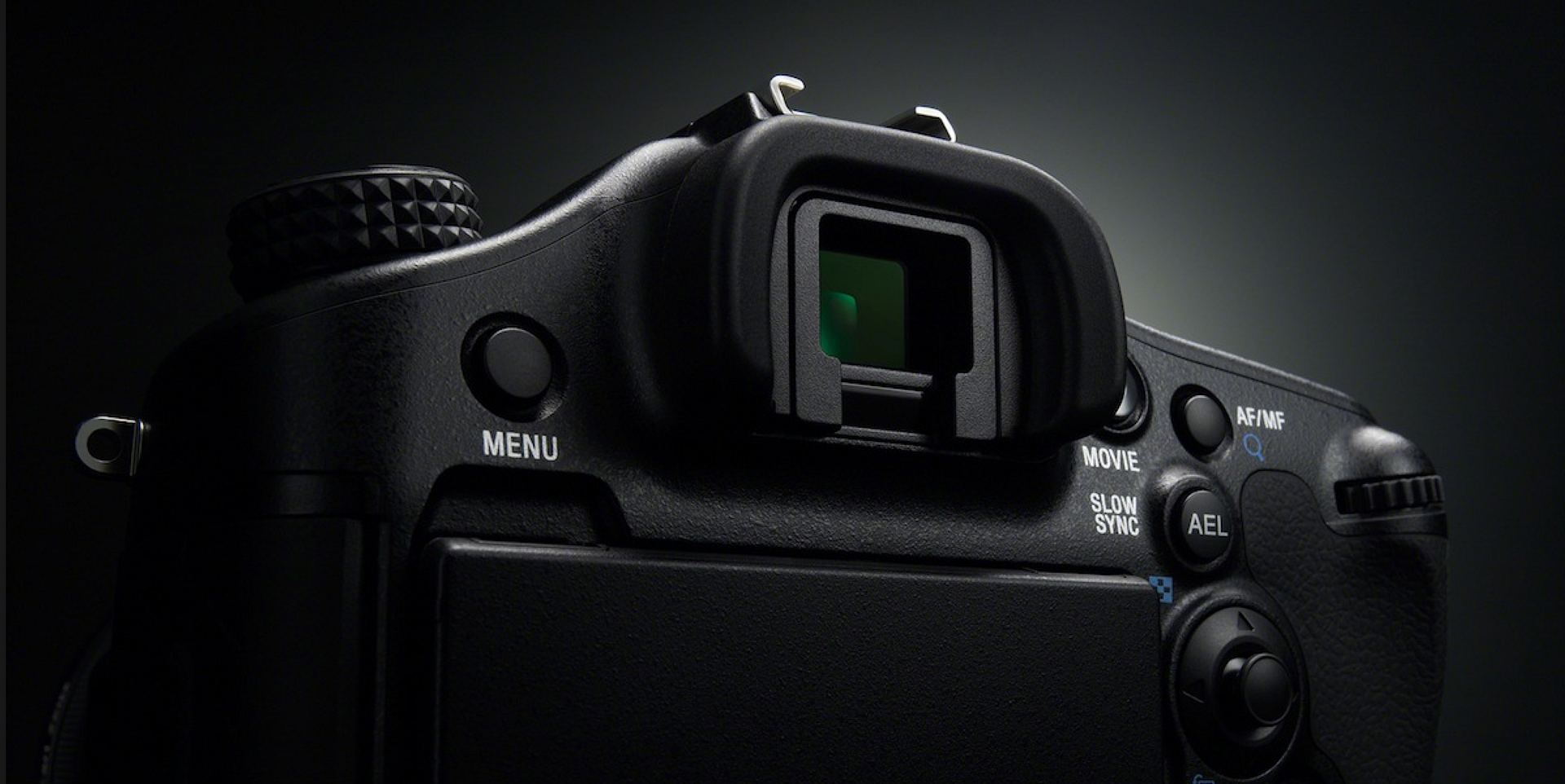
And the next source claims to know that the new generation A-mount cameras will feature a brand new EVF. This time the resolution will go up to around 4mio dot. And he also confirms that at least two A-mount cameras are scheduled for a Spring release!
We have an exciting time ahead of us! Wish You a good jump into the new year 😉
———
Message to sources: You can send me more info anonymously by using the contact form you see on the very right of your browser. You can also contact me directly at sonyalpharumors@gmail.com.
For readers: Subscribe the RSS feed (Click here) and Twitter (Click here) stream and the Facebook fan page (Click here) in order to not miss any news!
——–
Reminder (SR = Sonyrumor):
SR1=probably fake rumor
SR2=rumor from unknown sources
SR3=50% chance it is correct
SR4=rumor from known sources
SR5=almost certainly correct!
95 Responses
But will it be as energy efficient as before?
NEX needs bigger freaken batteries
Keep the same battery so all sony cameras will be compatable..a77/a99 batery…but wth new battery tech capacity only should be increased when its possible.
I assume you mean the form factor because the current batteries are not great.
It would be nice if Sony would release one long battery to fit in the vertical battery grips versus two standard batteries plus a caddy. The lone battery would be greater than the sum of the two individual ones.
I mean keep the size and shape identical so a new higher capacity battery would be interchangeable with the current battery.
I carry a total of 8 battries for 2 cameras and have NEVER run out in a single day of shooting no matter how many pictures I have taken.
Thats a substantial battery investment and I want to be able to use them for my fiture sony cameras.
I also want to only carry one type of battery that works on all my sony cameras.
Re-charging time also needs improvement.
A new litium ion battery technology claims to have 30x the capacity of the current ones and charge in minutes.
Put this new tech in the same housing as the old battery when it is available.
Will it be announced at CES or CP+?
That seems to be a good news, if batteries are powerful.
But if they want to match the pro market, the most important is to have a really pro-grade AF ! (D4, 1Dx, D800, 5DIII, 7D…)
Mirror killer 🙂
We need electronic (global) shutter to eliminate the last mechanical stuff.
Yeah that would be fantastic, especially for video.
In video you already have electronic shutter…
What would be great is full sensor output for video like the RX10.
he’s talking about electronic GLOBAL shutter (like the sony F55), not electronic shutter
Exactly, for the elimination of rolling shutter
Yeah full sensor read out would be brilliant along with the option to use uh XAVC S codec
The key difference between the Sony F5 and F55 is the electronic global shutter. Unfortunately it is an $11,000 difference. I doubt it is coming to alpha cameras anytime soon.
Hopefully this new EVF will also be in the Nex 7 successor.
I hope it is a mirrorless X700 like camera!
the X-700 wasn’t a very pretty camera… too plastic
Best tech for a camera that no one really needed?
Seriously, I wonder Sony keeps their line of A-mount being their top. They better connect to reality. A-mount is a way to nowhere.
Well I think it’s more for prospective DSLR buyers rather than existing Sony users. But I agree that some DSLR users will never be satisfied so there’s diminishing returns to this, and has to be balanced carefully with increased battery drain.
Wake-up call for you: not everybody is interested in toy E-Mount cameras.
A-Mount and SLT are the future!
Been selling like hotcakes haven’t they? 🙂
A-Mounts APS-C outsell the NEX/A7 by a wide margin. This will further increase as the entire line of A-Mounts completely transitions to fullframe. The A58, and A77 replacements will likely outperform the A7. They have the space to house additional electronics including the new steady shot system. The mirrorless cameras have not caught on and most camera companies that have bet their future on them are failing. Olympus will likely go next. Sony will ditch its NEX line well before the A-58 or A-77 or their replacements.
Nice try. Even retarded americans bought more nexes than alphas 😉
Provide your source of information or shut-up, cause I’m smelling a load of bull $h!t.
Nex outsell a-mounts by 4:1 worldwide. Although retarded americans only buy it more in 1.2 times.
A7(r) outsell crappy A99 in a couple of days after sales start.
The future lies with both A-mount AND e-mount, and it seems with A_E_mount hybrid, which is not e-mount sized.
“A-mount and SLT are the future”
Keep dreaming because it ain’t gonna be pretty for you when you wake up 😉
He’s actually telling you the truth. The SLT (A58/A77/A99) are Sony’s top interchangeable lens sellers, and their sales are actually increasing. More people are adopting the A-Mount annually than the E-Mount. The A7 was designed to boost E-Mount uptake, but NEX sales are down. NEX are low margin cameras and Sony doesn’t earn enough off the platform to justify its separate mount.
Maybe the NEX should adopt the A-Mount. The A-mount is winning on the sales floor.
Sales = Success
And A-Mount is very successful. It sells more full sized interchangeable lens cameras than Olympus, Fuji, Pentax, or Samsung.
I’m thinking a little longer term, in 2020 (just 6 years from now), I don’t think Sony (or anyone else) will be producing an SLT.
I’d wait for 2015. The 45mp mirror-less A-Mounts will be Sony’s Professional Cameras. They’ll likely be much smaller than the A99 but larger than the A7.
@LOL – speak for yourself. E-mount cameras are toys for hobbyists and nothing else. E-mount lenses are feature-limited and Sony is marketing them as cheap compact solution for compact cameras. Welcome to reality.
You are not very smart, at least.
When people want to buy pro equipment, they are getting canon or nikon, not sony.
So, this artificial product crippling is kinda useless: only a few buy A-mount stuff. And much higher audience of E-mount will know if they want to get pro equipment, they will better stick to canon or nikon, because Sony makes toys.
Well, this shows why Sony struggled to their losses, because it was their approach everywhere and it always fails. We will show the same thing after Panasonic/Fuji FF camera with much better lens selection.
Wrong answer. To see an A77 or A99, beside a D800 or Canon in a Pelican is very common.
Are you even qualified (Diploma in photography) to make that statement?
Sure I am. I am a great photographer.
LOL go troll somewhere else please.
Would you care to elaborate on Panasonic FF?
Yet another mount?
I like your signature… 🙂
This is consistant with my roadmap/prediction that we will see many camera inovations but only a few minor sensor improvements..if any for 2014.
I would like to see the 24mp exmor sensor in the a77 replacement be replaced by a c size 36mp exmor r sensor but i dont expect sony to put that much effort int sensor development until the new tech 54 mp sensor in late 2015/early 2016.
If thats the case my current a77 /a65 will need to last another 2 years.
Bleh, just dump the A-mount and head straight for the next AxR camera.
Compact full frame mirrorless is da future. 🙂
Some people prefer big bodies when you use a big lens like the case of many fast A-mount glass (135 1.8, 200 2.8, 300 2.8). If you like compact cameras, fine, I like them too (enjoy using my NEX-5 with small legacy lenses) but when I use a big aperture lens, the NEX-5 isn’t good enough (unless I bring my tripod. But then I feel limited, and that’s why I bring my a850 for that. aX series for small lenses, aXX for big lenses. Everyone happy.
+ 1
i shoot surf, own a A77, and SLT’s are miles away from mirroless in action/sport photography
diferent jobs, diferent tools
wouldn’t the A7r, vertical grip, and LA-EA4 adapter be better?
What’s the point of doing that when you already have an SLT?
Pros:
– Selling the A77/99/whatever to have one (modular) system
– Newer, better sensor?
– 36MPs
Cons:
– losing IBIS (though likely not an issue for surf photography with bright light and fast shutters?)
The pros would have to bring more than that to swap bodies, make a loss in cash and make me use an adapter for my A-mount lenses.
In other words, there aren’t any pros but plenty of cons. 😉
FF mirrorless, but not necessarily compact
Sony needs to bring new optics… still… 😉 and better steady shot with tele optics too … 😉
I can’t say that in the several hundred hours I’ve spent shooting with the A77 I’ve ever looked through the viewfinder and thought “I wish this EVF had higher resolution”
Agree!…yawn…
Agree too!
perhaps not, but I expect that you’ll find the new higher-resolution VF a joy to use, and won’t want to go back
Agree with this too!
Agree!
Please provide a low lag , high refresh rate mode as well. Even at the expense of resolution.
Resolution is cool but makes very little when framing.
I wonder when the other manufacturers will get on the EVF bandwagon.
“I wonder when the other manufacturers will get on the EVF bandwagon.”
I must admit to have been firmly in the OVF good EVF bad camp. Until I started to use them and though for a number of uses I still prefer the OVF. I have to say when I go from my E-M1 to my D800 I miss the EVF a lot more than the OVF when I go from my D800 to E-M1. The additional information and the benefits for video are major advantages for me along with the magnified view for manual focus.
Yep, same here. Given that EVFs are getting better and better, that video is clearly here to stay and is becoming more and more popular, and that newcomers would have started taking photos on phones and compacts, it only makes sense to ditch OVFs. That said, I hope DSLRs won’t share the rangefinder’s fate.
4 million dots = marketing speak for 4/3=1.3 million pixels
1280×1024=1.3 million
So from 1024×768 to 1280×1024… what a surprise!
Not the same ratios. But using your numbers that is 67% jump in resolution.
No it is not. To correctly calculate the jump in resolution, you have to take the square root, so it is sqrt(1.67)=1.29. 29% more.
Switch your monitor to 1024×768, then to 1280×1024. Is it so much better?
Yes, it is a nice improvement – but nothing to get too excited about.
If the finder gets bigger in size then it is a noticeable improvement, more space to put the information outside the framelines.
Exactly, an “improvement”.
More incrementalism, giving us something that isn’t really needed, while ignoring the fundamental weaknesses of the current EVF system.
Thanks for the correction. Tough times around the holidays.
Sony a58 replacement at the entry level.
Please Sony… a larger burst cache and better LL performance out of the next SLT!!!
Excited to see what’s coming for A mount . Hopefully they will have a better AF spread for the FF . I love my a99 , but wish the AF point spread was bigger .
Just curious, which FF cameras have an AF coverage area outside the APS-C box?
I find the res/clarity is already good enough with the A7 EVF. I’d rather have higher refresh rates to avoid the mushiness while panning but having more dots is counterproductive for that…
Sounds more like something that some marketing people came up with. Are we know going to see the megadots race now that the MP race has slowed down?
More dots in the evf will always be welcome but I am really hoping for better contrast ratios and less lag. Especially, I wish for an end to the slideshow effect when shooting at high frame rates.
Come on Sony, impress us!
EVFs on still cameras is still pretty young tech, but sony’s implementation is already vastly superior to Canon live view. All the kinks will work out as it matures.
Exactly. Lag in low light and slight show effect in high speed continuous shooting are far bigger problems than the number of MP in the viewfinder. Resolution of the current EVF’s in the high end cameras is not an issue, overall performance is. Add to that the far poorer battery life that EVF cameras present, and how long it takes the camera to start up from sleep or when turned on, and these are real-world practical issues that deserve to be addressed. The resolution of the current top-line EVF’s is certainly sufficient (I have never read or heard a complaints that the resolution of the EVF in the A77, A99, NEX 7, A7/A7R is not good enough). If Sony does not fix the practical problems of the current generation EVF cameras and just increases the MP count it will provide further evidence that it doesn’t understand the needs of photographers shooting different subjects in a variety of conditions.
You’ve made a severe criticism “Sony should learn something from Fuji….how to make firmware upgrades!”
On the otter hand, it’s SAR which stirs up the rush of those new products from Sony who put a greater deal of effort into the new than the past.
Yeap! Thats weird, but you are so right. May be what we would like sony to do is improving their customer and camera support, and I’m not talking about new firmware only, until major-leap improvements are achieved so it would be time to come up with a new body. But again, that’s not sony’s way. They just think about a 4mio dot EVF that won’t have real and better repercussions in photography.
If only their support team were just as good as the marketing team, Alpha would have another place among professionals, who would take them more seriously and make long-term investments with confidence in the brand, just as in canikon.
i cant wait to upgrade my A900’s… home this new Amount has what im looking for!
I tried out the A7r at the Sony store and wasn’t very pleased with the EVF – its just not as detailed and the dynamic range isn’t there. Being able to magnify the view for fine focus is awesome, but overall it didn’t win me over. When I look through an OVF it feels like there’s nothing between my subject and my eye – not so with the EVF. I really look forward to the next gen of higher res and dynamic range EVFs, but I’m keeping my a900 for now.
Admin, your site seriously still spamming (on iPhone iOS 7). I am not downloading candy crush saga no matter how many redirects the site sends.
Admin
I continue tp have the same problem with google new account form redirecting me from my android phone.
This happens every nite but does not happen during the day.
shit.
Really? Damn it. Something must be went wrong in code. I have no issue like that!!!
More pixels means also more dynamic range, more accurate colors and in many ways more lifelike view.
We are almost there that EVF has bybassed the normal optical vf.
Lets hope the FF camera specs in all areas will be in good shape.
We dont need more pixels, we need good AF, good IQ, good speed and battery life.
Add gread video and we are there!
Thats all.
While improved dynamic range of the EVF would be a considerable benefit/help, there are other issues that EVF’s present noted in my previous comment (lag, slide-show effect, long start-up/wake times, and poor battery life) that also require addressing before EVF’s can be considered to have by-passed the best optical viewfinders.
4K w/ zero lag EVF should bring it closer to Pentaprism quality. Hope that resolution will help at night and help reduce graininess. What’s more important is dual CPU, better high ISO than Nikon DF, 4x buffer, better battery life, faster AF with points across the entire screen, 15FPS, tethering, wifi, 36-50 megapixel, 4″ OLED screen, A-Mount or hybrid.
With all of Sony’s high tech and advance sensors, why can’t they surpass the overall picture quality & overall performance of CANIKONS. Easy formula, surpass the D4 and 1DX in every way and price it reasonably = #1 camera.
The Sony A900 provided about the same image quality, using the same sensor, as the Nikon D3x at less than half the price. It didn’t even come remotely close to the sales of the Nikon D3x. On a worldwide basis, in still photo gear, Sony has neither the name recognition, nor the advertising of Canon or Nikon. The formula is not as easy as just equaling or surpassing Canikon at a lower price. They simply do not have the entire system infrastructure in place from the perspective of lens selection, marketing, service and repair, and therefore name recognition among photographers, on a worldwide basis.
Yeah. It’s not that easy. When you have money to spend on a camera system – the bodies really aren’t the most important element.
Sony has a so-so lens line-up that is very expensive with a weak-ish used market. A terrible (I mean TERRIBLE) flash system. A not-so-good reputation for reliability.
These are enough to make some people avoid the system – even if Sony had the “best” camera in the world for $1,700.00
It’s not just that, but the SLT design does cause a light loss to the sensor which means high ISO performance will lag behind cameras in which the sensor receives all the light. Additionally, for whatever reason, Sony’s bodies don’t seem to have quite the resolving abilities of cameras with comparable sensors, which I assume has more to do with how Sony’s cameras process their RAW files rather than the lenses. And you can largely forget about Sony’s jpeg files, as Sony has long had an inability to provide high quality jpeg files compared to the competition. However, the differences are ultimately relatively marginal, and in normal usage it would be very difficult for most people to tell a Sony taken photograph apart from a Canon or Nikon taken photograph.
The current problems with Sony’s flash system are very real, and do have a real-world negative impact on photographers using the system, often requiring them to find work-arounds to avoid the overheating issues, or wireless delay, or other matters. In fact, with the release of the A99 and F60 the problems got much worse, not better, and Sony has yet to even acknowledge the problems, let alone do anything about solving them.
all the slt cameras suffer from delay using TTL (apparently because the camera meters pre flash off sensor which is a slow process). I agree it’s a big deal and they need to fix it in upcoming models. still, most studio shooters don’t use ttl anyways. what I don’t understand is why everybody are so upset about one out of many flashes is having problems with overheating? first of all, afaik lots of flashes overheat, though most of them less badly than the f60, and second: there are other flashes to choose from. to me, the f60 issues doesn’t necessarily have to mean the whole system is crap. doesn’t the Sony/Minolta system have it’s unique benefits as well? I’m not an expert, just asking.
OSC raises different points. All DSLR cameras, whether of the SLT design or conventional design, use a pre-flash to determine proper flash exposure. Thus, Sony is no different than Canon or Nikon in this regard. Why the camera may be a bit less responsive (i.e., some degree of lag between pressing the shutter and the shutter actually releasing I can say, other than the A99 in general has a somewhat sluggish response to a variety of control inputs. It may be that the processor in the camera is tasked with controlling so many different things at the same time that it causes a bit of delay (an example is formatting a card, where for each step of the process you have to wait for the camera to respond to your input selection). But, it’s not true of every function (e.g., scrolling through the menus doesn’t seem to have the same lag). Thus, it equally could simply be a function of the camera firmware and how it works.
As for most studio shooters not using TTL flash metering – so what? Most photographers shooting with flash are not shooting in a studio. This includes folks doing something as simple as taking family photos to professional (or semi-pro) shooters doing event work where reliable flash is critical.
As for the overheating problem of the F60 flash, it is far worse than any prior Sony flash I have owned or used, or what I understand about all the others, including all prior iterations of the top-end flash unit (e.g., F56, F58 and F60 flashes, and the Minolta flashes before them). Yes, all flashes will overheat with very heavy use, but the F60 overheats with moderate or less use. It overheats – or more accurately shuts down because it thinks it’s overheating – far too quickly an in circumstances that other flashes do not overheat. Because it is the top-end flash designed to work with the new hot shoe on the A99, and because the flash shoe adapter fails in regular usage when any comparable flash having the old shoe is used, the defects in the F60 are a fairly serious problem. To my knowledge there is no third-party flash that has the new Sony flash shoe, so using any of them on-camera would require use of the adapter, which itself is flawed in its design and will fail in the course or normal shooting (because it does not securely lock in the shoe and any slippage results in a loss of electrical contact). Another reason why the problems with the F60 flash are so annoying is that it does have some unique features, notably how the flash head rotates and adjusts its position. So, while the “whole system” may not be crap, the change in the A99 to the new flash shoe and the design flaw of the F60 have created all sorts of issues and problems for many photographers. While there are some work-arounds, it should not be necessary for such integral equipment to require the photographer to have to figure out what they are and how to use them.
thanks for clarifying some things. indeed, quite a lot of the problems mentioned should be easily fixed by releasing more flashes, with the new shoe on them.
now, what I meant to say about the delay was that dslr:s use a dedicated light meter for pre flash, but the slt cameras use the image sensor to meter pre flash. I guess that is what causes the worsened delay between pre flash and exposure.
Happy New Year!
@BRWAT
Sales figures in japan. Mirrorless sales took 40% of the ILC market in japan and Sony has 26.3% share of it. So, about 10% of the whole ILC market just by their mirrorless cameras. On the contrast, best selling SLT only has 1.9 percent share from DSLR market. Not to mention the A7 selling much-much better than A99. This is clearly visible from Sony last actions: they do most moves on E-mount area, not A-mount, where they cannot compete canikon.
http://translate.google.com/translate?sl=ja&tl=en&js=n&prev=_t&hl=en&ie=UTF-8&u=http%3A%2F%2Fbcnranking.jp%2Fnews%2F1312%2F131227_27056.html
Higher Refresh rate (120Hz?) and Lower EVF delay (<20ms) would be desirable for shooting moving objects!
As for 4 Million Dots EVF, is it 1280x1024x3Dots?
MicroOLED makes a better EVF (RGBW array) at half the power consumption:
http://www.imaging-resource.com/news/2012/01/27/new-evf-makes-it-clear-the-optical-viewfinders-days-are-numbered
Being heavy a99 shooter (ca 40 000 frames in last 9 months), I’d prefer beter high ISO sensor (t same 24MP resolution), faster CPU and buffer and mainly more responsive joystick. EVF is very good already.