







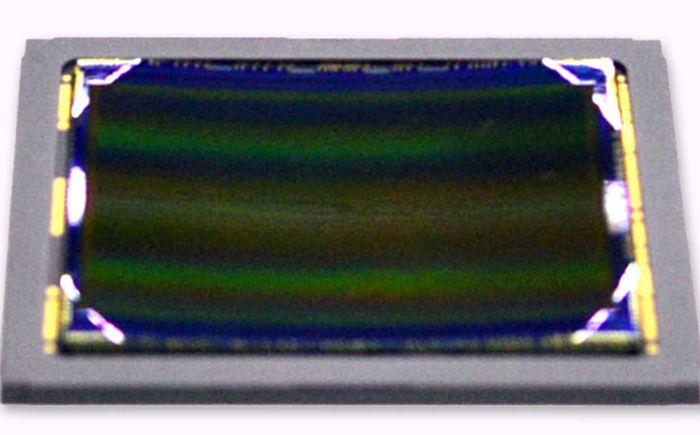
Sony curved sensor image via Spectrum.
First a recap: The A7000 and the A7rII have been rumored to be released in early 2015. But so far it seems that Sony had “production issues” on those cameras and the release keeps being pushed back in the hope they will fix these issues in the meantime. In the case of the A7000 we think to know the issue has to do with extreme overheating. The latest we heard from trusted sources who usually get right info from Sony is that the A7000 is at least coming within June. Please note that I got this kind of information from different good sources who shared correct info in the past. But this doens’t mean Sony can change their mind and schedule for a number of reasons we don’t know yet.
A7rII: I now got a very strange rumor from two different new sources. This means that you have to take them really as a very “wild rumor”. But sometimes wild rumors become true (A7S with half million ISO and Autofocus Zeiss Batis line were two of them). The two sources met official Sony A7rII testers. And they have been told in an “Informal” conversations that this will be the first Sony FF camera having a curved sensor. Now, I have to say I would be extremely surprised if the rumor turns out to be true! So far I have only found patents describing such a FF curved sensor for a fixed lens RX like camera. I don’t even know if current FE lenses would work on such a camera and if yes how Sony has solved that problem. One of the sources said that the FF curved sensor allows increased corner sharpness performance with all third part and current FE lenses.
P.S.: So far the only “real” Sony camera using such a sensor is the [shoplink 37134 ebay]Sony kw1 selfie cam[/shoplink].

Recap of curved sensor news:
First real world Image of the curved sensor from Sony (SAR article here). RX2 with 35mm f/1.8 lens and curved sensor (SAR article here).
VLSI Symposia tipsheet (via ISW) explained better how this sensor works:
“Curved CMOS Image System: When light transmitted by a lens strikes a perpendicular target such as a CMOS image sensor, it forms a circle of light called an image circle. It’s difficult for a flat (planar) CMOS image sensor to deliver high image sensitivity at high resolution (highly scaled pixel pitch) because of the fundamental physical limit known as quantum efficiency. To break through that physical limit and to achieve higher sensitivity anywhere within the image circle at higher resolution, Sony built and will describe an imaging system that comprises a hemispherically curved, back-illuminated CMOS image sensor (BIS) and integrated lens. It doubles the sensitivity at the edge of the image circle while increasing sensitivity at its center by a factor of 1.4, with a 5x reduction of dark current (Jd) compared to a planar BIS. Moreover, a common problem known as lens field curvature aberration (Afc) is mitigated by the curved sensor itself, and so the curved BIS enables higher system sensitivity with a brighter lens with a smaller F number (Fn) than is possible with a planar BIS. In addition, by controlling the tensile stress of the BIS chip to produce a curved shape in the first place, the energy band-gap (Eg) is widened and a lower Jd is achieved. (Paper T2.1, “A Novel Curved CMOS Image Sensor Integrated with Imaging System,” K. Itonaga et al., Sony)“
In Summary:
Back in June 2014 Sony said they are ready to produce curved sensors in mass scale (Article here). And there are plenty of patents showing how it works. But so far we only saw them “applied” on a fixed lens RX camera. But if Sony really managed it to make it work on the A7rII and current FE lenses than chapeau. This yes would have been worth the long wait for the A7rII. But for now let’s be clear that this might only be a dream for now…
–
Stay tuned on SAR and subscribe the newsletter to get info when it matters:
[wysija_form id=”1″]
To not miss any rumor quickly subscribe our social network:
RSS feed: http://www.sonyalpharumors.com/feed/
Facebook: https://www.facebook.com/sonyalpharumors
Twitter: https://twitter.com/SonyAlphaRumors
GooglePlus: https://plus.google.com/104216500156717934391/posts
If you have some “rumor” to share just send me an anonymous messages here:
at sonyalpharumors@gmail.com or use the contact form you see on the right top of this site.
Reminder (SR = Sonyrumor):
SR1=probably fake rumor
SR2=rumor from unknown sources
SR3=50% chance it is correct
SR4=rumor from known sources
SR5=almost certainly correct!
218 Responses
If this is true, the current lenses can be used on it?
I guess this depends on whether they were designed for it in mine or not. Many say ‘not’, but the thing is many say many things that are just not correct. It is entirely possible as they KNEW this tech was coming.
Only if you accept very unsharp corners with current lens.
I can imagine the drawing is for new RX1.
But there is the possibility that the on-sensor micro-lenses are angeled towards the corners – but still plain on a plain sensor.
In a short answer ‘YES’.
IF and that’s a big if, Sony is coming out with a curved sensor to be used in FF ILC – there is NO way Sony is going so make the existing (F)E-mount lenses non-compatible. Or used but with degraded IQ, for that matter.
And the way they have been rolling out new FE-lenses the past years, they are most definitely not bringing a new line of lenses only to be used for curved sensors.
Yeah, this seams like a really far fetched rumor for the upcoming A7rII.
However, the only way I would be happy to see Sony adopt yet another mount is if it was for an interchangeable system of prime lenses for a curved sensor. That may be many years away, but the size and quality improvements might make curved sensors the future of photography down the road.
We’re not there yet. And as I understand, current lenses designed for a flat image plane cannot be used on a curved sensor.
Also, I wonder how a curved sensor increases the complexity of 5-axis IBIS
Well, legacy lenses will work. Simply their field curvature should be compatible with the sensor.
Film is flat. Like all flat sensors. I don’t see how legacy lenses designed for an image circle on a flat surface could work with a curved sensor.
‘designed for’ doesn’t mean ‘effective at being’. Very few lenses are flat field, very few. Which may very well be the point.
If you’re cool with very blurry corners and edges. We won’t have to wait long to see if this rumor has any merit.
Like IBIS on E-mount too right?
There is a difference:
IBIS works on any sensor – has nothing to do with mount.
Nobody with technical background said IBIS for E-mount is impossible. Most people just believed it will not happen because Sony decided to put IS into lens only, like Canikon.
Curved sensors need different lens designs.
No existing FE-lens, E-lens and no adapted A-Mount/Canikon/M-Mount/Any-Mount will have sharp corners anymore.
BUT: IF (and it is a big IF) Sony places a lens-elements in the body between sensor and mounted lens, it could work. But this IF is so big, that I doubt it will happen.
OR: The curvature is so slight that is almost plain and just marketing speaks of a curved-sensor-revolution – but without any optical impact 😉
No, most people thought it was “impossible” because they claimed there wasn’t any room left for the sensor to move within the mount diameter (which was a nice sequel to the argument for the E mount that it was too small to fit a FF sensor to begin with).
You on the other hand are falling for the assumption that a slight curvature cannot help reduce or compensate for an existing curvature on almost every lens available. That last part is a fact you must have overlooked…
I remember that most people thought IBIS was “impossible” – luckily I am not most people. I often disagree with most people and write unpopular statements.
Sigma claimed in a dpreview interview, the E-mount diameter of 46.1mm is a bit too small for FF sensors. That would make lens-design more complicated as necessary. But they did not mention that it is no problem to produce FF-lenses for Nikon-F mount with 44mm diameter. (Hmmm???)
But that wasn’t an IBIS topic at all.
Diameter+IBIS? increases vignetting when IBIS has to work a lot. But this is better than an unsharp picture without vignetting. And if the camera is hold quite still or mounted on a tripod, you have no more vignetting as without IBIS.
Room for sensor-movement? Because the sensor is not inside the mount, the mount cannot influence this room.
I have also been making similar comments since nex came out, and my comments are highly critisized.
When I make comments that people are not yet ready for they are highly critisized…for being impossible and not going to happen…as time goes by they are less critisized as being impossible, and more critisized as being redundant or so obviouse that anyone could have predicted it.
True
“The horizon of many people is a circle with radius zero – that is what they call standpoint” (A.E.)
Oh – the slight curvature, I meant:
What I wanted to say: if the sensor has a curvature that is so minmal that you can only measure it with a hightech-laser-tool but is almost plain – then it is a PLAIN sensor, but marketing is allowed to speak from a curved sensor.
I have stated in several comments here ..as you are saying..that I do not believe a modestly curved sensor will be detimental to any current lenses..see some of my other comments for details.
The lenses are opted to work with a flat sensor surface.
During the change of the focus alone there can already be a change in the curvature. That’s why you find lenses that are perfect on test-charts with a predetermined distance from the camera – but it can happen that these lenses lose some corner-sharpness when focused to infinity.
Indeed VERY FEW are flat field within the complete focal range, but maybe every lens has a certain focal length where it is almost flat fielded.
This is probably a miscommunication. Curved sensor with the current lenses makes no sense.
They were probably talking about how micro lenses and filter stack is optimized to cope with angle of incidence at the corners of the sensor.
100% agree
But then the drawing in the rumor is wrong. Or made for RX1 successor.
would simply be great, curved sensor, 5 axis IBIS and compatibility with all E-/A-mount lenses… a killer for architecture and landscape photography no one else could match for at least some time…
but personally I see some issues with the compatibility
IBIS for architecture and landscape photography? Huh?
low-light conditions??? simply longer shutter speeds possible… I use the IBIS from time to time and I am pretty sure I am not the only one. Much handier than a tripod…
While IBIS is great to have, for critical work, better use a sturdy tripod in my opinion (talking about real estate, architecture photography here).
IBIS is never bad
Ever tried to take a landscape photo with tripod – standing on a bridge, and the bridge was always a little vibrating because of traffic?
I did – and I was happy to have an OSS-lens 😉
Never said IBIS is bad.
It’s like seat belts or ABS on cars: a blessing when you need it.
BUT it won’t help you during critical situations such a longer exposure (iI was thinking about a restaurant, camera on tripod with a 5/7 seconds exposure to blur people faces and transfiorm walking waiters in ghosts).
IBIS will always help you, but if I had to take some architecture photography I would choose a tripod and a TS lens.
One of the least believable things I’ve ever read on here. All of the current lenses are designed to present a flat image to the sensor. While existing lenses would work, they would be WAY out of focus at the edges, and any new lenses designed for a curved sensor would perform similarly terribly on existing flat sensors. Same goes for pretty much every other camera lens ever made – all designed to make as flat of an image as possible, be that onto a sensor or film.
It would divide the platform in two and to be honest probably kill off Son’y camera division. A 500mm f1.4 lens would be more believable.
well.. A and E mount already kind of divided the camera marked of Sony. At least only the way A–>E-mount is possible. Why not dividing it more, with the B, C and/or D-Mount system…. 😉
In theory ILC with curved sensor is best.
In practice it is very very hard to introduce such a system on the market:
It would be a huge investment to bring enough lenses for the first curved sensor interchangeable lens camera on the planet. No existing lens design currently works – every lens has to be developed from scratch.
When E-mount (and FE) was introduced, the lack of lenses was the weakest point of the system. But for current E-mount there was the possibility to adapt existing lenses – with curved sensors: no way
Don’t worry, Metabones will make an adapter to use flat field lenses on curved sensor cameras.
Metabones cannot make adapter for eMount->eMount.
But anyway: it’s a SR2 rumor, it will not happen, but it’s fun thinking about^^
That really really depends how curved is curved now doesn’t it? Fact is most ‘designed to be flat’ lenses aren’t flat. This could be curved to compensate for that, rather than require all new lenses.
Yeah, but current lenses are not uniformly non-flat, so fixed curvature would help with some lenses and make others worse…
True, but maybe the current ones for FE are?
Even if they were, there are also Zeiss lenses, which are not designed or manufactured by Sony, and that would kill the support of lenses from other mounts, which is a big selling point of the system.
Well lenses are not flat, or very few are, so this means Zeiss too.
Otherwise current A7 line will always be popular!
I’m not interested in a Sony camera right now, but just curious about everything is photography related. So: what if existing lenses could be used without problem by simply adding some kind of converter?
Exactly. There is no uniform “correct” curvature, and most aren’t even a straight curve anyway.
Also generally higher quality lenses tend to have flatter fields and low quality lenses highly curved fields, so making a change like this on an existing system would ironically make most good glass look worse and some (but not all) bad glass look better.
If at all, I would guess the bending is so less, that it is hardly possible to see. Silicon is so brittle, you can’t apply much stress to…
but that’s only a guess; maybe the do use some kind of etching and/or polishing to increase the curvature
Yep, guess is it is tiny. But that would be enough to make a solid difference especially if lenses ‘couldn’t’ be designed from the get go to be flat, but could be designed to offer a fairly uniform curvature. Also may very well help with smearing, which may be more disruptive than slight loss of sharpness from an incorrectly (minor) adjustment for field curvature.
just another strange idea… if it is not static but dynamic the camera could adapt the sensor to a lens. Just like the VLT main mirror is beeing adapted in real time. Piezo actuators can do that, but I really think the stress for the silicon could be too much…. but if it’s really a thin layer and only very small amounts of bending; one could also imagine for corrections of not perfectly centered lenses…
Let me dream! 😉
I think Sony already stated that after bending the sensor the curvature is stabilized by a ceramic substrat, so no thin souple layer.
The only way I see the actual FE lenses still working on a curved sensor is that the curvature compensate only for the correction applied by the microlens layer.
In particular, the 24-70mm and 28mm FE lenses have horrible distortion. Now, does distortion and field curvature both easier handled by a curved sensor? I admit, my optical knowledge is only guessing.
Let’s imagine something like an ” Optical tracking telescope compensation” 😉
Maybe they found a way to modify the curve of the sensor according the focal. but in this case : where is the patent 🙂 ?
I guess that would also explain the A99mk2 delay. My bet is that Sony wants all of its future stills cameras to also do 4K video using H265, but their processors are two weak for that. They HAVE to solve this, however, as competition is already ahead with the GH4, suitable for those who need 4K but don’t want to carry an extra device to get it.
Ah who says ANY of what you just said is true?
This is my interpretation of latest rumors. None of it and/or all of it is true.
Two questions:
Who said A99mk2 is delayed?
How is your post related to curved sensor for A7Rmk2?
“The A7000 and the A7rII have been rumored to be released in early 2015. But so far it seems that Sony had “production issues” on those cameras and the release keeps being pushed back in the hope they will fix these issues in the meantime.”
This is the part I was referring. An earlier rumor said that the A99mk2 was supposed to be announced along with the a77mk2 (people had models of this to play around with after all) but Sony decided to delay to introduce more advanced features.
Don’t forget that G7. At 799.00 it’s going to get a lot of people on the 4k bandwagon.
For sure. Connecting a hard drive with its own batteries, effectively creating a rig can be too much considering that you also have to rig some sort of sound solution.
This year has been an odd year for Sony with no interchangeable lens cameras released only lenses. No one would have have picked it especially considering the old joke that Sony releases more cameras than lenses. There is so many posts about should people wait in buying a new Sony cameras round at the moment.
Maybe Sony felt that with all these lens releases the system is now complete and its time to start a knew one 😉
we still have six months left….
This is a SR-1 (minus 1) rumor…
Guess so, too.
Because afaik the curved sensor would require a new lens system, and I doubt, that Sony would go for a new system with a mark2 of an existing camera type.
Maybe the “testers” tested a RX2 (or whatever the name would be).
I for one, am all for this. A new mount will allow much smaller lenses to be used with this sensor. Complete game changer. Sony risks losing FE users, but I hear the new camera will come with an “amnesia” kit that will allow you to forget your previous Sony mounts/lenses.
sounds like a hard time for my liver 😉
Do you even still have one left?
with all due respect, folks, and I almost hate to say it, but there is no such thing as a lens designed for a flat sensor! it just so happens that this is the easiest sensor to make.
think of the human eye, which has a curved everything.
& then, if a flat sensor is always in the same place and yet always gets an image of the same size for any lens, how hard can it be to design a curved sensor that does exactly the same thing?!
“…there is no such thing as a lens designed for a flat sensor…”
I really want to get an idea of what you are trying to say, because I have the feeling that you have indeed something useful to say; but the above sentence is such a outrageously ignorant bulls*it that I almost can’t stand it.
Possibly the OP meant there is no such thing as a lens with a perfectly flat focal plane. Which would be fair enough. However, as written it’s clearly nonsense. Lenses have been designed to work with flat sensing planes (plates, film or sensors) throughout the history of photography. It’s just that the degree of compensation varies (from none to a lot), but can never be perfect.
There there are image-space telecentric designs where it’s meant to be irrelevant, but that’s a whole different issue.
>There there are image-space telecentric designs where it’s meant to be irrelevant
I welcome your share of nonsense.
Any lens can be made image-space telecentric by moving aperture stop to its front focal plane. This doesn’t cure field curvature.
The human eye isn’t very relevant. The only part of the retina which sees detail is the foveola, which is in the macula. It’s responsible for the high resolution part of our vision and is only about 0.35 millimetres across. It only covers a very small part of our central vision. Vision outside this area loses resolution and fall away to the periphery. As such, edge resolution in the eye is unimportant.
That we have an impression of a sharply resolved world is just an illusion. Our brains are automatically wired, during the development of visual perception in very early childhood, to perceive sharp vision only in that very small part of the field of view which the eye is capable of resolving in detail. It is so automatic that we don’t notice it.
In contrast, cameras are expected to capture images which are sharp across the frame. Our eyes simply are not like that. In fact I would think that if our eyes were optically tested for acuity at the periphery of our vision independently of the retina’s ability to resolve it, we’d find the eyes’ lenses are very poor. Field curvature is real enough on a simple lens, but it’s very unlikely that it is anything like as much as the eyeballs curvature. In evolutionary terms it was probably much more important that the eyeball can be rotated in two axis (dictating a sphere) than we achieve sharp vision across the retina.
It’s interesting to imagine what we’d be like if we had evolved with flat retinas and excellent peripheral acuity. In those circumstances it would be unnecessary to have rotating eyeballs. We could have switched attention completely in the visual cortex and this would have been far quicker than moving eyeballs. However, very probably the amount of “wiring” and processing required would be inefficient and, hence, we evolved to concentrate acuity on a relatively tiny part of the retina.
So, in short, forget the eyeball for edge acuity. It simply isn’t “designed” for it.
The human eye is totally rellevent!
Cameras capture 3 colors only…they do not capture the full electromagnetic spectrum.
We are FOOLED into thinking this is a color photograph because thes are the same 3 colors the cones, that make up the color sensors in our eyes, are sensitive to.
Cameras are in absolutely no way desighned to produce an image that in any way resemples the real object…they are only desighned to mimic what the human eye sees.
That has always been the case since cameras were invented.
The closer a camera mimics the human eye the more realistic we will BELIEVE a photograph is.
It may have escaped your attention, but this comment was about field curvature and edge resolution and precisely nothing to do with colour perception.
If you want to discuss colour response, then that’s fine, but not by responding to a posting that has nothing to do with the subject at hand.
So to repeat the point for your benefit and make it absolutely clear, the human eye has not evolved to have excellent peripheral acuity and is therefore very different to the way cameras have been designed in this respect.
I missed nothing but apparently you have
The human eye sees a sharp central image and has extentive peripheral vision that focuses to infinity.
Even when looking at a close up obect our peripheral vision works quite well with distant objects.
A curves sensor will better focus on distant backgroun materiel while being sharp on closer central objects.
Both in construction and function a curved sensor performs more like the human eye..since the entire function of a camera is to comvince us that we are looking at what our eyes see the simmilarities to the human eye are always totally relevent.
I just assumed that this was so obvious that I would not need to go into more detail.
Yes, the “Eye-argument” is always a good one. It’s also very relevant for when people say that one can’t create smaller lenses with low F-numbers. It’s even applicable for topics such as autofocus, image stabilization and dynamic range.
Do note that the eye has a pretty great sensor behind it though. The sensor is so advanced that it even can interpolate things that aren’t visible and use memory to predict how something looks, acts and what dimensions it has etc.
A lot of that has to do with the highly advanced central processor
I’m sorry but you don’t know the main problem with human eye.
Silicon chips sent data out throw small number (a few dozen) pins, while eye has separate nerves from retina to brain. In order to reduce number of nerves, group of receptor cells share a nerve. So it makes any extra resolution unusable — so it were no selective pressure to develop visual acuity on periphery.
You have a habit of making dispute when none exists. I’m well aware that the visual cortex of the brain is not wired up like optical sensors in the same way that the brain doesn’t work like a Von-neuman architecture computer.
So would you stop your obsessive contrariness for its own sake. What I said was that the eye, visual cortex and visual perception has evolved to optimise acuity only in the central part of the eye. It’s probably much more efficient that way as a system that had equal acuity over the entire retina would require too much processing (read dedicated part of the brain and the size of the visual cortex). Whilst such an eye might have some evolutionary advantage, it’s almost certainly vastly outweighed by the disadvantages. Which is essentially what I said when speculating on what the nature of an eye with high acuity over the entire FoV might look like.
With respect:
As films and up to now all sensors are flat, lenses are designed for that flat surface.
The human eye has a curved sensor – and it works with way less lens elements as a camera-lens 🙂
It’s possible to copy the human eye with a simple lens design and a curved sensor – and it will be a gamechanger. But I doubt Sony will change an existing system. They can do for a uber-RX1 with fixed lens.
A problem with field curvature is that it is often bent in the opposite directions for the tangential and sagittal planes.
Of course, sometimes lens designers intentionally introduce astigmatism to trade for other improvements, but this is completely irrelevant in this case.
Nobody intends to use curved sensor with flat-field lenses, it’s supposed to be used with completely new design.
By opposite I mean one can’t improve both at the same time. And by often I mean always, almost.
Your argument is ..though correct…totally irrellevent.
One plane is parrallel to the center of the lens and is therefore totally immune to field curvature issues.
The other is perpendicular to the image center and is therfore the only plane that can exerience coma , vignetting etc.
So while your comment is correct it is totally irrelevant.
Dmtry
I strongly dissagree that your assumption that the curved sensor is not intended to be used with flat field lenses.
See some of my other comments for more details, but this would simple put more background in focus isince the subject is usually closer and centrall located.
In no way will it lessesn the image quality, and in many ways it would improve it.
In the case where these “improvements” are actually detrimental to what the photographer is trying to achieve they would simple choose a differrent camera for that usage.
I can in fact easily see several circumstances when this would not be beneficiall, but far more cases where it would be.
If new lenses where introduced specifically for curved sensors then we would have the choice of using either type of lens on a curved sensor camera.
I am often DOF starved too, however, usecase where curved sensor fixes it is fairly rare. It this case, variable field curvature lens is the better way
You and some others mention a variable curvature sensor.
There is absolutly no indication that anyone is even close to the technology to make that happen
Contrary to the rumor wrt compatibility.
Although I agree thi rumor is unlikely…if sony introduced curved senor it would probably not be called a7rii..
Lets look at how this might possibly work effectively.
First this would have to be a BSI sensor…which is not currently used in ff.
This means increased light sensetivity and is particularly advantageous for extrmely high resolution.
Assumin a relatively modest curve it would inprove sharlness on lenses that currently are not perfectly corrected for flat field.
The question is what happens with a really good lens ehen used on a curved sensor.
The image is not actually degraded because the focal plane is not flat, but rather the area in sharp focus changes.
If for example your current lens focuses on everthing that is 2 meters from the camera, with the curved. Sensor the center of the frame would be focused sharpest at 2 meters while towards the edges stuff further away would be in focus.
So many pictures would actually benefit by lack of a flat field,
In a typical composition where the subject is closer than the background, and in the center of the frame, this would result in more of the background being in focus.
Plus the sharpness possible in the edges would be greater.
In other instances of course thes very same advantages may prove to be disadvantages.
The bottom line is all current lenses would still work with a curved sensor and image quality would not be lessened, but may be differrent.
In many cases those differrences would be considered improvements, in other insances not.
As for just looking at plain raw resolution the curved sensor will probably result in improved resolution even wkth current lenses.
No way at all, so the lenses of the system would be obsolete for this particular camera…
Absolutely no current lenses would be obsolete with curved sensor
The focal plane would simple be differrent allowing more background in focus, less vignetting and less coms.
Oh man bring the scientific article that says that because i read a little too much about this topic, i’m very sure sir your are wrong.
I knew it. The flexible sensor is coming sooner than I thought.
Same evolution as smartphone displays:
1st generation was flat
2nd generation was curved
3rd generation was flexible (iPhone 6+)
I place zero credibility on this one. Among other things, in that existing lenses have some element of field curvature, the degree of that curvature will vary. A completely new range of lenses all designed to target a particular field curvature is a non-starter. Any such camera would still have to work acceptably with existing lenses, not to mention adapted ones.
What is more likely is some “tweaking” of the filter/micro-lens stack across the width of the sensor such that the edges are less prone to colour shift and other artifacts. However, even that has to be limited as the requirements of WA “symmetrical” lenses are very different to those where the exit pupil is a long way from the focal plane (like many long focal length lenses of non-extreme retro-focal design).
A7S sensor seems to work OK with both near and far exit pupil lenses.
Of course it does – angle of incidence has a lot less impact because of much larger photo sites.
It does, but to a large extent that’s attributable to the larger photosites. With larger pixels it’s rather easier to design the microlenses such that the light from offset rays falls on the photodiodes. It also seems such relatively large photosites are less prone to colour shifts.
In addition, the A7R with around 1.7x the linear resolution will naturally show up “softer” edges more than will the A7S.
Too many people have the completely false idea that a modestly curved sensor will not work with some current lenses…totally not true…more of the peripherals and background would be in focus.
Hardly any of the average pictures are of a perfectly flat subject ,perfectly perpendicular to the camera, most have central subjects located closer to the camera than the peripherals and background objects.
For a relatively few ocasions this would not be an advantage..but no camera is best for everything and on those occasions you would opt to use a differrent camera.
It would be totally unnecessary to replace any existing lenses.
Additionally simpler lenses can be desighned that will work with cured sensor but not as well for flat sensors.
Did I get that right? I think You got the optics totally wrong there Barry. You can’t compensate for shallow dof with a curved sensor, it doesn’t work like that.
Barry is not talking about extending DOF away or towards the camera, but the field that is in focus. You focus on a tree in the center of the picture, then the tree is in focus, before and behind out of focus. On the corner of the picture is a second tree, it might be further behind and sharp (e.g. Leica Summicron-R 35mm first version), or with some other lens, a tree more to the front might be sharp on the side (and again behind and before unsharp, because out of DOF). This is different with each lens and can be very complex behavior. With a curved sensor this behavior would change again. And Berry thinks for some lenses this could result in a flatter field.. for lenses that have already a flat field, it would get worse again. The other point is, for portrait etc., it is not important to have a flat field. For architecture it might be, thought.
I think this would make more sense with an RX1m2 or RX2. But it definitely sounds interesting !
I’m sorry. Is this a late April Fools joke?
Don’t forget that people said it was not possible for the A7 to get IBIS. If any camera company can innovate to this level…it will be Sony.
I never said IBIS is impossible for A7 – I just lost hope Sony will do it some years ago.
I think I was not the only one 🙂
I am not saying this feature cannot or will not be done, but I would more likely expect it would happen on a new camera rather than the a7rii which will probably be an updated version of the a7
We will probably see IBIS and faster autofocus, even possibly…mayby slightly less than 50% chance of a higher res sensor, but a drastic change like a curved sensor would certainly be for a camera with a new name..such as a9, and not for an a7 series camera.
I actually think this would be the perfect situation for Sony to test out the curved sensor. (not that I’m agreeing they will) It would be a poor idea to just drop such a new design into a brand new system without having any real world feedback. I believe that’s why they did what they did with the a7ii and IBIS. This is still a new technology market and they’re slowly advancing with each and every release. Hopefully they will one day combine all these little changes and give us the ultimate camera. (Curved A7R resolution with A7S ISO, A7ii IBIS, and a6k AF)
If you are correct this will then DEFINITELY be a backside illuminated sensor.
Inherent with the BSI desighn it will probably have higher iso and higher resolution than the sensors currently in use.
Again however since this would be a totally new class of camera I would expect a new name rather than calling it a7rii.
The rx seems to be the idea test platform, given that it’s where compact ff made its debut. If it doesn’t sell, it’s not impacting on the e-mount numbers…
The problem with a A7r II with A7 II features is like it is a bit too little. The only thing that separates the A7r II and the A7 II can’t be the LP-filter and the amount of MP.
Of course…. But as of yet we don’t actually have a name for this camera. People are assuming it is an A7RII. The rumour could actually be for there next gen A9 (or what ever)…It is a rumour after all…
Some said it was impossible, most, like myself, just said Sony would have to make the camera thicker to fit the IBIS in the camera, and thought given the current lens based approach for stabilization it was unlikely they would add in the bulk and weighted needed to do it to the A7 line. Of course both the impossible and myself were shown to be wrong.
A fixed lens curved sensor camera makes sense or a new line of curved sensor cameras. Adding curvature to the current A7 line would require a very limited amount of curvature to keep existing lenses useful.
I don’t get the people that says something is impossible since such statements has been proved to be wrong oh so many times in the past.
Maybe just some production fail sensors. And Sony sells them as “curved sensors”. No lies there so why not?
Sony has a very simple patent to put a single curved element on the sensor surface to effectively reduce the angle of incedence.
This could possibly have been missenterpreted by someone as a curved sensor…in any event I would not expect this feature on the a7rii.
Hey Barry – good memory:
I found that: http://www.sonyalpharumors.com/innovative-sony-multilayer-sensor-patent-shows-how-to-get-rid-of-corner-issues/
it could be a flexible sensor that changes its curvature depending on focal lenght
This does not sound realistic at all.
Firstly, for such a big innovation Sony would at least come up with a new camera name, e.g. A8 or even A9;
Secondly, a curved sensor will need its own custom designed lenses, not only for the specific flange distance but also the specific sensor curvature radius, so it will make much more sense to be used in fixed lens cameras like the RX1 series.
so far a7r ii doesn’t exist so the name.
Well, wouldn t a lens adapter solve some compatibility problems?
Once again many people like yourself are of the make the INCORRECT assumption that a curved sensor will be incompatable with current lenses..toally not true…in fact more background can be maintained in focus with current lenses.
All current lenses are optimized to project the scene they capture to a flat surface. Of course some lenses might work somehow but there is no telling, how they will behave in general.
That will give any existing lens a toy-lens charactersitic with unsharp corners:
That prohibits you making an image composition with the sharp-focus-area outside the image center.
That will prohibit you, taking landscape/architecture picutres, where every pixel should be sharp.
If you call that compatible – you are right.
At infinity focus that may be true of some lenses but not others.
I see many instances where this effect will be an advantage…and of course there will be some circumstances where it will not be an advanage.
I think curved sensors would be a good tool, but like any tool better for some jobs than others.
You will have the choice of using the lens/camera combination that gives the result that works best for you.
People will also invent lots of new effects that were not previously possible.
Don’t you think most modern day lenses are designed to make it possible to have your entire horizon in focus, all the way from the left side to the right side of your photograph, including everywhere in between?
Stopped down, everything is sharp anyway. Full open, most wide angle lenses have already now the problem getting the corners sharp. So if the curved sensor doesn’t work well, it is not now the wide angles are all sharp in the corner (wide open). Stopped down, who cares, all is sharp anyway.
But what will happen when you take a picture of a flat object (say a brick wall) all at the same distance will that all be in focus, or will the corners be out of focus when you use a corrected (for flat sensor) lens?
There are some circumstances..such as the one you desribe here…where you would not choose an existing flat field lens with a cuved sensor.
In those particular circumstances you would be better off either with a flt sensor camera, or with a curved field lens.
This can either the the form of a lens desighned for curved sensor, or a current lens that is not fully corrected for thes abberrations.
Many lesser quality lenses may may suddenly become high quality lenses of choice.
I know you know what you are talking about:
A curved sensor can be used with current lenses – but the the constraints of being unsharp outside the center.
For many situations like portraits or wildlife the pictures will be very good.
And for usecases where you need complete image-sharpness like group-shots at wedding, landscape or architecture there will be more and more curved-field-lenses you can buy in future.
I would maybe switch to curved – but not yet. I want first to have a lineup of at least 10 curved-field-lenses I can buy. If I want to unsharpen parts of my picutre: gimp. The other way: ?
Thanks for explaining that Barry, it is just as I thought it to be.
I believe that FL has also some to do with how much the field curvation of the lens will be in the end. So to get the best results the curvvation of the sens should adapt with the FL of the lens to get the best results. I think that is quite a thing to get done for Sony. But who knows they fond a cure for that…
In most cases the lack of a true flat field will not be noticed.
In those cases where a true flat field is important..such as circuits, artwork architecture. And such then special lenses are widely available specifically desighned for a true flat field…and they would be used with the type of sensor they were desighned for..in this case flat sensor.
These commonly available special flat field lenses are more commonly known as MACRO lenses.
Even if you shoot a flat subject, the distance from the lens to the center of the subject within the image is shorter than the distance in the corners. It is yet to be seen how a lens will behave with a curved sensor in such a situation. There is no ILC camera on the market with such a sensor, so we simply do not know.
And dont listen to couch engineers auch as barry and whoever else claims to know how it all will work. They dont. There are just too many variables to account for, that only optical engineers who have built lenses, will know exactly how those lenses are corrected and how they will work. And its only for the lenses that they have built. An engineer, who worked for Nikon, would have only assumptions on how a particular Sony lens works, based on common designs. But there are details that he/she will have no idea about.
An adapter with some included glass elements maybe, but not the classic A->E mount tube adapter with only electric connections.
wild rumor = a7rii further delayed n a distraction is needed
Always remember the “delay” is based on rumors, no camera was ever announced by Sony and Sony did not give any sort of indication as to when it would be announced.
A7C
A7)
One subject that has been largely forgotton lately is the stacked multilayer sensor.
In this case a curved sensor would reduce angle of incedence and make proper color allighnment easier.
Furthermore elaborate corrections are necessary to focus the 3 primary colors on the same plane…apochromatic….
Since in a multilayer sensor the 3 colors are actually located on differrent focal planes this could allow less correction for color if the lenses could be allowed to focus differrent colors on differrent planes that correspond to thier location on different planes of the multilayer curved sensor.
We would now be able to build simpler, lighter less expensive lenses because the camera would now be correcting many of the abberations that we have traditionall been correcting with ever more complicated, expensive and larger lens desighns.
Would people really want version 1 of Sonys implementation of such a sensor though… with 11+7 bits? I mean — new tech is great and all but the other aspects of the camera has to follow as well.
Good point Barry.
Wavy sensor please. Call it the funhouse edition.
LOL
yeah make all my future models look 6 foot tall and a size 0
Maybe this will make the 24-70’s corners stellar? (?)
Current FE lenses will simply be “over-corrected” since they already corrected field curvature and then u know what theres no field curvature issue *awkward*, not they need to release new FE:) series lenses.
Pretty sure put it on a RX first before u mess with E mount is the right thing to do…
We can be very convinced that this rumour is built on severe misunderstandings and mix ups. I would give it SR0. 🙂
Although it is true that most lenses posses field curvature to various extent, this is nowhere NEAR as much curvature as the sensors shown in the patents from Sony, and used in their “curved-sensor-test-camera”, the KW1 “Perfume camera”.
Basically, all lenses out there are designed for flat sensors or film, and they will be TERRIBLY unsharp outside the central part if used with a curved sensor. Further, the vital advantage with the curved sensor concept is the possibility to remove requirements to correct for all of the lens aberrations in the lens design formulas, making these formulas considerably less complicated.
It will be possible to relieve the burden of optical lens design by share some of it with the curved sensor, so that the curvature of the sensor would be chosen to reduce/eliminate e.g. field curvature and vignetting from the lens design formulas, and colour shift due to angled light rays at the borders when using flat sensors. Which will significantly simplify the part of optical lens design in this combo by render possible to use fewer lens correction elements in the lens, making it lighter, smaller and cheaper. Just as we can see in the Sony patents.
But of course, the increased complication making a curved sensor with high precision, may perhaps completely offset the gain for simpler lens design completely, at least for larger sensor sizes. Hence, an RX2 (or whatever) FF camera with curved sensor might never be realized, because the drawbacks with this concept may cause that the total combo performance will be lower, and the total cost higher.
.
It’s currently not widely known, but mobile devices typically suffer from some pretty nasty vignetting and other aberrations due to the super-compact optical system. There’s a LOT of correction done by mobile image processors which was hidden from users until recently with the advent of mobile devices that can record raw sensor data.
A curved sensor like this is PERFECT for mobile devices to make up for the limitations of the optical system but makes zero sense for larger devices, especially ones with interchangeable lenses.
And once again.
A curved sensor camera would be
feasible for prime lenses only. Forget about an interchangeable lens
system, forget about zoom lenses. Every focal length will need to have its own
individual sensor curvature radius.
Great! Primes are the only way forward! =)
A7rII is dead . . 😉
I have no doubt they will put out a curved sensor camera, and maybe it will be a full frame mirrorless… But I would never buy it. I have too much invested in existing lenses that were designed for a flat sensor or flat film strip… If used an adapter for them on a curved frame I’m pretty sure the results would be less than if I used them on a flat sensor camera.
SR2!
I think your worry is unnecessary. If Sony use this technology in current line of the mirror less camera I believe the curved sensor is only used for improving the sharpness on the edge of the picture and Vignette control instead of changing the lenses.
All these correction can be solved by the software in the camera body.
Of course, to fully take advantage of this technology, it has to be made with special lenses but I believe the sensor’s concave curvature will be larger. And it takes more time to design both the ‘fully’ curved sensor and the special lenses. And probably it will be a fixed full size compact camera or MAYBE larger size sensor !
Thing is, all existing lenses are designed assuming a flat sensor, premium lenses go to great lengths to eliminate field curvature. So a curved sensor would CAUSE issues with most existing lenses (except for possibly some of the worst performing lenses in the lineup)
Curved sensors make much more sense for a device with fixed optics with predictable field curvature. I’d need to go through the math, but for example, field curvature will be significantly less for a telephoto lens than a wide-angle lens since all light going into a telephoto lens is close to the optical axis.
So by your logic the highly corrected very expensive lenses would suffer from a curved sensor, and some cheaper uncorrected lenses would become better corrected :-). Then I would say, bring it on, Sony! I have lots of very cheap lenses.
That’s not at all clear; the very best lenses exhibit some curvature at the focal plane. That’s the usual cause of why they are less sharp at the periphery. If the curved sensor was designed so the very best lenses became almost as sharp in the4 corners as in the centre, then the less good lenses would all improve as well….
I guess you worry too much.
All the lens currently available are designed for flat sensor,
but many of them are still suffer from field of curvature,
you will get benefit from a curve sensor.
In the past, people think that offset microlens can only benefit for specially designed lens, but in fact it make benefit for all lens, include those old minolta lens.
Also, the sensor may only curve a few nanometer at the edge, 😉
it may be purely a marketing stuff, so Sony can heavily advertise it as the world 1st FF curve senor, which Sony usually love to do.
but practically it may make very little difference from flat sensor.
Another problem is that field curvature of an uncorrected lens varies with focal distance which makes it difficult to standardize.
There are some situations…such as nevercats flat brick wall…where any deviation from a true flat field would be significantly detrimental.
In such casese the combination of this new sensor and todays best corrected lenses may not be a good choice…use something differrent in that case…
For the vast majority of situations however the only noticeable differrence would be that more of the background would be sharp and in focus.
This idea that a curved sensor would suddenly make your lens collection uselless is totall nonsense, based solely on irrational fear of something new and unknown.
You can try it yourself if you do not believe us. A curved sensor is going to bring the edges of the sensor forward (or the middle backward), perhaps by 1-3mm. Take a fast, wide open FF lens into your hand and focus it on a piece of paper. Now lift your hand by a millimeter and check if the image is still as sharp as before.
I would guess that it’s not 1-3 mm but much more like 100µm… bending silicon is not like bending a sheet of metal…
If the photograph and the sketch in the patent are any indication, then it is 1-2mm. Also, 0.1mm would probably not result in a substantially different lens design, and thus not be worth the trouble.
A sketch in the patent may not be the best source since technical drawings are useless without proper annotations. The picture might be misleading due to optical effect, letting the edges appear more bend as they are.
But this is just a guess, so we have to wait; anyway, I do not believe in an a7rII with curved sensor…
You did not even have a look at the patent, did you?
If I read it correctly, Sony talks about sensor curvatures that satisfy -5.0 < radius * focal length < -1.0. For 35mm focal length and a 36mm wide sensor, we would be talking about a sag of the sensor somewhere between 1 and 5mm.
I can try it myself?
I do not have a curved sensor camera to try it on perhaps I can borrow yours.
As for your paper idea…your test method was custom desighned by you to produce the failure you hope to see.
You suggest foccusing on a flat paper first the curving the paper…of course that would result in out of focus image.
The image must be focused on the curved paper you are attempting to test, not the flat paper.
The fact that you can only curve your paper on a sinlgle plane would still result in only a tiny line of the image in focus because the shape is not spherical.
Instead paint a mildly concave surace such as a + 1 diopter close up lens inner surface white and focous your image on that and it should work.
At best it would be a very inprecise test suitable only for the most rudimentary proof of concept…but my test is desighned to work whereas your test is deliberately desighned to fail
As a teenager I was trained to do a home demonstration that proved my vacuem cleaner picked up more dirt that the homeowners.
I could provide absolute proof of that fact every single time, even when I knew the homeowner had a better vacuum than mine.
I did not mean that you should bend paper. I meant that if you change the sensor plane (even by miniscule amounts, for instance by using a misaligned adapter), you get bad corners. With a curved sensor and lenses that are calculated for flat projection, you get dramatically out-of-focus corners. My experiment demonstrates how dramatically. A curved sensor is like an extremely skewed adapter that puts *all* corners more than a millimeter out of where the lens designer expected them to be. You are not correcting a slightly flawed image plane, but you are pushing most of the image out of focus.
You don’t seem to grasp what curved sensors are for.
Sony struggles with putting a sensor from A7r into the body of A7 II? The simplest possible R&D job ever? I highly doubt there could be any technical difficulties in doing that.
They have probably heard about 5DR, and decided not to bring a 36mpix knife into a 50mpix gunfight. Or decided to stagger their releases so not to cannibalize A7 II sales. I bet it is some marketing BS like that.
Maybe. Even if the A7r II would make use of a curved sensor the A7r II is supposed to be a refinement of the already available A7r (just like the A7 II).
I say maybe because in the past Sony hasn’t cared that much about cannibalizing their own products. The A5000 clearly cannibalize on the A6000 since most of the P&S-crowd uses the display anyway.
Nothing is simple. Maybe there is no delay and sony wants to release when current a7r stocks are low. Alternatively the IBIS system may need to be modified to work with the 36mp sensor (or the sensor micro lenses need to be re-engineered).
It is a little harder than that. If they can’t resolve the shutter vibration issues, then it will be pointless to release it anyways. And, 50mp is overkill, considering most lenses don’t even resolve 36mp center to corner.
probably they want to add OSPDAF and it’s NOT easy.
They did, with totally different sensor and huge price increase over current A7r prices.
I guess it all depends on how curved the sensor is. Almost all lenses have field curvature, some more than others, and they currently suffer with flat sensors. Perhaps Sony has it curved just enough to improve the performance of the vast majority of lenses. So, wide angle lenses I can see this happening, but a lot of teles have little field curvature and these could potentially get worse with a curved sensor – maybe Sony doesn’t care.
In any case I don’t buy that the A7RII would have a curved sensor – it’s just too easy to make a lot of people unhappy with their lenses that work great now maybe not working so great with such a thing. Fixed lens bodies it’s probably the greatest thing since sliced bread. Jut because some prototype has a curved sensor and it’s in an A7R body doesn’t mean the A7RII will have it.
Besides, this close to the A7RII launch (if the rumors are true) there would not be any prototypes – they’d all be pre-production/near production/actual production bodies out there for use/evaluation.
Tension are high on this rumor~
The last six months seems to indicate that Sony is no longer doing much marketing via controlled leaks.
So now they made FE lenses obsolete or now you have to buy an adapter? Lol typical sony
It could be a beginning of the EC-mount. The E-mount is joining the A-mount soon! 🙂
NEX is available, again 🙂
Every time a rumor about a release date is totally wrong, Sony is struggling to get it launshed… Sonyalpharumors never fails…
Curved sensor in an interchangeable lens camera – makes perfect sense to me: the sensor is bent depending on the lens used resp. the zoom position of the zoom lens. Of course you need new lenses. Not that the old FE lenses won’t work, but results will be mediocre at best. Since sensor design is progressing (and this is the really strong Sony department) there will be new lens lines for every new camera.
this all runns to 1inch curved 4k sensor+lense for smartphonemassmarket…
Sony wants to make $$$$$$$$$$$$$$$$$$$$$$$$$$$$$$$$$$$$$$$$$$$$$$$$$$$$$$$$$$$$$$$$$$$$$$$$$$$$$$$$$$$$$$$$$$$$$$$$$$$$$$$$$$$$$$$$$$$$$$$$$$$$$$$$$$$$$$$$$$$$$$$$$$$$$$$$
Seems highly unlikely, I would imagine sony would first test the waters with a fixed lens camera before considering an ILC camera and overcoming the technical hurdles (and whether they are worth overcoming).
It’s all maths and can be tested in a lab. That’s not to say they haven’t made prototypes. They don’t need to test consumer reaction to it – If it’s better, it’s better.
Having said that, each lens in the FE lineup has a different field curvature and each zoom has variable field curvature. It’s highly doubtful these technical hurdles have been overcome, if ever.
I am sure if this is ‘ture” then these “A7RII”s with curved sensor are just test beds for the upcoming RX2. There’s zero chance Sony would spend so much R&D and design/marketing money into FE lenses, to just make them incompatible with their latest camera (A7RII).
Although it depends on how much of a curve we are talking about. Generally a curved sensor would not work well with most E-mount lenses and other, adapted lenses.
Using a curved sensor for an ICL camera system the lenses designed for it would have to use the same rear lens group. That would severly limit lens constructions and is not a very good idea. Also producing large curved sensors would propably be much more costly than standard flat sensors. Only if the lens could be made more simple with improved performance in a compact camera there could be some gain using a curved sensor. Especially if price for the camera is high.
So most likely this is a mix-up in rumors.
But what if it is not actually the sensor that is curved but something else?
Even with offset microlenses the A7R images are softer in the sides and corners with many adapted WA lenses, especially RF lenses compared to A7 and A7s having smaller MP sensors with bigger pixel pitch.
Could it instead be the microlens plate that is curved with taller microlenses off center?
How about a variable curvature sensor? You adjust the curvature of the sensor to match the field curvature of your current lens.
Smaller + brighter = camera phone. That’s where the curved sensor is heading.
Yeah, but if you have one of these big a*s lenses (like the Zeiss 35/1.4) on your A7RiiPhone, long talks will be a pain in the arm. LOL
35/1.4 is retrofocus crap. With curved sensor, 35/1.4 lenses will be much smaller.
Could it be, that the horribly distoring FE 28mm f/2.0 lens would all of a sudden to its magic on a new curved sensor? Many lenses have field curvature, could it be that a new curves sensor introduces new anomalies, not necessarily worse than with current lenses? Hmm, just asking, as I have a hard time imagining that a curved sensor would work on current lenses.
Well, maybe I can use a headset…
Yea maybe they will invent this tech to take over the market in smart phones. It they get it to work like I think they will, APS-C may be in trouble.
Sony already controls the Smart phone image sensor market. If fact there are dominant in basically any market that requires an image sensor.
One major issue has not yet been addresses
AUTOFOCUS COMPATABILITY
Current E mount cameras autofocus mirrorlessly with native lenses…as the AF points get moved the senspr will read those changes and adjust.
Current A mount lenses can use an laea4 adapter to focus on E mount cameras.
The laea4 adapter will deffinitely not work with a curved sensor.
The camera would focus using a flat mirror, but capture the image on a curved sensor…they simply will not match.
The solution to this of course would be a new on sensor AF system that would be compatable with current dslt and dslr lenses.
If Sony has desighned something like this than not only can A mount lenses AF with a simple mirrorless adapter, but also Canikon lenses would be able to AF on an E mount camera.
So a curved sensor would make fast non native lens autofocus compatability even more essential.
I have been talking about this compatability ever since the first Nex camera was anounced, and still get critisized every time I suggest it. But if Sony wants to have the flexibility to introduce future innovations like this curved sensor then this issue will take on ever increased urgency.
Current rumors do suggest a new faster AF system…but whether it addresses the compatability issue or not I do not know.
If it does not address that issue then we can completely forget about seeing a curved sensor E mount camera…ever.
What about having a LAEA-Curved adapter that is suited for curved sensors?
Extremely difficult to accomplish.
First …preciscely matching up two curved surfaces and maintaining perfect allighnment is much more difficult than doing so with flat surfaces.
Secondly the 45% angle mirror would make a prohibitively difficult task into an inconceivably difficult task.
It would be far far easier to desighn a new autofocus on sensor system than an lea adapter for a curved senspr…….plus it would have many more uses than the laea adapter would.
That’s not much different from Speed Booster.
No similaity
It doesn’t matter, this isn’t happening nor will Sony ever release a camera body that can natively autofocus another company’s lenses.
It’s like talking to a broken record. Barry just repeats the same crap over and over and thinks that he is so important that Sony actually gives a crap about him on an individual level. Remember though, he gets his info direct from Sony managers.
I was a broken record talking about higher resolution and IBIS on E mount too
These are/were things that need/needed to happen.
Interchangeable lens cameras need to have interchangeable lenses.
Sooner or later that fact will be realized and it will be one more of those things that was so obvious that anyone could have predicted it.
DEPTH OF FOCUS at the sensor is what will allow a flat mirror to still operate correctly. Please note I did not say depth of field. It will also depend on the radius of the curve. I think it would be more the size of a beach ball than a golf ball. I wouldn’t be surprised if the curve was so subtle that you could not even notice it without taking measurements.
Extreme overheating? Thought it was same sensor as A6000. Are they trying to do 4k?
So just because some lenses are bad in extreme corners (which typically consist of bokeh anyway), we should shun any resolution improvements in center?
Just use 1/4 of the sensor and use the center part, you get the best optical quality part and you can call the day 😉
Depth of field works both side of the lens. As I have run a 4×5 I am not horrified by all kinds of things the little camera people fear. Adapters don’t frighten me at all.
When you tilt your back on a LF camera, it’s depth of field that allows it all to be in focus. Now that is a simplification but it should do for an illustration.
As a former 4×5 guy, I totally agree on the adapter issue. Tilting the back is a good example but I believe the term you are looking for is depth of focus which refers to the film plane where depth of field refers to the subject
Lets just keep congregating here and lay and wait for an answer. Sony, its like a disease. I have been infected. It gets worse every day. I am overheating!!
yes, according to previous rumors it was the 4k recording that was causing the overheating issues
people waiting for the RX-2 be like….
hahaha, that’s me 🙂
How about this – the next 36mp and 50px cameras will be announced
together. Sony will do this to avoid customer hostility (“I just bought
36mp and then you announce 50mp”…). This is because both these are
targeted at the same market segment, i.e. image quality highest
priority.
The curved sensor rumor confusion is due to it’s use on the new 50mp camera, not the a7rii (the role of which is only an updated A7r).
Sony has never worried about a customer who has already bought a Sony product so we know this isn’t true.
Sorry, but this would NOT work with existing lenses. Not unless they all had identically horrible field curvature to begin with, or of course if you shot everything stopped down like crazy, and/or didn’t give a crap about corner sharpness…
Also, even if they did redesign the optics from scratch, wouldn’t the new plane of focus still be curved? No thank you for astro-landscapes and other things, but it’d sure be pretty cool for portraits and other lightweight applications where fast lenses are good, but lugging around a ton of weight for 10-16 hours is NOT. 😉
Exactly, competitive advantage, no one else could do this for those lenses, not without this technology. Sony lenses for 20,24,28 could be the best in the world.
curved sensor – never in an ILC. Would be great in a fixed lens prime…
lets just have a bold speculation, what if the curved sensor can be adjusted to different curvature in camera, say when using existing lenses with good correction already, theres an option to make it flat in camera
Can’t imagine how IBIS would work with this thing.
You probably should read some textbooks, then
They should also make this sensor square, to make full advantage of full frame lenses since we rarely print photo in old format these day.
You can’t use curvature sensor with any existing lenses as the lenses has been designed and build for flat image plane.
You need totally new lens line that are compatible only with the specific curvature sensor that doesn’t change never.
You throw away all the possibilities to adapt the lens, unless you want just one small portion of the frame to be in focus.
SONYALPHARUMORS….FAILURE!
I hope you consign these two sources to your “Got lucky with guesswork once but ultimately pure fabricators” category for sources.
I think it would come true see the nex a6000 kit lense 1650, maintain the pocket-able size and improve the sensor to make better image. Sony logic for APS-C compact camera.