







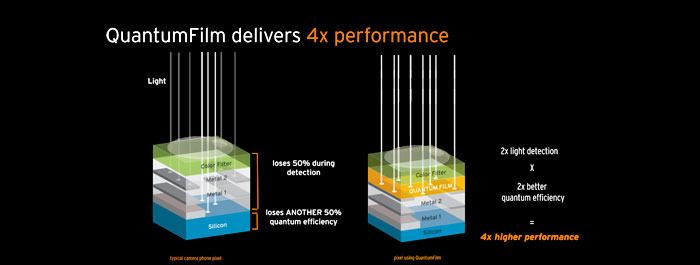
Invisage CEO Jess Lee stated that Sony is likely to become a Invisage partner to make the first mass production Quantum film stacked sensors in 2016. The sensors will be first used on smartphones because one of the main advantages of the new tech is the much thinner sensor. But the new tech could be used on larger Digital Camera sensors too because of the higher performance. Quantum Film sensor tech explained via Wikipedia:
QuantumFilm Technology involves the creation of a film to coat the image sensors used in a cellphone camera, allowing it to capture more light, improving the quality of the images taken.[9][10] A typical camera phone pixel sensor is made up of several layers, with a layer of colored plastic or glass acting as a color filter sitting on top of several layers of metal connecting silicon electronic transistors together, which is itself on top of a base layer of silicon used by the sensor’s electronic transistors and photodetectors. The light coming to the sensor has to pass through the layers of metal before reaching the silicon, a weak light absorber, so the sensor detects only about 25 percent of the light that makes up the image.[11] QuantumFilm Technology places a layer of semiconducting crystals – called quantum dots – on top of the chip, which allows the chip to absorb more light, place more pixels in a smaller space, and create sharper images.[12]
Using quantum dots is more efficient at capturing light than traditional silicon-based image sensor chips (capturing 90-95% of the light that hits it), giving the sensors higher sensitivity in low light as well as higher resolution.[3][13] And while traditional image sensors read an image from top to bottom (which can create a blurred image when the subject is moving), quantum dots detect the entire image at the same moment, reducing the chance for distortion.[14]
Invisage holds patents related to the development of QuantumFilm technology, as well as its applications toward optoelectronic devices.[15]
found via Image Sensor World.
71 Responses
History repeats itself. We’re all back to shooting on film.
if it is film, then any silicon chips are films too, because they made as multiple thin films
Now BSI is yesterdays tech. Let’s wait for next gen – hahaha
This is a bsi sensor.
Yeah – at least you realized, it is just the next evolution. I already wondered if someone here in this jabber-forum will recognize that this is also BSI.
Maybe it will be named Exmor RQS^^
quantum film layer is organic!
Here comes the barrysensor.
Before we can bless this sensor with such a name, it must be tested with a 1000mm lens (or longer) to determine if it truly is worthy of Barry’s seal of approval.
4X better than traditional sensors but not 4X better than BSI sensors, which already take the metal out of the light path.
thats true, but still the yield in the quantum dot is higher. and having a 2 times more sensitive sensor is also a nice thing…
And I bet they’ll throw all the sensitivity to the resolution increase. Because “40Mpx” on your phone looks so cool…
there is no such thing as “throw sensitivity to resolution increase”
And even if it didn’t the increase of pixel count would make that dual exposure tech a lot more usefull to output larger files with major DR improovement.
Global shutter attributes are interesting. Of course the linked articles state it was to be marketed in 2010. Looks like they need a company like Sony to bring this tech to the mass market.
Yeah, that feature might put the mechanical shutter to retirement. Flash Sync in every speed.
The EVF could practically work like a Range Finder you would see the live-feed everytime.
They can do all of this but in July 2015 – there is still no 14 bit color from a Sony mirrorless camera.
Yet ironically, as of July 2015 – there is still no way to accurately focus any Nikon DSLR unless one removes the mirror from the viewing path. Obviously not reading our internal memos are you Anton!
I guess those nikon you mentioned are defected models.
14-bit color is boring. Quantum film is much cooler!
You can go Medium Format for its 16bit if you want, they’re there and the Pentax 645z seems like to be a good deal with the 55mm f2.8 kit
it’s still 14 bits, they are lying
Aww, too bad… Guess to gotta go Hassy or Phaseone then…
AW YISS!
The A99II will bring 8K, this new sensor with 50MP, Better IBIS, Better AF…
Hahahaha
except it will be called A9
I was joking but i really hope that sony bring both models (A & E-Mount)
But that tech must be compatible with on sensro phase detection too, otherwise would rely just on contrast detection. And even if it works at 15 stops of DR with “global shutter” the AF speed will make people whine a lot.
What if it’s neither detection (contrast or phase) and this is what drives the SLT/alpha sales further on a 50MP FF A99-Ultraaaaaaaaa?
What then? Many here on SAR would love that.
Well, that at least would shut the haters that whine about the 1/3 stop from the SLT…
Nothing will quiet the haters that whine about 1/3 stop from the SLT.
i think it’s a lot easier to do OSPDAF if photon penetration depths is lower (which is supposed to be there with such film layer)
Sony also patented recently a multi layerlayer phase detection sensor using a color layer and white layer with phase detect pixels on multiple layers.
This should greatly improve phase detect sensors.
I am sure it wouldn’t and the patent is “just in case”
It may never appear in larger-format (and compared to a phone, APS-C is large format…) sensors, or will take a very long time.
The article clearly states that it is originally going to go into phones – which need all the help in sensor technology they can get, and also have the benefit of usually only having a wide-angle prime attached. Just like we’ll only ever see curved sensors in fixed-lens small-package devices like phones.
Real photographers don’t need AF.
Digital will never outcompete film.
BSI is for cellphones.
from A7RII,sony solved the problem by adding the phase detection points above the pixels, and the circuit of these focus points were independent, doesn’t matter what kind of new sensor tech, thats why the A7rII has no lowpass filter, as well as phase detection points
I don’t mind a dslr body.
This technology utilizes current cmos manufacturing facility, but new manufacturing capability required for the quantum film.
This involves vaporizing of the quantum film materiel the electronically depositing it on the sensor using cathodes, similar to electroplating.
Interesting.
Hopefully it will see the light of day unlike Panasonic’s organic sensor.
“And while traditional image sensors read an image from top to bottom
(which can create a blurred image when the subject is moving), quantum
dots detect the entire image at the same moment, reducing the chance for
distortion.”
This last part reminds me of CCD. Could this be the dawn of a new hi sensitive CCD sensors? I LOVE THEM!! 😀
Time to cancel my A7r2 preorder.
The chase on new bodies is endless.
Chris, that was a joke 🙂
female bodies?
Cameras of course. But for the record, I am not into the rainbow color thing.
I am using a Canon 5dsr this week…believe me you do not want to cancel your a7rii order.
What’s so wrong with 5DSR? Why are you disappointed?
If I read or watch reviews of that cam, everybody seems quite happy with it – except video capabilities. But that’s not the desired use-case, and therefore the 5DRS is just “perfect”.
I will go into more detail after I return it..
Basically I am using both an a77ii with 150-600 Tamron, and a 5dsr with Sigma 150-600mm sport.
Shooting…museum
Zoo
Wildlfe.
With emphasis on birds in flight.
When the Canon shots are good…they are really good, much netter than the a77ii combination…but the percentage of keepers is far lower for the Canon.
As for tracking bif the Canon is virtually useless.
The a77ii does a good job of tracking.
Ive been spoiled…evf…shows you what your pix will look like, optical viewfinder does not, and my pictures are very differrent than what I saw..for example…I shot about 100 pictures of male Ruddy Ducks….every one of them have white beaks!!!!
Highlights are totally blown out…terrible dynamic range compared to Sony…shadows were ok though, but highlights terrible.
In the museum…at high iso, handheld, no flash…a whole day yielded not one single usable shot.
I found it diffocult to use, but of coarse that is because I am unfamiliar with it.
Bottom line…if you can control your shooting situation and your technique is immaculate the 5dsr will definitely yield fantastic results…if you need to be able to shoot a wide variety of situations and cannot pamper your camera…the 5dsr is not right choice..
I will soon be getting my A7rii, and after I have seen how both cameras compare I will give a more detailed opinion/cmparison…but from the perspective of the kind of shootong situation I just described…
My review will be slanted more to how versatile the camera performs when the photographer cannot or is unwilling to make the shooting conditions perfect for the camera.
Thank you barry for this detailed report.
Even if the 5DSR has a high pixel count that allows crops as if you had used a crop sensor at all, it is not made for BIF or sports. Too slow frame rate for that and too bad focusing system compared to a 7Dmk2 or A77ii.
Looks really like the 5DSR is a specialist camera (well lighted studio and not-moving models) whereas the A7Rii seems to be much more versatile. A7Rii is probably a little weaker for studio-shootouts, but much stronger everything else.
Sharpness on the 5Dsr is very impressive…..Not tempted by it… Looking forward to my A7rII
I think Olympus was working on something similar.
From Invisage’s own site: they show efficiency at about 80% in the lowest bandwidths compared to about 55% in Silicon, and that difference is about the same throughout the visible spectrum. That’s not exactly 2x. It’s more like 1.5x. Moreover, their comparisons also pre-suppose a non-BSI sensor with less than 100% fill factor. I have no doubt that Quantum Dots will present us some gain over current state of the art, but I actually think that some of the other aspects of Quantum dots are much more interesting, including the fact that it can “bin” on the fly. That coupled with global shutter and less crosstalk seem to me to be more important to how it will be used.
The incresed eficiency is less in the uv range, then increases dramatically in the visible light range, and increases even more into the infrared spectrum.
The potential here seems to be about 2 f stops or up to 4x the resolution.
Subtract from that the fact that current sensors have been increasing in effieciency.
Clearly there is some potential here.
Sorry, there’s only one stop difference if you go from 50% efficiency to 100%. Best case I’d expect from their literature so far is 1/3 to 1/2 stop.
Add to that a big improvement in dynamic range plus the potential for improved imaging in non visible light imaging.
For example, based on the absorption spectrum charts the infra red cababilities are hugely improved
You have to read these marketing materials really close. They often use terms and claims that are easily misinterpreted.
Theoretically, we’re chasing maybe the last two stops of dynamic range with current sensor designs. To get more dynamic range than that, you need to either rollover the saturation or use another method for separating highlight data from shadow data (ala the old Fujifilm dual photosite approach and some of Sony’s alternating photosite designs).
Just making the current sensor designs “more efficient,” which is what Quantum Dots do, is not going to produce a huge impact. When I wrote 1/3 to 1/2 stop, that’s what I’d guess is the added dynamic range based upon the Invisage literature compared to current BSI designs. They spend a lot of time marketing against older, non-BSI designs, though they do point out the lower color crosstalk vis-a-vis BSI.
In essence, Quantum Dots is like EBSI (extreme back side illumination): it puts the photon capture well above the silicon layer. Moreover, it minimizes the depth of the sensor overall and allows for lenses closer to the sensor without side effects.
For smartphones, Quantum Dots makes a lot of sense. For large sensor cameras, not as much, just as BSI itself doesn’t make a huge difference. That’s the dilemma camera makers are in: not only do smartphones sell in far greater quantities, but the investments that are being made in sensor/lens designs are bigger for smartphones, and the payoff is far higher with the smaller sensor sizes than with the bigger ones. Thus, smartphone cameras just keep getting closer and closer to what the big cameras can do (the IQ gap narrows).
A lot of people, including myself, disparaged Nikon for picking 1″ for their mirrorless camera system. But as time rolls on, it’s looking more and more like a well-considered choice. 1″ is still getting a lot of the benefits that the smartphone developments are producing in ways that are visible to users (e.g. BSI and Stacked in recent Sony sensors). When you roll those same technologies up to APS as Samsung has, the benefits are far smaller and less visible, and then you also have the “if APS is only one stop different than full frame, why don’t I just go full frame” thinking.
Thing is, sensor cost is almost exponential to the area of the sensor. So smartphones have a big cost advantage to 1″, which in turns has a big cost advantage to APS, which in turn has a big cost advantage to full frame.
As for infrared, okay. Are you sure you want that? We’ve been filtering that out of sensors since Kodak’s problems with it in the mid-90’s. Most dark fabrics will change color if there is near IR pollution, for instance. Nikon’s recent D810A has that issue.
Each small step helps get us a little better.
With the lower signal to noise ratio that allows a little more signal boost before noise becomes ant issue.
My hope for the next new camera is 78+ mp,
Ff, bsi , native 12,500 iso.
Since that is very comparable to a7rii it should be doable.
what? you need uv and/or ir?
This is the visible light spectrum absorption graph.
If it progress like the BSI tech, it might take 2 years until we get one in FF size.
But just like the new graphene trend, I really don’t believe much in any tech that have quantum or organic in its name.
Not really. SLT affects only high ISO whereas OSPDAF affects pictures even at minimal ISO.
I don’t want a global shutter. I’d rather prefer faster readout than 1/240 sec, this would be still rolling shutter, but faster than a focal plane shutter.
Less than ten years from now ISO & noise will be essentially gone.
If you claim, the technical evolution will solve all your problems, I give you bigger problems to solve!
(P.Pohl – my math professor for numerical mathematics and computing algorithms)
I did not say ISO & noise are my problems. Noise & grain will simply become creative choices.
Only in post-process or for “in camera-software”. Digital ISO noise is only ugly whereas film-noise & grain is a real creative thing.
Of course it won’t. The limit is the quantized nature of light and this sensor (if it delivers as promised) gets extremely close to that ultimate limit. As it is, current generation sensors are within about 2 stops of what is theoretically possible.
It will end up being a de facto standard even if upon scientific analysis noise can be produced. For photographers and standard users of the near-future, noise will be a creative choice introduced artificially.
They are one kind of Organic Sensor?
may pana-fuji’s organic sensor was suffer.
More detail infos about this very interesting technology:
http://www.invisage.com/technology/
Video comparison quantumfilm mobile phone to a I Phone 6:
https://www.youtube.com/watch?v=WpfIHdn1Df0
It’s truly nuts to an extent considering the SLT bodies also have IBIS. I can slap a Tokina 11-16 on an A77 vs my old D7000: yes, I lose 1/3 of a stop because of the pellicle mirror, but gain 3-4 stops back from IBIS. Same-ish story with the 16-50 lens: yes, you lose a third of a stop, but NEITHER CANON NOR NIKON MAKE A LENS WITH THIS FOCAL LENGTH AND SPEED SO YOU’RE ALREADY AT LEAST A THIRD OF A STOP UP!!!!
Honestly, if I wasn’t so happy with my true mirrorless options, and my bad shoulders precluded carrying so much stuff, I would have definitely bought into the A-mount.