







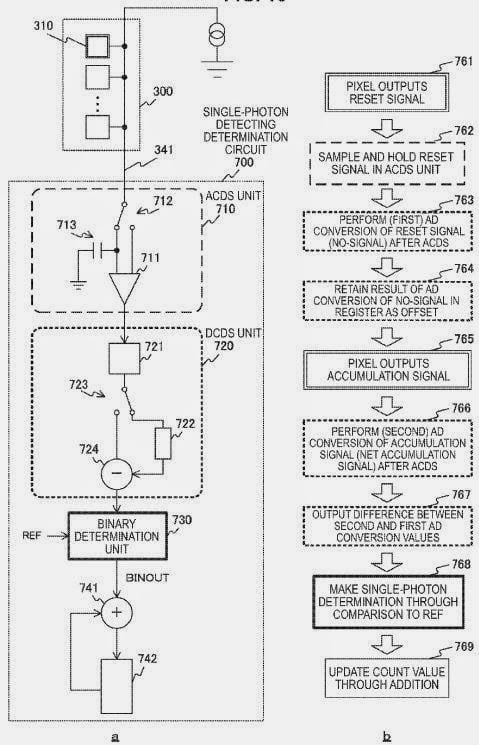
Sony has a new idea to improve the image quality at very low light conditions. They propose a new tech that actually counts every single photo hitting the sensor:
“since a pixel signal is extremely weak when weak light is detected, it is desirable to reflect electrons generated from photoelectric conversion on intensity of the pixel signal while losing as few electrons as possible. In general, however, when electrons generated in a photodiode are transferred to a floating diffusion, carriers (electrons) are doped at an interface level generated due to a defect present on a gate oxide film interface (interface defect) of a transfer transistor.”
“there is provided an image sensor including pixels each configured to include a transfer transistor configured as an embedded channel type MOS transistor and to output a pixel signal based on a charge transferred to a floating diffusion from a photodiode by the transfer transistor in an on state, and a determination unit configured to convert the output pixel signal to a digital value, then compare the converted digital value to a threshold value, and thereby make a binary determination on presence or absence of incidence of a photon on the pixel that has generated the pixel signal. Accordingly, the image sensor that makes a binary determination on presence or absence of incidence of a photon on a pixel exhibits the effect of reducing influence of an interface state on the transfer transistor.”
We don’t know yet how big the improvement is. But maybe the day is not far away we will get a new A7sX with 1 million ISO 🙂
via Image Sensor World.
86 Responses
1 million ISOs… We’ll want more.. 🙂
When we can shoot 1/1000 f8 in the dark as cleanly as ISO 100 – I will ask no more 😀
Sorry Sony.
If you cannot count the number of times photographers have requested SSM updates for 85/1.4 and 135/1.8, or how many times photographers complain about the f60M flash overheating, or how many requests for the iISO to MIS adapter to have a real lock, or how many times your customers complain about a7R shutter vibration and lens mount wobbles…
… then counting photons is meaningless for your current customers.
Cry Me A River, then build a bridge and get over it.
Bravo
Suck up.
What? 1M ISO?? That’s it?
It is just one and a third stop higher than what current A7S is capable of.
Strip the bayer filter layer off an A7S sensor, and that will give you about a stop. So a 1 million ISO B&W camera is already possible.
Doesn’t shot noise dominate in SNR terms at such low light levels?
Shot noise dominates at high light levels. At low ones it’s usually read noise.
I’m talking about SNR, not the absolute amount of noise.
Yep. And counting every single photon doesn’t really help you there. So dreams of cameras with clean ISO 1,000,000 are just that: dreams.
I think this is a hoax
I have seen this drawing before ..it is some sort of research detector that detects individual pixels one at a time..it is a huge device and has absolutely no photography applications
Update
I just reviewed the source indicated in this post, and it does indeed indicate a single pixel, not a pixel array rhat would be of any photographic use.
I am not sure what this device would be used for but it is definitely not a camera sensor.
For those SAR followers that keep asking for fewer pixels….here you have the one pixel sensor you have been asking for
If past is prologue, why would anyone believe you. You’ve been wrong about everything sensor related.
Actually most of my predictions turn out to be correct..but so far ahead of what people are currently predicting…look back several years and you will see most of the stuff that is just happening now..of course noti everything I predict is accurate…thats the nature of talking about things that have not yet happened.
And of course I will always be deluged with trolls like you that do not like to hear what I say…or do not want anyone else to.
Believe anything you want…and yoru are even welcome to tell others what you bliyeve..if you think anyone will believe you.
No specific knowledge about this rumour, but photon counting detectors have been in use in x-ray mammography for close to a decade. High sensitivity + low noise = lower radiation exposure. Those are slot-scanning devices, and each photosite is approx 20 microns, but that’s at least partly because the x-ray image is formed more like a contact print, and at 24x30cm they already get up to 100MP:) I have chatted with the original developer (Mats Danielsson) mid 2011, and spectral discrimination was something that was already working in the lab back then. Obviously there would be lots of practical barriers to overcome to apply this tech to visible spectra, miniaturise the photo sites, signal processing, but it’s an interesting approach.
There is nothing clever about predicting sensors with lots of megapixels.
You think you are a man of genuine insight, but your predictions are akin to predicting that next summer will be hot in Arizona.
Yet you have argued against every single one ofthese predictions that yiu now critisive as being so obviose
You argud over and over again that these things would never happen..then when they do you critisize me again because anyone could have made the predictuion..
Here I am being called a lier because I am saying this is not a photographic and somxeone does not want to believe it.
sensor while at the same time you are critisizing me because it really is not a photographic sensor and it is so true and obviouse that I should not say so.
Thats why you are a Bazzhole…but perhaps I will again be critisized for making too obviose a statement.
Still, the ultimate (?) sensor should determine wavelength (without color filter) and direction (as in a light field camera) of the photons it is counting, instead of just counting … or not? 😉
You and Barry are on the same bat$hit wavelength. Do a mind meld.
Not quite. Barry hangs onto buzzwords and doesn’t quite grasp the physics. The perfect sensor would, indeed, determine the number, direction and wavelength (or energy) of every individual photon. Of course nobody has the faintest idea how such a sensor would work.
so what…. with 5D mk4 and s/r, canon will dominate the market for another decade, and their wondeful variety of ef lenses will keep selling forever… suck it up Sony.
Hopefully it won’t be as big a flop as the POS 5DM3.
It will dominate until Sony releases a mirrorless model with the same resolution but much better dynamic range, color depth and focusing accuracy. And for thousands less. 🙂 Enjoy your week in the sunshine.
One word…. hillucination
Thats not a word
It is if you are smoking weed in the hills
You realize Sony will make money on 5d sales right?
Yes, via the semiconductor division. Selling components to other companies, and selling cameras to consumers are two different things. Success in the first market doesn’t guarantee success in the second.
Logically, which market should Sony focus on first – the exponentially broader market of getting a small piece of most camera sales or the narrow market of getting a larger piece of their own alpha camera sales?
Of course they should focus on the first, and they do. Which basically was my point.
The OP said that Canon will dominate the (camera) market, and you replied that Sony will make money on Canon camera sales, as if that would help them in that market. I pointed out that those profits goes to another Sony division operating in another market.
It benefits the alpha division as well – this is R&D that the alpha division does not have to pay for. This translates to greater pricing flexibility on the camera bodies. Additionally, the alpha division gets access to a broad array of sensors they otherwise would not thanks to all the different customers commissioning sensors. Sometimes, the still cameras do get the sensors first when it makes strategic sense. For instance, the rx100-2 / rx100-3 sensor – Sony used it for well over a year before selling them to Canon. Sony also deployed the a7s sensor which is still exclusive to that camera so it hasn’t lost the competitive (and PR) advantage for video centric SLRs that they gained from it.
My point is that the synergy of selling sensors externally as well as internally is a great benefit to alpha users. I doubt Sony would have acquired the Minolta IP in the first place if not for the sensor division and this potential synergy.
Well…canon’s lifecycle to refresh their cameras takes about a decade…if that’s what you mean??
Just a bunch of science-talk for sharks with lasers mounted on their heads.
I’m already waiting for years for the next in the series…
And the point is????????????????? Do we really need every camera in the world to be a night-vision camera with 10000000000 ISO? How about investing time in sensor technology implementations for stuff like endless rolling shutters for example that plague every camera on the market? That’s years overdue.. people seem more interested in cat vision cameras than endless jellyfish video.. is amazing. And what about investing time in better glass, specially one that doesn’t cost the price of a car? How about researching lenses that get smaller in size and maintain performance as I witness the big irony that cameras seem to get smaller and smaller and lenses get bigger and bigger??? Have people even noticed how ridiculous some of these newer minute mirrorless cameras looks with their lenses attached on them???.. or is it that portability only “matters” on the body size and a 2 foot long lens on it is OK? And what about researching better battery technology, about 100% overdue during all my lifetime, that can last enough to do some proper work instead of having to recharge more frequently than I can count fast enough? Wouldn’t that be good??? Yeah.. I want a camera so good so good so good in low light that I can take pictures in PITCH BLACK with my lens cap on and see whats in it! Sony is laughable.. no wonder they are going under along with their already defunct VAIO computers, soon to be Xperia phones (http://www.xperiablog.net/2015/01/27/report-sony-to-cut-a-further-1000-jobs-within-smartphone-business/) and “amazing” TVs that are next in line (http://www.forbes.com/sites/marksparrow/2014/02/09/sony-spins-off-tv-business-in-bid-to-reconquer-market). The more money they loose each year, the worse decisions they make.. WAIT!!!!………………… let me go buy their new $1000+ walkman to make them some money! Thats gonna save them:)
You may not need ISO 1 000 000 or more, but if the camera can produce acceptable results at that sensitivity, IQ will probably degrade less from stop to stop, meaning ISO 1600 will look like as if it was ISO 200 for example.
And it’s not as if it’s the same people who work on sensor tech and lens design. All the tech mentioned in the OP is from vastly different fields requiring different engineering skills and knowledge…
it doesn’t mean so… such camera might not have ISO 1600 at all.
What an ignorant comment. Minimizing information loss has nothing to do with high native ISO. My point was that high ISO performance can be a benchmark for these cameras just as 0 to 100 km/h is for cars. You’re not buying the car because you’re too lazy to wait 10 seconds, but because if it benchmarks well, it cannot have a weak engine.
If a camera produces clean images at ISO 1600, it will probably produce better images at ISO 3200, than the camera that is unusable at ISO 1600. The NX1 is more efficient, than a 28MP SLT of the same format wolud be, meaning the Sammy collects the same amount of information at ISO X, as the SLT at ISO Y (where X > Y). The gap is probably not more than a stop, but let’s say a new sensor is 4 stops ahead. That means ISO 3200 has the same quality as ISO 200 on the older sensor. That also means it maxes out at ISO 204800 (implying the older maxes out at 12800). Once again: my point was that people should stop crying, because in this case lower ISO settings will also benefit, because we are not expanding ISO, but ‘improving’ each setting. Making ultra-high sensitivity settings usable is merely a side effect.
It’s you who ignorant here…
You’re describing potential scenario which has nothing to do with photon counting – increase in QE while keeping full well capacity the same. While in this case with counting, more complicated circuits will surely decrease full well capacity, and they won’t perform good when multiple photons strike at near times — they can only count individual photons when they are rare.
No sh.t Sherlock. Maybe, because I wasn’t talking about photon counting? Read OP’s post again. We are talking about high ISO in general. OP said high ISO is bad, I said not always. You are desperately trying to correct everyone, like you are the smartest dude on the planet. My advice however is: if you have nothing smart to say, then do not say anything.
Go follow your own advice.
he said nothing about photon counting. He made very valid points in response to the above why-do-you-need-iso-100000000-rant by J.Andrews.
spare me please of your photo-forums-physics, which is not better than Andrews’ rant.
Agreed
Sensors are already operating at about 50% quantum efficiency, that means 50% of incoming photos are converted. A perfect photon counting sensor would achieve 100% with zero read noise, but that would only correspond to a 1-stop improvement in SNR, anything beyond that is impossible unless the laws of physics change.
So it might make ISO1600 look like ISO800, but that’s it.
Yet the A7S is more than one stop better, than many FF cameras out there. Maybe we catch every 2nd photon, but the story does not end there. QE is only photon to electron, not photon to jpg (or whatever format you choose). FF is bigger than an eagle’s retina, yet the latter has better resolving power and better low light by miles. Creating a better picture with fewer photons is possible. It’s not all about collecting all the photons. Maybe collecting all the photons will only give 1 stop, but using them more efficiently may give another 3 or more stops. In other words, maybe we cannot increase signal much further by collecting more photons, but we can decrease unneeded, generated noise (see A7S for example, where we did not increase the number of captured photons, but reduced the total amount of noise by reducing pixel count).
An Eagle has better low light than a FF camera? Care to provide a link to the research where this has been demonstrated? Because it sounds an awful lot like you’ve just made it up because it “sounds right” to you.
There are sources of noise other than photon noise (dark current, read noise, quantisation noise) but they are all small when compared to photon noise (assuming you amplify prior to readout and you are not willfully underexposing), so there’s no way improvements there are going to be “3 or more stops”. Again you’re just making things up.
Care to provide a link to the research where this has been demonstrated? Because it sounds an awful lot like you’ve just made it up because it “sounds right” to you.
Anyway, an eagle has 1 million light sensitive units / square mm. So you’re are saying that an eagle’s low light cannot be more than twice as good as an 864MP FF sensor’s (‘cos the eagle is at 100% at best, while current cameras are at 50%). That’s just ridiculous. I don’t know how they call it in English, but those ‘units’ that are in animals are not just twice as good as current Bayer sensors are. There’s plenty of room for improvement.
Sure, here’s some research into sensor quantum efficiency:
http://www.sensorgen.info/
Here’s an explanation of what 1-stop means:
http://en.wikipedia.org/wiki/Exposure_value
And here’s another explaination of why you can’t have more than 100% (which is one stop more than 50%) quantum efficiency:
http://en.wikipedia.org/wiki/Perpetual_motion
You seem to have put an awful lot of words into my mouth, there. All I said was you have no evidence that an Eagle’s vision is better in low light than a DSLR, as such a thing would be incredibly difficult to prove.
I understand what you are saying and I’m not doubting you. I’m only saying QE is not the only factor. According to the site you have provided the A7S is only 30% better, than the A7R, yet it’s about a stop better at high ISO. The more photo-diodes and circuits, the more noisy it gets.
An ultra-high resolution FF sensor may have 100% QE, yet it won’t have better low light, than the A7S.
What you’re forgetting is that the only ISO that matters is the sensor’s native ISO. The rest are signal amplification and manipulation techniques. Unfortunately none of us, except for Sony Imaging, knows the native ISO of either sensor, so it is impossible to compare these sensors properly even using Imatest. Because if A7r sensor’s native ISO is different from A7s native ISO, which is seems to be based on DR results, the entire data set is skewed in favor of one or the other sensor for each of the parameters in test.
DXO test each camera at whole powers of two multiples the native ISO, given the resulting plots are very linear it seems entirely reasonable to interpolate between the readings and compare camera sensors when the native ISOs differ.
‘And once you’ve captured 100% of incoming photons (or thereabouts), then there’s nothing you can do to get less noise. Sorry.’
This is not true, QE has nothing to do with noise! ALso with a QE of 100% there are ways to reduce the noise, for example dark noise when cooling the Sensor (or even different Sensor tech).
QE has a direct effect on noise anywhere above the minimum ISO, by converting more photons you achieve lower photon noise.
There are other sources of noise, such as dark current, which I’ve already mentioned. The point is they make a small contribution, to get the three stop improvement that some expect to be possible those other sources of noise would have to make up something like 90%!
With perfect electronics you will still have a large amount of noise in low light: http://en.wikipedia.org/wiki/Shot_noise
The A7S is only a stop better at very high ISOs because it provides analogue amplification for those high values whereas the A7R uses digital amplification and hence multiplies up the read noise. When normalised for resolution, the two cameras are very similar when it comes to noise:
http://www.dxomark.com/Cameras/Compare/Side-by-side/Sony-A7S-versus-Sony-A7R___949_917#tabs-2
With Stan’s comment included:
Now we have QE, different kind of amplifications, different native ISO’s etc. Once again I still do not understand how QE is the only factor when it comes to low light performance.
I have no idea what Stan is referring to. The point is high ISOs on some cameras are “faked” (produced by deliberately underexposing the image). Once you discount the artificially high noise levels that result from fake ISOs you find photon noise is by far the largest contribution to the overall noise level.
QE is not the only factor, it’s just the one with by far the greatest potential for improvement. Camera electronics contribute to noise, but with any good sensor the contribution
In order to achieve your 3-stop improvement by “using photon more efficiently” camera electronics would have to account for 90% of the noise you see. In reality it’s closer to 10% in low light, thus the only thing you can do is capture more photons.
And once you’ve captured 100% of incoming photons (or thereabouts), then there’s nothing you can do to get less noise. Sorry.
Those QE values look like pure bull****… Look at A900, A850, Leica M8.
Hope Sony focus on the lenses beside the cams, if you want the AF, the only way is to get their hella expensive Zeiss, and they are NOT worthy for that price, SERIOUSLY.
That’s the work of Sony imaging. The sensors are developed by Sony semiconductor, two different entity in Sony’s world.
No need to complain they could do both at the same time, though semiconductor seem to follow a more rapid pace probably because their r&d budget is more higher.
Hey, I work everyday with with single photon detectors and photon counting detectors (these are two separate things). If you want an efficiency similar to what you have in a camera, you have to cool it down below 1K. It’s Kelvin, no Celsius or Fahrenheit. Not sure how to fit the cooler into the camera body… and for each single pixel!
No overheating problems anymore great!. But what will it do to the battery life? 🙂
thats pretty cold!
Sony does have a minor (like the world’s largest) imaging sensor development and production business. Why do individuals immediately assume this technology is being developed for some consumer camera? Even if it does trickle down, think this has no scientific, industrial or government applications? Short-sighted hobby photographers…tiresome.
Lots of tiresome stuff going on at the internet. Sorry about that.
We welcome new techs and we are glad things are going in the right direction.. Sooner or later in distant future it will be the standard tech for consumers, why not be happy such things are being created? 😀
This was an idea presented by the father of CMOS a few years ago. There was a video on youtube. I wonder if he is working for Sony or Sony is just implementing his idea?
I love father C’mos
Eric Fossum came up with the idea, yes.
It is very misleading interpretation of the patent. Actualy every CCD or CMOS sensor detects photons. It is how fotovoltaic effect works. It is the only way possible. Difference here is that the sensor will count these events taking an advantige of long enough time between successive hits. But in properly lit conditions the sensor will get quicly oversaturated. I doubt the new sensor will get into a large sensor camera.
*Insert a comment pretending I know exactly what is going on here*
Probably only useful for extreme low light situations like astrophotography.
Will they also be making photon torpedoes?
This looks very “blue sky” to me. Also, I can’t see it working at other than very low light levels as the photon arrival rate will just swamp the counting system. In a typical photosite in normal lighting conditions you might expect of the order of tens of thousands of photons, and these will arrive in perhaps 1/100th of a second. So this will have to work at the rate of millions of operations per second. Not so bad in itself, but each photosite has to do this independently. That’s 10s of millions of photosites all working at counting millions of photons per second. That’s a recipe for generating a lot of heat.
So I suspect that this would be more like a specialist sensor for ultra low light levels rather than general purpose cameras.
nb. existing camera sensors already have quantum efficiency (QE) of the order of 60%. Colour filtration loses around 50% more (depending on the density of the colour channel filters), but this technology will not, of course, do anything about that as it can’t sense the wavelength (or, alternatively, the energy) of the photon. The A7S is exceptional not because it’s got exceptional QE, but because it controls low light read noise to exceptionally low levels which, combined with larger photosites, maintains DR at very high ISO levels.
No, the patent shows they are looking at an accumulation of photons, not just one.
A bit like counting the height of a pile of bricks. If you round to the nearest brick, you can reject any part of the value that is probably noise. For example, 34.3 bricks becomes 34.
They are essentially using the ability of digital measurement to reject any noise (at least, any noise below inherent quantisation level caused by sampling). If they are rejecting based on n photons and not just 1, this would work for all sensors…. but as you imply, the sampling rate would have to be very fast.
I’d refer you to this phrase :-
“a binary determination on presence or absence of incidence of a photon on the pixel that has generated the pixel signal.”
So it is making a binary decision on the presence of a photon (which means it has to detect every photon). It may well be that it eventually accumulates a charge to represent this, but it still has to work by “counting” every photon.
Ah ok, you could be right.
If I had to design a circuit against this patent, I’d be feeding a fast clock into the comparator circuit so that I’d be sampling the number of photons over a short time per clock cycle, then I’d clamp it to the nearest 1-photon reference…. hence the ‘pile of bricks’ analogy. That’s mainly to circumvent practicalities (I doubt you could switch a transistor on the power from a single photon, and neither could you do it fast enough to capture a single photon).
But then again I moved from electronics to web application design in 2000, so I probably don’t know how well these things can be done today anymore!
This is clearly a patent for a scientific instrument that has no direct applicability to still photography, but Andrea loves to imagine each and every Sony patent bringing about a new sensor with performance figures far outside the realms of possibility.
THIS DEVICE HAS ABOLUTELY NOTHING TO DO WITH CAMERA SENSORS.
This is a specialized photon counting pixel..yes this is a single pixel not a pixel array.
It is in no way intended to be used for camera sensors.
This is also not new..I have seen this drawing a couple of years ago.
You already said that below.
It’s worth saying twice. There really is no need to post every single Sony patent here when they have nothing to do with photography.
as if 1mio iso is far away. it isn’t much of an improvement over the 400000 we already have…
but of course a sensor that counts every photon with its wavelength and arrival time would be the perfect sensor, you simply would have all the information. you could take a video and extract from there all the stills up to (1/very very very large number) s you or you could combine all the images (photons) of the video sequence in to a long exposure, you could choose the shutterspeed of an image or video after you recorded it and so on….
but as already pointed out, this would be a lot of data that could only be handled at low light situations with todays hardware.
I think we need an a99II before we get this.