







Sooner or later we are going to have large CMOS global shutter sensor on Sony Alpha cameras. This week Sony just announced smaller 2/3 and 1/1.8 inch CMOS global shutter sensors. The new Sony video on top shows the advantage of the global shutter over rolling shutter when recording fast moving objects.
Here is part of the press text (via Sony.net):
Global Shutter Function
Industrial applications require imaging of fast-moving subjects. However, there is the issue that existing CMOS image sensors are unable to accurately identify fast-moving subjects due to focal plane distortion as a result of rolling shutter operation. The IMX250LLR/LQR and IMX252LLR/LQR address this issue by providing analog memory inside each pixel and realizing a global shutter function, which enables high-picture-quality imaging without focal plane distortion.
The Industry’s Smallest Pixel Size Class for Industrial Applications
Analog memory, transistors and other elements must be added to the inside of each pixel to realize a global shutter function, which made it a challenge to reduce the pixel size. The newly developed products use Sony’s fine pixel fabrication technology to realize a small pixel with a size of 3.45 µm compared to the 5 µm range that is the existing standard for global shutter pixels.
This enables high-resolution imaging using a smaller lens than that of the existing products.
High Sensitivity
In order to reduce the size of pixels equipped with a global shutter function, it is necessary to secure a sufficient pixel light-detecting area while also securing an analog memory area within the pixel, so there were concerns over a drop in sensitivity.
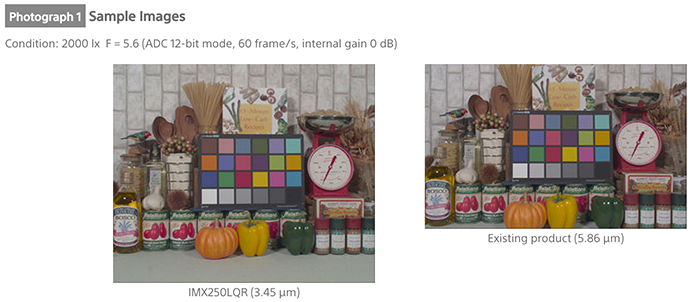
However, high-sensitivity pixel design technology and condensing process technology were used to increase the sensitivity of the newly developed 3.45 µm pixel, and realized high sensitivity exceeding that of the existing 5.86 µm product (1.1 times compared to the existing 5.86 µm product).
In addition, EXview HAD CCD*1 technology also increases sensitivity in the near-infrared range, enabling use with high picture quality even under near infrared light.
*1: EXview HAD CCD is a trademark of Sony Corporation.
High Frame Rate
Customers have strongly demanded higher frame rates for industrial applications, so an ADC 8-bit mode was added to the IMX250LLR/LQR and IMX252LLR/LQR in addition to the existing ADC 10-bit and 12-bit modes. Also, the column-parallel A/D conversion technology of Sony CMOS image sensors is used to realize high-speed imaging of up to 163.4 [frame/s] (ADC 8-bit) for the IMX250LLR/LQR and up to 216.3 [frame/s] (ADC 8-bit) for the IMX252LLR/LQR (Table-3). This enabled further increasing the processing speed for industrial applications.
A Variety of Functions
The IMX250LLR/LQR and IMX252LLR/LQR are equipped with a variety of functions needed for industrial applications, such as ROI mode and trigger mode. ROI mode crops arbitrary areas, and up to 8 × 8 = 64 locations can be set. Various exposure methods are provided for trigger mode, which controls the exposure time using an external pulse. In addition, the IMX250LQR and IMX252LQR (color products) are equipped with functions such as subsampling, horizontal and/or vertical inverted readout, and multiple frame set output, and the IMX250LLR and IMX252LLR (monochrome products) also have a pixel addition function in addition to color product functions.
32 Responses
No more max sync speed for strobe and flash? Please educate me~
Yes. But the exposure time should be at least as long as the flash time.
So does it mean it still need syncing between the strobe and the global shutter? Coz what I know in high speed strobe, the flash pulsates in sync with the moving gap of the shutter.
Of course it needs syncing.
It has to do with the way focal plane shutters work. At high shutter speeds they are never fully open so you actually need a LONGER flash duration to make a full exposure. Because a global shutter exposes every pixel simultaneously you are limited by the speed of your flash and not the speed of your shutter. Very cool stuff if you shoot with strobes. Lots of great videos out there if you google it.
So basically will it function or perform like leaf shutters did? If so, will there be any syncing required between the global shutter and the flash burst at high speed since from what I know at high speed strobe they pulsates to fill in the narrow shutter gaps evenly
I guess that’s what’s coming in the A6xxx in 2017 then. In the meantime, while we are waiting for such a scientific marvel, we can all relax and enjoy watching Manuel Neuer making great saves.
The use of analog memory on the pixels will result in increased noise over a digital option.
I like the idea of global shutter, but apparently there is a price to pay for it.
No BSI either in the present models.
BSI only benefits high pixel density sensors. Scale RX100 sensor to FF size, and you’ll be looking at 147mp sensor, aka Barry’s dream sensor.
The 28mp APSC sensor in NX1 is BSI CMOS, but its not that much better than a regular CMOS. At least not by as much as smaller, high pixel density sensors.
BSI might help with the smearing problem, I hoped.
Corner smearing? Isnt that lens specific?
I thought that was due to angle of incidence. Essentially any wide angle lens that has a rear element too close to the sensor.
I thought that any DSLR lens or any telephoto lens doesnt have that problem.
All the CMOS global shutter systems I’ve heard of require a temporary store to dump the accumulated charge into. That takes up silicon “real estate” and reduces that available for the photosite’s main charge accumulator. That has an adverse impact on dynamic range (and also introduces the potential for increased read noise).
Also, I seem to recall they all have a fairly slow maximum shutter speed. Not too much of an issue for video purposes, but rather more of one for action photography. Of course it can always be supplemented by a physical shutter, but that adds cost and complications.
A workable global shutter for large format still cameras without compromising still image quality is one of those holy grails of the photographic industry. There’s is some way to go. I expect to see global shutters on large format sensors to be initially targeted to video, not still cameras.
Today that may be an issue, but sooner or later, the universal global shutter is the way to go.
Which is why I called it a holy grail. But that doesn’t mean it’s going to be achievable without some compromise. It may be that a game-changer appears, but nothing much points to one at the moment. They all look like refinements of the same basic theme with an interim charge store. Sure it can be made to work, but at the moment, for still images, there will be a compromise on IQ, and given that’s what people seem to obsess about above all, that makes it difficult to launch such a camera.
There’s a close parallel with multi-layer sensors (like Foveon). The holy grail is to get rid of the need for a filtration layer and have full colour sensing at all points. However, the Foveon has significant shortcomings (due to inherent common-mode interference in the colour channels). There are plenty of speculative patents out there, but so far nobody has produced a workable solution (for single sensor designs). Maybe it can be done. Maybe it’s just not achievable.
The reason why the sensors with global shutter will replace all other types, is not sufficient or insufficient IQ; it is production cost, because it makes the expensive mechanical shutter superflous.
Lower prices is what most customers want. Higher profits is what companies want. If that leads to decreased IQ, it will advertised as a feature and I promise you most customers won’t care if the price is right. This is not the first time in tech history. Maybe for a certain period, some enthusiastic enthusiasts will praise the better IQ of their “old” CMOS sensors. But after a few years the global shutter CMOS will be superior in IQ than any traditional CMOS. That’s exactly what happend after the transition from CCD to CMOS sensors. (Leica M8/9 is a good example)
Damn, I should make my money as a prophet. I would be rich.
Sure thing about the target on video, the camera is already available since 2012:
The Sony PMW-F55 CineAlta 4K Digital Cinema Camera for a whopping 30.000$
But of course we wanna have the same capability for 2000$ in the A7sII with an even better and larger FF sensor 😉 😉
Or buy yourself an xt-10 for 800 and have it until 1/32000. No jokes.
But that’s not a global shutter . .
dude, that’s electronic shutter not global shutter.
FACEPALM
Yes! A global shutter would be the ultimate game-changing feature for the A7s II. In addition to being amazing for video purposes, I would guess that the global shutter is more apt to the lower megapixel count of the A7s sensor.
I suspect there are issues (mostly cost) in scaling to full frame but the issues you mention are largely mute. Pixel for pixel the high-end Pregius models are very close in performance to the aging sensor designs used in Sony’s current full frame sensors. So there might not be a big jump in IQ but there shouldn’t be a step down either. the difference in sensitivity between the F55 and F5 is less than a stop and things have improved since then. The F55 captures an amazing amount of dynamic range too—14+ stops for APS-C! So the tech is here already. Has been for some time.
Unfortunately, the sample video shows the new streamlined train that slopes backwards by about 30′, so they look like that in real life…LOL
Do you have a focal plane shutter in your eyes? Mine are global shutter eyes.
The windows will still be upright.
The news here is not the use of a global shutter it is that Sony shrunk the pixel well size while maintaining (or possibly slightly improving) the dynamic range and noise. For several years Sony has had the Pregius line of smaller sensors with global shutters with the same pixel pitch and similar IQ as the regular CMOS sensor used in the A7 and A99. They just haven’t scaled it up yet probably due to cost. At this new pixel pitch they are getting around the same pitch as the A6000. So 24mp APS-C and 50+mp FF.
EXview HAD CCD!!!! I want one in the A7 series camera, make it limited quantity for people like me who really love a CCD sensor camera 😀
InVisage is a step ahead. He built a complete new Sensor technology in a mobile Phone. And this is already ready for new mobile phones not for industrial applications.
http://www.invisage.com/technology/
I hope in the next years are a fullframe sensor with comparatively technology ready for consumer cameras.
https://youtu.be/tMBI1DLWp8U?t=2s
I’m going to take my Minolta 50mm 1.7 apart this weekend. I wonder if I can replace the aperature with a 9 blade circular set up. Can it be done? Probably not, but we’re sure going to find out!
Long story short… unless you’re shooting a bullet train at max speed… zoomed in, I think you’ll be ok
There goes half my work.