







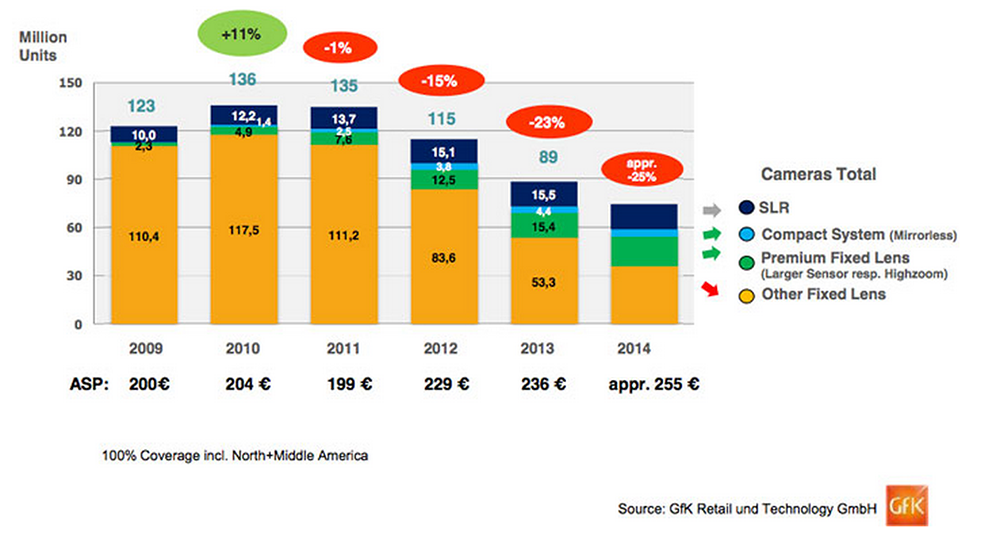
The last couple of years we heard a lot about the digital camera market being in crisis and the new mirrorless system cameras not taking off. Well, the Photokina partner agency GFK shared some unexpected data (Source: MirrorlessRumors):
1) Revenue increasing:
While it’s true that in terms of numbers the companies are selling less cameras it’s also true that companies are selling more high profit margin premium cameras! This means the last couple of years average price of the cameras increased (and therefore also the profit margins increased).
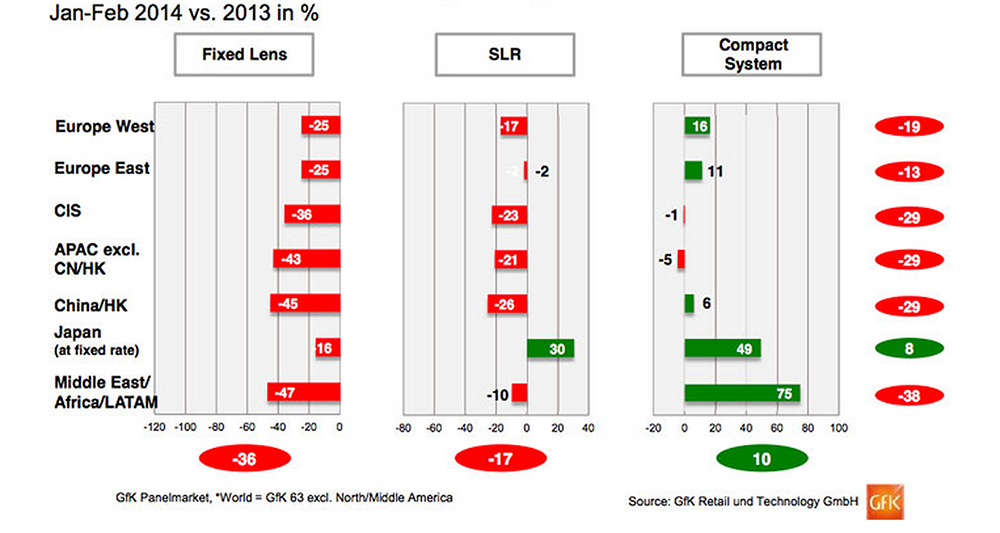
2) Mirrorless is taking off (slowly).
While Mirrorless keeps being not popular in US it’s taking off in all the rest of the world.
3) Premium fixed lens camera is growing fast
Sony certainly did the right thing with the RX line. They offered a premium and class leading range of fixed lens camera that are to-day unmatched by other companies.
The current trend in the market goes in favour of Sony that leads the probably two fastest growing segments in the digital camera market: Mirrorless and premium compacts. And as an addendum watch this nice graph that explains why smartphone users actually buy a larger sensor camera:

0 Responses
never believe anything that is told to you, unless it is officially denied!
If I see the statistics you show here, sale per million units fall since 2010 at a rate of 10 to 25% per year. Can anyone tell me then how the revenue of camera manufacturing companies can increase. I am a magus, but their is some magick that probably escapes to me.
Margins on the increasing higher end are bigger than those of the decreasing lower end camera’s. So for every high end camera sold they can lose several low end camera sales and still make a profit.
Virtually everyone reported lower margins in their most recent financials, with maybe the exception of Fujifilm and Sony, though it’s somewhat unclear for those two since they have other products than cameras bundled into their numbers, and in Sony’s case they bury significant costs in SG&A.
More appropriate would be to say that “the Japanese camera companies are transitioning towards higher margin products that sell at higher prices and are attempting to reduce costs, as well.” However, the overall numbers don’t yet reflect that this is increasing their overall margins yet. One problem is that you can’t downsize in Japan easily. You end up with redundant staff you’re still paying.
The best example to see how the shift is occurring and not exactly working yet is Olympus. They’ve pretty much shut down anything but higher end products. In doing so they’ve quickly lowered their sales volume from 8m+ units to this year 1.5m if they meet their numbers. However, their personnel in the camera group hasn’t changed by that same level, so they now have more employees per camera made than ever before. The GPM when you look purely at parts versus sales price looks good, but when you add back in overhead, marketing, sales, and more, the margin declines to lower levels than it was.
The problem is while we are celebrating the demise of compacts, it’s those same compacts that were the bread and butter of camera companies, and allowed them the luxury of also selling enthusiast level products.
Are enthusiast level products self-sustaining? All vendors claim they want to focus on the high end, as though it were easy. And since the high end products also suffer from almost no secondary market, they are not truly high end, merely expensive.
And those expensive levels are coming down also with the accellerating incentives. Means, the hoped-for margins won’t be their either.
Strange Days for shutterbugs.
As the income gap increases the strategy seems to be concentrate one selling to the wealthier people.
It is a more difficult challenge to sell to the middle class that are growing poorer and still have increasing quality demands.
revenues = income – expedinture.
they probably optimized production (while it was new it was pricier to make), and released pricey bodies
Income – expenditure = profit. Not revenue. Revenue is income.
So from about 136 million units in 2010 to something like 75 million units in 2014? That is a huge decrease in sales! Still, SLR has been growing over the years as well, but judging from the second graph this could be the first year SLR is actually shrinking? Premium fixed lens seems to do best of all types. Did not expect that eventho I love my RX100.
The DSLR market shrank in 2013 already: from 16.2 million DSLRs shipped in 2012 to 13.8 million shipped in 2013.
Source: CIPA
2012: http://www.cipa.jp/stats/documents/e/d_2012_e.pdf
2013: http://www.cipa.jp/stats/documents/e/d-2013_e.pdf
Statistics 🙂
One shown sales in terms of money, the other in terms of units.
Put together, DSLR’s have moved up in average price, becoming the High End alternative.
According to CIPA, both went down. CIPA probably doesn’t include Samsung, but i don’t think this changes much.
CIPA does not include Samsung (or Leica). This is trickier than it may at first seem, especially for mirrorless numbers. Here in the US, retail sales numbers have consistently shown Samsung outselling Olympus and Panasonic, for example. While US sales aren’t great for mirrorless, the fact that they’re having success against the name companies here might indicate that they’re doing well elsewhere, too. Certainly in Korea ;~).
Very different numbers compared to those in graph 1 here (15,1 in 2012 and 15,5 in 2013). Who’s right, who’s wrong?
We need to see the source of the numbers. CIPA source is very well known, and regarded to be reliable. I’ve been tracking those numbers for almost two decades and they appear to overall match the other data we can compare against it.
Photokina has a vested interest in getting people to their trade show. They appear to be trying to put a positive spin on the market. But without knowing how they compile their numbers, we can’t really believe them. Moreover, that second chart shows that they are willing to leave off negative information (North American sales) and emphasize other short-term impacts (Japan sales prior to the sales tax increase). So I’d have to conclude that they’re trying to cook their charts to show the message they want to make rather than collect data and try to explain it.
And yet if you look at the first four months of 2014 as shared in the spreadsheets over at 43rumors.com, DSLR sales are up 43% Jan to April, while mirrorless interchangeables are up 22% in the same period.
We are getting conflicting numbers from industry sources. Some of the numbers don’t pass the smell test.
I don’t know where your figures come from. The graph posted by 43rumors.com shows a decrease of 17% for SLR sales and an increase of 10% for mirrorless cameras
http://www.43rumors.com/finally-some-more-good-news-mirrorless-market-is-growing-compared-to-last-year/ second graph
Over the same period, CIPA figures (shipment) are minus 17% for SLRs and plus 12.2% for mirrorless cameras
http://www.cipa.jp/stats/documents/e/d-201404_e.pdf
The main difference between the two, as already stated by other people, is that the GfK figures put together for promoting the Photokina event exclude sales in North and Central America.
Sorry, the graph I am showing above is not the one I intended to. Here is the right one with the changes over the first four months of 2014 compared to the same period in 2013: minus 17% for SLRs (in red; bottom centre) and plus 10% for mirrorless cameras (in green; bottom right).
Yes, DSLR’s and MLC have grown by some 3 million units each, when PremiumFixed have grown some 10 million units. ( 2010 onwards ) .
Am I right in assuming that PremiumFixed is basically owned by Sony?
In which case it makes sense that the market’s growing exponentially, given the state of it in 2010
> “1) Revenue increasing:”
It’s not the revenue that is increasing, it’s the average sell price per unit: €199 in 2011, €229 in 2012, €236 in 2013 and approx. €255 in 2014f.
This is logical since the lower end of the market is decreasing more rapidly than the upper end.
Unfortunately, the decrease in volume (number of equipment sold) is quicker than the increase in average price per unit, thus meaning that total revenues are decreasing, not increasing.
Also correct. Do a little math:
2010: 136m units * 204 euro ASP = 27.7b
2013: 89m units * 236 euro ASP = 21b
That’s a 24% decline in three years.
Again, I haven’t read the original German release yet, so don’t know how they posed these numbers. However the Web sites that I’ve seen that have picked up on them are drawing incorrect conclusions about the health of the industry.
If you look into Sony financial statement, you see quite big restructuring costs. Meaning closing down compact camera production to ensure good health with smaller turnover in terms of units sold.
So, question is, how do we define healthy business?
But ,yes, companies need to adapt to this change, and not being a player in the PremiumFixed can for sure be a concern for some companies.
Healthy companies is another matter …
Canon, Fujifilm, Nikon, Olympus, and Ricoh (Pentax) are healthy companies.
Panasonic is a recovering company.
Sony may be a recovering company; too soon to tell.
But then there’s the issue of divisions within those companies. Then the pattern changes:
Canon and Nikon are healthy groups.
Sony is a recovering group.
Panasonic may be a recovering group; too soon to tell.
Fujifilm, Olympus, and Ricoh are still unhealthy groups.
The Japanese tend to be in it for the long haul, so we’ll probably see them all try to adjust to a more healthy position. However, the film era and its similar decline tells us that this might not actually happen. The cumulative costs since the late 90’s in Pentax (losses and acquisition costs) are so massive that they’ll never be recovered.
The way I put it is this: the pond is getting smaller, but we still have the same number of fish. Something will have to give. Either the fish get smaller because they eat less, or some of them die off. Alternatively, someone could do something to make the pond bigger.
Well, C & N may be healthy, but in the camera world, they aren’t where the action is right now. (But maybe they are where the money is.)
If they are wise, that should be a concern.
For me, one clear indicator is that the EVF vs OVF discussion have almost died. That is a true sign of the market acceptance and a hint on where we are going.
And neither C nor N have really blown anyone away here.
In your fish analogy, if all smaller fishes create and move to another pond, where the two whales doesn’t fit, there will be a lot of space for all fishes. But the whales may end up stranded.
The problem is that your new pond is smaller than the old pond, but still has the same number of fish.
Yes, if the whales are able to get to the new pound.
But can you see any sign of them even trying to swim in that direction?
C&N don’t depend on their cameras as much as they depend on the lenses and accessories that go with them compared to say Sony… For me this is the biggest problem with Sony, they don’t focus enough on the lenses and accessories that go with the cameras.
I would love to see a study on the average amount of money a Sony camera owner spends on additional accessories compared to your average C or N owner. I would expect there to be a pretty big difference.
Japanese may be in it for the long haul, but these makers have already changed direction more than once. Let’s not even count film cameras. Olympus essentially abandoned DSLRs and 4/3 because it could not make money there. Fuji abandoned DSLRs because it could not make money there. They weren’t in it for the long haul then.
More- shareholders won’t be in it for the long haul, especially with the big consumer product manufacturers spinning off their signature consumer lines (television, PC…).
This is not wishful thinking. The more options the better for everyone.
The blindness right now is the high price the manufacturers are charging for their photo products. The market is slipping away from them while they cling to 2010 and not 2014 pricing. There are encouraging signs, however, in all the recent price-off offers.
That could explain Olympus’ current sale.
Where is NA in the 2nd graph?
It has been purposely withheld, because North American sales of CSC are poor, and actually declining.
Correct. And Japan is deceptive, too. This is a graph of Jan/Feb 2014. Sales were intentionally increased by the Japanese companies during that period because of the pending sales tax hike that went into effect April 1. They all believed that once the sales tax rate hike went into effect sales would go down, so they did promotions prior to that to goose sales.
Yes but good or poor should not be withheld as information remains information !
If you look at the first graph, in 2014 it’s premium compacts, then (a little smaller) DSLR, and then – off by a wide margin – mirrorless ILC.
This is a wake-up call for all those A-Mount bashers over there. Mirrorless ILC is a very niche product. If you want a full-featured camera with fast AF, you take DSLR. If you want compact, you take RX100 / RX1. This is especially true for FF mirrorless, which is even less compact than APS-C, and still has nothing in the AF department compared to DSLR.
Dude your argument is just “spin”… The only thing that graph shows is that the fixed lens compact market has shrunk a lot…While each of the other sectors have grown.
I can just as easily say ” If you look at the 2nd graph is is obvious that the compact system. Ie mirrorless. Is currently experiencing healthy growth. Whilst DSLRs are slumping (-17 vs +10)”… It is easy to make numbers say what is convenient for your argument…It is all in the way you try and spin it…
“and still has nothing in the AF department compared to DSLR.”
I suggest you watch this….https://www.youtube.com/watch?v=up8K_xd_iwU
duott said “This is especially true for FF mirrorless… still has nothing in the AF department compared to DSLR”
Gav, you are posting a video which shows an aps-c mirrorless. I doubt we need to explain what the differences are, both in the sensor and in the focusing capabilities.
2 of the cameras he’s testing (including the one which gave the best results, the GH4) have even smaller 4/3 sensors.
In addition to that, he’s shooting outdoors with good light.
Gav the article is slanted. All North American information was omitted, in the second graph. As you probably know DSLR sales have always been robust in North American, and mirror-less sales are rapidly receding. The author provided no actual reason for the information gap, so drawing conclusions from this article is really an exercise in futility.
I’m definitely going premium compact (RX100III) this summer, and DSLR (A77II). It’s obviously a better option than than a CSC. When I want all out speed I can grab the A77II, and when I want to travel light I can take the RX100III.
Different strokes for different folks.
Struggling to see a definition of “high end compacts” and to see that this equates to Sony RX. Can it simply mean compact cameras with a price higher than say $300 or something?
I think all of the cameras with 1″ sensors or better might be considered premium. I really don’t know, I’m guessing.
Does anyone know?
Well, I think the price is the deciding factor. For a compact pocketable point and shoot, it would probably be around $200 (Canon s100), but for the superzoom it would probably be over 400-600
I don’t care about the figures, my A77II is absolutely awesome!
The figures are actually showing that SLR, are doing well.
Absolutely, Mirrorless is growing, but so is the SLR portion! I’m really glad to see that.
And the most important stats is the number of cameras you buy yourself!
I have 3 cameras in my bag: S90, NEX-6 and A7r. These supplement my mobile phones cameras…
The sample shots from the A77II over at dyxum are very impressive. Sony seems to be doing a lot more of the little things right these days. They always had a feature like the play memories app that is for sharing jpegs but then the jpeg engine wasn’t that great. Looking at the A77II it seems to have the best jpeg engine so far in a sony camera.
People that dont need the very best camera available can manage with smaller easier to use choices such as cell phones…especially as the quality of those choices continue to improve.
This leaves a full size camera market that demands more from thier full size camera.
Clearly one full size camera will not fit all…but one segment has not been addressed.
There is still no super high res reasonably sized camera available.
There are several technologies that can provide that..and indeed I often talk about them…but clearly as the full size camera market increasingly demands better this market segment is one that needs to be met.
The other side of the coin of course is the changing world economy.
While the wealthy continue to grow wealthier the middle class continue to grow poorer and fewer.
That creates the dual challenge of creating both more affordable camera while building a better camera for more demanding costomers.
Another part of the equation is that whilst electronic and sensors are getting cheaper, glass isn’t.
So, where is the incentive to build a $500 50MP camera (we will get there) if all lenses needed to resolve that will cost $1000 and more? Will many customers buy inte cheap bodies if all the glass is out of reach?
Sigma ART lenses are aready OK for 50 MP camera.
Once you remove the requirement for lenses to be f/1.4, it’s a lot easier to build a cheap and sharp f/3.
I’d be happy to buy cheap FF camera for my cheap legacy glass.
I find this frenzy for faster lenses to be bizarre.
Cameras are faster and faster so the need for really fast lenses just isnt there.
For some mysterious reason people seemed to be fixed on out of focus images…bg…
I grew up with film when photographers wanted depth of field.
I still want my entire subject in focus.
The fact that smaller apertures are more economical is an added bonus.
Disagree on the need of 1.4 lenses, just because you don’t need them, doesn’t make it that way for everyone.
I’m all for the addition of cheaper/lighter lenses. I’d probably be the first one to buy a Sony 85/2, if they were ever to build one. Nikon and Canon have 1.8s, don’t know why Sony is limiting themselves to SAL85F28.
A jump in size from f1.4 to f2 is already significant enough, and Sigma Art lenses are perfectly capable of 50+ mp on a FF camera wide open.
You….and others like you need fast lenses…so therefore you are correct..there is a need for them.
You are also quite correct yhst many lenses can easily handle higher resolutions.
Lenses are tested on todays cameras with todays sensors. Therefore the TEST RESULTS do not exceed the resolution of todays sensors.
Tha actual resolution of the lenses however do.
Many people missunderstand this and therefore falsely beileve we have reached the limits of the lenses.
Also lenses can be made even higher resolution and will be when higher resolution lenses are needed.
Lenses are still substantially buit by hand …hence increasesd cost.
Eventually cost reduction methoud..such as digital manufacturing methods will find thier way into an industry that requires a lot of differrent products but a relatively small volume of each.
>While it’s true that in terms of numbers the companies are selling less cameras
Yet, somehow the caption for Y-axis of the graph says “million units” and value for mirrorless increasing.
Which is right?
What’s confusing? Overall sales are down in terms of the number of units, but average sell price is increasing because sales of premium and large sensor cameras (including mirrorless) is increasing.
The figure says MILC is increasing from 3.? (unreadable) million in 2012 to 4.4 million in 2013.
Yes , but overall numbers are down.
I haven’t yet had the chance to read the original German source material, however CIPA shipments for 2012 of mirrorless cameras was 3.9m and in 2013 it was 3.3m, so if those numbers they cite are some attempt to consolidate actual retail sales numbers globally, it would mean that a quarter of the sales they cited were for cameras shipped from the maker more than a year previous. You know, those fire sales of older product that piles up in inventory.
Likewise the DSLR numbers don’t come close to aligning with CIPA shipment numbers, either.
Note that this is a press release from the group that runs Photokina. They might have a vested interest in saying that things are healthy, as they won’t fill up the trade show exhibition floor or get their usual level of attendees if everyone thinks the camera business is unhealthy.
If I’m a camera maker I’m not going to be smiling when looking at that chart. A simple calculation of total number of units sold times average unit price tells me the market for cameras is shrinking not only in units sold but in total revenue. Sure you can spin it that high end camera are selling in larger numbers, but just because a camera cost more doesn’t mean that it has a higher profit margin than the lower end cameras.
What that chart really shows is the impact that camera phones has had on the market… god help the camera makers if the phone manufacturers start to really increase the quality of the cameras in the phones.
The quality is almost here. Nokia 808 has very good 8/2.2 (28mm eq) lens. Add another 75mm eq prime to phone — and that will suit 95% needs.
The main problem with Nokia 808 in its phone part 😀
Wow that’s some super tiny fraction of Mirrorless cameras. I hope they’ll improve in the future.
The camera market however, will keep shrinking No matter what. Flagship Smartphones these days can match or even better 1/2.3″ compacts in terms of IQ! And smartphone shooters actually know that RX100 (1″) shoots better than any smartphones by a respectable margin, so they will rise.
Here in the middle east mirrorless is hitting hard, I was selling some of my gear A99 , A77 , A7R
The A7R was the first to go , and people keep calling me asking about it, both A77 and A99 are sitting on the shelf until I decided to post the A77 on ebay.
After 30 minutes the A77 was sold for someone in the US.
This story summarizes the whole graphs above.
While it is true Sony is winning the contest in terms of deign and offerings, Sony is losing sales due to a lack of interest in support of retailers (at least in Aus). NO ONE STOCKS THEM, OR RARELY EVER SEES A REP FROM SONY. Unlike Cannon who visit all retailers, provide regular training and support.
All Camera stores in Aus stock Canon 2 to 1 over Nikon and Sony rarely or not at all. Sony just either makes it hard for them to deal with Sony, or shows no interest in them stocking Sony.
Average consumer is sold a Canon because this is what the sales people and store know best.
If Sony was as aggressive in channel partner relations and advertising as they are in Design, consumers would better informed and able to purchase their cameras.
What’s the point of advertising if the consumer cannot ever see one of their cameras in real life, or the sales person has never seen one or knows the first thing about them.
Only customers they get here are well informed, internet savvy enthusiasts.