









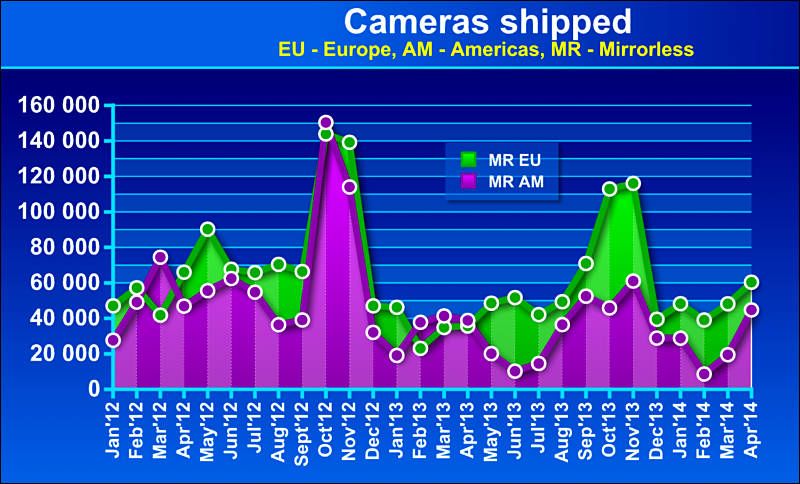
CIPA mirrorless shipment data from Japanese companies. Image courtesy Personal View.
The Japanese CIPA and the German GFK agency shared some interesting new data about the worldwide digital camera market. And finally we see some slow but continuous growth in the mirrorless market:
1) CIPA
CIPA (data can be seen here) shared the Japanese camera shipment numbers. And as usual Personal View did a great job summing them in graphs (can be seen here).
The interesting data here is that in the period January-April 2014 mirrorless system camera shipments growth by 16% while DSLR shipments did fell by 11%
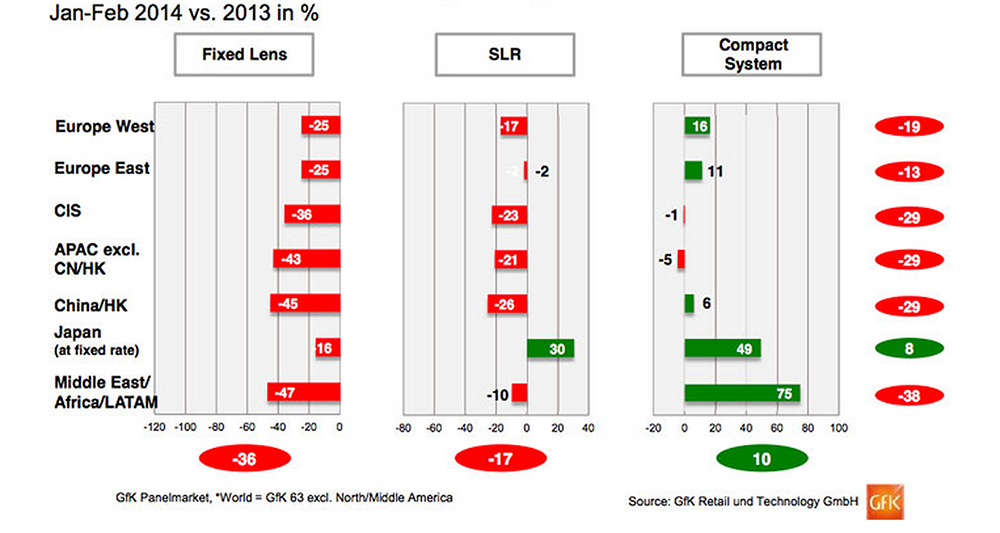
Mirrorless camera sales are increasing almost everywhere (Source GFK at MirrorlessRumors).
2) GFK
The German agency that works in partnership with the Photokina organizers shared plenty of surprisingly positive data (more about it at Mirrorlessrumors). While it’s true that the budget compact camera is shrinking the premium market increased. And with premium we mean, premium DSLR, premium mirrorless and premium fixed lens compact cameras. And there is where companies have higher profit margins. See graph below:
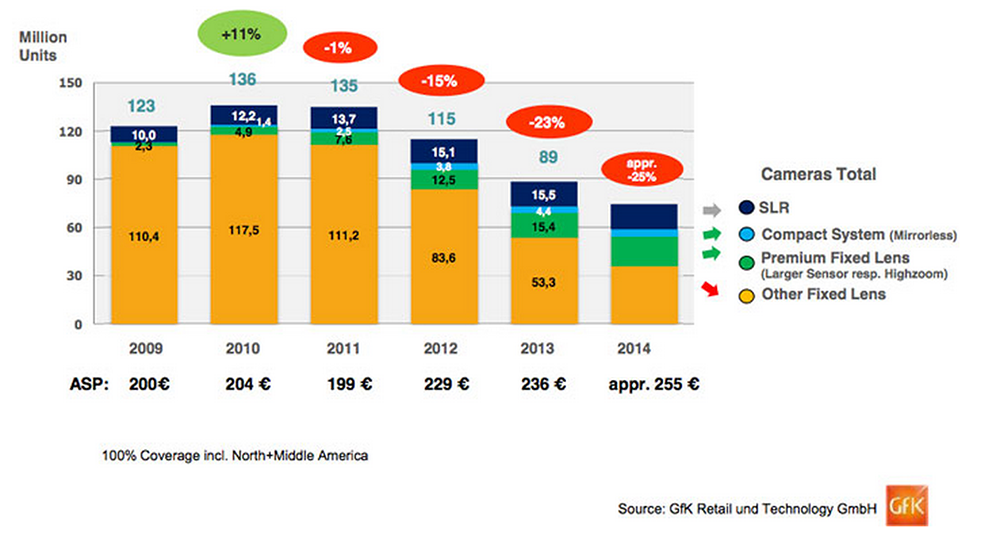
Camera unit sales dropped by 25% but revenue is increasing.
Well, this could be a good news for Panasonic and Olympus. Both companies are now focusing their efforts on mirrorless cameras. And and as we heard many times now their goal is to create more “premium” mirrorless cameras and premium “compact fixed lens cameras”. As you know Panasonic latest financial reports shows they are recovering very well from the losses they had the previous year while Olympus is expected to have a break even during the current fiscal year.
Let’s see what kind of “premium” stuff will be announced by both companies at Photokina…
55 Responses
> “Camera unit sales dropped by 25% but revenue is increasing.”
It’s not the revenue that is increasing, it’s the average sell price per unit: €199 in 2011, €229 in 2012, €236 in 2013 and approx. €255 in 2014f.
This is logical since the lower end of the market is more rapidly decreasing than the upper end.
Unfortunately, the decrease in volume (number of equipment sold) is quicker than the increase in average price per unit, thus meaning that total revenues are decreasing, not increasing.
Well observed Mistral you would have thought that the massive losses posted by all the big mirrorless players in recent years would make this obvious
It’s good that more units are being shipped as manufacturers are finally slashing prices. But of course that will affect profitability, which for some reason is not depicted here.
But I see what appear to be some other discrepancies with the text when I actually look at the links:
In the charts titled “Production,Shipment of Digital Still Camera January,January-January in 2014” and “Production,Shipment of Digital Still Camera April,January-April in 2014” we see the number of DSLRs shipped in January as 685k and the number of mirrorless shipped in January as 218k, whereas the number of DSLRs shipped in April is 975k and the number of mirrorless shipped in April is 265k.
Thus, DSLR shipments increased 43% January to April and mirrorless increased 22% January to April.
Additionally, look at the powerpoint slide entitled “Cameras Shipped (with no subtitle)”-
this graph directly compares DSLR w/mirrorless shipments. The curve shows DSLR going higher and steeper than mirrorless since January 2014.
I don’t know how these numbers are supposed to square with the claim that DSLR unit shipment decreased at the expense of mirrorless, when if I interpret these numbers correctly if anything it’s just the opposite.
A further look at the longer term trends shows there is ALWAYS a lull in January-February. That appears to always be the low spot for all camera sales, with gradual increase in units to the first quarter. What is most telling is that the troughs get lower every year as do the peaks, so the long term trend is fewer and fewer shipments.
And as we know too well, shipments don’t equate to sales. It can just as well mean more stock is languishing at the distributor or the retailer shelves.
Numbers bouncing around at fewer units year after year is NOT good news, it’s rather a sign of a hobby of fading popularity, perhaps following a fading demographic.
Hopefully I’m reading or interpreting the numbers incorrectly, but I see little to be happy about.
Premium mirrorless? Anything to do with M43?
LOL in some wild dreams.
I just finished my wild dream. Thank goodness I had a washcloth nearby.
Is that a Nikon J in your pants or do you just have a tiny sensor, Tom?
Yawn. (Going out and take some photos)
+1000. 🙂
Math is HARD.
Yawn….zzzzzzzzzzzzz
If you’re saying that this above is math, then it’s not hard at all. It’s simply boring. And I prefer to walk out in the nature, breathe some fresh air and take some photos 😉
Well said!
Chart gazing is just a tidier form of shank cranking. 😉
Oh, sorry. Thought you were out taking photos in nature instead of yawning at blogs.
I was, it’s not that difficult to stop some seconds and politely reply from my smartphone. (This post is boring, the blog, apart from trolls, is nice)
Cankon are you listening? Bueller Bueller Bueller?
Canikon are too busy counting their profits and laughing at mirrorless’ immense financial losses.
The beginning of the end of DSLRs. I think the tipping point is still quite far away, probably in 3 more years. Then, it will accelerate until it’s watershed, starting with all those DSLR owners with just one general purpose zoom lens.
Inevitably, those mirrors are going to go. But believe me, m43 will be gone sooner.
Nikon 1 will be the first to go, long before M43.
Yet Nikon 1 has more market share than Micro 4/3 in some markets, despite coming later and despite not having multiple vendors.
But, really, if you like micro 4/3, why would you even care how Nikon 1 does? Kind of odd.
I don’t recall expressing a preference for either system.
Just an opinion of which would go first despite Nikon’s massive marketing and distribution arms.
If you like N1, why would you even be on an M43 site? Kind of odd.
Didn’t realize one had to choose a side over silly luxury consumer toys.
Exactly. Which is why it’s best not to assume everyone else has.
Time to shave those armpits, Tom. Clip out the nose hairs, too.
Dare I suggest you actually look at the actual CIPA data .Preferably with a claculator an/or a grown up.
http://www.cipa.jp/stats/dc_e.html
We’ve been hearing for six years that DSLRs are going away, and yet they are the only profitable segment. Don’t understand this anguish over the segment, and wishes for its death.
I don’t think most here are in anguish or wish for the death of the DSLR. I’m guessing most of us started with an SLR or some sort. I’ve owned three DSLR’s, but my D5100 is gathering dust now.
The people on this site (and the other mirrorless sites) embrace mirrorless technology as the next logical step and therefore expect the DSLR to become more and more of a niche. That shouldn’t be a surprise.
The fact that Canikon & Sony have started their own mirrorless lines shows that they’re paying attention, but they aren’t going to give up their bread & butter DSLR lines until the market dictates.
The trolls on either side of the argument aren’t in the majority.
The religious whack jobs are in the minority, but are as vocal as fundamentalist christian zealots. Mirrorless cameras continue to lose millions of dollars, year after year after year.
Laughable. You are a joke. DSLR’s make money. Mirrorless cameras make losses. Immense losses. Crushing losses. Panasonic and Olympus have shed enormous value “making” mirrorless cameras.
You are nothing but a religious whack job.
Exactly. Look at Minolta & Pentax DSLR’s. Printing money!
P.S. – Where was the religious part?
What companies are behind these numbers?
The top chart is CIPA, so that’s the official Japanese numbers (does not include Leica or Samsung). The source of these numbers are the camera companies themselves, entering data anonymously into the CIPA database. I’ve never caught a serious problem with their numbers in the two decades I’ve been following them.
The two charts below that are from the group that runs Photokina. I haven’t read the original German source material yet, so can’t say where that data comes from. However, both charts are a little on the suspicious side, and the bottom chart does not say what every Web site that’s been posting it says it does. Do the math: revenue fell from 2010 to 2013, even using the data in that chart ;~).
There is something about certain mFT fans especially amongst the Olympus crowd, that leads them to have some kind of blindness when it comes to simple numbers. I recall the abuse you got from them when you correctly and reasonably predicted that there was no way that Olympus was going to come close to the sales targets that they stated earlier in the year.
Honestly you would think that considering Olympus has been making ludicrous financial predictions about their imaging division and failing to deliver literally for years now they would see sense.
On the other hand, numbers are difficult to comprehend at times. Even I’ve had to look two or three times at some sets of numbers to understand them sometimes, and there have been times when I’ve got them wrong. So I’ll give people some slack there.
What’s frustrating is when someone argues in a way that the numbers don’t actually show, and continues to argue that after it becomes apparent that the numbers don’t show what they think they do.
Given that Olympus hasn’t hit a forecast in the camera group in a long, long time, basically I’m always going to discount their forecast until some other set of numbers tell me that something has changed. Olympus is again forecasting 630k units for the current year in sales, but is sitting on 250k worth of inventory. That’s an unheard of inventory in the camera business. Nikon tries to never go above 45 days. So something has to give.
Man, those Personal View graphs are some of the ugliest damn things I’ve ever seen!
Where are the Americas on the CIPA charts? Did they get lost or is it their personal view that the world is still flat? There must be sea monsters and dragons lurking by the edges.
Maybe just obese Americans with their SUVs lugging DSLRS. 😉
I think you mean on the Photokina chart. As I’ve pointed out elsewhere, that particular chart has some very misleading information on it: it emphasizes the push into Japan before the sales tax increase and fails to cover the Americas at all. In other words: emphasize the good news, delete the bad news. That alone is enough to make us suspicious of intent. But Photokina is trying to drum up business for their trade show, so a positive spin sure would be better than a negative spin for them, right? ;~)
Positive spin makes perfect sense.
it says excluding North & middle America , that is a handy subset of data to ignore if you want to try and bump the mirrorless sales to look better
Yeah. The Americans and their SUVs are really making the rest of humanity look irresponsible and bad. Come on, Yanks, catch up already.
Here we go again. Blame the customers when a corporation’s products are not selling.
Moreover: how do you know exactly which market has its pulse on the true market trend anyway? There’s an equally likely chance the rest of the world is behind, and NA is leading the trend.
You can always count on the mirrorless fanatics to slander others to promote their religion. Bank on it.
Not really considering North American sales are so low.
North and Central America is a bit of an irrelevance as far as their sales go so even a large increase or decrease would be fairly insignificant.
Personally, I think they should stop wasting money and effort there and concentrate their resources on markets that don’t have a ‘bigger is better’ culture
The demise of compacts is a crushing, maybe fatal blow for the manufacturers.
Compacts subsidized the business in its making of more expensive products. The jury is out if a much much smaller number of product sales, even if more expensive, can generate sufficient revenue to support manufacturing, distribution, marketing, and back end operations.
If it was simple to do this, manufacturers would have voluntarily jetisoned their low margin lines years ago. I mean, why bother?
This is nothing new. Nikon Fs never sold in sufficient numbers to be self sustaining, hence the Nikkormats, and later compact film cameras. Additionally, Nikon F’s provided a high-end for aspirational owners of Nikon compacts. Today, there ARE no more owners of compacts. So where are the incrementally new buyers of high end coming from? Likely form nowhere, as the high end consumers over the last few years tend to be churners- the same round of folks who bought the last model. This is not sustainable, so this set of loyal consumers will also dry up soon. You can only be made to feel like a sucker so long when six months later your camera you pre-ordered is selling for hundreds less. Yet again.
More, the ‘high margin’ lines are experiencing diminishing margin, as we see in the recent round of price off incentives everywhere. And once consumers get a taste, the incentives will only increase as manufacturers desperately slash, trying to find the level of a sustaining demand.
This is looking ugly, boys.
Um, no not really. Revenues are down but profits are up. Sounds like a Leica-like better deal to me. I’d rather have more money in my pockets than the idea of having more money.
Profits are not up, not by any means. OK, Nikon’s are, I don’t know about Canon’s.
Profits are NOT up for Olympus, Canon, Fuji, Samsung, Panasonic cameras. Not possible, since they never made a profit in their digital lines in recent years.
Don’t know where from the data shared in this article you got that notion.
Sony’s profits are up (for its imaging division):
“Operating income increased
24.9 billion yen year-on-year to 26.3 billion yen (256 million U.S.
dollars). This significant increase year-on-year was mainly due to the
favorable impact of foreign exchange rates and a decrease in
restructuring charges, partially offset by the above-mentioned decrease
in sales of video cameras. During the current fiscal year, restructuring
charges, net, decreased 9.5 billion yen year-on-year to 3.4 billion yen
(33 million U.S. dollars).
…
Overall segment sales are expected to decrease mainly due to a
significant decrease in sales of video cameras. Operating income is
expected to increase primarily due to a decrease in costs, partially
offset by the decrease in sales.”
Good for Sony, but its numbers are not broken down specifically for the consumer photographic sales. More: break out the boat anchor of consumer photo gear, and Sony’s profits would have been up even more.
Sony still maintains commercial sales, for example, as well as serves as a supplier to other manufacturers, which helped sustain the imaging division.
You can only hide losses so long by continual internal restructuring.
I agree it’s looking ugly. I’m not looking forward to having fewer players and fewer options.
I have been saying this for a long time. There will be several players exiting the mirrorless market. Their simply are no profits to be made making mirrorless cameras and the catastrophic losses suffered by these camera companies cannot continue forever.
Mirrorless doesn’t make money. Period.
It’s not the mirrorless market. It’s the photography market.
The only reason that the the big two are still making profits is because they are the big two and have retail presence, brand recognition and economies of scale.
They could just as easily be selling mirrorless cameras only and still would be the only ones making a profit.
After all the dSLR sales of the other brands were hardly a wild success even when the market was growing. And now the market is shrinking…
That is true. Fujifilm lost enormous money making SLR cameras, just like they are with mirrorless.
There, not their.
I just think that US MR sales lowest most of the time could it be US people have big palm and dislike compact MR…
No, we just like real cameras.