







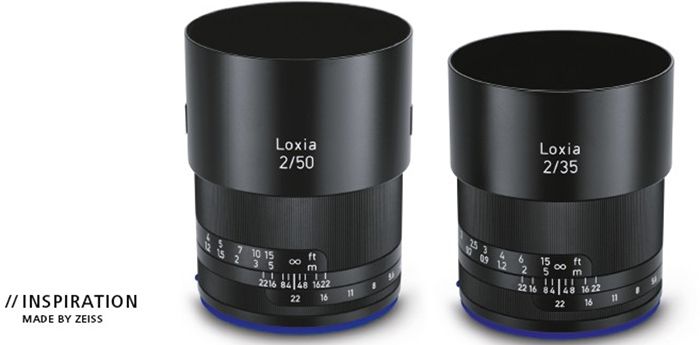
Reminder: The worldwide first Zeiss Loxia Full Frame E-mount lens preorder are now running at BHphoto:
Zeiss Loxia 35mm f/2 Biogon T* Lens for Sony E Mount (Click here).
Zeiss Loxia 50mm f/2 Planar T* Lens for Sony E Mount (Click here)
Cinema5D had the new Loxia lenses in their hands and posted some image samples within their short preview.
For me, the two Loxias were the last missing pieces to make the A7s a perfect “go-anywhere-with-me” camera. They are built as nicely as the camera itself (metal housing) and the full package feels very much like a much more expensive Leica rangefinder camera. The nicest touch about the lenses is their very small size (apart from their built quality) – and I think that was the priority when they were designed. Typically for Zeiss, the lenses are extremely sharp and have hardly any noticeable distortion or vignetting (which can’t be said about all 50mm photo lenses on the market – I used the Canon f/1.4 50mm on the A7s before and while the image is very nice, the lens vignettes heavily when shooting wide open).
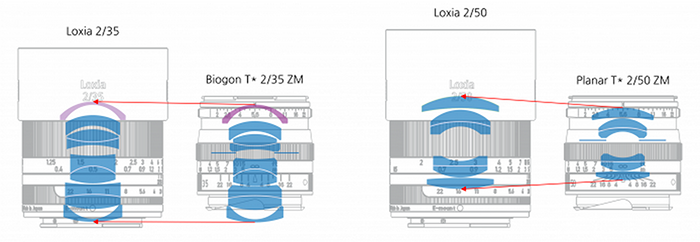
And the Korean site Dicahub compared the lens performance of the new Loxia with those of their “original” the [shoplink 9808 ebay]Biogon T* 2/35 ZM (here on eBay)[/shoplink] and the [shoplink 9809 ebay]Planar T* 2/50 ZM (here on eBay)[/shoplink].
“Old” 50mm Planar charts on the left. And New Zeiss Loxia 50mm Planar on the right:

“Old” 35mm Biogon charts on the left. And New Zeiss Loxia 35mm Biogon on the right:

Dicahub noticed little differences between the old ZM and new Loxia series. But obviously the Loxia has one major advantage as it’s designed for use on digital cameras while the ZM series is made for film. And that difference may not be visisble on graphs but rather direct comparison with all lenses mounted on the Sony A7 camera.
0 Responses
Obviously, these are going to be great lenses, same as half of the other e-mount ones, which are being dissed to this day by clueless people who decided to build their opinion on a blogger who saw a sample from a preproduction model.
I don’t think they should be dissed. They are far from a bad lens, my only gripe is this; I can mount *any* lens on an A7/r/s, so we are talking competing with Leica, and legacy lenses, not sharpness, as we know Zeiss can give us sharp, so the question is, where is the character? Where is what distinguishes this lens from the rest of the pack, and f/2? Really? I’m a HUGE Zeiss fan, but as of late have been disappointed from their offerings for the FE mount. I’m in no way shape, or form saying they are bad, I’m simply stating they do not shine! The 55mm, is an awesome lens, but I swapped it for a Voigtlander.
I think the f/2 is what allows this lens to fit the camera it’s made for. Have you seen a Canon f/1.2? It’s massive. And…. f/2 on an a7S is plenty fast and will give you bokeh with ease.
Not touched a Canon since the late 80s 🙂 So no haven’t see it, but I do have an amazing Voigtlander 35mm f/1.2 on the A7, that as far as I’m concerned is not that big, and would probably wipe the floor with the Loxia, and even if the Loxia was to excel, I wouldn’t give up the speed or character of the lens for sharpness that I’d only notice if I was pixel peeping 🙂 I also have a quite small Voigtlander 50mm f/1.5 which is deemed nearly as in the same league as the Leica 50mm f/1.4 Summilux-M Asph, and I find that the Loxia being f/2 doesn’t cut the mustard, and yes I *would* notice the difference in DoF and Bokeh, because I admit, I’m a Bokeh Junkie 😀
Alright, I’m warming up to these lenses. Prices aren’t all that bad compared to ZM. To me, this comes down to the user experience. I’m curious to get my hands on one and give it a whirl.
http://diglloyd.com/blog/2014/20140904_1012-ZeissLoxia-vs-ZM.html
Lloyd Chambers take on the new lenses
Thanks for the link, it’s a vast improvement compares to ZM.
Haha – I can’t wait for him to find some “trumped up” problem with the lenses and starts a petition against them
So, it is the same thing.
The A7s will hardly put those lenses to the test. It would be much more interesting to see how the A7r gets along with them. The more so as the original Zeiss Biogon 35/2 ZM seems to disappoint when attached to an A7r.
I’m sure these are decent lenses, but what’s the point? Manual focus primes is pretty much done. If you have the money, Leica takes the cake in image quality, if you don’t there’s a plenthora of alternatives out there that work just fine, from $50 Nikon E-Series to Voigts to these. Utterly pointless anyone bringing out new manual focus primes.
These lenses perform better than RF lenses on mirrorless bodies than Leica and other M mount lenses.
How do you know? Until now, we have only Zeiss’ word for it, and, while 50mm rangefinder lenses generally work well with mirrorless cameras and Leica’s, specifically, are excellent, we know that the Zeiss Biogon 35/2 ZM, which doesn’t seem too different from the Loxia 35mm, didn’t perform well on the A7R at all.
How do I know? Because they have samples and I have eyes? 🙂
And no… 50mm RF lenses don’t necessarily work well on mirrorless.
Original ZMs are designed for film, not digital. Neither Sony designed their A7x to accept ZM lenses.
Read this: http://www.lensrentals.com/blog/2014/06/sensor-stack-thickness-when-does-it-matter
We’ll see how pointless this is. I expect these to sell well.
for film maker, its a great lens and its price. as long as the quality follow up, it will be more popular than ZE
These lenses look promising and are the right approach for modern manual lenses on a digital body… but I still feel they are priced too high for what they are. Patience is a virtue because they are sure to be deeply discounted in time.
Has Zeiss ever deeply discounted their lenses? If yes then after how long?
There was a pretty large discount on the Touits earlier this year. I don’t remember the specifics, but it was almost like a 2 for 1 special for a limited period.
They’d need a 3 for the price of zero deal to make me interested in a Touit.
They should offer a ROUND Touit for free. Maybe it would help all those photographers who say – “I’ll own a premium priced APS-C Zeiss lens when I get around to it”
Fair point. Rare though.
If something like this happens to the Loxias at some time next year, I will be all in:
http://www.sonyalpharumors.com/back-in-stock-800-off-double-zeiss-touit-kit-nex-5t-with-lens-and-flash-for-399-150-off-on-rokinon-lenses/
How much do you realistically see these selling for? Remember though, Touit became old news and discounted when FF mirrorless came along. These Loxias will not become obsolete like that unless Zeiss themselves release AF versions that are around the same size.
Hmm… so an F1.4 lens vignettes more wide open than a lens a full stop slower does when it’s wide open. I don’t find that very surprising. How does the FD 1.4 do at F2?
It sucks just a little bit less at F2
I own it. Not much different at F2. I mean, it’s a nice little basic lens but very hard to compare to the Planar.
“Go-anywhere-with-me” camera doesn’t sound very promising with an MF lens. I would say “go-shoot-snails-or-dead-people-with-me” is a more accurate description. Considering the A7s in the context, I would add another clarification “go-film…”.
ask any of the old great street photographers. mf is for snails and dead folks exclusively.
That was an exaggeration. But really, why in the world would you choose the Zeiss 50 f/2 over the Sony 55 f/1.8, assuming it’s more expensive and no AF. Cinema5d just lost the rest of its credit.
First off, dead people deserve the privilege of taking selfies just as much as the next guy. I agree with the go-film comment though. Manual and film- a match made in heaven. Or a grave…like, for like a dead guy.
How is the Loxia any better?ANY? At all? It may have solved the color shift problem but since the corners suck we can’t even be sure about the smearing. I don’t think Zeiss’ put any effort into these lenses.
You think so?
http://diglloyd.com/blog/2014/20140904_1012-ZeissLoxia-vs-ZM.html
It’s an old Biogon design slightly tweaked, the corners have never been fantastic and the MTF charts show accordingly.
Just did a side by side shot of the FE 55mm and the Nokton 50mm 1.5, both @ F2, on an A7… and the lenses are basically identical. Difference in sharpness is indiscernible, the nokton actually has slightly less CA than the Zeiss, and the bokeh of the Zeiss is slightly better than the nokton. One is a stop faster than the loxia, one is autofocus, the nokton can be had for around $400 on ebay, the Sonnar for around $700…
What I am trying to say is that Zeiss should have picked the 85mm f2 ZM lens to relaunch first.
Zeiss were wise enough to give these lenses a unique feature (over and above them being native E-mount). That is easy aperture de-clicking. That alone will ensure that these sell. These are the two most obvious focal lengths to start with. You may not like it, but these are made to generate profit for Zeiss. Sony still benefits, through E-mount camera sales and a large shareholding in Carl Zeiss.
More lenses are coming. We just have to be patient.
“Sony still benefits, through … a large shareholding in Carl Zeiss”
that is not true. Zeiss is fully owned by “Carl Zeiss Stiftung” and may never be sold in whole or in part. Read “http://carl-zeiss-stiftung.de/42-0-Stiftungsstatut.html”.
I stand corrected. The point regarding the sale of E-mount cameras stands, unless Sony intend to share E-mount with other manufacturers.
Thank you for link. I had been under that misapprehension for a while.
Not to mention the PR benefits of a premium brand like Zeiss being involved on the party front (given that sigma is still ignoring e-mount).
Loxia 2/35
https://www.flickr.com/photos/54167241@N02/14929175558/
Vignettes like crazy.
Still, interested in this lens line but not for this outrageous price.
I’m sure these lenses will be good (whether they will be as good as the autofocus 35/2.8 and 55/1.8 remains to be seen). My only questions are: how large is the market for these primes? Is it going to help building up a large user base? I can’t image that these lenses sell well outside the enthusiast user base frequenting forums like this one.
the A7 cameras aren’t entry level so the market should be defined already. And for Leica users this system must be a bargain!
Regarding the prices here where I live, many people consider the A7 as a good value (see A7 as entry level FF, for example) but complain about lens choices. They get more with time, but I know only a minority of people wanting to have manual focus. That alone is not a problem, more choice is preferable. But Sony wants to get market share from Canikon. I don’t know whether these lenses help. Maybe I’m wrong, but good quality lenses (F1.8) with autofocus in the 500-800 Euro range could help a lot better, in my opinion. Leica has a niche market only (btw., visited Wetzlar two days ago and had a look at the Leica factory. Lot’s of shops around with used Leica lenses, too. Quite nice).
some photographers enjoy the “real” Zeiss labeling as opposed to the engineered Zeiss with AF. To each his own. From a marketing approach it’s important to have choices. I don’t believe the a7 line has been as big as I would have believed a year ago regardless of the corporate spinning yarn. Their pricing has come under a lot of pressure along with everyone else’s.
What’s the difference? In all likelihood, it’s Japanese designed and made (either Sony, Cosina or Tamron, maybe others)
the big question is:
Does the min.focus distance, the better distortion, vignetting &smearing control & the EXIF data justify to pay double the price to change my ZM lenses ?
from what I see the Loxia 35 is worth an update. The 50 not necessarily
Double the price? Where did you find new ZM50 for $500 and the ZM35 for $650? I’d really like to know.
ebay , offer accepted by buyer, months ago
So an isolated personal good eBay deal is what you are basing the general pricing critique on. I get it. Sigh…
common sense man, old vs new, you can find many deals on old stuff, you know that
Compare prices for used lenses with other used lenses. Common sense man.
bought it new,sealed at a low price because it is an old unsold item.
Never heard of that?
Compare common retail prices with common retail prices. Your deal was a specific case. Because someone farted in Cairo, it does not mean all of Egypt smells like sh*t.
it does!
That’s it. I’ll never go to Egypt.
I am pretty sure the Loxia lenses are performing well and will make videographers happy. I do no video. I own SEL55FE18 and SEL35FE28 – both Zeiss labelled, I am happy with it. All tests of the SEL55FE18 put this lens in the same league as the Otus. No chance that the Loxia 50FE2 will top it. The point to me is: e-mount lacks lenses above 50mm – the SEL70200F4G is optically fine but also a shining white stovepipe – it makes candids almost impossible. Offering another 35 and 50 lens without offering also a 85 and 135 lens is like a slap in the face for all A7(r) users. Just my 2 cents. You may think differently.
I’ve tested the 55F18 several times with my A7r and I have to says, it’s sharper and much more lighter then my Zeiss Planar 50F2 ZM. And it’s not as big as everyone says it to be. In my defense I would says my Planar have slightly better contrast and color saturation and it’s looks cooler plus the manual focus is fun feels great. But that is very subjective. On top of that the SEL55F18 is weather sealed. Deep down inside I’m a little bit jealous but if I were to choose again the result may or may not be the same. I wish I could own both but that’s just stupid. Fun factor aside the SEL55F18 is the better lens IMO.
Its the better lens for photography probably, but video guys just manuals focus, so the Loxia will probably better for them 😉
ZM even better ! and cheaper
actually the reason I bought the Zeiss 50mm ZM over the SEL55 was because of the manual focusing. The focus ring is so sexy to turn. I use it for photography only. It’s not practical but it’s fun.
You say you want to own both the Sony FE and the Z_Lox, but I don’t find that stupid or if it is I am very very stupid. Was organizing my lens cabinet last night and realized I own 10 50mm lens’s. (of course they are in many different formats but..yeah I gotta make some choices.
No I didn’t want the Loxia. I already have the Zeiss ZM but you’re encouraging me to get the FE.
I agree with you but they will be releasing more soon so we will see if we finally get a 85 135 and something wider even though I don’t really care for wide lenses I know other people do.
Yup, I expect a 24 and an 85 for sure…
The third lens next year could be either wider or longer. Maybe either an 18 or a 135?
IMO the charts show that Zeiss really worked on those Loxias. Of course their general characteristics are pretty familiar to the ZMs (they have the same lens design after all), but still with clear differences.
A few things that I recall for the Loxia Planar are the clearly less distortion and the “almost-no-drop” at f/5.6. With the Loxia Biogon, the distortion is a tiny bit higher, but was (and still is) at such a virtually perfect level that this really won’t matter. I guess Zeiss “sacrificed” this negligible amount of distortion level to obtain improvements in other domains.
But those charts are really only charts. If I can make it to Photokina, I surely would like to take some pictures there with both the Loxias and my ZMs. To me that would be the ultimate comparison on which I will decide wether or not I will buy the Loxia(s). At this moment, I very much feel for it, because, if they perform well, the Loxia line will be the perfect glass for my A7r, turning it in a Leica M comparable system, but then adapted to modern times. Tradition meeting modernism indeed – “modern manual shooting”, that’s what I used to call it, where one can keep active control of all parameters, but still shoot very fast, often even faster than with AF, especially when hyper- or zone-focusing. (That’s IMO – of course I appreciate everybody elses opinion.)
it’s true, MF with modern facilities (Focus Magnification, Focus Peaking, Large EVF) can easily outperform AF in Low Light or similar situations.
What is questionable is the look we’re after when using those MF lenses.
The look from a ZM lens is unique, its mechanical smoothness is exceptional, its silver finish is beautiful, it produces NICE, unique, sweet images.
I too own the two ZM lenses and I am very sceptical what the Loxias could offer MORE
Consider the unique possibilities of this as a manual focus lens. If Sony’s E mount gets in-body sensor stabilization, which was revealed earlier this year in a leaked internal document (http://www.sonyalpharumors.com/soon-to-be-announced-new-e-mount-cameras-have-on-sensor-stabilization/), then the lens will be capable of automatically indicating to the camera body the correct focal length to stabilize to. Along with EXIF data and automatic focus magnification, this will be of great convenience compared to any other strictly manual lens, and the only one of its kind. Along with the unique precision of manual focusing abilities, this will be an amazing feature for video shooters especially.
All that said, while I like its rendition and fairly compact size, it wouldn’t hurt for the prices to fall a bit.
My short take on this, up until someone with a good adapter proves it otherwise…the old designs seem to perform better than the new designs (ZM > Loxia) but the designs are so close that it seems like they just took the ZM design and tweaked it a bit.
What did they gain with the tweak? the MTF doesn’t show any gains (again, wait for some real comparative samples) but I see that they compromised chromatic aberration and some sharpness performance. with the tweaks.
Slightly disappointing.
Now about that ZM 35mm 1.4….
Remeber the MTF for the ZM lenses are measured for film (no filter stack) and the Loxia plots are measured with the sensor filter stack in place.
ZM lenses probably perform worse than the Loxias on digital. But it’s dissapointing to see that the even the tweaked Loxias are worse on digital than the ZMs on film..
why couldn’t they offer those Zeiss Touits for FE? Good autofocus and great lenses.