







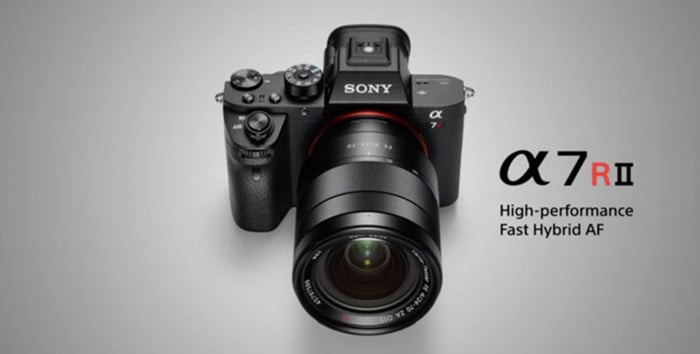
The A7rII will soon get a firmware update with 14BIT uncompressed RAW and maybe some other additional feature. So most reviewers here below will have to rewrite some piece of their review 🙂
Anyway, here are the latest A7rII tests:
A7R II and 90mm macro underwater piece (Imaging Resource).
Sony A7RII First Look By Mason Marsh (StuckinCustoms).
Sony a7RII Canon EF Smart Adapter Tests (Brian Smith).
Canon EOS 5DS R Versus Sony Alpha A7R II Comparison (ePhotozine).
α7RII and legacy wide angle lenses (The.me).
Sony A7R II: Other Areas That Need Attention via Firmware Update (Diglloyd).
Sony Alpha A7R II review (Techradar).
Sony a7S II vs a7R II vs a7 II (Digitalrev).
Using the New Sony a7R II at 150 Miles Per Hour (Alphauniverse).
Sony A7R II: la función de vídeo a examen (Quesabesde).
A7rII store links:
In USA: at Amazon, BHphoto, Adorama, SonyStore US, FocusCamera, Uniquephoto.
In Europe at Sony DE, UK, FR, IT, ES, NL, BE, CH, AT, SE, FI, NO, PT. Wex UK.
In Asia at Digitalrev, CameraPro.
50 Responses
No Way! The dual SD card slots via firmware upgrade?
LOL
https://delightlylinux.files.wordpress.com/2014/09/evo6.jpg
Perhaps something like this would work
https://delightlylinux.files.wordpress.com/2014/09/evo6.jpg
never seen that. Is there a downside of that or is it just the same as dual slot?
(besides I don’t think that I need a 2nd SD card slot) 🙂
I would be curious to see how it works. I guess that the A7 (s,r,I,II, no matter) doesn’t recognize that there is 2 micro sd cards. So what happens? Is the raw written on the 2 cards simultaneous or does it start to record the files on the 2nd card once the first is full?
WOW, never seen that before. Is that a little SD card RAID adapter? That would be cool.
Seems to be RAID 0 only. 🙁
yes, looks like. but I think it should be possible to produce a RAID 1 version. Actually sony could even do that on their own. 🙂
If you can survive with the camera JPEGs in a worst case scenario (modern SD cards from brands are quite reliable in our days), you can let them transmit in background via WiFi to your smartphone app.
I would like to see a internal storage solution, using M.2 SATA that is user replaceable, in adition to the SD card slot.
“Now that Sony is offering a lossless format (albeit uncompressed it seems), here are other areas that need attention.”
Lol. That didn’t take long.
Missing intervalometer? There is a camera app with many options – and you do not see it in the menus as long as you do not need it 😉
I am quite tired from all these naggings…
If you need a problem, you will always find it. If you need a solution, you also can find it in most cases, but it seems to attract more attention to search for problems…
They just need to open the App store for any developer to make any kind of App, that would bring the clear benefit of using the App system, and maybe people would uderstand that.
AFAIK the camera app is bad — it doesn’t set camera to hibernate between shots so you can’t do many shots.
In my 5 day stint with the a7r2 I found in silent shooting, I couldn’t shoot in burst mode. The a7s did fine with that, in fact it was quite useful for events. Anyhow, maybe the 42mp would clog up the burst mode in silent shooting, who knows, but I think it’s a relevant feature that should be implemented if possible. I hope it wasn’t removed just for the sake of product differentiation with the a7s and now the a7s2.
I’m sure Diglloyd is just trolling now.
He now wants, “Sound-based focus peaking (pitch and volume) while manually focusing (not just visual)”!
How exactly is that going to work? The point of manual focus is that you focus exactly where you want to – not where the camera wants to. How is the camera going to know where you want to focus and therefore when to increase/decrease pitch or volume? Besides that, it won’t be long before every living thing in your proximity wants to punch you in the face because of your squealing camera.
It almost as if he wants the camera to do all the focusing work for him. Oh wait, I hear there’s this feature called autofocus!
But keep up the good work Lloyd – pretty soon you’ll have your very own bespoke Sony camera.
The camera will make the sound of a truck backing up and sonar would be cool too.
Great for street photography and wedding ceremonies
Yep, that will be really popular at weddings. I can see a use for it now.
Uhg, the jack@ss photographers who leave on their beeping AF during wedding ceremonies I find incredibly irritating and disrespectful. Heaven forbid they rely on their eyes for a moment.
Helpful feature for visually impaired.
Possibly, but the camera still does not know what you want to focus on!
AF would be much more helpful for the visually impaired.
I think Diglloyd was kidding and is laughing his a*s off about the readers arguing how this bullsh*t could be implemented.
Hence, my trolling comment.
He’s either kidding, trolling or not particularly smart. Take your pick.
Not by sound, but some kind of focus trap mode using the PDAF would be a great aid for manual focus. Like you pull the focus and the PDAF points turn green when you get the focus, it would work faster and more precise than peaking IMO.
Looks like Diglloyd believes he’s standing on some form of upper grounds since Sony will now introduce 14bit output files and he is making up a list of BS to follow as if he’s the only one that made anything happen.
yup…don’t know what he’s talking about—just tried this A7RII for a couple days, it’s the bomb camera… balls-down. The prints are crisp on 3880, the best thing about it is the evf for m/f lenses..the second zoom has peaking (a7 does not on second zoom).
It’s so easy to nail focus w/ this camera it’s just great.
So those are “land mines”? Some of those may well be due to technical issues and not just simple firmware fixes. For example, with the 12 bit on “bulb” setting it’s quite possible that it’s pointless due to increased sensor noise and heating. Also, 14 bit becomes increasingly pointless once you move off of base ISO.
A lot of the others outside the area are just speculative. I’m not sure I see the point of a 16 bit JPEG. Surely those after that sort of quality will be using RAW anyway.
As far as 64 ISO goes, there’s already quite a lot around that hints at the lower ISO levels being effectively faked. Ultimately base ISO is simply defined by the full well depth of a sensor pixel, it’s QE and the area over which it collects light. It’s simply not possible to take it too low or the highlights just get blown out. The suggestion is that some camera manufacturers are fiddling the results.
http://www.dpreview.com/forums/thread/3894233
“14 bit becomes increasingly pointless once you move off of base ISO as the bottom end is just capturing more and more bits”
Sorry to say, but this is just wrong. Apples and oranges.
Bit-depth, the short version: Each sensor pixel captures an analog value. In order to store this value digitally, it has to be converted in a binary number. If you use 8bit, e.g. like your monitor, you have only 256 of possible values to match your analog value. This means losses due to rounding the analog value to the discrete value. With 14bit you have 16384 possible values, which just gives you more information fidelity. You don’t “capturing more and more bits”. You just have a much finer stepping of the discrete values, which is indeed pointless for displaying on a 8bit TFT display, but very important for extensive post processing.
You are right, that a 16 bit JPEG would be a little pointless, because the format is not made for extensive editing due to the lossy complession.
In post processing a higher bit-depth is all but pointless regardless how you put it or what signal amplification was applied (ISO).
By the way, 14 bit is better than 12 bit (4 x more accurate), but 12 bit is still way better than the traditional 8 bit (16 x more accurate !!). Personally, I think, 12 bit is still good as long as it’s stored in a lossless file format. So, yes, it’s a little over the top when Diglloyd calls it a “land mine”.
If you want to read more about signal quantization, the wikipedia article is a good starting point:
https://en.wikipedia.org/wiki/Quantization_(signal_processing)
This is nonsense. Digital sensors are certainly read using analogue means. The accumulated charge due to the photoelectric effect is turned into a voltage using a charge-to-voltage converted and that voltage is converted to a digital value using an ADC. However, that’s purely because there is not sensible way of actually counting the electrons. Light is quantised and so is the charge accumulated photosite is actually a quantised, not analogue value. It’s the number of electrons which have been excited into the storage area by absorbing a photon. The number that can be stored is ultimately limited by the nature of the silicon semiconductor and, in a typical systems camera is of the order of a few 10s of thousands of electron charges and that’s called the full well depth or the saturation level.
A 14 bit value allows for 16,384 different levels and a single bit will represent only about 3 electron charges on an A7R II at base ISO (which means 3 photons detected).
When you turn up the ISO level on a digital camera, all that is being done is that some degree of analogue amplification is applied (at least at the lower levels – some higher levels use multiplication in the digital domain). By the time you got up a couple of ISO steps you get to the point where the the bottom bit of a 14 bit value represents less than one electron charge.
If you doubt this, here’s one site that has calculate full well capacities for a large number of sensors. The A7R II hasn’t been calculated yet, but for the A7R it’s about 50,000 electrons. As the A7R II photosites are a bit smaller, it’s unlikely to exceed that. What this means is that (at base ISO), the bottom bit of a 14 bit value represents about 3 electron charges. At the next ISO level up it represents about 1.5 electrons, and the next one just half an electron. The read noise on an A7R is about 2.3 electron charges (the A7R II is probably a bit lower from DXO stats, but, by the time you get a couple of steps up, the bottom couple of bits will just be noise). Indeed, it’s blindingly obvious if you look at the way that DR declines with ISO. The reason that happens is simply that the noise floor is being amplified. In effect, the DR (in EV) is the number of the most significant bits in the value that contain useful information rather than noise. An image with (say) 8 EV and 14 bit depth really doesn’t contain much more than noise in the bottom 5 bits.
http://www.sensorgen.info/
If you want to understand the basic principles, I suggest you look here
https://theory.uchicago.edu/~ejm/pix/20d/tests/noise/noise-p3.html
Oh, and I should add I have a physics degree from Imperial College in London. It was quite a while ago now, but I don’t think the view is that light it still quantised. Light is NOT analogue.
I was only talking about signal quantization. Even if you say the accuracy of a 14 bit value is higher than the granularity of the original value (photon count or whatever) and therefore pointless, it applies (like you said) for the bottom bit of a 14 bit value (darkest shadow areas) only, but it doesn’t make 14 bit signal processing pointless.
BTW, I have a degree in computer science, shouldn’t we be more symbiotic?
Maybe, but this is in the realm of physics and the point was that we aren’t talking about an analogue value. With modern sensor we are very close to detecting individual photons. Indeed the A7S has (but only at higher ISOs) got read noise of only about half an electron charge. That camera is getting to the point where it can measure individual photons (at least in dark areas under low lighting).
Just out of curiosity: Your figures about photon count sound quite low. They refer to the relatively small pixels on an A7R sensor? As far es I understand, these numbers would be significantly (4x ?) larger on bigger pixels, like in the A7S, right?
They aren’t my numbers. They have been estimated by many people (see the link I posted).
You do realize that there is a gain value involved, right? The actual number recorded in the raw file is NOT currently the number of photons detected.
What on earth makes you think I said it was the number of photons? That’s a bizarre interpretation.
To make it absolutely clear, all I’m saying is that at anything more than a couple of steps up from base ISO, the least significant bit in a 14 bit value represents less than one electron (or absorbed photon). That is wildly different from saying it IS the number of photons.
If you take a photo at (say) ISO 1600 on an A7R (and assuming base ISO is 100 – but there is talk of these values being faked), the saturation level corresponds to about 3,000 electron charges. With 14 bits, there are 16,384 possible values, so it means that each LSB represents (as a proxy measure) about 1/5th of an accumulated electron charge (or detected photon). Even if the charge and ADC conversions process was perfect, for any given pixel it would therefore follow that there would be an increment steps of 5 between values. As it is, of course, there is read noise so these interim values will appear, but they are just noise. Only if you reduce the spatial frequency will you get some of those bits back through at the expense of resolution.
Are you actually saying that there really are 14 bits of real photographic information in a pixel taken (and exposed correctly) at say 1600 ISO?
No, and thank you for your clarification, which now makes sense.
OK – I was maybe a bit sharp in my response, but I didn’t think I’d implied anywhere that the system is actually counting either electrons or photons. It would be nice to do so directly, but it’s not technically possible on a photographic sensor (there are photonic counters, but they aren’t at all suitable for photography as far as I know).
I would most definitely pay for a discussion about the nature of light between you and Ken Wheeler aka AngryPhotographer.
Jokes aside, thank you for taking the time to write up such long posts. I really appreciate it 🙂
Haha, right, Ken would be the perfect one!
I would not want any form of conversation with that lunatic.
“An image with (say) 8 EV and 14 bit depth really doesn’t contain much more than noise in the bottom 5 bits.”
But a signal with strong noise is still better than clipping. If you keep the information you can at least attempt to reduce the noise by stacking.
Not exactly. The SNR at that point is less than 1:1, and even 1:1 isn’t photographically useful (one of my problems with most DR testing).
What’s not being said is this: bumping ISO upwards produces rounding in the data. That rounding very quickly becomes more important than the noise component itself.
I’ve written for some time that the Sony sensors deliver a useful 14 bits of information at base ISO, but above base ISO they really only deliver a useful 12 bits (and at some very high ISO point, even less). It’s actually why I pointed out Nikon’s compressed/uncompressed and 12/14 bit choices. A D810 shot at base ISO should be shot with lossless compressed 14-bit as the setting if you want the most optimal data. Above ISO 200 it can be shot at 12-bit and still get the most optimal data. Selecting the lossy compression gives less than optimal data at any ISO. So we really have a range of choice to select from that goes from “least amount of data reduction” to “most amount of data reduction.” You can balance your choice against file size and card size needs at any time. I can’t do that with the Sony A7 series at the moment. It’s still unclear what the A7sII firmware will give us in this respect, but I applaud any option that improves my choices.
Nikon D810 for some reason has lower base ISO than A7R (sensorgen lists 78k electrons) despite having essentially same sensor…
I like the chicago site, too. There is a nice article on Jim Kasson’s site demonstrating the effect of ISO (measurement + images) on 12bit and 14bit NEFs (D810). From ISO 200 on there is almost no difference anymore (measurments show this nicely), which is why I use 12bit lossless compressed at events and weddings most of the time.
I think Diglloyd is right about most issues: a man’s toy $3200 worth should have them. Setting like 12 bit / 14 bit / auto.
At least for silent shutter, it makes sense to users could choose between lower rolling shutter and higher DR.
i love ad block in chrome extension; makes this site less annoying.
They’re offering both compressed and uncompressed.
“The A7rII will soon get a firmware update with 14BIT uncompressed RAW”
What do you mean by “soon”?
Yeah the focusing system a7 is great .