







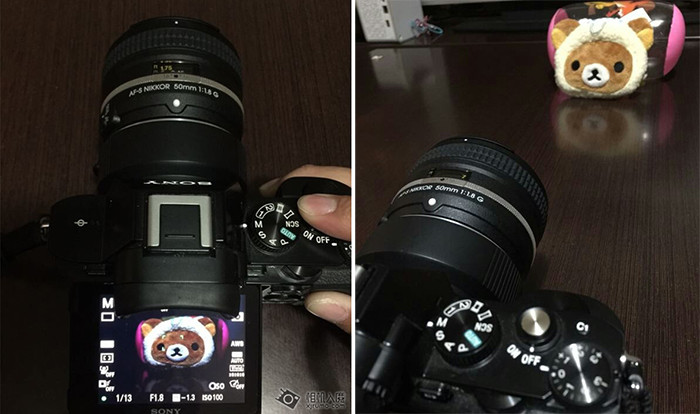
Electronic E-mount adapters are highly requested but difficult to make. We have electronic adapter for Canon EF from Metabones (Click here) and [shoplink 37432 ebay]Kipon (Click here)[/shoplink]. And also an electronic adapter for Contax from [shoplink 37433 ebay]Techart (Click here)[/shoplink].
But now we are close to get a very important new electronic adapter for Nikon F lenses! Xjirumo spotted that adapter made by an unnamed chinese company. It’s said that the adapter is almost ready for production. This really would be a BIG good news for all those Nikon lens owners that want to use their lenses with full autofocus and electronic aperture control on the Sony E-mount cameras! And in particular those of you who preordered the new Sony A7rII can epxect the autofocus performance to be “decent” thanks to the hybrid AF system! I hope to get some more info about the adapter soon.
USA preorders:
A7rII at Amazon (Click here), BHphoto (Click here), Adorama (Click here), Uniquephoto.
RX10m2 at Amazon (Click here), BHphoto (Click here), Adorama (Click here), Uniquephoto.
RX100m4 at Amazon (Click here), BHphoto (Click here), Adorama (Click here), Uniquephoto.
203 Responses
So, if all of these work well and the AF of the A7r II performs well then, the Sony A7r II is:
The digital Contax G (for most lenses…)
The digital Nikon FM3 (as in…size wise because we know the Df is a bit big)
The digital Canon anything that could have been smaller with no banding
And maybe the digital Zeiss Ikon, if the bsi sensor playes better with ZM lenses.
On top of also having IBIS, second most MP on FF market, 4K video, EFCS and maybe the best EVF without rainbow effect.
I wish I had the cash to pre-order one today.
Finally! It really took them (the adapter manufacturers) a while to reverse engineer that Nikon protocol.
I’m a bit dissappointed because screwdrive doesn’t need protocols and therefore easier is this aspect
The problem is screw drive also needs a motor, so they’re even more complicated to manufacture.
Why can’t adaptor manufacturer buy existing motors? On the other side, it’s easier to modify adaptor to drive nikon, pentax or minolta lenses than add all their protocols
Well, Nikon doesn’t even support screw drive in their 3xxx and 5xxx camera lines. And all the new Nikon VR lenses and Sigma , Tamrons all have an internal AF motor anyways.
I totally agree – it would be great to see, especially if the a7x cameras can focus using an la-ea3 style adapter.
Will it support older Nikon screw drive lenses?
Apparently: no, manal focus only.
“autofocus performance to be “decent” thanks to the hybrid AF system”? This is not entirely correct, I think. In the A7R II, the user can only choose between either PDAF or CAF for adapted lenses. It’s not like native FE lenses, where PDAF and CAF work together “hybridly” for the best result.
Well damn this is big!
Just sold my last Nikon lens so it’s a bit late for me. Still great news, though.
Now add a screw drive to that and watch Nikon unfold.
and one for Minolta with screw mount.
Agreed.
Hmm…. I sometimes wonder, why bother buying a mirrorless if people end up using lens adapters heavily. Size and weight went up and battery life is 1/3 of a DSLR. There is probably no price advantage either.
But the adaptability is superb and there are people who prefer an EVF over OVF in many shooting situations.
Some of Sony’s CMOS was optimized for short flange. Adapting DSLR lens is not ideal compared with dslr set-up. On the other hand you have to pay a lot to get a high quality adapter that prevents light leak and de-centering. I think getting a camera just for adapting these new lens is not very rational. EVF is really not why people buy cameras for…
“Adapting DSLR lens is not ideal compared with dslr set-up” it might be true or it might be not, depend on the lenses i guess. My first reason to use mirrorless is the adaptability and so far the performance are not disappointing, i can’t even distinguished the lens performance from my DSLRs & the most important things is it’s fun! also how can a cmos sensor alone optimized for a certain flange distance?
This is something Sony should have placed on a7r. They call it gapless, optimally positioned on-chip lenses. Your DSLR does not have it (no need). This only benefits FE lens that has short flange distance.
Focusing small incident angle rays doesnt mean defocusing the large ones, with aid of lenses, thats exactly the reason why people put lenses on cameras not pinholes.
In fact, the incident angle on some FE lenses (e.g. FE70200) will be very similar to the ones on DSLR. (the back element is actually quite far from the mount)
yes, it actually depends on the position of the back element, flange distance you said here means the distance from sensor to the lens mount, which has nothing to do with optics.
learn physics. 😛
You really should go argue this with Sony. They are either leaving out A7R or A7.
My argument is DSLR lenses works fine on A7 series, why do i need to argue with sony?
and guess what, the original A7 also have micro lenses on sensor, this is long existed on sony sensors, the question is they promote on the website or not. Its more to do with website layout rather than camera feature.
I am not arguing about the microlens, but the optimized positioning.
fine but optimised positioning is also just a way to guide the incident ray on digital sensors, such correction will work on any lenses, not just FE lenses.
A7r is known to be not ideal for adapting range finder lenses, which means even with the extra positioning effort, the coupling efficiency on this 36mp chip is still lower than the 24mp chip at large angle.
FE lenses are more close to dslr lens design anyway so its not an issue for A7/r/s anyway.
sorry i was mainly opposing your “Some of Sony’s CMOS was optimized for short flange. Adapting DSLR lens is not ideal compared with dslr set-up.” point in my first comment, might have replied in a wrong trend.
My argument is that their optimized positioning seems to be an issue. Need to do a direct comparison. unfortunately I don’t have that many gears. My friend keeps saying he is going to buy a D810 after buying a Distagon 15 for his A7r, which brings this topic to my attention.
There has been no reported issue with dslr lenses on a7r.
but if you need to be convinced logically, here’s my point:
FE70200 basically has the same back element distance as dslr lenses, so if such camera is optimised for FE70200(which they should), its pretty much optimised for dslr lenses, including the Distagon15 which is designed for dslr.
i would like to see the comparison, but i am pretty sure the difference is down to the image engine.
My thinking consists of many aspects. Earlier bakanecko mentioned rangefinder lens seems to perform worst on A7r than other A7 series bodies. As I mentioned, this optimized positioning only happens on A7r. I think it has already proven that there is an effect.
The other thing I am thinking is, is Sony leaving out one body when they are designing lens?
Rangefinder lenses especially wide angles have their back element very close to the sensor, that is what makes the angle of incident tricky.
And if u seen what a photodiode looks like on sensor, its actually deep inside like a well, which means digital sensor couple with rays that are normal to the plane the best, thats the whole issue.
A7r suffers more because the pixel size is smallest, and additional optimisation has been done for dslr type lenses.(not for rangefinder type)
the 12mp A7s on the other hand, can pretty much take any lenses.
Therefore, A7r will be fine with FE lenses and DSLR lenses, and standard/tele rangefinder lenses. just not wide rf lenses because of the back element distance.
Make sense?
and sony didn’t leave out A7r, it works fine with FE lenses/A mount/other dslr lens, its just that sony didnt optimise it for wide angle leica lenses.
Why not image a curved sensor designed for FE lens and you adapt dslr lens to it. The optimized positioning coupled with the microlens array apparently has an effect depending on the angle of incoming light. It might not be serious on some lens, but it would exist.
Lens cant be optimized for every brand.
because even for FE lenses, each one is slightly different, so there is no 100% perfect optimisation for all the FE lenses. you can only optimise it so that all the FE lenses are say at least 80% optimised. This is the same with all other system.
also the more off-centre, the smaller the incident angle, thats a general rule, so even for a nikon lens, this design will have positive benefit anyway.
these micro-lenses and positioning are there to cancel out some general negative effect cause by the flat sensor design, not to couple a specific lens perfectly.
It is a lot of money to invest in the lesser optimal choice.
nothing is perfect, if you only buy product that is 100% optimised, you need to find aliens to make them.
the question is, does it matter in reality/can you see it? answer is probably not.
people been adapting Otus on A7r, and it is the best lens we seen on A7r.
which means lens quality is the limiting factor for pretty much all other lenses, not the sensor optimisation.
people mostly complain about wide angle rangefinder lenses, which are mostly designed for film cameras, and they are so-unoptimised for digital sensors that they have red shift problem even on Leica M digital camera.
there won’t be any differences in picture quality if you use telecentric lenses, or people will stop using canon lenses on their a7r. There are so many pictures comparison already using dslr glass in the past.
you keep mentioned it as it is for short flange distance optimization purposes, if that’s true all the sony FE lenses which have telecentric design just like other DSLR lenses will be rendered less optimized with this sensor?
Well, I mention this since Sony also mentions this. Sony has a long history of intentionally creating issues/hassles to differentiate products. This is a problem worth thinking about.
well ironically the rangefinder lenses with symmetrical design perform worst on a7r than any other a7 series.
That’s probably because of this positioning thing only happens on A7r. I wonder how Sony designed their lens now.
Have you any evidence for the statement that Sony’s sensors are optimised for a short flange distance? Given the issues that have been reported on rangefinder style WA lenses (with short rear focal lengths), that seems very unlikely.
Of course it will always rely on how accurately adapters are engineered.
The issue that most people are concerned about is AF performance.
As far as why have mirrorless anyway if you have to use adapters which add to the bulk. Well, the answer is flexibility. If you have the ability to use (more compact) dedicated lenses as well as DSLR ones (which you might already have), then what’s to dislike? If you have, in principle, access to a vastly extended range of new and second hand lenses then, again, what’s to dislike? If you have the option for a truly silent shutter then, again, what’s to dislike?
This sort of camera will be the dominant type for system cameras in the not too far future. DSLRs will start being confined to niche areas.
It is on their own website. http://store.sony.ca/a7r-full-frame-mirrorless-camera-zid31-ILCE7RB/cat-31-catid-All-Alpha-Mirrorless-Cameras.
This is some design that only benefits FE lens. Your DSLR cameras do not need it in the first place. And rangefinder are not designed with this in mind. So having it is a minus for those lens since they are not designed to work with sensors like this. And it also means A7/A7 II which do not have it won’t get the most out of FE lens.
This is something that should be considered prior to AF perf.
That’s nonsense. All DSLR sensors have microlenses. The latest ones are “gapless”. May I point you at a Canon site.
“The EOS 50D DSLR introduced a development in the use of microlenses
where the gaps between each lens were removed – this is known as
‘gapless microlenses’. ”
http://cpn.canon-europe.com/content/education/infobank/capturing_the_image/microlenses.do
There is nothing about microlenses which stops them working properly with DSLR lenses. Indeed, for longer focal lengths the optical design of mirrorless and DSLR lenses will be very similar. The only difference is with shorter focal lengths were the DSLRs require retrofocal designs so the rear focal length of the lens is sufficient to allow for the mirror-box.
You see the incident angle of the array? Corner right.
It’s wholly irrelevant. So what if the microlens can handled some higher incident angles. In what way does that stop it working optimally with DSLR type lenses? The A7R II sensor is also designed to work with longer focal length lenses where the incident angles will be essentially identical. That’s going to be the case for anything longer than 50mm (and probably even 35mm). The DSLR and FE lenses will deliver (for the same F stop) the same range of ray angles on both DSLR and Mirrorless designs.
So there really isn’t any difference. Just why you believe some slight improvement for lenses with short rear focal lengths will hamper longer focal lengths, I can’t imagine. If Sony had done that they would damage performance on their own longer focal length FE lenses. It’s simply nonsense. Why would they ever do such a thing?
It is not about “if”. It has a fixed angle and it is all about flange distance. Image you change the angle a bit.
That’s completely wrong. Incidental angles are defined only by the optical design of a lens. The only impact a short flange distance has is that there is the option of designing lenses with shorter rear focal lengths. However, that’s only an option and not manufacturer will design moderate length mirrorless lenses with short rear focal lengths as they are then telephoto designs which are more complex, more expensive and likely even more bulky than a “symmetrical” lens with the front and rear focal lengths similar.
The range of angle of incidences is essentially a function of the placement (and size) of the exit pupil. Lenses with longer rear focal lengths and those where the aperture is
https://en.wikipedia.org/wiki/Exit_pupil
So again. The short rear flange length is an enabler only. It tells you precisely nothing about the angles of incidence for any given lens. For that you need to reference the optical design.
Also to repeat, there is not the faintest hint that mirrorless sensors are inferior when using DSLR type lenses. In fact they benefit. The only issues are with WA, fast symmetrical lenses which is where you get colour shifts, corner softness and the like.
Well, you are right. But Sony tweaked their sensors a bit according to the design of their own FE lens. I suppose other manufacturers do the same thing. See my point?
Your point was that adapting DSLR lenses would suffer. They won’t.
Well, I doubt it. A7’s thick glass already taught me a lesson. Why won’t this positioning thing matter? They both can have an effect depending on angle of incoming light
What “thick” glass? It’s not thicker than from most other cameras (thinner than some). As measured by Roger Cicala and Brian Caldwell.
You are welcome to spend some time Googling this.
I already did as mentioned, but you have yet to prove Roger Cicala and Brian Caldwell (good luck) wrong.
Good reference. Let’s keep this topic about gears other than needs. http://www.lensrentals.com/blog/2015/01/a-thinner-sensor-stack
It doesn’t give us much to compare.
Roger gave a whole list in another post, which included the A7R.
Sony A7R: 1.85mm to 2mm physical, 2.5mm optical
Canon 6D: 2.0mm pysical, optical unknown
Nikon J1: unknown physical, 2.8mm optical
Panasonic GF1: 4.1mm physical, 4.2mm optical
Olympus OM-D EM-5: 3.8mm physical, 4.1mm optical
Well, it is a good reading. https://sonyvnikon.wordpress.com/2015/03/16/nikon-d810-v-sony-a7r-with-zeiss-otus-85mm/
Steve GJ you’re flat out wrong.
Use some common sense, Chief ray angles are vastly different for a 21mm and a 300mm. You can’t optimize one without hurting the other.
When Sony ‘optimizes’ for it’s short flange distances with it’s cheap plastic lenses made proprietary for the Sony it does so at the expense of its own 200mm lenses (70-200 OSS F4) as well as Distagon designs and properly designed teles like the Apo 135mm or Nikon 300mm etc.
Part of it is lens investment. If you’re heavily in another platform, you’ll inevitably want to carry over at least some of your faves, especislly if there’s no equivalent in Sony’s lineup yet. The reason not to stay with a DSLR is it means you can also use native fe lenses.
Why not your original set-up? Unless you mean Canon.
Who says you are leaving the system as one of them becomes a second body while the lens investment remains intact and you can replace at your own rate. Weight is only part of the issue…bloat is the other and Nikon and Canon have become quite bloated, particularly with the use of plastic in construction.
A secondary body with shorter battery life (even different batteries and chargers) and no weight/size advantage? What do you really gain in the process?
Choice. It can be smaller when it needs to be.
If we forget about all the other advantages (all primes stabilized, much better LV implementation, better and more video capabilities, not to mention a working viewfinder when shooting video, the option of shooting fully silent without the need for a tripod, etc.).
and the raw compression, at least until it is removed.
There is no reason to remove it as it speeds up a lot of things too.
There’s only a request to add more options (such as non lossy compression).
Is D810 a much slower camera than A7r? The only thing it speeds up is post-processing.
And file handling in general after compression. I didn’t say it would speed up the camera, since compression takes its CPU toll too.
Well if you want to talk about needs…. I can wait but cant stand lossy raw, as many others do.
You can buy a better camera, buy just the camera, and use it with anything you want or have .
If you don’t wait a better camera don’t buy it.
A better car engine to use with bicycle wheels? A camera is always about a proper system.
camera is about taking picture with a proper system or not, why would you limit yourself to a “proper system” when we can choose many cameras from many brand with so many goodness on the market, just shoot and have fun.
This is another thing other than gears talk. I personally only have an A7 to shoot with film lens. But I sometimes notice people are buying a camera for purposes other than taking pictures.
“But I sometimes notice people are buying a camera for purposes other than taking pictures.” – So what? Why do you care what other people buy cameras for?
You don’t need to worry about my intention as well. I only asked why adapting a lens to a Sony body that has the close weight and shorter battery life to Nikon, and you might suffer from slight loss in IQ.
The difference between Sony A7r ii and Nikon D750/810/etc. is you can actually make the Sony quite small and compact. You can put the 35mm 2.8 and it becomes a pretty portable option. There is no portable option with full frame DSLR. There is no debate here, the A7 series cameras are still much smaller than full frame DSLRs.
Use any wheels you want with the better engine.
Keep the system you want.
This is also another thing other than gear talks. I start this topic since sometime I think people are buying A7r thinking it works best with adapted lens. This impression is unlikely true.
If you like your Nikon, and do not want to try anything else then wait.
Nikon will announce a ff mirrorless f mount camera around the end of this year.
I suspect it will have the same sensor as the A9 that may be announced in September.
These cameras will probably be similar to the a7rii but of higher resolution and maybe 1 stop lower maximum iso.
Clearly no one will convince you of the merritt of this camera, but if you are willing to wait you can have the camera you seem to want.
I am not talking about likes and dislikes. I focus on gears, which means it is all about technical adv. and disadv. Nikon is involved since it is a good comparison between D810 and A7r.
Your arguments are totally evangelistic and completely lacking in logic. You ignore mountains of evidence and preach your own brand of gospal.
Despite all our evidence you still preach your love for Nikon, or whatever mythological system you are reffering to, and even when I tell you how to achieve exactly what you preach you still argue.
Perhaps you are dissatisfied because you sense our lack of belief in what you preach,
As far as I concern, your passion for Sony is way stronger than mine for Nikon or whatever system you think I like. Same lens on 2 bodies. You have any comments on the MTF?
https://sonyvnikon.wordpress.com/2015/03/16/nikon-d810-v-sony-a7r-with-zeiss-otus-85mm/
oh hi Anton!
Well, get it if you want it badly. But passion doesn’t change what it is.
You keep reffering to the A7R!
WE ARE NOT TALKING ABOUT THE A7R, WE ARE TALKING ABOUT THE A7RII
You really do need to read about this new camera because your comments are total nonsence , because you seem unaware of what this new camera can do!
I corrected your earlier post, when you said A7R,
And now you post a link to an A7R article
Are you aware that you are talking about a totally differrent camera than everyone else is?
As long as Sony still solely implant optimized positioning in A7r2, I don’t see the necessity differentiating the two. But I am expecting detailed reviews to come out first.
You really are dense
This is not an optimised a7r
It has a 42mp BSI sensor.
102,400 iso
PHASE DETECT AUTOFOCUS THAT IS FULLY HIGH SPEED AUTOFOCUS COMPATABLE WITH DSLR AND DSLT LENSES
There is absolutely no similarity between this camera and any previous E mount camera.
Forget about what the A7R could or could not do!
This is not just a new sensor, it is a differrent type of sensor!!!!
BSI with phase detect hybrid autofocus.
..totally differrent focus system.!!!
optimized positioning is a structural thing you could still have in A7r2. I do agree there are some details we have to find out in later reviews. But as I said, this is a potential issue to worry about. This is like getting a OSS lens or non-OSS lens with better IQ. If your hands shake the etxra IQ might be useless after all. The same with adapting lens onto Sony’s optimized sensors that you might not get the best possible results.
Another thing about A7r2. I don’t think it will cause A7r to cease production. So people would still probably buy A7r for adapting, thinking it has the same IQ with D810. (In fact with adapters both weight similarly) A7r2 might not have this issue, but only time would tell.
You clearly have absolutely zero idea what you are talking about.
I’m done talking to you.
That’s fine. I don’t enjoy talking to people who doesn’t look at the technical side other than what’s presented in commercials. I still remember people praising Canon’s best experience with 5DSR, which has terrible DR and color depth in today’s standards. Since someone else already pointed out your error, I am pleased enough. I am not criticizing anyone after all. Just get what you want.
the IMX094 on nikon D810 and A7r was designed by nikon, manufactured by sony. make the reason why both company use the same sensor.
BUT, this new 42mp BSI sensor was completely designed and made by sony, I doubt they will give it to nikon.
and I think at price of 3200USD, sony is quite clear on that decision, they don’t want to share the sensor to others, but want to keep the profit just like if it was shared. So it is 3200 not 2200 more or less.
so, maybe nikon will come with something new, but not this 42mp
I truly welcome the BSI. However I read that IMX094 was also used in D800(E). But that does not mean the microlens share the same layout. The optimized positioning basically prevents light striking into adjacent pixels when it is not supposed to. If they do share same layout… There is no need to keep arguing as imaging-resources have direct comparison already.
The D800(E) and A7r has almost the same IMX094, A7r did changed the microlens for short flange distance lens, where D800 doesn’t need that as its a DSLR.
the D810 on the other hand, has an improved version of IMX094, they doubled the trap capacity. so you are doing an irrational comparison here again, at ISO100,the D810 improved about 5 percent in math, added primeval ISO 50 that D800 doesn’t have
Sony makes more money selling the sensors than using them solely in-house.
“The A9 that may be announced in September” – I doubt it, unless it’s gonna cost $4k+.
A high end flagship new camera will cost more.
Your $4k+ figure is probably reasonable….of course for that price I would hope for 78+ mp.
Hope so….
By the way..we are talking about the a7rii, not the a7r.
Maybe worry less about what other people ‘might’ be doing?
“Shut up and take my money”
no, no, no!
a better computer (which is what cameras are now, Leica it or not) to interface with glass to get nicer files as a result. get out of the last century already : )
Choice. Today I went out with my Leica R 90mm f2 and ordered a Nikkor 135mm f2 AI-s.
There is Canon that would take both lenses, thought also with Adapter.
No DSLR or other digital camera that would take my Leica lens at all (not counting the DMR which is not full frame)!
If I want the Nikkor to work on a Nikon DSLR with full frame and without adapter, at the time I bought the A7, the Nikon option was way way more expensive, like double or more.. Battery life? I am an amateur, I recharge my camera as often as my smart phone, I am getting used to it..
I could go on with a lot more lenses I have and love… but this is just today for today..
because no other company have body with 42mp BSI sensor, 5 axis stabilization, and 4k
Well you don’t have to use adapters, native E-mount glass is really good. But its nice to have the option of using just about every lens ever made. Plus there are far more CaNikon shooters, lots are buying A7’s as digital backs for other lenses. I know two people that bought A7r’s just to use with Canon T/S lenses for better resolution and DR compared to 5d3’s.
Personally the best thing about adapters is they fill the gaps in Sony’s FE lineup, like cheap primes and 2.8 zooms. Now you can use good, cheap lenses like the 24-105L and get decent AF in a stabilized zoom that’s cheaper than anything Sony offers.
This is clearly a part of Sony’s strategy when they stage press events to show off AF capabilities with A-mount lenses and Canon lenses. If they can sell a body to just a few percent of Canon’s user base, Sony executives will be shitting rainbows.
Because size is not the only advantage of mirrorless… And battery life isn’t necessarily that dramatically different. Look at the Samsung NX1 — the battery life is longer than Canon Rebels.
So advantages of mirrorless:
— FAST live view
— Viewfinder based video (making video easier in bright light, adding a stabilization point for holding the camera, etc)
— No mirror vibration reducing image quality
— EVF advantages — typically a larger brighter 100% viewfinder than found in comparable dSLRs. Histogram, virtual horizon, focus peaking, all in the viewfinder
— Reduced price — Mirror mechanisms are complex and expensive. Comparably featured mirrorless are cheaper to make.
— More accurate autofocus. On sensor AF is more accurate.. no back and front focus issues.
— Wider AF coverage, better tracking. By using the entire sensor, mirrorless has potential for better tracking. And AF coverage is often much wider — the new A7rii has focus points over 40% of the screen, more than any full frame dSLR. The A6000 covers 90%, more than any APS-C dSLR.
— Faster frame rates. The NX1 hits 15fps. The A6000 hits 11 fps. The Nikon 1 system hits 20 fps. The Canon 7dii is the only APS-C pure dSLR that comes close.
I prefer dSLR bodies — I would gladly take my Nikon D750, rip out the mirror, give it mirrorless guts, and a “universal” mount system that might require some adapters.
In terms of battery life we might be talking about 300 shots vs 900 shots. EVF draws a lot of electricity. When comes to adapting, AF is always suffering.
No….. battery life differences are only THAT dramatic when mirrorless is using a much smaller battery than the dSLR. Don’t get me wrong, it is a battery drain, but not THAT dramatic. And stick a smaller battery into a dSLR, and watch it drop too.
Examples: The Sony A6000 is rated to 420 shots. The Canon SL1 is rated to only 380 shots. So the mirrorless beats the similar sized dSLR by 40 shots!
Comparing the Samsung NX1 to the Canon 70D to Canon T5i.. It’s 500 shots, to 900 shots, to 440 shots. So the NX1 has about 60% of the battery life of the 70D, but slightly more than the Canon Rebel.
The A6000 approximately matches the Rebel.
On average, when using the same size battery, you will indeed get less shots out of mirrorless. Maybe even half as many. Not not typically 1/3rd.
So yes, you will change/recharge batteries a little more often. But not like you have to change batteries every 20 minutes. It’s a minor, but not totally trivial, inconvenience.
EN-EL15 has a capacity of 1900 mAh and holds about 1200 shots on D810 (CIPA marked). While A7r uses 1020 mAh battery and only holds about 350 shots maximum. I think it is huge difference depending on how you use it. I can shot more than 400 pics one day during trips. This is a huge burden charging my backups daily. With Sony in one day you might need to charge 2 batteries. With Nikon you can have two days to charge 1 battery.
first of all, those cameras should not compare side by side because sensor image stabilization eats battery too, 42mp has 6mp more info to read, process and save.
same logic as an old nokia can last for 30days, but a iPhone 6 can only last less than a day
secondly, you have two options on A7r2
one, if you need more battery on A7r2, you can always get a grip, very cheap third party, double the battery life. still lighter than D810 body.
two, if you don’t need that much battery for the day, A7r2 is a lot lighter to carry around.
the DSLR doesn’t have second option, you can’t cut the camera when you need something light.
but once again, I don’t think there’s winner for this, nor I see any comparison should be made. it’s just two different camera system. if you going on a hiking for days, I must agree with you that nokia is better. and nokia can be better than iPhone in many situation.
A7r I was talking about. And my initial question was about adapting lens in general. Adapters are quite heavy.
Given A7r2 has stabilization and higher pixel count, if they remove compression I am expecting higher demands in batteries.
So nearly double the size battery… So if you equalized the battery sizes.. it would be about 1200 shots compared to 745 shots — A very real difference, but not a world-changing difference to me.
So if you upsized mirrorless — So you eliminated the size differences.. same size, same battery size… the extra drain of the EVF, would make the difference 1200 shots to 745 shots.
Have I ever shot more than 745 in a day? Yes, but it’s pretty rare.
I went from the A99 to the D750 — 1230 shots versus 500 shots on paper — In practice, I notice a difference in how often I re-charge the battery. In shooting the A99 for a year, it was rare I had to change batteries in the middle of the day — happened 1-2 times when I saw the battery getting low, so I opted to change. Never actually had a time when the battery ran out. Only came close to those 1-2 times. But I did often have to re-charge the battery at the end of the day. While on paper, it got 500 shots, I was often shooting far more than that.
With the D750… the main difference, I am re-charging far less often. I can shoot an entire day, and the next day, and the next day, without making sure I re-charge at night.
So it is an issue? Yes. Is it a life changing issue of “how could anybody shoot with the lesser battery life” — Not really.
I originally was talking about adapting. So size difference almost gone in the beginning.
Almost gone, but not really…. not until you also upsize the battery.
The LA-EA3 is 110 grams.
The heaviest Sony mirrorless is the A7rii at 625 grams with battery and memory card: So a total weight, with adapter of 735 grams. Still less than any full frame dSLR.
The Nikon D750 is 840 grams with battery and memory card. So even with the adapter, the A7rii weighs about 15% less than a light-weight full frame dSLR.
I suspect we will eventually see an A9 — Which will have dual card slots, slightly bigger body, bigger battery…. Weigh in around 700-800 grams. So that it really will be the same size and weight as a dSLR, but also have the full dSLR ergonomics, including more competitive battery life.
EA is battery hungry. I know some buying noveflex, metabones AF adapters to mount their Nikon/Canon lens.
Everyone always get upset about the battery life, but not me. I hope they keep the same battery size across the smaller cameras, if they bring out a pro grade a9 then they should upgrade it.
We’re waiting Samsung NX to E mount electronic adapter. Would be great for Sony crop NEX cameras
For all the 3 NX lenses lol
Funny…
At least for
16-50
50-150
85
60 macro
10 fisheye
30/2
Ok. All the 6 NX lenses lol
Six is better than ZERO)
Why not be happy with the Sony glass?
Doesn’t exist in those combinations. Which are kind of basic for pro level shooting if you ask me.
There are no any native of them for sony
16-50
50-150
85
60 macro
10 fisheye
But are the Samsung versions worth a special adapter? Especially when you can get all that range with other mounts. Also, Sony does have 16-50 A mount lens which is quite awesome, and the new 90mm macro that more or less covers the 85mm range.
Can get range but not aperture values. And yes it worth. A mount 16-50 SSM is great but also require adapter, bigger adapter. 90 macro is crazy expensive and huge
To put is simply… I still don’t see the point. You get almost negligible benefit with Samsung lenses and you can get all of those benefits from other mounts or even native (F)E mount. EF mount deserves an adapter because lots of awesome Canon lenses, and same for Nikon F, and Sony A. They all offer super unique awesomeness not offered in any other mount.
I would be really happy to use the affordable 60mm macro and the 10mm AF fisheye lenses
If an APS-C camera comes with this AF, why not just get them in A-Mount? Or even EF?
Because only A 16-50/2.8 has ssm motor, 50-150 not exist or in version from sigma… 50 and 100 macro is screw drive only, 85 ZA is screw drive, fisheye is only 16mm and also screw drive…
But those are only APS-C lenses. Even if you wanted to use the 16-50, you’d be waiting for the new APS-C E mount camera to have A7rII AF capabilities as to not frustrate yourself from the up until now mediocre AF with this party lenses with adapters.
Ok, now waiting A6000 successor)
Actually all NX lenses are designed for CDAF so it’s likely they will focus well.
BTW we expect the new aps-c camera to come this year, but nothing about nx-e adaptor
nothing about nx-e adaptor because no one could even imagine that someone needs to put some crop lenses from one mirror lens system to another… “everybody needs FF lenses on both crop and FF E cameras” and luck that NX has larger focal distance that allow to make this adaptor like Contax G adaptor even with mechanical parts was made
I totally expected an adapter like this to come out soon.
It hasn’t come out yet. I’m dubious this will be any good.
Someone will make a good one, the demand for it is there.
I hope so.
There are always people say these kind of stuff but at the end time will tell and they kept quite eventually.
Time will tell. The F-mount (with G lenses) has proved tricky for manufacturers of adapters, hence there not being one yet.
“One camera to rule them all” J R R Tolkien
Exactly!
One camera to rule them all,
One camera to find them,
One camera to bring them all,
and with adapters bind them.
Yes, that is the correct quote.
That is good news as long tele is a significant (and for Zeiss a historical) shortcoming. As I transition from Nikon was wondering what to do with my Nikkor 70-300, where Sony A is way overpriced and the Tamron is very highly regarded. Then as someone remarked on the Tamron 150-600, get it in the Canon (and now Nikon) mount with the reportedly near native performance on the a7RII, as the Sony A version, Tamron omitted the in lens stabilization present in Canon/Nikon. Plus it open up other lens, such as the Sigma 120-300 f2.8 and Sigma 150-600 that is not even offered in a Sony A mount. With the 2.8 glass, don’t know how extenders will act with adapters though.
At least with the adapter, can delay replacing the 70-300, where the preferred combo would be to FE 70-200 f4 then use the adapter on one of the 150-600’s.
Nikon take notice: situation critical. You’ve held out as long as possible to preserve your sacred cow. You must begin today to take Sony seriously, as a threat to your dominance. If you don’t have a mirrorless answer to the A7RII in the works right now, then I predict you will FUBAR as the dominant player sooner than you think. You are underestamating the capability of your enemy or you’re just too damn arrogant to recognize the threat.
History repeats.
While Canon makes great new F1n, Minolta rocks world with AF, until Canon answers with EOS serving pros better with full system. Minolta flounders.
Now Canon makes great new 5DXx, Sony rocks world with a7RII… until Canon answers with new mirrorless with greater pro support system. Sony soon to flounder… because they just dont get the full package. They think fancy toys are enough for long term satisfaction and loyalty. They are wrong.
a7RII is a stop gap place holder untill the big boys answer.
If Canon were to make a mirroless full frame line with their old mount they would throw away most of the advantages the simplified construction yields. By creating the e-mount years ago Sony took this painful step of starting from scratch and is almost on the verge of having a good lens coverage now. So Canon’s mirrorless line would either be dslr sized or they too would have to start a mount from scratch. Either way it is now their turn to play catch up.
Canon and Nikon could create a mirrorless body with short flange distance, plus making their own adapter that works flawlessly with their own lenses. There is so much potential for Canon and Nikon
Wow, no mention of us at NIKON Clyde? We’ve been floundering here quite nicely sir, ever since the introduction of the superb EOS A/F system. BTW, we’ve never really gotten close to Canon since the had the sense to dump their FD mount which the experts (like you) slated them for back then. History does repeat itself, you’re living proof of that my friend! Go Sony for having the gall (like Canon did) to adopt a modern mount & system. I can hear them to this day, “who needs auto-focus, its a fad for sure.” LOL.
Well, we can only hope that with information easily available people start to research more before buying, the DSLR stigma is still strong, but people seem more open to try new things, even seasoned photographers…
And for Sony’s advantage this time you can almost get the body without giving up the whole lens system.
Thankfully there is already a Nikon mount that makes the highest quality resolution 14 bit color depth images in the world. http://www.bhphotovideo.com/c/product/1062499-REG/nikon_d_810_digital_slr_body.html
But who want’s to buy into a dying system that has no future and is already hopelessly outdated.
Between me and you we recognize this fact! But fortunately we’re blessed with a very loyal hobbyist user-base of wannabe scientist retirees who have no need for:
1. Quality HD & 4K Video
2. Balanced Audio Accessories
3. In-body Steadyshot
4. EVF Viewfinder with Peaking and Zebras
5. And now, compatibility to our incredibly outdated Nikkor AI lens mount too!
Isn’t it too early to call Nikon a dying system? Canon lived through more criticism.
Looks like the Canikon fan boys have worked through denial and are now in the anger stage, next comes bargaining.
This lens adapter is their only salvation, otherwise Nikon lenses will be worthless leaving them nothing to bargain with.
It doesn’t change what it is. Does it?
The fact that the Nikon is an outdated POS, no it doesn’t.
Whoever needs Nikon would still buy it. But Sony’s achievement today worth praising. I hope BSI sensors would become mainstream soon.
I’m sure they will, without a doubt.
We will see. I am not sure if BSI can be made into curved sensors. Samsung’s BSI sensors also won a lot of praising but no one seems to be buying their sensors. BSI might hurt one or two things in the lab.
um Sony’s method of curving sensors works only with BSI
That’s another good news to know. Now I would like to see it coming out in mass production.
But curved sensor will need all new lens’s. its probably best kept in fixed lens cameras.
It’s not bad to get a fixed lens camera. Maybe 2-3 if they have different focal length. I personally use 35mm and 85mm the most.
If we are lucky this is the reason we don’t have the RX2 yet.
Chris is still in the denial stage, lets let him work through that.
I don’t buy based on my likes. I buy after I rule out what I cannot accept. Sony is not off the table to me yet, Nikon neither.
He is right – the Nikon D810/D800E have better image quality than the A7r and likely the A7r ii, simply because Sony has restricted the quality to 11+7 bit lossy files. If they correct that and provide 14-bit lossless files, then it will be different.
Personally, I want them to provide 14-bit lossless files. Until then, I won’t buy one.
You are so boring. I would be nice to hear something intelligent. I come here to see ideas, opinions and information. You just drag everything down with your trolling.
As far as I know, he is correct. None of the Sony cameras offers 14-bit RAW. Yet.
I never said he wasn’t. Would you like it if I came in at EVERY thread to say that “E-mount had poor battery life”? It might be correct. It doesn’t make it less boring and unintelligent to repeat it every thread. I don’t come here to listen to other people’s obsessions.
Great news in terms of approaching a universal mount…
And if the adapter is any good…. I could see myself with a future APS-C Sony camera as the backup to my D750…. and 3-4 years from now, I could see an A7iv as the replacement/upgrade for my D750.
Very good news for all those Nikon lens owners (myself included)!
Hope it comes out and then can be improved by later models; more faster AF and accurate, etc and I can buy a Sony FF A7R MK 2 and use the adapter + Canon adapter with my lenses I have built up in Canon EOS EF and Nikon F Mounts.
Great news!
A few weeks back when I say there are large potential with with On Sensor PDAF on A mount lenses which some say is not feasible, look what Sony had offer on the A7R2. So does Nikon lens to e mount is starting to take shape.
I remember I choose Sony from the beginning because they’re a company that always innovate and evolve in a very creative and savy way. With Sony, I believe they will always do what other don’t dare.
So next time please don’t rant it is not possible or not physically feasible. When Sony doesn’t want to do it is because of marketing reason.
Sony itself is quite inconsistent in their design and can intentionally create issues to differential their products. I am sure Sony has a bright future, but it’s highly possible that the bright future of Sony has nothing to do with the camera you own now.
Alpha /’ælfə/. I hope lens mount wont develop as the pronunciation suggests.
Well, rather than saying inconsistent, it is their R&D root mentality. Sony has been like that. It is a company that never looked back when there are new toy in the house. Remember the MiniDisc? They started with a disc which then end up as NAND storage. So does their UMD on their PSP.
Of course it will have nothing to do with my camera & lenses since they’re the one making money not that I own any of their share or stuff, even you! The interest thing is that Sony are not afraid of radical experimentation on their product range so the end result it always fun to experience~
MD is dead because they refuse to catch the tide. Now PSV gives up UMD entirely. Sony used to be a typically Japanese company in which making changes is difficult. And it tries to make itself a 2nd Apple. They ask people to use their own version of iTunes-like software to transfer music into walkman. They have specialized usb cables and later gave it up.
Now it just looks like Sony has so much pressure on them and moving forward in a harsh without a steady plan.
You know that’s why they award themselves a guinea pig award in the Sony museum. They literally don’t want to plan when they see new stuff is coming and eager to try out. So thats what I like about them~ The surprise of uncertainty
This is also why they are selling their buildings. It is important to cut costs to increase profits. Sony probably won’t roll out new technology that quickly after A7r2. It is a good time to settle down for a while and play with what they have now. There are a lot to improve. More lens, faster processors, low light white balance and body software.
True~ they have been to playful for the pass few years end up killing many of their division. And I do realised sony really needs a good software team for their firmware coz I find them to be not optimised and efficient. Slows down many of their electronically reliant bodies
Apple is the 2nd sony. Jobs idolized sony and were good friends with Akio Morita.
they still use that stupid cable.I have a new hi fi walkman and it uses that stupid cable.
well this is Sony. You never know what they are thinking.
The Sony memory stick was another attempt of them to try and make their own standard
You are right. But what I mean is Sony now dreams about being today’s Apple.
Yes and no. What corporation wouldn’t dream of that? Given the development of a system that is seemingly more open to more brands lenses than any other system before it, and with more open video standards, the camera department doesn’t seem to have gotten the memo.
Another question unanswered…does AF improve with Contax G lenses?
Logically – yes since the AF was contrast detect only and now it can benefit from phase detect.
Reality – No clue whatsoever ! 😛
lol
Agree and from their entry level to higher end – and also becareful with other manufacturers too Samsung, Fuji, Panasonic. Must admit this also applies to Canon also…
some may also be interested in the Contax N to E mount adaptor too. full AF and aperture control for majority of the contax N lens. Fringer adaptor, you can get it from aliexpress. it works quite nicely with my 24-85mm and a7r, BUT it is full metal i.e. quite heavy…. and…not the cheapest….but then neither is metabone…
i just clicked into the link. does it only do autofocus but not electronic aperture control, because i dont see the aperture control lever that is used in some of the older nikon lens.
Is it safe to say that older lenses with aperture control lever would also be screw drive AF? If so, it would be moot as these types don’t support screw drive. Only an LA-EA2/4 support that for A-mount.
i may be wrong, please correct if someone has more info.
my understanding is that, super old nikon F mount lens has no electronic contacts. so purely MF with aperture ring on lens. then later ones (AF-D lens, i think) have aperture ring on the lens but no built in motor, so the AF is relying on screw drive inside the camera body. aperture can either be directly control via aperture ring on the lens, or if you leave it in the smallest setting (F22 for example), then the camera body can control the aperture via a lever.
moving on, earlier nikon G lens has built in motor (AF-S), and no aperture ring, however earlier lens still requires an aperture lever in the camera body to reduce the iris to selected aperture size after shutter button is pressed.
i believe the newest lens has both build-in AF motor and full electronic aperture which means the lever is no longer needed.
I don’t know, but since I have no Nikon lenses that are like that, I guess it won’t matter to me. This would, however, be great for me to move over to the A7 line and use my 35 1.4 and 70-300. Or I could just sell my 70-300 for an A mount, send the Siggy in to get a mount change, and get the LA-EA3
I really need that adapter, hope it will be available soon. I would prefer a reliable solution by a brand with more reputation. I always wondered why metabones didn’t come up with an adapter that cane control Nikons electric iris and activate VC.
That would be one of the holy grails for Nikon glass owners!
Hahaha suckerz!!! We are the Sony…Your lenses will be assimilated. Resistance is futile!.
They first have to come up with on sensor phase detection af on their own. I don’t think that sony will share this key tech. Of course canikon have great potential but bringing it to the market will take time.
My guess is that Canon will for another long period not bother to build full frame mirrorless while Nikon will try to save F mount at all cost even with their new FF mirrorless (there have been some rumors and sightings of a prototype).
Do Canon/Nikon have any type of patents that could stop third parties from making these type of adapters?
I suppose Canon was probably not worried about Canon->Emount adapters before, when on sensor AF was slow and barely worked. But now that the with Fast AF, a lot more people would be willing to take their Canon Lens and put it on the A7Rii.
Just wondering if people should buy adapters before a cease and desist comes out.
I don’t know how different the Hybrid AF is working compared to the A6000, but I would be very thankful, if Sony could bring this feature with a firmware update, so I could use Sigma lenses with LA-EA1 or Canon with Viltrox adapter
Just like sony… Instead of making a lens worth a damn (with an Fix F-stop less then F4) They make an adaptor and let the other companies do the work…. In fact thats a brilliant business plan….