







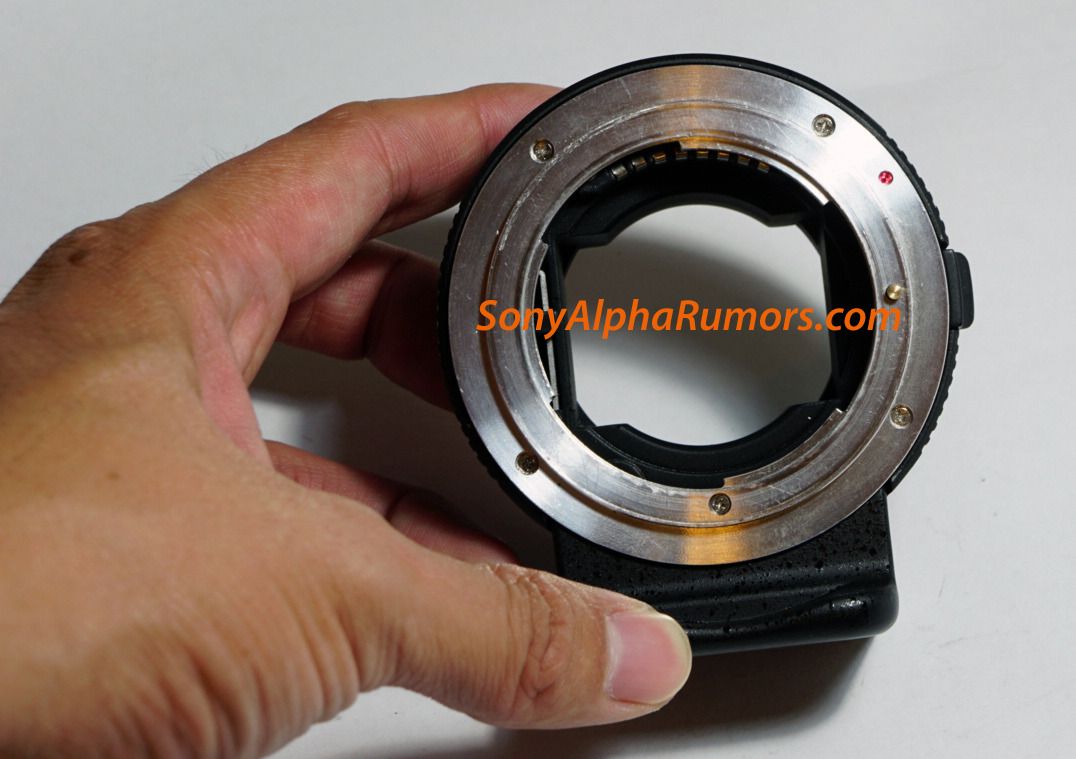
These are brand new images of the new Commlite Nikon G to Sony E-mount (Full Frame) electronic adapter. It supports electronic aperture and autofocus control with Nikon G lenses. Commlite already makes plenty of adapters which you can find for sale on [shoplink 38429 ebay]eBay (Click here)[/shoplink]. This includes the electronic AF adapter for [shoplink 38430 ebay]Canon EF lenses on Sony E-mount (Click here)[/shoplink].
The new Nikon G electronic adapter is the very first adapter that adds autofocus on Nikon G lenses. This is a new video which shows the autofocus at work:
The adapter should be ready for final mass production sometimes in late August/early September.



157 Responses
Oh, rejoice exceedingly!
Wow, let’s all hope it works a lot faster on the A7RII…
No reason to believe it wouldn’t, EF adapters are about that slow on anything but an A7R II.
I hope you are right. But I do think my EF lenses focus a tad bit faster with the Metabones on my NEX-7 and A7S.
Yeah but any difference would probably come down to how well that particular lens works with CDAF most likely?
Hence my comment. EF lenses built to work with PDAF on a CDAF only camera should (in theory) be slower to focus than a PDAF lens on a PDAF (A6000) camera. EF-S 17-55 f2.8 IS USM, EF 40 f2.8 STM and EF 70-200L f2.8 IS USM are surprisingly snappy on my CDAF Sony bodies. Usable for landscape and product photo. I still prefer to use manual focus though, but that’s another story.
One benefit is that the USM/STM lenses probably have negligible backlash – which is how they also work well with Canon’s “Dual Pixel AF” which is pretty much their version of Sony’s OSPDAF.
Screwdrive AF fundamentally has backlash you can’t get rid of compared to an in-lens motor like USM/STM.
EF adaptors are much quicker on Panasonic m43…
You mean the only one, unreleased adapter?
Awesome! Just need to hope there are no aperture stop down speed / timing issues but otherwise will be awesome on the A7R II.
more glass !!!
😀
Now Nikon officially joins the Sony E mount system.
And it should be available reasonably soon after the A7Rii starts shipping
You overestimate the importance of (very expensive) a7RII. If they make a sub $1000 APS-C body with similar AF – that would be a game changer.
Yes the high price point will make the a7rii less than desirable for entry and mid level users.
The a7000 is likely to be anounced in August with somewhere between 24-30mp, apsc bsi with special hi dynamic range single exposure mode, faster af, IBIS and phase detect af that works on dslr lenses….some of this I am very certain of and some is pure speculation on my part….
This will be the flagship apsc camera….less expensive than the a7rii.
I would certainly expect many of these new features to gradually trickle down to mid and entry level cameras…I would sort of consider the a7000 as mid level even though it will be the flagship apsc.
I try to speak from my own perspective, so I will naturally be most enthusiastic about the stuff that most interests me.
mmm… need for speed?
And yet, Sony still does not provide a mirrorless AF PD adapter for A-Mount to E-Mount?!
BS. if there is no mirror PD can only be in camera body, wait a7rm2
Err LA-EA1/3.
I should have made clear that I looking for a mirrorless adapter that includes a motor drive for all screw driven Sony and Minolta lenses.
What’s wrong with the LA-EA4?
It does not support PD AF. You are basically stuck with the years-old AF technology in the adapter and won’t benefit from new technology such as in the A7ii.
It’s not bad, but you are locked into the state of the art of when the LA-EA4 was made. There are limited number of PD focus spots. When new bodies come out we will not be able to use them to their full functionality.
I have a large collection of both SSM and screw drive lenses. The advantage of SSM lenses is grossly overstated. I use ALL my lenses on my A77M2. They all work wonderfully well and fast. The screw driven lenses make a lot of noise if you wonder about with AF on and the lens cap off.
Dave, I think this might be a while coming and may be a disappointment if it does. The screw drive connection might not be precise enough to ensure critical focus on a 42mp sensor. There’s a reason Sony introduced new versions of some of their SSM lenses. They likely have new ultra precise focus motors.
if they had sensor Z-shift if would be precise enough and quick even without PD…
Sensor Z-shift for AF is a dead in the water idea, because if the register distance changes for a specific lens under test, F-Stop changes too. See how extension tubes work…
There is no such thing as “register distance” in optics.
Also you might not know that changing f-stop during focusing is typical for even the best lenses, even those which have internal focusing
From sigma’s patent on 50/1.4 art (one of best AF lenses), example 3:
the lens is f/1.46 at infinity and f/1.69 at closest range.
Also you didn’t get the idea behind Z-shift AF — because sensor is lighter than lens elements, it may move quicker (even if for minute movement) whereas lens itself does large but slow movements.
Sure, i know that each lens changes f-stop during focusing, and I know how to calculate effective f-stop, but what i’m talking about has more to do with angle of incidence, and affects wider angle lenses more than standard or telephoto.
My comment is mostly based on converting the 58mm/1.4 rokkor to A-mount(not related to angle of incidence). Before the mount modification, it had an extra 2-3mm that had to be shaved off. While not being able to focus at infinity and effectively being a macro lens, it was losing about 2x stops worth of light. After modification to the mount, it fell in line with a 1.4 lens.
The whole point is that magnification wasnt high enough, for the (effective f-stop = f-stop x (1+magnification)) formula to explain why the lens went from 1.4 to 2.8 equiv.
We will not know until we are able to test 42MP sensors on various lenses. I’m convinced the reason Sony makes new lenses is in the hopes of selling them…. It remains to be seen if SSM auto focus any better then screw driven systems. I see no difference in mine. Truth be told, when focus becomes super critical, I turn off the AF, turn on the magnifier in the view finder, and put the camera on a tripod. Only then can I see the details in fur or feathers that makes people say “wow”.
I think we should wait until the A7rII is in stock first. For now it doesn’t make much sense to release that.
Unless they release a firmware update that allows other OSPDAF to work like the A7rII.
I wonder who will be first to offer a set of EF, F, A to E adapters…
I hope it’s Sony and that it also provides a motor for the screw drive lenses.
not Sony… because of e.g. legal issues.
Nikon is DOOOMED!!!
Where is that chinese who can make Samsung NX – NEX adapter? Hello!!! Chinese!!!
mirrorless to mirrorless adapters are hard and probably not worth it. And hey! The only NX camera worth buying seems to be the NX1 anyway so you can always buy that.
Why hard? there’s 7.5 mm between NX and E flange. No mechanical connection needed.
All mirrorless lenses are CDAF-capable so it’s much more worth than e.g. Nikon lenses.
>only NX camera
he was asking the opposite… to use NX lenses on Sony body.
So you want an adapter that’s 7.5mm thick?
Yes (expect I can’t afford it right now)
What’s wrong with adapter 7.5 mm thick? it would be somewhat hard to place needed electronics, but modern chips are thin and nx is aps-c only
Would you pay $2/300 for an APC-S only adapter?
$2 or $300 ?
If I had money enough, why not. But I am an unemployed person living in poor non-wellfare state.
Oh dear, I wish the best for your job search then. As for my original question, my point was that it wouldn’t make sense to most over-rich photographers either. In terms of Metabones quality, that’s like $400. For what lenses? It’s an economic dilemma.
There are f/2.8 zooms and 30/2 which Samsung has but E-mount doesn’t (Samsung 16-50 is even f/2-2.8 !!!)
E mount has the 28, and Sony A mount has 2.8 zooms useful via LAEA adapters. Are the Samsung versions any significantly better?
The 28 is good, but not small, it’s a FF lens (and even than it could be smaller). via LAEA — no IBIS and they’re not made for mirrorless.
I thought IBIS worked for third party lenses… And give me a break. 28 is plenty small.
They are all cropped lenses
E-mount has also cropped bodies.
With release of A7000 the “APS-C is dead” voices will be silenced, again 🙂
If possible that would be nice for E-mount APS-C users who have been starved of new leses since Sony have been going all-in on FF lenses.
However best solution is always using lenses on the camera they are made for.
If Samsung replaces the NX-30 with NX40 using the same sensor as in NX-1 or make a version of NX-500 with a built-in EVF Samsung would become a much more interesting choice as NX-1, while very interesting, is just too much camera for most customers looking at mirrorless systems.
The final nail in Nikon’s coffin.
Not any more than at Canon’s
Not with this AF-speed.
I know, but that’ll get better…
Probably with a few more new cameras.
Lets wait until A7R-II is available – and retest it
Even then I highly doubt it. Sony itself claimed 40% speed increase compared to A7r (which is not a speed daemon). In low light mirrorless usually revert to CDAF, too, causing hunting. It will be fine for casual use, that I am sure of. But it is a 3500 Euro camera. I expect pro level AFC for this.
40% faster on native E-mount lenses!
But factors faster with adapted Canon EF-mount / Sony A-mount glass. (A-mount on LAEA-3 adapter).
The A7Rii is the first E-mount camera that is capable of taking advantage of its OSPDAF for adapted glass. A6000 goes down to contrast AF only when using adapted glass. That’s why A6000 is quite slow with Canon-EF / Sony-A mount glass.
I guess this Nikon adapter will have the same AF-speedup with A7Rii that we already have seen on some videos for Canon-lenses!
“Factors faster with adapted Canon EF-mount … glass”? This I cannot believe and the videos I saw don’t show it. I hope they will get a great performance out of adapted lenses, but even some reviewers referred to a performance not up to par with native Canon performance, especially in dim light. But I have no problems being wrong.
Watch this and you understand, why I am speaking about “factors” when it comes to adapted AF-speed or A7Rii compared to everything before: https://www.youtube.com/watch?v=8oFDK9j6sbQ
– even if A7Rii with adapted Canon lenses is not as fast as a native Canon body!
Also not with this low light focusing ability At 0ev
Yeah, right. *sarcasm*
Pentax is next.
And now for Pentax K. And it will rename the Sony E system, such as the universal system.
I would so LOVE an autofocus K adapter.
I guess in 2 years it is available.
They should work on a focus trap mode for those cameras with OSPDAF, It would be great to see what focus point is active while you pull the focus manually.
Not really… Camera bodies are only part of their revenue source when it comes to cameras. Unlike Sony they have significant breadth in their line of lenses and could probably do quite well simply making glass.
If Sony is ever going to be the number one in high end cameras it needs to address two shortcomings, lack of lenses and much better flash system as a decent flash system has been something Sony engineer seem to ignore as an afterthought in all their camera.
Exactly.
Nikon and Canon don’t need any of their APS-C bodies if they can sell cheaper lenses to Sony users. And sustaining a production of cameras like D3300 or 700D is just a waist of resources. The reason why Nikon was a technological leader in optics 50 years ago is: back then we replaced bodies when they broke down (which could take a while). So they concentrated on lenses and released a new body when they really had some decent upgrade.
C&N could concentrate on high-end full frame (and full sized) bodies – something Sony is reluctant to make.
Sony just had Canon for lunch and now Nikon for dinner. Sumptuous.
What was for breakfast?
Minolta
You really think Canon and Nikon are worried about these adapters?
Well i think Sony’s profits comes mainly from lens. I doubt they would be happy if everyone are into adapting other brands’ lens.
First they really need to attract someone get into the system, this is the main priority. then you will definitely buy another lens, at least one.
They probably would start to repeat what they did on a99, blocking af-d.
Actually, i think traditional dslr users might not be into the e system. Sony doesn’t provide a strong flash system and af system overall is not incredibly attempting. The univsersal mount might a few users looking for backups but that might not bring much profits for sony.
Nikon might seems old but it actually is very reliable. Nikon focus down to -2/-3ev and high iso noise reduction is leading. They also have monstrous tele lens.
This adapter makes sense. As the reason many people do not switch systems is having a large amount of native glass in another system. And once they make the jump, they will eventually start buying Sony glass.
Please refer to my reply below.
Yes, I know this is the old, traditional DSLR vs mirrorless argument. It has been had for about 5 years now with thousands of people spending millions of hours arguing until blue in the face – with no real conclusion. Yes, DSLR currently has better AF – for sports (not more accurate AF). But this will change with time and PD AF will be overtaken by contrast detect when enough processing speed is available. It is just a matter of time.
Yes. The Sony has a bright future but it has nothing to do with your camera thing. Nikon probably rolls out their own mirrorless next year. Currently DF shows how small their body could be.
Adapting is fun for sure.
“Currently DF shows how small their body could be.”
Yes, DSLR bodies can be small – but they cannot overcome the flange distance issues. A minimum mirror clearance is required. This limits certain lenses to be a certain size (effects wide angle lenses much more than tele).
And yes, I am almost 100% sure Nikon will have a FF, or maybe DX mirrorless solution on the market within the year. I just hope to God they will not keep the F-mount with its current flange distance in place. It must be a new mount with a new set of lenses and one very high quality adapter that will take all old F mount lenses.
The size… might finally meet if you want high quality lens. FE 35 1.4 is a good example.
For current A7 line, as an user I have very complicated feelings. Now body weight, lens dimension/weight, and price are coming closer to dslr rivals. However overall focusing ability is still a bit weaker as well as battery life and some other smaller things. In my own opinion A7 attracts those who have very specific needs and are willing to make sacrifices. However that applies to other brands too as we are not paying $5,000 USD for flagship models or all-rounders.
PS. Df is crap in my own standard as well.
> In my own opinion A7 attracts those who have very specific needs
I would think exacly the other way! Mirrorless in general are for people that want everything inside one single system! How often did I hear the statement from DSLRlers “I don’t care about video features”. Typical DSLR-owners are the ones with very specific needs. Aiming for stills only – everything else doesn’t matter! And you have two sub-species: high-ISO+fast AF, of just maximum resolution – no compromises wanted – no all-in-one solutions needed. That would not be “pro-style”!
In the Mirrorless-world you find this “Hybrid”-thing: Stills and Video camera in one – having remarkable less compromises compared to a dedicated stills or video camera.
I guess we are looking at this problem from slightly different angle. Yes Sony does everything everyone does and seems to offer them in a small body. But the sacrifice is somewhat unfavorable from my perspective. This is a half-full, half-empty problem.
Sony has fast AF as everyone else but low-light focusing is questionable. It has high iso but when you need it compressed raw would play a part as well. Then video, I have to use an external recorder for high quality output anyway. Finally battery life…. Perhaps reliable weather sealing as well.
So it finally comes down to what you are looking for from your camera. I have a mirrorless and a dslr. I bought the dslr for reliable performance in daylight and dim light; and the mirrorless for things less important so I can save 300g in my bag. Image quality is useless unless I can capture the image in the first place. I once had the same thought with you. But later I figured image quality is second to mechanical performance of a body.
In fact, I don’t think Sony is the smallest package you could pick up that has good video output and good Af performance. But it definitely is the top in specs.
You are right.
But except the battery life, all these compromises are getting less and less with each generation of NEX/A-mirrorless!
AF: still behind DSLR, but the gap is getting smaller and smaller…
RAW-compression: maybe in A7Rii with a firmware-update?
External recorder( for 4K): Only for A7S! A7Rii – can record internal!
Menu-system: Compare current Sony models with old NEX-5!
Weather sealing: A7-generation 2 has a more sturdy body than 1st generation. Not sure about weather sealing – but some testers reckon an improvement.
A7ii still falls behind d750. A7r2 catches up with d810 in terms of low light focusing limit at -2ev.
At least for now, task critical people might have mixed feelings towards Sony. When a mount is refreshed tide might change.
I also don’t get it, why Sony sensors perform better on Nikon. As my priority is taking pictures and videos in low-light with small and lightweight equipment as possible, there is no alternative to Sony right now*. For me the Sony mirrorless size advantage over Nikon-DSLRs outweighs the image-quality more than 10 times. Not to mention the movie capabilities.
*Samsung NX500 maybe – NX1 is too big. M43 is out of race because of too small sensors at same body-size.
Nikon sensors used in nikon might have a variation. Also nikon knows how to tweak their firmware better than Sony.
Camera is a system rather than just a sensor. Dxo at least can’t represent performance in real life situations.
d750 focus down to -3ev. That worth to me the extra 250g in body weight. But i hate its smaller focus area compared with d810. That’s why it still attracts me even though i have d810.
99.8% BS.
Concern trolling is your daily bread.
This doesn’t makes your A7 focus down to -2ev. Oh, probably you don’t need it. Full frame itself is good enough for low light photography, cheers.
I strongly doubt Nikon to have a APS-C or FF mirrorless system with a new mount this year.
The DF and A7 in that link are displayed in different scale making the difference seem bigger.
Here is a better comparison with the current A7 II and f/1.8 normal lens:
http://camerasize.com/compact/#495.353,579.395,ha,t
Notice how the Sony lens need to compensate for the shorter flange distance by adding lenght to the lens.
The same problem arises for all longer lenses.
On the other hand wide lenses can be made much smaller, especially for smaller sensor formats.
For full frame however the big sensor causes problems with steep ray angles if the rear lens is to close. Therefore the benefits of FF mirrorless is not as big as it is for APS-C compared to DSLRs using a mount for FF.
My opinon is that for FF DSLRs are fine looking at the complete system.
APS-C DSLRs mainly are a budget and reach solution for sport, wildlife and other kinds of action photography and for those who can’t stand looking at an EVF.
For the rest, 80% or more, a smaller and lighter mirrorless system with an APS-C or 4/3 sensor makes much more sense.
The main reason DSLRs still are dominating the sales is price. The entry level DSLRs are still cheaper than the cheapest mirrorless with EVF. But that will change over time as technology moves on and make good, +2MP, EVFs standard and much cheaper than before.
In richer countries fast adopting new technology the mirrorless sales are already 30-40% of ICL sales. The only question is when the rest of the world catches up.
Nikon better have an APS-C/DX mirrorless solution by that time if they want to be a consumer company. Otherwise they may need to contract to being a mostly pro camera supplier, as they were in the beginning.
Wow, didn’t know there was a scaling problem. And yes, the Df and A7 are very close in size. I have always liked the Df and wish it wasn’t such a novelty/high priced affair for Nikon – I would probably buy one. The lack if video is a weird annoyance, but I don’t take that much video anyway.
But for the rest of your analysis – I agree with it. m4/3 is the smart choice for almost all people who don’t do professional work, or nail bite over every last pixel.
I feel the same. It would really be nice to have that 16MP sensor in a camera with classic styling, especially for older manual lenses. But I just refuse to pay that price for what is in essence a D600 with a different sensor and styling.
I’ll guess I’ll have to wait for an end of life sale or a used one. Meanwhile I may actually buy a Fujifilm X-T10 when price settles. Tried one at the big electronic store. AF with the 16-50 kit-lens was impressivly fast. Nikon are surely leaking many old loyal customers becuse they don’t have any DX mirrorless system yet.
No doubt.
The question is just how long it takes. As my wife uses cams professionally for events, she needs the AF-speed and flash systems in low light, which (right now) rules out my Sony for AFC (not AFS with A7s, for example). The Sony (with soon to ship Batis) will be used, too, by us, whenever the light is good enough. My guess considering the pace of development is that AF for events (not sports) for FF mirrorless will be sufficient in about one year from now. What I personally would like to see is a professional and reliable flash system asap.
how did you come up with “Sony’s profits comes mainly from lens”?
Do your homework.
http://www.irwebcasting.com/20141125/8/4584d17eaf/mov/main/index.html
I know this long time ago, and I didn’t see anywhere says “Sony’s profits comes mainly from lens”
Sony’s business includes many things besides cameras and lenses, do your homework.
Shall we discuss how playstation entertaiment affect sony camera’s business?
You made a false uninformed statement, which is typical of most of your posts. Nothing new here, just more half baked statements.
Looks like someone has no memory about what sony did on a99. Looks like your history of loyalty is short.
Non sequitur but not totally BS, you are improving.
Sorry by upsetting you with repeating Sony’s weakness.
¯_(ツ)_/¯
I’m not the least bit upset, just enjoy watching you make a fool of yourself.
Enjoy~ Sony makes the best camera in the world~ Whoa!
I have my pop corns and beer now. You can go ahead.
Sony has published the E-mount specification. Why do you think did they do so, if not enable other manufacturers to build E-mount adapters and lenses?
This is the same for every camera maker. Otherwise tamron and sigma are long dead. But it does not mean they won’t protect their own system. Nikon blocks 3d metering for non-Nikon lens. Sony blocked af-d for non-Sony lens. If they are so open-minded the world is in peace now.
You’re wrong, there is no public mount specification from Nikon or Canon. Sigma and Tamron lenses for Nikon and Canon are reverse engineered. That’s why they sometimes fail with new cameras.
Sony has published the specification:
http://www.sony.net/SonyInfo/News/Press/201102/11-018E/index.html
Still, Sony brings limitation to its camera by blocking AF-D. Those companies are the same.
What is “AF-D” that you say they are blocking?
That’s a very useful feature of A99. It’s better than AF-C but only supports native lens. But Sony decided not to share it even with a few old minolta lens.
However the point is, Sony is not morally better than other brands. There will be a day Sony start to limit use of these adapters, if their own lens business, which is part of their major marketing goals, is affected.
But for now, we are probably good. But I am not excited about adapting Canon/Nikon lens.
https://www.youtube.com/watch?v=kY5bdaLuO4s
“Blocking” seems to be your misconception. It’s a combination of different AF systems and the required hardware is not built into the A7.
On A99, 3rd party makers sometimes could trick af-d to activate on 3rd lens by duplicating Sony’s lens ID tag. There is no official support but official hindrance. As I initially stated, this is what Sony did on A99.
Is the A-mount officially open to third party lenses? No. Therefore I wouldn’t blame Sony to tie this feature to its own lenses.
again, this is true for every brand.
This has been discussed over and over again.
The idea is to sell as many bodies as possible => get large client base.
This is the only way to gain market share quickly – before shareholders become fed up with camera division losses.
Sony will gradually release new lenses and some users will switch.
On the other hand, they won’t have to bother with long zooms and such (expensive to develop). So if most Sony a7 owners buy Sony’s 16-35, 24-70, 70-200 and 35-100 primes (the most common lenses) this is a win for Sony. That way Sony doesn’t have to care about creating e.g. a 500/4. It wouldn’t be smaller or better than Canon’s and Nikon’s, so why bother?
Mind you, even if we assume that a7 series autofocus performance is similar (at least in good light and AF-S) with Sony and Canon lenses, there are still many reasons to buy the Sony. Better stabilization, smaller form factor and – what is important for many Sony users (read: hipsters): looks.
Camera is also a lifestyle statement, so not everyone will accept an a7RII+Canon L – even if this is currently the best IQ you can get below medium format.
Just look how many a7 users adapt old Leica lenses. In terms of image quality this is really pointless. Most Leica lenses aren’t good by modern standards, but that makes them quite affordable.
Buying a camera for adapting AF lens from other brands seems crazy to me. I do know some folks adapting film lens but those are minority among users.
Buying a camera for adapting MF lenses seems more reasonable?
Manual is something I can understand. Some people still use film these days. Also some manual lens make things easier for filming. It is for fun.
AF lens is another thing. Additional weight from adapters, loosing weather sealing, loosing battery life… if it is canon there is a reason, but it is difficult to justify doing so with Nikon AF lens.
No its not really hard to justify at all. If an AF adapter for Nikon G lenses comes out I will use it because the majority of my lenses on hand for work are Nikon G.
Its really quite simple and common sense.
To replace your D810 with a7r2 I suppose? But weight difference is smaller with that metal adapter. It then winds down to color rendering and construction and so on…
A friend of mine took a d800 and a7r (native lens) to inner Mongolia for a night shootout during winter season. He bought 7 batteries for his a7r and the next morning the screen won’t turn on. His D800/tamron 2470/2.8 was also covered in ice but survived the shootout with one battery…
However I am a task sensitive person if I am to pick up a full frame camera. So I might be demanding too much from A7 line.
Nice anecdote, but that’s all it is to me.
I hate the a7r but it’s been overseas several times now with adapters for canon and nikon and I’ve had no problems in hot and humid locations. I live and work literally by the seaside in a humid climate, again no problems. I have exactly 0 native lenses for FE system and swap out adapted lenses at the beach with no issues.
No I’m keeping my d810’s. I don’t care about the weight difference for either system.
I’m extremely far from being a sony fanboy but I’m not going to make up problems just to pursue an argument. That’s just petty and unproductive.
The weather sealing isn’t the point of the argument anyway. Its really as simple as this:
“Can I justify buying and using an AF adapter for Nikon G to FE?”
“Yes”
I can’t justify getting an a7r as primary and only body and keeps adapting from other brands, as i had been suggested over the past month.
And why is making this adapters for Canon more reasonable than for Nikon?
Sure, if you want to buy new lenses, Canon’s are often better nowadays. That’s true for most zooms, macro lenses and T/S. But what if you already have Nikon gear?
That said, I actually prefer Nikon primes (both wide and tele). Not for the build quality (obviously), but the often better value. E.g. Canon has nothing to compete with new Nikon f/1.8 primes.
And of course there is the 14-24/2.8 – a single lens that makes many people choose Nikon over Canon.
Anyway, an adapter doesn’t really weight or cost in a bag of FF gear. So why not buy both and be able to choose from both C&N? 🙂
Canon body is seriously out-dated.
My Family has been in photography for thirty years, I’m ready to move from Nikon and my father is tired of lugging his heavy Canons around which makes me giddy. Which brand can offer now compatibility with the collection of lenses we’ve been buying all these years? Sony takes the pot.
I have one question though. The adapter is going to be close to 300g. Current A7ii and A7r2 weight over 600g and battery life is about 1/3 (less with adapters) of dslr rivals. What are you gaining by jumping ship? Less burden? A new toy from different brand?
Canon is a different story. But Nikon… This is not the final nail on its coffin.
That’s a great question, in my case if it would be for photography I’d keep the D800 but I’m mixing more and more video, so the mirror is more of a burden if I have to hit the button every thirty seconds when not recording to put it up. Then IBIS for manual lenses and Slog in nearly all of Sony’s new cameras to have a good chance of matching colors fast in post is really interesting. The weight in my case is secondary.
But you’re right on battery life; that’s going to hurt. Also Strobes for Sony are a pain, I saw the Nissin and it looks fine but we still have no news on the Odin II or the Indra500 for Sony. Either way it’s a decision I’ve been mulling for over a year now and I’m still reluctant. The A7r II and this adapter may be the final straw.
You make great points in your first two paragraphs– but most people aren’t able to work with such a flexible paradigm (as you mention in your last). But “hipsters,” whatever they are, aren’t buying new Sony cameras. They are buying quirky vintage film cameras and lenses.
Kids with the money to buy into a lifestyle have been considered “posers” in every era, modern or old. (I’d call myself a wanna-be poser, for the record.)
The design of Sony’s cameras are more important than you give them credit for, however. Canon’s reuse of the 5D mkIII chassis, while it makes perfect financial and utilitarian sense for Canon, is also perpetuating Canon’s image as maker of cameras stuck firmly in the mid 2,000’s.
Their plain, obese, and old fashioned looks/design (no moveable screen in 2015, for example), will eventually affect sales. I agree, however, that if you’re going to stick with floppy mirrors and all the other 80’s technological rigamarole, why fix something that isn’t broken? Something is going to give eventually.
Great news from users they can buy any lens they want since then.
On paper but this “AF” is useless.
I like the idea, but that’s so slow it would be quicker to focus manually.
Slow Af, not even worth it
I could focus faster than that using FP
All the adapted lenses have shitty AF. Though it’ll be interesting to see how it fairs on the A7rII with everyone raving on the fast AF with canon lenses.
You have to start somewhere, right? And on the a6000, this is probably as good as it will ever get. The a7r II and a7000 might be a different story. I’m glad they’re trying to work it out.
Does this have a mechanical lever to control the aperture via electronic communication of the aperture from the body? If not, it rules out its utility with most Nikon lenses… unless you only shoot wide open.
“It supports electronic aperture and autofocus control with Nikon G lenses.” Nikon G has a mechanical aperture, so apparently yes.
I thought that too.
I’m not so sure. Mechanical aperture control in this adapter via electronics would actually require a motor inside the adapter that can move the aperture lever. I don’t actually see this lever in any of these photos, nor do I really even see where such a motor would reside.
I really hope it has this ability, but don’t see much evidence for it.
‘Electronic aperture’ control might just mean that it works with Nikon G lenses with electronic apertures, like the new 300, 500, and 600mm lenses.
There is something, look at the photo, left side. That is exactly where the Nikon aperture lever sits.
http://i1266.photobucket.com/albums/jj524/picrumors/picrumors001/picrumors001023/IMG_1058_zpsm0olljf9.jpg
Also in Nikon nomenclature lenses with electronic aperture are called ‘E’ lenses, not ‘G’.
I was wondering if it was there, but it’s very un-strategically hidden by the ‘SonyAlphaRumors.com’ logo…
Aside from the expensive telephotos, there’s only one regular Nikkor lens with an electronic aperture, right? Even if there’s a couple more, 99 percent of Nikon glass needs manual control of aperture– so unless these guy are a bit thick, I don’t think they are going to work out the AF issue and not the aperture control issue.
The PC-E lenses too, they were the first.
Apparently yes – this will only work with a handful of modern Nikon lenses.
But reverse engineering the interface and making a working adapter is most of the work needed and – looking at the performance in video – they still have a lot to do here…
Adding a motor and lever is not a major technical issue. It will be, however, a major cost issue. I bet Sony-Nikon adapters will be ~$100 more expensive than those for Canon EF. Not a big deal, really. But they have to work better than this one.
Well, the slow AF is likely more the camera, as these adapters tend to just emulate Sony LA-EA adapters. So I bet this adapter on the a7R II would be a totally different story with regards to AF speed.
I expected G adapters first. Not all my lenses are Nikon G lenses, but I am sure the next ones with screwdriver are coming next. Sony themselves need to make a sort of LA-EA3 with screwdriver for their best lenses: 135 1.8 Zeiss, 85 1.4 Zeiss, and all the Minolta ones. So Sony is in the same shoes as Nikon here.
https://www.youtube.com/watch?v=hG3OeR28pfs
https://www.youtube.com/watch?v=hG3OeR28pfs
I would like to see an adapter for manual focus lenses that has camera controled extension…either extension tube like or bellows like.
This way non-autofocus lenses can become auto focus.
Besides AF & aperture ctrl, does it support VR? The 80-400mm MK2 VR lens sure looks tempting.
Ah, thank you! Very exciting.