







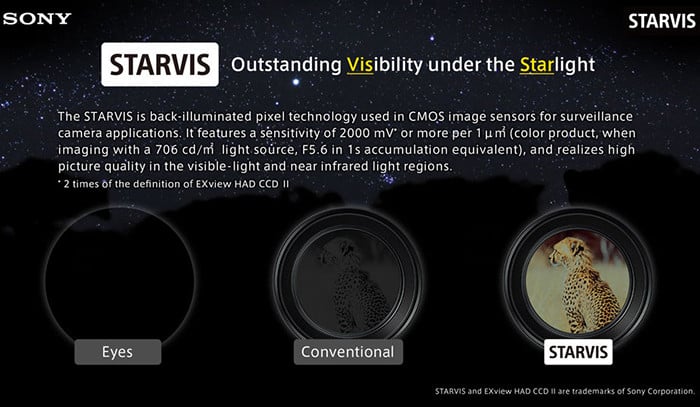
Sony posted a Brochure (PDF here) and a Slideshow (website here) explaining the detailed new Starvis tech. There are four different sensor size available. it has to be seen if in future Starvis tech will be available on larger sensors too.
Found via Image sensor world.
32 Responses
Don’t even need to look at PDF after that brilliant marketing video.
STARVIS…..STARVIS…..STARVIS………………………..
If this is so good, how come they are still no actual photos made with this shown anywhere? And please don’t link to that stupid video with fake mockup images.
Meh, looks like a dashcam sensor to me.
You may be right, this could be something fo the security market.
This IS intended as a security camera and is clearly marketed as such.
I would use this for a music video – it’s like an interesting filter….
This is obviosly intended to compete with the new Canon 4 million iso ff camera.
But Sony has not posted actual iso information to really compare.
This camera utilizes the near infrared spectrum to enhance sensetivity, however this will result in distorted colors in normal daylight photography.
I think this is the competition for Sony Starvis, not the Canon FF cinema camera: http://www.x20.org/color-night-vision/
There are many competitors and Sony needs to consider then all…but you must choose your battles, and at this time I believe Cannon is Sony’s main concern and has the biggest target on thier back.
Plenty of information to compare. And people are making the wrong comparisons already. The best of the Starvis chips is actually the 1.3mp sensor that shoots 720P. The source lighting for these sensors is specified in CD/m2, with the source light being about as bright as most HD TVs out of the box. So, shoot in your living room at night with all the lights off but the TV and see what you get.
People also seem to keep forgetting that photons are random. Video thus has an advantage over stills in low light, as we’re seeing 30 samples a second, not a single sample.
Your information is incorrect.
IMX226CQJ sensor
9.33mm ( 1/1.17″)
Supports4k high resolution/high sensitivity video.www.sony.net
And although sensetivity data is available it is not indicated as iso…and since the Canon claims 4 million ISO this is not a comparison the average consumer can make.
Since you seem to understand these numbers perhaps you can make a direct simple comparison/translation for us so everyone here can better understand them.
Read the signal level claims.
I am not sure if you are able to correctly compare the light sensitivity or not.
I and apparently everyone else here are having some difficulty making the comparison iso/low light sensitivity comparison between the Sony and Canon products.
Do you know how they compare?
I know how the Sony sensors compare, because they give us the mv levels. The 4K/8mp sensor is not the best of the bunch ;~).
Canon doesn’t publish sensor docs, so there’s nothing to compare there. ISO is not signal-to-noise. You’ll have to wait for someone to have both products in hand and be able to do a true scientific comparison under controlled conditions to get your answer. Even the specs that are published have a lot of problems (e.g. what was the spectral consistency of the light?).
Remember how they did the AA filter you can turn on or off for the RX1RII? Maybe they can do that with an infrared filter too.
For normal photography a simple scre in filter would be sufficient.
So what’s the max ISO? I want numbers.
800.000.000
It seems to be Sony’s. Current gameplan to simply wait for Canon to play a card then play a stronger card.
Such was the case with Canon 5dsr sensor/ Sony a7rii sensor
And in the case of the ne low light monsters..
Canon..ff 2mp , 4 million iso…shoots 1080p
Sony…smaller format, 12.4 mp ..iso not stated..shoots 4k, spectrum enhanced with near infrared for better night photograph.
It is difficult to directly compare because we do not have iso numbers,
But the Sony is higher resolution, more compact, and shoots 4k…..probably lower price too.
Clearly Sony is agressively targetting Canon.
By waiting for the new canon product then rapidly introducing a better version Sony can really hurt Canon market share.
Canon is now actively trying to produce what is rumoresd to be a 120mp ff foveon sensor…I am guessing it will actually be 126mp because 126mp would have significant advantages over 120mp.
So again a guess but perhabs we will see a 126mp ff foveon mirrorless Canon camera in late 2016.
I would be surprised if Sony will not have something ready to beat that….in fact I would be very surprised if Sony is not paying very carefull attention to everything Canon is doing and custom building whatever it takes to beat Canon.
We have heard very little from nikon..
I think if possible Sony should buy Nikon camera and lens divisions.
They can build 2 parrelel E mount camera lines..the existing E mount as a consumer line, and pro body style version under the Nikon label…everything interchangeable.
Nikon lenses would allow Sony to better compete with Sony lense…and by all means keep existing Nikon managers in place for thier knowlege of how to properly run a camera company that professionals respect and admire.
With such a stratagy Sonikon would be unstopable…look out Canon.
Actually, I prefer competition. Not astronomical prices.
I wonder how this starvis compares to A7S…
pixel-pitch: starvis 1.6 um – A7S: 8.2 um
Totally different applications. Starvis does not need to have high megapixel or to be colour accurate or good dynamic range.
The specs are not good to complain
The Technic to shrink the the sensor thickness is not new. The Technic is in the Sony a7s already used!.
I don’t know why the a7sii has not a back illuminated sensor and global shutter. With both has the a7s essential more highest ISO.
The starvis is only for security cameras evolved.
“I don’t know why the a7sii has not a back illuminated sensor and global shutter.” – Because until whatever trick Sony came up with for the Pregius or whatever it was called, CMOS and global shutter were mutually exclusive. Also because BSI is a waste on low-density sensors, it offers little to no advantage. BSI reduces the amount of sensor area “wasted” by support circuitry, and that percentage increases as sensor density increases. If sensor density is very low, the “wastage” that can be reduced by BSI is also very low.
Sony has an 12MP Global Shutter Sensor -SAR posted this in 2014
No matter if wasted tech or not, we want new specs not relevance. Besides, is this new sensor tech possibly going to the new 43sensors, Olympus is waiting for? That would be interesting.
That Pregius or whatever it was called, listed CCD in specs…
STARVIS….. STARVIS….. STARVIS….. STARVIS….. *Ding~ SONY, Make.Believe
^This – Physiological Hypnotic Marketing Methodology
Starving for Starvis
Should have been Starve-us. I think its Sony’s way suggesting they are going to Starve us all because we have to spend all of our money on the rapid replacement of new camera bodies…