







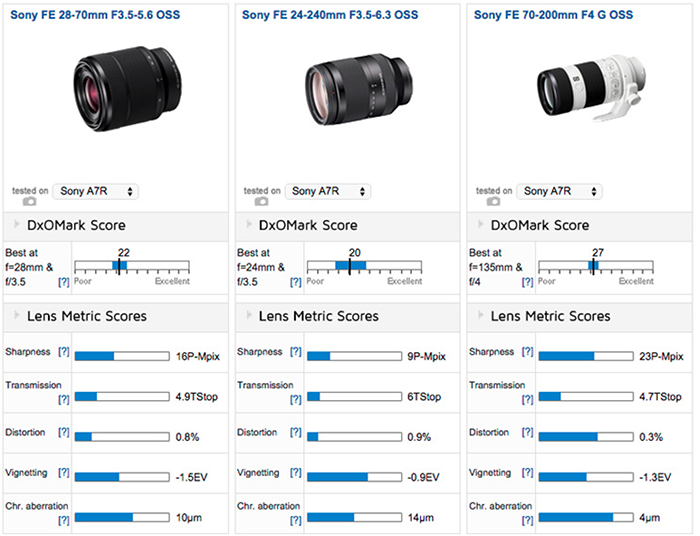
DxOmark (Click here) posted the full Sony FE 24-240mm lens test. They write:
Costing $998, the FE 24-240mm is not very cheap, but packing a massive 10x focal range, Sony’s OSS image stabilization and dust/moisture resistant construction, you get a lot of lens for your money.
While offering a versatile all-in-one solution for wide-angle or long telephoto shots without having to change lenses, the FE 24-240mm is not the strongest optically and ranks in the lower half of our lens database. That said, the image quality delivered by the FE 24-240mm is good for a superzoom, and as we’ve seen in the Sony FE 24-240mm vs Nikon 28-300mm analysis, the Sony is as good in most areas and actually slightly better than the Nikon at the wider apertures.
The FE 24-240mm’s performance is also better at the wider focal lengths between 24-50mm. Zoom in further to the telephoto focal lengths and Sharpness and Transmission start to suffer somewhat, which has affected its overall score. Head-to-head against the $1,498 FE 70-200mm f4 G OSS, the analysis showed that much better performance is available from a dedicated telephoto zoom with more homogenous sharpness across the entire frame. At the wider focal lengths, however, the FE 24-240mm actually displays better edge sharpness than the FE 28-70mm standard zoom, which covers a much shorter focal range. So if you’re looking for a good quality standard zoom with the added versatility of being able to shoot telephoto without changing lenses, the FE 24-240mm is a convenient and good value choice for Sony A7 shooters.
Sony 24-240mm FE lens store links:
USA: Amazon, Adorama, BHphoto, FocusCamera, Sony US.
Europe: Sony Germany, UK, FR, IT, ES, NL, BE, AT, CH, SE, FI, NO, PT.
Asia: Digitalrev, CameraPRO, Sony Australia.
53 Responses
What choice do you have? If you own A7 series and looking for native super zoom, enjoy this overpriced lens.
Yeah, and don’t bother with more than the lowest resolution setup…
For what it delivers (IQ) the price level seems to be a little bit steep, however when evaluating the whole package (built, etc) it becomes reasonable.
I bought it as a travel-all-in-one. My wife doesn’t like primes like I do, and she doesn’t like me changing lenses all day. 🙂
So I gave it a try, and for this purpose it is fine. As every 10x zoom it has flaws you need to circle around.
If you respect the basic superzoom rule (on the short end stop down at least 1 stop, on the tele end stop down at least 2 stops) sharpness on a 24MP is quite ok.
We should establish new category – a reader wife’s zoom. And compete there!
Hohoho, and that’s supposed to be funny?
….
Not at all. I mean categories of things we don’t buy ourselves but which are nice to have.
insn’t 24-240 the best sold FE-lens?
Doubt it, it was only released recently. besides the kit lens I would expect the 24-70 or the 55 1.8 to be the top sellers.
I think you are right. I mixed the facts – there was just something about to be most pre-ordered FE-lens when announced.
Then you got it wrong.
It’s my camera, and my lens. I wouldn’t have bought it for my personal desires I wanted to indicate. But now I have it, and I found it quite convenient during vacation usage.
And usually married people are going together on vacation. And there I sometimes love it to have my hands free and let my wife capture some images, if I want to make a pause.
Why? It performs pretty similarly to the Zeiss 24-70mm for a similar price but has a considerable amount of ’emergency range’ at the expense of some extra weight / bulk. If I wanted a normal zoom for FE this would be where my money goes.
Why don’t DXO mark test the A7 or A7II with any FE lenses?
How would tester discover full potential of the lens without the best sensor?
They test other lenses on multiple sensors, in fact they state specifically this scenario as part of the whole point of P-MP. People want to know how well a lens will perform with their sensor.
Time for Sony to build a decent 24-105….
Vario-Sonnar 24-105/f4 and I’d be in
me too
Quality already seems to be very good in the 24-100mm range, but drops off after that, but with the advantage of having some extra range when one needs it.
Zony 28-135/4 can be better actually, cuz i already have 16-35 🙂
I’d prefer something like the old Nikkor 35-70mm f/2.8.
Exactly! Street and portraits, best for travel. And a WA in the pocket.
Sigma’s 24-105 Art in native E mount would be a cool piece of hardware… but they even don’t release it in A-mount (which would be OK for me together with the LA-EA4) and still showing no interest at all in Sony’s FE System…
‘convenient and good value’ = the polite way to say ‘overpriced and heavy piece of shit’.
Obviously nobody is buying a 10x super zoom for the image quality. Taken in the context of the type of lens it is, it seems pretty decent.
Not the kind of thing most people here would buy, but then if a company only made what the kind of people here would buy, they’d be bankrupt within a week.
Not nobody. I do, and if I don’t get quality, then I don’t buy. For me, the existence of the Panasonic Leica 14-150mm f/3.5-5.6 Four Thirds superzoom was one of my reasons to go to Micro Four Thirds, after Four Thirds cameras were discontinued (Canon full-frame was no option because of other reasons), so that I could continue to use it.
there are IQ reasons why people buy FF superzooms instead of compact camera superzooms
Not that the DxOMark figures would be of real use, but from the text it seems the Four Thirds mount Panasonic Leica D Vario-Elmar 14-150mm f/3.5-5.6 and the Canon EF 28-300mm f/3.5-5.6L for full-frame DSLRs remain the only two good superzoom lenses on the market.
RX10 or FZ1000?
Neither of them will even come close to the IQ of an E-M1 with the 14-150 lens (or a Canon full-frame DSLR with the 28-300L, for that matter), let alone in low light. Even if they would, they would be no alternative for me, because the superzoom is just one of my lenses, the all-round “standard zoom” which I use if I don’t want and need to carry any of my other lenses.
‘neither of them will come close to the IQ of’ – Oh please, I can’t wait to hear your explanation of how this is so 😉
Go to dpreview and compare the cameras. At low ISO and in the screen center the difference might not be striking. Right, the lens they used on the E-M1 is better than the 14-150, but the differences will still be there, and I’d expect them to become even more noticeable when you compare longer focal lengths. And even if they wouldn’t – there is still the high-ISO difference, and, come to think of it, the reduced DOF bandwidth of the superzoom cameras.
There is a stop at the most between m43’s and Sony 1″, actually less. The RX10 is a constant aperture f2.8, that means at the very best the E-M1 has around 1/2 stop advantage, if that and only at the wide end. Anything beyond this and the advantage of the RX10 becomes obvious. The RX10 lens is pretty exceptional throughout the entire range. Add the extra resolution and not needing to change lenses and it is pretty compelling. Yes it is still a super zoom, but if that is what you want you are almost better off having it just for the times when you want a superzoom. You would have to have 2 3x f2.8 zooms (12-35mm and 35-100mm f2.8) to get an appreciable gain of less than a stop.
All right, I see the point; I didn’t take the aperture into account!
And while those 20 MP doesn’t quite seem to come with the same per-pixel-sharpness as the Olympus’ 16 MP, at 400mm equiv. FL the Sony still has significantly more telephoto reach than the 14-150 (which can be quite nicely combined with the 1.4x converter, though, but, at f/7.9, that’s not really something to write home about).
Well, interesting!
Nevertheless, I’d really like to see a real comparison 😉
And still, I wouldn’t want to have a second (and quite hefty at that) camera just for the superzoom feature. I’m still more flexible with the DSLR; sometimes lens combinations like ultra-wide + superzoom or superzoom + supertele do make sense. I guess the latter will become one of my favourites when Olympus finally gets that 300mm f/4 out…
The Sony RX10 lens doesn’t have more telephoto reach. It’s 24-200mm *equivalent*. Not true focal lengths.
The Olympus 14-150 is 28-300mm equivalent.
The Sony is a bit wider though
Oh, right, thanks for the correction. It was the Lumix FZ1000 that had a 25-400mm equivalent lens, not the Sony. And of course the Lumix has no constant aperture, either, although f/2.8-4 is still quite good for that focal length range on what at least is a 1″ sensor.
in lowlight, RX10 has advantage over E-M1 + slow zoom at tele end
True, I didn’t take the constant aperture into account. Then again, the RX10 only has 200mm (equiv.), while the E-M1 plus superzoom goes up to 300mm (equiv.).
I think people would’ve loved it if it was $499.
“Decent” isn’t a good enough when it’s price tagged $998.
I bought this lens because I wanted a telephoto but kind of wish I bought the 70-200mm used for the roughly the same price.
Yeah, worse than the kit. this pretty much seals the coffin for me. When Sony offers a decent 200mm + tele for less than $500 I’ll buy into the system.
How is it worse than a kit, when the kit does not have either wide or long end, and its pathetic 28mm wide end is not sharp in the corners for landscapes?
http://www.dxomark.com/Lenses/Compare/Side-by-side/Sony-FE-24-240mm-F35-63-OSS-on-Sony-A7R-versus-Sony-FE-28-70mm-F35-56-OSS-on-Sony-A7R__1515_917_1244_917
See 24/4 vs 28/4 on the kit for example. See 35/4 vs 35/4 for another.
DXO is a wash at best, looks like the 24-240 slightly worse of a lens, and I hate, HATE! the Sony kit lens.
If this is a valuable lens for you then maybe you should just be shooting a SLR. It’s massive, expensive and less than impressive optically.
Gotta love that P-Mpix score. A total made up BS metric by Dxo. I can only imagine how many people get suckered into that number.
Unexpectedly good results for a lens like this. The most useful Sony lens so far. A7s II (with better Af please)+this would be pretty awesome, which is rare for Sony.
I find your logic pretty suspect. On the 43rumors you’re complaining about a $1400 pro quality fast F/2.8 telephoto lens, and here you’re all aroused by a plastic $1000 kit lens.
Point 1) One shoots 300 mm eq at f/2.8, the other at pathetic f/6.3.
Point 2) Pana and Oly sell a lens that meets or beat the Sony for about half the cost.
MFT for the win, bud.
1) It is not a kit, it is superzoom
2) It is 12-120/1.75-3.15 in terms of m43, much better than any superzoom m43 has (but much bigger too)
3) The point of this being the most useful Sony lens shows how useless their 28-70 and 24-70 etc are, with pathetic ranges.
4) I love my OM-D, but Oly and Pana should stop outrageously overpricing their decent lenses.
1)Fair enough, It’s a kit quality superzoom in sharpness and speed.
2)Pana and Oly’s superzooms are 14-140 MFT eq. that 2 mm less wide, but a full 20 mm on the long end.
3) It’s hardly the “most useful sony lens”. It’s attrociously large and heavy. Hold it in your hands. You ain’t bringing that A7 + 24-240 anywhere you dont absolutely have to.
4)Besides the Leica branded lenses, show me MFT lens that is more expensive than it’s sony/Zeiss counterpart.
Lens (Sony/MFT)
Superzoom ($1000/500)
Fast Portrait ($1000/300)
Fast prime ($800/350-550)
I love the Sony Alpha platform, but you cant for a minute claim they beat MFT in selection, lens quality or price.
“Pana and Oly’s superzooms are 14-140 MFT eq. that 2 mm less wide, but a full 20 mm on the long end.”
Field of view is not counted in mm. It is 15% wider view on wide end, and 15% more wider view on the long end – and you can always crop on the long end (especially given 24mpix vs 16mpix), but you cannot “uncrop” wide end.
“15% more wider view on the long end”
My god, just stop. Yes, the lens has less reach. Not a benefit in the Tele world
“You can always crop”
TRANSLATION:
“Yeah, you know that 4 lb two liter soda jug you have attached to your a7? Yeahh, you still have to crop down.”
“3) It’s hardly the “most useful sony lens”. It’s attrociously large and heavy.”
It is, but it is shorter than Oly 40-150/2.8, and a pretty usual size for FF zooms.
Comments on 4) ???
It makes no sense, you ask for “besides Leica”, but compare to “Zeiss”. It is basically the same overpricing scheme with using brands licensed from other companies which had nothing to do with development and sales of the lenses.
42.5/1.2 “Leica” is overpriced even compared to real Zeiss – Batis 85/1.8 (which would be like 42.5/0.9 in m43).
7-14/4 @ $1000 is overpriced for a f/8-equivalent lens (non existing in any FF of course). 45mm Pana macro at $900 is a joke, WTF?! Did they sell a single copy after Oly 60? Sony 28/2 is cheaper than 15/1.7 (while working like 14/1), WTF?!
And the Sony FE system is not even a good example, as it is overpriced in its own turn compared to other FF systems. Canon 40/2.8, sharp 20/1.4 equivalent for $200 anyone? 50/1.8, 25/0.9 equivalent for $119 anyone? I’d take it, even if it only would be decent in the center area from f/1.4 (as the Canon from 2.8).
These are realistic prices, not “steal and run” kind of prices.
“f/8-equivalent lens” Yeah. That 7-14 has skirted physical reality f = N*D
Like I stated above, there is a equal or better MFT offering for every Sony FF lens and they cost less. This is not debatable.