







Image courtesy: DxOmark.
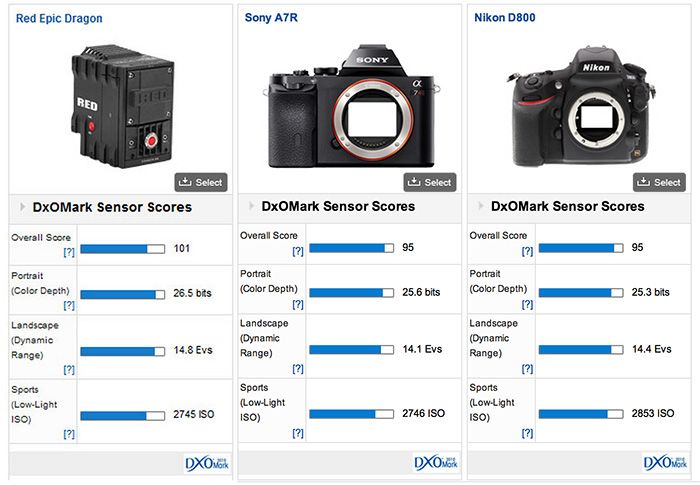
From all cameras tested to date by DxOmark the Red Epic is the first to outperform the Sony 36 MP FF sensor. Well you have to pay $17,500.00 for the Epic “brain” only (no accessories included) to slightly beat the Sony A7r performance. Obviously, the Red main feature is the 5k video recording. But I am pretty sure Sony will release a 4K FF soon too 🙂
I am now wondering how well the new 50 Megapixel Sony medium format sensor will score at DxO. I am pretty sure it will overrun the Red Epic! P.S.: Hasselblad 50MP Sony sensor camera is available for preorder at BHphoto (Click here).
0 Responses
Who makes the sensor?
Not sony 🙂
One is full frame one is APSC, one is for photos one is for videos, comparing apples to oranges.
It’s larger than APS-C (about APS-H), but yes, I agree on the latter.
Red markets their products as “Digital Still Motion Cameras.” They claim their cameras can produce still frames at IQ equal to or greater than competitors’ high end still cameras so it is a worthwhile comparison to see if their marketing is complete bs or not.
Pointless and misleading. Red Epic is a digital video camera and on this front it’s far superior to the A7R
Except that:
A) they didn’t have access to Bayer data (propriety filter) and the data is more cooked
B) the results are based on temporal oversampling of multiple frames, which can give huge noise reduction possibilities (similar to stacking, see MFNR on Sony cameras giving about 2 stops benefit too).
Which makes the stellar results from a sensor almost half the size of FF, all the less surprising…
Apples vs oranges (technically), even besides the obvious fact that they target completely different markets to begin with.
This result is based on single shot , in the multi-frame mode it does even better.
No, it reads out pixels multiple times during a “single” shot. That’s why it’s called temporal NR and effectively works like stacking.
You can’t double the QE of CMOS out of the blue.
If you actually read DXOmark’s technical analysis you will see that they believe even the single shot uses multiple sampling. To quote.
“With a sensor area 0.56 x smaller by surface area than a 35mm (24 x 36
mm) full frame sensor, the results are very impressive. As the sensor
and image processor can deliver very high frame rates, the Epic Dragon
is certainly adopting multiple sampling techniques to reduce noise
levels (also known as temporal noise reduction). Without such
processing, such high SNR would only be possible from a sensor with an
exceptional Full Well Capacity. Performances like this seem, to us,
above the current technical capabilities of CMOS sensors.”
Who are you? Some teacher? Have you tried simple sentences like “I need to pee” first? English is a tricky language.
Well, i’d like to see the Sony F65
Sony may release a 4K camera, but check out the F100, F3, or even F55 and F65: this new camera will output either to a shockingly shitty camcorder-level amateur codec or an external recorder (and probably only Sony-branded one which alone costs more than Epic, at that). Sony’s still photography division may be doing great things, but their motion division are lazy highway robbers who would still be selling 1080p F35’s for $200k if Red hadn’t come along and forced them to sorta innovate – or at best the F65 would’ve existed but cost 3x as much.
Just to point out, the second-highest DxO score is the Nikon D800E, at 96, and therefore (just) above the A7r (and regular D800). The D800E’s sensor may be a Sony, but Nikon routinely gets more out of Sony sensors than Sony does.
True Dave, and it turned out that it’s always better to buy Sony sensors in another manufacturers bodies as they will give you commitment as a whole system.
A7/R?? Great Sony sensors in a crippled Sony cameras.
if the A7 and A7r are crippled cameras, than you must be saying that Leica is beyond crippled. Since Sony is now the biggest competitor to Leica.
So yes, i agree very crippled cameras that are taking a giant in the camera industry down.
What exactly are you talking about? A7/R are crippled as a WHOLE SYSTEM, I own A7, and yes I enjoy shooting with it, but it’s definitely not a professional choice. Nikon uses Sony sensors, but they have great lenses lineup, wide variety of flash systems and zillion accessories to choose from, and I don’t know how! but they managed to make the sensor perform better in HI ISO and SURE better corners.
And about Leica I’ve shot with M9-P for a while, and it’s easily get beaten by Sony if you shoot colors and if you wanna make the most of EVF technology. but it’s a joy to carry around more than to shoot with.
PS. Leica colors sucks but if you’re a B&W shooter you will enjoy it.
The D800(e) does not perform better at high ISO. And no, a single data point showing 0.05(!) EV difference does not prove me wrong, especially when another (for example higher ISO) data point swings the other way.
And what’s the comment about corners based on? Apples and oranges I bet (different lenses or the same lens with and without adapter, the adapter being the weak link).
If you’re a photographer who takes DXO as industry standard then our discussion will be useless. And no, there is nothing to do with apples vs oranges check my original comment, Nikon made the best out of Sony sensors. and if you know nothing about the corners issue then maybe you haven’t shot with the A7/R yet.
Controlled tests show that the D800(e) and A7R perform about the same at high ISO. Not just in charts, but also in images.
And it’s quite telling that you avoided explaining what you’re referring to when you talk about this supposed corner issue, compared to a D800.
I know where you’re heading with that comment, a dead end. Because the corner issues mentioned by most, are with lenses that do not even work on a D800 (mostly symmetrical wide angle designs).
!!!! yep useless discussion. if you like it or not, the A7/R have corner issue with all the lenses NATIVE or NOT.
An A7R with a FE 55mm has no more corner issues than a D800 fitted with any Nikkor 5Xmm. Wait, let’s rephrase. The former combination has less corner issues than a D800 fitted with any Nikkor 5Xmm.
An A7R fitted with the native FE 35mm, performs better in CORNERS (and center) wide open (f/2.8) than a D800E fitted with a Nikkor 35mm f/1.4 stopped down to f/4 (and the former combination pulls ahead further stopped down to the same f/4).
And if those Nikkors fitted on an A7R show more corner issues, try a better (aligned) adapter.
If you’re going to mention shading or colour shifts, you hit the dead I mentioned, since that’s not related to an A7R sensor compared to the D800 sensor, but rather lens design and distance between exit pupil and sensor.
– edit- post moved down the thread.
This is kind of a broad shot for a one point difference when you are talking about a camera that beats all others except the one. Are you here to contribute or to slam. A one point difference, I wonder if that is even discernible to the eye.
You realize that the margin of measuring error is about 5 points?
Removing the AA filter has no effect on these measurements. The curves for the three 36 MP cameras are near identical.
Sony have stronger color filters. Better color separation at normal shooting conditions at the expense of top end ISO noise. You can fix high ISO noise. You can’t fix poor RAW color as easily.
Sony _had_ stronger color filters. It is not the case for A7r, just check the color response for this camera at DxO mark. It is barely better than one of D800(E)
ah, yes. I was more referring to the incessant whinging about standard Alpha DSLRs. Granted, the difference in color reproduction was not apparent early on because Adobe used such rubbish RAW conversion, but its obvious now. I know Sony are weakening the filters now to compete on high ISO, which is sad but they probably need to do this to stop the high ISO crowd going on.
It records 6K resolution. If Red made a 65mm or full frame sensor based on the this sensor technology from Epic Dragon that would be amazing!
Would be interesting to see what ARRI Alexa or Sony F65 would score.
It’s worth reading the full technical analysis. First thing to note is that DXOmark doesn’t have direct access to the RAW from the sensor as the format isn’t available. They have to deal with the output after it has been processes via the REDCINE-X application.
Perhaps the biggest indicator on how such an excellent score was obtained was suggestion that each pixel is sampled at least twice per frame. This would, in effect, double the full well capacity and explain how a smaller sensor can beat 35mm FF sensors on SNR.
I’m not quite sure how such an approach would be applicable to still images. There is also a considerable price to pay in power consumption. Sampling a CMOS sensor at high rates generates a lot of heat. It’s notable that the RED camera has to use active cooling in the form of fans to keep the sensor temperature acceptable.
A user can run it at 12 fps for stills.
This is not about the capability of the RED camera, but whether the techniques used are usable on still cameras. For instance, the multi-sampling technique is not feasible for fast shutter speeds as the. Indeed the RED doesn’t have a physical shutter, and if frames are to be captured using pixel-level clear/sample cycles, it will preclude such fast speeds. Indeed given the maximum frame rate at full resolution is 85, it would appear that the highest shutter speed using the clear/sample technique is going to be 1/100th second. Beyond that, you have to sub-sample.
Even doing that, the very high data rates will use a lot of power and heat up the sensor. Now try scaling that up to a 36MP FF sensor, and all the problems get much worse. That’s even before we consider multiple samples per frame.
In short, it’s not obvious how this technology would apply to still cameras.
Actually it is the second camera. The Nikon D800e that you seem to have conveniently forgotten about scored 96.
So the D800e outperforms “the Sony 36MP sensor”? That’s amazing, being able to outperform itself. Magic.
Read the text one more time.
The A7r sensor is not a 100% match to the Nikon D800e sensor.
No, there are no 100% matches in their databases, even comparing 2 cameras from the same brand using the same sensor. The answer as to why was already given, earlier in this thread: margin of measuring error (and sample variation), being about 0.33 EV or 5 points.
That’s also why the D800 and D800e don’t give an exact 100% match. And no, the AA filter does not make any difference for these measurements (it does for resolution).
Sony claims that the a7r sensor is new and was developed specifically for it.
Reminds me of their claims that the 5N sensor was new too (A580 sensor clone really, minus AA filter changes).
Which uses a SONY SENSOR just as he said!
Not only does the Dragon sensor out-perform every other camera tested, including the costlier digital MF backs, it does so at up to 96fps at maximum resolution, and without the burden of a physical shutter.
Now if this is not great news… Some insignificant benchmark has been beaten by some product hardly anybody will buy. However, the next product of a huge multinational might beat that. Hardly anybody will buy that other product, either.
Let me go back to watching paint dry, it is more instructive and free of nerds.
Red is a fairly small company competing with the likes of Sony, Arri, Canon and others. They do not cater to a mass market. They cater to profession directors of photography, apparently you are not one of them and thus are disinterested but I fail to understand how you were forcibly pulled away from your paint to read the post and then troll the article.
Otherwise it is interesting to note that this small company is able to produce a sensor that according to dxo is the currently highest performing one around. It takes the wind out of the sails of other larger companies who get by using low(er) quality sensors.
I am just trying to teach you snotty nerds some common sense 🙂 Life normally sees to it, no worries.
And yet somehow you are not only reading this on a Sony rumour site, but commenting on it.
Wow! We hardly even have any 4K cameras available and Red is already shipping a 5K module.
I still think this RED module applies some sort of NR. I would be glad to know they are not – I would love to see FF DxO mark high ISO rating at about 4200. This will make ISO25600 fully usable with DxO PRIME or other advanced NR methods developed on NL means.
BTW, I am not sure if MF Sony sensor will completely surpass this RED unit. There’s a stop of difference in tonal depth between A7r (which is better than D800) and RED. 44×33 diagonal is ≈55mm. 36×24 is ≈43mm. 55/43≈1.28. 1.28²≈1.63. This is less than a stop.