







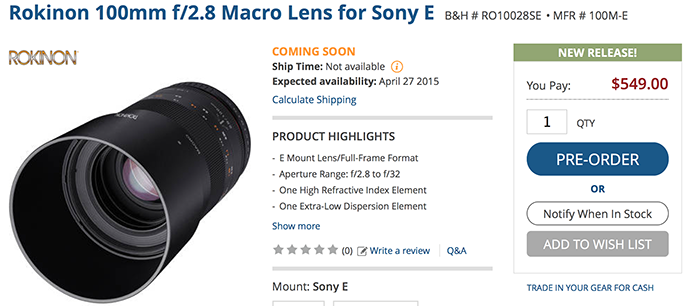
Good news folks! This is the new Rokinon f/2.8 macro lens you can now preorder at BHphoto (Click here). It works well on both Full Frame and APS-C E-mount cameras and it will ship on April 27 already!
Full specs can be read at BHphoto! (Found via MirrorlessRumors and an anonymous source).
Home in on close-up subjects with the Sony E mount 100mm f/2.8 Macro Lens from Rokinon, which affords life-size 1:1 magnification along with a minimum focusing distance of 1′. This manual focus portrait-length lens also incorporates one high refractive index element and one extra-low dispersion element into its design to reduce chromatic aberrations and distortions throughout the focusing range. An Ultra Multi-Coating has also been applied to minimize flare and ghosting for increase contrast and color neutrality. A long focal length lens with close focusing abilities and a high magnification ratio, this macro lens is ideal for making close-up, detailed images of nearby subjects.
- This 100mm f/2.8 lens features a Sony E mount, and is compatible with full-frame sensors or APS-C sensors, where it will provide a 150mm equivalent focal length.
- A bright f/2.8 maximum aperture is useful for working in a variety of lighting conditions and the minimum f/32 aperture helps to attain a long depth of field when working with close-up subjects.
- One high refractive index element and one extra-low dispersion element help to control chromatic aberrations and minimize distortions throughout the focusing and aperture ranges.
- An Ultra Multi-Coating has been applied to lens elements to reduce lens flare and ghosting for increased clarity, contrast, and color fidelity.
- Featuring a macro design, this lens affords a 1:1 maximum magnification ratio along with a minimum focusing distance of 1′.
- Benefitting working with especially close subjects, this manual focus lens features an internal focus design to maintain the overall lens length during use. Additionally, the front filter mount does not rotate when focusing to better enable the use of polarizers, graduated ND, and other filter types that require precise positioning.
- A rounded nine-blade diaphragm contributes to a pleasing out-of-focus quality when using selective focus or shallow depth of field techniques.
Sony Deals:
Zeiss FE Distagon lens is in Stock at Amazon US (Click here) and Adorama (Click here).
Back in Stock: Refurbished Zeiss FE 5mm lens for $749 at [shoplink 35071 ebay]Secondipity eBay US (Click here)[/shoplink]
Til April 4 deal: Sony DSC-HX50V/B at cart(!) is $219.99 +LR5 +$20.00 GC at Focus Camera (Click here).
32 Responses
Is this april’s joke, because it’s cruel 🙂 This looks like very nice lens, I was looking for a compact Macro lately. Well done Rokinon!
You do realize this lens is longer, heavier and uses a larger filter size than the upcoming Sony FE Maco, and with out AF or OSS? The one immediate advantage is price, but we will need to see some test results first to see if it is really a bargain lens.
If you are really after light and small, you may be better of with an adapted Tokina 100 – Smaller, lighter and with AF, or the Tamron 90mm, which is similar to the Tokina specs, but slightly more expensive than the Rokinon.
sigma 105 is about same weight with af and os as this lens, 100$ more tho
The sigma has a focus distance of 31cm!
I’m not sure what makes you say the Rokinon is larger than the upcoming Sony FE 90 Macro.
Rokinon – Approx. 2.85 x 4.75″ (72.5 x 120.6 mm)
Sony – Approx. 3.11 x 5.14″ (79.0 x 130.5 mm)
According to the numbers, the Rokinon is the more svelte lens. It has an extra 10mm, but loses the auto focus and stabilization. For the application such a lens would be used for, that’s not entirely a compromise.
At half the price, and Rokinon’s recent positive track record, it will likely be a desirable option.
Oddly enough, the specifications have been updated. The Rokinon is now listed as..
Approx. 2.85 x 5.87″ (72.5 x 149.1 mm)
So it is nearly 3/4’s an inch longer than the Sony FE 90 Macro.
If the new 100 macro is anything like their 135/2 lens, it’s going to be absolutely fantastic!
APSC or FF?
Both
FF
Dang, it’s even heavier than that huge Sony 90 f2.8 macro coming out and with AF/OSS
It’s heavy which likely means it’s well built, most high quality lenses are. The dumbest complaint ever, Aaron Norris is a dip $hit that can always be counted on to deliver the most petty complaints imaginable.
real metal and glass construction will do that
So how does the fact that the Zeiss Makro-Planar 100 F2 weights less than the Rokinon 100 f2.8 change your comment? I guess it must be made of tin foil?
There can be such a thing as bad construction and design too you know?
First of how can you accuse them of bad construction of a lens that hasn’t even been seen yet.? I’d prefer to reserve judgement until we actually have access to them. Compare lenses today with legacy glass from the 70’s and 80’s. Plastic vs Metal in many cases. Without AF the legacy glass in many cases weighs the same as the new stuff with AF motors and such. Rokinon construction is very similar to the legacy glass of old, so I am not surprised at the weight here. They have a reputation for ‘not so light’ lenses with durable quality construction. So if we are going to make assumptions about a lens no one has seen, wouldn’t it make more sense to assume it will be similar to other products from the same manufacturer? They have some excellent optics. I think it is more likely they have built a very good product rather than a piece of crap, but there won’t be any hiding it when they hit the market. We will all know soon enough
Hmm, the Samyangs I’ve seen so far have been mostly plastic. In my 16/2 it’s the E-mount adapter that’s metal. They feel alright in the hand though, heft-wise, definitely not cheap.
If heaviness in this instance means good glass then I’m all for it. O’course my Minolta 100 2,8 RS doesn’t feel very nice to MF but it isn’t handicapping and gives great images so will likely continue to use that with my APS-C E-mount.
Can definitely see a market for this lens, so long as it doesn’t go soft by f/9..
Is this the lens rumored a few days ago “Samyang launched a new teaser on their facebook page. It’s highly likely this is for a new 100mm macro lens. And as usual expect it to be available in native A and E-mount”. April fools joke or is A-mount getting boned?
The BH Photo web site shows the same lens, essentially, for both A-mount and E-mount. It isn’t clear where SAR got the idea that it is designed for “mirrorless systems only.”
remind me of the 24-700mm lens.
today is a bad day for announcements…
People also found Nikon F mount of this lens, so likely it is not a mirrorless design. I will pass.
In my opinion not having automatic aperture is a big disadvantage for any macro lens. You’ll often be using narrow apertures like f/16, greatly reducing the light available for precise focusing, and it usually isn’t practical to focus wide open then manually stop down for the shot.
For not much more you could get an older a-mount 90mm Tamron and an LA-EA3 adapter. That’s a lighter lens with very good optical quality and would make macro photography a lot easier.
you are not using an evf or liveview then; my experience is entirely the opposite of your “opinion not having automatic aperture is a big disadvantage for any macro lens”. The use of tilt-shift and macro lenses was a primary reason for moving to sony so I could see the approximation of the final image as I worked, and having several macro lenses that are manual and the fact that I used the FE 55 with tubes while the lens is actively stopped down makes it hard to understand what it is you are talking about.
which tubes do you use with the 55. I never thought about using it for macro
Commlite version NEX II via Neewer on Amazon. They work with A7x and APS-C with full electronic control. TheFE 55MM lens is stellar for stitching on aps-c in portrait orientation too, so with singh-ray filter set. and tubes it is macro through ultra-wide and one filter system solution.
I’m using an A77II, and I’ve tried using a manual lens on extension tubes as well as a dedicated macro lens.
The manual lens works OK if there’s plenty of light, such as bright direct sunlight, or something lit in a studio. But stopping down to a narrow aperture in dull light makes the EVF too noisy to easily see detail and texture, especially when using the focus magnifier for precise focusing. In those circumstances being able to focus when the lens is wide open at f/2.8 is a big advantage.
I also consider the greater depth of field to be a disadvantage when focusing, even though it gives a more accurate view of the final image. It’s easier to see precisely where the point of focus is when the depth of field is at its narrowest and less of the subject is highlighted by focus peaking.
Of course it’s possible to get well focused shots with a manual macro lens, but I find that focusing at f/2.8 makes it much easier to put the point of focus exactly where I want it, e.g. on a bug’s eyes rather than on its wings or legs.
Fair enough, I can understand how automatic aperture is a benefit in your process. I shoot in B+W profile with effect on and peaking set on yellow. Afterwards I do a batch conversion of the raw images and have found the focus peaking to be mostly perfect to know my plane of focus while stopped down since there is no depth of field at 1:1 and a 100mm+ lens. Same thing for t/s lenses on the foregorund with tilt, it is great to know while working rather than guessing hyperfocal.
Hope there is a superior A mount version.
you won’t shot A-mount if you want superior result. E-mount is the way to go.
Where is the A99? I thought that was rumored for release a long time ago?
Has disappeared off the B+H site?
Probably “leaked” too early…