







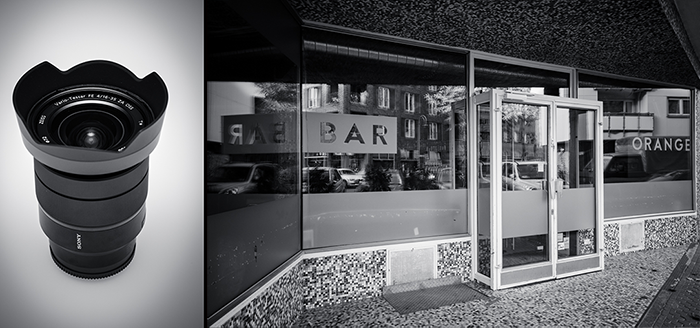
Image courtesy: Jörg Haag.
The 16-35mm FE is shipping in Asia (Amazon Japan and Digitalrev) and Europe ([shoplink 30495 ebay]eBay UK[/shoplink]). And it will ship soon in USA too (check dates at Amazon, Adorama, BHphoto, Sony Store US, Sony Canada). SAR readers are getting their lenses and this is a review published by Jörg Haag (Click here):
The FE 16-35mm is an adequate replacement of the A-Mount, at least from the perspective of image quality. An aperture stop less light is something to get over, because this is easily compensated by the better ISO performance of the α7 in comparison to the α99. I am looking forward to many hours of photography with this lens and I think this lens will not be inferior to the A-Mount counterpart in the field of architectural photography.
You can discuss with Joerg directly on SonyAlphaForum. More image samples have been posted on Photographyblog.
Check the full shipment date info here:
USA/Canada at Amazon, Adorama, BHphoto, Sony Store US, Sony Canada.
Europe at Sony DE, UK, ES, IT, FR, CH, AT, NL, BE, FI, SE, NO, PT.
Australia and Asia at Sony AUS, Amazon Japan and Digitalrev.
0 Responses
Very helpful review – looks like another blinder from Sony!
Fairly good review, but it’s a pity the Flickr samples have been downsized.
I love how he measures distortion. I do the same, I just look at a picture and can immediately say if it’s 1.73 percent distortion or 2.54 percent. Why bother with test benches, right? Same for the color comment. A picture of some graffiti with naughty add-ons in non-controlled light reveals to his trained color spectrometer eye that this lens renders “warmer” than what is typical for Zeiss? Right.
Forgot so say: My above comment has nothing to do with photography, just with hot air type reviews of technical aspects. This guy clearly is a talented photographer, lots of nice images on his site.
If there’s little distortion (and that’s evident in the image), what difference does it make what the actual number may be? The same with color. In the photographers opinion, having taken thousands of photographs with many Zeiss lenses, the 16-35 seem’s warmer.
Novices would do well to respect the opinion of more experience photographers over the absolute numbers generated in the lab.
Good thinking. If your optometrist’s eyes are good, what difference does it make what the actual correction numbers may be for your glasses?
What a silly analogy.
One doesn’t need to send a meal out for chemical analysis to establish whether it tastes good. Similarly, an observer of images shot with the Sony 16-35 needn’t possess specialized education to see the vertical and horizontal elements display little distortion.
There are many measurebators and few artists. I can see in which camp you place yourself.
Lenses are not designed an produced by artists but by engineers and technicians. No artistic skills are required to produce great lenses, but knowledge about physics and engineering. When talking about photographs, artistic vision and talent are of importance. When talking about technical merits of a lens such as distortion and color fastness, knowledge about physics and engineering is of importance. Which is why I don’t like people presenting adhoc unscientific thoughts about the technical aspects of things as facts. You clearly are not an engineer and have no scientific background, which is why you do not design airplanes and brain scanners and synthesizers and software controlling power plants and all the other things people rely on to be designed and built by knowledgable people with scientific mindsets. With some of those products, artists then create great, beautiful things like images and music, but the artists are no engineers and should not pretend to be.
That’s a flawed argument and it was pre-destroyed by guest79. Your lens might be made by engineers and performance aspects could be measured to three digits after the decimal point, but that doesn’t somehow mean more than the opinion of the photographer who is using the lens. Also, there are artists involved in the creation of many of the products you are talking about and they are called designers.
Even as a non mechanical engineer I can tell you if a car accelerates bad, good, great or freaking awesome. You need the numbers from 0-60, I just need a smile in my face.
Same goes with lenses. Of course any experienced photographer can tell you if a lens is sharp, has CA, distorts or not. No need for any measured numbers. Numbers are just for comparisons, but meaningless to most artists.
Hi Gonzo,
I did not “measure” distortion, I wrote that it is extremely low in comparison to other wide angle lenses that I own(ed). When moving the horizon out of the vertical center of the image, vertical lines like from the building fassade I used as an example tend to bend towards the image center which is not the case with this image.
And it does not take a spetrometer eye to tell that a lens renders warmer colors than others. This maybe a “hot air” review of technical aspects to you. My intention was to write what I think about my first walk with this lens and not to create a scientific judgement based on data and figures.
Greets,
Jörg
Keep up the good work Jörg, don’t get irritated by those kind of people who can do nothing than complain about a great free review you provided for us.
Thanks again!
So here is a question… If you already have the Voigtlander 21mm 1.8 do you sell it to buy this lens? Or is it worth owning the cv21 AND the 16-35?
I would like the Voigtlander 21 as well !! Lol… but this is a 16 to 35 mm so you cannot compare it to a fixed lens.
I have the Voigt 15 f/4.5 and it’s great in cities, even with the magenta fringe (that I compensate in Lightroom quiet well). And the Voigt 35 f/1.4 Classic SC with is great for B&W.
Eventually I would buy the 16-35 from sony if it was half the prize …or at least f/2.8 !!
It is worth it owning both, the lenses are different enough. But it depends on your budget and needs.
yea i currently have both the SEL1635Z and the Voigtlander 21mm F1.8 Ultron.
both lenses are very much different with the Ultron giving extremely sharp, almost distortion-free images when the horizon is level. and the bokeh is smooth and nice as well.
the SEL1635Z gives me the versatility of zooming in and out to fit the framing exactly, with low distortion.
i use the Ultron for landscapes and it gives a very unique, strong starburst on the lights. however i plan to sell it off because of the overlapping focal lengths, and that i barely use it for anything else.
What camera do you use Ryan ? I did fear that the Ultron doesn’t work well on the A7R, thanks !
Ultron works well on the A7r, this is the reason I am so conflicted on selling it or not. Here are a few images I took with the Ultron/A7r. What some might call defect in the lens, I call personality.
The irony is that people write nonsense like “An aperture stop less light is something to get over, because this is easily compensated by the better ISO performance of the α7 in comparison to the α99” as if shutter speed is the only important factor AND at the same time most aren’t even capable of proper handholding to eliminate camera shake!
Sorry I didn’t get you. What exactly do you wanna tell us?
I think that his point is that there are other considerations besides shutter speed when it comes to maximum aperture of the lens. Depth of Field being the main one which can not be compensated for by simply changing the ISO.
Which is utter nonsense on a wide angle zoom. We want deeper DOF on those lenses…
On a 70-200 he as a point, if that’s the factor that makes on photography “better”
Why do “We want deeper DOF on those lenses”? because somebody told you so in a book?
Pictures are ok. I think I’m going to purchase an 18mm F4 ZM lens instead. I think I’ll get better corner performance at that length…and it’s a distagon so the vignetting should be pretty muted I hope.
Look here at this review of the Zeiss T* 18mm/f3.5, a nice lens, too (it’s in German, but you should be able to translate it with Google, otherwise ask):
http://www.cetus-a.de/blog/2014/5/sony-a7r-und-zeiss-18mm-f3-5-zf2-das-dreamteam
Precisely what I was thinking of suggesting. One can also try the Voigtlander 20mm, which is cheaper and smaller.
Hmmm, I didn’t know about that one. I will check, is the manual focus ring nice and smooth? I bought a 135mm F3.5 rokkor just for fun with this new A7. It’s like crack man, I can’t put the dang thing down. Once you start manual focusing with a smooth focusing ring it’s addicting. I wish my alpha Zeiss felt that smooth.
Try the Mamiya 645 150/2.8 APO adapted to Alpha mount. Very stable and balanced with all the “manual focus” smoothness you enjoy. I don’t know why, but Mamiya never made a big deal out of the APO designation, only putting an A on the front. It’s every bit as sharp as Mino 200/2.8 APO, with built in lens shade, and absolutely NO vignette on FF because it’s for 645. Add the MIREX T/S adapter for supreme control… Ahh but then you’ll need the Mamiya 80/1.9 to go along with a ring flash.
So many camera combos. So little time.
Tell me about it, I have a Nikkor 135 3.5, awesomely built, integrated hood, great fun. They really don’t make stuff like this anymore.
The Voigtlanders are well built; the focus is really smooth, but because it is a pancake, it has some shortcomings. It is slightly cramped and overall the Zeiss will be better in terms of IQ, but it is more expensive, bigger, heavier and the filter ring is enormous. Here is a comparison between the two, but on a 12MP FF:
http://photo.net/nikon-camera-forum/00TAyN?start=10
And here (scroll down the page or make a search for it) there’s an example on the D800:
http://www.getdpi.com/forum/nikon/34666-what-lenses-d800-6.html
Wow, that’s pretty nice. I didn’t know about that one. I wonder if they used flat field or if this is right out of the camera. The corners look fantastic. Great images.
Overpriced rubbish…
… says somebody that has never used the lens.
I hope Sony will work on an affordable alternative.