






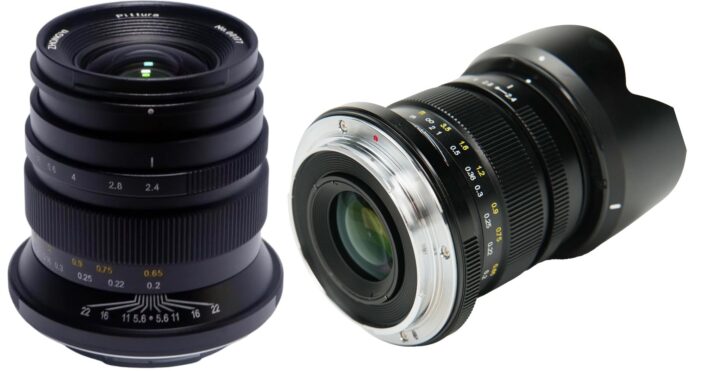


We talked about the comeback of Meyer-Optik Görlitz back in February. Now we have additional information about the Trioplan 100mmF2.8: It will ship in December and cost €1,400
The lens is said to have a very smooth “soap bubble” bokeh.
Here a sample of the bokeh, shared at the FR-facebook page by FR-reader Jennifer with her [shoplink 35749 ebay]Meyer-Optik Gorlitz Primoplan 58mm 1.9[/shoplink]


For the Full Press Release Click “Read More”
The original Trioplan f2.8/100 lens from Meyer-Optik-Görlitz gained a fanatical following of photographers who fell in love with its dream-like soap bubble ‘bokeh’ effect.
The modern remake of the famous lens, currently in prototype, uses experience and modern technology to emulate this stunning effect more authentically than ever before. Great news. But what exactly is a ‘bokeh’ effect, and why is it so well-loved?
Bokeh, usually pronounced ‘BOH-Kay’ but sometimes ‘BOH-ka’, is a photograpic effect that produces an aesthetic blur in the parts of an image which are out of focus. Derived from the Japanese word ‘boke’, meaning ‘blur’ or ‘haze’, bokeh describes the way a particular lens renders out-of-focus points of light. Whereas some lenses unintentionally produce blurring that is distracting and undesirable, others use clever alternate aperture shapes and other engineered adaptations to create ‘good bokeh’ that is pleasantly ghostly and pleasing to the eye.
The distinctive circular shape in the Trioplan bokeh derives from the number of aperture blades. The Trioplan f2.8/100 is made of fifteen steel aperture blades whereas modern lenses often have only six plastic blades. This results in a circular aperture rather than the more common hexagon. The more blades, the more circular the aperture is.
The soap-bubble bokeh effect is, strictly speaking, actually a lens aberration – but it is so pleasing to the eye that it has become a desirable effect. Of course, state of the art engineering could simply correct these aberrations which would make the transfer function of the lens look better on paper (in MTF diagrams, magazine tests, etc) but then the soap bubble bokeh effect, so admired by photographers, would be lost.
Bokeh has many creative applications. Most commonly though, photographers specializing in portrait, macro or long-zoom images use good bokeh to their advantage, by enhancing blurred areas created by the shallow depth of field and making the subject stand out starkly against a gossamer background.
Meyer-Optik-Goerlitz has been associated with innovation, precision, durability and quality in the world of photography for nearly 120 years. In 2015 the Trioplan f2.8/100 finally returns, nearly a century after its first appearance in 1916, ensuring that a new fan base will be able to experience a modern take on the classic soap bubble bokeh lens.
via Digitalkamera.de.
17 Responses
Fully manual 100mm lens, contains 3 elements and optical formula was already developed (no new development costs), yet costs 1400€. Makes. No. Sense.
And ad-hoced to a mount to which it has no mechanical/electronic coupling. Pointless. Better to get a lens in an established mount and adapt.
it’s got a $1000+ sounding name
I’ve owned a few Meyer-Optik lenses over the years and they were very nice as “special effect” lenses. But at that price you can buy heaps better manual focus lenses (like an S-M-C Takumar 105mm f/2.8) plus adapters.
Wait oh shi… 1300 euro? Really? I’ll give $199 max. Maybe one zero is overkill?
There is absolutely nothing “smooth” or “desirable” about that bokeh. It is harsh and hideous. Bright ring bokeh is about the worst you can get, apart from the swirly stuff that Petzval fanbois appear to covet.
There are plenty of old, incompetently designed ~100mm lenses around that will adapt easily to Fujifilm X mount. They are also very cheap. But there are also some stellar performers, all at a fraction of the price of this horrible Meyer lens.
Sure, it doesn’t fit most definitions of “smooth”, but “desirable” is subjective.
Looks like the obnoxious donut bokeh from a Cassegrain mirror lens like my dad’s old Reflex-Nikkor 500mm f/.8. As the old adage goes, a bug can be turned into a feature by documenting it…
I loooove this type of bokeh. So much better when it comes to painting a background than the usual sanitized bokeh !
A simple apodization filter could create it for a much lower price though…
Actually you can get the same kind of bokeh with the fuji 55mm 1.8 (m42).
http://tinyurl.com/p5npce6
Wow…the bubbles really distract you from the subject.
Distracts you from the flaws of the lens! And your pocket from the price…
I have sometimes thought that bokeh mavens go overboard but this convinces me how important it is. This is hideous. It looks like a flower growing underground in a giant insect hatchery.
Soap bubble, eh?
http://d2o9zv0j9qze78.cloudfront.net/wp-content/uploads/2014/09/Condoms.jpg
The “very smooth soap bubble bokeh” sounds like an oxymoron (and as someone who owns a vintage Trioplan, I can say that its bokeh indeed the opposite of “smooth”). Also, the number of aperture blades doesn’t have that much to do with bokeh, since most “bokeh shots” are taken wide open when the blades are fully retracted and the opening is circular in every lens.
It will be the kit lens for hasselblad lunar and stellar
Just thought of something … instead of Meyer-Optik trying to resurrect their early pre-War lenses, why don’t they instead copy classics from the 1960/70’s for which the patents have expired, with current coatings.