







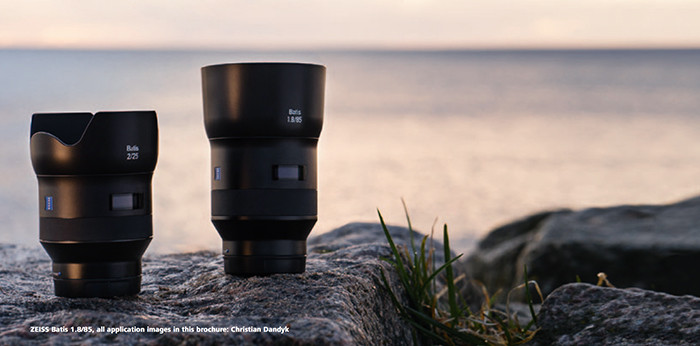
Zeiss just released the full technical specifications and leaflet of the new Batis lenses. Check it out here:
Batis Leaflet: zeiss.de/content/dam/Photography/new/pdf/brochures/batis/batis_leaflet_en.pdf
Batis 85mm Technical Specifications: zeiss.com/content/dam/Photography/new/pdf/en/downloadcenter/datasheets_batis/batis_1885.pdf
Batis 25mm Technical Specifications: zeiss.de/content/dam/Photography/new/pdf/en/downloadcenter/datasheets_batis/batis_225.pdf
There are also two new videos:
Michael Pollmann Batis introduction
Carl Zeiss Lenses – New Pro Era
Both Batis lenses are now available for preorder in USA and Europe (UK/Germany)
Zeiss Batis 85mm f/1.8 lens in US at Adorama, Bhphoto. In Eu at Amazon DE, WexUK. In Asia at Digitalrev.
Zeiss Batis 25mm f/2.0 lens at Adorama, Bhphoto. In EU at Amazon DE, WexUK. In Asia at Digitalrev.
In Europe and Asia the Loxias can be found in Stock via [shoplink 36456 ebay]eBay sellers (Click here)[/shoplink] and Digitalrev (Click here).
Found via Mirrorlessrumors.
31 Responses
I was about to say, “so much for the theory that the Batis 85/1.8 was designed by Tamron”, but it looks pretty much identical to the Tamron patent.
http://www.sonyalpharumors.com/did-tamron-design-the-zeiss-batis-85mm-lens/
Oh well, a good lens is a good lens, whoever designed it.
They have the same software anyway. Différences between zeiss and tamron deal with manufacturing, glass quality
neither ZEISS nor Tamron manufacture glasses — they buy it from independent suppliers.
yes but maybe with different specification and raw materials no?
The Pro in the “New Pro Era” video for sure does not know how to use an ND-Filter for the timelapse…
I guess Zeiss is not too proud of the distortion and vignetting performance – the supplied charts are with in-camera software correction enabled.
While not a deal-breaker, pincushion distortion of 3% on 85/1.8 means some resolution loss in center after fixing it in post.
On new A7R2, the vignetting is sure to be improved.
It’s 0.3% after correction applied (Zeiss learns bloody tricks).
Yes, but applying correction on pincushion distortion means stretching center of the frame, thus reducing resolution there. This is probably not reflected by the MTF chart, after the correction lens will be bit softer than MTF suggests.
Not a major issue, though – super high resolution sensor paired with sharp lens with good contrast should not lose too much with software correction for real life applications.
I agree. I was disappointed to see software correction in the optical spec sheet by big Z.
This marketing is so wrong. Like I’m ever going to listen to some company flogging its wares, dictating what my future is. F*ck off with your cheap shot brainwash material, do you think people are stupid?
The lenses look decent. How about shut up and let them speak for themselves.
ironically it seems you know less than nothing about marketing.
sell an idea and the lenses sell themselves.
..plus I thought it was kinda cool..
Such poorly constructed ideas are worth only as much as the buyer is gullible. They are laughable to anyone else. Only one of these half baked “ideas” are modern.
Any release dates yet? B&H still says Beginning of July 2015″
Distortion and illuminance data are given with the camera correction turned ON, so these are the software corrected results. No word on the MTF data though, I wonder if that’s with the autocorrection ON or OFF.
So, it seems that the 85mm Batis is based on a Tamron design… click image to see both designs overlaid. Just like Fuji and Olympus, Sony/Zeiss are outsourcing lens designs to third party manufacturers. Let’s just hope this lens is as good as the outsourced M.Zuiko 75/1.8.
well, it seems you are spot on!
I was first!! **stamps feet**
Admittedly I didn’t go to the effort of overlaying designs.
Pat on the head and a couple of gummy bears for your efforts
I have heard, that Sigma designed the Oly 75mm. (Same for lenses of the “big ones”)
I have heard, that the Zeiss Touits (for Fuji) are build by Fujinon.
But I have not heard about Fuji lenses being designed by someone else? (it’s not unreasonable since nearly everyone seems to do it)
Still: if you have any sources (or know what lenses), I’d be really interested in it!
Thanks 🙂
Why does Zeiss outsource the design to a Japanese company? Without knowing anything about the work involved in designing lenses, I’d think the one thing where Zeiss can compete with Asian manufacturers is expertese in designing the lenses.
Still no comment on fly-wire tactile feel.
Do these lenses accelerate manual focus?
Other fly-wire lenses I’ve owned (and sold) do.
Makes it impossible to pull focus for video, or use a focus rack.
Do these lenses react to slowest turn manual focus fine tuning?
Other fly-wire lenses I’ve owned (and sold) don’t. Slowest turning doesn’t do anything.
Makes it impossible to achieve critical close focus for eyeball sharpness on portraits.
I literally get sharper and more consistent results from my Samyangs, simply because their manual focus rings are precise and linear.
The fly-wire lenses are fine for AF. Not ready for precision manual focusing.
Whenever you’re ready Admin:
http://www.bhphotovideo.com/explora/photography/features/infographic-inventive-camera-designs-sony/bi/19115/kbid/10779
http://www.bhphotovideo.com/explora/photography/features/sonys-innovative-journey-camera-design-and-technology/bi/19115/kbid/10779
I hate manual focussing on my FE 35 2.8. I prefer the canon FD 35 2.8 for a 10th of the price.
Yeah, me too. It’s got the least tactile and most disconnected feel of any lens I’ve tried so far. Great lens otherwise though.
it’s answered in the first video with the german rep from Zeiss.
Not specifically. The most I could get out of the vague comment is that focus is accelerated depending upon how fast user turns dial. They didn’t address slowest focus turn being completely non reactive, as I’ve found with FE 55/1.8.
For info:
https://www.youtube.com/watch?feature=player_embedded&v=KBmJHGrxYh8
Matt Granger.
At 2:22 in the video you can see it does NOT respond to slowest focus turn.
BRAV) ZEISS !!!
Distortion graphs shown with camera corrections on. Enough said.