







Two of our readers got the chance to shortly test the new Sony A7rII:
Faymus Media tested the A7rII video mode and posted his impressions on SonyAlphaForum (Click here):
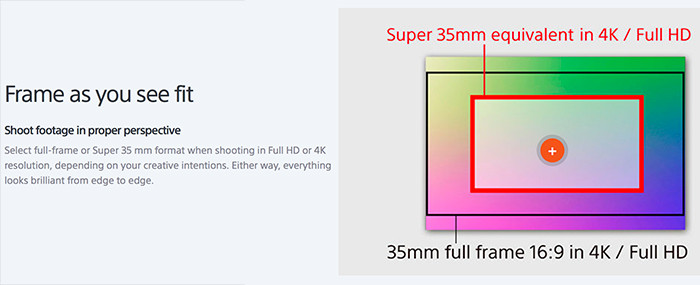
I used one today at the Adorama Fair. The S35 crop mode eliminates motion scew/rolling shutter. Tack sharp video, looks amazing. The native ISO for Slog-2 is 800 ISO. I punched the ISO to 12,800 and the lens to f/16. Looks clean. Has backlit sensor. Images are 14-bit RAW. I never had any issues pushing the images.
And one of our readers tested the A7rii with metabones and the [shoplink 37552 ebay]Canon ef 35 1.4L[/shoplink]:
I have to say that performance was really amazing!! it really seems like you’re using canon lens on its native camera
Terrific news! Sony is learning and improving…let’s hope they will sooner or later give us lossless RAW too 🙂
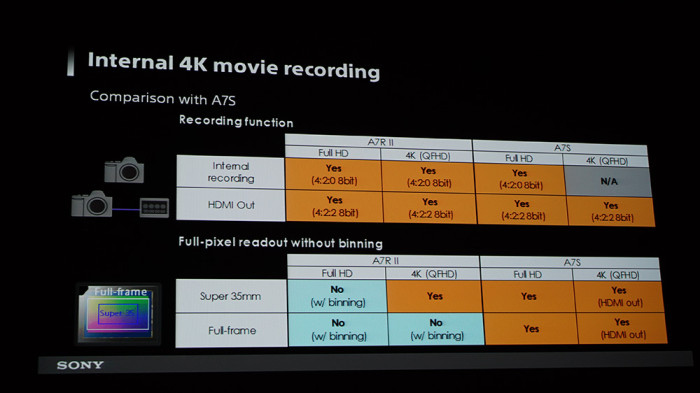
UPDATE: Slashcam posted that A7rIi vs A7s video mode comparison:
Store links:
In USA:
A7rII at Amazon, BHphoto, Adorama, Uniquephoto.
RX10m2 at Amazon, BHphoto, Adorama, Uniquephoto.
RX100m4 at Amazon, BHphoto, Adorama, Uniquephoto.
In Europe at:
A7rII at Sony DE, FR, IT, ES, NL, BE, CH, AT, SE, FI, NO, PT. Wex UK.
RX100m4 at DE, FR, IT, ES, NL, BE, CH, AT, SE, FI, NO, PT. Wex UK.
RX100m2 at DE, FR, IT, ES, NL, BE, CH, AT, SE, FI, NO, PT. Wex UK.
In Asia at:
A7rII at Digitalrev, CameraPro.
RX10m2 at Digitalrev, CameraPro.
RX100m4 at Digitalrev, CameraPro.
–
SAF post found via EosHD.
63 Responses
“it really seems like you’re using canon lens on its native camera”
But like the dual-pixel or PDAF?
Sounds too good to be true. Let’s wait until the emotions settle for reviews to be more objective.
It reminds me of everytime Fuji releases a new X something camera. Even if its the same 16mp, people shout out loud that it is THE BEST and SHARPEST most AMAZING IQ sensor EVER!!
Better keep our inner “Steve Huffs” in check for the time being.
Still though, Canon must be bricking it after the 5ds non-event…
Nah, the 5Ds had a big splash, alright? That’s solid. They will sell enough of them and a lot of people will keep buying Canon for years to come. Not everyone has the same needs and not everyone feels the form factor of mirrorless is for them.
What matters here is that Sony has a strong lineup, a solid focus and the know-how to deliver. What we are missing is still a bit more of a pro-focus. the Sony PRO program is a good step in that direction, which somewhat reassembles the CPN and NPS of Canikon. Lossless compression of RAW files would be great as well as the maturity of the lens line and the ability to, little by little, incorporate XQD cards into their cameras (maybe dual card slot SD-XQD) to allow for better 4K codecs in the future that would maybe need faster readouts than what SD could offer.
Who knows, maybe SD will be still great down the line and XQD will be the Betamax. USB still dominates and that DispPort/Thunderbolt idea never took off as well as USB3 for a standard.
For the slide, I think sony made some mistakes.
I.E. A7s has no way to output 4K under super35 format, not enough pixels on sensor on super35 mode
This i want to see because even though one might not buy Canon lenses it’s good for the brand and what’s good for the brain is good for all E-mount users.
What is it about the 7r II which gives the excellent Canon EF performance and AF performance on the EA3 adapter?
The normal A7 has on-sensor PDAF also shouldn’t it be similar?
I will make an informed guess that the much higher read rate of the A7R II allows for far more PDAF points to be read, far faster than before. It has to be remembered that, during normal framing, the sensor on a mirrorless is working quite hard. The sensor has to be read continually (on a sub-sampled basis of course) in order to keep the EVF refreshed fast enough. This will get worse with higher resolution EVFs of course. This activity will compete with the requirement to read all those AF pixels as well. What I hadn’t appreciated about BSI sensors is that it would be possible to add more circuitry (and thicker interconnects) without having an adverse impact on light collecting potential. It looks very much as if this has opened some technical doors.
Combine that with faster processors and it has the potential to improve AF performance. Of course, quite apart from the sensor improvement, then there are bound to have been improvements in algorithms and processing. Just ordinary development. It will be interesting to see some side-by-side comparisons of AF lenses with their native mounts.
Sensor readout speed has little relevance because single AF point is small anyway. It’s pixel angular response what matters the most.
They made SOME sort of improvement in on-sensor PDAF with the A7RII that improved capability with the EA1/EA3. PDAF is disabled with EA1/EA3 on all older bodies, it’s CDAF only. The Metabones adapter is pretty much the functional equivalent of an EA1/EA3 so it just happens to get the same benefit. Even the A6000’s really great OSPDAF is only for E-mount lenses and won’t work with EA1/EA3.
As SteveGJ said, it could be one of the benefits of moving to BSI in that they were able to make the AF sites even fancier.
If AF for Canon lenses pan out then there’s the tantalising prospect of using some very affordable and great lenses on the A7RII:
1. The canon 35mm f/2 IS USM is a great lens which fills the obvious gap that exists in the Sony line up. They have a great f/1.4 that’s too big and too expensive for me[ after spending all that money on an A7RII, i.e. !], or else there’s the great f/2.8 which is just one stop too slow, followed by the Loxia f/2 which has a bokeh I don’t like and manual focus, followed by the Zeiss Distagon M f/1.4 which is the best but only manual focus. Hence the Canon fills the spot.
2. There’s the greatly improved canon 50mm f/1.8 STM which is sharp and has great bokeh and flare resistance – all for the lowly price of $125.
3. There’s the prospect of using the excellent Canon 85mm f/1.2 if one really wants to stretch the budget. But of course the Batis would do just fine.
4. Canon 135mm f/2. Now STABILIZED!!!!!! and very, very affordable for what it represents.
There might just be a spike in the sales of Canon lenses! ….all depending on whether that AF is as good as people make it out. I suspect the normal weakness will still be present – AF lock on speed at low light levels.
5. An alternative to the 90mm macro is the canon 100mm IS macro lens.
The Sony Distagon 35 1.4 is AF, not only manual focus.
He was referring to the Zeiss Distagon M, which is manual. He already mentioned the Distagon ZA 1.4 at the beginning of his list, which is the one you’re referring to.
I’d change your Canon 135 for the ZA 135.
Yes, we need a Zeiss 35m f2 AF but I suspect it would be Zeiss Batis coming up and not Sony/Zeiss.
for ZA 135 you have to go back to LA-EA4 so you are back to killing-light mirror and limiting AF of LA-EA4 (LA-EA3 won’t focus ZA135 due to lack of screw driver in LA-EA3). Canon 135L actually can use all of 399 PDAF system of A7R2 with no mirror in between
Tamron 150-600 in CANON mount – because for A-mount, VC is removed!
I would add that many will be able to more easily rent lenses that are either too expensive to purchase or too rarely used to warrant owning them. Just buy a good adapter and the Canon catalog of often rented lenses are at the ready.
I totally agree with you.
800 ISO for SLog-2… booya! I can’t wait to pair this baby with the new 28-135 F4 and potentially eliminate NDs from some day shoots.
Good question!
This is just speculation but Sony often sets SLOG at the “base ISO” of whatever camera its in. For FS700, and FS7 its 2,000 ISO for the A7s its 3,200.
If SLOG on the A7r-II at 800 ISO, can we assume that is its native or base ISO?
All I want to know is- will we see the same phase detection AF on the A7SII or A7III- how long do we have to wait! It should have been on the A7II.
The mirror is GONE no more slt, probably no more A mount….probably on all future E mount we will see this kind of af
Also on the new Nikon mirrorless ff. F mount camera to be anounced near the end of this year…..
Thos camera has high iso so I am guessing we will see an A9 of higher resolution that this camera before a A7Sii
YES. I passed on the A7II because it was the same sensor. While it is impressive they managed the improvements that they did I’d really like to see some trickle down to the A7/24mp sensor (that is if I don’t buy the A7R2 before then)
What is max record time?
30m as usual, unless you use the clean hdmi out. Then ofc there isn’t one.
Well dpreview say it’s when in normal OVF mode, so that’s PDAF, right?
“Images are 14-bit RAW. I never had any issues pushing the images.”
Really?
It’s not about pushing. 11+7 bit doesn’t mean you can’t do anything to the images. The lossy compression shows when you really push/pull stuff and most of the times it appears as artifacts, not as the inability to do anything with the file like a jpeg.
I don’t really know anything about this compression stuff (only the things i read on sar) But people say this camera only got 11+7, and this guy said 14 bit…
And from other peoples complaints the problem with 11+7 seems to be some problems only appearing when trying to push the exposure in post.
In Sony marketing literature, all cameras that shoot raw shot 14 bit. That may, or may not be true. You need rawdigger to know how lossless or lossy the compression is.
In essence, lossy compression (like Sony’s) can create artifacts in certain circumstances and sometimes you may have some banding, or dithering, because Sony’s idea to keep every megapixel to a 1mb contraint can deter colourful gradients from showing flexbility in post (say, darken, brighten or hue changes) THAT is what people complain about.
The files are still malleable, but not as much as Canon or Nikon or Olympus. Let’s say Sony gets you 90% there but 99.9% of Sony customers will never notice and thats the embarrassment of the company that wants to appeal to professionals.
Ok, but the guy still said 14-bit raw. So is it 14-bit or is it 11+7?
No one knows until someone puts those files through rawdigger or any other program that can tell us accurately whether that is true or not. We just need to wait and see. 11+7 has been a fact since the NEX 7/ 5n generation of cameras.
The fact that you say it needs a computer program to tell the difference sums it up to me.
That may sound simplistic, but the reality of it is that I encountered it myself. Some gradients don’t do as well as my previous 5D2 files, albeit the shadows are a big improvement and banding is a non issue as a noise created problem. However, some posterisation can happen, and it has happened to me.
As I said before, the vast majority will not notice because it all depends on how you work with your files.
Although let’s not forget (if you start dragging other companies into this debate) that banding in shadows and high ISOs will limit malleability in many more situations than Sony’s lossy RAW compression. The exception might be Nikons, but only because they use Sony sensors without Sony’s compression scheme.
I strongly suggest that you take a look at the very few examples of this “issue”; you will get a very clear idea of whether this matters to you. I personally find it ridiculous, although I do agree that Sony could easily provide lossless on principle.
I don’t think it’s learning and improving. it’s on their plan, you can see their path, from OVF to SLT evf, to eliminate the OVF, to design a mature ospdaf system, from APSC e mount to FF, from RX1 to A7. they are all well planned
a7s has the best 135 FF full pixel readout 4K output, that’s why it has 12mp. what’s your point it has to be super35 mode?
the a7r2 has more pixel, it will have full pixel read out on super35, but in the other hand it’s FF 4K have binning.
the a7s still the only best one does FF 4K in the market
I mean in this slide, sony “claims” that a7s has 4k in super 35 mode, that’s not possible
That’s true, but with the much higher read rate that appears to have been enabled with the introduction of a BSI sensor, it is possible to conceive of a high sensitivity, somewhat higher MP count A7S replacement which uses over-sampling techniques and can still run S35 on a 1:1 basis. Such a sensor would (at 24 x 36mm) have about 24MP.
So an over-sampling 24MP A7S II with 1:1 at S35 seems possible albeit I don’t think it could ever fully match the A7S low light performance. It would also offer 1:1 S35 video (but, obviously, this wouldn’t match the A7S FF performance).
Such a camera ought to have reduced rolling-shutter artifacts. It’s all about sensor read-speed.
I dunno… It doesn’t seem too far fetched to expect two stops better improvement over the A7R2 by applying the A7R2 tech to a sensor with much larger photo sites. That would put the 24mp sensor as equal to the A7S. It doesn’t seem outside the realm of possibility.
Any real-world a-mount Sony lens AF speed tests with mirrorless SONY LA-EA3 adapter?
Great!
Now for the A7s 2, get rid of rolling shutter in FF mode too!
I can’t see any real compelling reason to shoot A mount if you’re not an A mount user already. This camera signals a very promising future for lens adapting. Just imagine where it will be at in a few years. You would specifically want the native mount in order to pass over this and for no other reason. Sony perhaps has the most modular system in a shrinking market which is a safe zone for those wanting to try all this new tech and not abandon their system up front.
It wasn’t until now that FE is starting to look like a real solution over A mount. I still hope for an A99II, but this camera is already beyond what I demand- so…what’s the point really?
Pretty much how I feel as well. Though I’ve not gotten into debates about the future of A-mount up until now, the release of this tech makes me wonder “what’s the point” too. I now have just 1 screw-drive glass left (the 135mm) and honestly I don’t care anymore about A99ii update. If it happens, I’ll be in the market for it, but I won’t loose any sleep if it doesn’t.
On a side note, just think of the economics of fully embracing the E-mount system:
After all… by the time I buy just A7Rii, Batis 85/25 and macro 90 …a nice sum of about $6.5K will depart from my account. Beyond that, I’m prepared to shell out another $3K for A7Sii. That’s about $10K in the matter of about 6 months by the time I get a few accessories for these.
That is not even counting the A7ii, 35mm 1.4, 55mm, 70-200 F4, 28-135 F4 that I’ve started with over the past 6 months… about $8K.
So, folks, for those of you thinking about adopting this as a full-fledged system, prepare to shell out about $20K for a full set of FE glass and 3 bodies.
That’s a lot of cash. I’m simply looking to continue adapting my lenses but with better integration. I’m sure at some point I’ll sell of what I have for native lenses. Just waiting on that 135mm Batis.
If the A-mount SSM lens compatibility on A7rII is as good as they boast, I would actually prefer them NOT release A99ii even though I have bunch of G and Zeiss glass. They should instead focus on A9, adding everything that’s missing in A7 – ergonomics, large battery, dual cards, dual/faster processor for more speed, higher resolution EVF, faster interfaces (USB3, SD UHS-II), more controls.
Some of the new FE lenses are too tempting and I would prefer running single system. While giving A99ii now would make many existing A-mount users happy, it would also continue the fragmentation of their system.
100% agree and in a long run this is inevitable. It simply makes no sense to run 2 systems side by side… not for the manufacturer nor for the consumer. Question is, and this is the key to Sony’s strategy, is how quickly do you converge A and E mount. With the A7Rii it’s coming quicker than I personally expected. Exciting times ahead.
One might speculate that A7Rii and the rumored A7xxx is the part of that convergence strategy. In that case we might see the A9 (or perhaps several siblings with different sensors) in the autumn, instead of the rumored A99ii in September.
There will not be an A99ii
I still think they’ll release it. One more go around. Maybe internal 4k and 50MP- but who cares. Once you can say that to yourself than everything else becomes a moot point. No one is going to give up a modular platform for 8 more MP’s or for that matter even slightly higher performance (at what I’m sure will be a higher cost as well).
My initial complaints- poor mount (fixed)…to small body (mostly fixed)…poor adapters (better performance with those adapters and more on the way). So basically, adapting doesn’t seem like such a big deal now. More importantly, the future looks incredibly promising. We’re only seeing the surface of what’s in store in terms of adaptation. Better integration and higher performance- only a matter of time. It’s to cost prohibitive at the moment for me and I’m getting great results straddling the fence between the two mounts. So basically, I’ll sit on the sidelines and see how this pans out. Still.
I think we all know how this is going to end- just many of us didn’t want to admit it till now. It wasn’t compelling enough. Well, it certainly is now.
If, and it is unlikely, they ever build another A mount camera , they will build an A9 with higher mp than the a7rii, and simply put an A mount on it and call it the a99ii.
They will not invest time or resources into it.
Sony has pacified the A mounters and will now go after Canon market share.
Canon and Nikon will have to go mirrorless, and when they do Sony will suddenly be right up there on top with them.
The lens compatability will…as I have continually said it will….put Sony camera sales on the map…of course a little Sony marketing would not hurt either.
Adapters will remain 3rd party, for now, to avoid legal complications.
A source finally managed to gather some info about the next A-mount camera. He told me that:
–
A99II was planed to be released along with the A7II back in November.
But Sony decided to work on a more advanced version of the camera.
Level SR3 from Sony alpha rumors.
http://www.sonyalpharumors.com/sr3-finally-some-a99-
A99 successor-rumor-coming-mid-september-and-has-4k-recording/
– The A99II is now scheduled to be announced in mid-September
– It has internal 4K recording and new sensor
– It will be launched along a new 24-105mm f/4.0 lens and a new Zeiss 85mm f/1.4 SSM.
– Still not sure if also the 135mm f/1.8 SSM will be announced among the A99II
PS Sony 24-70mm f/2.8 ZA SSM II pre-order is also another indicator of Alpha’s future
I heard tjat rumor too…and I think it is a false rumor
I guess we will find out in September
Good points but Sony needs to come out with an updated LAEA3 adapter that includes a screw drive. Right now that’s only available on the LAEA4 (if I’m not mistaken).
We also need to know what the minimum light level is for PDAF focusing (and for native lenses) but so far it looks very promising.
If this thing will focus at EV -2, I may have to sell a child in order to pick one up on release instead of waiting until next year.
Finaly we can use the lense we want!
When will they release a RAW file to look at? Why no pro reviewers yet? Sony didn’t give one to any top reviewers?I’d love to hear the shutter noise.
Yeah. The way it works is that within a 2×8 pixel block (I think it’s 2×8, I’d have to look through the darktable source code again to be sure…), there’s an 11-bit “max” and an 11-bit “min”. There’s then 7 bits for each pixel to determine where in the range between “max” and “min” you are.
So if you ARE going to see an artifact, it will be brightness quantization (potential banding) within a 2×8 block IF that 2×8 block has greater than 7 bits of dynamic range within it.
Not sure if that’s a 2×8 block of pixels for a single color, or if it’s shared between colors in the Bayer filter. It would be bad if it’s shared between multiple colors in areas that are highly saturated.
It is upscaled. So about the same as the $100K Arri Amira that now claims 4K.
Agreed. As I say below, most will not see it. For most it won’t be a problem. But I can’t move pixels in journalism and I have found artifacts. My solution is to go around it by darkening those areas because they can show when you want to bring shadows up. No, it doesn’t happen 100% of the time, because not all photographs are equal, but when it happens and it happens to a shot I like, it’s disappointing and frustrating.
I am not the sort of guy that makes noise and complains about a multitude of shortcomings or other strategies and call Sony cheap on whatever, but this one particular thing has struck me more than once. I do love the damn thing (RX1 and previous NEX 7) so much that I am willing to sail this ship but I do not see why they cannot offer a lossless option. I simply can’t.
Maybe it’s because the buffer numbers won’t look as good. Or the processing times will take longer. Maybe it’s because you won’t get as many shots per burst… but for goodness sake, an option is not the end of the marketing campaign. They could just bloat the file size out of proportion and then put an asterisk to every spec number they have related to speed and say that such performance numbers can only be attained by Sony’s ULTRA RAW FILE or some thing like that.
BTW what is the fps for still using only APS-C area? If it has 4k, it should be somewhere near 25…