







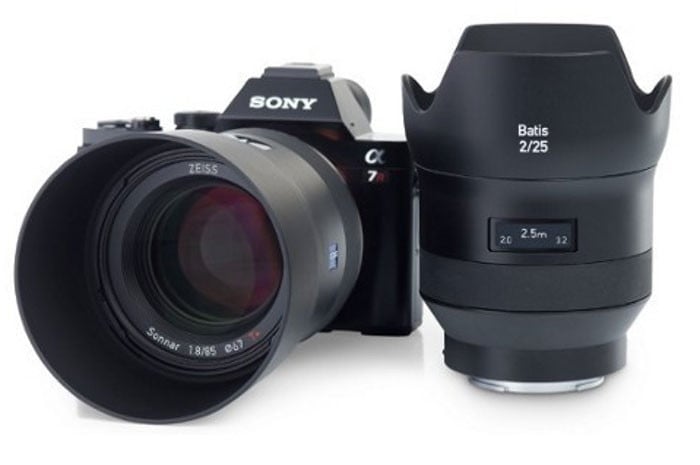
On Facebook Zeiss answered many questions from their followers:
1) Yes, the Batis 1.8/85 has optical image stabilization
2) The displays are not limited in their lifetime. After many years of intensive use, they will become darker. If sometime they might be difficult to read, they can be easily exchanged by our ZEISS service.
3) Batis lenses use different components than Sony or Sony/ZEISS lenses.
4) Our Batis lenses are primarily made of high-quality plastics, aluminum and optical glass.
5) ZEISS Batis lenses are made in Japan.
6) MTF charts will be available in June.
Both lenses are now available for preorder at BH and Adorama:
Zeiss Batis 85mm f/1.8 lens in US at Adorama, Bhphoto. In Eu at WexUK. In Asia at Digitalrev.
Zeiss Batis 25mm f/2.0 lens at Adorama, Bhphoto. In EU at WexUK. In Asia at Digitalrev.
Lens shade for 85mm at Adorama, Bhphoto.
Lens shade for 25mm at Adorama, Bhphoto.
107 Responses
This sentence is marketing speech:
The displays are not limited in their lifetime. After many years of intensive use, they will become darker. If sometime they might be difficult to read, they can be easily exchanged by our ZEISS service.
… basically says nothing. It can be applied to almost anything produced.
Translation: “It lasts until it’s broken. When it’s broken we will replace it… for money.”
If we still make it…
Well said!
awesome ! can’t wait for FE Z50-150/4 🙂
OMG why not revive the 40-120/2.8! 😉
This struck me from the beginning as a Sony manufactured lens, and the evidence is mounting. Putting an oled on a prime lens, and only using as a distance scale is a Sony style thing to do.
Eh? There nothing at all to suggest this is Sony manufactured. It isn’t anymore Sony than the Otus, Touit and Loxia ranges.
What else would you like on the display? Footie results?
Is Zeiss’ manufacturing in Japan now? Are the Otus, Touit, or Loxia focus by wire? Why not have f-number, or have different scale modes, or different resistance modes on the focus ring? If you’ve got focus by wire, it’s only a little more work to set the lens up to be used with a rig. For that matter, the lens could have a port for a proper servo controller, like a video lens. You’d then have different modes displayed on the lens for photo/video mode. Like I said, it’s very much a Sony trait to have technology that opens different possibilities, only to leave it impossible by bonehead design choices.
the zeiss zm lenses are mostly made in japan by cosina, so its likely either there or in a sony facility that itll be built
the oled may give more easily understandable info than the old numbers painted on system…. but numbers painted on tends not to break….
What? I think engraved scales are much easier to read.
Zeiss has been manufacturing in Japan since the Contax days at least, so as Leica. Even Otus is made in japan. Just that you know 😉
Also Touit was focus by wire. it probably simplifies the structure and allow it to be smaller, just my guess.
I agree mechanical focus is better though.
I didn’t know that Zeiss manufactured in Japan.
The cost of manufacturing in JP was much lower back in the days(80/90s?) compared to germany, now not so much difference but they dont bother moving the whole factory back.
Nikon makes really good lenses even in thailand and china, dont see the problem in japan as long as they keep the quality control.
The costs were and are lower in Japan than in Germany because the manufacturing contractors for cameras and optical devices in Japan have the scale that got lost in Germany when Japan out-innovated German camera companies in the seventies and eighties. For other sectors and goods this is not necessarily the case.
The Zeiss ZF/ZE lenses are manufactured by Cosina in Japan, as did most Contax SLR lenses towards the end of Contax SLRs. Same or almost the same applies to ZM lenses. Loxia lenses probably are also manufactured by Cosina. I am not sure about the Otus lenses but it would not be surprising that they also manufactured by Cosina.
I am pretty sure the Touit are not manufactured in Germany, it’s highly likely the Batis lenses are manufactured where the Touit lenses are.
But I am not aware of Leica lenses being manufactured in Japan (apart from a handful of R zoom lenses that were based on Sigma lenses). The rebadged Panasonic cameras might (or rather they are manufactured wherever Panasonic manufactures theirs). The X series is rumoured to get a substantial assembly job in Asia with only the final assembly being in Germany. And Leica M cameras are partly assembled in a Leica factory in Portugal. I however have not seen any solid information where the T camera and lenses are manufactured (but I would guess they follow the X series).
Thanks for the info.
For the leica bit I remember they moved to japan when they have financial problems back in the 70s? dont have a reference on that though you are probably right.
Leica (or Leitz which I think it was still called then) did open a manufacturing plant in Canada around that time. But there was also a cooperation with Minolta, the R3 and R4 contained quite a lot of input from Minolta. And the plant in Portugal was also opened in the 70s.
And there are all those Zeiss lenses manufactured in Germany by non-German immigrants (who’ll work for lower wages) but supervised by a German technician………and it go’s around and around the more you think about it all. None of it makes a jot of difference as long as you get a good copy!
I think the German version gets Schott glass, of course they say they’re all within tolerances but I still think the glass is slightly different.
Yes, I remember these discussions back in the 1980’s when it turned out some of the best primes available where made by Olympus, I think, back them, Olympus where one of the few optics manufactures that made their own glass too. Interesting topic.
I think the country is less interesting than which lenses are manufactured by the same subcontractor or plant. In that sense, saying a given Zeiss lens is manufactured in Japan can be a synonym to saying it is manufactured by Cosina (and not a Zeiss-owned factory).
I often think about cars when this topic comes up, a US manufactured Accord is just as good as one from say the UK. Yet in general, US cars in the Accord’s class aren’t as good. Adult supervision plays a lot into the equation I think!
Many old R lenses were said to be Minolta rebrands, they’re significantly cheaper than the real Leica Rs, just go look for R lenses on eBay or something and everything below the $500 mark should be Minolta/Sigma, except for maybe a few really really old designs, like generation 1 R50/2 or something.
No back in the Contax days you still had a certain fraction of the lenses made in Germany, they fetch a higher price on the market these days. Right now we still have the very last consumer grade lens actually made in Germany by Zeiss, the ZM 15/2.8. I hope I’ll be able to afford one before they cease production on that too.
They later changed most of the AEG lenses to MMJ which is made in japan. Just see how rare contax MMG lenses are… but yes some of them were still made in germany.
To be fair, they make no difference on quality, just depends on how much you like the ‘made in germany’ engraving
You could display depth of field. You could make the control dial adjust aperture, or make the display a touch screen.
It does display DOF.
Obviously, it shows DoF. They designed it to offer what an analog DoF scale does.
That said, I find it a lot less readable. At least on a product photo it doesn’t look as nice as a good mechanical one.
http://cdn.mos.techradar.com/art/camera_lenses/Zeiss/Batis/Zeiss-batis-hero-970-80.jpg
I don’t think this will be a huge problem if it will work like analog ones (distance scale will move). That would be quite nice.
But if it’s going to calculate DoF and show 3 numbers in the same exact positions… not so good.
Zeiss lenses are manufactured by Cosina in Japan, it’s not a Sony manufactured lens.
Not interested because of the OLED. Sorry, get it off the lens because it doesn’t need to be there. You can’t have that info just read out to the back or future top deck LCD? Plus, now that I know they are plastic- that explains the pricing.
Well the A7 shows distance information on the display in MF mode, but not DOF info.
Even if the Zeiss supports that function, the DOF info would be missing, so it is useful as it stands.
DOF information is a function of focus distance, focal length and aperture. Since all of that is available to the camera already, even with existing lenses, only thing preventing it from being shown in camera is the camera firmware.
Obviously, but the fact is it isn’t at the moment. Even if it will in the future, there is no harm it being on the lens.
Main harm from it being on lens is that it adds cost and increases chance to fail. I do not mind either, because status OLED display is probably a lot less prone to failure than aperture or focus control mechatroncis.
Only scenario I can think of, where info on lens barrel would be really useful (compared to EVF or LCD) would be waist level shooting using zone focusing, but that would not be an issue with flip/tilt LCD either. For landscapes, I would prefer distance/DoF info in viewfinder or rear LCD, not the lens barrel…
OLED is reliable today, I don’t think there’s a plausible chance of it failing on the lens, only loose brightness over time. Plus the cost of OLED displays today is negligible. I feel it’s nice to have an extra tool photographers can use.
It’s also a function of the pixel pitch of the camera sensor (circles of confusion) which the Batis lenses will have no idea about.
So to get accurate data you will need information from both the camera as well as the lens.
In my opinion, the best place to have this info is in the camera, with the lens providing input as well.
DoF is a “property” of an optical system.
What you’re thinking about is called “circle of confusion” and is an arbitrary parameter. It is defined using sensor size, not pixel size.
Circles of Confusion are certainly not not ‘arbitrary’. Also they have absolutely nothing to do with sensor size and everything to do with sensel size (pixel pitch). The CoC for the NEX 6 (16MP) is roughly the same as that for the A7r (36MP).
DoF is also a function of your intended print size which is where CoC values become important. If you’ve used a decent DoF calculator you will have seen this. You may want to read http://diglloyd.com/blog/2012/20120522_2-depth-of-field.html and http://www.photozone.de/depth-of-field
Have you read the texts behind these links?
In the photozone article a word “pixel” does not occur. They do, however, propose a few CoC based on how photos will be used.
Are you aware that the idea of DoF and CoC is quite a bit older than digital sensors?
And that, again, no sensor or film is needed? You can project the image from the lens on a wall and it will also have some DoF. No pixels or film grain exists. It is all about light.
CoC is a parameter related to how you look at the image.
So if we assume that whatever sensor size we use, we’re trying to create a similar composition and will view the photo in similar manner (same print size, same LCD), the CoC scales with sensor size.
What you’re confusing it with is called Airy disk (i.e. diffraction limit). So you confuse sharpness with DoF.
Are you suggesting that DoF has nothing to do with sharpness or lack thereof due to focus (note no mention of diffraction)?
The way I see it (which may be wrong, but you have failed to demonstrate why yet), the DoF is the range of distances between which the sharpness of the captured image is acceptable.
So if I wanted 20MP of sharp pixels across my frame, my choices of aperture based on subject distances may well be different to what I would use for 80MP (at the same FoV). This is assuming that I want to print/view the both images at the same DPI (which will affect viewing size due to differences in MP).
Diffraction limits only come into play when the apertures get smaller and smaller but what I say above doesn’t require small apertures to be useful. Consider, for example, wanting to keep the entirety of a person’s face in focus. I need to stop down my 36MP A7r more that I used to stop down my 21MP 5D2 if I wanted to print both images at the same DPI.
Just put a small piece of black electrical tape over the display if it really bothers you, problem solved.
A piece of tape on my lens would be a much more serious problem.
What happened to oss degrading the optical performance of primes (or whatever excuse Zeiss used to trot out)?
Technology happened I guess. The tiny bits needed (gyros, processors, magnetic drives) have been evolving at a quite fast pace the recent years.
Notice you don’t find optical stabilization on the Otus lenses, because it does slightly degrade performance.
It’s ever so slight, though, and doesn’t trouble the Canon/Nikon 300mm f/2.8, 400mm f/2.8, 600mm f/4 etc.
The Otus lenses are simply aimed at a different market who will most likely use them with a tripod in low light, Batis are more suited toward traveling light.
Fortunately that was marketing BS made up to explain why they didn’t make IS lenses. Yes there is a small impact from the extra elements required, and there can be problems with bokeh if the actual IS group is moving, but it’s very minor. Certainly owners of the Canon 200mm f/2.0L IS aren’t complaining of poor image quality…
When he said “high quality plastics”, can I assume the 25mm will rely on software distortion correction? Is this what is going to differentiate between Loxia line & Baltis line besides AF?
“unlimited OLED?” yeah… that’s not how OLED works.
Depending where you read, OLED seems to have a lifetime of anywhere between 10,000 and 50,000+ hours.
Even if you assume the worst case, that is over one year of continuous usage (24 hours a day, 7 days a week).
If the average photographer used one of these lenses continuously for 1 hour a day, everyday, it would last over 27 years.
I’m betting this issue will actually be a non-issue for the vast majority of owners.
Not sure that lifetime isnt meant to be purely as lifetime (without being used). As far as I know any OLED tech degrades over time.. old AMOLEDs from Samsung are sometimes near useless today.
AMOLEDs are a different tech. OLEDs are rated for 10,000 45,000+ hours of actual use.
Different than what? It’s the basic type of OLED display. As far as I know there are two main types of OLEDs and these lenses most likely have AMOLEDs. I agree about old Samsung displays, but when we talk about smartphones in this case (and I think we do), these things are exposed to some heavy usage so it’s not that surpising.
LOL, I sound like a typical expert-wannabe.
Energy usage is the primary responsibility of the active matrix OLED TFT. These screens are extremely effective in battery operated devices such as smart phones due to their energy saving characteristics. AMOLEDs are for higher voltage appliances such as TVs and Monitors. While they do use similar filters and screens, the ‘tech’ behind them is much different and OLEDs are, by their nature, a longer lifetime product as the result. I would think it would be about 50+ years before giving out on their own. Product/circuit board failure is another story however.
Doesn’t AMOLED stand for Active Matrix OLED? 😉
The difference is absolutely huge. You’re comparing a colour display to a black/white display. Certain OLED colours like blue is known to wear out fast, but that type of concern is irrelevant here.
Secondly you ignore that these display is 95% black. This means the display is 95% turned off. OLED dispays the deepest black by shutting down the pixel.
This factor will minimise the wear and tear on the display even further, since most of the pixels are turned off even while the lens in powered on, and the only time the pixels are turned on is when they need to shift to white.
You are correct. OLED was created for long lasting LED performance. And yes those figures are based on actual USE or ON time. Not sitting in a drawer somewhere.
Can’t wait to work with the new 85/1.8. The ZA 85/1.4 is great, but quite unbalanced on the A7r with the adapter.
Sorry, what has “High quality plastic” to do with distortion correction. AFAIK this means that the lens outer case is (covered with) plastic, nothing more. (almost) every lens can bennefit from some correction in software.
I interpret it as some sort of hybrid plastic material, that is found very commonly in lenses these days.
Can only confirm when 1st report is out. I hope it’s not like the Sony 28mm F2
The only negative aspect about OLED is, if it can be read in bright sunlight.
The good: you can read it in dark environments.
Alternative would be eInk, but here you have the problem with its slow refreshing time.
In general I think, OLED is the better choice right now.
Maybe in a few years, Focal-Distance and DoF is part of standard camera displays, so you can see it through EVF and it does not matter if the OLED on the lens is too dark or even broken.
You’re mistaken, those large pixel black and white displays have been organic for a long time, there’s no problem reading them in bright sunlight.
Oh – I thought it is similar as my smartphone, that it is a matrix of shining pixels.
the “slow” refresh time of the E ink is still faster than what you would think you require it to be in this situation anyway, especially on such a small display 😛
I think I require about between 30 and 50 refreshed per second.
Everything slower does not give me the feeling of having a direct connection to the focus ring of the lens.
How did you know how fast I need it?
jesus, are you the flash? how fast do you think you will be focusing?
realistically the DoF display will probably only update 2-3 times per second tops (or during steps while AF focusing is working), and it gives so little information that I think that there wouldn’t be a need for 30fps
I want to have 10 m distance, and I turn until I see 10.
Try this with a refresh rate of 2-3 fps – hahaha!
I don’t buy a 1000 bucks lens and having a disadvantage to an old analog distance-scale. If you want to have it, … well, clever german product designers prevent you from buying stupid things by not constucting them.
I hope people will drop that stupid habit to shoot everything via eye level viewfinder. Just, lenses that really need distance scale markings (widish ones) should not be used at eye level.
I don’t like how they are holding back on MTFs. Wouldn’t we expect those upfront. Afterall, it’s the only indication of a lens’s quality before anyone can get their hands on it. Even then it’s a sometimes poor one.
yes the lenses are made of plastic, not glass. LOL
Perhaps Zeiss need to test many production copies to eliminate sample variations?
However the variation hope it’s better than Sony’s.
Can someone explain the need for AF on the 25mm? With a good distance scale etc it seems a bit redundant.
Redundant from the point of view of who? Hipsters? 😀
This might be a shocking information for you. People use AF with all focal lengths. Why wouldn’t they?
Don’t care much for hipsters or any other people needing to belong to certain specific groups in society (yes, this includes some photgraphers as well). 🙂
And of course people AF with all focal lengths but one might think that a 25mm would resonate more with people shooting landscapes, urban landscapes and architecture. That crowd would probably care more for robustness and an AF-motor is just another component that can fail.
How many in the P&S crowd will buy a 25mm rather then buying the 16-35, 16-70 etc?
I want to shoot wide street scenes. I’d like to use the flexible AF point to focus on people instead of backgrounds or foregrounds.
Street scenes shoot with MF, with distance scale.
I guess I am jealous of photographers who are walking tape measures, I have a Voigtlander Nokton 35/1.2 and I slightly miss focus from f/1.2 to f/2.8 when shooting street scenes at night (e.g., under a street light). If I have time to magnify and tweak focus then great. If not, it’s hit or miss even with focus peaking. I’d prefer DMF and fall back on simple AF when I don’t have time to tweak.
Or, use a flexible AFpoint. Your way isn’t the only way, nor is it the best.
Why exactly can’t AF be used in serious landscape or architecture photography?
Moreover, 25mm on the APS-C becomes a wide standard and usefulness of AF in such lens is rather obvious.
while this lens would resonate more with landscape, urban and architectural photographers, it is not limited to those groups. If zeiss put out more MF lenses, they risk having a reduced market size, and thus less sales, and less profit (unless they raise the prices)
for people who prefer MF for landscape and architectural, they can switch the lens in MF mode and use the (in my personal opinion: horrible) focus by wire system. If they do want this they can just buy the Zeiss 25mm f2.8 because, lets face it, if we’re stereotyping lenses and users, they are not really going to be needing the 1 stop difference because stereotypically they are going to using the lens on a tripod and shooting at f8 or f16 anyway….
having the lens be f2.0 and AF for not much increase in price compared to the MF ZM 25mm f2.8 means that this lens has much more options for people….
“one might think that a 25mm would resonate more with people shooting landscapes, urban landscapes and architecture.”
Well, there’s the answer to your question. Stop defining focal lengths by usage.
why not? sometime my left hand isn’t available and I need to take a picture with one hand.
And that type of shots is something you would mount a 25mm lens to do? I really don’t see that.
focus specifically on dancer 10 ft away at night at f/2.0 and not the crowd 3 ft away from me.
I have a 28 mm f/2 (on FF), this guy really needs to be focussed accurately wide-open at close distances (and then creates a nice bokeh). A 25 mm f/2 is not dramatically different.
I think I’ve come around to the reasoning behind this. With focus by wire, it’s either this, or no scale at all. I do think it could be taken further, and actually enhance the lens functionally, but we’ll see where this goes.
potentially we could have a on-screen focus scale with a firmware update like fuji (?) have on their cameras
They already have on screen focus scale. Don’t get my started on ‘Fuji style updates’.
but not DoF scales is what i was thinking of? I don’t know what the new Sony E mounts is like, as I have a RX series camera
A huge weakness of the fly-by-wire system can be solved by copying Ricoh and introducing snap focus.
And “aluminum” refers to what, in this context?
Aluminum lenses, of course
Remember, the focusing ring is plastic on Zeiss lenses. It doesnt have anything to do with corrections, of course.
Maybe because they aren’t production ready and that is why they aren’t shipping for a couple of months? No one of forcing you to pre order.
Looks like these are Fuji designed lenses, like loxias.
Yes, just like the Loxias, which are Zeiss modified versions of older Zeiss designs.
I assume you call yourself LOL as a form of irony.
What does the oled do? I don’t get it
stabilization is for both of them or just the 85mm?
Just the 85mm.
thx, could be good also on 25mm to stuck to 100iso so that we could keep the dynamic…
Just reports your f number, focus, and (I think) hyperfocal distance, as with the old engravings on lenses once upon a time. May not even go that far…
Seems like a solution to something that wasn’t really a problem!
Focus distance plus near and far limits.
It is really sad that there aren’t physical aperture rings 🙁 in that case these would be pre-order immediately!
Vlad, can you tell me more about it? Because I also hate the fly-by-wire, I wish it would be much better focusing feeling like in a mf lens.
Yes, I think it could actually be turned into a strength with proper design. These same lenses with a servo controller on a video camera, like broadcast lenses would destroy that market. Also since the iris/aperture is fly by wire, that opens possibilities to all of these new lenses for crossover use.
Diglloyd already has the MTF charts for these lenses posted…