







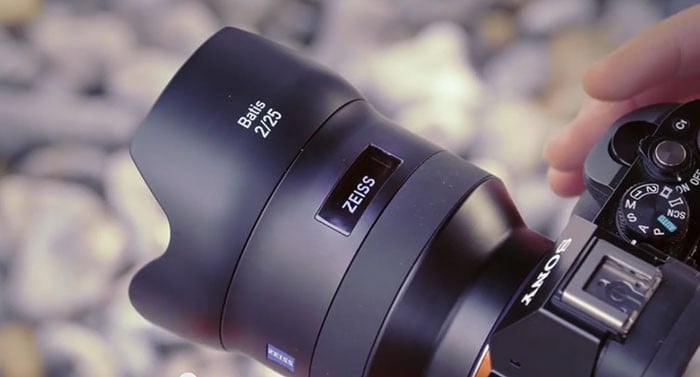
The Zeiss name gets displayed at camera startup on the white PMOLED
The new Zeiss Batis FE lenses are the worldwide first lenses with a white PMOLED screen on it. If you ever wondered what the heck a “Pmoled” is here comes the explanation:
Normal OLED TV’s use active-matrix addressing schemes because it allows for higher resolution and larger display sizes. But the new Zeiss Batis lenses have white PMOLED screens that use Passive matrix addressing just like [shoplink 36507 ebay]ePaper Tablets (read Amazon Kindle)[/shoplink]. It means they offer an increased brightness and clarity in direct sunlight. This means you don’t have to worry that you might not read the screen in daylight!
Quick note: Few Loxia 35mm in Stock in USA via [shoplink 36510 ebay]Poppflash (Click here)[/shoplink].
Both lenses are now available for preorder in USA and Europe (UK/Germany)
Zeiss Batis 85mm f/1.8 lens in US at Adorama, Bhphoto. In Eu at Amazon DE, WexUK. In Asia at Digitalrev.
Zeiss Batis 25mm f/2.0 lens at Adorama, Bhphoto. In EU at Amazon DE, WexUK. In Asia at Digitalrev.
Lens shade for 85mm at Adorama, Bhphoto.
Lens shade for 25mm at Adorama, Bhphoto.
50 Responses
Passive versus Active is a type of adressing, not of displays! The display is an OLED and not electronic ink, so it will not have the virtue of being as visible as an electronic ink display in sunlight. The good news is that as it is self-emissive, it will be visible in the night, and as OLEd is brighter than LCD, it will have a better visibility than your backscreen in daylight. Active adressing means that each pixel of the display is driven by transistors individually. Passive addressing means that the pixels are not driven individually.
I really wish that you would have read what was disseminated with a higher level of integrity. So, you have knowledge, but you failed in recognizing the actual message. Shame on you.
I’m sorry, haven’t meant something wrong, in fact I even do not understand what the problem is, and I apologize if I offended you it was not my intend.
You did not offend, but your technical knowledge got in the way of the message. I think it is clearly stated via the use of “just like” that what is being used is not, but is similar to. That of which I have just said in no way takes away from the facts that you presented… for me, being valuable, no less than as a reminder. TY.
Georgeously design lens.
It reminds me fast sport car even being still you know it’s gone be fast on the road … In another words, all this lens need is a good photographer.
You nailed it by saying all the lens needs is a god photographer. My Vivitar or Zuiko lenses from the 1970s no where match this lens, yet many great photos for there time were taken with them. So it will be with this lens if the photographer is capable.
Attention Batis reviewers…
Please comment on the tactile feel of the manual focus system. Critical focus portraitists and videographers want to know if the Batis fly-by-wire manual focus ring is accelerated like the Sony lenses.
I’ve never heard a manual focus videographer praise fly-wire. I’ve heard numerous videographers complain about it. And it’s not a matter of “getting used to it”. It’s a matter of accelerated fly-wire being fundamentally incapable of precise follow focus specifically because of the accelerated nature of the mechanism.
I’ve never heard a critical manual focus portraitist praise fly-wire. I’ve heard numerous portraitists (including myself) complain about it. Those of us who make a living shooting fashion and portraits are unwilling to accept landscape enthusiasts telling us to “stop whining and just get used to it”. For opposite reasons of videographers, the Sony fly-wire manual focus cannot accommodate extremely slow critical focus adjustments required for off center sharp eye focus at widest apertures. It’s possible to turn the fly-wire focus ring so slow that it won’t focus at all. Then turning a little faster causes focus to “JUMP” past desired focus point in an accelerated fashion. It’s a horrid thing for critical off center manual focus.
Do the Batis lenses operate the same as the Sony fly-wire lenses?
I’m pleased and happy for everyone who seems to enjoy fly-wire focus. Many of you seem harshly defending of the platform. Good for you. But I’ve yet to hear anyone explain WHY they like it better than HSM/USM or a good helicoid manual focus lens. Your defensive OPINIONS are only as valid as the REASONS you can back them up with. So if you’re going to defend fly-wire focus, fine. But please explain how accelerated manual focus or non responsive slow focus is a benefit to anyone.
I’m also pleased for everyone who enjoys the fancy flashy lenses that light up and impress your friends. If you like that, then I’m really happy for you. Such design philosophy abandons old traditionalists (like me) who appreciate hard end stops and real distance scales. But I guess it moves photography forward in some way that I have not yet begun to fathom… somehow… maybe… I guess…
______________
I’ll be grateful for the day when Sony enables a custom function menu for fine tuning the tactile feel for manual focusing the fly-by-wire mechanism. Until then, I’ll count my losses of investing and returning those that I’ve used, and be thankful for my experience of having done so, and return to plain old adapted manual lenses, or adapted Sony/Minolta USM and screw drive with LAEA-4.
LOXIA ?!
this isn’t e-ink /epaper. e-ink such as used on the kindles,etc is something entirely different. as a matter of fact, the slow refresh rate of e-ink would probably annoy everyone to death.
e-ink is actually micro capsules suspended in liquid and charged to on / off.
as a matter of fact, if this is PMOLED technology then it’s a negative not a positive, since PMOLED requires more of an active charge to light up, and actually decays quicker than regular OLED / AMOLED displays.
Imagine one day when the lens becomes self aware and will start expressing its thoughts through the PMOLED screen like when you take an over exposed image the screen will scroll a text displaying “Mike, you sucked at M mode, please use Auto mode for god’s sake”
Or use P for Professional mode as Ken “the Chuck Norris of photography” Rockwell says…….
Excellent choice sir~
If you think Sony’s focus by wire lenses are THAT bad, you’re not a serious/experienced/working portraitist, because you’ve obviously never used a Canon 85L – the 85L’s implementation is SO BAD it’ll actually ruin any internal audio when you’re recording motion with its clang-clang-clanging when adjusting focus, plus is sloppier than a $5 hooker to focus!
As to why these lenses are designed this way, go read the many excellent papers Canon put out when addressing their 85L’s focus-by-wire detractors.
Sony/Zeiss/Olympus/Fuji/Pentax, et al. are actually improving focus-by-wire usability, albeit slowly. All Sony need to do is offer a firmware upgrade to address the speed-ramping. But, in practice (out in the field) it’s an extremely workable system, given the fact one is proficient of craft!
It’s a different world today for a working photographer, we have to wear many hats, we accept (and work around) many design compromises. If you prefer traditional kit & traditional designs have at it – eBay is only a click away.
The way focus by wire works in Sony cameras is a simple software decision. There is no reason what so ever to work that bad, other than badly written algorithm.
A simple update could fix the problem with unresponsibe focusing that sony lenses exhibit.
Exactly! I wish they implement this “workable” firmware on this lens, so that the MF becomes actually usable. In fact, the latest Sony FE 90mm macro does have an improved and usable MF switch as commented by some users, although i didn’t try that out myself yet. Simply this, it’s highly workable for Sony to provide a firmware update for all its FE lenses so that their MF becomes usable. It’s an easy fix, but, to do or not to do, all count on Sony, until we see a hacker does a favor for us such as the famous magic lantern team does for Canon cameras.
Honestly, I’m watch Samsung for real innovation.
I don’t think you’re “honestly” doing anything John, except projecting your own inadequacy upon others. It’s called “Gaslighting” John. Look it up. You’re good at it.
Like the compressed RAW (non) issue people like to bemoan, just putting in a FW fix would go a long way.
I’m not an experienced portaitist because you don’t like 85L clanking for video?
Please reconsider your logic (or lack thereof).
And please address my specific complaints about acceleration and non responsive slow focus… instead of avoiding the subject, making excuses, and accusing me of something you have no idea about.
I don’t see how being a passive scheme “means they offer an increased brightness and clarity in direct sunlight”. The word “passive” is misleading. It refers to the pixel structure, rather than the resulting drive scheme, which is anything but passive. Active matrix displays allow pixels to be on constantly at the target brightness, and each pixel has a small circuit around it to store the brightness level till it is updated (at the frame rate, which could be pretty slow here, and can even slow down when not being updated). Passive matrix displays only stay lit when they are actively driven, and as the display is a matrix, you can only light one row at a time. If you have N rows of pixels, that means that you sequentially light each one for 1/Nth of the frame, at N times the brightness, and rely on the persistence of the eye for it to look like a static image. There is no reason why passive is brighter than active. If anything it’s the reverse. Passive displays are stressed harder due to each pixel running at N times the peak drive current, so will tend to lose reliability faster at a given brightness.
As someone who has designed drivers for such displays in the past, it seems like a very strange choice for a camera lens. To my mind battery power is way more important than having a lit up display on my lens at night, meaning that this is the absolute worst option, because…
– OLED is more significantly power hungry than reflective LCD, which is very readable in sunlight.
– Passive matrix OLED uses more power to drive than active, and tends to wear out sooner (although the lifetime may be good enough in both cases).
Seems like more of a marketing gimmick than a step forward to me…
seems like a nerd looking for attention
You got it exactly right. PMOLEDs are passive matrix displays, which means they are MORE power hungry than active matrix displays. The main benefit for PMOLEDs is that they are cheap to make and simple to control.
We are talking about AF + MF lens. If we only need a pure MF lens, there will be nothing to discuss here. Right? 🙂
sure this is an af/mf lens but he is complaining about the type of manual focus batis lenses work with.
I was wondering, if the MF is unusable, what’s the use on this LCD screen to show focal length info? If using AF, who needs to see the info?
Totally agree with you. I wish this lens can do fixed speed MF pulling instead of the unusable/unreliable variable speed mechanism. Only then, this will become my darling lens. We already reading excellent performance test on this test, can’t wait to see more good news.
E=M×Cool^2
You like to play the “gotcha game” and that’s indicative of too much reading online, too much quoting “other sources” and not enough real-world experience.
Do you actually shoot? What do you shoot? Are you a hobbyist or working photographer? Do you shoot stills or motion or both?
Like I said, focus-by-wire issues are what they are, and “if you have the basic trade-craft (experience), they’re workable and they’re an OK compromise **WHEN** you shoot both stills & motion on the same platform.” That is what the A7 platform was designed for BTW!!
If you’re looking for one camera design/lens design that covers every possible eventuality, keep looking (hint, it doesn’t exist yet) but if you want a good “COMPROMISE” buy either an A7S or GH4 and a handful of A/F focus-by-wire lenses.
There’s no magic bullet here, sorry to tell you, if there was I’d have it………
BTW, the Canon 85L reference, it’s one you’d be well aware of if you’d been around that kit for either stills or motion. This stuff isn’t that complicated, but for the life of me I cannot figure out what the fascination you kids have for going into forums and be-arching about everything on the market. Photography has, and always will be, an exercise in lateral-thought and improvisation, now its devolved into a mental exersize in chart reading and specification regurgitation.
Answer these questions:
1. Are you a hobbyist or working photographer
2. Shooting stills, motion or both
3. How much kit are you wanting to lug around
4. Budget
5. WHAT is you end product goal
With the answer to those, we may be able to help you along.
Way to avoid the subject John, making this about my perceived lack of experience. Still you haven’t mentioned one word about the real issues I point out… again, that being accelerated focus and non responsive slow turn of manual focus.
Shoot the messenger instead of addressing the message. Good plan John. Funny that you don’t even acknowledge the problems I point out, but instead defend the FE fly-wire as an “OK compromise”… and then “Honestly” look to Samsung for “real innovation” as shown below.
John, I shoot commercial advertising, magazine editorial, and luxury catalogue still photography. Self employed for thirty seven years. I shoot with Sony A-Mount ZA and G, Minolta A Mount, Mamiya adapted to Sony for tilt shift, a few Tamron/Tokina lenses, and have an a7R/a7II set aside specifically for use with my Otus 55, 85, and Zeiss 135/2. I would gladly adopt Sony fly-by-wire lenses or these new Batis lenses if they did not have the horrible manual focus mechanisms that they do. They’re far from “OK”. They’re the worst thing ever for manual focus stills or video work. I’ve tried the FE fly-wire and returned it. That’s how I know of the problems they have. That’s why I suggested a reasonable fix, a real solution.
FE fly-by-wire lenses are made for hobbyists who don’t know any better. They are not up to precision professional work. I was hoping the Batis took a different approach.
.’s wall of text was difficult to read, but why would you need to go all personal on a subject like that? What’s the difference if he’s a hobbyist or a pro? He’s presenting a very real issue. Focus-by-wire is simply problematic and while it can be addressed by simple software it isn’t. The fact that one can work around it is hardly an excuse, especially when some companies are actually implementing some solutions (to an extent).
What are you even defending here? Incomplete design decisions?
https://www.youtube.com/watch?v=W-YpfievjSk
Maybe you should watch this, maybe there’s a lesson there too.
I’m wondering why is there a screen on a lens?
Can I load kindle books on this screen?
Sure… if you don’t mind the fact that it would take years to read them…
Nice profile picture by the way…. The color of your face, your pose….Very artistic….
Thank you!
Zeiss Batis = lens lust for my A7r and me. Can’t wait for my preordered 85 f1.8 to arrive. I am sure this lens will become a Sony FF PRO IQ Classic “The moment mirrorless photography meets your requirements. OLED is just another indication that Zeiss is willing and able to innovate “… for the mirrorless Sony α series…”
Hi I am working for Eink, and I had join in “passive matrix” project several years ago; as I know, this product had never being launched by SiPix or Eink, since it’s not suitable for rapid display, such as Amazon Kindle. The Amazon Kindle is by using TFT array to switch E-Paper on and off, and not belongs to “Passive Matrix” product.
All kit can be problematic in inexperienced hands or when inappropriately selected for an ill-suited assignment. Take your pick as to what fits your mold.
Obviously, for you, the problem can only lie with the operator; impossible that something was designed/implemented badly. Good luck with that kind of thinking.
Yep, 1000 Ph.D’s at Sony know less about optical/camera design than you Bubba. Maybe, just maybe, you’re not part of the target audience………….
Yeah, mate, companies and people who work for them are always smarter than everyone, reality sure has proven that. They always bring the best possible solution for our needs, eh?
Let’s look at an example, shall we? How do you focus at night with your fly-by-wire lens? Mind you, I manage to do it, but it is hardly a convenient way of doing things. So, your 1000 PhD’s couldn’t make a mechanically coupled MF ring or simply copy Ricoh’s snap focus?
Spent years focusing & taping the lens ring on a 5D3 to shoot Aurora.
Now its actually pretty easy with the EVF on a Sony A7S and ANY lens I choose to use, just pick any point-source, press that focus magnify button (twice) and its THAT EASY……….
Which system do I prefere, being objective, neither, taping the lens ring is better (given you tape it in the right place) for astro-photography. But, as is often the case, the EVF method is easier on the fly (with any lens).
If you are referring to the fact that a regular lens with an infinity mark, or hard stop will suffice, then you’re dead wrong, they DO NOT focus at infinity at that hard stop oftentimes, especially at f/2 on a 24. Try it!
So, that’s your solution, taping the ring? As to focusing on stars with the EVF, been there, done that, not perfect and certainly more time consuming than simply rotating the MF ring or snapping focus.
I am referring to the coupled MF ring. Whether the hard stop at infinity actually works (with modern tolerances and adapted lenses, it never does) is entirely irrelevant; I simply test the lens for a day and I know exactly where to put the focus ring to get my infinity or hyperfocal. You are dead wrong if you think this does not work; I use it constantly and it is both very quick and extremely reliable. By using a fly-by-wire lens, all of this disappears. Ricoh solved it to an extent.
So, I have to disagree. The problem is there, whether minor or not, yet it has not been addressed. Explaining how we shouldn’t complain, but tape lenses and not doubt the gods working at camera companies, is simply preposterous.
I’d have thought, after 37 seven years, you’d have learnt how to choose THE CORRECT KIT for YOUR purposes………….cannot help you there. I’d respectfully suggest that YOU stop waisting YOUR TIME, trying to convince others that YOUR lack of experience in choosing the correct kit for YOUR NEEDS is an issue for EVERYONE ELSE.
See where this is going………….
John, the Canon 85 doesn’t have an accelerometer. Canon got it right.
If my comments are not relative to YOUR SITUATION, then why do you speak at all? No, I won’t hire you for anything. You haven’t claimed you do anything. You only question others and hide behind accusations.
Yes I see where this is going… Only to more accusations and insults from you, arguing for the sake of arguing, never addressing the original premise… acceleration and non responsive slow focus.
Stay focused John. Maybe all your hot air will actually hit target.
How does YOUR SITUATION benefit from accelerated focus, and non responsive slow manual focus? Come on John, let me know specifically how they help you as a photographer… or are you even a photographer John? Let’s hear about your credentials now?
Yes I’ve been staff fashion photographer eight years, with over 100 published editorials and 25 covers. Now I’m freelance shooting campaigns for international clients.
What do you do John?
>FE fly-by-wire lenses are made for hobbyists who don’t know any better. They are not up to precision professional work<
Canon's superlative looking 85L is FOCUS BY WIRE, AND WE MADE THAT WORK OK……………. never used one have you, not shooting Canon are you, not shooting STAFF for any FASHION publications are you………
Right there, you really jumped the shark with the focus-by-wire comment. FYI, every video camera I have, have used, or have ever owned has been focus-by-wire, only has-been stills shooters appear to have an issue with focus-by-wire lenses for video. As our friend states in that video, "you aint Spielberg" (you understand the differentiation between VIDEOGRAPHY and CINEMATOGRAPHY – maybe you aren't in the target audience for this FE kit, if so, move right along, obviously nothing to see here!!!!
FYI, I'd address you comments but they're not relevant TO MY SITUATION. Want to hire me to address YOURS and I'd be happy to bill you for MY TIME.
>So, that’s your solution, taping the ring?<
On an EF lens for Aurora photography, that's the common method. As for anything else, it won't work @ f/2 for Aurora photography, you've got to nail infinity focus when you have a couple billion point sources in your frame.
Again, if you don’t like the kit, MOVE ON, nothing to see here, stop waisting your time with fallacious arguments and second-hand inaccurate rhetoric………
Oh, I see you’ve dropped the VIDEO & “fly-by-wire” nonsense now, figured out the difference have we between video & cinematography, well done!
Earth to John… try to stay on topic and answer simple questions before flying off to fantasy conversations you have with only yourself.
I’ll repeat…
How does YOUR SITUATION benefit from accelerated focus, and non responsive slow manual focus? Come on John, let me know specifically how they help you as a photographer… or are you even a photographer John? Let’s hear about your credentials now?
Don’t like being wrong do we. Simple answer, I don’t have any issues with the basic operation of the FE lenses. Not to difficult to figure out really. Your issues are somewhat intriguing, I’d suggest you go rent and shoot rather than read & rant about non-issues. As to qualifications, you’ve not provided any YET, qualifications in the real-world would be your BOOK or at least a WEB SITE. But I do realize you guys like to use GEAR LISTS and rhetoric…..
What do you know about guys like me John? What am I wrong about John? Why are you projecting “we” upon ME? A little self incriminating projection perhaps?
http://ctphotographx.com/
Again… Let’s hear about your credentials now.
Still didn’t answer the “simple” question.
How does YOUR SITUATION benefit from accelerated focus, and non responsive slow manual focus? This is the original topic, of which I’ve explained how FE fly-wire makes it impossible to achieve the specific requirements for my profession.
So beyond you not having “any issues” with “basic operation” of FE lenses (as most amateur enthusiasts don’t know any better)… How does accelerated focus and non responsive slow manual focus benefit your situation? They HURT my profession… and THAT is why I CANNOT use them… Understand John?