







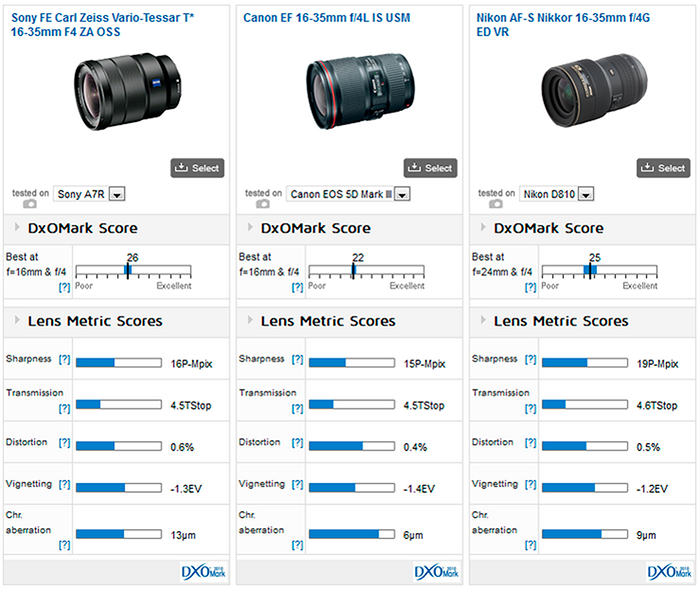
The new Zeiss 16-35mm FE lens got tested at DxOmark (Click here). And it scored the best result among the three f/4.0 wide angle zoom tested by DxOmark. It beats by a hair the Nikon 16-35mm f/4.0 lens. The only real “cons” of the lens is that it’s also the slightly more expensive of the three. But we can live with that or not? As long as results are that good!
Also Focus Numerique (translation here) tested the lens and said “Le 16-35 mm f/4 de Sony est impressionnant“. I think it’s clear for everyone what it means 🙂
One more thing: Worldwide shipment officially started today at Sony Canada and Amazon Japan. Check the full shipment date info here:
USA/Canada at Amazon, Adorama, BHphoto, Sony Store US, Sony Canada.
Europe at Sony DE, UK, ES, IT, FR, CH, AT, NL, BE, FI, SE, NO, PT.
Australia and Asia at Sony AUS, Amazon Japan and Digitalrev.
0 Responses
DxO scoring nonsense strikes again. 13um chr. abberation but it’s the best… first time I ever saw double digit values.
And diffraction starts a stop earlier for the a7r compared to the D810 apparently. Lol. These days they not only get their scoring wrong but it seems they’re incapable of making meaningful measurements too.
CA isn’t very high rated as it’s easy to correct. Sharpness isnt.
Yea, because that doesn’t cause any loss in sharpness… oh wait.
Exactly.
So the Nikon beats the Sony in every area except transmission (the least important, and only by 0.1), but it scores lower? How does that make sense? It beats the Sony by a significant margin in sharpness too.
Same thoughts here too
DXO lens reviews are total bollocks. Wish people would STOP promoting that shit.
DXO lens reviews are total bollocks. Wish people would stop promoting that BS.
Dig deeper into the field maps for sharpness. It appears that wide open the FE lens is sharper at more focal lengths. It seems to get softer when stopping down though, which is really strange…
Agreed. Sony may have concentrated efforts on the wide end of this lens given the current lack of wide lenses for their FF Emount Alpha series. On paper looks to be a solid wide angle zoom!
agreed…scratching my head with that one. really just hoping it holds it together up to f10
Yep, so much for using this for landscapes.
I’m not impressed at all. Given the price tag, this 16-35 should have been better than this. Moreover, this FE 16-35 has the same test result as Nikon’s cheaper and lighter 18-35g
It doesn’t beat the Canon or the Nikon counterparts when sharpness is concerned. The 5d mk III has a 22 mp sensor and the Canon lens manages 15 mp (68%). The D810 has 36 mp and the Nikon lens manages 19 mp (53%). The A7r has also 36 mp and the Sony lens manages 16 mp (44%) so the Canon lens is indeed the best regarding sharpness.
The only real advantages of the Sony lens are the size and weight…
I don’t think you can calculate the sharpness in% across different sensors. That’s probably even more inaccurate than DXO itself 😀
The results are not cross system comparable. The sony and nikon are tested on much higher res sensors. According to photozone, the canon outperforms the nikon.
Too bad Canon sensors suck 😀 You can’t have everything…
But you should expect more from a lens that is so expensive. I wait and see the results from http://www.photozone.de
What “more” exactly would you expect? 20% better score because 20% more dollars?
I’m having 24-70 deja vu all over again. Overpriced for what the lens delivers. 🙁
DXO lens reviews are garbage.Totally unreliable. Let’s wait for some real reviews.
I’d really like to see how well the Canon 16-35 f/4 would score if put on a body with comparable resolution to the A7r and D810. Until then, it’s hard to really say much…
Too bad Canon has no sensors that can compete on todays market 😉
Dxo is a big joke. At this score, it is identical to Nikon latest 18-35g which is much cheaper and compact.
that nikon is a great lens, but it is variable aperture, starts at 18mm vs 16mm and also has no VR. Considering that, the weight and price difference are justified. Plus it’s much more difficult to design VR lens with this level of sharpness and IQ.
So we should buy the Nikon for our A7 cameras instead of the native lens? Needless to even consider for some little % here and there. The Zeiss is a great lens for people in E-mount system, that’s all we needed to know. Not one single person owning an A7 would switch to Nikon now or use the adapted lens that won’t autofocus, needs an adapter that degrades IQ, lacks OIS and has a variable aperture. It’s cheaper for reasons 😉
This Nikon not even going to 16mm, so no needless to compare.
So much butthurt in the comments, this is great *gets popcorn*
Looking at the field map of sharpness, it appears that the FE 16-35 gets less sharp as you stop down at most focal lengths: http://www.dxomark.com/Lenses/Compare/Side-by-side/Canon-EF-16-35mm-F4L-IS-USM-versus-AF-S-Nikkor-16-35mm-f-4G-ED-VR-on-Nikon-D810-versus-Sony-FE-Carl-Zeiss-Vario-Tessar-T-STAR-16-35mm-F4-ZA-OSS___1367_0_373_963_1467_0
Field map at f/4
It gets much worse if you compare smarter!
the Zeiss is best at 16mm? Is there 16mm on that Nikon? Does that Nikon autofocus on A7r? Does it stabilize? No. Pointless
Sharpness that is crucial for what most people would use a 16-35mm for is quite lacking in comparison to Nikons offerings. It makes less sense to get the A7r if you got a lens that only achieve a resolution of 16 MP….
Shame it doesn’t resolve as much as the Nikon. That’s a major minus, especially when you have 36mp to take advantage of.
Sharpness on the Sony is mediocre compared to the Nikon. Hard to tell with the Canon because of the sensor difference.
I like looking at DxO for significant differences. 1 point on their synthetic tests is meaningless. You’d have to look at detailed reviews which I’m fairly confident will show both the Nikkor and the Zeiss are fine optically.
And here come all the comments about DxO’s flawed methodology. We all know where this is going. Rage on haters!
You can trust them if you wish.
http://www.dxomark.com/Lenses/Compare/Side-by-side/Nikon-AF-S-Nikkor-58mm-F14G-on-Nikon-D610-versus-Sony-50mm-F14-on-Sony-Alpha-900___1254_915_1022_371
Darden? D’Artagnan? Des trois mousquetaires? C’est tois? Fighting for your french brothers?
mais bien sûr 🙂
MY conclusion:
It’s great from 16-28mm from F4 to F11 and at 35mm at F4 in the center and at F8 everywhere. Don’t know about you guys, but that makes a lot of sense for my photography 🙂
Couldn’t care less about other options as the last thing I would do is using a huge adapted SLR lens on my A7r that ends up having more compromises than the Zeiss.
So what really counts is:
It’s a great lens for E-mount users and the corners at wide angle wide open are better than many expected, even on A7r!
“It’s a great lens for E-mount users and the corners at wide angle wide open are better than many expected, even on A7r!” That’s actually among the most logical pro-Sony sentiment I’ve ever seen on this site. Kudos for being level headed! 🙂 It’s rare around here.
Look 2 months back and those are the points people have been most concerned about. And, just because other lenses are some 5% better or worse here and there, it doesn’t matter, does it? Should I switch to Canon or Nikon now because one or the other lens is slightly better here and there at some focal lengths? Others might be worse! Shall we adapt SLR lenses to the small A7 body? Well, that’s not the point of a lightweight small system then. Would would you suggest us all to do? Just be unhappy or jump ship?
There is no free food. Sorry to tell you that this lens still makes a lot of sense to me as A7r owner and I’m happy with this option.
So apologize for actually liking a product, your life seems to be full of dislike and hate. Butthurt troll…
Uhhh… dude… perhaps you’re having trouble recognizing when someone AGREES with you. Calling someone who agrees with what you said a “butthurt troll” makes you look like an a-hole. Good day.
I don’t know why I completely misunderstood you. Maybe my english lacks and I need more sleep. Sorry and apologize.
@admin delete it if you want
No sweat. Misunderstandings happen. 🙂
This is good to hear. Presently using Canons 16-35 2.8 II with my 7r and have been pretty suprised how soft the canon is outside of center. To hear this thing is pretty good, edge to edge, gives me hope. That, combined with being able to shoot a few mm wider with filters on, could be quite nice.
Now if they would just start shipping it in the states before all the leaves fall off 😉
The weak point seems to be 24mm (my favourite length). Not good in the center at f4 and the corners don’t sharpen up. From 24-35 there is some other odd behaviour: the corners are worse stopped down than at f4 (look at individual measurement curves).
Every time I look closely at DXO and compare their scores to what I see in actual pictures, I wonder why they are considered any sort of authority. I guess it’s because they have no direct competition.
you owe us the bad picture samples of the FE16-35 now 😉
I don’t think the FE is a bad lens, it looks like a good lens for a zoom and about even with the competition. My objection is to DXO, and in particular their abstract numerical scores, being considered some sort of authority. I don’t object to the lens.
For example, look at: https://farm4.staticflickr.com/3858/15079707307_b1527d1027_o_d.jpg
Look at the vignetting in the left side corners, it looks like 3 or 4 stops to me. DXO has the vignetting at -1.3EV. Now I expect DXO measured the vignetting accurately, but they did so somewhat in from the corners. I don’t know why — perhaps that’s been standard practice since film when people printed cropped, and nobody’s questioned it since?
Many people wouldn’t care about that, but the vignetting really bothers me. And it won’t correct easily because I’m a low light guy, and there is no such thing as “simple” correction at ISO 25600, so I’d have to crop it. But reading the headline DXO results gives me no clue that it’s there. Thus, I look at pictures rather than DXO results.
I could say the same for their high ISO tests of cameras, which are basically “the highest ISO that looks like low ISO” (around 1300 for APS these days). These are not even slightly reliable as a guide to how the camera will perform at 6400-25600 when it’s gone non-linear, and the colour noise either is or isn’t splotchy, and the luma character is or isn’t amenable to noise reduction. DXO mark is just too simplistic. Look at pictures instead, and put them through your workflow.
DXO pass themselves off as experts. But they are really just guys with an automated test system, measuring things that are amenable to automated testing, and putting it in a searchable web database with simple headline numbers.
Again, I think the lens is fine for most purposes.
This picture has a gradient shadow getting darker to the left side. It’s not usefull at all to rate any vignetting with that sample. I prefer the automated testing system, no matter if the internship student Klicks the Start-button 😉
Yes, that picture isn’t very useful. However, badly explained statistics aren’t much better.
I find DxO generally to be helpful in a 1st cut at determining if a lens is worth considering. However, their synthetic tests don’t tell me but so much. A good case in point is a Sigma 20mm refurbished lens I was looking at. DxO considered it one of the best landscape lenses for the D810. The first independent detailed review I bumped into trashed the lens as unacceptably soft wide open and corner sharpness was a mess even stopped down.
Point being too much of DxO talk – like this SAR post – is fanboy chest thumping, bragging rights. It’s like car enthusiasts boasting a Road And Track test proved their favorite car brand ran the 1/4 mile 1/100th second faster than the other guy.
If it’s the same as the full frame Sigma 20mm f1.8 that I owned (?)… Mine was a nice lens and pretty sharp at f1.8 and in many reviews thought to be better than the equivalent Canon.
In isolation it may be thought to be rather poor but when comparing kit you have to consider the competition and if the competition is worse then it’s effectively and in comparison one of the best 😀
“I find DxO generally to be helpful in a 1st cut at determining if a lens is worth considering.” – yea, numbers are easy to get, sadly: their numbers in lens tests tend to be so far off from the reality, that it’s useless for even a “1st cut”. You’d be much better off by judging lens quality by it’s price – it tends to be closer to the reality than DXO scored are.
Good point. There are no shortcuts in optics, good quality comes at a price. However, some poor lenses have high prices … that’s why tests are needed.
Except in this case where the Sony is the priciest.
There are many real lens testing sites (lenstip, photozone, lenscore, photographylife …)
Haters will hate….
“Best f/4.0 wide angle zoom on the market”??? SERIOUSLY? I tried to use DxO’s tests to show how much of an impact the lens being mounted on the high resolution A7R made, but unfortunately as of right now, the only other cameras it’s been tested on are APS-C. So instead, I decided to illustrate the point by changing Nikon’s camera from a 36mp camera (the D810 as shown in SAR’s picture) to the D610 (a 24mp camera like the A7). As you can see from the image I’m posting, the “sharpness” drops from 19 pmp down to 14!!!! All other numbers stay the same. The “overall score” also dropped 3 full points down to 22. All that by changing the camera. You would expect similar changes to the Sony lens if the A7 was available as an option. What does that mean? That this lens isn’t “the best f/4.0 wide angle zoom on the market”, it means that when comparing these three lenses in the configuration that SAR chose, it has the highest DxO overall score based on their “black box” / “magical formula” scoring system.
Given the fact that the EF 16-35 f/4 IS scored higher than both other combinations in the test I ran in sharpness, it’s probably safe to assume that if Canon had a 24mp body (instead of the 5D3’s 22mp) that THIS lens would be viewed by SAR as the “best f/4.0 wide angle zoom on the market”. Heck, mount it to the A7R and see what happens!!!! That score would go through the roof!
But:
1. Nobody want’s to mount the Canon on the A7r when there is a good native option.
2. Too bad Canon has no better camera to match their probably great lens.
3. The overall sharpness score on DXO is of little use, look at the field map for the focal lengths and apertures you wanna use.
4. The roof might fall on your head then, take care
I agree on all points, especially number 4.
My point was, the author’s claim that the lens is the best in class is crap. If he wanted to say it’s the best option for E-mount owners, that’s fine (but would require more than just a DxO score).
Well, according to THIS comparison it seems to be the best. There will never be THE definite review and comparison. But at his current competition at this point of time on these best available cameras for each system the Sony lens + camera system simply wins.
I hear so much talking about Canon having the “best system” (you know, they have like 300 lenses and 50 different flashes and grips and stuff). Now it doesn’t seem to be the “best system” because the camera clearly lacks in term of sensor to make the lens shine. It “might” be better on another camera and sensor in the future, who knows? We can’t buy it.
The Nikon is tested on the same 36 MP AA-less sensor and looses by a point. You can doubt the overall score now but that doesn’t mean admin is incorrect 😉
Sorry, but I gotta love the admin for being a little fanboy sometimes. If he would always be 100% unbiased he would probably work at a review site, but damn he isn’t! And he doesn’t have to! It’s his site, it’s a Sony site and he loves Sony. And if he doesn’t like what Sony does he is always honest. If that is a problem for someone to understand than it’s the point you just have to go to Canonwatch or whatever brands site you prefer 😉
I was actually wondering a few minutes ago if he purposely posts heavily biased comments just to generate traffic! lol
I don’t have a problem with him saying it’s the best combo as rated by DxO. None at all. 🙂
yeah I think he does 🙂 But there is so many bad talking about Sony on the internet that it must be a pleasure for him to send some regards to other brands when to come out with another winner product. 😀
I have the 18-35 and it’s extremely sharp and scores even higher at DXO. But this score is quite weird. In all subcategories despite transmission the Nikon wins (sharpness especially, as can be seen, too, by looking at the individual measurement curves). How this turns out to be 1 point more on the Sony, is beyond me. Nevertheless, it is a good zoom and in case I switch I know there is a good native lens to look for.
The problem is, those are not subcategories. Those scores are not related very much to the total score. DxO explains it, somewhere below someone posted the link to their scoring logic. The categories are just measurements at the optimum at the focal length-aperture -combination (different for every lens) , the total score is an average of all measurements at all focal lengths and apertures. The Nikon is best at 24mm, the Sony at 16mm. In average the Sony is slightly better. That’s what those numbers mean. It’s weird and that’s why dxo usually creates lots of confusion with this chart
I usually wait for lenstip or photozone to provide measurements. I like those sites better.
1. Clear BS. Keep on trying.
2. Disputable
3. Their sharpness testing procedure is some random magic that they do god knows where, god knows why, god knows how. I can make some gradients in a photoshop for you too, if you’d like some.
4. Yea, let’s back up argumentation with an insult. Well done. I’m sure your mum would be proud.
Either you can read and understand or you can’t 😉
Oh btw, you increased the butthurt-count to 13! Two more and you reach Canon-level 😀
Honestly, based on the numbers at DxO, I don’t see a basis for claiming that this is the best zoom of its type.
I don’t want to say that this is a poor lens, just that I doubt that it is the best, whatever that may mean. I have the Nikon 16 to 35mm / F4 lens for my D600, and it has its sweet spots and it also has some real weaknesses. I will seriously consider acquiring Zeiss 16-35mm FE for my Nex7 and A7r once the lens was been on the market for awhile, and any teething problems are solved.
For me, the real story here is that even this high-end wide angle lens continues to disappoint on the APS-C E-mount bodies in terms of sharpness, and the A6000 doesn’t out perform the NEX-7; in fact, the 20MP A3000 remains the sharpest combo to any E-mount lens according to DXOmark. Now, imagine how it’s going to perform on the upcoming 54MP FF sensor…
Yep ! And it’s not the first time.
On the Nex 7, the Zeiss 35f2.8 was not that much better than the SEL35f1.8 according to Dxo’s data. The Zeiss 55f1.8 is actually still one of the sharpest lens for Aps-c e-mount (Sigma 60mm is the sharpest one, as a reminder), but it’s not that better than the much cheaper SEL50f1.8.
However, one big difference is that if you buy a FE lens, you’ll be able to use it on future FF bodies without the crop mode, so if I were unsure I’d stick with Aps-c, then I’d probably buy FE lenses.
One last thing I want to know is if the FE lenses are way better on the A7 compared with the Nex7. It surely is (I’ve seen some comparisons on the web), but how much ? Too bad Dxo uses the A3000 and A5000, that probably almost none of its readers buy, but not the A7.
The Sigma 60/2.8 is sharper and cheaper than the SEL50F18, BUT unfortunately unstabilized; this lens might be the one that might be the reason to stay with APS-S.
The upcoming FE 28/2 lens might be interesting for both APS-C and FF with and without it’s wide angle converter, as a fast wide to normal combo on APS-C and as a wide to very wide on FF, if it performs well.
The A7 is better than A6000, BUT the gap isn’t close to be big enough to justify it.
When will DX0 will test the Samyang wide angle lenses? They seem sharper than Zeiss ones from what i see in other reviews so why are they not tested by DX0Mark?
Do they? From what I seen – they don’t. But they do offer great image quality for the price.
Please stop giving DxOMark so much credit!
What I see is, Sony FE is only very slightly sharper than the Canon EF, despite the massive resolution difference in the bodies. Nikon has the same sensor as the Sony and it can squeeze some more resolution from the lens, which means Nikon lens actually IS sharper.
The whole single-score-for-everything approach is faulty and should not only be avoided, but olso burried deep in the ground.
One can alway pick the point he wants… Gianlucca Buffon is also better in goalkeeping than Lionel Messi. But who cares?
And what would you think about if a sports website site made it a headline?
“10 people who are better at goalkeeping than Messi”
I’d laugh but not go to the websites comments and whine about that statement.
The Sony and Nikon are only slightly sharper than the Canon in the center but are much better balanced across the entire frame. See Sid’s whole field shots further up the page.
Having a higher resolution sensor would probably help the Canon center sharpness values but would not help much in the corners. Perhaps Roger at Lens Rentals will do a 16-35mm f/4 shootout and you can see how the lenses in isolation perform. Unfortunately at this time he is not set up to measure the Sony lenses.
presently i use canons 16-35 2.8 II for my wide and its pretty junk outside of the center using the 7r. It was a my favorite on the mkIII, not so much with the 7r. If its a little better in the center and much better to the edges this lens will be useful.
Yeah, but the new 16-35/f4 is much better all around.
Fair enough, I’ve never used a copy. I’ll probably keep the canon around for the astro but presently I’m really looking forward to something sharper for my day to day. AF is going to be nice as well.
going to have to take your word for it as I’d owned the 2.8 for a year or two before the f4 released…and honestly, prior to moving to the 7r I shied away from anything as slow as an f4 unless it provided some other valuable quality. Will say that despite the 2.8’s flaws it will likely be kept around for astro stuff as f4 is kinda meh for that, not to mention as much as i love the 7s the images are a bit small for Landscaping.
It’s not fair, Canon lenses should be tested using a modern sensor. This leaves out the 5DM3.
Actually, Canon lenses should be taken out and used in means of photography. All lenses should be treated like that.
When would prices of the “best” lens come down to ~800 Euro mark? I will wait for “blitzangebot” from amaxaon.
Do us all a favor and hide in the closet until that happens, spare us the constant complaining.
I wonder how much time people are spending on studying charts I don’t even know what they mean. Then they become self-proclaimed professional equipment tester.
Meanwhile I buy that lens, go out shooting and I am happy since I’m not a professional. All my friends and family are impressed by the image quality the FE system offers.
Well thats what friends and familiy usually says 😉 .. If your gonna spend 1500-2000 dollar on a lens , a least for me I do research about the lens, its a lot of money for some.
Yeah, but c’mon, one should be satisfied reading that three or four sources tell you, this lense is a good one and worth the money.
Noone, in all of the comments under the news, said that this lens is bad. I don’t know what you are trying to dispute here.
DXO lens tests are BS, there are better lenses than Sony, none the less – it is a *good* lens.
“in all of the comments under the news”
–> that’s what I meant wih self-proclaimed professional tester 🙂
Finally someone who makes sense!
yes, sony has many many “best” lenses in the world, including the FE 55 1.8 which is claimed to be the best AF lens in the world by SAR. But sony is still a loser in the market.
btw, i don’t understand the nikon looks better in small scores but is worse in the final score
After you read this page, you will understand why.
http://www.dxomark.com/About/Lens-scores
That’s because you don’t have the comprehension required to understand the test. You’re not retarded you’re slow.
Come on! The Zeiss Otii are the “best” lenses! 🙂
They don’t AF.
That is another reason why they are the “best”!
The best lenses are all manual focus only.
The Nikon 14-24mm F2.8 is the best uwa zoom lens ever made it competes with many legendary primes within its range and is only outperformed by the rarest prime gem
Marketshare doesn’t take nice pictures. I prefer having nice gear… by the way, Audi also has small market share. Enjoy your Toyota!
It’s funny how the Tessar “beats” the Nikon, the Tessar being less sharp, distorting more, vignetting more and having more chromatic aberrations. 😀
In fact, its only technical advantage is better transmission, according to DXOMark.
That is the magic of the blue Zeiss tag! Now you know. 🙂
Their overall score is based on all FL’s and apertures, you’re looking at the optimum values achievable.
I think the sharpness figure corresponds to the maximum sharpness at the lens’ best setting, while the overal score compiles the sharpness across the zoom range, in which case the Sony is more constant.
It is one thing to measure stops of DR, another to pull off some p-mpix magic.
That makes significantly more sense:
http://www.colbybrownphotography.com/an-in-depth-review-of-the-sony-fe-16-35-f4-oss-wide-angle-lens/
I pulled one of the RAW’s from that review and edited it. The sharpness really wasn’t that great at 16mm, F11 + a7r so the low resolution from DxO seem to have some merit unfortunately.
Yep, checked the file and it isn’t sharp, but then it is at 1/10sec and without a tripod apparently. The 100% crops of that house pic tell a different story. I simply wound’t trust DXO for lenses.
Oh…. without a tripod? That’s odd. Didn’t even think about that since i can’t imagine a landscape shooter that sees a 1/10 and decides not to use a tripod. I wish he would have used a tripod then.
The house shots may be interesting and tell a different story but since i mainly shoot landscapes and urban landscapes so the ones featuring those are of a bit more interest.
It seems to be a nice lens. Though, resolution looks a bit weak. These claims are always rediculious: It is not the best wide angle 4.0 lens. The Nikon is not that consistent but has better peak quality. However, we don’t really know how the Canon will perform. They should test it on the A7r – and my bet is it will outperform the resolution of the others, at least the resolution of the Zeiss (seems not that difficult) …
Nikon is the winner if you like heavy fringing.
It already has been compared on the same body, the Zeiss did better.
What a an absolute load of rubbish!!!
Nikon beats it on almost all levels and still it scores less?!! lol
It is actually 16% sharper…!!!
From this day onwards…i will no longer trust DXO Mark as they are obviously weighting more heavily on certain measurements, which are completely unseen to the human eye!
Look at the Nikon 18-35mm, which is actually less than half the price of the Sony Canon lenses…yet it blows them out of the water!!!
http://www.dxomark.com/Lenses/Nikon/Nikon-AF-S-NIKKOR-18-35mm-F35-45G-ED-mounted-on-Nikon-D810__963
Nikon lost, read the review. Have plenty of tissue available to dry your tears.
When Sony imaging division go belly up…like the rest of the branches of its business…scrubs like you will come crawling back to Canon and Nikon…and quite frankly…we don’t want you back. Amateur!!
Dxomark’s “perceived megapixel” data is humorous at best. It’s the stuff of lab tests and measurbating.
Now that’s something you know something about, measurbating and the other thing.
Why yes indeed….that’s what this forum is all about. But, the perceived megalpixel IMO takes it to another level of stupidity. I think it’s a worthless metric.
A worthless metric to go along with your worthless opinion, perfection has been achieved.
I could eat a bowl of alphabet soup and shiiit a better response than that.
Nikon is the first loser of the competition, you are just a loser and a cry baby.
How do you get to this conclusion? But maybe I shouldn’t ask, here is no sound answer to be expected.
Damn. You are one ugly kid.
We finally have a decent ultra wide for Sony Emount! This is a major event for us Sony Emounters. The fact that this newly designed lens measures up there with well-respected Canon and Nikon equivalents is another plus. Who cares which is 1st, 2nd, 3rd. Success comes from the mind and the hands of the photographer no matter the equipment pointed at their subjects.
It doesn’t matter who is 1st, 2nd or 3rd. But what does matter is why the sony gets worse as you stop down?? Seems like a lot of money (the highest price of the three) for mediocre results.
You mean after F8? Is that a problem? I’m happy shooting wide angle wide open anytime, that’s where this lens seems to shine. And F8 still looks good.
Your mediocre results might come from your photography…
when you shoot landscape, you’d prefer to have small aperture to increase the DOF, right?
That stat is confusing, that it gets a little worse as it stops down that is, and while I love wide open, when stopping down while landscaping, sharpness/DOF is the goal so…hrm… It would have been cooler if they had swapped this trait with the 24-70 which benefits greatly from stopping down. Predominantly people lens vs landscape lens and all…but hey as long as it holds its together until f10 I’m cool. Right now I’m using Canons 16-35 2.8 II and well…Im really not pulling that len’s much now because of how it performs on the 7r so either way this will be an upgrade….
For all you people that say I’m a FE hater- I’m getting an A7 in the mail today. Just for shiiiits and giggles I bought a Rokkor 135mm 3.5 and a few adaptors. All the glass I’ll mostly be using is A mount Zeiss. I seriously hope this thing doesn’t suck, but I figure it’s time to put my money where my mouth is. It was either that or the A77II- which I’d rather. But, for all the money I have in glass I can’t justify a crop sensor at the moment. Anyway, this wide angle lens above doesn’t look to bad, but I will personally consider the Nikon if indeed the A7 ends up doing it for me.
You should try both lenses first. The difference is so marginal, I doubt you would see an actual difference. Those scores are just an average of all focal length and aperture combinations.if you know the weaknesses and the strengths of each lens (no zoom lens is perfect over the whole range) then you will find that you could live with all of those lenses for the purpose they are built for. DxO writes in their general explanation that for the sharpness score results of less than 10% difference are just irrelevant. Get the lens for your system and dont let you misguide by some summary numbers
LOL? The chart shows Zeiss to be worse than both competitiors, yet it’s final score is higher?
The idea behind E-Mount seems to be: sacrifice everything in favor of compactness. AF, ergonomics, batteries, fast lenses – but now it seems that lens IQ had to be compromised too, even at f/4, to make lenses smaller.
You are correct. One of the objectives of Emount is to deliver quality in small and compact. Or at least as small and compact as physics will allow. The fact that Sony has done this again for another zoom is commendable. Even more amazing is how close they are coming in IQ to venerable Canon and Nikon equivalents their first time out of the gate at UWA FL. So many critical comments about DxO yet it would seem everyone references this site from pros, to hacks on forums. What else would you have to talk about if DxO didn’t provide these references ? Let’s see your lens rating methodology ?
Read the review then dry your tears. WAAAAAAAAA WAAAAAAAAAAAA
Does your momma like to f-ck you up, take a picture and laugh? Poor kiddo, terrible childhood. But that’s not a reason to post your pics here.
Damn. You are STILL one ugly kid.
At most FL’s, sharpness is similar wide open but more uniform, which is quite a feat considering it’s quite a bit more compact as a whole. But haters will always find fault.
why only 7P-Mpix sharpness on the A6000 but 16P-Mpix on the A7R? Am I the only one disappointed with the A6000 sensor with most lenses?
Disappointing? What exactly has been your experience?
No experience, he only looks at DXO charts to figure if a camera or lens is good, it’s nice, it means you don’t have to pay any money, take pictures or question your skills.
btw I really wonder how do they come to the conclusion that the A6000’s 24mpix apsc sensor scores only 7mpix while 20mpix sensor from A3000 & A5000 scores 8mpix….
Great observation. I noticed this and tested it for myself also. There is a list of lenses when comparing the A5000 and the A6000 on DXO mark with this backwards performance on the A6000!
I don’t base my experience or purchases on DXO mark. I learned not to trust them a while ago. I know legacy glass is not designed for APS-C but my old NEX-7 IMHO showed the character of the lenses a lot better. Also as MikjoA pointed out the 20MP A5000 scores higher sharpness level than the 24MP A6000 with this new 16-35mm F4 lens and a lot of other lenses such as the Sigma E mount 60mm F2.8. I have also experienced in person better image quality with the Sigma 30mm, and 60mm on the A5000 than on the A6000. I hope the new sensor in the rumored A7000 will be better in this regard. One can hope! 🙂
Because one has a 36Mp 135 sensor without AA filter while the other has a 24Mp APS-C sensor with an AA filter, maybe ?
Or that DXO scores are mostly… useless…
Or a bit of both.
It would seem to make sense that way but the A5000 scores higher sharpness score than the A5000. By doing equiptment testing on my own in comparison to DXO lens combos I do trust the Mpix sharpness measurements.
It would seem to make sense that way but the A5000 scores higher sharpness score than the A6000. By doing equiptment testing on my own in comparison to DXO lens combos I do trust the Mpix sharpness measurements.
If anybody ever bothers to read the guidance that DXOmark produces, people would note that they don’t test lenses as such. The test lens/camera combinations, which is why the same lens is often tested on many camera bodies.
As they say, the design of the sensor and lens work together. The most obvious issue is resolution, but thinks like microlens design, filter stack thickness, and AA strength (or absence) matters. That’s why DXOmark caution making simplistic cross-mount comparisons of lenses.
Which, of course, is why headlines screaming which is the better results are meaningless out of context. The most obvious example is the Canon EF 16-35. It loses out on resolution, but it’s fundamentally limited by the available Canon sensor resolution.
The headline numbers do not mean the Canon is a worse lens then the Nikon of Zeiss. However, it also doesn’t render the results meaningless either. Those with a modicum of intelligence and ability to understand the implications of the results know this.
My problem with DXO are mostly the scores, the scores are biased and sometimes based on idiosyncrasies that while valid from a purely technical point of view, are utterly useless to the practicing photographer.
They do great work, their charts are a priceless tool, but their scores are useless, misleading and doing a great disservice to photographers, manufacturers and themselves.
If you mean the overall score, fair enough. I’m not a great believer in characterisation complex performance by a single metric. That said, there are statistical ways of combining individual metrics which reflect general performance, but they are really only of use for filtering out items that are particularly bad in some area,
Even the intermediary scores are barely useful, one should not rely on them excessively, it’s digging through the charts and maps that is the real value there.
Roger Clark has some great articles on his website about DxO scoring and sensors/lenses. From his reverse engineering he believes that Sony, while still having better sensors all around, is manipulating the algorithms used on the hardware to score higher on tests like DxO, making them seem way better than the others when they are just a bit better.
It’s not that simple, unlike video game benchmark rigging, the camera never knows it’s being used for benchmarking purposes, so basically, it performs for the benchmarks the same way it performs in a photographer’s hands.
Where there is a “cheat” is that Sony chooses to exploit the bias of DXO’s scoring algorithms to get even better scores than competitors, it’s not specifically a problem of Sony “cheating” but of DXO’s algorithm being unbalanced enough to be biased excessively toward some behaviours.
The day DXO uses more balanced algorithms more representative of actual use is the day the gap between Sony sensors and others will narrow.
That’s why I don’t like DXO scores…
Interesting….interesting….
Let me rephrase, I’m not saying that Sony deliberately “cheats”, but that they seem to place emphasis on sensor development and signal treatment that happen to be those toward which DXO scores are heavily biased, it can be perfectly innocent as it results in great real-life results anyway, and that’s all that counts “does it translate into better IQ ?”.
It also doesn’t mean that Sony’s sensors are not superior to Canon’s, they are, but that superiority stacked with the bias in the scoring algorithm has a multiplying effect that, in my opinion, misrepresents the gap between the sensors.
Real cheating would be to find a way to produce artificially better results when shooting charts and using DXO scoring algorithm, while providing little to no image quality improvement in real world situations.
I’m sorry for being impolite, but Roger Clark is an idiot with his “reverse engineering”. DxO described procedures they used and it is quite hard to discover anything better than SNR, what is key point for any dxo sensor metrics.
And, to say, the real life is even worse for canon sensor than DxO mark shows: canon has annoying banding, which degrades percepteble IQ quite a lot.
A lens is capable of resolving a certain number of line pairs/mm. If you now take the lens and mount it to different cameras, this will result in a greater number on FF, due to the larger sensor (resolution x linear size for each direction gives you the number of line pairs/picture height, so a total of 1.5^2 = 2.25 more MP, when scaled to the 2D area). You see, you almost exactly get the 16MP if you multiply the 7MP with 2.25. This is the reason, why lenses designed for new mirrorless APSC or m43 cameras try to have a larger number of line pairs/mm to account for the crop factor (Voigtländer 25mm goes up to 82lp/mm, for example).
Interesting, thanks for sharing.
i don’t understand Dxomark scores….the sony lens has worse sharpness, more chromatic aberration, more distortion and more vignetting than the Nikon, but it’s better???? how the heck
It has a slightly bit better transmission but it doesn’t explain anything it’s a real mistery… it doesn’t make sense…
Read their reviews and their general description of what those numbers mean. Then it actually does make sense 😉
But I agree, for people who don’t know DXO numbers are confusing.
Just another case.This happened many times before.
Because you need to educated yourself what those numbers mean. It’s been explained here many times and there are links as well. The total score is the average performance and th number below the peak performance at each lenses best focal length
That’s the advantage of creating a new lens mount every couple of years: Everybody has to buy your lenses, no matter what they cost or how good/bad they are, because there simply are no native alternatives. Good thinking on Sony’s part.
Another one with a pre-packaged opinion.
And a very superficial one at that, coming from a position of ignorance and lack of understanding.
And the disadvantage is that you alienate your existing customer base as you render their lens investment worthless…
If what you said was true, camera manufacturers would be inventing new mounts at regular intervals. The fact is they don’t. New mounts are designed when there’s a functional requirement. Canon’s EF mount dates back to 1987, and was invented to exploit AF. (There’s a variant in the form of EF-S, but that was again functional, to allow more compact lenses to be exploited for APS-C format sensors). Nikon’s F mount dates back to 1957, although there are compatibility issues with some camera variations.
Other new mounts, like those for mirrorless cameras, are all designed for functional purposes.
In general, camera manufacturers do not invent mounts purely to get a new round of lens sales. If they did that, then it would be a great way of driving loyal customers to move to a competitor. Established system camera manufacturers are obsessed with maintaining their current customer base. Only the innovative ones take the risk of an entirely new mount, as Minolta did in 1985, when they invented the modern SLR AF market.
Note, it doesn’t quite apply in the E-mount as (with an adapter) owners can continue to exploit A-Mount (or even other mounts). It’s only if they want the functional advantage (size, CAF etc.) that they have to buy e-mount lenses. That was Sony’s good thinking. the adaptability of the mount, not the generation of one for the sake of lens sales.
The question is: will it blend, äh, wobble
A combination of sensor and lens envy, join a support group before it’s too late.
I don’t know what to think about these DxOMark–Scores: I once owned the Nikkor 16–35, and it always felt terrible (on any body I’ve tried it with) – honestly, I never got a sharp image out of it (the newer 18–35, for example, was, to me, way, WAY better!).
Now, I’m pretty much looking forward getting the pre–ordered FE 16–35 – on Photokina, it felt great. I’m still using Nikon, but it has been always a pain in the ass to focus ultra wide angle lenses (no matter which one I’ve tried), so the biggest advantage will be the possibility of focussing this lens manual with nice focus peaking. 🙂
Yeah, they are a little strange to me as well. From all of the other reviews I have read the new Canon is much better than the Nikkor 16-35. It would help to see them compared all on the same body and see some real world example shots.
it´s a 36mp body they test on.. sure sharpness will be better on a 36mp sensor.
why not testing the canon lens on an 8MP body and compare it to nikon on a 36mp body?
they could make it look even worse….
for a real LENS test you have to eleminate the differences in sensor performance and resolution.
I don’t care for this “real” lens test becouse I do not shoot with a lens alone. In real life I will always use a camera together with a lens. And if I use a Canon lens I will use most likely a Canon Camera, if I decide for the FE I will get best results with the Sony A7r. It is not DXOMark’s fault or Sony’s fault that there is no Canon Camera with a comparable Resolution to Nikon’s or Sony’s high res cameras.
Unfair sharpness comparison with Canon (36 vs 22 Mpx). It would make more sense to put the Sony lens on the A7, but DxO simply ignores the A7 for some reason. And also would be nice to see the f/4 compared to the bigger brother f/2.8, but again the sensors are different so no point…
DXOmark state there tests are of the lens/camera combination, and really shouldn’t be used to compare cross-platform.
In any event, if DXOmark wanted to test the lens on a higher resolution sensor, it would make more sense to mount the Canon on an A7R rather than artificially limit the Zeiss by mounting on an A7.
Totally agree. But I doubt they will ever use adapters…
Agreed, but I think that’s only because where do you stop? The combinations of lenses and bodies are already enormous and would grow dramatically. The only justification might be that the A7R could be something of a benchmark body for FF lenses as it can mount so many different varieties.
In essence (electronics aside), they are only really extension tubes and if engineered accurately (largely front and back flanges absolutely square), then ought not affect IQ.
No. It would make more sense for Canon if they would come up with a camera that can compete in high resolution landscapes. You can’t blame DXO for that.
I am always amazed from posts about DxO from all different kind of kibitz on photo-forums … LOL …
It seams like, that DxO people with experience from testing thousands of lenses have no idea what they are doing … Ha .. ha … ha … This is hilarious !
from the 70-200mm f2.8 test you are right they are clueless.. that is why they have to retest after the turmoil gets too big…
only thing the french are good in is surrender in times of war.
… you should update your self deeper in history of WW II … by the way, grass is everywhere green mimd you …
I have concluded that Ken Rockwell may very well be an idiot. I can’t figure out if half of what he writes is in a sarcastic tone. Besides his “wonderful” advice on buying all your gear cheap and selling it later….he adds this on his list of things not to do when becoming rich”
“Don’t Have Kids
I won’t go here either. Kids today are an expensive luxury. It’s not 200 years ago when we all lived on farms and needed them to help with the milking.
Not only are they scaldingly expensive, they are the root cause of all pollution and environmental destruction.
Think about it. Do you have any idea from where more people come for whom we need more oil and for whom we need to bulldoze more virgin landscapes to build tract homes for them to live and raise more kids?
Sure, my kid is special: it’s not my kid, but everyone else’s kids that cause pollution, poverty, shortage and crowding. Think again.
Kids go far deeper than the thousands of disposable diapers each consumes. The worst environmental crime any individual can commit is making more people. Sure, my kid might cure cancer, but we are up to something like 7 billion people on this planet and no one’s kid has cured it yet. My kid is far more likely to degrade your environment and cause more cancer than he is ever likely to cure it. Isn’t hope grand?
Even more expensive than the monetary cost is that they consume any time you ever thought you might have to better your personal and professional development. They are far worse than watching TV.
Ever wonder why half the ads on TV are for baby stuff? Because half our economy goes into paying for that baby stuff.
Sorry, Ryan, I said I wouldn’t go here, so I won’t.”
I didn’t know children where a product or to be treated as a commodity. Geez.
From now on your nickname will be Christopher Columbus
Mr.”Thinkinginpictures ” …
I seriously think you are the one who should have never been made
I know your upset, it’s easy to be. But like I told you, when you choose to shove a 400mm 2.8 up your aaaass there is no guarantee of easy removal. You can blame me all you want, but the proof is in the corn hole.
What about the A mount Zeiss 16-35mm f/2.8 Zoom Lens
Sony Lenses in 2015 2nd half
E-mount 24-70 F2.8 G OSS
E-mount 16-35 F2.8 G OSS
Sony Lenses in 2016
E-mount 14-28 F2.8 zeiss sonnar, no OSS 🙁
E-mount 24-80 F2.8 zeiss sonnar, no OSS 🙁
My new toy I guess…
I honestly don’t understand how it is “best” when Nikon 16-35/4 has higher sharpness, lower distortion, lower vignetting and much lower CA?
DxO’s ratings are inexplicable and meaningless. But measurements are not.
Total score is the average score across all aspect and focal length while numbers below are its peak performance. DxO’s rating is useful when you compare difference lens on the same camera or vice versa. In this case, since the both a7r and 810 has pretty much the same sensor, the score should reflect real world comparison
You can’t compare sharpness of a D810 or A7r to the 5Dmkiii when comparing lens sharpness. Any lens you put on the 5Dmkiii is going to be significantly less sharp than anything on a D810 or A7r because of the 5Dmkiii’s high pass filter.
It would be interesting to see how that Canon 16-35 tests on an A7r.
Unfortunately DXO just compare whole lens+camera systems. So what you just found out is simple: Canons system lacks good cameras.
Which is why I jumped to a A7r and my 5D is collecting dust. 🙂
I’ve been considering that Zeiss 16-35 E mount lens but already have the Canon 16-35 2.8. So seeing a proper comparison would be useful. But I’ve been thinking of just hanging in there a little longer hoping we see a nice 14mm and 24mm prime.
The Canon 16-35mm F2.8 version I is very soft in the corners. It produces bad coma aberrations when used at wide apertures. It is a mediocre lens on the 6D and even worse on the A7r.
On the other side, the Sony 70-200mm F4 G is not up to the Canon 70-200mm F4 IS which produces great results both on the A7r and on the 6D. Looking at the DXO results for the Canon 16-35mm F4, it seems to produce better results in the corners. Not sure whether the lower performance of the Sony16-35mm in the corners is due to the short flange distance of the FE mounts, or to the lens itself.
I have the 16-35 f2.8 II which is decent in the corners. But for it to work perfect you need the metabones mkIV adapter, I only have that mkIII. So I’m at that cross road. I don’t really want to invest more in lens mounts. I’m sold on the e-mount system and would like to just start getting all e-mount. But I think a lot of those canon lenses will be hard to beat.
Something strange is happening. Canon on the internet, not in real life yet, seems to getting compared and matched with Sony everywhere. It used to only ever be Canon and Nikon.
In real life Sony beat Canon years ago. It’s just on the Internet that the majority of people thing the biggest manufacturers make the best cameras and lenses. They simply don’t.
Good lens. It bests ZA version in everything except distortions and CA. “Nah…” – said Sony,- “We gonna fix it in post!”
Mmmm just out of curiosity , the Nikon has higher resolution, lower distortion . lower vignetting , lower CA and lower price . So just how exactly is the Sony better ?
read on, you will learn it
This is the problem with the DXOMark making scores up off the top of their head. Second place by far in resolution, last place by far in CA, last place in distortion (though all have negligible amounts), but they randomly assign it the highest overall score so we get entirely false headlines about it being the best. The 7D2 scoring 10-15 points lower than cameras that the actual data shows it neck-and-neck with (though that’s admittedly unimpressive since those cameras are all much older) was even worse. DXO’s charts and graphs of actual data are great, but no one should ever look at their scores ever.
Because you don’t understand the numbers or you don’t like the results?
I’m not gonna explain the numbers again, just scroll through the comments.
Canikon lost this time, deal with it.
I can assure you there is nothing random about DxO methodology. Full disclosure pertaining to approach and methodology is presented. Please refresh your browser and clear your cache and they again.
Then please disclose that you are associated with DxO.
Here is a quick ‘cheat sheet’ for all those crying they “don’t understand how the Sony is better”. You see that score they give, the one you are crying over? Now you see that little blue bar, that is the ‘score’ represented across different focal lengths and difference performance levels. Now look at the Nikon and you will see that bar ranges much more than the Sony, dipping down lower. The numeric score is the average of those scores, because the Sony has a smaller bar that means it is more consistent across its range than the Nikon is, so it gets a better average score… understand? if they took it from the worst score of each the Nikon would be quite a way behind. However The individual scores show the peak for that lens regardless of how terrible it is at other focal lengths.
great explanation, thanks!
The problem is really that they should invest a bit more efforts into this final comparison graph as, without any more text, it can be highly misleading (as can be seen here in this forum today). Maybe they should show the range or the average as well for those lens metric scores and not just the maximum. This system might be great for comparing primes, but for zoom lenses, maybe not so much…
I prefer to look at DXOs great graphs (field map/global map) as I find them much more useful than those end results. But I think that’s mostly the case if one doesn’t read a review or even it’s conclusions but just jumps to the “final score”.
And not to forget, the Canon is used on a camera with much less resolution. So it is not only s lens test, it’s about a system. It would be interesting to test these lenses all on the A7r. Than you had a good comparison of these lenses. And you know what, my guess is that the Canon will win. Oops, I’m at the wrong place to say this and will be burned now ..,
Sorry but this isn’t actually as true as you think it is. For one people have compared them on the same camera, but more importantly look at the field maps, they won’t improve with more pixels. If anything the A7R is more demanding and difficult to please.
Have to agree with this. The 7r’s sensor show’s your glass for what it is.. good, bad, no hiding with that sucker..
While the fanboys on all the sides jigger about to make their lens the “best” .In real life all three lenses will be more than capable of excellent results. The differences boil down to one lens being a “midges ball hair ” better at a certain focal length /aperture while the other is a “midges ball hair” better at a different focal length/ aperture and looking at the detailed DXO results the differences are typically so small that they fall into the margin-of-error of the test.
The fact that DXO test only one lens is also a bit of a problem as even amongst some higher grade lenses there are better samples , which would probably sway the test either way. I have the D810 and A7R and I already have the Nikon 16-35mm f4 { which performs very well, not as well as my 14-24mm but very good} so its not really worth getting it for me. Certainly not when in the UK the Sony is 50% more expensive than the Nikon { I am Scottish after all lol }
There is one area where the Sony wins hands down and no sample variation or juggling test scores can change that :
In terms of size, I’m seeing a huge stack of…as you call it…”a midgets ball hair”….difference in size. I feel sorry for those midgets, I hope they shoot Sony.
Congratulations “Thinkinginpictures”! You just won the butthurt award 2014 🙂
But your mom just called, you need to take your pills and then back into your little cage!
I did just take my pills, it’s not nappy nappy time yet. My mom said lights out after I rid myself of all the trolls under my bed. Your the last one.
for your bf, yes it does.
I’ll make sure I let him know. He likes awards, hoses and random sharp objects so this is good news.
lol it is not meant to be an awesome pic , it is only to demonstrate the main advantage of the A7R+ 16-35 combo namely size. For landscape use in particular { a common destiny for such lenses } lenses are more often than not used stopped down and I would happily wager that there will be no differences between these lenses and all will deliver wonderful results.
So your choice other than price boils down to other factors such as size/weight image stabilization and so on. If I did not already own the Nikon the Sony looks to be a very decent option if somewhat pricey compared to its Canon and Nikon rivals.
One quite important point here. The (more recent) Nikon 18-35 rates higher on DXO than either the Sony Zeiss or Nikon 16-35. It has no stabilisation but is smaller end to end than the Sony Zeiss. Unfortunately it doesn’t feature on Camerasize, otherwise I would post a more realistic comparison picture here.
At the end of the day nobody is going to pick a system over these minor differences, picking different lenses on the same system yes, but comparisons here are just for bragging rights.
DOX is good to show witch lenses are best for my camera”.
I took a look at Photozone and SLR Gear tests of the Nikon and Canon: At Photozone the Canon is clearly better but looking at SLR Gear blur graphs the Nikon is clearly better. Maybe the DXO conclusion they are very similar is a very realistic/real world conclusion.
Weight: CaNikons are 20 – 25% heavier.
I was lucky to preorder the Sony at a 20% rebate and look forward to a lens I need as wide angle on my A7R and standard on my A6000. Maybe I will later get a Zeiss MF 21 or 24 – if they make them for E-mount.
Sometimes Dx0 shoulw review other manufacturers than just the usual ones.
For example, Samyang has very good results at a lower price but Dx0 seems not interested. On the link below, the test between the Samyang 16mm and the best Sony FE from what they said (16-35 mm). Maybe Sony should think to reduce their costs to get a Dx0 score/Price
rate higher.
http://www.dxomark.com/Lenses/Compare/Side-by-side/Samyang-16mm-F20-ED-AS-UMC-CS-Sony-on-Sony-SLT-Alpha-77-versus-Sony-FE-Carl-Zeiss-Vario-Tessar-T-STAR-16-35mm-F4-ZA-OSS-on-Sony-A7R___1185_734_1467_917
Samyang is in a different league–i.e., very expensive. Maybe one of ten can compete, the rest is plain junk. Zeiss seems to be a better bung for your buck.
You’re seriously comparing a full manual APS-C prime lens for a-mount with a full automatic Full Frame zoom lens for e-mount?
That’s like comparing a Snickers with grandmothers chocolate cake…
Hmm you make this title seem like DxO states it’s the best UWA zoom on the market – which is another terribly misleading title that really DxO made no such statement. they were actually quite lukewarm to the lens stating:
Sony isn’t the only manufacturer with an eye on budding moviemakers. The
addition of stabilization to this ultra-wide zoom was crucial, not only to
appeal to that group (in addition to stills photographers) but also to compete
with rivals. Both Nikon and Canon already offer a similar lens. While the new
Sony Zeiss offering is likely to be popular, it isn’t that much smaller or
lighter than those rival models made for DSLRs. Given that it’s more expensive
and that is doesn’t convincingly outperform them either is a pity, but hardly
unexpected. Lenses like this are a balance of compromises and overall the Sony
isn’t likely to disappoint.
Now I could be wrong – but where in that conclusion is the statement “best F/4.0 wide angle lens on the market”
even on the head to head comparisons:
Although the Zeiss has higher levels of CA across the field as a whole, the
Nikkor has quite heavy fringing in the corners and more noticeable barrel
distortion. Sharpness isn’t as uniform as the Zeiss either, and particularly at 35mm
where it’s restricted to the centers. The new Canon performs well but it’ quite
obvious the sensor of the Canon EOS 5D Mk III holds the performance back a little
resulting in the lower overall DxOMark score (remember the score is based on the
lens and sensor together).
Have to agree with Richard. This would be more impressive as an achievement if the 16-35 Nikon weren’t a relatively old design which is surpassed optically by the newer 18-35 (which is smaller than the Sony Zeiss and seems to rate higher) on DXO: http://www.dxomark.com/Lenses/Compare/Side-by-side/Sony-FE-Carl-Zeiss-Vario-Tessar-T-STAR-16-35mm-F4-ZA-OSS-versus-AF-S-Nikkor-16-35mm-f-4G-ED-VR-on-Nikon-D810-versus-Nikon-AF-S-NIKKOR-18-35mm-F35-45G-ED-on-Nikon-D810___1467_0_373_963_1094_963
I don’t want to read through this Canikonicicdarwism again but it’s suck good discussion. Whens the next troll topic Admin?
So let’s see
Sharpness: Sony 16 Nikon 19
Transmission: Sony 4.5 Nikon 4.6
Distortion: Sony 0.6% Nikon 0.5%
Vignetting: Sony -1.3EV Nikon -1.2EV
Chr Aberration: Sony 13μm Nikon 9μm
And the result is better for Sony!!!!!!!!!!
Thank you DXO for proving to be total BS!
I know i saw this article and your post pretty late, but… Pay attention to focal length, Sony and Canon are measured at 16mm, while Nikkor is measured at 24mm. I am sure both Sony and Canon would score much higher at 24mm.