







I hope Sony (and Mark) do not mind if I report their interesting article about the World’s Fastest Auto Focus Technology used by the A6000 🙂
Here is the full text originally posted at Blog Sony.
—
Straight Talk from Sony – World’s Fastest Auto Focus Technology
Dear Readers,
Below is an overview of Sony’s latest technological advancement, The World’s Fastest Auto-Focus, written by Mark Weir, a Sr. Technology Manager here at Sony Electronics. This overview can be very technical for some, so you’ll understand why Mr. Weir is known as the professor around here. Please read on and hopefully, you’ll be as amazed by this technology as we are.
World’s Fastest Auto Focus Technology
By Mark Weir, Sr. Technology Manager, Sony Electronics
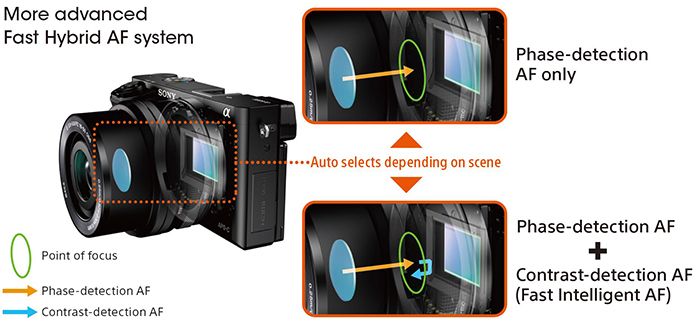
Digital camera technology is changing all the time, but some recent developments indicate that we are entering a period of exciting innovation. These developments are apparent in the revolution taking place in Auto Focus technology – and leading the charge is the AF system introduced in the new a6000. Until very recently, cameras performed autofocus in one of two ways – Phase detection with a dedicated optical sensor, and Contrast detection measured by the image sensor. “Hybrid AF” – autofocus systems that employ both approaches are reaching performance not possible just a short time ago.
Phase detection autofocus was introduced almost 30 years ago, and still operates on the same basic principles. A beam splitter directs light from opposite sides of the lens to a dedicated sensor which analyzes differences in Phase (luminance patterns), and determines the direction and distance the lens must be moved for the patterns to be aligned, and thus in focus. Phase detection AF has expanded to most all modern DSLR cameras, and has been steadily refined with the development of multiple AF points, predictive tracking and even specialized sensors for wide aperture lenses. Phase detection AF is quick, but its reliance on optics and mechanisms makes it bulky and expensive, and has trouble covering the entire scene.
Another approach to Phase detection has recently been developed which utilizes the camera’s image sensor – eliminating the optics and mechanics of the traditional design.
Contrast autofocus is far simpler – the contrast in the scene is measured and the lens moved until contrast is maximized – the point at which the scene is in focus. The advantage is simplicity and focus precision, although Contrast AF is typically not as quick as Phase detection AF.
The strength of the a6000 is use of both Phase detection and Contrast autofocus – while maximizing the performance of both with Sony’s Bionz X processor. Phase detection AF is provided by the newly developed 24MP imager, which includes 179 embedded AF sensors covering more than 90% of the frame, with focus speed as short as 0.06 sec. Covering more of the frame than most any other camera, a6000 can track even fast moving subjects and focus continuously at up to 11 frames per second. Contrast information is read from 25 areas of the image sensor and combines with Spatial Object detection based on recognition algorithms. Both Phase and Contrast detection AF systems can be used alone or together, based on direction from the Bionz X processor – even when shooting video. With the support of these two systems, photographers can enjoy ultra-fast, accurate and intelligent AF across nearly the entire frame – a potent combination not possible with earlier technology.
Much of a6000’s autofocusing performance is possible because of advancements in device technology – imagers with embedded AF sensors, processors with faster throughput, object recognition algorithms, and lens drive design. As device technology continues to advance, camera performance will advance with it, providing image makers with options for even greater creativity.
——–
Sony A6000 store link list:
Sony A6000 at Amazon, Adorama, BHphoto, SonyStore. In Europe at Sony DE, UK, FR, IT, ES, AT, NL, BE, CH, FI, SE, PT, WexUK.
Silver A6000 at Amazon US, BHphoto, WexUK.
Sony A6000 with lens at Amazon, Adorama, BHphoto, SonyStore, Sony Canada, WexUK.
Silver A6000 with lens at Amazon US, BHphoto, WexUK.
Sony 70-200mm FE at Amazon, BHphoto, SonyStore. In Europe at Sony DE, UK, FR, IT, ES, AT, NL, BE, CH, FI, SE, PT
A6000 Gariz case on eBay in [shoplink 26006 ebay]Black (Click here)[/shoplink], [shoplink 26007 ebay]Brown (Click here)[/shoplink], [shoplink 26008 ebay]Camel (Click here)[/shoplink] and [shoplink 26009 ebay]Red (Click here)[/shoplink].
0 Responses
If the lenses support it.
Please elaborate. I have the A77ii and have been using it a lot! I find the auto-focus works remarkably well on ALL my lenses. I have a lot of lenses.
You don’t know your A77II very well then, it doesn’t have hybrid AF.
Not only that, it is defeating the purpose of this marketing propaganda about NEX 6000.
I’ve my A77II for only a few days now and today just tried the Eye AF (yes, the “II” has it – but buried a little bit).
Works and from behaviour (going forth and back while searching) I think it is kind of contrast AF/hybrid mode. It also works only in AF-S and DMF modes, not in AF-C. Because of the latter limitation not really useful to me because I like to have my models moving…
A77II have phase detect in combination with subject recognition.
But not contrast AF.
Achim, you don’t know what Hybrid AF is, may I suggest you Google it.
It certainly isn’t on the A77II and had nothing what-so-ever to do with Eye AF! Eye AF is merely an extension of Face Detect.
Just to be absolutely clear, the A77II uses a dedicated PDAF module just like any other dSLR.
right and next gen A77mk3 will not even have the mirror or SLT design at all. it will be a complete mirrorless.
You can not remove the mirror and have fast AF, why do you think Sony have just spend a ton of money on the DEDICATED PDAF module in the A77II? You really don’t understand this stuff I am afraid. Whatever follows the A77II will be an SLT.
It should only be a problem with A mount lenses which are designed for PDAF. E mount lenses should be fine with either of PDAF and CDAF because they were developed for the latter. Or am I wrong?
You are wrong. 😉 It works with SUPPORTED E-mount lenses and that means Sony ones. Even older Sony E-mount lenses had to have firmware updates applied to the LENS (not the camera).
I didn’t know that, thanks. But I was more generally talking about the AF motor drive.
What do you mean about the motor drive?
For CDAF you need AF motor that can go back and forth really quick, so that the camera can distinguish really fast what direction is out of focus. Lenses made for PDAF cannot accomplish that because it is not needed for PDAF and thus the motors can’t do it. CDAF lenses of course work with CDAF, but they also work as well with PDAF because it is no problem for the motor to go to correct position and then stop.
So I am wondering why there is a need for an update because the camera has to make the measurements and then tell the lens what movements to do. This is at least how I understood the communication between lens and camera.
Don’t believe me? Just find out for yourself and start here:
http://www.sony.co.uk/support/en/content/cnt-dwnl/prd-dime/sony-sel-firmware-update-ver02-win
“Benefits and improvements:
Enables “Fast Hybrid AF” function. – Without this lens update, the camera will use the normal contrast-detection AF even if Fast Hybrid AF is selected.”
No, no. I believe. Why would you lie on this matter? I am wondering why this is needed, because of what I understand how things work.
Sorry what is the problem?? You have just said that E mount lenses support it….Third party lenses…Who cares…. Not Sony’s problem… No camera manufacturer promises that third party lenses will support all features on a camera…
People who use third-party lenses care and there are a great many of them.
I didn’t say it was Sony’s problem, so don’t infer that I did.
I am inferring that there isn’t a problem… Sony make E-mount lenses. and they work as they should with E mount cameras…There is no problem…
Well then you are simply wrong, there is a problem for owners of third-party lenses.
By “problem”…You mean not taking responsibility for taking the risk of buying third party lenses…it is your choice…Just don’t whine about it.
“World’s Fastest Auto Focus Technology”
Shouldn’t people be dumping their Canons and Nikons if this is true?
If everybody immediately dumped their investment in a system every time a competitor gained a notable technical lead, life would get very expensive. That’s not how it works.
Yes…
Well, at least it was the last advantage a DSLR had. Now the DSLR digital “transition technology” simply got obsolete.
What advantage do the SLTs hold then?
Fewer moving parts, simpler construction, the potential for higher frame rates (certainly at any given cost level), the option for continuous PAF and quieter operation.
Indeed, Canon themselves recognised some of these advantages when they put a pellicle mirror in the EOS RT back in 1989, although it had more serious problems in the film era. Those were notably the loos of 2/3rds of a stop of light (and film was much less sensitive than modern sensors) and a very dark viewfinder (not an issue with an EVF).
The only issues with an SLT/pellical mirror in the digital era is the loss of about 1/3rd stop of light and the necessity of using an EVF (for many an EVF is an advantage with information in the viewfinder, focus peaking etc.).
Pellicle mirror came about in the 60s:
http://en.m.wikipedia.org/wiki/Canon_Pellix
True, but I was looking for an example which used AF as it’s pretty well parallel with what Sony are doing so reflects (no pun intended) some of the potential advantages in that area.
Maybe AF tracking at this moment, it’s better tech than a DSLR. But it will also be totally replaced with mirrorless one day, only a matter of time.
This should have been titled: “Progress Report from Sony” instead of “Straight talk”.
We got rid of color shift issues associated with the NEX-7 (even with our own “system lenses” ) and the slow AF is vastly improved in the new model. Isn’t this the whole story about the A6000 in a nutshell? Most people know that already.
> Shouldn’t people be dumping their Canons and Nikons if this is true?
Well, if focus were the only thing that were important, sure. If it were true.
As I’ve been reporting for several years now, Nikon (and Canon, too) have a fairly constant leakage to the other companies. Including me. Remember, I started using m4/3 on safari back in 2009 and haven’t really stopped. Simply because there wasn’t a better Nikon solution. This year I’ll try the V3 for that, but we’ll see, the V3 has lots of liabilities that an E-M10 doesn’t. It has one ability, though: it can take my F-mount lenses, so my 500mm becomes a 1350mm equivalent without being degraded with TCs. But as I wrote, we’ll see.
Frankly, mirrorless is succeeding because it’s “good enough.” The marketing by the mirrorless companies trying to trumpet “better” inevitably fails because the customer tries it, finds out that they bought a marketing line, and now disbelieves the company. The proper pitch for mirrorless right now is “almost as good as a DSLR at virtually everything, but more accurate in focus, smaller, lighter, and maybe even more fun.” Moreover there’s the issue of where the photos will be used. Most of the mirrorless cameras have better WiFi connection to iOS/Android/etc. than the DSLRs.
Thus, a better marketing line is “DSLR-like speed and quality, compact-like size and weight.”
Frankly, I believe you are wrong 🙂 Most that buys these from marketing fluff comes from iPhones (or smaller compacts) , and then it is a real step up.
If you come from entry level Canon DSLR, chances are that it is still a step up. Nikons entry level tends to be less ‘entry’ and a bit higher spec’ed, and priced, so maybe it is a toss there.
But if you come from a D300 or a 5DmkIII, bought the marketing and got dissapointed, you are just being naive. And probably the D300 was out of your league.
And I agree with your pitch!
Maybe they will catch up to the 70D soon?
It’s not clear how a DSLR could ever combine CAF with PAF unless in Liveview mode with hybrid PAF-on-sensor.
CAF on the main sensor will ultimately be able to do things that PAF can never do in terms of context as, in theory, the former has the entire image to analyse.
Canon already combines OSPDAF with CDAF.
Also, the 70D uses Dual Pixel AF which is on-sensor. Nothing stopping them from combining image analysis with PDAF this way.
Canon lenses are all motorised of course (and a lot of the newer lenses have USMs). Also, from what I hear the Canon dual pixel approach is great for fairly static targets but not for sports and other high speed stuff. So I still think that to make it work well, the lenses have to be optimised.
…and you are correct. Unfortunately others here are a bit clueless. They think you can slap any lens on the camera and it’ll AF as fast as one with a dedicated PDAF module!
The motor is not the real issue, it’s the control.
LMFAO it’s taken years for Canon to catch up to Sony. How does the 70D perform when *not* in liveview as my A77II is VERY fast looking through the viewfinder AND in liveview.
I assume you are being sarcastic?!? Canon’s Dual pixel AF is years behind Olympus Panasonic and Sony on sensor AF technology… Dual Pixel is really slow and searches a lot…Not even close yet.
ROFL by your logic Sony and others are trying to reduce the number of pdaf pixels
Why make yourself stupid over brand loyalty?
maybe has too little money to buy anything else than what he already has, and has to hate all the others that seem a bit better than what he has for now. I think all die-hard brand fans are insecure , trying to justify their own camera choices and in order to do that they tend to degrade or insult others.
usually Nikon or Fuji guys the worst kind of fanboys out there , they take everything personal and never accept anything good about Sony or Pana or Canon or even Leica.
I sometimes like my Nikons but I hate Nikon fanboys , they are jsut too childish and insecure never accept anything wrong about Nikon or what Nikon has done or does.
Hmm here’s my ranking of die hard fanboys:
1. Pentax
2. Olympus/Pana FT/MFT
3. Minolta tied with Fuji X
4. Leica
5. Nikon
6. Sony SLT tied with Sigma
7. Canon
8. Sony mirrorless
9. Samsung
10. ?
Maybe he has used Dual Pixel AF…and knows what he is talking about…But don’t let me stop you…
What on earth are you on about?!?
What I am saying is that Canon are a long way behind their competition with mirror less AF technology. Their Dual Pixel AF system is a bit rubbish…Doesn’t seem that confusing to me…..
Sigh… how can they be behind when what they do is what Sony and others dream of achieving?
Have you even looked in to the details of Dual Pixel AF? Canon had to slow it down in the 70D because it was too fast as Canon wants it only for video. If it was the sole AF system, they would speed it up. If Sony can do it with just a few pixels why do you think Canon can’t do it with the whole sensor? The Dual Pixel AF tech also doesn’t waste pixels.
At least get the facts right.
Sigh… You need to stop reading Canon white papers…As with all technology the proof is in the pudding…Canon’s Dual Pixel AF is slow (tracking is a joke) and searches…Its that simple. They are a long way behind in real world usability…If actually using it isn’t “Fact” Then please enlighten me….
But it’s ok to read sony ones?
I highly doubt you understand how ospdaf works… if you did, it won’t take this long to realise how significant canon’s dual pixel af is. If we’re lucky they’ll share it with others.
Yeah.. of course… I don’t know what I am talking about… What was I thinking…… I am sure Dual Pixel AF it will be “amazing” when Canon can get it to work properly…
Ok in the mean time learn the differences between common ospdaf and dual pixel af.
As far as I aware I have made no reference to the technical aspects of OSPDAF?!?…Perhaps You could learn about practical application of technical theory..
And you can learn about not thinking in black and white. Canon doesn’t have dual pixel af in a camera that exclusively relies on ospdaf like the a6000. Currently the dual pixel af is aimed as a solution for video. How can you compare these two? It’s like comparing a race tuned car to a prius for fuel economy.
Also Canon are likely to deliberately cripple the usability of dual pixel af for stills because they need to sell their dslrs to back the massive collection of high end dslr lenses. Just see how much denial they’re in about the importance of mirrorless… e.g. EOS M, M2, 100D, etc.
Hmmm I get the feeling you rather like the sound of your own voice….and at the risk of following you off topic…
On the one hand you suggest that “dual pixel af is aimed as a solution for video”. But on the other you claim the Canon is intentionally withholding the technology from their stills cameras “because they need to sell their dslrs” Implying that the technology would steal DSLR market share…In your words “How can you compare these two”…
You need to think through your logic a bit more…
Did you go to art school by any chance? because I feel like you have.
3 archaic : talk or report of a notable person or event
—-
Content Copyright If you want to use any image from this website you
have to ask for permission. You cannot copy more than 20 words from any
of our posts. And you have to define the source with “Source: SonyAlphaRumors.com” (working link).
You don’t like your own rules, hm?
Sony needs to go back to the drawing board. By all accounts the E-M1, X-T1 and GH4 are all faster focusing, as is the 70D in live view, due to the Dual Pixel PDAF technology.
“By all accounts”…Meaning you don’t actually know…
Having tried the dual pixel AF from canon…It is not particularly good….Slow and searches…
Oh and inaccurate…
You haven’t actually tried all those cameras. I have. The A6000 is up there with that bunch, maybe even better at some things. See my comment about suitability to purpose, above. No camera is best at all things.
the GH4 is the world’s fastest mirorrless and the A6000 close second.
everything else is slow crappy in terms of AF speed and tracking.
You clearly haven’t used the E-M1, which is just as fast as the GH4. You’re not aware of your own bias.
and those Youtube junks are really useless, should not even called reviews, the one from HK or canada they are not serious reviews , they are just trying very hard to get more traffic coming over to their sites, that’s it.
if you want to discuss something serious about cameras go to Lula or getDpi fora, there are no other serious camera related sites online. DPR used to be good , but they are terrible now(with really degraded forum quality).
There is stupidness written all over your response. I’ve tried all of those cameras, except the GH4. The A6000 is by far the fastest. I doubt you tried any of them or you’d know the X-T1 is sluggish and not in the same discussion as the other 3.
https://www.youtube.com/watch?v=UfhKtwbqbfc
The Nikon 1 is about twice as fast with tracking. Sony’s focus tech is good but not special. Canon’s 1DX, Nikon’s D3 and D4 and many others are all faster.
Workd’s fastest isn’t true of with mirrorless (where Nikon have the crown by a mile) or DSLR where there are a number of faster bodies.
If this is true; then its pretty stupid/shameful of Sony to proclaim it to be the worlds fastest AF. Im guessing it could be the fastest withing a certain price bracket, but that doesn’t make the marketing campaing any less shameful/untrue.
If it infact is the worlds fastest AF then disregard this post.
Virtually every camera maker in the last decade has proclaimed “worlds fastest autofocus.” In virtually every official document you’ll see, this claim is always footnoted. Fujifilm did it only with a very wide angle lens, Olympus limited it to a group of cameras, and so on. And all of these claims tend to be about initial focus acquisition.
For years in the pro world the debate has been about acquisition versus follow. The Canon pro DSLRs have tended to get initial acquisition faster than the Nikons. The Nikons seem to follow complex motion more accurately, especially when they went to the color metering assist (which Canon has now copied).
The real issue with focus speed is suitability to purpose, not actual speed. Birds in flight is a different problem than toddler walking to mommy than race car coming towards you down straightaway. It’s tough to come up with a generalized system that does everything as you’d expect.
“which Canon has now copied”
Was that necessary? It’s pretty common for Japanese companies to “involuntarily share” their tech. It goes both ways when taking about C and N.
I guess Thom himself even not aware of it but he is at heart a die-hard Nikon fanboy……….if you follow his posting you can easily see it.
But this does not mean he is bad or his site is not good , actually it is great and helpful but it is only great to Nikon crowds.
I used to shoot Nikon Canon Sony Pana Leica, but now I seldom shoot DSLRs or Leica,I just feel they are all dated, nothing new , nothing interesting, and noone shows any sign of any of them actually listening to us (customers).
These days, I just use GH4, A7s A7R msot of times.
It is funny, how Tom’s entirely reasonable comment is bringing the fanboys out. Nobody “hates” mirrorless, but most non-fanboys are also willing to accept the disadvantages of the mirrorless offerings out there. And I say that as someone who prefers his X-T1 over the D800e for anything but speed of operation.
I’m used to the fandom response. I’ve been seeing it for over 20 years on the Internet now. If you write anything that they think might demean their dedication (even if it doesn’t) they go into attack mode. I sure hope that these folk don’t truly believe all marketing lines, or else they’re going to have a life spent buying things that aren’t as good as promised.
Thom, sorry for mis-spelling your name. I suppose I don’t understand the fanboy-ism. I am currently using an X-T1, a D800e, a Mamiya C220, Pentacon Six and a Fuji GX680. They are of course all “best” but only “for me” and “at certain things” and probably not even that. Maybe people are just very insecure.
I think users of all brands have now come to realise or are in the process of realising the benefits of mirrorless. The only ones who should oppose are Canon and Nikon (as manufacturers) because they are doing their best to ignore the elephant in the room by introducing deliberately under supported mirrorless bodies or by releasing crippled mirrorless bodies when they can do much better.
I have multiple sites that cover multiple camera companies. I call them as I see them. I’d say I’m mostly agnostic. Nikon FANS call me anti-Nikon, BTW.
Historically, I’m a long time Nikon shooter, but in the past several years I’ll bet I’ve shot more images with cameras that don’t have an N at both ends of their name. Again, I call it as I see it. Agree or not, but I’ll defend what I write with my research and use.
But you as well as I know that bias are unconsious to ourselves. And in that sense, each and everyones history and background is good to know. Because it sets our preferences.
For instance, you ‘have’ to mention that C have ‘copied’ N’s AF technology.
I on the other hand would never mention that, but instead mention that both C & N copied Minoltas idea to use AF.
And neither of us would be wrong… 🙂
– It’s just bias. That little darn thing that’s sets our frames and we use to measure others against.
And no, I did not find you text to be a critisism to MLC’s. I think that all claims are correct when they were done. With the footnote of course.
Nikon actually had autofocus before Minolta (and VR before Canon, for that matter). They did it differently, and in-lens, not in camera. Once Minolta popularized the current secondary mirror/PD route, Canon and Nikon followed. Unlike Minolta, they paid royalties to the originator of the idea, Honeywell.
I don’t believe use of the word “copy” reveals any bias on my part. When something is created by one company and it becomes apparent that it has a benefit, the others scramble to make sure that they’re not at a deficit, so they end up either having to license (not the case here), copy (the case here), or find a different way to do the same thing (not the case here).
It’s actually you that has the bias towards the word copy. You seem to feel that it’s a denigration of some sort. I simply stated “which Canon has now copied.” I did not imply good or bad in that sentence; you inferred it.
Now if you read other things that I write, you’ll find that I believe that direct “copying” is a sign of weakness. It means that you feel you really need that thing but don’t have another solution available. Your only choice is to copy, and perhaps change a few minor things to try to get around patents.
Nikon has certainly copied things from Canon, as well. So I’m not sure where my use of the word copy is showing bias.
I wasn’t so much aiming at your word “copied”, I just put in quotes because Canon would admit copying. Much as a artist doesn’t copy, they just ‘get inspired’ ! 🙂 It was more about the fact that our bias is our frame and we all have a frame which sets the context we see things in.
In such the use of the word copy doesn’t reveal the frame as much using an example from the Nikon sphere does. Because it is your home turf and therefore easier to use examples from that arena. As I said, if I wanted to provide and example of copying, I would refer to AF system, or maybe wireless flash or high speed sync flash.
Canon is not my home turf, but I guess they would refer to SSM or IS.
Or maybe white lenses.
I think so. Most of the involuntary sharing of tech between Canon and Nikon has occurred due to third parties supplying it. For example, the flash systems are much alike because both companies chose the same underlying supplier.
The color-integrated-focusing technology, though, is all Nikon. I can’t imagine them sharing it with Canon voluntarily, and to my knowledge, they didn’t. But I’ll ask next time I talk to one of those engineers.
FWIW, I try to call a spade a spade. Nikon has now copied Canon’s sRaw idea, for example. Essentially, the two companies will reverse engineer to keep parity, license third party technologies that aren’t exclusive to gain parity, etc.
I think you should try the GH4 and A6000 seriously in real world before forming so hard bitter opinion on mirrorless AF.
They are indeed better than most of comparably priced D-SLRs.
Just do not compare it to D4s but to D5300 or D600, you then know what I mean and what Sony and Pana meant.
What is bitter about his opinion? It is simply a fact that those “fastest AF” claims are not true. And faster than a D5300 but not as fast as a D4s or “better than most comparably priced” cameras by definition is not “fastest”.
Also, the acquisition vs tracking and suitability to purpose debate is a very valid one for anyone who actually uses fast AF for their photography.
I have and I do, so I’m not sure what you’re suggested my problem is. I do this regularly, and in real world shooting.
“Better” is both a subjective and vague statement the way you’re using it. What subjects are we discussing, and am I allowed to move the camera out of the defaults? Because if I can’t on a Nikon consumer DSLR, then I can’t get rid of the automatic single/continuous calculation it does, which indeed slows it down for moving subjects because it’s a moment before it will decide the subject isn’t static.
Focus systems ARE rocket science. Much like it takes advanced calculus and lots of CPU to do constant trajectory calculations, focus systems have the same problems with tracking calculations. In my experience with the A6000, it tracks straight lines fine, not so good on random motion. But I haven’t written my review yet because I’m still testing. Ditto the GH4.
The Nikon 1 isn’t an APS-C sized sensor. Making fast AF on small sensors is child’s play in comparison, compacts have been doing it for years.
Compacts have not, in my experience, got fast AF. However, what they do have is a considerably deeper DoF, which means that they are more tolerant of less-than-precise focus.
Compacts have generally had lousy AF.
I am speaking in relative terms.
Did you watch Gary Fong’s video? Not only is the A6000 as fast or faster than the SLR’s costing several times as much, but has focusing capability and features well beyond the technology of the Canons and Nikons. This system is a generation or more advanced by comparison. See the video here: http://www.sonyalpharumors.com/sony-tidbits-113/
You’re kidding right? You are claiming a Sony sponsored video is proof of Sony’s superiority?
I own the cameras. The Nikon 1 V3 is the fastest most accurate system period. Forget depth of field. It’s better at f1.2 as well. Plus that argument makes the full frame bodies even better thanks to the Sony’s crop sensor.
Sony make some good bodies but lying in order to sell them is foolish. The Nikon 1 has many flaws and it’s IQ is worse thank the Sony by a mile. However if you want he best autofocus bar none, the Nikon is it.
As for the pro bodies you’re simply wrong. The Nikon D4s is faster than the A6000 period. So is the Canon 1DX. The Nikon tracks better than the Canon. The Canon is a little more accurate.
Only fanboys try to lie in the face of the evidence. Sony can boast about making tiny full frame bodies. Like every company their products have flaws. They can’t claim fastest AF until they can track at 20fps or more.
So you’re right. Doesn’t that make the A6000 that much more incredible? So few compromises: better IQ than the V3 while only being a little slower and priced the same (or less). Not to mention the D4S and 1DX, which may be marginally better, and are full-frame, but cost magnitudes more and are much larger/heavier.
If you have to come out and say your product is the world’s fastest, then chances are it’s not the world’s fastest.
In that case I have the World’s fastest car*.
*This may not be true.
Or chances are it is.
Well, if that text warrants the title of “Professor” then I’m worried.
– That’s a sales guy with his side blinders on talking.
The 6000 still is a marvelous piece of camera…
If this is the worlds fastest autofocus then why can it not be made compatable with A mount and 3rd party lenses.
In that case the SLT mirror would be eliminate and we could have high speed focus on mirrorless A mount.
For the same reason I keep telling you how the AF works, or rather doesn’t work, with A-mount lenses. You don’t listen though and ask it AGAIN and AGAIN.
The fact that they are not making these things compatable is not a matter of technology by rather one of priorities.
If they wanted to make it work there is actually no reason they could not find a way.
You have told me many times that because this is the way Sony CHOOSES to do things nothing else is possible.
Then you mistake not listening to what say with not agreeing with you.
I am definitely not of the …it cant be done school….and I have many times over the years been told that almost everything we currently do cant be done.
So if you want to join the ..it cant be done masses go right ahead but dont expect me to agree..then again every so often some of them actually break away from the. It cant be done mass and actually figure out how to do it.
Lenses that were made for PDAF generally don’t work well with CDAF, because the latter require faster and more accurate movement of the lens elements. Of course Sony can make new A-mount lenses fulfilling those requirements, but the lenses that were made to work with PDAF only are not optimal for use with hybrid AF.
Barry, IT ISN’T GOING TO HAPPEN. When will you get it into your thick head that Sony would have to support EVERY A-MOUNT LENS IN FIRMWARE to make them work with OSPDAF.
Yet AGAIN I have to tell you this!
Again you seem to think it cant be done…because sony chooses not to do it..
If as you seem to think it cant by done because every lens would have to be supported by firmware…and if as you seem to think that is too much to require of an in camera processor than that would actually make the solution rather simple…Sony would simply need to make a seperate firmware update for each lens and facilitate internet access of them .
Individual users can then download only those firmware updates for the lenses they want to use.
Furthermore Sony can charge a fee for the download to offset thier cost.
Your very reason for claiming it cant be done is the method to make it doable.
As I said unlike you I am not of the cant be done school…problens are there to be solved..not to make us give up…
If Sony chooses to make it work I belive they could and using your own argument I have just shown you one method of doing so.
>Sony would have to support EVERY A-MOUNT LENS IN FIRMWARE
Nope. If at least most important lenses were supported with at least one central focus point, that’d been better than no support at all.
Yes they would. Like Barry you simply don’t understand how AF works.
I do understand, but you don’t understand your reasoning is circular.
Why E-M1 supports OSPDAF with old 43 lenses?
You still have the idea stuck in your head that if Sony doesnt want to do it it cant be done…here is your argument..
All that is required for the lenses to work is firmware support
There are too many lenses so Sony CHOOSES not to provide firmware support.
Therefore it cant be done.
It’s because A-Mount lenses (in general) do not have the physical capability to meet the exacting requirements of the combined PAF/CAF system. Screw-drive lenses have got far too much backlash for effective CAF operation and even motorised A-Mount lenses were never designed for fast, precise CAF with it’s requirement for highly precise and fast back-forward motion at extremely high speed.
You might as well ask why a DVD-player won’t play Blu-ray disks whilst a Blu-player will work with DVDs. The latter was simply designed with capabilities that the former was not.
Just as in your example…blue ray is the newer system and was deliberately built to be bacwards compatable with DVD…so too the new mirrorless systems can be built backwards compatable with old A mount.
The new backwards compatable focus should be at least as fast as the older system with the older lenses.
Todays SLT is backwards compatable to screw mount lenses which will focus better than they did on the old cameras but still the screw mount will not respond as fast as a high speed focus motor.
So too the current lenses could still be made to focus to thier current potential while newer lenses can be desighned to focus even faster.
But what you are asking is for A-Mount to work as well as newer E-Mount lenses. You might as well ask DVDs to work as well as Blu_ray. Blu-ray players will up-scale DVD to HD, but it can never match the resolution of a true Blu-ray disk. The same with older A-Mount lenses.
Also, not all A-Mount lenses are equal. Older lenses don’t have distance encoding, and that means they can never work with ADI flash exposure. Why on earth do you think that A-Mount lenses can always be made to work with new camera facilities? It’s simply a ridiculous notion.
As for newer screw-drive bodies focusing faster with old A-Mount lenses, I can tell you that wasn’t always the case. With some Sigma lenses, the higher torque motors would strip the lens gears (as happened to me). Several A-Mount bodies had the option to reduce the focus speed to allow for lenses that couldn’t cope with the torque.
No, basically he is asking for A-mount lenses to focus on A6000 + LA-EA1 (or 3) at least as fast as the same lenses on SLT-style A-mount body.
Correct..I am asking for current lenses to focus as fast as they are currently capable of but without the mirror.
Which isn’t going to happen on mirrorless but you don’t listen.
I don’t know why you say “no”. I’m under no illusions what he’s demanding. That is he wants legacy A-Mount lenses on the EA1/EA3 adapter using the A6000 autofocus as fast as native E-Mount lenses on that camera. It’s clearly not possible unless A-Mount lenses have the same optimisations that E-Mount lenses do.
If the target was just to achieve the same AF as native mode A-Mount bodies (we might argue which actual body), then you go for the LA-EA2/EA4 adapter, but for some reason that’s not good enough for him.
They’ll never be compatible their AF technology has already diverged since the launch of A77II. Sony’s new 79 point AF is revolutionary, and as future A-Mount lenses are optimized for this tech compatibility between both systems will be doubtful.
You’re inventing bulls%%t by repeating marketing texts.
Olympus E-M1 supports hybrid PDAF with old 43 SLR lenses and nothing prevents Sony from doing the same
“Todays SLT is backwards compatable to screw mount lenses…”
This has nothing to do with backwards compatibility. SLT still uses a dedicated PDAF module like older A-mount cameras. The only advantage it has with regards to focusing is an uninterrupted view of the subject, as there isn’t a mirror being flipped.
Barry Compact System Camera technology, and DSLR are entirely different. It’s like comparing a SUV to a Prius.
SLT have an entirely different AF system that is wickedly fast. Faster than the AF system in the above document.
Of course you need an A77II to use one, and I’m pretty sure you don’t own one, cause you would have already known this.
The A77II SLT’s 79 point PDAF is the fastest AF, and it will only get faster.
Apparently you haven’t used a modern SLT like the A77II. It’s Sony fastest camera, even with screw driven lenses from the 80’s.
So if your making comments without having used the technology then, don’t waste out time
The a77ii is a great camera..thart was never an issue..but so is the a77.
With limited resources I need to decide if I want to risk not having money for the Barry sensor when it comes out.
I am doing a bird shoot soon and am actually considering one for the shoot.
Well without the A77II in your system your missing what could have been your greatest asset. It makes my Minolta 400mm F4.5 feel new again. And 12fps (all in focus) on a 20 year old lens is an achievement.
Can’t you rent it for testing? It will be easy to decide 😉
That is one of the options I am considering but I also am waiting for theTamron 150-600 for Sony mount I preordered…that complicates things because I want to put the camera on that lens…I am considering renting the Nikon version and the d 810 camera to put it on but lens rental is still awaiting arrival and I dont know if I can rent one.
I dont want to rent Canon version because canon camas are currently too low resolution and the a7r is like playing with tinker toys…too many parts and slow autofocus when I am done..in fact I am not even sure if the adaptor will focus a Tamron lens.
If you value the speed benefit between A77 and a77II, don’t mess that up with third party lenses.
3rd party lenses are often the best value…particularly in the case of the lens I mentioned.
It would not make sense to buy an inferior or more expensive Sony lens just because Sony wants to keep certain features proprietary.
Also people have commented to me that the fast focus features of this camera also work with third party lenses.
Are you trying to say Tamron lenses will focus slower than Sony lenses on the a77II ???
Well, if it beats the 70-400 mkII, let us know!
I just found out the A mount Tamron 150-600 are beginning to enter the country and I should get it in time for my next bird shoot.
I have not used the 70-400 so cannot compare them for you.
I do have the Sigma 50-500 which I expect to be retiring soon…..
To provide a bit more technical response:
Aquire AF is a process in many steps, overly simplified:
– Determine what to focus on, and HOW MUCH out of focus the lens is.
– On a screw type AF, rotate the screw the correct distance.
– On an SSM type , send a signal to indicate how much to move focus and await focus confirmation.
The first step may well be te same for many lenses, but the performance of the latter depends heavily on lens design. I.e how much glass needs to be moved and how far does it have to move. and how strong is the motor that shall do this. ( Lens design have changed a lot since AF was introduced s moving a small amount of glass is beneficial for AF performance).
The latest Sony lenses have more processing power and motor power to provide extemely high AF speeds. This benefits both inital AF aquisition and tracking performance.
I suggest you read what I wrote and not what is going through your head. I am explicitly talking about the A6000 hybrid AF system. I am not, nor have ever referred to the performance of A-Mount lenses on A-Mount bodies.
Do you have that clear. Just to confirm once again, all my comments about A-Mount AF performance are using AF on the sensor in combined CAF/PAF form and not using PAF on SLT. As this thread is all about the A6000, I would have thought that abundantly clear, but that seems not to be the case.
I think you should have written it in simpler terms. The A-Mount, and the E-Mount are two entirely different platforms.
The A-Mount doesn’t need to do anything to its AF system, is incredibly fast (as any A77II user can testify). Its 100% backwards compatible with all Minolta AF lenses.
It focuses screw driven lenses faster than most SAM lenses.
The analogy you stated simply doesn’t make any sense. The E-Mount system (and mirror-less) AF systems are currently inferior to their modern SLR counterparts.
The E-Mount is like a MacBook pro trying to reach Mac Pro (A-Mount) levels of performance.
The only problem is when A-Mounts are upgraded the performance gap between the two systems becomes a canyon, as we have seen with the A77II upgrade.
PDAF is entirely different from CDAF. PDAF does not require the back and front focusing adjustment that CDAF does.
Hope it’s a 1000 times better than the a99’s staggeringly bad AF.
This document refers to mirror-less technology not SLR.
It’s A6000 marketing hype.
When they say 11fps they’re specifically talking mirror-less, cause the SLT are 12fps even with screw driven lenses.
The fastest Auto-Focus award goes to the A77II, which you decided not to buy for what ever reason, and it’s very fast.
The A77II doesn’t need a hybrid system because it’s 79 points are wickedly fast enough.
Come on man…He decided not to buy it because they only used a 24mp sensor instead of the 54mp stacked sensor he was promised they’d use by a “Sony Executive” he managed to get ahold of. Nevermind that the 24mp is the fastest sensor Sony currently has in any APS-C camera, it’s not good enough for old Barry here, and it’s apparently ancient and useless technology which takes photos that look like they were taken by a 90’s era camera phone, or at least that’s what I’ve been led to believe by Barry’s non stop ranting.
That’s marketing text, not corporate secrets. I am sure they’re happy you posting that here.
No not secrets, since the camera incorporating them has been out for several months.
Could newly developed A mount lenses support hybrid AF? Or, is there something inherent in their design that precludes hybrid AF? Candidly, I don’t see why it couldn’t be built in, but I don’t follow lens design too closely. What do people think?
If cameras become totally mirrorless, then it will be possible, but not with old lenses, they are too slow. It needs totally new lenses to do it, maybe some recent ones can be updated by firmware. But, forget screw drive lenses for that.
Screw drive lenses have a chance of supporting it than anything else… you need the AF in the body (A mount) or adapter (in E mount) to support hybrid AF. Screw accuracy is a different matter.
Screw-drives have too much backlash to work well with CAF. Such systems need very fast, low mass, low backlash drive systems.
The screw-drive lenses were developed in the days when focussing was (largely) one direction only using PAF. If the lens over-shot the focus point because it couldn’t achieve focus, it was a relatively slow process to reverse.
Where old legacy lenses (of whatever several mounts) are made to work with CAF, they are painfully slow. OK for fixed subjects, but not moving ones.
I was speaking conceptually… hence the last line about accuracy.
No, the modern A-Mount has been designed with a dedicated 79 point AF system, which allows 12fps or better bursts. In order for it to preserve cross-compatibility it would have give up speed which no one is willing to accept.
Modern A-Mount lenses will be designed to operate faster than 12fps, with the A77II type AF system.
I agree. The A-Mount 79 point AF system is highly optimized for the A-Mount system. The notion of maintaining cross-compatibility for the sake of the 1% that actually use it, is absurd.
The A-Mount new 79 point 12fps AF system is only the tip of the iceberg, and should easily reach 16-20fps within a year or two.
I do like the idea that the e-mount will reach modern DSLR AF parity in the near future. However Sony DSLR performance will already be a generation or two ahead, when this occurs.
Nikon, and Canon’s performance will not. They seem preoccupied designing mass produced Walmart quality DSLRs for the time being.
They haven’t seen the danger of mirror-less cameras, and it might already be too lated for them.
is there any video version of this ? I want to see it in video.
Sure – https://www.youtube.com/watch?v=UfhKtwbqbfc
Great stuff! Will Sony please put this in the A7r Mk2 please? That and a non slappy shutter. Then we’re there!
We need a real NEX-7 successor, not this toy camera.
If the a6000 is holding you back from capturing amazing images I feel bad for you.
I’ve had this toy camera and it is by far and above better than my NEX-7 (now sold).
Could you at least back up your idiotic statement please?
The NEX-7 has tri-navi, the A6000 doesn’t. It’s about the controls, nothing wrong with the A6000 otherwise.
I would like to thank admin for providing yet another opportunity for fanboys for all systems and particularly the SLT and mirrorless fanboy crowds to fill their diapers to overflowing on SAR.
Not to mention those who prefer theirs filled with sarcasm.
Oh wait – does that mean me too?
No need for sarcasm because unlike all the other fanboy boasts theirs is the best camera and system I know without a doubt mine is clearly far superior. Anyone who doesn’t think like me knows nothing about photography.
watch out…we got a badass over here.
today I tested CDAF with the a7 and LAEA adapter (the one that doesn’t have the mirror) and with the Zeiss 50mm f/1.4 SSM I noticed it focuses faster than my 3 year old NEX-5, but that’s it. Focuses just faster. Not fast.
Anyone here with A-Mount lenses, adapter without mirror and a6000 to see if it focuses faster than any other E-mount cameras out there?
A-mount lenses on the A6000 do not focus any faster than other NEX.
Is there any difference between screw-driven lenses and ssm lenses?
Pretty sure there is no AF for screw driven lenses on the LAEA 3 or LAEA 1. You need the mirrored LAEA 4 or 2 for that.
Maybe a fast camera is as fast as you need it. I remember the AF cameras Nikon put out in the 80s that were barely usable. Fastest or not, the A6000 may be as fast as needed for those who own it.
Photography should be fun. That’s my motto.
Exactly! It’s pointless to argue about which camera has the fastest AF, the best IQ, the fastest frame rate, or whatever. It’s all about the camera’s capabilities relative to your needs. If a camera allows you to take the kind of pictures you like in the shooting conditions that you’re working in, then it’s a great camera for you.
Was expecting a REAL explanation, oh Sony…
Bummed thy went STL with the A77II ………..Holding off for the A99II now im just hopeing thy have a 12fps crop mode for sports
Too rich. Didn’t we have enough of ever successive Fuji camera coming out in the last year declaring “the world’s fastest autofocus?” Only to have later iterations of the claim come out with an asterix with all kinds of disclaimers and exceptions and restrictions. And to have even later iterations drop all such claims whatsoever.
Here’s a hint to mirrorless. Instead of marketing departments trying to provide convoluted explanations, just show us. Let the reviewers marvel, instead of offering excuses and good-enough rationalizations. Promise less, deliver more.
Someone at Sony hire this guy, please.
Can it do manual exposure in AF video mode? I absolutely could not believe that after three years the a77II still fails at that basic feature… does not bode well for the a99 mkii
The camera does not have a contrast detect AF system, and manual mode means that you can set aperture, which in turn inhibits PDAF. Sad but not strange.