







The japanese blog Egami found a new Nikon translucent mirror patent. The Patent No. 2011-28177 has been released on 2011/02/10 and the filing date is 2009/07/29. But there are a few crucial differences between the [shoplink 3617]Sony A33/55[/shoplink] solution and the Nikon patent. Egami highlighted them (attention, google translated text):
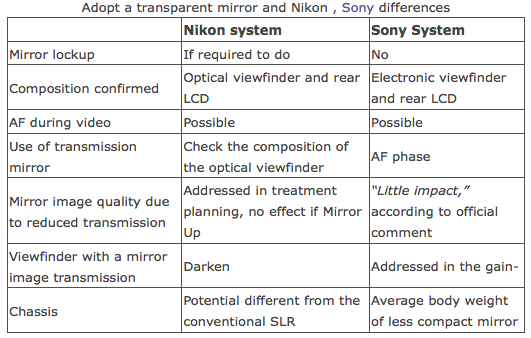
The mirror lockup is one of the most requested features on SonyAlphaRumors. See the poll results:
[poll id=”28″]
The A77 is rumored to NOT have this feature. But I hope Sony will take it into consideration for the A99 fullframe translucent…
37 Responses
If you flip up the mirror to take a shot you have to:
1. Use the LCD screen cause the viewfinder will be black
2. Use contrast AF or manual focus cause i doubt nikon found a way to introduce PDAF on the sensor 🙂
The whole point of the translucent design is to keep constant PD autofocus, otherwise the better choice would be a SLR.
It would be nice to be able to lift the mirror and use contrast AF to focus, but sony should definitely keep the EVF for APSC cameras. The ebst thing is to make PDAF work on the sensor, and then mirrorless would be the future.
“If you flip up the mirror to take a shot you have to:
1. Use the LCD screen cause the viewfinder will be black
2. Use contrast AF”
huh? You didn’t get it.
DSLRs currently have the flip-up mode and they can PDAF + have picture in OVF.
Flip-up mode means that mirror flips while taking the photo – not that it’s kept constantly on top!
well it says mirror lock-up which means holding the mirror up… so i didn’t get it wrong. Although I should have used lock-up instead of flip-up, but i meant flip up like flipping the mirror up and keeping it there 🙂
Even so, if it had a Flip-up mode the image would still be dark enough to not make it popular. For reference check canon’s implementation of the translucent mirror in the 60′.
Not sure If I get it correctly. When mirror is down, it seems it reflects light to prism, how does PDAF sensors get light then? In case of Sony, the translucent mirror reflects 30% light to PDAF sensors. So in case of Nikon, if say 30% light goes to prism, there should be AF sensors somewhere in the light path.
Surely this would work the same way as any other conventional PDAF DSLR with an optical viewfinder.
It’s good in theory that Nikon are going to try to keep an optical viewfinder, but if it is significantly darker because it receives only 30% of the light, then what’s the point?
FF cameras have big bright OVF, but if they get only 30% of the light they won’t be much better then any conventional pentamirror OVF, maybe even worse. That is why i said it’s better to use a dslr than this 😛
Nikon made several variants of their F series with pellicle mirrors back in the film days.
Used conventionally, they make a lot of sense for sports photography, but Sony went on a different tangent with their implementation, focusing more on video.
I’m surprised Canon isn’t getting their toes into this category, being the only company that managed to be commercially successful with a pellicle mirrored film camera.
I saw the Sony future. Sony will be soon world#1 in imaging devices and follow by Nikon #2 by 2012. But this will hold me to buy A77 unless it is a very interesting camera.
Nikon is a follower in this new mirrorless world. Nikon no dare to take up the challenge until Sony breakthrough the barrier with this innovative camera and for that Sony quickly replaced Nikon #2 in UK lol ….
Competition will mean cool stuff from everyone — yay!
I’m gonna die laughing if Nikon will be the one to make SLT tech RIGHT as it should be done….
ok, maybe with exception of viewfinder – this one in Nikon version gonna be very very dim, cause you’ll need part of light for sensor and part of light for AF aside from the viewfinder.
One partial solution to this would be reducing the amount of light sensor gets but this means more noise – and more noise isn’t something Nikon lovers gonna accept so easily.
No one claims that Nikon would be using the same kind of pellicle mirror as Sony. Let’s assume the mirror would reflect 80% of the light instead of just 30%. That would surely be enough for an acceptable OVF. 20% light on the sensor will be enough in most situations. In dim light, you get the option to flip up the mirror.
The only disadvantage I see is the inevitable light loss when recording video (with AF & OVF at least).
how are you supposed to take a photo with 20% of the incoming light hitting the sensor?… if you say the mirror flips up then ur still better off with a traditional D3X/D3S.
The point of having translucent mirrors is NOT about having a bright OVF, its for stuff like Sony’s PDAF.
Yep. Exactly.
First, 20% was just an example. Second, 20% isn’t as bad as you would think. That’s something like 2 stops, which shouldn’t be a big issue when recording video (because of the lower resolution of video). And when you’re not recording video, you would have an almost normal DSLR (with a slightly lower PDAF performance, because the phase detection gets 80% of what it gets in a normal DSLR). Of course, it’s still a compromise, but at least you get 100% light on the sensor when you need it (available light photography). And no extra ghosting or scary CA’s as with the A55.
And about the OVF: I know the advantage of SLT is about the PDAF when _recording video_ and high picture frame rates. But a lot of photographers wouldn’t even consider buying a camera with an EVF. They would never go for the Sony concept but could very well accept the limitations of the Nikon design. I personally don’t mind and EVF (if it’s good & better than in A55), but I hate the fact that you can’t get rid of that extra sheet of plastic in the way that might sometimes mess up your pictures. The Nikon concept therefore does have some appeal to me (but as a Sony user, I’ll have to wait for Sony to improve).
Well, to me, it looks rather like a copy&paste from the Canon EOS RT with flip-up mirror… For the rest, I agree with Almond below: What’s the hack of having a translucent mirror, when you flip it like an ordinary mirror?
Video and serial shooting. That’s what for.
You don’t try to tell me that the mirror is there to have night-time ghosts and increased purple special-effects? 😉
What’s the point of the translucent mirror if you’re gonna lift it up for the shot?
That’s exactly how the current reflex mirrors work and they are way better…
FAIL
Seriously I have nothing better to do than try to prove everyone’s wrong because I have no life. I make up half of my arguments just to sound smart, on previous posting I clearly said that I had jumped ships to Canon … yet I still wonder why I’m always back here “quoting” and lecturing others with my ignorance.
ur not on a boat? WTF!
Because you have nothing better to do 🙂
what? lol
lol i know you start jealous about sony future camera while canon sit there enjoy do nothing so far in mirrorless world. nikon start to see the market after seen sony overtake it in many places.
Finally! The A700 whiners can move on to Nikon and leave Sony to innovating and improving their DSLT experience!
Yeah, they just have to wait about.. 3-5 years?
Maybe even more considering the fact that not all patents are made into real products.
Mirror lockup to me only made sense in a steady blur free shot such as macro or long exposure. Putting a mirror into and out of this state is just annoying and something else to worry about.
I’m actually intrigued by the fact I won’t have to worry about the mirror in Macros and longer exposures.
Bring on the A77!
Yeah!
Yeah! Yeah!
This is an interesting idea from Nikon, if I’m reading this right. It looks like the design works generally like a normal SLR, except that it allows a little bit of light through to the sensor when the mirror is down, and that is used for Live View. Therefore, one can frame with the OVF (which will be a bit darker than normal Nikon EVFs,) or use Live View, and the mirror flips up, letting all of the light to the sensor.
Looks like the operation of the pellicle will be different based on whether you are shooting video/burst mode (stays down to allow focusing whilst capturing) or single shot (option for traditional slr flip up/down action).
More configurable. The a77 should do this as well, but the rumour is that it won’t.
Still confused. When the mirror is down how does the AF sensors get light? Not talking about the Image capturing sensor but CCD line sensors that do PDAF. I couldn’t find it in the diagram. For the sake of argument if there exist another mirror behind the translucent one like normal DSLR, then even that mirror needs to be removed from lightpath while taking picture, thus no AF during mirror blackout. What’s the point of having the a half mirror then. Unless Nikon found a way to incorporate the AF sensors in the prism itself I don’t see how it works. Please can anyone explain
Ok, here it is – an animated explanation how that’s suppose to work.
http://alphacorner.eu/download/NikonSLTPatent.gif
Note though that I don’t have access to original patent so I could make it only as good as the website described it.
The light beams are marked orange – their size shows you how it’s distributed between sensor and OVF (assuming 70%/30% relation which already gives noticeable difference in OVF, more light to sensor == even darker OVF).
Hope it makes things clear enough! 🙂 (and I didn’t mess anything… hehe)
Unless nikon bakes PDAF sensors into their main image sensor, this light split mechanism will NOT give Phase AF… which I must say is the fundamental component to Nikon’s revered AF algorithms and reliability as quoted by many pros over Canon.
I’m sorry but, if as the GIF explains it, this gives Contrast AF to nikon users who shoot video (and OVF live view of whats being recorded) by completely removing Phase AF off the camera. I don’t think Nikon people themselves would bother to buy this.
At least, as a Sony user, we can still be envious of 51 AF point systems with 9 cross AF points… we know Sony’s getting there, but man… Like i said, if this is a drop of the Phase AF system of Nikon just to have some fancier optical live views and gimmics, then not even Nikon people would buy it.
Yes, that’s all true. It’s not what GIF says, but rather – it’s what the patent supposedly says.
It’s more like… a Camcoder in DSLR package instead of DSLR with camcoder functionality.
It’s very weird in did, Personally my best bet would be that Egami missed something, like that the sensor has PDAF sensors, cause I don’t see Nikin releasing full CDAF camera ever. Nikon lenses ain’t suitable for contrast detection – just check the movies from D3100, they totally sux in AF.
I think we won’t see such camera from Nikon anywhere near next 3-years period. Or there’s something important missing in the puzzle.