







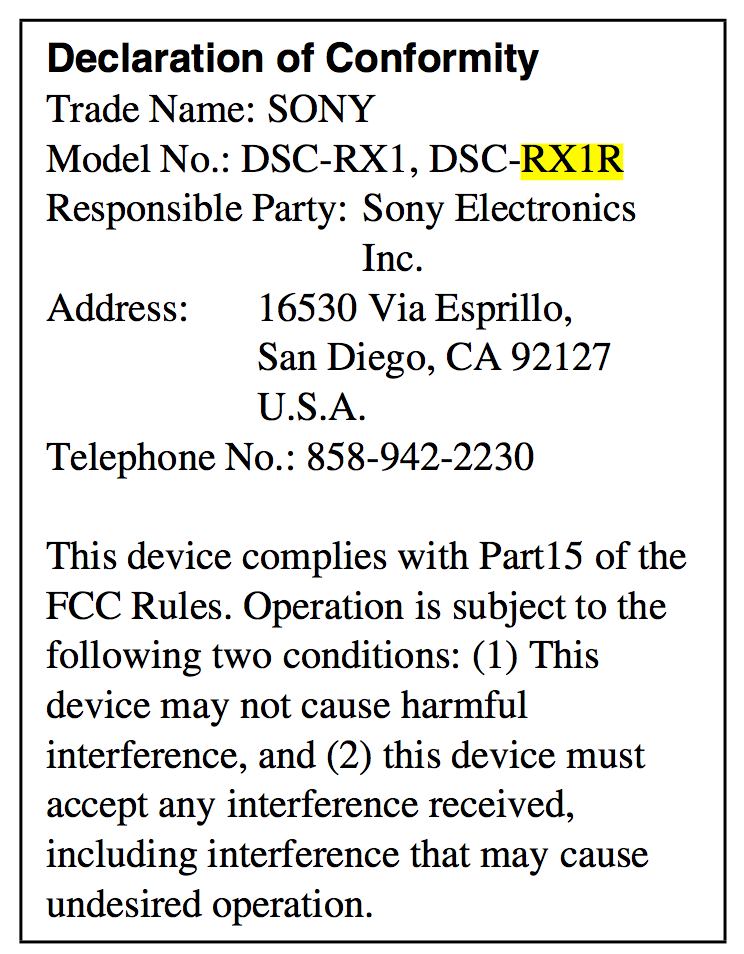
I got feedback from trusted sources (and also via colleagues from photo rumors) that the only difference between the actual RX1 and the RX1R is that the RX1R has no Anti Aliasing filter. I have no info about the price of the RX1R but I really do hope they do not charge extra $$$ for that. The new RX1R will be introduced as “High Resolution” version. Like the Nikon D800E is the “high Resolution” version fo the D800. That’s why the manual is the same of the current RX1!
Reminder: The Rx100MKII and RX1R will be announced on June 27. There may be a “Mobile Cybershot” smartphone camera too.
80 Responses
LOL, people expect too much.
That’s it?
As useful as a marzipan dildo.
The market for this is the same market as the D800E.
Also, people who truly believe they will REALLY get considerably more res out of the same sensor.
Disappointing, really, because I wanted another focal length and they could have had my money, again.
The RX1 released less than 6 months ago, expecting a sequel or successor already is less than reasonable (from any camera company).
Who wanted a successor? We all expected a ‘variation’. So, some wanted a new sensor, some wanted built in EVF and what not. I wanted a mate to my RX1, an RX2 with a 50mm lens. That’s hardly a successor. Just a mate.
Yes, a 24mm would’ve been great 🙂
But, at least, this shows that the RX1 is selling well.
So, you only wanted a “variation” with:
– a new sensor
– a redesigned body to support and include an electronic viewfinder (yes, before you think it, it would have to be redesigned/ re-engineered -they can’t simply glue it on top)
– a new lens with a different focal length
Your definition of variation is wildly different than the actual definition. A variation must be able to be produced using the same manufacturing lines with mostly the same parts. A non-AA version fits the bill. You were hoping for a sequel / successor to a very new camera. It is unlikely that will happen for at least a year from now. Companies tend to like to get a return on their r&d.
C, so you went for the semantics and screwed that up. There is nothing in the definition of “variation” related to the exact extent of the variation. Maybe you should check the “actual definition”.
Sequel is what the RXR1 is. I was hoping for tele version of the lens in it. ah, well.
The AA less sensor alone is worth the revision. ya, that is the correct term. Revisione.
Silly… everyone knows you eat marzipan… it’s supposed to go into your mouth.
Will cost 1000 more without the AA filter
Well rx1r it is then!
Admin: any more news about the RX100MkII? Is it really going to have identical imaging technology (lens not faster or wider, same sensor)?
then it is useless for me , I need AA filter since I use it for video too.
I had the D800E and I could not accept the moire from it in any video I shot with it.
and the D800E is not a true AA-less camera, so if the RX-1R does not have it then it would be even worse than my D800E was.
AA-filter does not affect HD video aliasing/moire. The filter is there for high resolution photos. No hardware filter could serve both photo and video AA. It has to be done in software/post processing.
This no anti-aliasing filter is become a hype these days.
Very few people has a need for this and will just get more aliasing
to look out for. The difference is minimal.
At least Sony should put a 36 MP or something sensor in the camera.
A 48 MP senor with no anti-aliasing filter would make some attention.
I thought I read that Sony had stopped making cameras with minor differences?
That should be the policy if they want to make money again.
The AA filter removes artifacts, *not* actual image info. Removing the AA filter means that you get *artificial* (aka made-up) details. This seems to be a trend in photography these days (the same is achieved with sharpening filters by the way): Create over-sharp pictures, no matter that the details have never been in the object you take a pic of.
Are you sure about what you are saying????
the AA filter blurs the image to get rid of moire that is created by the repeated pattern of the sensor.
So you do not agree that moire is artificial detail?
It’s not detail but byproduct of repetitive patern given by Bayer colour filter array
Ermmm… No. You might want to look it up but what you’ve written is wrong. AA filter is a blur filter and it does reduce detail captured by a digital sensor. That’s why you end up sharpening your photos in post processing to get some details back – and that is indeed artificial creation of details based on increase of contrast on pixel level.
No. Google for the Nyqvist theorem. The sensor is physically incapable of detecting details at the size that is blurred by the AA filter. This is a hard limit by nature.
Just to let you know, the advertising, fashion, and fine art community have been using AA filter-less medium format cameras for years, even when their pixel density was much, much higher. Moire is a real problem, but it’s not a big problem. Fixing moire is actually quite simple. False colors created by moire is a different problem, but Hasselblad figured out a way that the fashion and fine art landscape industry found acceptable. Moire is nothing but a paper tiger.
Just a correction. I meant when the pixel density of medium format was much, much less lower than what 35mm FF is today.
Sure, the fashion industry uses MFDB without aliasing filters, but have they been given a choice? Plenty of fashion photographers have issues with moire in patterned clothes, and I’d bet they’d like to see AA filters as an option. The problem is that good AA filters are relatively expensive, particularly for MFDB-sized sensors, and they can cause astigmatism issues at the periphery of the sensor, where some wide angle MFDB issues already struggle on digital.
What a let down, Didn’t Sony announce recently that it’s not going to release small incremental updates? Isn’t that why there will be no more Nex this year?
This is not an upgrade, but a parallel product.
+1
Looks like Sony is back to the “Barely Better” game again…
Wait…Now its the “Barely Different” game now… And that’s even worse.
There was no need for that camera with no AA. RX1 is/was a great camera, leave it at that and focus on newer models and technologies…That camera with the AA filter was just fine. Anyone who didn’t buy that camera with the AA filter wont buy it now without the AA filter… The only thing that can help with more sales is a Lower Price.
I think the no minor increments they’re talking about is between one generation to the next, not between variants from the same generation. Let’s see if they can keep their words when A77 replacement is out.
No Wifi? Fail.
Yeah, and no Facebook upload button.
:))
Sony may have just dropped a hint with this one…
Makes me wonder about the upcoming updates (NEX 7 & RX 100) and possible future releases (NEX 7, NEX 10, RX 2, RX 200, etc.) without antialiasing.
Just guesses.
How can it make you wonder about the RX100 coming up when it is already leaked that it has a flip screen and a hotshoe. Those are big enough changes.
I was referring to the removal of the antialiasing filter. 🙂
It also will come in a red box…so there is that to consider
Hmm if it has slightly faster AF, then it will be worth a purchase for me. But if it’s just no AA filter, I’ll pass
Pull the trigger on the RX1 then?
Do it. Do it.
Wow! I´m gonna sell my D800e for that!
Perhaps the R in RX1R means Removed AA-filter? 🙂
.
Another minor improvement camera from the company that will only make major improvements.
Again, the RX1 will not be dropped. RX1R is NOT an upgrade, it is a variation. Both will be sold in parallel.
.
This is a major news! I am selling my RX1 asap to get ridy to buy the RX1R!
Thank you, Sony!
A user removable AA filter would have been more impressive. Could have the choice of an infra red filter too.
And again… What flash system shall we use for this new MIS? The Sony unit is faulty and 3rd party players ain’t playing.
This new RX is such a predictable trendy move. Why were the resources put towards this when other elements are more critical to system users?
make believe
Which Sony unit is faulty?
F60M is faulty. Plagued with overheating issues. Pros and Enthusiasts alike are reporting failure in all sorts of environments. Check Dyxum or DPReview forums and read the multitude of threads on the subject.
I fear Sony purchased the guts to the faulty Nikon SB900… very similar behaviors. Nikon replaced the SB900 with SB910 specifically to fix the overheating problems.
Oh that’s easy one,buy RX-1R and put a cheap UV/clear filter on it. Stake 2 filters if 1 isn’t enough. You’ll get slightly blurred picture. That what AA filter is for. Need crisp picture? Take the filter(s) off.
LOL!!!
So, it’s going to use new sensor (with new architecture / layer something )?
I don’t think so. I guess it’s the same sensor but without AA filter.
So, where is A99VR ?
I can’t imagine that people that haven’t bought the original RX1 will buy the RX1R just because of the filter. And I don’t think that people at Sony believe this either. Rather, I think this is just an excuse for a price reduction on the original RX1.
Even though it’s not photography related, I do a lot of signal processing stuff and I just don’t understand how you would even get the idea of removing an AA filter. If you want false detail, just open lightroom and jack up that sharpening slider.
I hope this trend doesn’t get too far. Don’t want my choices to be limited to AA-less cameras next time I update.
Relax, the RX1 is a new camera. There is nothing wrong with releasing a variant for the people who may desire such a thing. This product makes sense for a couple of reasons – the camera is targeted at a s imilar market as Leica M cameras (which do not have an AA filter) and Sony is possibly using this camera as a testing platform to determine if AA-less cameras appeal to their user base. If so, it is entirely feasible that they will do the same for alpha cameras.
Why do people on here get pissed off that Sony expands options for it’s cameras id beyond me. Not every camera body and feature will be for every person, that does not make it worthless because Sony makes cameras for more than one person.
aliasing is something to be avoided, and it is a one-sided perspective on image quality to remove the aa filter, propagating that you get ´more´reality, more resolution – in fact you get more artifacts – strange how major companies jump on the wagon of some seemingly purist photo nerds who brought that up
Sony might come up with somr new anti aliasing technology with Olympus who replaced it by digital AA filter since E-5.
Moire is usually visible in scene that has a man-made structure such as building in architecture photography. In nature,it’s close to non-existence. Maybe there’s a market for such camera. For those who prefer one with AA filter,regular RX-1 wasn’t discontinued yet.
The purist nerds involved with fashion, advertising, and fine art landscape have been living with moire for many, many years, even when medium format had a way less lower pixel density than today’s FF sensors.
The low-end aliasing nerds are the ones clamoring against aliasing.
there must be more to it than just this. I refuse to believe it.
Hahahaha..denial.
That’s what every Leica fan said when the specs of the Mini M leaked.
Just like people do not expect a car manufacturer would put a new horsepower engine into a face-lift version of a car before next generation. Though some might expect this is “R” version with racing spec for RX1…. 😛
so RX1R just that’s it? no internal EVF, tilt lcd, improvement AF speed, video quality, no improve for focus peaking, wireless internal flash, etc?
better i wait RX2 then (~w~)a
No internal EVF in RX2 either. RX cams do not have built in EVFs. For that, there is NEX.
you wrong, RX100 MkII have build in viewfinder plus tilt LCD. maybe two years again RX2 will come with build in viewfinder. not interesting with nex cam, except cz 12mm/2.8 touit
Where did you see the RX100 MK II with build in viewfinder info? I think you are on crack mate. It has a hotshoe to support the same EVF the RX1 uses.
Chill, mate.
You may be disappointed by Tout 12. It’s Zeiss, not Sigma, it could be lemon wide open.
If Sony could enable photographer control of the over aggressive noise reduction algorithms also, through to Zero reduction, then I would consider it. I prefer the noise to artificially soft photo’s
then use raw
I was quietly hoping that Sony would announce an rx with 21mm lens for hiking landscape stuff. Still am actually although I know 50 is more likely one day. Fe
If they remove the AA filter, the JPEG engine will change too…
Say hello to Honami,hehehe. I’m guessing RX-1 will have the new jpg engine also via FW update. Pure speculation,by the way.
Lame!
I know there is a lot on this topic but here is a sample from this site “Two months ago I gave you a shock by telling you that Sony canceled the planed A-mount camera releases for 2013. The reason why Sony dropped them is that the new CEO wants to really challenge … and to achieve that goal the new cameras have to be not just a small upgrades but a real new big step forward over the predecessors.”
This is a new camera, just with a slight variation, but new none the less new. If the statement above is true, then where have all the A-mounts gone?
Dan
I dont think its a new camera. Just a variation, thats why they called it RX1-R and not RX2 (or what ever). Its like D800 and D800E or K5II and K5IIs…
Then logically they could have released the A-mounts as A77R or whatever.
Hm, so Sony went “full retard” following great examples of Leica and Hasselblad?
Cause thats exactly what it is. Removing AA from 24 mpix FF sensor that has very sharp lens in front of it is very very bad idea. Even regular RX1 can give you moiré (not much, not always but can). This will be like false-color and moiré fest.
Even D800E with AA negating itself (two layers of AA, which cancel each other = working almost as no AA) does give moiré, and its far from rare thing. And thats 36 mpix sensor, not 24..
Removing AA is nice trend, but it should be done only when sensor does have high enough pixel density (if you remove AA on most latest m4/3s, nothing happens). But 24 mpix FF isnt enough..
Unless you are Leica. 🙂
Yeah, I already get moire from time to time with my RX1. I was beginning to wonder whether it had an AA at all. I can’t see much reason to be interested in the RX1R.
I still wish some new variations of rx1. One with a 28mm lens and one with a 60 or 100 mm macro lens. And if the prices are right, the trio would cost as much as a Leca m240 with one lens (35mm or 50 mm)
Cross fingers!
What’s the problem? We were told it was a variation…not a new model. If it had a different lens, or a different body with EVF, that would make it a new model.
The best analogy is with the D800/E.
I personally think this could be a great move; more and more companies are realizing that the AA filter is unnecessary for many users.
Wow! Why?
Does Sony truly believe there is that kind of market segmentation?