







[shoplink 14656 ebay]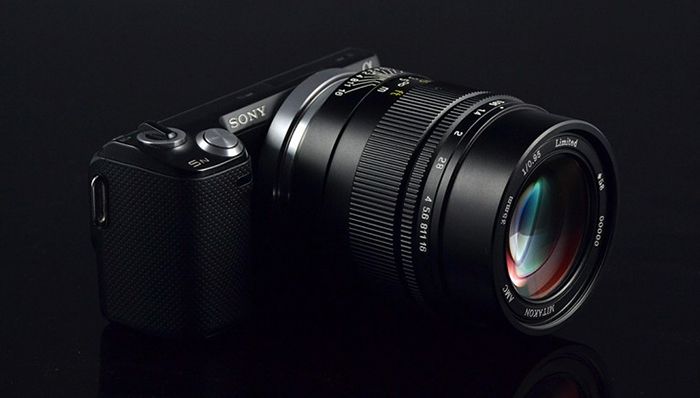 [/shoplink]
What you see here on top is the [shoplink 14656 ebay]Mitakon 35mm f/0.95 lens for ASP-C E-mount cameras (they are on auction here on eBay)[/shoplink]. Some image samples can be seen here and a short SAR reader review here.
Well, we just learned that Mitakon is developing a new 50mm f/0.95 Full Frame E-mount lens! This will become the first native E-mount Überfast lens. Of course Image Quality will by miles away from the $11.000 Leica Noctliux. But if it is as good (or as bad) as the current 35mm Mitakon than it may become an interesting lens after all.
The lens will be announced in mid 2014. Price is yet not known.
———
Message to sources: You can send me more info anonymously by using the contact form you see on the very right of your browser. You can also contact me directly at sonyalpharumors@gmail.com.
For readers: Subscribe the RSS feed (Click here) and Twitter (Click here) stream and the Facebook fan page (Click here) in order to not miss any news!
——–
Reminder (SR = Sonyrumor):
SR1=probably fake rumor
SR2=rumor from unknown sources
SR3=50% chance it is correct
SR4=rumor from known sources
SR5=almost certainly correct!
56 Responses
doesn’t SLR magic have a 50mm .95 hyperprime too?
They even have two:
the f0.95-> costs about 1k $/€, cheap build, not too good optically
the t0.95-> costs about 2k $/€, native M-Mount, excellent optics and build quality
The HyperPrime CINE T0.95 (f/0.92) is 2995 US$ (from Hong Kong, additional customs, taxes may be apply in other countries). The RF-coupled/calibrated version is 4995 US$.
On the A7/A7R it produces significantly less purple fringing at open aperture compared to the Noctilux.
I have the SLR Magic Noktor CINE 50mm T0.95 on my A7R. Bokeh is much smoother than the Mitakon
http://puu.sh/5pINY
so the 50mm 0.95 emount is different from the m-mount version? is it full frame?
The optically inferior 1K$ Version covers APS-C. The 3K$ CINE Version (as well as the 5K RF-coupled/calibrated version) covers full frame.
I only know your images samples with the CINE lens using a crop sensor (NEX 7). Do you know already if it will perform as well on the a7/r (or on a Leica body)?
I will post an article on my website soon that shows the 50/T0.95 as well as the 35/T0.95 used on the A7R.
In this album you find more examples of the HyperPrime CINE 50mm T0.95: http://www.flickr.com/photos/hhackbarth/11180024593/in/set-72157629501567855
The link will start on a picture from where all further examples are shot on full frame sensors (Leica M and A7R).
Thanks for the link. Btw, thanks also for your articles. I always find them very informative.
The EXIFs reveal: T-stops don’t lie. Hard to believe you got those shots with such high SS and low ISO. Added to that, the sharpness of that lens is insane. The majority of fast primes at 1.2-1.8 that I know are less sharp WO than this lens.
looked at the samples from cop version – a lot of CA there, still might be lovely for B&W
Are there any lenses nearby f1.0 for Amount? Anybody know?
I will not pay more than 600 usd. I don’t believe they can beat the voigtlander 50/1.1
Steve Huff says it beats the CV, results from photozone.de say it’s really sharp in the center wide open, but edges really suck.
From Steve’s test shots I’d say edges really don’t matter that much for use of a lens like this, it should be treated as a Noctilux and used accordingly.
That lens Steve reviewed was also nocti price range. This one is going to be much cheaper, so I really can’t expect the same quality.
The non-coupled version is said to be $3000…that’s in the $11000 price range? Optics are exactly the same as the $4000~ coupled version.
Come to think of it, anything below $2000 could seriously hinder its ability to use special elements… but if it were larger and much heavier, say 1.2kg…they still could get away with an optically successful design. Kind of the Zeiss design philosophy, just make it however large it takes for satisfying performance.
Why not loose half a stop and go for the tried and tested CV 50mm 1.1? It may be massive, but you really know what you get after all the samples on Leica/Sony cameras.
I’m not sure, seeing 3D-Kraft.com prices above, whether the price advantage may be so significant as to warrant their lens vs CV’s one, no?
Did you see for example the bokeh comparision that Steve Huff made between these lenses?
The CV has neither the sharpness WO nor the smooth bokeh to speak of. I would rather pay for a DLSR 1.2 to have a better lens and better manual focus feel anyday. I’m not sure if the SLRMagic already sorted out their Loctite fiasco but I would think twice about getting that lens. Only if they pay more attention to the build quality. I can’t find any recent user report with the 50 0.95. Huff already distanced himself from the company.
That’s wrong. Steve Huff distanced himself from the bashing spread by two particular users.
I admit I haven’t seen any comparison of anything between many of today’s 50s since that’s a focal length I am little interested in. My comment, perhaps unclear, was rather to do with current available lenses from trusted sources since the only mitakon or slrmagic lenses always had some sort of build quality or optical compromise to achieve their price level compared to the established offerings. When they promoted their 24mm vs the zeiss E24 Steve Huff made a comparison and I couldn’t see any reason, other that price, to go for the slrmagic but at a clear compromise, especially wide open.
Before the SLR Magic CINE I tried and tested the CV 50/1.1 alright. It was crap. Unusable unless you stopped down to f/2
I remember reading that (on the M cameras) the T0.95 had better center performance than the CV and very close to Noctilux in many sharpness and fringing. Also the T-stops rating for a lens is usually 1/3-1/2 slower than the F-stop rating which means the SLR Magic is probably more like a F/0.92 or something. The difference is closer to a full stop. Will you get a full stop difference on a digital sensor where light gathering diminishes below f/2.8? Probably not even if that is “technically” true.
Mitakon’s lenses in the past have been similar to SLR Magics but cheaper and not as sharp. It will be interesting to see how this ones fares.
Edit: The difference between the SLR Magic and the CV is closer to a full stop.
(log(1.1)-log(0.95))/log(sqrt(2))= 0.42
Less than 0.5 stops. If you call it an F/0.92 lens, the difference still is just half a stop.
Fast lenses lose more light to transmission loss. f/1.1 is usually around T/1.4 (your average f/1.4 gets you around T/1.6), varying of course due to different materials and design, but around a full stop less than T/0.95.
I hope they can offer two versions with different direction focus throws. Not a fan of Canon/Leica/Sony rotation.
Then you’re not a fan of “everybody else’s rotation”. Nikon to my knowledge is the only company that has everything backwards.
For the record I’m not a fan of Nikon’s rotation LOL.
Speaking as a Nikon user for many years. I feel I have to correct you Nikon goes the right way ,it is everyone else who goes ass backwards 🙂
Speaking of assthisandthats, Nikon’s circular viewfinder window is unsettling to me. I can’t help but envision a puckered asshole every time I see the back of a Nikon camera.
So I guess this is ANOTHER manual focus lens?
Ok for video guys I guess.
Can’t be “miles away”… unless mitakon is another name for lomography or whatever
Mikaton and SLR Magic are the same brand.
Same as Rokinon, Samyang et al.
Different brands for different markets, same manufacturer.
No they’re not the same company, unless you mean all Chinese companies are the same.
That’s wrong. They are not the same company and their lenses are different. If you look at the comparison of the Mitakon 35mm f/0.95 and the SLR Magic HyperPrime CINT 35mm T0.95 here…
http://3d-kraft.com/index.php?option=com_content&view=article&id=138&catid=40&Itemid=2
…you will see the difference!
Why on earth don’t they make it for A-Mount?
Is E-Mount some kind of priority mount now or what?
Mirrorless vs. DSLR
So? They’re changing the mount from M-mount anyway
Because changing to e-mount only requires slightly extending the body of the lens, while modifying for a-mount quite probably requires changing the optics.
The Leica Noctilux is manual focus and, until the M, didn’t even have video. Not just for video guys.
.95? Really….doesn’t…seem….necessary.
Not necessary…
…but magic.
Zeiss needs to bring back the 40mm Super Q-Gigantar .33.
Nah, I rather want Sony to make the Sony 40mm Ultra-BS TeraQuark T0.77 with QBOSS (Quad Balanced Optical Steady Shot) at half the Zeiss preiss…
Here’s some samples of this lens currently under development from the Chinese xitek forum, including 100% crop.
All shot at F0.95 on A7, lens not completed yet so no aperture blades installed.
http://forum.xitek.com/forum.php?mod=viewthread&tid=1237837&page=1&ordertype=1#pid51208185
BTW, it’s a f0.95 lens instead of t0.95 found on the current SLR MAGIC lens.
The maker says prices will be around 7k RMB, that’s about us$1165 at today’s exchange rate. Expect the price to be higher when the lens hits shelves, due to the constant dollar depreciation/ RMB appreciation.
us$1165 could be great. If the quality is usable wide-opened, and it eventually comes in less than $2k with AF or around $1k without AF, I think it could be a very competetive lens.
Honestly, when I compare smaller camera set-ups, the 2 stops or so you might gain in high-ISO performance buy getting an a7 or a7r instead of a micro 43 camera would be all lost again if all your compact full frame lenses were a few stops less bright than the f/0.95 manual focus or f/1.4 autofocus lenses you could get on m43. Bright lenses are the key to a portable set-up that works as well as possible in low light.
There’s no way this would be an af lens. The Chinese Mitakon has 0 experience with af and is really only starting to enter the game with something like a family workshop. It’s not backed by deep pockets either.
But sure, competition is always welcome. From what I saw on the Mitakon 35 0.95, it actually had decent sharpness and bokeh, but fared terribly on CA and coma control. They’ll still need to work on coatings IMO.
It’s more like you only need a f/2 lens, for example, to get more than what you get with a f/1 lens on mFT. The slower lens can be made to:
1. Better optical quality
2. Better tolerances
3. With lighter weight
4. With optical stabilisation
5. AF can be made more responsive
6. Cheaper (due to above)
As an example, compare the difference between a 25/0.95 on mFT and an equivalent 50/2 (rangefinder) FF lens.
Meh… had the Mitakon 35mm… decently sharp but horrible colors and mediocre contrast, even stopped down. Tried to get used to it but in the end I sold it. Not really interested in this given that there are other tried and true choices (besides what the heck do you need f0.95 for?).
It sounds interesting!!! .95 on a full frame that is very cool.
For me one of the reasons why I bought the Leica M 240 and meanwhile swapped to the Sony A7R.
I really don’t want this A7R but it looks so good. Will one of you guys let me- a random stranger- borrow it for a few weeks. I just want to take a few shots and see how awesome it looks on my shelf.
I just took some pictures in San Francisco with a different version of f1.0 lens at 35mm on Nex 7. I used a Sony 50mm f1.4 with a Much Mall Focal Reducer/Speed Booster from eBay. This is smaller and lighter than the Mitakon solution, and cost half as much. I shot at around f1.4 ISO200, 1/4000th and got super sharp images. If anyone is intereted, I can try it this evening at f1 at the Chili House Restaurant on Clement St. It looks pretty dark outsid already.
==Douglas Boyd
I hope they have it priced around $1,199.99 at the most.
So this brings something up that I’ve wondered about: How bad are vignetting and chromatic aberrations with the existing 35/0.95 on full frame?
If the 35/0.95 makes a decent, even if severely vignetted, full frame photo that’ll be one checkmark off my negatives list on the a7r (since I already own it).
untill unless you have very specific requirements go for 50mm f/1.8 D for FX format and 35mm f/1.8G on DX format. both of them are very cheap and incredibly sharp. you can refer to http://pixelarge.com/nikon-50mm-f1-8-af-d-nifty-fifty-2/ for more details. good luck
Vishal Singh
http://www.PixeLarge.com