







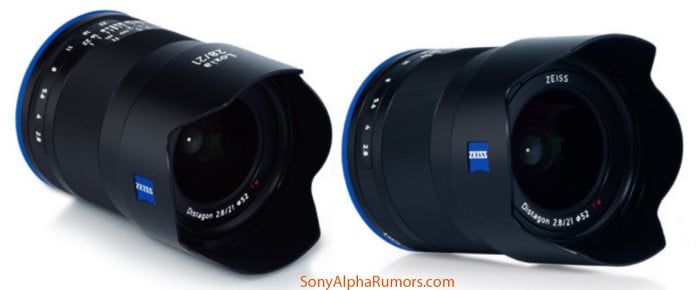
This is the new Loxia 21mm lens!
Here are the full Loxia 21mm f/2.8 lens specs and images! Here is the news roundup:
Preorder:
In USA at BHphoto.
In Europe at Fotomundus.
Price: USD 1,499 (excl. VAT) or EUR 1,259.66 (excl. VAT).* and shipment start in December.
Reviews:
Full loxia review by Alexander Wätzel
Image samples:
On Flickr.
Discussion:
Loxia discussion on SonyAlphaForum.
Press text:
Full press text here on SAR.
The lens has just been announced at Zeiss.de.
Interesting tidbits:
The new Loxia lens is expensive but still cheaper than the new Milvus 21mm f/2.8 lens ($1850 on BH).
Poll:
[poll id=”239″]

292 Responses
Wow, I won’t be able to sit this one out. Looks very promising!
It is still compact !! yay.
My wallet leaks allready
Well, as expected, 40% increase in weight compared to the ZM line, same as the other fat Loxia. So, one should also expect a 10-20% price increase. A bit on the expensive side, but it is compact and the 52mm filter thread is awesome. Let’s see how it will perform.
I kinda wanted something with a wider aperture for astrophotography. I guess I’ll have to settle for this. But is this worth it? I have a 16-35 2.8 already, so I’m not sure if I even need this one.
Hmm, the only reason for you to get this one will be the size and maybe IQ?
This will be more appealing for those 16-35 f4 users, the extra stop, size and probably IQ is all good reasons to get it.
This is simply amazing and my be a good example of why mirrorless is superior to DSLR’s when it comes to wide angle lens designs.
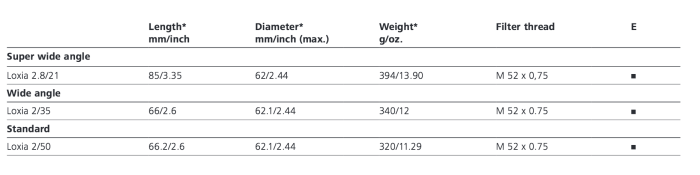
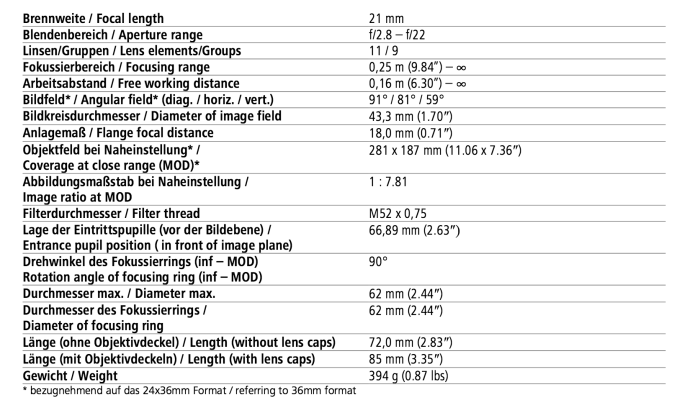
The Milvus 2.8/21 weighs 851 grams and its dimensions are 95x95mm
This Loxia 2.8/21 weighs 394 grams (less than half compared to the Milvus) and its dimensions are 62x85mm
My guess is that the Loxia will be cheaper than the $1843 that the Milvus costs in the US due to a simpler lens design.
The Milvus is a size monster in comparison. This is quite incredible.
yeah it’s tiny and a distagon too. Normally distagon = enormous
Yeah, I’m surprised with the size. Good that Zeiss managed to keep at dia 52!
Looking at the glasses, I guess it’ll be more expensive then the Loxia 35 :/
Its $1499. Was expecting at least $1800.
Well done Zeiss!
Very, very, very impressive. And the IQ from the Loxias is second to none (well, probably the Otuses, although I’ve never tried them). And people STILL wonder why we love the Loxias so much… THIS is why.
http://www.zeiss.de/camera-lenses/de_de/camera_lenses/loxia/loxia2821.html
It’s now also on the German Zeiss page.
Nice well spotted, but also ..
Dutch: http://www.zeiss.nl/camera-lenses/nl_nl/camera_lenses/loxia/loxia2821.html
English: http://www.zeiss.com/camera-lenses/en_us/camera_lenses/loxia/loxia2821.html
Also notice the updated Brochure, and Data Sheet under Downloads.
– http://www.zeiss.nl/content/dam/Photography/new/pdf/brochures/loxia/loxia_leaflet_en.pdf
– http://www.zeiss.nl/content/dam/Photography/new/pdf/en/downloadcenter/datasheets_loxia/loxia_2821.pdf
Plus the link to Application Samples on Flickr:
https://www.flickr.com/photos/carlzeisslenses/sets/72157657249768273/
Thanks for those links, appreciated!
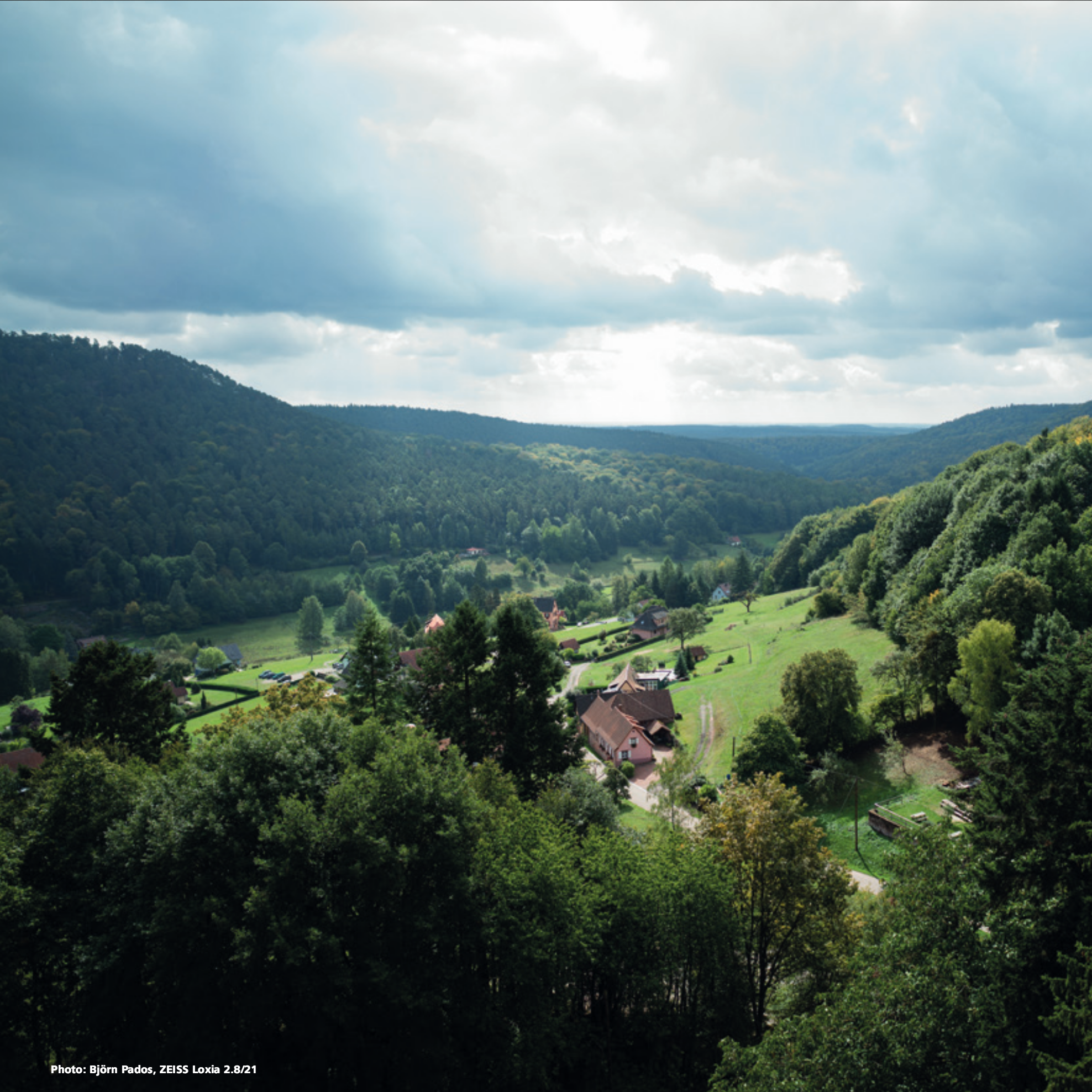
excited by this, but what is the deal with the sample photos? there is no sharp point anywhere
Somebody messed up.
Lots of sharp points here: https://www.flickr.com/photos/carlzeisslenses/sets/72157657249768273/
Why the photographer decided to take that landscape shot at f/2.8, though, I’ll never know. That doesn’t tell me what the lens can do edge to edge for large DOF landscaping.
Wow! Datasheets look VERY promising. Awesome sample pics. Is this a kind of torture-like-method to bring my most preferred focal lengths al last? If only Zeiss could tell us within what time they plan to release the full line of LOXIAs.
“AWESOME sample pics”
What? They look horrible.
I would get this to replace for FE1635 which is also good but the size is too big. Hopefully the price is less than FE 1635.
No chance, imho.
$1499 so probably no.
MF lens replacing AF zoom?
mmm…
MMMMMM….
nah..
If its for landscape AF doesn’t really matter.
There are no MF zooms nowadays – that is where your confusion comes from.
21 is a sweet spot for architectural and 19-23 is the range I typically use with the 16-35 (other than walk around where closer to 35.) In architectural/real estate could see for 90% but not for the front “money shot.” I guess I could pre-focus and adjust for the angle of the triangle before I mount to a pole and raise it 20 feet off the ground. Easier to use the FE16-35 than determining ground level focus (AB), 90 degree angle, elevation (BC) to calculate (AC) and set the focus to AC.
From the Zeiss Lenspire page:
The Loxia 2.8/21 will be available worldwide starting December 2015. The lens shade is included with delivery. The recommended retail price is USD 1,499 (excl. VAT) or EUR 1,259.66 (excl. VAT).*
Ouch, but as expected…
Yes, as expected. The same price as the present ZM 21mm actually. This definitely looks very tempting.
First Norwegian site up with a preorder button got my money…
Just a small comparison: the Nikon 20mm F1.8 is faster, lighter (355g mainly because of plastic iso metal), has AF and all this for about half the price. Combined with a D750 the Nikon 20mm is very close to the A7RII + Zeiss combo in both size and weight. Furthermore I read in reviews that the previous Loxias (35 & 50mm) are very hard to screw off due to its very small attachment grip (they are trying to make things a bit too tight). Looks like there is still a long way to go for E-mount. But I’m following up the evolution closely and hoping that it keeps improving. Competition, competition & again competition is good for customers …
You don’t even know the quality of the photos the Loxia puts out yet so you can’t really compare and Nikon D750 isn’t close to A7RII, its almost half the amount of megapixels.
“are very hard to screw off due to its very small attachment grip”
This is simply not true. I’ve never had the slightest problem attaching or deattaching my Loxia. If you experience problems with this, I’d say you have some sort of medical condition…
I did not try it myself, I mentioned what is shown in reviews I saw when previous Loxias came out in a attempt to make things as tight as possible. About the medical condition statement, this is simply not a mature remark so we better ignore that.
You started it. Nyer.
The tight fitting is a feature not a bug.
It’s for superior weather sealing. Much superior than the Nikon lens you’re sporting.
Hi, believe me, I do not consider the E-mount size as a bug like you suggested … I was commenting on the lens design, not on the E-mount design. What I commented was the size of the lens grip close to the mount.
You’re still wrong. The tight fitting is not due to the size, has nothing to do with the size.
The tight fitting is due to the blue gasket, it’s a weather sealing feature.
I’m not talking the tight fitting, nor the weather sealing, that’s just fine. I’m talking the grip size you need to grab with your 2 little fingers to screw/unscrew the lens. When having no grip, it is hard to unscrew … And this has nothing to do with being wrong or right. It is only about does it fit your fingers or not. That’s all. Some people might feel like it fits, but others don’t.
No, you’re not even talking from your own experience, but from reviews which you misinterpreted.
The reason those reviews have a hard time unscrewing the lens is due to how tightly it fits. And the reason it fits so tightly is due to the superior weather sealing.
Rubber gasket = lots of friction. It has nothing to do with grip or size.
Indeed, having a wider grip and allowing fingers to put more force, would help to overcome the extra friction you talk about (due to weather sealing etc) and it would not be an issue anymore for many out there …
A wider barrel would not allow better grip. The opposite would happen.
At this point, your complain is with the circular shape for the cylinder and the rubber gasket, both which are natural things for a good lens.
So you didn’t read my comments correctly ? I repeat: “Combined with a D750 the Nikon 20mm is very close to the A7RII + Zeiss combo in both size and weight.”
It’s not really fair to compare the D750 with the A7RII with 42 MP and IBIS. You should compare the D750 with the original A7: 24 MP and no IBIS. And that combo is much lighter than the Nikon!
I did. So by the same kind of comparison the a6000 is way smaller and lighter and is the same mega pixels.
Correct, but this comparison would make more sense if both would produce the similar FoV and DOF, which unfortunately is not …
It’s a niche product for sure, all the more fun owning one.
Don’t worry we have our reasons, and they’re valid because they’re our reasons. 🙂
“Looks like there is still a long way to go for E-mount.”
Nice try. The Nikon may be lighter, but together with the D750 it certainly isn’t. Apparently, 30 and something grams are enough to call the Nikkor “lighter”, but the roughly 200 grams between the two setups is “very close”.
This is not even like comparing apples and oranges. This comparison holds no, absolutely no, information for anyone. If you want to compare bodies please compare D750 to A7 or A7II because they have more similarities. If you want to compare to A7rII at least choose the D810 for the common lack of low pass filter.
If you want to compare the Nikon 20m F1.8 well then there is not yet any equivalent on the market for sony FE mount. Which is no big fuzz because when manual focus is no issue for you (as this loxia lens interest would imply) you can simply buy the Nikon 20mm F1.8 and attach it to any Sony E-mount body with a 19$ adapter.
For me it makes sense to compare since both are FF, have similar FoV and DOF. It is true that resolution has improved over the last 2 years, but investing in lenses of certain brand assumes that sooner or later also the bodies/sensors get improved over time.
You make price + size + performance to your argument. Yet you choose the most expensive of the available body options that all meet the criteria FF, FOV and DOF.
If you choose the A7 with a cheap adapter and the Nikon 20mm you will have a budget winner.
But you seem to write from a user-perspective that is already heavily invested in a system. In that case I can understand, that this very lens does not make you switch systems. No hard feelings. Regards
The reason for comparing the Mark II of the A7 series, is because I do not expect Sony to go back into time and remove the IBIS in future bodies. So for me it made less sense to compare with the Mark I series which look like a 1 time event and which most users will replace sooner or later with more recent body versions. Thanks btw for understanding my post 🙂
You compare the flagship A7R II to a midrange D750… The midrange second generation Sony camera is the A7 II which by the way share the sensor with the D750 hence a closer base for comparison…
A7II 24 MP (+IBIS) 599g for $1700, Nikon D750 24 MP (no IBIS) 750g $1900. You may leave the lenses out of this as you can adapt your beloved Nikon 20 to the sony for an additional 20 bucks and all but loose the AF (or you wait for the AF adapter from Nikon for an additional ~$200). At 20mm AF is not for landscape shooters anyways…
Sorry Peter, but the only PDAF system Sony provides today is the A7RII allowing me potentially to re-use Nikon AF lenses through a future adapter (which even is not yet commercially available today). Even the A7sII does not provide PDAF support. So no, for me there is today no Sony alternative for the A7RII. I know, reality is really complex and especially very expensive ;o) even if we all want it not to be …
Now you are broadening up what you started as a “small comparison” 😀 BTW you are wrong, the A7II has PDAF just not as fast as the A7r II… but then again AF at 20mm is not a dealbreaker.
I have not enough insight in the Sony system to judge the usability of the PDAF on the A7 II (I read everywhere there is no comparison on AF speed with DSLRs but maybe all these reviewers are wrong), but the A7 II would not be an option for me anyway taking into account the low DR and high ISO noise levels compared to D750. But this would lead to endless discussions … My original point still stands that weight and size are pretty close to the D750+20mm, whether that is with A7 II or A7R II makes no difference at all on that aspect. About the price, I compared the Nikon 20mm with the Zeiss 21mm (I did not compare the body prices at all), and again there my original point also still stands, Zeiss lens is double the price. So I do not see the point of further discussions. If I would have written A7 II iso A7R II in my original post, some people would have commented that image quality of A7 II is inferior to D750 as well as PDAF speed. So whatever I write, people would have written comments distracting the key message I gave concerning weight and size of both systems, and my price comparisons on lenses only, not bodies …
come on, you can find more than that to complain about, try a little bit harder … 😀
I could find a lot more if I would have invested in it and experience all the weaknesses … But I did not.
compared to Nikon D810 and Milvus 21mm f2.8 … Not a unfair comparison …
or compare it to a Leica rangefinder combo, for dof, zise, price and quality comparison. There is always something better, smaller, bigger, cheaper or whatever suits your needs … Just make your pick.
You left off one thing that is far easier to visualize. Nikon takes a 77mm filter while the Zeiss requires a 52mm filter. That is a huge difference, notable both in physical presence on the camera and handling, but is typical of Nikon’s plastic G lens. But even the older 20 2.8 D lens with screw drive (swish, swish, swish focusing) took a 62mm filter. Zeiss makes a nice, solid, compact package.
True, diameter is significant difference, but for me less important than length and weight because when putting camera + lens in the bag, lens diameter has almost no impact on bag size.
http://camerasize.com/compact/#567.437,579.395,ha,t
they are the same… yeahrright… -_-
I did not write “the same”, but “very close”. You just misinterpreted my comment. Please also note that the Nikon 20mm is faster and has AF with great image quality. Not bad for a lens half the price …
you make falls claims and bend the facts to your liking all day long, that’s fine with me… but please at least go to the next camera store and hold an A7 already…
I only listed some facts. No need to get nervous about that …
The Nikon lens is designed around an additional hidden flange distance which you’re hiding from the argument. It’s a hidden additional 28,5mm which you did not account for when you said length was so important to you.
Your Nikon lens design would then become 10,9cm long.
Whereas the This Loxia lens would be 34% shorter at 7,2cm.
34% is not “very close”.
I only looked at the total size and weight of the system (body + lens) and compared. My personal opinion is that they are very close on size and weight. No need for detailed technical info about flange distances etc. Just look at the 2 pictures behind the link above sent by Peter. Its just my personal opinion that they look very similar in size, taking into account the lens is faster and has AF built in. Enjoy your day 🙂
Even on the whole system, the Sony system is 18% shorter. Which doesn’t qualify for “very close” either.
The reason I compared the flange is because you left it out when praising the wider aperture of the Nikon lens. You hid the cost of that wider aperture.
Well that is where we disalign: 18% is too small for me to talk about a significant difference. By the way, if that 18% would have been an issue for me and F1.8 would not have been important to me, then I would have bought the Voigtlander 20mm F3.5 and stick that onto the D750. Guess what, it would be 51.7mm shorter (80.5-28.8) and also manual focus & metal built just like the Zeiss. Now you can count your % difference again … ;o) which I will not do, simply because the D750+20mm F1.8 combo is small and light enough for my purposes. At the end, it’s all not that big deal to me.
That’s fine to prefer the superior aperture on the Nikon lens. But that aperture comes at a cost, and the Loxia design is roughly 34% shorter. So you can’t exactly say “it’s faster and only a little big bigger” like you did.
That Voigtlander lens, by the way, would have an equivalent 59,7mm length on the E-mount flange, but a much wider Diameter.
If you look at it from a Volume perspective, the Voigtlander lens takes up more space, so it’s actually the worse design if you compare Aperture in relation to size.
Who cares? Nikon primes are garbage compared to Loxias.
So, FE mount has
10mm
12mm
15mm
21mm
28mm
35mm
50mm
55mm
85mm
Native mounts in fixed focal length (I stand to be corrected if I forgot any lens) and a couple of zooms.
Not bad for the youngest mount (FE, not E) in the ILC world, eh?
Bloody excellent!
Not a bad number at all 🙂
The only one I can spot missing from the list is the 90mm.
To 90mm it’s a very rich complete system. Longer than that, not so much yet. It’ll get there though.
25mm Batis.
You forgot: 25mm Batis, 90mm G Macro, Samyang 135mm (MF)
I will add them now except the 135mm, because Samyang just re-mount SLR lenses.
Samyang/Bower/Walimex Pro also offers native FE mount lenses:
12mm F2.8 fish eye
14mm F2.8 recti
24mm F1.4
35mm F1,4
50mm F1.4
85mm F1.4
135 F2
and their respective cine equivalents.
Ah. I don’t count those because they are just re-mounted SLR lenses.
Fair enough but they are still valid options for adapter haters 🙂
Done.
Try the Samyang 135/2 and you will see superb image quality results – remounted or not……. It is better IQ than the much more expensive Canon 135/2 at less than half the price.
Wel you could add 16mm fisheye I guess as well, that and your list doesn’t tell the whole story which is:
10mm f5.6
12mm f5.6
15mm f4.5
16mm f3.5 FEA
21mm f2.8
21mm f2.8 UWA
25mm f2
28mm f2
35mm f2.8
35mm f2
35mm f1.4
50mm f2
55mm f1.8
85mm f1.8
90mm f2.8 macro
That is before we include any Samyang adapted SLR lenses.
Mitakon 50mm f0.95
Mitakon 85mm f1.2
The Voigtlander 40mm 2.8 is M-mount but works only on e-mount with helicoid adapter, and was fine tuned for better performance on e-mount sensor.
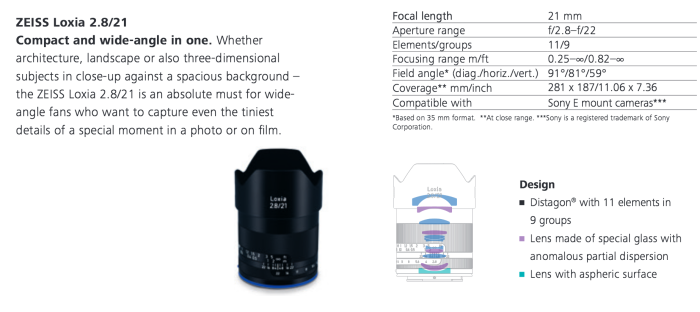
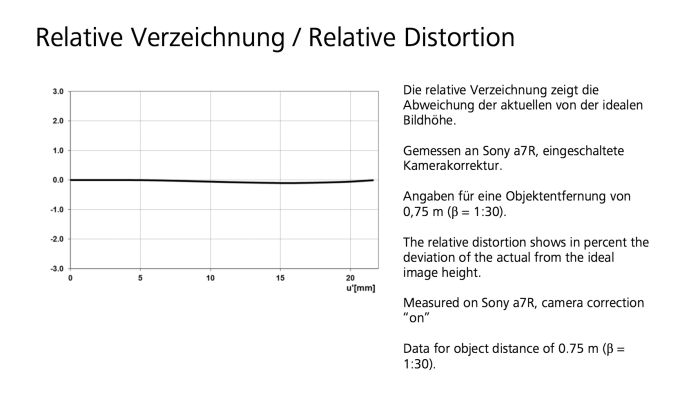
What’s with the distortion graph showing a “corrected” profile?? Come on Zeiss, you should know better than this, even if you are relying on in-camera correction profiles to make up for that deficiency in the design. Everyone knows you can make practically zero distortion for any lens with software correction, this graph is worthless.
Im excited there is now (hopefully, Im sure it will be) a high quality wide (native) option for the A7 series, but I’m still waiting to hear about those other 8 Sony lenses.
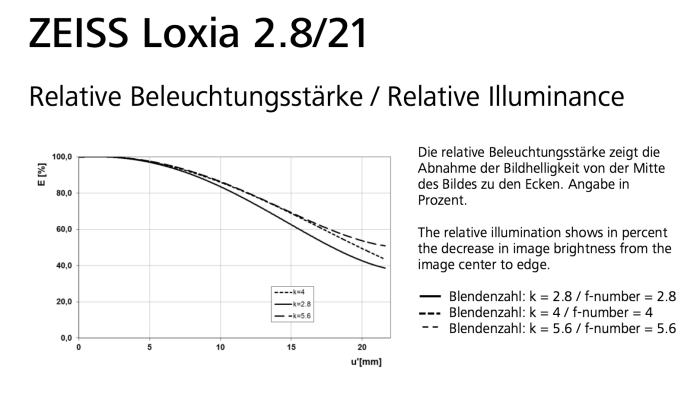
Yes! Pretty small, good luminence, high performance, this is the first Loxia that’s got my attention! If it were Biogon we would’ve gotten another stop or so of falloff.
But much less distortion
No, I just checked and the non-digitally-corrected distortion is about twice of the ZM Biogon’s, but vignetting is halved, I’ll happily take that trade-off!
Looks like a perfect replacement for my 21mm ZE. Wonder if its focus ring stops exactly at infinity? That is my only complaint with the other 2 Loxia lenses, hope this one does not have the same problem.
It doesn’t stop exactly at infinity. Like any Zeiss lens. And this is great because it requires less precise flange distances. When used with an adapter for example (especially of importance for the DSLR lenses). The tolerances don’t need to be as tight for the camera & adapter manufacturers for achieving infinity focus. It’s on purpose and shows the attention to details from Zeiss.
Ps: You shouldn’t focus to infinity anyway. Nothing is really there (not even stars) and it’s wasting DOF…
Zeiss claims this is not a problem but a feature related to temperature dependent movement of infinity. So I guess this one will have the same behaviour.
Oh my! f/2.8 21mm FE and it is a Zeiss at $1500 US. Great to be in A7 bandwagon!
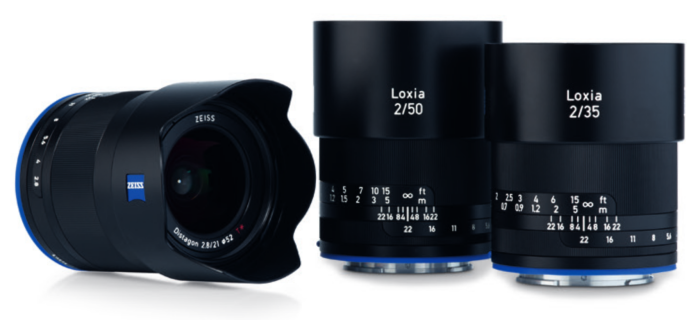
The size is roughly the FE 55mm. Loxia 21mm is just 2mm shorter in diameter but 1 mm longer length. So it’s going to have a similar feeling to it as the Loxia 35mm, compact, dense weight, makes them feel very substantial on your palm.
And I like that almost straight 0 line showing low distortion. It’s going to be a nice architecture lens.
The distortion is with camera correction “on”, which is fair because that’s what most users will have it to set to. I’d be curious to see it turned off though.
I was about to ask a question on that…even Zeiss doesn’t give real distortion these days.
It is shown in the Zeiss specs sheet. Dunno why Andrea posted only the digitally corrected one. Maybe he posted what he subconsciously wanted to see (a straight horizontal line) from a Zeiss lens.
Please, can you show the link, where I can see the original distortion charts? I would like to see also, Thanks
And what do you think, how much the photo quality worse by the digitally correction?
http://www.zeiss.com/content/dam/Photography/new/pdf/en/downloadcenter/datasheets_loxia/loxia_2821.pdf
Digital distortion correction does the most changes in outer areas, especially the corners. The result is a slight lost of information (smearing, less details). How much? I don’t know, I don’t have tried out the lens yet.
I think there is absolutely nothing wrong with digital corrections! I just question the premium price for a lens that needs correction in post.
“Digital distortion correction does the most changes in outer areas, especially the corners.” I think that it depends of the kind of distortion. Sometimes it’s the center that can be stretched…
To put it into perspective, the Nikon 20/1.8g has -1.52% the Zeiss Loxia about -2% distortion. The Zeiss Distagon T* 21mm f/2.8 ZF had approximately -1.7%.
Simple, don’t use digital correction, 1.5% mostly barrel is preferrable than any mustache. This lens is very close to the very best 21 out there, SEM 21.
Oh, thanks, I’ll go take a look myself.
” correction off” chart is there in pdf data sheet
http://www.zeiss.com/content/dam/Photography/new/pdf/en/downloadcenter/datasheets_loxia/loxia_2821.pdf
Yes, almost zero distortion, like any digitally corrected lens. W T F are these (once premium) manufactures thinking?
Well, there are the upcoming Voigtlanders.
Zeiss is keeping size and cost down. Yes, it could be more expensive. This won’t be a high volume lens, so they must make their profit and cover the development, marketing, manufacturing and distribution costs. The market will control the ultimate cost and if Loxia prices fall too low, say goodbye to Loxia.
Customers don’t care about cost. All what matters on the consumer side, is value. A sh*tty product may have caused high costs and sh*tloads of work, but it still would be a sh*tty product, not worth the price, from the customers perspective.
No, I do not say the Zeiss is a sh*tty product, I just tried to make my point. From the customers perspective, a products price is justified (or not) by the value, not the production costs.
OK, much lighter and cheaper than Milvus 21/2.8 and heavier and more expensive than the Nikon AF 20/1.8.
The big question is what image quality it delivers.
Ugh, the guy who had the prototype for a review, he can’t even tell zoom ring from focus ring.
What! A brand new lens and no zoomring? What ARE they thinking of…
Maybe because eveytime he turn the ring, there is a zoom in viewfinder that makes he think this ring should be called : zoom ring =))
Or the focus breathing is so awful that he thought is was zooming.
“… Speaking of the zoom ring … man, that zoom ring. …”
I laughed so hard. But we should not take that serious, he is German, so probably a bit lost in translation.
Maybe he wants to tell us, that there is severe focus breathing, but he was not allowed to write any negative word.
lololol!
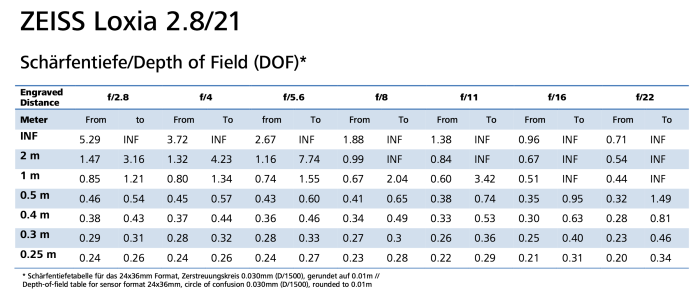
The DOF table contains an error in the sixth row.
At d=0.3m and f/8, the far end of the DOF should be at 0.34m instead of 0.3m. The DOF at f/8 can’t be smaller than at f/5.6.
$1500 for a lens that needs digital distortion correction because it has double the distortion of its predecessor? There was a time when Zeiss advertised their lenses for extra low distortion.
Hey Zeiss, I have a cheap Sony E 16mm lens. With distortion correction and CA correction in post, it is a world class lens. LOL (BTW, I could make the same joke about the Leica T lenses)
The Zeiss ZM 21/2.8 is a fine lens, no doubt, but hardly $1300-fine.
I have no problems to make compromises if that helps keeping the product affordable. But compromises at a steep premium price? (Well, OK, the blue Zeiss badge is without compromises.)
Let’s see how the Loxia performs. Nevertheless, at this price I would not buy it anyways.
What do you guys think? Are you all getting a $3k paycheck each month or don’t you have families or other interests other than photo gear? It seems to me, most ppl here have absolutely no problem with skyrocketing prices. (not only Zeiss). Just wondering.
Mitakon planned a 300$ 21/2.8, I’m waiting for that or a FE28/2-like around 18-21mm
or a 24 tse
Yes, lenses like the FE 28/2 are the way to go.
Which is basically a Fisheye without distortion correction though.
You get what you pay for either way. If you don’t wanna spend it that’s fine. It’s expensive i agree, but then that’s just its value. It’s not something that suddenly drops 50% in price like some camera bodies do.
Sony FE 28mm F2: Visible distortion. Looks hardly like a fisheye. 😉
Yes, you get what you pay for.
However, my point was, you probably get much less of what you paid for with the Loxia. Don’t take my word for it, we dont know yet. We’ll see.
Just for comparison (I know, different FL, rolleyes):
Zeiss Distagon T 21mm f/2.8 ZF2
Less distortion but nasty waveform, very hard to correct.
I still think you don’t get what you pay for in this case.
Sounds like someone needs a better paid job!
Considering the Voigtlander 21mm, which is actually faster and cheaper.
I try to prioritize with lenses – one hardly needs that many. Adapting also saves a ton of money, unfortunately quality uwa lenses are a modern thing.
I’m with Condor. All this über photographic gear is maddening for the costs involved. I’m sure the tactile feel of this Loxia is a big help but the corrections needed by a lot of these new optics is hardly what I call progress. Sure, we can let the computer fix images more quickly, etc. but I’m already doing that with my 20 working class Sony and legacy primes, which are capable of some stunning images.
Mirrorless lens prices are one reason why I, while having switched to a mirrorless camera a year ago, primarily use DSLR lenses with it. (It’s an Olympus OM-D E-M1 and Four Thirds lenses, but I could just as well imagine me using an A7 series camera with A-Mount lenses, if I already had some.)
I’m like you. I’ve upgrade from an A57 to a used A7 because I had backfocus with all lenses and no other choice from Sony despite the A77 II that was too big.
Now I’m kind of happy but I need to replace my old lenses and I can’t afford any !
I have to work with the old SAL50mm, a used Nikkor 85mm with an adapter, and the Zeiss 24mm F2.
For the last one, I’m happy I could purchased it for around 600€. Sure, it’s nowhere near the 21mm focal range but serioulsy, I’m restricting myself a lot to buy some gear and the cost of all the Zeiss lenses is really too much.
I wish I could get my hand on the 55mm or the Batis but it means doing nothing for 5 to 6 months, probably a lot more with the increase of all the taxes in France.
This is cool for the FE line, and I’m happy professionnals could buy these. However, Sony really needs to work on that lens lineup to bring us some old magic like the SAL35mm or the 85mm 2.8. Both lenses were cheap and really good optically.
Where do you see the “double distortion” thing?
There is only one graph and that one has camera correction.
We can give a thought to the fact that when Zeiss “advertised their lenses for extra low distortion” when lenses like the Contax 21mm G and 16mm Hologon were out they didn’t need to worry about sensor/lens performance and the reworked formulas needed to make the rear element create incident light without much angle and also keep the lenses compact in relationship to their aperture and the fact you can’t place lens elements as close to the sensor/film plane as you were able to before.
I’m not sure where he’s getting his numbers, but that graph is with in-camera corrections turned on.
Link?
http://www.zeiss.com/content/dam/Photography/new/pdf/en/downloadcenter/datasheets_milvus/milvus2821.pdf
http://www.zeiss.com/content/dam/Photography/new/pdf/en/downloadcenter/datasheets_loxia/loxia_2821.pdf
this is the Milvus lens, which has the same distortion values!!!
The Loxia is based on, and should be compared to, the ZM 21/2.8.
I believe that this Loxia is based on the distagon design of the Milvus lenses not the ZM.
Possibly. I don’t know. The holy SAR admin Andrea just mentioned it is based on the ZM 21/2.8:
http://www.sonyalpharumors.com/sr5-the-zeiss-loxia-21mm-f2-8-has-a-distagon-design/
I think Zeiss themselves are a much more reputable source than some rumor site. From official Zeiss PR
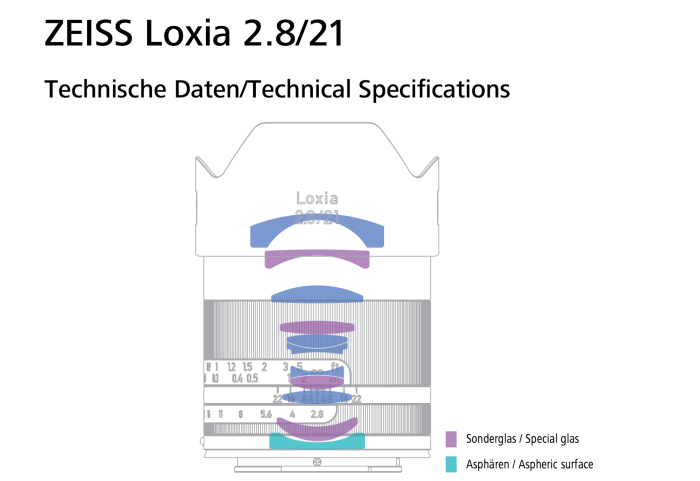
Specially developed for digital sensors, the newly calculated Loxia 2.8/21 consist of 11 lens elements in nine groups. The underlying optical design is a Distagon type. High resolution along the entire image field, low distortion and color fringing, and an appealing bokeh – especially at the maximum aperture of f/2.8 – round out the exceptional features of this lens.
Agreed, absolutely. However, Distagon or not, the origin of the lens is not the point. I was talking about value. About price/performance value. I know the ZM version only.
I don’t know the ZE version, but from all what I heard, it is a good lens, but nothing to rave about.
That was before we knew it would be a Distagon. The ZM is a Biogon.
Every lens is based on something, Distagon dates back to the 50’s or something, but this is a brand new derivative natively for E-Mount, and only E-Mount.
It’s not based on the ZM 21 at all, they’ve said it’s a completely new design
I just believed what the holy SAR admin Andrea told us yesterday:
http://www.sonyalpharumors.com/sr5-the-zeiss-loxia-21mm-f2-8-has-a-distagon-design/
The uncorrected distortion in the new Loxia seem better to me. I have the old 21mm ZE and it has very strong moustache distortion as evidenced by the ‘U’ like curve in the distortion charts. The curve for the Loxia is much more muted.
From my experience I wouldn’t call it strong (ZM), but definitely visible distortion, nothing a company like Zeiss should be particularly proud about. What do you mean by “muted”? The max distortion is almost twice as much as the ZM. See my post above.
Sorry, I thought that you were talking about the 21mm ZE (Milvus) version. That is the lens I own currently and I tend to compare the performance of this Loxia against its Milvus cousins.
I meant ‘muted compared to the moustache distortion in the old ZE & Milvus’ lenses. In the 21mm ZE the moustache distortion causes straight lines to appear wavy making the lens unsuitable for architecture work. In the Loxia the moustache distortion is very muted.
And as Will Humber gave us the link to the Milvus, which has roughly the same distortion than the new Loxia, your “very strong moustache distortion” should more or less apply to the new Loxia lens (maybe a little less “wavy”). Which is not what I call impressive, or in other words, a proper reason to pay $1500 + VAT.
see above
The Zeiss specs sheet shows the uncorrected distortion (-2% max)
Here is the distortion of the older ZM 21/2.8 (-1.1% max):
Again, this lens is considered a good performer (I tried one extensively), but no example for the legendary Zeiss superiority.
I would not pay this kind of money for the lens either. But since the only competition to this lens needs either to be adapted, is considerably larger or has worse build quality, I really believe that Zeiss can price it that uncompetitevly. If you take into consideration that Zeiss lenses from Batis and Loxia lines have been extremely hard to get by since their anouncements, I almost think this high price is a further move from Zeiss to mitigate their limits on production capabilities.
As much as I agree, I think you’re missing the point. The idea of these lenses isn’t value or even performance. If that mattered the original A7 or the A6000 with standard Sony or third party cheap lenses would be perfect. A Loxia with newer FE cameras give enthusiasts who enjoy the act of photography what they want.
Good point. Still wondering how many can afford this, without having an empty fridge.
I wonder the same thing about the latest Mercedes or Lexus. Yet we seem to see those all the time.
1500 Euros is a lot for a manual focus prime, it better performs according to this price. Otherwise, the Nikon 20/1.8g (adapted via Novoflex) is very good and much cheaper.
Agreed. 1500 EUR is not cheap, but I don’t think that ever was the intention of the Loxias. These are for guys wanting excellent performance in a small package, and a wonderful tactile experience. For me as an all manual shooter, the actual process of taking the shot is a large part of photography. Not saying this is better or yield better result than people using cheaper or more automated solutions. Just saying this is the way I, and most likely a few more, enjoy photography.
That is o.k. I am just thinking of whether the price/performance is justified. I tried the 20mm/1.8g on my D810 and performs admirably, especially from 2.8 on. Distortion is about -1.52%, slightly less than the Loxia (-2%, according to Zeiss). I will not have the nice tactile experience, very true. As soon as the first reviews show the performance, we will know whether it is worth it. I hope so, otherwise I will have difficulties to convince my wife to go with this one and not the Nikon which could have double duties on the Sony and Nikon cameras we own. However, I had hoped it to be an f2 lens like the Batis 25mm or the previous Loxia lenses.
“…the intention of the Loxias…” What does that mean? Every company has the intention to sell their products for the highest possible price.
The customer has to decide if the asked price is justified or not.
“The customer has to decide if the asked price is justified or not.”
Yup. And judging from the Loxia success story so far, they are not lacking. Maybe YOU don’t think the price is okay, but there definitely are those who thinks differently.
Just to make myself clear: I was talking about the announced 21/2.8, not about other Loxia lenses.
I still have problems with bringing both words into one sentence: “Loxia” & “Success”.
But of course I know that some guys here in SAR define success quite different than me.
It’s 1500 dollars.
The European price is 1250euros.
Without tax, yes. But in Europe people usually compare everything including tax.
Yes, sorry I haven’t seen it was the price without VAT.
25% in my case. Proud to be Swedish. Yes, your sarcasm indicator should be flashing.
That full review – a manual focus prime with a ZOOM ring ?!? Wow, how do I focus then ;p
Kidding of course, I know that the guy’s mixed the terms there, but lets give him the benefit of the doubt, his native language is probably German, so he mixed up the terms, or even the article might have been translated for him by someone else.
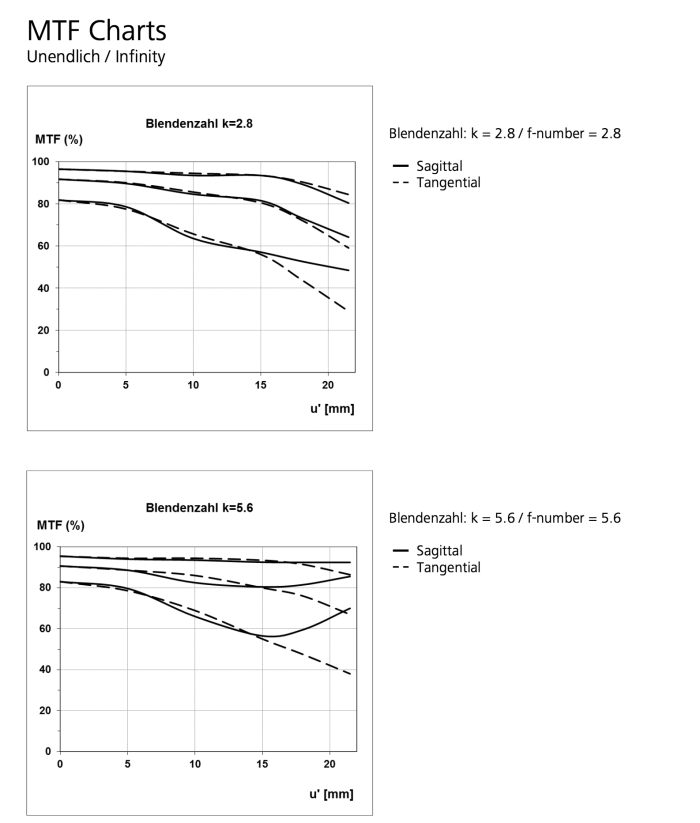
So compareing MTF Charts … the Loxia is great wide open, but the FE 1635 is sharper stopped down? So go for the zoom for Landscape?
Are Zeiss and Sony/Zeiss MTFs compareable?
One of these will be my next lens.
Why should I compare with older A7 series, if all the future A7 bodies seem to include IBIS ? When changing systems, I’m more interested to know the future evolution … I understand you want to level the features to make a more “fair” comparison, but hey I’m not defining the Sony product roadmap who apparently wants to promote and keep IBIS in all their new A7 models. But I would be more than happy if they surprise me in the future and provide us a truly compacter and lighter mirrorless FF system.
1500 is crazy talk. Beside that- the only problem I see is it isn’t a 17mm.
Sony and Zeiss decided to go full Leica on us… Man, Canon`s 85 1.8 usm sells for 350.
I doubt this lens is any worse than a Leica equivalent…so in those terms, I guess it’s a great buy. Not for this guy though. Heck no. That’s 135mm money.
The fact that some other brand has even crazier overpriced products, does not change a single bit of the actual value of the above Loxia lens.
With “value”, the price/performance ratio is meant, not the price/production cost ratio. The price/production cost is important for the manufacturer, but I don’t care. If the value is good, than I don’t care what profit the manufacturer makes. Even if he makes huge profit.
BTW: I do not think Leica products are overpriced in terms of price/production cost ratio. But I think they are outrageously overpriced in the price/performance department. BIG DIFFERENCE!
Well put. I really dig the loxias and I think- as far as the FE line goes- it’s one of the best aspects of adopting the system. The 35mm is the only one I find appealing at the moment. I only have so much cash, so a bunch of MF lenses might be to limiting for me.
With that said, I see an A7II and maybe one of those 35mm’s in my future.
I find the Loxias appealing too, I would love to have one under the christmas tree, but I would never prefer it to a lens like the FE 28mm/2. So, I will wait for a sanely priced Sony (or Sigma, or Tamron, or ???) 50mm/2 and 20/2.8 (or f4, i wouldn’t mind).
Sorry to disagree but the the Summilux 50 is outstanding and probably one of the best lenses in terms of price/performance. It is not all about lph but also other characteristics. Zeiss and especially Leica are very good in terms of dropping contrast wise behind and before the focus point, what makes the images “pop” and this is something you don’t get in that way from an “ordinary” Canon, Nikon or Sony lens.
at that price id rather pickup the 4.0 G lens
Price in € excluding VAT ? This is quite unusual ! Are you sure you didn’t mean including VAT ?
Isn’t the Loxia line designed specifically for the Sony E-mount? If that is the case then I do not understand why Zeiss would allow such loose tolerance in their design.
The 35mm and 50mm Loxias were based on the existing ZM lenses. That might be the reason for the lack of hard stop infinity in those lenses. But since the 21mm Loxia is a entirely new design, I’am hopeful that it has hard stop at infinity. I’ll keep my fingers crossed while the reviews come out.
I currently shoot time-lapse videos with the ZE 21mm and ZE 50mm lenses and love the hard stop at infinity feature. I’am planning to switch to the Sony system now and replace my ZE lenses with their Loxia counterparts to have a truly lightweight compact system. Its just the lack of the infinity hard stop that is holding me back right now.
Cause of temperature difference, they have to accommodate photographers who’ll use these lenses in the Sahara Desert and those in North Pole.
I don’t see the problem of checking if the image is in focus first before doing landscape of time lapse as it doesn’t take that much time and depending on your DoF used, the hard stop doesn’t stop exactly at the end (or having some wiggle room) will not be an issue.
I agree that it is not difficult to change my workflow to adapt to the lack of hard infinity in these lenses. It is just a luxury that I would miss from my old ZE lenses.
I do not buy the temperature difference argument though. My old Zeiss lenses worked fine in temperatures ranging from +45C(plains of india) to -40C (high himalayas in winter).
https://instagram.com/p/1QJr_Mi-fL/
Zeiss doesn’t have loose tolerances. The infinity focus is set very precisely. It’s just on purpose a bit over. This ensures that in every situation you can reach focus.
1. When using filters (likely to change focus)
2. When in cold temperatures (this effect is very relevant! The focal length is shortening. I see this all the time in my refractor. Even with 5 degree differences)
3. When using adapters
4. When camera manufacturers don’t have precise flange distances
…it’s a good and necessary thing
Wait I’m puzzled now…
You like the hard stop of the ZE ?
Those are over infinity too!
I only own the ZEs…not Loxias.
Is it more extreme on the Loxias?
What aperture did you use for that? Cause if you shoot landscapes at f8 the hard stop is reliable but those who complains are usually the ones who use it at f2, hence the DoF is much more critical.
The argument is not for sale, it’s physics. If you haven’t seen a difference, it is quite probable that you didn’t care about perfect focus – no offense here, when shooting at -30 I also hurry up to get it done. And there are also manufacturing tolerances – hence why with most adapters lenses will skip past infinity. I simply test each lens with the adapter one time to see where infinity/hyperfocal/other useful distances are and then remember it – a very straightforward workaround.
About the 1500, looks like some 3th party competition supporting this new FE-mount system would be healthy. Currently, there is simply no competition for Sony-Zeiss within E-mount system (excluding the use of adapters for a moment). Voigtlander could bring some help, but apparently they don’t want to or are not allowed to compete (yet) after introduction of their super-wide primes which are simply filling an early market gap. Voigtlanders current approach with their 3 new super wides are scaring me even more, since their 3 new lenses simply confirm the lack of competition allowed within this E-mount system. Samyang is also there, but not giving really compact E-mount designed lenses, but more Canikon lenses internally adapted for E-mount. Furthermore, no AF yet on 3th party lenses … So situation looks easy: Sony & Zeiss put serious premium prices on all FE lenses (and also cameras) and consumers have no alternative, besides using adapters of course. So what will future bring to this system ? Will Tamron and Sigma jump on the E-mount and if yes, what will be the commercial agreements they have to make with Sony/Zeiss who clearly have the intention to keep their premium prices (of course) for lenses. On top, Sony is developing body upgrades at a high pace which devaluates the older bodies and loosing their market value quickly. It’s technically a nice system, but I’m still really afraid to jump on this wagon mainly because of commercial reasons. The financial burden is simply too high for the moment for me, taking into account the quality you get in return. It looks as if the prices of FF mirrorless will potentially only drop after Canikon introduced their FF mirrorless systems. But God knows whenever that may be …
Now that they announced this lens we can wait for the most important news for e-mount, the 8 new sony lenses…
Imagine that these are real out of camera samples of this lens 🙂 That would be the best trolling lens of all times in optical industry. Oh, wait, there is that trioplan remake…
Samples are blurry.
They are not full res.
If they look bad at small sizes they will be far far worse once you magnify the flaws.
No. They look great at normal view. When I hit the magnifying option in the web browser they look bad (i.e. pixelated) because they are low res.
Yes a few of them see out of focus. It is really a shame that they used these samples to show off the lens.
Not the First time that Zeiss poorly chose a Photographer for that kind of samples…They really should change whoever is in charge whit that.
Photography slowly returns to its roots when it was an expensive hobby horse of selected few.
Why continue to post this utter nonsense? Plenty of cheap $hiet out there, loads of it. And most of it far exceed the capabilities of the hobbyists and even advanced amateurs.
Quit asking for very high end gear at junk prices. OMG, the new 911 is almost $100K!!! How will ANYONE afford to drive now!!!
Different industry, different trend. Got new cheap E/A mount options lately?
If you want cheap, the kit zooms tick that box. Plenty of affordable e-mount primes out there too. In other news, it’s disgraceful that the G6 isn’t more affordable.
You wrote photography returns to its supposed roots not Sony camera systems. There are a plethora of inexpensive digital cameras and lenses that can enable anyone on a budget to capture excellent photos from micro 4/3 bodies to canon digital rebel cameras to bridge cameras with great fixed lenses.
Exactly! And despite all this availability, the number of hobbyists and even professional photographers declines during the last decade. Hence Sony and others start looking for higher margins.
B&H pre-order link is up now, just placed mine.
Looks good, exactly what I’ve been looking for.
I thought you were looking for a spoon?
He gave up on this, because there is no spoon.
this is a manual lens innit?
AF and has a hidden zoom ring that makes it a 16-21-35 with a churn of a switch.
Read much?
for 1.5k i was expecting it to be AF
I wouldn’t be surprised if the Batis lineup adds a wider FL down the line (likely very far down the line), presumably below 20mm, so it doesn’t cannibalize into it’s own Loxia lineup, but frankly at these widths AF starts to loose it’s advantages, at least for me. 21mm and below is rather easy to MF and if you’re doing landscape/architecture chances are you’d want to MF anyway.
Otus.
I love my Loxias to death, but the Batis are better. I hope more Batis are coming soon, in particular 2/135 and 1.4/50.
For 1.5k plus VAT I was expecting it also makes coffee and will do my laundry.
And to be fair, those are pretty cheap compared to Leicas, and I can bet that they won’t take long to announce T-mount Loxias as soon as the new Leica hit the market.
Haven’t seen them in the same image or read and compared the dimensions but for whatever reason the lens with the hood, standing up reminds me of the Minolta AF 35 1,4, see for inst. here http://www.kenrockwell.com/minolta/maxxum/35mm-f14.htm
No.
“I don’t see it” “Hmm, do you really think so?” and “Well yes, I would say!” are all socially adept answers, yours is No.
$1500 is in line with quality 21mm lenses from Zeiss including the previous versions in C/Y mount, G mount, and M mount. The C/Y and G mount versions have always been some of my favorite lenses. See examples at:
https://www.flickr.com/photos/profsr_jones/albums/72157629404109563
https://www.flickr.com/photos/profsr_jones/albums/72157629404169517
That said, I’m not impressed with the samples I’ve seen so far from this lens. Maybe it’s just the processing but there seems to be a good amount of flare and vignetting. I’m sure there will be more to judge by soon. If it turns out to be as good a the previous version, I’ll definitely buy one.
Thats exactly what I meant: $1500 + VAT for a quality 21mm/2.8 MF lens is quite overpriced. No doubt, absolutely in line with the other 21mm Zeiss offerings.
: )
Those who need a 21mm but find the price unpalatable can give the Sony 28mm f2 a try with the UWA adapter which gives a 21mm f2.8 FOV.
Can’t image it will be as sharp as this lens but stopped down a bit I don’t think the difference will be terribly high and with the Sony copy you get full AF to boot and can use the lens as a 28mm f2 prime as well.
Main disadvantage would be wide open performance and the lack of a filter option.
I’m not a dxo guy, but they did rate the 28 as one of the sharpest lenses for the FE system. I was quite suprised to see it listed so high myself. For 400 bucks, I’ll deal with the lack of an extra 7mm.
It’s sharp enough, but it was too high maintenance in terms of post for me. Certainly lacks the character of the 35/2.8…
Agreed. I really really want to love the 28mm but the images just don’t have the contrast and color of the 35mm f2.8. If only the Zeiss was 35mm f2 at the same price or slightly more I would have been all over it !
But I can’t justify paying so much for a f2.8 prime no matter how good.
I sold my 35/2.8 to buy the 28/2 and really regretted it. Needless to say, I sold the 28/2 and bought a replacement grey market 35/2.8. It’s a high price to swallow, but I genuinely think it’s worth it considering how versatile it is (for street work I’ve managed to get photos that would probably have ended up with me getting punched if I’d been using the 35/1.4).
Dxo’s test is bunk. Lenscore.org tested it on a 200 megapixel sensor and rates it as the worst FE prime (which it is).
I don’t think I can even take Lenscore comparison seriously. 200 Mp is just so far away from reality. It’s too theoretic.
In real life, you would use it on the A7, A7S or A7R series. And that’s what DXO reflects.
That 28mm is pretty darn top tier for its price.
DxO posts whatever it is paid to post. DXO reflects nothing but garbage and extrapolated test results.
That said in the real world the 28/2 performs exactly how it is priced. The 35/2.8 is a good bit better, the 25/2 Batis blows it out of the water completely.
Have you used the 25?
I have serious doubts Mike has actually done any proper testing with any of the above lenses.
I have seen samples of the 28mm f2 and I find them impressively sharp at f2.8 onwards. f2 is slightly soft but very useable IMO.
People who have actually compared the 28mm and 35mm like thephoblographer have said that both the 28mm and 35mm are comparable in sharpness. Though personally I prefer the color and contrast of the 35mm but by no means the 35mm is a good deal better.
Even Stevehuff who isn’t that technical a reviewer has tested the 28mm f2 with the Zeiss Batis 25mm says there isn’t a terrible amount of difference between the two lenses other than the 25mm being far better corrected for distortion.
Possibly. My issue with Dxo is the tend to use single composite indexes to determine performance. Hence, the made up “perceived megapixel” score they assign to lenses. It’s not completely useless, but it tends to confuse consumers and draw to much attention to one aspect of lens design. I’m assuming lenscore.org isn’t taking into account post software correction. I’ll have to take a closer look at it.
The main disadvantage is…the size. That huge UWA adapter should’ve given f/2 aperture, instead it slows the lens one stop and still manages to be huge, I don’t get the people at Sony…
I would also recommend the Sony or Minolta (preferable) 20mm A-mount with an adapter. I have the Minolta and it gives really nice images!
T-mount Loxias? I doubt it.
not impressed with the size…to call it compact is a bit disingenuous no? give me something smaller than the 35mm 2.8…closer to the 20mm apsc sony pancake 😀
If you really care for size you are in the wrong place. Move to a quarter frame sensor camera system like m43 where you can get really compact lenses and the quality isn’t terribly far off even the Sony A7 series. I have been pretty impressed with what my friend with m43 can do with his cameras.
naw if i really cared i would have stuck with my nex3n, i could stick that in my trouser pockets with the pancake lens! but it would be nice to have a smaller lens for those times that i just feel like blending in. Guess i could just use the apsc pancake on those days… but FF :/
The reason why that 20mm pancake was possible might have been due to the fact that it only had to accommodate for APS-C.
And you can see various other pancakes for Nikon and Canon, but those had a really long flange distance working with them.
The FF E-mount has neither small sensor, nor huge flange distance, so you might be asking for something that is physically impossible.
I didn’t think the flange played a role in that, thanks :/ now my hopes are even lower! but hopefully someone surprises me! still crossing my fingers for sony’s ensuing announcement
Would it be possible for Sony to create a rangefinder type camera that works with these lenses? Heck, it would be awesome if their were a film body made for FE as well.
I assume I’m way off here.
Why would you want rangefinder focusing?
Because, believe it or not, there are other people than guys in white pyjamas or wealthy hipsters, who would love to use a Leica M for serious photography, If they could afford it.
It wouldn’t be a primary option for me- but I get the appeal. Some people just prefer that OVF style experience. Given the frames within the rangefinder- you get a bit more stretch on the sides. You can watch as objects come in and out of your FOV from the edges.
I could see a lot of appeal with a true Sony version of a Leica M. You can still allow for attaching an EVF externally or do what fuji did- switch between the two.
Just buy a Leica M, second hand they are cheaper than an A7Rii and will probably last longer. Nobody else is going to bother with an _actual_ Rangefinder.
Probably? I would say, “definitely” is the appropriate term.
It would be nice if someone would take the A7 and repackage/rebrand it as compact Rangefinder Styled camera (but with EVF), and rework the menu and ergonomics at the same time. The Zeiss brand would work … as would Voigtlander
Fairly easy to do considering the RX1 size, it would even have enough space for the A series battery.
Only if that would mean some competition on the rangefinder market. Epson tried it. Dunno, but I guess the rangefinder market is owned by Leica forever.
It has no way to adjust a mechanical rangefinder and I doubt that the electronics in the lens track the distance at which the lens is focused. It would have to be similar to the Fuji ‘rangefinder’ or ‘digital split image’ which is generally not great. I would welcome a RF style body from Sony, but I imagine it would operate just like an XE1/2 from Fuji (no bad thing).
Unfortunately, I guess you assume correctly.
But seriously, when it comes to film gear, there is nothing left to be desired. The market is full of the finest vintage film cameras for a few bucks (except Leica M of course).
Yeah, but you can’t adapt FE lenses on them. I think it’s great a can kill a roll of film with my A mount glass every once in awhile.
Go for a 120 camera body. Those lens won’t disappoint you.
Any optical rangefinder viewfinder will never show something as wide as these lenses. If it would, everything would be very small and make the rangefinder unusable for ‘normal’ focal length lenses (and the lens itself would very likely obscure part of the view). Meaning you’d need an external optical viewfinder anyway.
im wanting to pickup the 28mm sony, but am waiting to see if they churn out something similar but better in time for the holidays :/
Why no biogon? Leica M9 shows it can be done!
Well, nothing stops you from mounting them on any mirrorless.
Maybe that’s why it is so expensive.
Wow. A powerful lens. WTF is that?
I’d toss the landscape myself.
The ZM Biogon 21 has twice the falloff. I’m glad they didn’t recycle that horrible design.
A difference of only 200g for a complete system is indeed what I call very close. That you try to overemphasize my statement that the Nikon lens is lighter, is simply your personal interpretation. I only wrote that the Nikon lens is faster, lighter, has AF and all this for about half the price. These are all just facts.
Wasn’t overemphasizing anything, rather disagreeing with your emphasis. Facts are always subject to interpretation. It is also a fact that (as someone already mentioned), FL is part of the lens design, so it is difficult to compare weight this way; also, you are omitting build quality and filter thread size (unless you are making an entirely subjective comparison). Personally, I wouldn’t call 20% or 200g close, but that is subjective.
In the end, yes, the Zeiss is heavy and expensive, no disagreement there, but that is true for any Zeiss lens, just look at the ZF 21mm (which is apparently wore than the Nikon). I am pretty confident there will be something cheaper and lighter in the near future.
I hope that with third party covering ultra-wides, their 8 new lenses are more to the teles, new 24-70 and 85 are kinda expected, but 135-200-300 would be great to see, specially if they manage to make ones that are fairly fast/compact.
I didn’t know the new Leica will be T-Mount. I read somewhere it will have a new mount, because it will be full frame.
T-mount is basically E-mount with wider diameter and inverted electronics (on top of the mount).
Same flange, and by being wider (5mm) I think it’s safe to say that they allow FF with ease.
It will be T mount, aka the new Panasonic mount.
I have shoot Leica M for many years (film days), but I do not see a specific Leica “POP. Of course I see the “POP” in some good Leica lenses, but I also see the “POP” in good Nikon lenses.
The main difference is, that Leica has no really bad lenses. Many lenses were state-of-the-art at their release time, but that applies to Nikon, Canon, Zeiss, or even Sigma recently, too. The second difference is, that the built qualtity (the physical feel) is unmatched (I would even say by a wide margin).
Saying all that, I still think the actual Summilux 50 is NOT $4000 good. By far not.
It’s possible, but Sony has such a huge head start over Leica now, Zeiss might prefer to keep its rival hanging dry for a while.
Steve Huff have one for testing.
http://www.stevehuffphoto.com/2015/10/12/the-zeiss-21mm-f2-8-loxia-lens-review-for-sony-fe-in-pictures/
21/2.8 is bigger and heavier than brand-new Nikon 20/1.8G, and at twice the price, and without AF. And for mirrorless it is easier to make the wide angles. WTF?
The Loxia design is heavier, but it’s not bigger. Loxia is designed for a small flange distance underneath it, while the Nikon lens is designed for a 46,5mm flange.
Once you’ve properly include the flange distance into the equation, the Nikon lens becomes 37mm longer.
It should be smaller for the FE mount than for F mount, it does not need to be retrofocal, at least not so much as for Nikon. Not to mention that the Nikon is wider.
It already is smaller. The problem is you’re not acknowledging that that flange distances is part of a lens’ design.
Look at this FE lens(refresh your browser): cdn.cvp.com/images/products/altimage/20%2010%2020141413800461IMG_400174.jpg
The elements are designed with a particular flange in mind, so you can’t just count the length of the lens from the front element to the element furthest back.
You have to count for the entire Flange distance.
And when you do this, the Nikon design is far bigger than the Loxia design.
It is not the picture of Nikon 20/1.8G, it is only 80mm long. And no, I do not have to count part of the camera in the lens size (that would be insane).
Wrong, you have to count the flange distance, because the flange distance is PART of the lens design. If the flange distance is 100mm, the glass inside the lens have to be designed around it.
“It is not the picture of Nikon 20/1.8G”
It wasn’t meant to be. It was just to illustrate to you that you are wrong if you only count from first glass to last glas.
So the Nikon’s *design* is larger than the Loxia.
“Design” is larger? What it even means?
A lens design, for example what they show in pictures for patents.
A lens design is always defined from the front glass all the way back to the sensor. The whole distance from first glass, to last glass, to the sensor is Part of the design.
Might have to reload website to see images:
photorumors.com/wp-content/uploads/2015/04/Sony-FE-55mm-f1.8-full-frame-mirrorless-lens-patent.png
photorumors.com/wp-content/uploads/2015/04/Canon-35-mm-f1.4-lens-patent.png
Who cares about your definition of lens design? The only real thing about lens size is how much it takes in your bag, and the Loxia is 85mm long with caps.
Not my definition. It’s Sony, Canon, Nikon’s, etc.
It would be good of you to understand that certain lenses are physically impossible with long flange distances, and certain lenses are physically impossible with short flange distances, it helps you get a good perspective so you don’t whine about things that have to comply with the physical reality.
Either way, whose bag has trouble with 85mm long lenses? Perhaps you should buy a new bag if you have problems with 85mm lenses?
You show some 21-element lens, the Nikon is 13-element lens.
The 20mm f1.8 G is a fine lens but its nothing great compared to the Zeiss 21mm f2.8 for Nikon.
Just have a look at images taken with either lens on flickriver and I very much prefer the rendering and color of the Zeiss.
Good glass for modern sensors is heavy. Just compare and old design Nikon 50mm f1.4 AF-S to the Sigma 50mm f1.4. Size wise the Sigma is significantly larger but performance wise the Sigma is also significantly better.
Color can be anything with digital. And I bet stopped down all the way to f/2.8, the Nikon is better than the Zeiss (at least vignetting is better for sure).
If you truly believe that color is just digital and doesn’t depend on the sensor and lens then there is no point discussing this topic with you any further and you will never appreciate a good quality lens. Be happy with the Nikon 20mm and leave the 21mm for those who demand the best IQ.
Personally I will never spend so much money on the 21mm but I simply don’t like the Nikon 20mm color and contrast. And no its not simply boosting contrast in PP. Else people would be most happy using old MF lenses with low contrast.
A couple of months back: We want more lenses!!! :@:@:@:@:@:@:@:
Present day: Expensive! I can use my Nikon/Canon and adapts it
ROFL, a couple of months back you could’ve use those adapted lenses.
I’m pretty sure no one asked for lenses they can’t afford. Why should they? I don’t care about lenses that are so overpriced that I would never ever by it.
I would pay $1500 for a Canon 24/1.4. But for a 21/2.8?
The contradictions you ROFL about don’t exist. The contradicting opinions you mention, come from different people. That’s what a forum like this is for.
Sorry, I can’t see anything funny.
It’s okay, you’re probably not here long enough to see how was it a year ago.
And everyone has different needs for a lens, I don’t mind paying $1500 for a 21/2.8 providing it’s sharp wide open. The Canon you mentioned is soft wide open and only sharpens up at f2.8, and with the excellent A7(gen-2) low light results, missing out f1.4-f2.0 wouldn’t be too much of an issue, though I do lose out on “bokeh” but for a smaller and lighter lens, I’ll take the compromise.
I would gladly take the compromise too, but not for this outrageous price.
The thing is, every new lens from Canikon are much more expensive than their first version, even if the design is basically the same, now imagine that with a whole new design. Just like the RX1 was not affordable but paved the way for the A7.
^^ Tele lenses for mirrorless will not any smaller than lenses for DSLRs. So that’s why most manufacturers are playing to the mirrorless strengths rather than their weaknesses.
If you really need good tele-lenses then you will need to buy a Sony A mount tele lens like a Tamron 70-300mm USD and use the LAEA4 adapter.
Relatively speaking, Zeiss seems to have done the impossible: taken advantage of the shorter flange distance in a rather wide lens, making a far lighter and smaller lens than it’s previous DSLR-compatible optical formula predecessors, …and yet without sacrificing much in corner performance according to MTF charts.
Of course the proof is in the pudding, but consider me impressed.
Now, if only they could make an ultra-sharp 21mm f/1.4 for FE that costs less than $2K and weighs less than 2 lbs, I’d buy.
“… the impossible….” ???
They are just the first who designed a working native 21/2.8 for E-Mount. That’s not rocket science. (Maybe the price tag is. LOL)
A 21/1.4 would be indeed something! And $2K would be a reasonable price. Very reasonable. But I really doubt this will happen. They would charge $7.6k like Leica, if they could. I would expect such a lens would at least cost $3.5k.
So far actually, seldom has an FE lens taken advantage of the shorter flange distance and saved weight / space, without compromising on corner sharpness, max aperture, or both.
All the killer-sharp lenses for FE are, you guessed it, …almost as heavy and big as their DSLR competition. Go down the line sometime and see if you disagree. If you want even more proof, check out the corner sharpness of some old film rangefinder lenses that are so light and tiny.
My point has always been, if you want the same optical quality, the weight savings you get from losing the mirror is nothing compared to the weight savings of choosing a smaller sensor or tighter aperture.
“take advantage of the shorter flange distance and saved weight”
It doesn’t work that way.
DSLR has an mirrorbox with lots of empty air. When you put glass elements in place of all that empty air, you don’t save weight. But you can get better lens out of this added glass.
It’s a design freedom the shorter flange mounts have.
Yes many native E-mount glass is rather big. I’m no optical engineer, but I would be very surprised, if they are all optimized for SLR alike flange distance.
What I was trying to say is, that a 20mm/2,8 is not more difficult to design for mirrorless instead of SLR’s. As far as I know, for short focal lengths, it is the other way around. The longer the flange distance is, the more retrofocus is necessary and the more difficult (and expensive) the whole design process is. That’s why I said it’s no rocket science.
The 20mm/2.8 lenses for SLR are one of the smallest of all focal lengths. The Zeiss Distagon for Nikon is an rather odd exception. So, no surprise, that the Zeiss is not big.
Anyway, I just don’t get what is so special or innovative on that lens that it justifies spending $1500 + VAT on it.
Yes, but the angle of light hitting the sensor winds up being beneficial, which is why retrofocus optical wizardry isn’t entirely a bad thing, if you’re worried about things like coma and CA.
But you’re right, 20mm f/4’s have been ultralight and sharp as a tack for decades. Both Nikon and Pentax, at least, have legendary 20mm f/4’s. And f/2.8 isn’t that much different when you’re at 20mm, at least not weight-wise. All that was needed was some good computer-aided R&D for killer optics, and we’re good to go.
I don’t understand either, BTW, especially considering Sigma may be about to announce a 20mm f/1.4 that could possibly match this lens when stopped down two stops, if it is anything like any of the existing Art f/1.4’s at 2.8…
Still, flawless quality 20mm f/2.8 in such a decently small package is worth at least a bit, for someone who does nightscapes and goes backpacking a lot. As an astro-landscape timelapse photographer, I’d absolutely rather have two A7S II’s and three or four ultralight f/2.8 and f/2 primes that are native to FE, than a single 5DsR and Canon 11-24; and I bet they’d weigh about the same and maybe even cost a similar amount too. (Too busy to do math)
Yep. But $900-1000 would have been more than enough for a up-to-date 20/2.8 right?
I think A7Sii and 5DsR are playing at the same level, they are just for different kind of users. And again: The Canon 11-24 is a spectacular, never seen before, lens design. No surprise it costs an arm and an leg. The 28/2.8 is not.
5DsR + 11-24 = $6800
2 x A7Rii = $6400 without any lens
So, I guess one A7Rii with four primes will cost the same as the Canon set. An A7Rii with four Zeiss primes will cost waaaaaay more than that!
So, no two A7Rii for you. 😛
I have a dream…
First, consider that Nikon’s 20 1.8 G is incredibly sharp, under $1K, but made of plastic, and outside Japan.
Next, consider that Nikon does actually still stock their AI-S 20mm f/2.8, and it’s “only” ~$600 and 270g. (The Loxia is ~390g)
Dream with me, for a moment, that one day Nikon decides to update a few of their AI-S manual lenses to be incredibly sharp, and 20mm f/2.8 is one of those lenses.
In this dream, I don’t see how a modern Nikon 20mm 2.8 AI-S could cost more than $900-$1200.
I cannot justify the price tag knowing there’s another Zeiss 25/f2 with AF for the same system. This is targeted at hardcore E-mount Loxia looking for the Leica look. On the positive side, I’m really impressed on how they manage to compress a 21mm in the same forma factor as the 50 and 35.
Sorry for the late reply. I have the email notifications turned off in Disqus.
Really? Which ZE’s do you shoot with? I use the 21mm and 50 f1.4 ZEs and the both their focus rings stop exactly at infinity. I’am using both the lenses for over 5 years now.
And the good news is that Zeiss replied to my comment on their Facebook page and confirmed that the 21mm Loxia has hard stop at infinity. A few other reviews confirm this as well.
Maybe I should have clarified that I shoot with the ZE lenses on my Canon 5D mark ii. Hence the perfect infinity focus at the hard stop.
I haven’t shot with any of the Sony bodies. So it is quite possible that the ZE’s do not have infinity focus at the hard stop. I have no idea about it.
Anyway the good news is that Zeiss has confirmed that the 21mm Loxia does indeed have a hard stop at infinity. I’am getting the A7Sii as soon as it is released in India and the 21mm Loxia will also be added to my kit bag as soon as it is released here.