







Preorders:
Sony Alpha a7II (Body Only) for $1,698 at Amazon (Click here), BHphoto (Click here), Adorama (Click here), SonyStore (Click here).
Sony Alpha a7II with FE 28-70mm OSS Lens for $1,998 at Amazon (Click here), BHphoto (Click here), Adorama (Click here), SonyStore (Click here).
Sony 70-300mm f/4.5-5.6 G SSM II Lens for $1,148 at BHphoto (Click here).
Highly trusted sources (Thank You all!) confirmed the 5axis stabilization of the A7m2 works with ALL third party lenses like the lenses from the [shoplink 30855 ebay]Leica M[/shoplink], [shoplink 30856 ebay]Zeiss ZM[/shoplink], [shoplink 30857 ebay]Konica Hexanon[/shoplink], [shoplink 30858 ebay]Olympus OM[/shoplink] series. Terrific news if you consider for the firts time in history those lenses will get a 4.5 stop stabilziation on a FF camera!
One of the sources wrote:
In body stabilization of the new A7II will work with all third party lenses. For lenses without electronic connections, you will need to manually enter the lens focal length. For lenses used with an electronic adapter, such as Metabones Version 4, the info is conveyed automatically to the camera and you will need to turn off any stabilization in the lens.
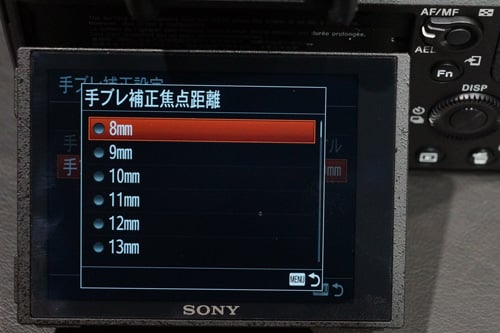
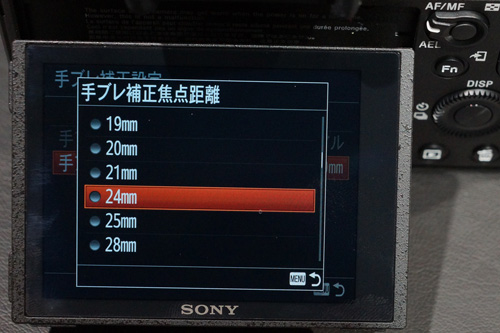
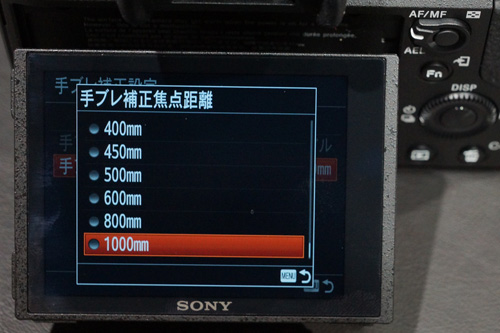
As you see form the images posted by Sonyshop-satouchi, Biglobo and Yagumo-Camera the 5 axis stabilization can be manually set for a long list of focal lengths!
P.S.: Sony A7m2 launch news is now reported on Sony Germany, Sony UK, Sony Italy, Sony France, Sony Australia.
To not miss any of them quickly subscribe our social network:
RSS feed: http://www.sonyalpharumors.com/feed/
Facebook: https://www.facebook.com/sonyalpharumors
Twitter: https://twitter.com/SonyAlphaRumors
GooglePlus: https://plus.google.com/104216500156717934391/posts
Reminder (SR = Sonyrumor):
SR1=probably fake rumor
SR2=rumor from unknown sources
SR3=50% chance it is correct
SR4=rumor from known sources
SR5=almost certainly correct!
133 Responses
What’s a good camera
the camera you have on you….
Sometimes my smartphone is a better camera than my Sony A99.
Uh, admin, i guess they mean the 3 axis stab that are inbody will be active (aka, equivalent to what we have with alpha mount) The other two are within the lense. So there is no way those could get stabilized. At least, this is my understanding
Then you don’t understand, but it still gets stabilized.
They have 5 axis IBIS. Watch the video from sony. It’s so plain simple.
Rotational shake cannot be handled in the lens.
worst menu implementation ever. Sony could have grouped every ten numbers like (10-20mm), (20-30mm), (30-40mm) and so on. When user chooses a group, they will be taken to one deep down menu level and then pick the exact focal length. Save more wheels and clicks
Or make something like how you enter the date, four number fields in which you can scroll from 0 to 9.
that sounds like something I’d absolutely not want
turn it off then
Oh boy, here we go; more BS complaints.
And why are you so friendly with that barrel, is there a hole we’re not seeing from this angle. 🙂
It would face strong competition to be the worst ever.
In practice, it’s not necessary to go down to the exact focal length. A tolerance of 5% or so should be more than adequate. Hence the menu entries get more sparse the higher the focal length.
Possibly of more use would be to have a very quick way of selecting lens profiles that you’ve stored already. That way it could be made very quick. Even better might be a system that allows RFID tags to be attached to the lens and read, but that’s maybe a bit too much to expect.
Have to disagree on this one.
Either you’re using a prime or you’re using a zoom. If you’re using a prime, you scroll once and click once. So it might be a long scroll…it won’t be THAT long (5 selections from 400mm to 1000mm).
But what about zooms? Say you’re using a 24-70mm, or 28-135mm….you’d really enjoy having to scroll back out of the 20-30mm or 30-40mm group to get to the 100-150mm group.
Seems like they chose the most straight-forward way to implement this: Pick from a list.
Edit: Further thought: If you’re using primes, what are the odds that you’re going to switch from a 24mm to a 28mm, or from a 50mm to a 55mm? You’re most likely going to switch from 24mm to 55mm to 85mm or something like that; which means that you’d be stuck in the same hassle of going backwards in the menu out of the group (e.g. 20-29mm) that you’re currently in to find the next group (e.g. 80-89mm) to click that and then make another selection. Way more clicks and scrolls and exits.
Enable the option to configure the value to a dial. that way people who are bothered by this can turn a dial and see the number that IBIS is working to onscreen. No need to go into a deep menu.
A9 is sure to fix that 😀
It’ll probably take you one turn of the dial to get through the whole menu, hardly a show stopper.
When we will see a7s m2 ????
Tomorrow.
5 axis,a7s m2. I can pay straight away !!!!
this IBIS move by Sony just brilliant!
1st blood?
Don’t feed the …
If they were evil brilliant they would say it had stabilization. Make it look like it had stabilization. But no stabilization whoo hoo ha haaaaa
“…and you will need to turn off any stabilization in the lens.”
So, they are recommending turning off IS on the third-party lenses (if they have one). What about (legacy?) FE lenses that have IS built-in? Is the recommendation the same?
Related question: Are cheaper/smaller FE lenses with NO built-in IS on the horizon?
My guess is it’s because the body has no way of knowing what oss is up to on 3rd party lenses…
It’s surely either or with OSS and IBIS. In other words, you can use OSS if IBIS is turned off and vice-versa.
Of course OSS doesn’t provide for roll-correction, and it doesn’t look like Sony would enable just that to be selected so a hybrid approach could be used.
No, this was detailed in another post on this site recently. The OSS and IBIS work together; the camera automatically turns off IBIS for the two directional shifts that the lens already accounts for, but leaves the third shift in play.
That’s for E-Mount lenses. The article (and responses) are about legacy lenses. For alien mounts, the camera won’t obviously know if OSS is turned on or not unless the lens (and adapter) communicates the information in a way that the camera supports and understands.
Right, then you’d obviously just have to turn off stabilization in either the lens or the camera.
They do the opposite for FE lenses — turn off part of IBIS implemented in the lens.
As well firts time in history a camera is so much to be used with third party lenses ;-])
And that’s a bad thing, why?
A very good thing for the manufacturers and retailers of E-mount adapters !
He doesn’t actually say it’s a bad thing, although I’ve no idea what the emoticon is trying to say.
Because it makes you waste our space here with your posts.
And if it wasn’t you would likely be one of the biggest cry babies complaining; why won’t it work with my lenses Waaaaaaaaaaaaaaaaaaaaaaa.
Waaaaaaaaaaaaaaaaaaaaaaa
Supported lenses will work with oss adding 3 axis the oss does not have.
For unsuported lenses oss should be turned off and camera provides 5 axis stabilization
Thank you, Captain Obvious, but we already know that. Your whole post is a regurgitation of information readily available on the Sony website and in this “rumour”.
So should I say to the people here asking this very question that I cannot answer it because Baz will find my answer too obviouse?
Or should I be more controversial in my response so my other critics can complain about that?
Naturally you omitted the favored option, which is that you don’t post at all.
Hmm, wonder how the beercan compares to the 70-200…
Depends, I still like the look of my Beercan images and it is plenty sharp of A7S to be virtually indistinguishable, but kind of prefer the rendering on the beercan. On the A7 it starts to show some of the ugliness of the BC more. Then there is the AF, which is kind of woeful on the BC.
I wonder the same. I had to adjust the centering on my BC and now it’s almost as sharp as the Canon L tele-zooms. Therefore, I expect the BC to be on par with the FE 70-200, maybe slightly worse than it.
Beercan also feels heavier and needs the LA-EA4 adapter for AF. You can’t beat it on the price though, I bought mine for around 80$.
I’m a fan FD 80-200 f/4 L. Super sharp wide open. here’s a decent lens comparison chart:
http://www.photozone.de/active/survey/querylens.jsp
I had seen this before from other sources. However, whilst it does work with all lenses, then it’s not going to be very practical to use with a zoom lens unless you don’t change the focal length much. Not too much of an issue if you are using things like Leica lens, but it’s surely going to be essential for the adapters for Canon & Nikon lenses to pass this information over electronically, or it will make zoom operation with IBIS painful.
How many people are going to be using zooms without electronic contacts though?
Not many I would think, but that’s why I say it’s important. There are, of course, some ancient zooms that don’t have any focal length decoding.
then those zooms have never been stabilized before. Is it really that much of a problem then?
No. Just a bit of musing on my behalf. I don’t think it will have any material impact on sales.
I have such 85-210, bought for $20 on ebay 😀
Well, it’s not that the IBIS won’t work if you input a different FL than that of the lens. It just won’t be as effective (in theory). So you just keep trying setting up different FL until you reach a nice compromise point.
electronic adapters of Nikon lenses don’t exist anyway..
btw most CaNikon zooms have OIS already
Is that because it’s not feasible, or just because nobody has thought it worthwhile to do? Clearly mapping and converting interfaces is a problem, especially if they have to be reverse-engineered. With modern hybrid AF systems the protocol complexity has moved on even more. It’s potentially a testing and compatibility nightmare.
I know that Sony have released information under (free) licence for the basic information for e-mount, but I don’t know if it’s comprehensive enough to produce a full functional interface that allows all the features to be exploited (it implies that it isn’t).
http://www.sony.net/SonyInfo/News/Press/201102/11-018E/
Even if Sony does give the protocols for someone, it doesn’t mean they would give it for those wanting to build Nikon-E adaptor. And Nikon doesn’t give the protocols…
True, but Sigma produce Nikon compatible lenses, so at least one company has reverse-engineered the protocol (that said, Sigma’s track record on A-Mount compatibility has been patchy).
I was rather wondering if there are any fundamental issues.
I am sure Sony retails some control and won’t let Sigma to built such adaptor. Trough, why would Sigma be interested in such adaptor if they want to sell their lenses?
I’m not suggesting that Sigma would. What I am saying is that if Sigma (and others) can do it, then so can an adapter manufacturer given sufficient engineering expertise.
As for Sony blocking the development of such an adapter, then why? I can’t see any downside to Sony in providing an attractive migration path to Nikon lens owners who, once becoming e-mount users, will become potential customer for native lenses. After all, it’s on of the reasons Sony encouraged adapters for other mounts via the licencing scheme.
However, I suspect for the fullest compatibility, Sony would need to have camera firmware that dealt with the peculiarities of the various protocols as I’m sure things like AF have to deal with physical capabilities of lenses as well as mere electrical characteristics.
However, were Sony ever to come up with a way of using Canon or Nikon lenses on e-mount with full performance, then it would no doubt be seen as extremely aggressive. It would be a direct attack on their home turf.
I see your point about Sigma. But it passed 4 years since e-mount came and no adaptors for Nikon appeared, probably it’s quite difficult and Sony would come with complete lens lineup earlier than adapter comes.Sony licensing is restrictive. If they wished more adapters, they’d have published the protocol to everyone.
It’s not a just, or even primarily a matter of a complete lens lineup. E-mount could have the most complete lens line-up in the world, but the costs of re-equipping themselves might appear prohibitive. It’s a mechanism to allow those heavily invested to move across, or at least buy an e-mount body, whilst still using their
However, I am inclined to think that the Nikon interface presents unique difficulties or, as you suggest, it would have been done already.
One interesting thing of course is that Nikon are a big customer of Sony sensors (much more than Canon is). It may give credence to the idea that Sony wouldn’t want to alienate Nikon so might not encourage the development of a “smart” adapter. Japanese businesses often work in such ways. Not exactly a cartel, but also not stepping on toes unnecessarily. The lost of Nikon business for large sensors would be a big hit for Sony, but with Cannon there’s less to lose.
AFAIK Nikon stopped buying APS-C sensors from Sony and now buys from Toshiba. So I don’t think Sony would think Nikon will use only their sensors…
Really. Toshiba? I know they have a sensor business, but didn’t realise it extended to system camera sensors.
In any event, APS-C is becoming less important with Nikon. It’s the FX business where the money is, and I suspect Sony would like to keep a lot of it. Spreading the development costs over the two company’s lines will make a big difference. (The D4s sensor is different of course).
When the first Canon AF adapters came out there was talk of when the Nikon AF adapters would appear. At the time it was said the reason a Canon AF adapter was possible because their patents had expired but Nikon’s hadn’t. Also Nikon was threatening any company that planned an adapter. There was no proof of the threatening though. Even before the AF was put into the Canon adapters there was electronic control of the aperture. It would be nice to have that for the Nikon G lenses even.
Do we know yet if the A7M2 is using the D610 sensor, or the D750 sensor?
It uses neither.
The D610 uses the same Sony sensor in the A7. The D750 is a new FF 24MP Sony sensor. Which sensor the A7M2 is using is still unknown. But it is likely one of these two, not an entirely new FF 24MP sensor.
They may be different iterations of the same sensor, but they aren’t the same. A7 and A7 II have OSPDAF the Nikon’s do not. If you were going to say it’s the ‘same’ sensor as something it would be the A99.
Sony always state they are new but it’s possible they are the same when a similar approach could be taken like a Third party a mount lens. It has stabilisation still there but isn’t available as a feature on the lens.
The D750 sensor has almost exactly the same characteristics as the one in the D610 according to DXO. It’s basically the same. The only real differences are the jpeg processing (noise, colors, sharpness), auto white balance and probably other minor software improvements
It uses the A7 sensor
It’s probably the same. D610 sensor and D750 (sony) sensors are the same, except for their jpeg processing which is pure software. And they are both very close to the A7 sensor (with probably different AA filters, IR filters, and maybe others slight differences). I guess that A7II sensor is the same.
Here are the full spec for the A7M2 (courtesy of Wikipedia). So basically the answer is neither.
General characteristics
Crew: 1
Length: 10.99 m (36 ft 1 in)
Wingspan: 14.00 m (45 ft 11 in)
Height: 4.28 m (14 ft 0½ in)
Wing area: 30.86 m² (332.2 ft²)
Empty weight: 3,226 kg (7,112 lb)
Loaded weight: 4,720 kg (10,406 lb)
Powerplant: 1 × Mitsubishi Ha-43, 1,640 kW (2,200 hp)
Performance
Maximum speed: 630 km/h (339 kn, 390 mph) at 6,600 m (21,660 ft)
Cruise speed: 417 km/h (225 kn, 259 mph)
Range: 1,240 km (770 miles)
Service ceiling: 10,900 m (35,760 ft)
Endurance: 2.5 hr cruise + 30 min combat
Climb to 6,000 m (19,685 ft): 6 min 7 sec
Armament
Guns: * 2 × 20 mm Type 99 cannons
2 × 13.2 mm (0.52 in) Type 3 machine guns
what’s about the sensor, Loran or ILS?
Finally my dream camera is coming true! I’ll just wait for that A9 to see what it’ll bring of better stuff and then… time to rob some bank 🙂
(just to be nitpicky: but my dream camera would have a ‘box’ design, like all the other NEXes, without the faux-prism. But I doubt Sony will change that design on their FF line)
They will make RF style body when RF sensor will be ready.
RF sensor… what?! Does a rangerfinder-like camera need a different sensor now?
I thought the same thing. Maybe GreenLens meant MF sensor? But that is already developed too. HHmMMM
One possibility is that GreenLens means a sensor that works better with wide-angle RF lenses with less smearing and magenta shifts at the corners and edges. Such a sensor would be less sensitive to extremes of angles of incidence issues. It would probably mean some form of compromise on microlenses such that it was not so optimal for typical DSLR type lenses.
Yes, thank you, was in the bus typing.
Always gratifying when you can read somebody else’s mind from a distance. It’s a useful skill for the Internet age.
LOL… NEX-7 was in RF style body, and its sensor had very bad angular response… There is no relationship between body shape and sensor….
We are talking FF here. Sony has exactly one lens to bundle with such a camera. Maybe two.
This has nothing to do if the EVF is in the corner or in the hump.
I think the whole sensor + IBIS package is too big inside the body, so a large EVF + optics like on the A7 would be hardly possible. I’m not saying it will never come, but either the body had to be at least a bit wider or the EVF would be compromised… The hump isn’t fake, if they could make the EVF and optics smaller, I’m sure they would…
To be honest I’m not asking for a small camera. I know that to fit a big sensor, with IBIS, plus an EVF, you have to have space.
It’s more a question of personal taste.
The Fuji X1-Pro is a piece of brick, definetly not pocketable, but still pretty (for me).
Now let’s only wait until they even enable the old lenses to autofocus by the Z-shift sensor and Sony will rule the camera world.
My thoughts exactly from the beginning of all hype regarding movable sensor, haha 🙂
Sony is destroying the chances of Canon users of selling their gear. Ebay is flooding with extremely cheap Canon 6D and 5D3. Everyone’s dumping them like they have the plague, and where Sony fails to persuade, Nikon succeeds with the D750 and D810. Sell now and loose some money, or sell later and loose even more money? The only positive thing in this entire Canocalypse is that waiting a bit longer will bring us the Sony A9. Any news on the 46-50 megapickles sensor front?
what? aren’t you delusional?
I think Vlasic sells megapickles: http://www.vlasic.com/
Could it be that they’re all expecting a Canon 6D Mark II with 5dm3 features, or even better, a lot of those cross af sensors from the 7D mark II?
Nah, it’ll be a Canon 6D Mark II with 6D Mark I features, and a 5D Mark IV with 5D Mark III features. All for a measly 4000 USd at launch in the case of the 5D Mark IV, and 3000 USd in the case of hte 6D Mark II.
Stop taking your meds buddy
Surely is great to have IBIS, but I would by really happy if focus peaking was improved by Sony with no need to enlarge the image to make focusing precise. Just my 2 C.
IBIS is great particularly for manual focusing using magnified view.
the peaking on a7 is great if yellow & set to med. It takes practice but it really does work spot-on after practice & getting to know it.
Hallelujah!
I wonder how it would work with a non oem zoom lens w/o electrical contacts. Would you set the zoom length at the longest or shortest focal length???
Longest… I guess.
You assign the focal length listing to one of the Custom buttons and set it as you zoom.
😛
You will have to always adjust the focal length because w/o electrical contacts its impossible for the camera to know what focal length your lens is currently add… At best use a prime lens if you can 🙂
Are there any that can deliver good enough results to justify the effort?
you will have to keep changing it whenever you change your zoom. Setting it to longest or shortest wouldnt work unless you are at those 2 focal length cause thats how the camera knows how much the sensor needs to shift
Get this or wait for A9? Tempted by this as the A9 will be more expensive and can’t see it offering much more for ME than this + A7S. Only somewhat disappointed I sold my 70-300mm G just before this was announced.
In the same boat. Focussing in low light would be great for weddings, for example. D810 goes to -2ev, D750 to -3ev, A7ii to -1ev. So -3ev would be great. Reliable tracking is another thing, as well as true 14bit raw.
The A7S goes to -4ev. Interested to see the tracking of the A7 II in person but it seems like it is similar to the A6000 bit with a smaller focussing area, A6000 struggles toward the edges anyway which is somewhat understandable. Coverage looks reasonable enough though.
Why not to buy both and sell one later?
Personally I’d wait and see what the a9 brings to the table – they’re going to need to ad something impressive to justify the price…
1. Faster AF
2. 4k & better video quality
3. More MP
4. Better body
5. Improved EVF
6. Dual SD
These would justify the increased price…
Justify it from a market perspective yes, but not for all potential buyers.
What price? Do we know the price of the A9?
“Sony invents camera that cures cancer.”
Yeah, but the EVF kinda bothers my nose.
Hahaha. Well said.
An important question is whether, when you input a focal length manually, Sony puts it in the EXIF data. If so that is a BIG avantage in helping keep track of what lens you have taken shots with, especially if the menu option for setting focal length can be assigned to a button to make it easier. Does anyone know whether the information will be recorded in EXIF?
REB, This is a very important point. Sony has always in the past resisted adding support for entering lens specification for non 1st party (Sony/Minolta) Lenses. This causes a pain when organizing photos in Lightroom where you either have missing, fake or incorrect lens information (f/0 for aperture for example or a fast Sigma prime showing up as a slow zoom lens) .
Sony should allow you to be able to maintain a list of manual lenses in the camera body and each entry should allow you to specify the Lens name, focal length range (important for zooms), shooting focal length and shooting aperture. Then when you put a manual or adapted lens on your camera you can quickly select from the list of preregistered lenses and the camera should right the right information to EXIF.
In fact, Sony also needs to add ability to customize the EXIF information such that I can place copyright information in the camera and have that automatically written to every image. This prevents the problem where non-destructive editing software like Lightroom will let you apply copyright EXIF information but it only applies to processed images — the originals are untouched and remain without copyright information. Also Lightroom does not let you edit lens or shooting information as well so it is a necessity for the camera to allow me to customize it and have it written automatically at shooting time whether it is a RAW, JPG or movie file.
These are all very simple firmware additions that make life so much easier for serious or professional photographers but Sony still will not implement it despite how little effort it would take.
Sony needs… Sony should… What you mean is “I want”. As for these being “simple firmware additions”, unless you’ve actually worked with the firmware source code you don’t actually know that. I don’t disagree it would be useful, but there are Lightroom plugins which allow you to edit lens information.
I will never get though, why they made the record button in silver and not nicely black and integrated looking like on the A6000??? Especially when all the other buttons are black too now on the A7mk2. Doesn’t make sense and hoping A7000’s record button will be black.
does that affects the picture in any way?
Who cares… They could have made it pink if they wanted too.
….you need a life, man.
aarrrgh! This damn record button! Yo man, this camera will fail, thats for sure. Until now I thought this camera will be one of the best mirrorless cameras on the planet. How blind I was. Sometimes we are kind of blinded by flashy features and oversee the most obvious flaws. The record button!
Hurray!
Doesn’t Pentax have in camera stabilization that works with all lenses?
Sony’s dSLRs/SLTs also have IBIS that work with all lenses.
Not all, only native lenses. Plus, Sony’s full frame; Pentax’s APSC. Big difference. Well, it’s not really that big, only about 1.5 times bigger.
1.5 is the focal length crop factor.
Sensor size is double.
what means the “firts” time. That fluckling Chinese kleyblolds write strange things. I use also one of those, hahaha.
That camera seems to become a new runner, just can’t await to see the A7000.
I’m happy with the a7 with older manual lenses..this is fantastic stuff! Got to have one of these things.
Now fix the chunky, unergonomic on/off switch below the important shutter button and I might be happy. Waiting for the first A9 leaks.
Not third party, adapted lenses