







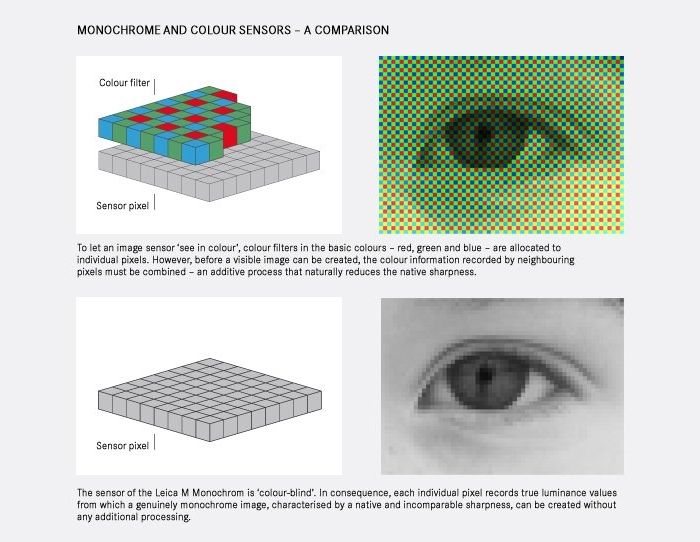
This is a Leica diagram to explain the Leica Monochrome advantage.
A couple of months ago I told you that I got rumors about Sony working on a Black and White Full Frame sensor. Recently I got a rumor from an anonymous source about a new B&W camera:
“Sony has understand that niche markets are profitable and is developing a FF CMOS black and white sensor for his flag ship RX-1. I was told that the sensor has a higher frame rate, +6db S/N gain compared to the color version and resolution of 24MP. My source said also that this will probably be available end of 2014, start of 2015. It look like Sony is really a nightmare not only for Leica but also for NIKANON.“
I pray to all gods that this will become true! This could become the sharpest, purest and highest dynamic range FF camera ever made! There is currently one such camera and it is the Leica Monochrome ($8000 here at Amazon). But I am sure the Sony camera will have a superior Image Quality and I guess price will be under $3000 just like the current RX1/RX1R series.
[poll id=”182″]
———
Message to sources: You can send me more info anonymously by using the contact form you see on the very right of your browser. You can also contact me directly at sonyalpharumors@gmail.com.
For readers: Subscribe the RSS feed (Click here) and Twitter (Click here) stream and the Facebook fan page (Click here) in order to not miss any news!
——–
Reminder (SR = Sonyrumor):
SR1=probably fake rumor
SR2=rumor from unknown sources
SR3=50% chance it is correct
SR4=rumor from known sources
SR5=almost certainly correct!
0 Responses
A resounding, yes to it! I will not buy it but will look forward to an A series (interchangeable lens) monochrome camera.
Go Sony! 🙂
I shoot predominately in black and white. I’m very intrigued. That said, if the A7s handles lowlight like no other, I’m not sure how useful this RX would be over the A7s at the same price.
It’ll be better and cleaner and like 6x the resolution.
I wish this is an RX camera that holds both the color sensor and the black and white sensor and that I could switch the sensor as I need, since the lens remains the same.
Like a drop-in bayer filter? Once you see the ill-effects of the bayer, you’ll only want to shoot in BW.
Strange move. At 24Mpix it will have roughly the same resolution as the colour A7r (although with better sensitivity). But it looks like Sony are exploring many niches. Kudos to them !
It should have better visible resolution than the A7r (much better, like 3x resolution, no?). And much better light sensitivity. And better dynamic range. This is basically the ideal digital camera (if BW is your thing). And it should be easier on the processor. I’d like to see a global shutter.
“This is basically the ideal digital camera (if BW is your thing).”
That remains to be seen. A sensor does not translate to a camera automatically. That too a P&S one.
Jon, I too would be very attracted to a great B&W sensor with a great lens. Not to mention a more silent shutter than the A7r that’s making me deaf 😉
This sensor will be a bit younger than the A7r’s so might benefit from slightly better technology. Apart from that I don’t see how it would have significantly better resolution than the A7r (Leica’s Monochrome is more or less a match) or sensitivity beyond the 6dB mentioned by Andrea.
I’d LOVE it to be much better. I just don’t think it will be. Incrementally better, yes. ignificantly better, no. Read Ming Thein’s recent take on the Pentax 645 using the MF Sony sensor. You’ll see there is an improvement at pixel level over the D800e, but not a revolution.
I’m not saying this won’t be a great camera. Just not big enough a change for me to sell the A7r and get one. The A7r is already an excellent B&W machine 🙂
Cheers,
Pascal
I have the A7r and a Leica MM (the cheapest monochrome camera in the market!). The MM wins in every department although I would love to have live view and not just the RF.
I’ll happily take your word for that. It bodes well for the coming camera.
If you have a chance to rent (in the US there are rentals), I would highly recommend that you try one. The ability to make handheld (sharp) portraits at 1/10s and the malleability of the resultant files ought to be experienced first hand and can not be communicated at all. 🙂
Hear hear. The A7r sure is clucky and loud compared to a M. And its ergonomics are terrible.
I’ve never used an MM so can comment but don’t share your enthusiasm about the malleability of the M files in colour 😉 The A7r is pretty good and my very limited time with an M240 left me slightly disappointed.
Just as I (and many many others) found out, with the monochrome camera, even a cheap 1955 FSU Jupiter-9, 50/1.5 delivers stunning images. No need for an $8000 AA Summicron 50/2. This is one important reason why I would like an interchangeable lens camera and not the RX1 like abominations.
As for the M240, I did not even bother to look up its specs let alone attempt to try one. 🙂 The A7/7r deliver and deliver in spades (despite the limitations). 🙂
The reason the monochrome sensors are so great compared to cmos sensors is that most of the resolution is not lost to the bayer filter and color interpolation. That’s why a Sigma DP Merrill can have a 15mp file, but look as detailed (or often more) than my 36mp A7R. A monochrome sensor does the same thing, basically, but only with luminance values (so snr is way better). If we really do get a 24mp monochrome sensor, I’d expect it to look as detailed as a 50mp cmos or better.
Jon, Vivek. I sincerely hope you are correct. That sounds very promising! Tri-filter colour shots, anyone ? 😉
That’s the one thing that would persuade me, actually, it would be a cool project and the results should be stunning in terms of details and colour accuracy.
But only if it was 36MP, and only with interchangeable lenses (so basically if they did this as an A7M).
In theory you should get about 2x resolution on average, more on objects that are very strongly coloured. But in practice you will be limited by the lens, so the gap over the A7r wont be massive.
Dynamic range will be better at higher ISOs, but base ISO DR is limited by the read noise, not photon noise, which is the same regardless of colour filters.
I’d rather have a 48MP Bayer sensor.
Cool!
I’ll buy a monochrome RX if it has a built-in 50/2 and a full-pixel readout for video. Otherwise, I’ll wait for the next alpha camera to feature a monochrome sensor, and buy the hell out of it and officially leave Canon for Sony.
It’s all very nice and all that but I do wish Sony would point their limited resources at getting the basics right.
The RX1 basics are way more than right, son.
Good for you, I am glad you like it.
like user interface? menu system? stupid focus-by-wire. yeah, they’re real hodgepodges of cameras, i agree. more like electronics than cameras. but at least sony is pushing the industry in an interesting direction.
There does appear to be plenty of people in Sony to tinker with hardware, but few resources on the firmware development side. On the lens side they should simply give up and get Tamron and Zeiss to do it all for them, give them a list of lenses and let them get on with it.
And Sigma!
Uhm, sony does fine lenses themselves. After all they have both the Minolta guys as well as their knowledge from the film industry, where they still lead.
…and you miss the point…
No, because I don’t want them to stop putting resources in lens development themselves.
Yes because they haven’t done so since taking over from Minolta YEARS ago. That is not going to change so give it to Tamron.
Focus by wire really frustrated me with the 50/1.8 on my parents’ nex 3. Has it improved with newer lenses?
I don’t think so. Canon’s 85/1.2LII has lovely focus-by-wire. But Sony has a really unpleasant implementation. Very disconnected. Why they can’t add instant-override like the Canon is beyond me.
They vast resources compared to many smaller companies. Other than their sensor division, their capabilities (cameras) are questionable.
Sony as a whole is a large company, but their imaging division will have limited resources, resources that should be put to expanding their A and E mount lens range as just one example, but there are plenty of other examples.
The camera division and the customers will be better off if it is spun off and let go off the megalith Sony empire.
If it was profitable then yes, but that’s the catch, if it is profitable then Sony would not let it go!
Instead they’ll give it minimal resource to milk the division and support other failing parts of the business that they still like to cling on to because it is “Sony”.
True. 🙂
A shame.
That would be very cool. With Sony’s sensors, this camera could shoot up until ISO 50k and look really good. See what happened to the Leica Monochrom…while the M9 could only reach a half decent ISO 2500, the Monochrom spits out gorgeous ISO 6400 images.
A very cool camera worth considering indeed. More so if it has the same body and characteristics as current RX1 because the accessories already available make it a nice match.
I would easily consider shooting many projects in B+W just to have the nice files.
it’s normal, in monochrom, noise translates to grain I use 12500 on NEX-7 to simulate Tri-X grain. Fine 6400 grain gives a nice touch, in color it disturbs.
Yes to an A7-like and -priced monochrome FF. $3000 would be too much for me. And I’d prefer interchangeable lenses.
There is no reason that a monochorme A7 cost 3000$. The video is obsolete anyway, or do you want to turn old silent movies like in the early 20es?
There’s every reason a monochrome A7 would cost far more than the regular version. The smaller production volume means all fixed costs from the setup of the production line to the firmware coding to the design and printing of marketing materials and packaging is spread over fewer sales, thus the sale price has to increase to cover it.
Talk about niche products. RX1 was already niche with an FF sensor and fixed 35mm lens, no viewfinder and $3000 price. Then to make it b/w only? I’m sure it will take fantastic pictures but, come on.
That no viewfinder is a real, genuine gripe. Until that happens I am not getting an RX, even if it’s an RX 50, which I really want.
Uhm, you can buy a viewfinder for RX1 and RX1R.
Ugh.
Come on what? It’ll take fantastic photos. Way better than BW converted cmos files. What more is there to say?
It’ll probably be brilliant. I’m just saying that with so many limitations, there won’t be that many people willing to sacrifice, at that price, for what realistically will be a difference (vs. other full-frames) only noticeable to pixel peepers.
tonal curves will be greatly affected. smoother highlight rolloff will be perceptible by even laymen. though, you’re sort of right about pixel peepers; still helps with printing, though.
when will we get an interchangeable sensor camera?
with a drawer you slide in at the bottom, this must be possible, one camera and a box with 4 or 5 sensors, from 12 to 52 mpix, that is the way to go.
Can’t see that happening, given the tolerances they’d have to work to.
+1
Leica tried, along time ago, with their only digital attempt for the R mount.
If someone could figure an M3 digital module (shaped like film) I would leave modern digital bodies forever, only upgrading/collecting new sensors.
That had happened as well and failed.
http://www.f-stopeight.com/converting-film-cameras-to-digital-efs-1-the-technology-that-almost-was/
I’d like to switch between A7R and A7S by exchanging sensors, would be really cool. But with independant lenses, not the way Ricoh went.
Ricoh has an M-module, too (for m-lenses). It has to be modules, as the tolerances are too high.
We have one. It’s called the Ricoh GXR.
Except that’s not really a camera, more like a battery grip with interchangeable cameras.
I’ve never seen a battery grip with a processor built in. Or a memory card slot. It’s an interchangeable sensor camera. The tolerances are way too tight to separate the mount from the sensor.
What’s with tolerances? How is interchangeable sensor different from interchangeable lenses?
micheal jackson sensor on horizon!
You mean it only shoots naked young boys?
Ugh, man. Where did you get your sense of humor. It’s horribly gleeful. Just go away
If this rumor is true, Sony’s marketing strategy baffles me, I mean one would think that Sony would want to spend more money expanding their FE & E lenses, so people are tied to their eco system, because that’s where the need and the market exists. Every single forum/website/reviews I see/read, majority of the people want more quality lenses for the FE mount. I wonder if Sony even listens to their customers. I have Sony’s entire FE lens line up, which is just 5, so I’d like to see Sony coming up with more lenses instead of a $3000 black & white camera.
The biggest objection people have to Sony is the lens lineup. The apsc e-mount lenses have gone dormant and FE is all over the place. A-mount is more mature, but crying out for some f4 zooms and for the gaps to be filled (like a 35/1.4 za and uwa primes)
We need an 85/1.8 and a good 24. A 135 STF for FE would be a godsend. A 100mm macro. A 50/1.8 with OSS and a 35/1.8 with OSS would be pretty killer, as well.
If they did that, IMO what would be the point of A mount. STF, 135mm 1.8, 100 macro- those are anchors for the alpha mount system. I will say this though, if Zeiss comes out with a line of manual focus high end primes for FE I’ll switch. I need a 135mm, 85mm and don’t see that happening anytime soon. However, if it did it could sway me. But they would have to be stellar performers. I’d only move over if they have something optically to offer me. The 55mm- while really good- just isn’t enough.
The real question is whether or not Sony wants to flesh out their FE lineup. If they can figure the engineering of a curved sensor ILC, then I don’t see the point. But if curved sensors are only for fixed lens compacts, then by all means, cannibalize the A-mount sales–it’ll eventually happen, anyway.
I wholeheartedly agree, if Zeiss releases their rumored manual FE lenses, then I could really see myself investing in Sony. As it stands, the FE cameras/lens combos are too distant, not really enjoyable to use, mostly due to a terrible menu system/organization and focus-by-wire lenses.
But I do think we’ll see an 85/1.8 by the end of the year. And a 24 sometime next year.
I don’t understand why bringing new cameras stops developmemt of new lenses!? Those are completely different teams, working parallel.
Because a near-bankrupt company like Sony doesn’t have unlimited resources so allocates budget money based on priorities. Lenses and flashes don’t appear to be a priority. Sony marketing appears to be throwing as much mud (in the form of bodies) at the wall as they can to see what sticks. I guess I’m a rare photo nerd here on SAR as I don’t plan to join Sony’s Body of the Month club.
Meanwhile, Sony’s a-mounts are openly mocked on Canikon forums for poor system support with many claiming they’d never buy one because their lens system sucks. Sony’s flashes pretty much suck, too. Did they every replace/fix their buggy overheating flash(es)?
Yep. That’s such a shame. I think Admin should run posts about what are the issues we find with the Sony equipment, new tech discussions, etc in different threads that can be easily viewed. For that end, I think the format of SAR needs to change, to be a mixture of the present post based design and a thread based design like that of REDUSER.net. That way, the Sony users can bring around a cohesive direction to their input. And a community based voice for all things that need to change and also to hep the young photographers.
It already exists, it’s called Dyxum.
Your assuming these niche RX1’s are requiring a ton of resources. I question just how much time and attention Sony need to put out these cameras. I personally think we aren’t seeing the newer tech in an A99II sooner for marketing reasons- not resources.
Mmh, one thing many people don’t see: Canikon lens lineup was not built in a day. On the contrary it needed years, many more than the E-mount today, just look at the lens histories.
Why should the system support be poor? A-mount has everything 99% need, doesn’t it? Plus some extras, that Canikon does not have (STF, mirror lens, …). It is not about quantity. There is a lens for everything except maybe > 500mm… but that is only needed by *very* few people.
The flashes are in my opinion far superior to the Nikon, Canon ones, because of the way, you can use them in vertical mode with indirect lightning. The old design that Canikon still uses is absolutely not good, but still they hold on to it. Overheating problems? I only have them in extreme conditions. In conditions, that speedlights were not made for.
All in all it is quite clear to me: you should not check on Canikon forums for how good or bad other systems are, because naturally there are many “fanboys”, or simply people, who want to explain, why they hold to their outdated Canikon systems…
Just my 2 cents :)…
The current Sony lens line-up has 99% of what I want? You kidding me? Heck, last night I spent over an hour shopping old Minolta 400mm f/4.5s on FleaBay.
Do I look like I am kidding you ;)? So what else do you miss?
Obviously a Sony 400mm f/4.5 for starts. Please help me find it on their store site. When you find it send me the link. ;^)
I agree that bringing new cameras does not have to stop development of new lenses and I wish it was true in Sony’s case … so far Sony has only introduced some not so happening FE lenses (with the exception of ZEISS 55 f/1.8). There is a bigger market and need for more good quality FE lenses then a monochrome camera – voting results and the market clearly indicates that.
I shoot 95% for B&W output but wouldn’t want this sensor. You get so much more control during the RGB conversion to monochrome than you ever did with B&W film. Plus, on the all to often occasion that a client says “lovely B&W, can I buy that in color?” Then you still have the RGB RAW to sell him……
Any color camera can do B&W, I do then not see the reason for such a sensor, even if it erases the disadvantages of the Bayer filter. B&W is just today remaining a personal appreciation, is used sometimes in publicity. I love B&V, but the votes show clearly that most would not buy such a camera. A fixed lens camera has the advantage that here all parameters match, but will that compete with a ILS Leica, I doubt that. I would buy that camera, but not for 3000$.
It is a specialtiy camera, not for the masses. So what “most” people would do, does not matter here 🙂
Most people don’t have taste. If you can’t see the benefits of a dedicated monochrome sensor (and cmos looks good to you), you can remain with the masses. However, Sony will turn enthusiasts, professionals, and artists if it can pull off a monochrome sensor.
And why would you ever want to discourage Sony from making an exciting camera? Aren’t there enough crappy CMOS cameras already?
What most people would be is completely irrelevant. it’s a niche product as all B&W cameras are. Don’t want or need one? Simply move on…
If you have ever used a true B&W digital camera instead of a Bayer sensor color camera converted to B&W, you would realize that there are some pretty significant advantages for the B&W photographer.
No, I won’t move on! I want reasonably priced good lenses, and not B&W cameras! I want 85mm f/1.8 for $400 comparable to Canon’s. I want 70-300mm for $500 comparable to Tamron’s. I want 24-75mm f/1.8 for $800 comparable to Sigma’s 18-35. I don’t want B&W, I don’t want ISO409,600, I don’t want $800 point&shoot, I don’t want curved sensor… And, in particular, I don’t care what all you other people want!
zorglub76, clearly the entire universe revolves around what you want!
… AND I want that bloody universe to come to senses and start revolving around my needs!
Ok. We will talk about your needs later. But first, do you understand the reason for it to come into existence?.
How long have you been out of this world, if you’re asking me these kinds of questions? Everyone knows it’s “42”
🙂 Apologies.
disqus does not loads on SAR since yesterday, I use the disqus dashboard to comment. It works great on Imaging resource, only here it is a pain in the a..
If it’s a b&w rx1 with the current 35/2, then it’s a no. If they go for a 50/1.8, then I’d consider it.
On the other hand I would prefer it just a tad wider, maybe 30mm 😉
Of course, they could just whack it in an a7 and make everyone happy…
Hopefully the all-in-one construction and leaf shutter mean they can include a built-in color filter. That’d be fantastic.
If there was a built in yellow, red and orange user selectable optical filter, that would raise the value of this camera substantially to me.
or even built in red green and blue filters so you can do old school colour landscape photos with a tripod 😉
That was my thought too but I always tended towards a red filter in my B&W landscape work to get that nice blackish high contrast sky.
Using this sensor in a fixed lens body is a waste, I want a Sony B/W sensor in an A7 body so I can use interchangable lenses. Also I would have prefered 36MP which would give great resolution and amazing DR.
It will be interesting to see how well the Sony stacked sensor performs in B/W next year.
Using a fine 24MP sensor (any sensor) in a fixed lens camera is a waste.
What should we use then?! o_O
GH-4. Best bang for the buck with true 10bit 4K capability. 😉
Badly blown out whites. Pass
I pass on the A7s for numerous reasons (although it is not half as bad as the RX1 series) and would welcome an A7m. 🙂
In my case, I need the A7s for color video. No other choice. And i want to stay within the system.
I would too. Marco is a m43rd user if I am not mistaken.
Don’t you think his crying need is better DR?
That is for him to decide. Once you go FF there is no going back to nano sensors. 🙂
Not just FF, even APS-C has been offering nearly all the conveniences of m43 for at least the last few years with a visible quantum jump in image quality.
If I close my eyes, the world ceases to exist. 🙂
Is that a clever random comment or is there a metaphor somewhere?
If I close my mind, nothing beats the m43rds. 😉
Phew. I thought you were whupping my take on m43.
i understand it now. That’s a very fascinating oversight of a very shoddy image quality for practically “zero advantages” . I think Steve Huff too “cannot notice” the unpardonable DR of m43. which reminds of the silent era DR minus the feel of the film.
It’s the multi-tool of “video cameras” for sure, but it’s weak in the stills department and audio is a major kludge. It’s a tough call when looked at objectively!
But yes, I agree with you, it’s the best bang for the buck.
Are you not interested in bigger prints ultaprints etc.???
Only one choice d800e/d810….but you have to carry a little bit more than with your current m43 equipment….but you could create a relatively small fx setup
d800e/d810
28 1.8
50 1.8 or 60 macro
(85 1.8 if needed)
70-200 f4
or if 24 mpx enough d600/d610 or a7 with lens setup…being on a sony site 😉
a7r not an option shutter shake vibration problems……
just 2cents
That’s so misleading and mischievous advice. I wouldn’t touch Nikon or Canon. Especially to start to build a Nikon system in these times.is moronic to say the least.
would only partially agree….
if you need the resolution….dd800/d810 only viable and affordable option……pentax 645z even more expensive heavier, bulkier etc…and not much advantages over d800/810…..
sony a7r not an option….sadly…shutter vibrations are not acceptable….
successor hopefully soon and better….
and still the lackl of fe lens is still a big big big argument not investing in sony a7 series…..
and sadly sony seems to concentrate rather on new cameras (or more cameras in gerneral) than on building lens as typically for sony or sony is known for…..former times showed us this fact and it seems they didnt want to change this or continue doing this…..regrettably…..
they thin with a bunch of cameras we could make more money than with lens…..
yeah and they should not onyl focus on ne wlens also on much better af system af system in the sony a7 series (especially s and r) is so worse…..all other companies or competitors are better nikon, canon, fuji, olympus…..
fullframe lens will always be big and heavy especially the zooms…so small body big lens is not better imo even worser than big body and big lens…balancing issues…..esp. if you have to use an dapter as well….
1.8 primes are relatively small….
so snmall ff body only make partially sense….
and also it would be better if the sony bodies woudl be more expensive than the lens…..
imo its better if the lens are cheaper than bodies…becuase you are buying more lens than bodies…..
so canikon or panikon are not worser there…i would they slight advabtage for them because the lens are cheaper in general and or they have at least more options with cheaper alternatives than sony ….
I don’t mind paying a little more for the lenses, because I only buy once. But i would like to pay a little less for the bodies which I would need to change periodically.
Nope. He needs a combination of A mount and E mount, depending on the type of work situations. All his present and scaled up future needs will be perfectly served by the present Sony choices. Plus, it’s Sony pushing technology today at affordable prices so i would build my lenses for the Sony system.
I would rather be frustated with the lens gaps in Sony for the next couple of years than be frustated with the bodies that don’t get improved or lack of new exciting and advanced bodies, which is the case with the present Canikon.
yeah and one big argument is you would learn a lot…..its more challenging and demanding for your skils as aphotographer…..
with a m43 especially the omd system everybody can make nice pictures due to the ibis….no blurred images anymore….always sharp in focus…if they are or would be forced to use a different camera they have a major problem because a lot of didnt get the knowledge about iso, shutter speed and aperture….
as a beginner best to start with an old dslr in order to learn the basics mentioned triangle
Are you for real? How can IBIS correct for bad exposures, subject movement or other issues that might arise because of poor understanding of aperture, shutter speed and ISO? IBIS helps against camera movement, nothing else.
Unfortunatly I have an allergy toward DSLRs 😉 but thanks for the hints!
Actually, I had some photos printed 1 meter width for an exhibition, and they were taken with an Em5 and MZuiko75mm. Usually I get photos printed 40 x 30 cms, and they looks nice.
Ultraprints are different: photos are printed and you look at them through a magnifier lens (10x if I’m not wrong): that’s when you need a higher pixel density. So as Ming Thein told me, I can’t ultraprint bigger than 20 cms width with a m43 camera. But I can go beyond that size with the tiny powerhose Ricoh GR.
Next purchase could be a Sigma dp2 Quattro, and there won’t be any problem with it 😉
GAS is a bad thing.. :/
Yeah, I’m a bit frustrated here. I had kittens Sony drags its feet on a-mounts and came out with a very minor sensor tweak on the a77II. Yet it seems they’re pouring endless resources into the RX line with them now pondering developing a specialized B&W sensor. I don’t begrudge people who really want a B&W sensor their joy but as SAR’s survey reveals, this is one of the least popular items I’ve seen polled in my short time here.
One just has to wonder about Sony’s priorities.
Sony also appears to be emphasizing bodies more than support for overall systems. Did Sony ever fix the buggy flash they were dumping as fast as they could on suckers… errrr… customers not too long ago? At risk of stirring up the ‘a-mount is dead’ trolls, how about expanding the breath of your lens line-up to better compete with Canikon? Just re-issuing minor upgrades to existing lenses and charging a lot more for them doesn’t cut it.
Yeah, e-mount fans (I don’t happen to be one) want more lenses too.
Interchangeable cameras are all about systems and if Sony want to get out of 3rd place they need to live that.
I can’t complain about the sensor in the a77ii – noise is better than the predecessor and they haven’t gone for a pointless pixel boost. But the main differences there have always been about performance/usability. Odds are we’ll see a 36mp sensor in the a99ii. Main thing for me is they’ve demonstrated a continuing commitment to the a-mount…
The a77ii catches up with the Nikon 7100 in IQ. That’s the good news. The bad news is a 7100 replacement is rumored around the corner.
It’s frustrating that I’ll have to wait another 3 years for the a77 replacement I want given I’m pretty sure the sensor tech is available to produce it. However, there’s more profit in incremental and Sony marketing has made it pretty clear new tech shows up in e-mounts 1st with a-mounts pulling up the rear a year or more behind.
And? Sorry but any D7100 replacement is not going to have a huge jump in sensor performance, probably nearly none at all. Nikon will fix all the other problems, the ones they deliberately omitted from the D7100 to make sure they could do an ‘upgrade’ later down the track, like bigger buffers. If you think A77 II is a minor upgrade, wait until the D7100 replacement hits… D610 / D810 anyone?
As with every niche market this will also sell quite well I guess, although I’ll not consider to buy it.
I hope it sells well. Because I want to buy the A8Monochrom.
BW is fine.
But really…
Where’s the A99 mark II?
That’s what I’ll be spending my hard earned cash on!
Otherwise, it’ll be MF for me this year!
Yeah, I’m with you. Really frustrated!
Maybe Sony is hoping a B&W sensor is an unmet market they can sell to Canikon. A RX might be the first in a wave of announcements. I really don’t believe this but it’s a theory.
Let’s just be honest with ourselves here for a minute. The A99II will be a warmed over A99- just like the A77 the rumored 135mm 1.8 SSM. At this point, a 36MP isn’t expected- it’s just like showing up and being late to the party. It’ll have the same body, remove some features people will be pissed about and fix the auto focus and hopefully better video. 4K? State of the art ISO? Class leading MP that isn’t two years old at this point? Nah- why bother- they got mirrorless for that. I’ve just come to accept it- Sony is all over the place and the A99II isn’t going to change that.
Sony needs to concentrate on making new lenses……its way behind other brands now and lack of modern quality lenses is probably Sony owners No1 complaint!
Given what Sony tends to do with its lenses line up, I would welcome (and buy) this monochrome RX1. What I’d like also, is a built in EVF, but I see it less likely to happen.
that would be a dream 🙂 or even just optical view finder… since it is fixed focal length.. i see why not.
Without having to worry about bayer filters and using a fixed lens, might be a good test bed for the curved sensor as well as being B&W.
this would be a lot of new tech. make everyone’s brains explode. I want.
With the right software, you can make a stunning BW image from a colour sensor. Why would I buy a camera that limits myself to only BW images.
Read, it says it is sharper.
And about a stop more sensitive.
The images on the M Monochrom are very sensitive and subtle, and it allows you to use filters the way we did “growing up’ A pure Monon sensor is a beautiful thing. And the gorgeous CCD on the Leica has such an amazing noise character, this is one area where I could not imagine Sony figuring this out.
Leica Monochrome still requires that you manipulate the DNG files for the best results. There is always room for improvement. In terms of the camera itself, the writing speeds and garbage low resolution LCD for some are pain points. I see this as an easy score for Sony and I think they’ll figure it out- no problem.
You have no idea about what you are talking about. It is hardly an easy “score” for Sony. In fact, if they bring out an RX1m abomination, it will boost the sales of the MM (and Leica may jack up the price yet again!).
That made me burst out laughing.
wait….could it be possible to “bayer” the sensor on readout? in other words…..take the readout from pixel “x” on the sensor grid and assign it a “red” color in processing? The pixel next to it could be assigned a “green” value and so on.
Couldnt the bayer color assinments be done downstream in the processing phase?
Cliff
and how does the green pixel know that green light is coming… ???
each photosite is just a “voltage” producer. in a 24 million pixel sensor, the readout collects 24 million “voltage” readings and sends them downstream for image/jpg building.(the voltage “logs” simply go out to a raw file)
I dunno…if there was some way to “digitally” apply a R, G or B color value to each of these voltage readings, that you might not need an optical color filter.
im prolly just dreaming here…
You can’t do that. You split the visible spectrum into three so when you – for example – read a photo-diode with a splitter that only lets red through you will know it’s red (because it has a red splitter) and you will know the intensity (=luminance) because of the voltage. The higher the voltage the “stronger” the red is. The photo-diode can tell you how strong those photons are (=luminance), but it cannot tell you the frequency (=color).
but…and I admit I could be 100% wrong here…couldnt they take one single pixel voltage value and call it an R, G or B value (and digitally for all pixel voltage values in a virtual Bayer RGGB grid) and then deBayer it down the road like they normally would?
woah…this is crazy! lol
in other words….can you take a luminance value and assign it a single chromanance value instead? 0-255 black and white now becomes 0-255 blue scale or red scale or green scale
The problem is that red has luminance. Blue has luminance. Green has luminance.
“couldnt they take one single pixel voltage value and call it an R, G or B value”
The photo-diode has X as voltage. How do you know the R/G/B ratio? Maybe 100% of the energy comes from green. Maybe its 1/4 green, 1/4 red and 1/2 blue. There’s no way to tell. If you don’t seperate the spectrum all you will know is that X kg was lifted. No one will tell you who did it. Maybe it was lifted by a man. Maybe a child and an adult female did it together.
Electrons are stupid. They don’t know what hit them. All they know is that something did and forced them to move (and create an electrical circuit that can be read and digitized). In short, photo-diodes (the light sensitive part of the sensor) can only be used to guess (only “guess” since it will never be 100% accurate) the energy level of the photons. If you let the different colors’ energy level mix… then it’s all over. It’s like R + G + B = a. No matter how hard you try you will never get your colors back, since you only know what ‘a’ is. If you use splitters however, you will only have to deal with one color at a time, so R = a, the neighboring pixel is G = b, the other neighboring pixel is B = c. You know the value of a, b and c from reading out the sensor. In this case, if you know a, b and c, you also know R, G and B. Now interpolate the 3 pixels or downsample to one pixel and you get a colorful RGB pixel ready to be processed and saved on your SD card.
As far as I understand… no…
The whole point is that you capture luma from the whole spectrum (no color splitter), thus no need for interpolation. God knows about chroma information. We don’t
No, the luminance would be wrong. The current Bayer layout is to guarantee that green light reaches the green pixel at the proper brightness, shutting out most of R and B. (it should theoretically be 100%, but of course the exact amount varies from manufacturer to manufacturer).
I suppose it might be possible to have a red, green, and blue color filter in front of your lens. Then take three locked off shots in succession, and then combining the frames after tinting them in photoshop. Might be cool for extremely niche applications like still life or landscape photography.
You mean changeable color filters (thus changeable color matrix)? Count me in 😀
I could DEFINETLY buy this….buy buy buy buy. Will it utilize a curved sensor as well? Where do I throw my money!!!
…and save R&D by using the exact same casing as RX1 with a fixed screen and no EVF
Sony must be hit in the head is they think I/we will buy a BW camera for 3000$. I wouldn’t pay 100$ for such a camera, it has no point. You can make BW pictures from any color cameras LOL.
stop trolling
LOL, now I’m a troll, very interesting.
I’m just saying the truth, it is painful yes, but you can create a BW image with any color camera on the planet, but you can not bring back the color from a camera like this. You must bee hit in the head to buy something like this. This is the pure truth. It is like trowing 3000$ out of the window.
You can argue as much as you like about de-bayering, better SNR, greater DR, who cares if it is BW.
A BW camera that can take IR pictures may be fun, but this is f…ing insulting!
Then why is the Leica M Monochrom one of the best and most sought after cameras on the market? It’s a lot of photographers’ dream camera, but the price is out of reach. There is a built-in market for this kind of a camera, especially if it makes its way into the A7 or A8.
The BW Leica is another big joke. If people dream about it is their problem.
But don’t worry, Hasselblad will bring later on a Nebula edition of this camera, for “the real photographers”! LOL
I apologies if I indirectly offended anybody, but for me this is absolutely hilarious. As I sad before, you can easily create an BW picture on the camera, with any camera in the world now.
Yeah, but there is no camera that competes with film BW (which is the standard) except for the M Monochrom and the Sigma Merrill.
Even if it’s stupid, it’s an untapped market that could bring Canon, Nikon, and Leica users to Sony, even if it’s just for their cameras.
Actually is you scan the best BW film you can finde for 35mm cameras, you will have a very big surprise, all M43, APSC, FF cameras beat it for resolution, and most of them also for DR.
I have a professional Epson film scanner at home, and I do make a lot of scans. Film is fun no doubt, but nothing more.
I understand the feeling of film, I like it, I also like to take from time to time BW images, or at least edit them.But to trow away so much money for a BW camera, makes absolutely no sense. They money better spent at a lathe (smith) for the Leica logo and the rest of the money can be invested is something more constructive (lenses, books, a 4K recorder for the great A7s etc).
One, your Epson scanner isn’t professional. A drum scanner is the minimum. And the only way to compare resolutions would be to print them side by side (optical for the film)
Two, I don’t believe the any M43 sensor will outresolve Tmax 100.
Three, it’s not about resolution. It’s about tonality and highlight rolloff–something digital cannot do elegantly. Further, no digital sensor can match the color space of film. Film is still the standard for color and tonality and highlight recovery and smooth tonal curve.
I don’t want to start an argues about film, it has it’s strengths and weaknesses. I don’t directly print from film because most of the labs are digital now. I printed A3 in the past directly form film and is full of grain, resolution is lower than any 12+ MP to date. For me any modern digital (relatively) big sensor outperforms film for my needs. The feeling is not the same, I agree.
Your Tri-x may have a lower usable resolution, and exhibit lots of grain. But your slow films and slide films should print A3 without grain impeding on detail, no problem. But if you don’t like the look of film, that’s another matter entirely and isn’t really up for debate. I do think film can handle being pushed past it’s technical limitations better than digital, though.
Well, you might not. But every survey I’ve done or have seen for the past 10 years indicates that, at the same price, about one fifth the one fourth of the serious photography customer base would buy a monochrome camera. Every survey. In practice, we’ve never really had any opportunity to validate that number. All actual monochrome cameras that have been produced are essentially short runs that sell for more than the color version of the product, usually way more.
The camera makers seem to think that this isn’t to their advantage, that those 20-25% would buy the B&W version instead of the color version, and thus they’d be producing two cameras to achieve the same sales numbers as one, which isn’t efficient and lowers ROI. I don’t believe that to be true, and have surveys that suggest that it isn’t. I personally want a B&W and color version of the same camera (right now, D810). In fact, I really, really want both versions. A B&W version would resolve more like a 48mp camera for landscape work I’m already reducing to B&W from 36mp color. It would give me almost two stops better signal to noise ratio, too. It would have cleaner tonality (assuming I profiled it correctly).
The only thing that isn’t black and white is the future of A mount.
LOL good one!
if it has that crisp bw look of leica monochrome for under 3000 with that zeiss 35mm… i am all in 🙂
Andrea – are there anymore rumors about the a99II? Any info about FF a-mounts? Maybe we need a poll for that 😉 “Would you buy an a99II?”
+1 to A99II, by the way I’ve always been impressed by the wide tonal range of Black & White photos, and most likely Sony’s sensor will outperform other camera manufacturers.
Well that makes 2 people now who want an a99II. Whoo. Go us.Sony should be aware of the demand 😀
+1. Count me in. 🙂
5!
(with Full frame AF coverage, 16-bit raw files in all drive modes, wi-fi and 4k internal please)
Make that 3.
If they would put in an A7, then yes. But for me not in a fixed lens camera. Would love to have gorgeous high dynamic range B&W video capability with interchangeable lenses!
Hmmm, what´s next? Will B&W TVs come back, too?
I’d love a BW tv specifically made for monochrome blu-rays of BW movies.
I really don’t get it. I use professional grade medium format cameras and lenses, develop, scan and process those monstrous negatives at home and end up with lovely results. And the entire process is extremely engaging and rewarding. Oh yes, the cameras cost pennies on the dollar compared to digital monochrome cameras like the Leica, and probably even the up-coming Sony. Oh well, if it means Sony is doing well I’m all for it.
Any particular B&W film you use? I just tried a roll of Illford C-41 type film in my Rollie- it was pretty good. I’m still exploring my options with this.
Tri-X has been my all time favorite, especially for casual, handheld work. In great light, or on a tripod I find Neopan 100 Acros rather amazing, especially when developed in Fuji Super Prodol (SPD). I’ve also shot quite a bit of HP5+ and like it as well. The only emulsion I’ve been unhappy with is the super cheap Arista Ultra Edu 400 from Freestyle. It’s amazingly cheap but I’ve had very unpredictable results with weird splotchiness and strange grain that doesn’t show up in every roll, but is often there. It is also incredible thin and prone to curling. I dearly wish Fuji still made their Neopan 400 Presto in 120 but alas, it’s gone…
There will obviously be a very limited audience for a BW camera and even more limited for a fixed lens BW.
Those that do want this will of course be very happy if Sony makes it.
Yeah, I do.
Mayby this will be a BW. version of the curved sensor/ 35mm lens camera.?
I think flat sensor makes more sense for this. BW is a small market. With a curved sensor it will be only for a BW RX2. With a flat sensor, you could have a RX1BW, Nikon DxxxBW, A7BW and maybe a few more which would give an ok number of sensors.
We all need to boycott this. They are paving the way for the invasion. Reptoids don’t see in colour, you see. Sony is secretly run by the tyrants from Alpha Draconis. WE MUST STOP THEM!
I like reptoids. Try to get along with them.
I just changed my Avatar to a reptoid I painted but it sometimes takes up to half a day for the the chsnge to appear.
Reptoids DO see color as well as infrared and ultraviolet.
Thats why Canon just patented a new 5 layer stacked sensor.
R, G, B, IR, UV…..if the reptoids are coming Canon also wants to have a camera to sell them.
Conceptually, very interesting. But in reality, can’t you get better, more controlled results from a RAW conversion? I think Tony Northrup debunked the Leica Monochrom on YouTube with that result. And yet, I still want one…
Hrhr. That guy gives me the creeps. Testing and comparing a leica with telephoto lenses… come on! He even says it: the 90mm summaron is one of the cheapest leica lenses you can get. Then why is it not the sharpest? ^^
Tony Nothrup will end in the same category of people than Ken Rockwell, on the end no one will take anything serious anymore from what he cooks.
Add EVF, stop cooking RAW, give real losless RAW and then we’ll talk.
I reckon the camera will be a great success. Just look at the amount of comments it generated here alone.
Can I tell you staggering fact? Around 40% are comments by vivek.
Well, I am not for a RX1m but look forward to an A7m. 🙂
Yes, I am excited about monochrome cameras. If Sony can deliver them, even better! 🙂
I’m on your same boat. (Except that I would also welcome a 50mm RX1, monochrome sensor, and built in EVF)
Why, are you crippled? 35mm is the ideal all-round format, just move closer or further away from the subjet. And, it is easier to move closer to an object that further away, forward you see where you go.
I would love an RX1m. I am not sure how much I would be using an A7m if I have one.
No EVF. No buy, whatever the price.
That is where they make their money. EVF, OVF, Thumb grip, lens shade, special lens cap, batteries (you need loads), and all the other stuff they showed in a spread.
This whole story about how a very very special Zeiss branded lens gives stunning performance is absolutely not neccessary for a monochrome sensor. You can buy any cheap, old run of the mill lens and still have great captures.
Use it with all your old film lenses…the angle of incedence should not be an issue like it is in a color senso.
Good point, a monochrome A7 with no video and sold for 1200$ for the body alone, there we can enter in a deal. If they can sell an A7 with zoom lens for 1500$, this must be possible.
Most people who comment on a camera will never buy it, even if you disregard the trolls. New technology, unusual designs and oddities always generate lots of comments, but that is no guarantee for commercial success. Just think about Sigma’s Foveon cameras, the Pentax K-01 or the Hasselblad Lunar.
Just like excrements…billions of flies don’t lie!
Well, we can start a discussion on the engine of the Bugatti Veyron, if you like. This will bring interesting facts on the W24, but this will not mean that all those involved will buy one. We can discuss the subject and technology for hours, even days, but that means nothing. I bet that any subject you start with, you find thousands of people to discuss it. Every camera and every technology involved in it will start a discussion that can last, but this will not say that those involved will be or are directly interested to acquire the object. The votes on this subject are quiet clear. B&W remains a niche market, and those who use it will be delighted by such a camera if the price is ok, but certainly not for 3000$ with a fixed lens. Leica makes a monochrome camera, but I bet that more than 90% of those who buy it are Leica fan boys with thick wallets and collectors. Those who stick to B&W today are and remain marginals and I doubt that Sony cameras will ever become a status symbol same as Leica.
“Leica makes a monochrome camera, but I bet that more than 90% of those
who buy it are Leica fan boys with thick wallets and collectors.”
That is true. Leica do have a solid fan base (because they listen to their core customers) and thanks to them the Leica MM is there for anyone to buy.
Interestingly, the MM is the CHEAPEST monochrome still image camera in the market. Do not be fooled by the price tag! The next ones for monochrome are medium format digital backs (not complete cameras) and they are priced out of this world.
Also, the MM can take any of the thousands of old lenses in Leica mounts and still produce stunning images.
As I said earlier, if there is this RX1m abomination, the price of the Leica MM is likely to go up. Sony would be giving pleasant dreams instead of nightmares.
It’d be interesting if the camera had inbuilt color filters and a mode to take 3 successive monochrome (rbg) shots and merge them for true rbg resolution (I think Hasselblad uses similar technology based on sensor-shift). You’d basically get Foveon quality without that color inaccuracy mess and you could optimize your exposure for each color channel individually.
If it has no Bayer filter on the sensor, this won’t be possible. You can add “physical” colored filters to the lens, but this won’t give you a colored image. If it’s like Monochrom, it won’t record rgb, but luminance.
You don’t know the first generation of colored photography?
It is on mono film, with colored filter in front of lens, and shoot one shot per filter on same subject. To view the combined photo, people use projector or lube, each photo with a color filter, project 3 photos to same place, then you can have color vision
http://en.wikipedia.org/wiki/Sergey_Prokudin-Gorsky
Yes, I know it. Someone did something similar on his Leica MM (there’s a post about it on Steve Huff Photo website), but results were quite ugly in my opinion. (And I don’t understand why I should buy a monochrome camera and get mad with filters and Photoshop while trying to add colors to its images..).
I was simply writing that colored filters, as we use today, have a different effect on a sensor capturing luminance.
On MM you cannot play with rgb channels in Lightroom.
Of course I might be wrong and Sony has monochrome sensor capable of doing that..
So you are meaning to seriously tell me, that a monochrome image taken with a blue filter isn’t blue but ‘luminance’ (whatever that means for you).
The Monochrom will obviously render its jpeg in black and white because there is no context in terms of color. As soon as you add another monochrome image with different response characteristics, you go from monochromatic to dichromatic vision and finally to trichromatic/rgb.
And as regards ‘And I don’t understand why I should buy a monochrome camera and get mad with filters and Photoshop while trying to add colors to its images’:
There obviously is a significant advantage in recording the true rgb values for each pixel of an image instead of using Bayer-interpolation. Otherwise people wouldn’t be using otherwise extremely limited cameras such as the Sigma DP series. And btw. I was suggesting that the switchable filters were in body side and the processing done in body. No need to ‘get mad with filters and Photoshop’.
I don’t know if such a multi-shot solution to true color resolution is actually practical. But at least Hasselblad has decided that it’s worth enough to be included in some of their top products.
No, I’m saying that if you put a blue filter on a Monochrom and take a portrait of my pale face I will appear dark. Not blue. The filter will alter the scale of gray, it won’t color the photo in blue. This because the sensor of Leca MM lacks of Bayer filter.
You can still work around to turn black&white files into color images as in this link I found for you
http://www.stevehuffphoto.com/2013/05/27/color-photography-with-the-leica-m-monochrom-by-richard-greenstone/
Leica MM has a different sensor than Foveon: the latter is a three layers stacked sensor, with each layer capturing a Red, Green and Blue light. Monochrom simply cannot. Indeed, what it captures is called luminance, pure light. It’s also the reason why Foveon sensors have some trouble past 400 ISOs: light is litterally filtered. This does not happen with the MM where ISO 10.000 is still usable. You can download some DNG files from the official Leica website and then play with them in Lightroom.
‘The filter will alter the scale of gray, it won’t color the photo in blue.’
Thanks for pointing out the obvious. The obvious that I already pointed out one post above: “The Monochrom will obviously render its jpeg in black and white because there is no context in terms of color”.
Yes, what I’m saying is just that it would be interesting if there was hardware and software inside the monochrome Sony camera that enabled to do what the guy in the link did automatically. To be honest I still don’t understand what point you’re trying to make.
We’re saying the same thing. My doubt is simply this: would Sony offer a hardware/software capable to turn the b&w pictures into acceptable color images? Personally I don’t like the aspect of the linked images, and I think that was just an interesting experiment.
That’s an interesting thought! I’m not sure how easy it would be to put a filter wheel containing at least four full frame filters into a relatively compact camera like RX1, but
hopefully it should be possible. Four filters? R+G+B+Clear, the latter for “pure”
B&W photos.
It may be noted that most unmanned interplanetary spacecraft use cameras with monochrome sensors (or more correctly, panchromatic sensors) and a built in filter wheel containing about a dozen or so different colors, from ultraviolet to infrared,
sometimes also polarizing filters. The separate exposures are transmitted to
Earth and combined to more or less “natural” color photos here. But primarily, the
different filters give a wide range of information about the composition of
surfaces and atmospheres of moons and planets.
Well many “amateur” astro-photographers use cooled Mono CCD cameras with filters to produce sharp/clean/contrasty images. However, good quality filters aren’t so cheap and the filter wheel isn’t compact. It does make everything more bulky and heavier. Honestly, I wouldn’t see a huge benefit of a mono sensor+filters than one-shot colour sensors for daytime photography.
Love it! I’m kinda familiar with remote sensing optical designs. I can see a camera with a filter wheel protruding out and around like an old View Master
http://jomsurf.com/you-can-watch-3d-youtube-video-using-viewmaster-like-device — Note: another reason to believe there is a future in 3D imaging!
Back to the topic: If you have a “Bayer-Like” filter pattern of RGBV, and you shift the filter (but NOT the sensor) just one pixel each exposure, then for stationary images, in 4 exposures you could get a full-frame, color, low noise image.
– Bert
As far as I know, Bayer filters are fixed to the sensor, with one micro filter (red, blue or green) in front of each pixel. But moving the whole sensor, including the Bayer filter, one pixel between the each exposure should give the same effect as you mention. But it would require relatively high precision and a very stable camera and motive. A better solution could be to take several exposures, each with slightly and randomly different position (just like normal handheld serial photo) and then stack the exposures with computer or in-camera software.
I’ll buy that!
Can Sony please consecrate on lenses for a change.
Sure
concentrate.
I am think about a monochrome A7s. will it reach 7000 mark on DXO low-light testing?
A7s is 3700, and if the 6db improve is true, that’s one stop improvement, which make it 7400.
and also in theory, colored MSK prevent around 2/3 of lights from reaching the sensor, so 1 stop improvement is very tangible.
More like 1.5 stops. Yes, generally you are right. 🙂
I’m still waiting for the FE 16-35 F4
Same here.
Would like to see some wides by now
+1000
and i’m wait for FE 24mm F2 and FE 20mm F/2.8 😀 that would be great companion for wide angle lens E-mount sony beside FE 16-35 F4 😀
From what is said here on SAR , no FE 24mm or 20mm in the near future.
Personally I went for old legacy manual focus lenses, some of them are amazing.
If you are looking for a 24mm try the Minolta MD 24mm 2.8 it is great.
What about having three of these behind a Dichroic Prism.
3x sensor cost.
I know and I doo not think you understood, see this:
http://en.wikipedia.org/wiki/Dichroic_prism
I think a B&W version of the A99II, or the A7 would probably be a better idea. Allot of current users would have no issues dropping the cash if it turned out to be a great product.
It would be more exciting with a monochrome where you can change the lens! So a “A7M” 😉 A7 monochrome! Maybe with the new curved image sensor?! 🙂
A7m, yes!
Curved Images sensor… do you want to buy all new lenses and no long zooms? (See my post on the previous discussion.) – Bert
Because of one camera, are you kidding? Till Sony greatly improves its customer support, it can’t be anywhere close to canikon nightmare.
My wife is a radiologist and uses special black and white monitors at the hospital. If this camera comes out I’ll have the perfect companion to exploit those high resolution monitors. I’ll just have to find a way to install Photoshop in the radiology reading room.
This would probably make a pretty nice IR conversion camera.
FOVEON