







We are all excited about the latest Sony A7rII and RX cameras. So what could be so special on the rumored “a7000” APS-C E-mount camera to make as “Wow” again? Well, we have the answer: The Sony A7000 is rumored to be the first system camera of the world having a native “on sensor HDR” feature. This means both images and recorded video are capable of 15.5 stops of dynamic range!
I don’t know yet in detail how this works on the A7000. I know the [shoplink 38262 ebay]Xperia Z smartphone[/shoplink] has a similar on sensor HDR tech. If they use the same technique on the A7000 than this is how it works (via Image Sensor World):
How HDR video recording works
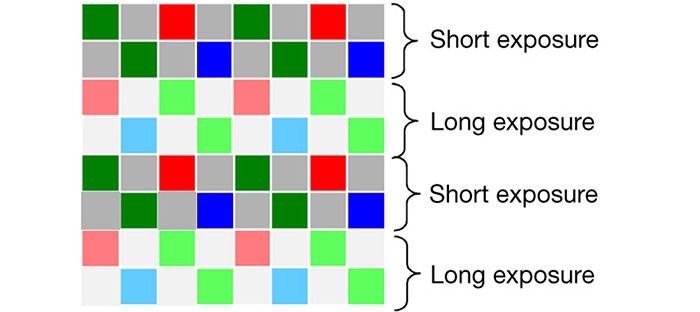
To achieve true HDR video recording, the advanced Exmor RS camera sensor in Xperia Z changes the exposure every two lines of pixels. This creates a spatially varying exposure (SVE) array image, which is then used to make an image that is perfectly exposed in both dark and light areas.
To simplify the concept, for each frame the camera shoots one picture with two different exposure levels at the same time, one light and one dark. Then, an intelligent software algorithm is used to combine (synthesize) the two shots into one picture, pixel by pixel. This allows you to see the details of both the dark and the bright parts of the picture.HDR for still images
With HDR for still images, the camera quickly captures the image twice with different exposure levels and stitches the two shots together to create one optimised photo. This way, HDR lets you capture clear photos even against strong backlight. HDR is automatically activated when Superior Auto detects scenes with strong backlight.
–
To not miss any rumor quickly subscribe our social network:
RSS feed: http://www.sonyalpharumors.com/feed/
Facebook: https://www.facebook.com/sonyalpharumors
Twitter: https://twitter.com/SonyAlphaRumors
GooglePlus: https://plus.google.com/104216500156717934391/posts
And if you have some “rumor” to share just send me an anonymous messages here:
[contact-form-7 id=”14822″ title=”Share”]
Reminder (SR = Sonyrumor):
SR1=probably fake rumor
SR2=rumor from unknown sources
SR3=50% chance it is correct
SR4=rumor from known sources
SR5=almost certainly correct!
221 Responses
Sounds similar to what Magic Lantern’s been doing.
You mean Xperia?
EXR had a kind of native HDR.
Yeah, Fuji has this in their EXR super CCR many years ago. The resolution is reduced by half because half of the pixels are underexposed to preserve highlight area.
I rather would like a 5 axis IBIS !!
Well done sony. Is a stellar news. With slog-2 A7000 DR beat the cinema cameras mosnter that cost 30000$ 😛
Canon is in extreme pain! The sony research team is absolutely the BEST!
I reckon the a7sII will have this.
ISO 10 million? No problem.
Don’t think that is physically possible, but improved usable ISO, increased magic DR and probably more pixels on the camera along with stabilization and in-camera 4K, Sony will have to make a lot of those.
You can “physically” have whatever ISO setting you like…. but it may look terrible.
Exactly why I said “usable”. As test show, the usable ISO for the A7s is way beyond other cameras, including Sony’s own offerings.
That said, for a stills camera, a 16.4 or maybe even 18MP would probably be better, and with current/upcoming tech this seems easily achievable.
I think Canon have this in video via magic Lantern for some while
ML records two subsequent frames in a different ISO value, resulting in half frame rate video. This tech would do it on a per-line basis. This should yield far better results and be useable with motion too (or am I dreaming?).
In video mode yes, but in stills mode Magic Lantern alternates ISOs between row pairs.
This approach if it works in video mode would be very effective with no loss of framerate.
If you are referring to this, the Sony approach seems to be way better. While ML adds some really nice stuff to the Canon cameras, a lot of it is just dumb fluff. And this is fluff. Slow action 720p fluff.
http://cgi.tutsplus.com/tutorials/a-simple-way-to-shoot-hdr-video-footage-using-magic-lantern–ae-20993
The magic lantern implementation is slightly different, it uses different ISO settings instead of different exposure times for each row-pair. This implementation is slightly better in that you’re actually capturing more light with the brighter pixels, and will keep the exposures closer together to minimise resolution loss. It comes with a slight downside of potential motion artifacts, compared to the ML version.
The magic lantern approach wouldn’t work with a Sony sensor anyway as the Sony sensor is very nearly ISO invariant.
You are confusing “ISO quality invariant” with “ISO invariant”. The latter would actually mean that the sensitivity of the sensor doesn’t actually change even when you change the ISO, which is completely false since the sensor has roughly half the sensitivity if you halve the ISO, which forces the photographer to double the shutter speed to compensate.
From a photography standpoint, manipulating the ISO on a per pixel basis would indeed be functional to change the exposure of the scene, and because Sony sensors are indeed nearly ISO quality invariant <= ISO 1600, the quality can still be quite good.
What they are actually doing I do not know, but your reasoning isn't valid.
My reasoning is complete valid and I’m not confusing anything.
The term that is commonly in use (not one that I have invented) is “ISO invariant” and means that shadow noise (relative to the signal) does not vary (by a significant amount) when changing ISO setting.
What this means is that with an ISO invariant Sony sensor, if you shoot an underexposed image at ISO100 and then brighten it three stops on your computer, it will look roughly the same as if you shot a well exposed ISO800 image.
If you did that with a Canon sensor, the image you brightened three stops would look much worse than the ISO800 image, as you would be increasing the read noise when doing this.
So the Magic Lantern dual ISO in stills mode uses a different ISO setting for alternating pairs of rows, so the high ISO rows benefits from the low read noise (relative to the signal), reducing the noise floor and increasing the dynamic range. However if you tried this with a Sony sensor it wouldn’t work as the read noise is approximately constant across ISO settings.
The proposed Sony A7000 implementation thus uses a longer exposure for alternating rows instead of increasing ISO. Longer exposures capture more light and thus provide a better signal to noise ratio.
Interesting. that clears a lot up.
It sounds like the effect will be a limiting concern to frame rate though, at least to less than optimum lighting conditions.
I also suspect that the effect might create ‘shimmering blacks’ as does DRO in video (esp if you go too far away from base iso).
After all this years dealing with the discriminating Canikon people, today I can said I’m very proud to be part of the Sony family, now a can go out to any kind of photography activity without worries or shame of my equipment. No more black electrical tape on the Sony logo of my camera anymore Yeah!!! LOL!!!
Any links to HDR video footage? How does this look like?
Looking at the articles image it suggests the Bayer pattern also has added white subpixels. That would also be a novum, isn’t it?
No, you’re reading the diagram wrong. It’s just highlighting alternate rows of pixels.
No, I’m not wrong, I understand the alternating lines thing (a bit like interlacing in ancient TVs, but without temporal offset for that matter), I was talking about the gray in white dots, which are not present in a regular Bayer pattern!
The diagram image is from an older patent, where Sony was into RGBW subpixels, but they abandoned it, because image quality wasn’t as expected (http://image-sensors-world.blogspot.be/2013/01/sony-explains-hdr-video-mode-in-its.html).
No, I’m not getting it wrong, I understand the thing about the alternating lines with different exposure time (a bit like interlace on former TV sets, just without temporal offset, for that matter).
I was thinking about the gray and white subpixels only, which are not present in a regular Bayer pattern (RGGB).
The diagram image is refering to an older Sony patent as can be read here: http://image-sensors-world.blogspot.be/2013/01/sony-explains-hdr-video-mode-in-its.html
The article says, that as the image quality wasn’t as expected with RGBW pattern, Sony subsequently dropped that color filter pattern.
I can live with a6000 with IBIS
Presumably this would work by the reset process in the EFCS (or fully silent shutter) clearing alternate pixel line pairs across the sensor at a different time relative to the second shutter. Of course there must be a trade-off. The “longer exposure” pixel line pairs will be good for dark areas, but be in danger of blowing highlights in brighter ones. In the case of the “short exposure” pixel line pairs, brightly illuminated areas will gain, but dark areas will get lost. So there must be some form of interpolation process, so there might be some loss of detail compared to a uniform exposure. However, this trade-off might be relatively mild given that this is adding perhaps only 2EV.
Yeah, the double EFCS approach seems plausible.
Essentially you have three areas of each image, the highlights will only have data for half the rows as the other half will have clipped so resolution loss here will occur. The majority of the image will be well represented by both the light and dark rows so no loss will occur here. The shadows will have noisy rows and less noisy rows, the less noisy rows can be used to help reduce noise in the other rows. So you lose a little resolution in the highlights but that’s about it.
Magic Lantern have an implementation of this where the ISO setting is alternated between pairs of rows, and it works very well with almost no visible loss in resolution.
Based on the explaination posted here…for still pictures shoot 2 seperate pictures in hdr mode then stitches them together….it does not say simultaineously, ….if so that would still create a blurred still picture with moving subjects.
I have used hdr on the Nikon cameras that work in that manner, and it is very problematic for handheld shots.
I am hoping that is just an ambiguous explenation, otherwise this feature would only be usefull for video.
Also…half the pixels in this illustration are gray…why is that?
I actually assume that it takes 2 pictures simultaneously; otherwise this feature would not be very useful and thus not revolutionary. It could easily do that because you basically shoot 2 pictures with half the amount of pixels. Of course the exposures differ but theoretically there is no difference in subject movement between a longer exposed picture and a composite image of the same longer exposure comined with a short exposure.
That is how the description says it works in video, but the explaination describes a differrent process for still pictures.
The question still is why are half the pixels gray?
They are gray for you to understand the concept !
I think the gray and white ones are white subpixels (no color filter on them).
The diagram looks like it was rather hastily drawn and may be implying things NOT implied by the text.
As in the diagram applies an RGBW pattern when this trick could be (and probably is being) applied to a more traditional RGGB pattern.
To indicate that there are different rows of pixels capturing different amounts of light. It is merely an illustration. In the “white pixel” row, the green red and blue colors are also brighter compared to the “grey pixel” row.
That explanation is for the Xperia smartphone, not the A7000, the A7000 implementation will likely be different.
No it doesn’t mean that there are two pictures taken one after another. It will simply use EFCS to set different exposure times (relative to the closing shutter) for alternate pixel line pairs. All EFCS does is reset the charge stores. All that is necessary here is to reset adjacent sets of line pairs at different relative times to this closing shutter. This means the short and long exposures are overlapping, albeit within the constraints of the rolling shutter.
What is necessary is some form of interpolation process to produce the final result, either as a “pseudo raw”, or an actual raw along with meta-data so the raw converter can do the required processing.
This has to be global electronic shutter.
The system would not work with rolling shutter
Rubbish. It does not need a global shutter. All that’s needed is for the EFCS to reset adjacent line pairs differently. Just consider a long exposure time of 1/80th and a short of 1/320th. All that’s necessary is for the EFCS to reset lines 1 & 2 1/80th second before the closing shutter and lines 3 & 4 1/320th before the closing shutter. Just continue that for each line pair down the sensor. I effect, it’s like two different EFCSs travelling down the sensor, each skipping alternative line pairs.
It cannot, of course, be done with a physical first curtain (although it should work with either a physical or electronic closing shutter).
I guess it can be done with sensor working with diferent ISOs for the pair of lines. Diferent exposures would be problematic.
For cellphones ok, for cameras no.
There’s no point alternating ISOs between pairs of lines with a Sony sensor as the read noise doesn’t change with ISO, unlike Canon, where read noise actually decreases when you increase ISO!
I’m no expert here but how to maintain the same “shutterspeed” then?
Diferent ISOs at the same exposure i guess. If its different please enlight me.
The EFCS wouldn’t work here since the trailing curtain (mechanical) shutter is going to be travelling at a consistent speed.
It’s not varying the exposure from line to line, it’s varying the sensitivity. For example if you had the ISO set to 200, half the sensor would be operating at 200 and half at 100 to handle the highlights.
Whilst a second mechanical shutter does travel at a constant speed, then why is that a problem? All that an EFCS does is clear the electron wells which is can do line by line (or even pixel by pixel). There’s no requirement for there to be a single EFCS progressing down the sensor line-by-line. It’s perfectly feasible for their to be two EFCs. The first would deal with lines 1&2, 5&6, 9&10 whilst the second would be 3&4, 7&8, 11&12 etc. The first EFCS could then precede at (say) 1/32nd sec in front of the closing shutter whilst the second could proceed at (say) 1/128th of a second ahead. The result is that the first set of line pairs will be exposed for 1/32nd second and the second set for 1/128th second.
This is technically much better than performing an ISO amplification as the “long exposure” rows will receive 4 times the number of photons which means it will inherently better SNR in dark areas than the “boost” method. That’s particularly so with most Sony sensors which demonstrate so-called “iso-less” behaviour. That is they have low read noise (measured be electron charges) at all ISO levels. Canon sensors (and that on the A7S) are different. Their read noise is higher at low ISO.
In any event, the dual-EFCS process ought to work in principle and it’s also compatible with the diagram in the news item which specifically shows different exposure by alternating line pairs, and not different amplification.
No, it only does that for video. According to the Sony quote, it uses the regular sequential exposure blending method for stills, which is what the person you’re replying to specified.
Of course, this is all for that cell phone. We have no idea if the A7000 technology is actually the same (or of course if this is even true haha).
NO,the two bottom paragraph is explaining how the camera phone work, the admin think it might be similar
it would be pointless if its just bracketing,and the wouldn’t call is ON SENSOR HDR.
there’s cine cameras already use such tech to read two different EV at the same time, and they call it ON SENSOR HDR, not bracketing.
Actually the whole quote is describing how the camera phone works.
Of note is that the SVE is ONLY USED FOR HDR VIDEO on the Xperia Z. It is NOT used for stills.
It’s the *video* approach that is new, NOT the stills approach. The stills approach is already available in Sony cameras.
I would hope the on sensor HDR would be written in a RAW format.
In RAW?
Yes.
Thanks Matt.
Boooring! Give us better high ISO or otherwise shove this 15,5 DR up Sony’s CEO’s, and don’t forge tto finally give us at least 1 sharp zoom. Keep your 16-70 for yourself.
Add to that an assortment of cheap crappy lenses, like Nikon and Canon have.
well this will give better high isos, because there will be better dynamic range even in high isos
Also more noise, as per traditional HDR. When you merge two exposures, you also combine their noise levels.
Higher dynamic range is better because you don’t get the noise from superimposed exposures.
I’m also betting the HDR video will fall apart pretty quickly if you ever try to lift exposure in post, so the DR is probably a moot point (as its almost certainly biased towards lightening the shadows rather than extending the highlights IMO).
Sony already has ‘HDR-lite’ for video via DRO, and you can see the advantages and disadvantages of it by taking a current Sony camera ad shooting some video with DRO set to 5. It will lift shadows, but you also get shimmer in dark shadows if you are not careful, and that’s the noise the Dynamic range optimisation introduces. It only really works well at base ISO, and I’m guessing the HDR will be similar.
When you combine noise you get less noise, not more. You are averaging the noise and bringing it down.
People are supposing that the technology in this sensor will be the same used in the actual sensors with invariable ISO…
I guess its not the case.
If they still use the same you will be able to choose between HDR on and OFF.
But if this is a sensor tech, this will not be an option so you are really getting the benefit of two blended exposures with at least better quality.
So you will never get the true raw like we know today, will be a raw already blended.
The noise will be higher than it could be possibily in low ISO well lit shots and lower in high ISO poor lit shots.
Well, i say that because we don’t acctualy know how better in “normal” conditions(not blended) the new sensor is in relation to the last best sensor from sony, but if its better, in noise terms, than we will see only benefits from that.
I’m not convinced of that. Depends upon how the high ISO values are created. If we’re just talking about the usual multiplication of data, no, this approach will have some significant issues at higher ISO values. The lower values in the short exposure will have rounding and other errors that have to blended with the longer exposure that doesn’t.
Thom can you explain me with more detail what you just said?
Profile> Fuji Rumors
Nothing to see here folks, just another butthurted guy passing by.
Has Sony hired the magic lantern devs? Looks like dual ISO at work here
Or Magic Lantern guys just copied the Xperia tech.
does this mean that we will have buit-in stabilisation?
No it doesn’t. But it doesn’t mean it will not have stabilisation either.
If this becomes reality we are one step closer to “Dynamic range priority -mode” that I talked about in my comment maybe half a year ago. If this is possible then maybe it will be possible to expose per pixel some day. I think cameras can already detect which pixels are going to be over exposed so if a camera had per pixel exposure the camera could make shorter exposure for those pixles and longer for those that otherwice would be under exposed. I’m not sure if you could still get a RAW file out of it or would it always be JPG.
Bammm! The marketing department is striking again. I wonder how many ways are there to make one property better at the expense of another … and how many people fall for it hook.
Let’s be honest, my dear engineers: For years now, you have no idea on how to increase the true dynamic range of sensors, right?
If they can make it seamless and generate a good RAW file what would be the problem anyway.
That would justify the MP increase in future cameras, If they double the current MP but generate a final image with half of size but with double the DR what would be the problem?
http://www.northlight-images.co.uk/article_pages/guest/physical_limits_long.html
Interesting reading, however, the text just too much *wants* to come to the conclusion that larger sensors are the “solution”.
Pentax already has HDR. Dunno about Canikon, but I’m sure they have bracketing, that’s only a few clicks away from single image HDR… I mean come on… HDR isn’t new…
Any subject that moves can’t be captured correctly work with bracketing. Also, bracketing won’t work with video. This feature will work in such circumstances, and will matter to users with such needs.
Same stuff as bracketing.
Nope you are wrong in your understanding, its one shot with two diferent exposures, then it blends the two exposures. But they happen at same time, its like the sensor can have 2 isos at the same time, one for the first pair and other for the next pair until it ends.
It blends because it has to show an consistent exposure not bright lines followed by dark lines…
So it’s like interlaced video, but instead of reading out at different times we use different exposures. But then why did they write “twice”? when in reality it captures only 1 picture? It’s like saying bayer sensors capture the image 3 times.
basically it means capture one image with two different ISO value at the same time. shutter speed the same, aperture the same, you won’t feel anything different,
the “twice” means the sensor did twice amount of work than before.
People are so biased that don’t even try to understand the tech before whining on the coments.
I don’t know, i just don’t get the two exposures with two shutterspeeds, it doesn’t make sense, as you already said earlier.
I guess they probably used the wrong word to refer as simultaneous capture of two exposures of the same image at the same time. They blend in real time because. The bracketing you have 2 full exposures with diferent timings then you blend then togheter after.
no, it means on sensor HDR, Two different exposures read out at the SAME TIME.
True, but this doesn’t come without new liabilities. I suspect this won’t work so well at higher ISO values. In fact, I’d expect the feature to have a top ISO limit.
As Fujifilm discovered with their SR sensors, blending the lower and higher exposure together is a little tricky. The short exposure (highlights) has noise and significant rounding in its low values, which you don’t want to blend with the long exposure (shadows).
first of all, high dynamic range mostly used in low ISO conditions. the best DR all occurred in lowest ISO. because its just more practical to use for those people who care more about image quality. so I agree, this one won’t really make any good for high ISO photos.
this kind of tech already exist in cine cameras, the advantage is about saving more signal information. because the amount of photon from a single read out is limited. twice means more usable signal. it will indeed need more process work.
the fuji SR sensor is totally different thing, in SR sensor, there’s two sensor in each pixel, which means the sensiblity was cut to half half, but still limited as a whole. this one from sony, if its the same concept with current alexa and RED, means twice the capacity. for example, say there’s 100 photons entered a pixel in 1/60 second, but the pixel can only receive 60 in one read out. but if you do the read out twice, still within 1/60 second, the capacity is 120, so 100 photons all recorded with no loss
“Saving more signal information” only works if you actually save it ;~). My guess is that Sony is using this for JPEG and video, which means that you’re left with however Sony cooks that into 8 bits with compression.
You’re correct on how Fujifilm worked, but incorrect on how the Sony scheme works. Fujifilm dedicated small photosites between large photosites. This gave them two arrays of 6mp. In an area that was extremely bright, the small photosites would hit saturation but the larger ones wouldn’t. The way that Fujifilm combined the two data signals definitely increased highlight recording, but it also resulted in an oddity: the mid-tones tended to be noisier than they should be (because they were often using information from the smaller photosite). The Fujifilm scheme had very non-linear noise propogation.
The Sony scheme could have similar issues, though the dynamic range of the photosites being used is larger these days, so might mask it.
If the saturation of the Sony is 100 photons (for sake of argument), and 100 photons are equally hitting all the photosites in the Sony sensor arrangement, the first two rows will record less than 100 photons (shorter exposure) while the second two rows will record 100. This alternates all the way down the sensor.
Now here’s something to ponder: what happens when you hold the camera vertically? We don’t have this issue with video, but we do with stills.
Reread the quote. It’s talking about TWO different approaches, one which is used for video and one which is used for stills.
The video approach is NEW for Sony’s mirrorless cameras, the stills approach (which is the ONLY part you quoted) is NOT.
The method mentioned for video can’t be explained as bracketing.
For the photo mode: bracketing is just a sequence of photos, which is limited by the camera bandwidth, shutter speed etc.
I interpret this scarce explanation as a mode happening already on-sensor, not limited by the rest of the camera. Many sensors today are capable of capturing image at rates at and above 4k/120fps, while the cameras themselves don’t have the bandwidths and processing for such.
If the sensor has a builtin feature for making combined HDR images (and the light conditions are bright enough), the combination of two shots into one HDR can be made on-sensor in a way that even fairly fast motion artefacts are negligible – MUCH faster than a bracketing mode that needs to go through the normal camera processing, with the standard bandwidth and processing limitations. Call it “same stuff as bracketing”, but the end result will be very different from the existing bracketing modes regarding motion artefacts, if done properly on-sensor.
Sony does too, even my 6 year old A500 already had it. But if this rumor is true, it could work with a single exposure (more suitable for non static scenes), similar to the Magic Lantern firmware hack for Canon cameras (at the cost of horizontal resolution in bright areas), but with more signal (different exposure times vs different ISO’s in the ML implementation) to work with.
Rather want a APS-C version of A7R II with 10fps and allow lossless RAW 🙂 for 800$…. SR2 expectation?
Even $1400 would probably make me a buyer for your proposed A7000.
I’m in. 🙂
Me too.
15.5 stops how did you get this number?
Admin hears something, than spices it up a bit. It wouldnt be exciting otherwise.
Arri Alexa use this kind of technology. It merges two exposures for each frame.
and so they achieved 16.5EV of DR
But this tech is not about two frames, is all done in one single frame.
Arri Alexa = DGA
“The Dual Gain Architecture simultaneously provides two separate read-out
paths from each pixel with different amplification. The first path
contains the regular, highly amplified signal. The second path contains a
signal with lower amplification, to capture the information that is
clipped in the first path. Both paths feed into the camera’s A/D
converters, delivering a 14 bit image for each path. These images are
then combined into a single 16 bit high dynamic range image. This method
enhances low light performance and prevents the highlights from being
clipped, thereby significantly extending the dynamic range of the
image.”
http://www.arri.com/camera/alexa/technology/arri_imaging_technology/alexas_sensor/
Arri creates two signals from each and every pixel. That’s not what Sony’s doing.
Finally with this cam i can take great photos!
I see what you did there~
Seems to work like the log gamma in Canon’s Cinema cameras, or the dual ISO mode via magic lantern….so not exactly a new concept. The advantage is that when the baseline is an exmor sensor, you get 15 stops of DR. When this is applied to a Canon sensor, you only get 12 stops of DR
ML does it with double exposure
It’s a software HDR not hardware taking double exposures AT THE SAME TIME
The distinction between software and hardware here is small. Software is obviously directing the sensor to perform differently when the Sony is in HDR mode. ML is software directing the sensor to do two things. Not a lot of distinction other than the hardware has a different mode built-in rather than being managed externally.
No basically this sensor si able to capture the SAME frame with 2 différents shutter speed, ML takes 2 frames at 2 differents speeds and merging it
Thats a huge difference
Fundamentally, the end product is the same. Magic lantern simultaneously will record an image at two different exposure values by recording at two different ISO’s, Sony’s solution will simultaneously record an image at two different exposure values by recording at two different shutter speeds.
That’s not ML does
http://www.magiclantern.fm/forum/?topic=7139.0
Sorry for my poor english, i meant this is not at all the same thing.
ML capture two frames and merge them
The huge différence here, is that’s made at the same time in the same frame, so this is not a HDR mode this is the way the sensor works to get more DR
It works for moving subjects
Looks better for video (for stills you are probably better off doing a bracket or simply shooting raw), but will be limited by the usual Sony AVCHD/XAVC-S codec later in the workflow. Perhaps better to go with a dedicated video camera that can do log video or raw video. I picked up a BMPCC for my video a year ago (£400 new, so not even expensive). Although that has a massive learning curve, once you get past it you have 10bit raw log video (or Prores). Puts it all into some sort of perspective if you are looking for good editable video assets.
There’s a chance that a supposed A7000 will support S-Log2, since the RX100 IV and RX10 II do too.
So basically the sensor isn’t linear?
Its ok, I got this one. If you oscillated the whole sensor up and down and assuming this is the final arrangement of differentially sensitive component areas for optimization at least.
You could slow down the whole shutter open period by half and accept some skew or rather shoot still and globally unmoving subjects, and by adding these two component regions together over one another in image processing file, and assuming now they are not simply average plus a bit each way, but rather, optimized for twice the WHOLE range and meeting at the mid point together, you get something like unbeatable real high dynamic range output across whole resolution of sensor! Lunching XD
You may have to use twice the ISO level as the shutter speed would be half 🙂 So not really higher dynamic range/noise ratio result so much as allowing much greater range be recorded without being cut out low and high, nearly at once/ half shutter speed. (open aperture one extra stop instead? 🙂
Fantastic! Tell us more!
dude – what the eff are you talking about?
#walloftext #gameover
Au contraire
https://disqus.com/home/discussion/yougovuk/the_ideal_height_56_for_a_woman_511_for_a_man/#comment-1480993124
There it is! I was waiting for your ridiculous response. I can now move on with my day.
Genius idea!
It will be interesting to see the results if such a thing has been implemented, irrespective of exactly how, but I hope it won’t look artificial as many ‘HDR’ shots do. The trouble with such an ability is that it is easy to lose sight of ‘reality’ (I put that in commas because I just know someone will question exactly what that is!).
It’s often written that there are no details in the shadow, or the highlights are blown, but sometimes that is exactly how a scene will look. The shadows ARE too dark to make out details and the whites are too bright to see properly, so I’m never sure why this fixation with trying to change the output.
Certainly, if the result looks good while retaining a natural feel, it’s worth having, but once it reproduces an impossible artificiality then I draw the line.
It won’t look artificial… A7 séries havé already 13 stops DR at 100 iso, it’s just the same with more detailled highlights and shadows
Exposures are taken at the same time, that’s mean you get rid of ghost you can see in any multiple exposure shots
the HDR photo has that artificial look because the editor trying to show all details in one photo. I guess the source made a misunderstanding about HDR and HDR file.
This file will give you a much larger amount of info behind each pixel(you decide to show them or not), so that it gives you more flexibility when retouching. or with better exposure latitude, it can save your photos from wrong exposure. but you still have the choice to make it “HDR look” or not.
Great explanation lalala, we should NOT mistake “HDR look” made by stupid software with the actual High Dynamic Range of the image where you can choose how to post process it.
Yeah. Some of the “HDR look” is from tonemapping of bracketed shots with insane amounts of DR.
Some HDR compositing methods result in typically more natural looks than some of the tonemapping approaches that give the “HDR look”. For example, exposure fusion implemented by enfuse typically results in fairly natural looking results unless you do something insane like composite a 17EV image (see the second example at http://wiki.panotools.org/Enfuse ) – I’m fairly certain the A6000’s built-in auto-HDR is using an approach similar to Enfuse as it usually provides fairly natural results (it’s variable, can sometimes look a bit strange if you set it to 6EV.)
What’s being described here appears to be the rough equivalent of 2-3EV of bracketing with only two levels of bracketing.
Sony’s engineers could have used bat’s tears for this one but if the end result that could nail this 15.5 stops, assuming this is true, is another killer technology.
Wasn’t this rumored as a Canon-patent some weeks ago, based on DUAL-Pixel-AF?
Seems like a creative use of interlacing to get added DR in video (if I understand it properly).
That would require that Sony offer an uncompressed raw format ;~)
I thought most modern Sony cameras already have HDR feature where multiple shots are quickly
Taken and attached together quickly. 3 or 4 depending on what level hdr u select. A6000 certainly has it. What’s the difference ?
See lalala explanations or mine below
This is not a hdr mode, it’s a sensor way to get more DR
Artificially so, requiring still two exposures? How are the two exposures connected together? By software? When we talk about true dr of sensor it is one exposure and one exposure only. Unless u are telling me the two exposures are so quick u don’t even know you are taking them and there is no difference in longer time requiring shutter to stay open which can cause shake
No it’s one exposure, that’s the thing
That HDR feature trades temporal resolution (multiple exposures) for improved dynamic range. It’s problematic for video, since you’d have to read out the sensor at double the FPS of the video or more, varying either the video shutter speed or jittering the ISO sensitivity temporally. (One frame at 200, one at 100 for example). This would also fundamentally limit the shutter speed of the video, since now your slowest shutter speed would be 1/2 the frame period instead of the entire frame period. e.g. for 24fps video, your slowest possible shutter would now be 1/48 sec instead of 1/24 sec. (In reality there needs to be at least some gap so these shutter speeds will be a bit faster.)
This trick trades spatial resolution for improved dynamic range instead of temporal resolution. Bad for stills which are usually shot at full sensor resolution, but video is usually well below the sensor resolution, but if you have a fast sensor readout rate you can oversample the video and scale down. e.g. you have half the sensor operating at ISO200 and half at ISO100, but you can still shoot at almost 1/24 sec for 24fps video.
If lines of pixels have different exposures and are then interpolated, is there a risk of aliasing in the final video? Maybe not as bad as line skipping, but still might be a problem.
Personally I’d just like to see any new APS-c body with features found in the new RX cameras. This HDR stuff seems like a follow up camera to one with BSI sensor, 4k and so on.
All these great rumors about the A6/7XXX adding one upon another…
At this pace, it seems the cam will come out with a $2.000 or $3.000 price tag! (Body only)
Wow – that would be a game changer.
I have been establishing how such an idea could even produce better results than an equivalent dynamic range optimized sensor as per usual from Sony: it can’t unless it accounts for many things which themselves would require electronic global shutter which we don’t have. Therefore it only addresses low dynamic range problems, and never improves dynamic range of a commonly sized sensor type.
I don’t understand – why do you need a global shutter to have two arrays of pixels on a sensor that are at different amplifications? Say, one is at ISO 100 and another set is at ISO 800. Why do you need a global shutter for this?
He’s on drugs
Yeah, anfetamin derivated i bet. Once i’ve used a high dose of venvanse, thats extacly how i got.
I answered, busy now. As you know.
Not really. All you really said was “it requires a global shutter”. That doesn’t explain WHY it needs a global shutter – which is what I am asking.
Because the array shown above is unlikely and suggests something that doesn’t do much. With the array in horizontal strips and with groups and not lines of points it will only double the moire and aberration. Electronic global shutter
I told you im busy
now too late
If i get deleted im reporting
say hello to new surveilance too
i told you why
you know why
I know who to tell
they wont do anythting but ruin your life too
you are ruining mine right now
?
I am ruining your life? I can’t do anything to you that you don’t allow to happen.
Anyway, you seem paranoid and a little…well you know. For now, I will trust the teams of engineers and scientists at Sony – who seem to be on top of their game – that this is possible.
And we can both trust who is told. If i’m deleted or kicked.
No excuses left, kill me whatever, im taking you out as i go, no kicks or bs.
Everyone knows now how you are. They can work it out too. They can work out the consequences and ethics also, not up to me, i shouldn’t even have to with you. I’ll start, others will follow.
OK. You are either 1) crazy 2) playing a crazy person just to cause havoc on the internet or 3) a little from 1 and 2. Anyway, I don’t have time for silliness.
you are trying to use reverse psychology so we don’t both lose out, i already am, i will do whatever i can even from this situation, regardless of consequence for the moment. Im climbing you are descending, good riddance, everyone will see what consequences are or not, but they will see how a master cannot even be pushed without response.
Save your breath, honestly we have seen this before, the comments are pointless, they insult and now they are adding being rude and threating.
That almost made sense, but then my brain now seems to go temporarily dyslexic every time I try to read one of your posts. Must be some kind of defence mechanism.
society is composed of individuals, what are ‘you’ then.
‘Is that yours?’ the yacht.
you cant do anything about them.
‘buy the yacht’ prove them wrong.
what do ‘you’ think i’m trying to do?
What did the ‘guard’ go to now my photography has become everpresent regardless, not just a millionaire either this time, perhaps a yacht like this one?
i don’t tell people how you make me feel, i’m showing them all the truth so they feel it too.
‘Not’ blackmail. Then why do you wish it to be found to be?
‘kay.
You protect only yourselves, and that is all you do, protect yourselves, yet you want me seen to be part of you to be kicked, protecting only yourselves, grievous now to me as it is, countless lenses, camera, mastered photography in three years, already best photographer and a long way to go with a curve that suggested i anticipate everything, but never this. You are back stabbing or ignorant and you will find the consequences less humorous to deal with i assure you, as you seem to find this. It was actually a comment I over read once that even made me realize the obvious, yes, one comment. And now its only more obvious isn’t it, and with effect on some grievous things extraneous.
Knowingly so by implication, never attack a master, it is you who must reconsider ALL your false actions.
Aside from a few pictures of a boat we would all love to see your mastery of many cameras and lenses over the last three years so we humble photographers can learn from you? Website, flickr, instagram? Please do share.
Are you the real Simon Lawrence, and if so why only a few comments now and somewhat aberrated avatar image? I’m wondering, because you speak of my previous actions yet you may be referring to a false avatar instance of me and of course you with only a few posts numbered now may not be the real one.
rlol I guess that is one way of avoiding the question. So you are not willing to let us see the masters work? shame as we I am sure we could all learn something from you! I guess if you are not willing to show us your work we can wonder if you are ripping of someone else!!!!
Who can I be ripping off when I have posted photographic proof of my identity? Now in my avatar too. And can be used for further proof in future also. I shot it through a pretty good lens too, though not in the best of circumstances for it, it would be hard to simulate the real lens aberrations apparent, and impossible to simulate the rain dots in the full image size. Billion pound yacht handy too?
So that is a no to seeing your website and work then, shame as I feel we have so much to learn from you, a simple web address is all that is required, not hard to remember or type! Si
I can criticize the photos on the site named and with avatar like yours but you aren’t the real Simon obviously. In fact I know what you are doing too. Having ruined my life more generally you wish to disgrace me now in these posts also, to effect that somehow you did no wrong at all. its therefore worse, a double bluff and you know what you did too. In fact, in doing so, you are inadvertently risking my whole business operations and interests now too.
I would seriously love to know how I have ruined your life and that is not the first time you have said this on this forum. As for putting your business as risk, seriously, you are telling me that all your clients follow this forum and place their faith in your business based on comments made? That sounds like a very limited and risky way of prompting a busiess, I thought Facebook, your own website would have been a better idea!!!! As for not being the real Simon I can assure you I am real enough and have nothing to hide. I am not trying to disgrace you, i am asking to see more of your work but i have to admit your comments do lack substance and meaning and you treaten anyone who questions. I respect your right to comment and this is after all a site that respects freedom of speech but you do not respect others and you say you are a master and that others are wrong yet you cannot and will not back these claims up. I would love to see your work but you are clearly frightened to do so.
Again, you can prove you are Simon of course, I have proven who I am, And I haven’t spoken to you prior to this conversation, because indeed that is proven by the few number of comments this false instance of Simon, you’, have. Now you say that I have spoken to you and I haven’t.
Previously we spoke, and regards your photography and I was indeed punished by my reading of your work being removed. I spoke regards subjective and objective matters and art in relation to photography. You use what is commonly called a subjective perspective, and you know its not that objective right? So I didn’t speak out of turn, I spoke of the expressionism potential of it and now we have all seen the 15mm f/4 which is extremely expressive, did I even suggest wide angle macro so long ago also? I have several wide angle lenses and like them but would use them very specifically. I’m objective even when it comes to the subjective choices and application of gear and so on, for artistic effect and efficiency: is what I was saying to you, nothing negative at all. I suggested to shoot a subject from many angles, as if this would be the last time it was seen before being knocked down, and what records best the experience of being there and objectively to some extent the details and structure too.
I actually commended you on a particular unique and meaningful use of extreme wide angle, and applauded the contrasty processing and natural situations as subject.
wow I wish you all the best in the future. It is clearly impossible to have a creditable conversation with you. You say we have not spoken before yet you say we have because your comments were removed!!!!????? My case in point. As I said I wish you all the best as a master of your own business.
You are not the real Simon:
16 comments.
The real Simon posted a lot regards lens options wanted.
‘I would seriously love to know how I have ruined your life and that is not the first time you have said this on this forum.’
I didn’t say that to you, and yes you are ruining my life in an already very tricky situation which shouldn’t be so with my particular great love of photography being your selected means to do so. That’s what you are doing and anyone who supports that against the facts persistently is complicit in that. There has been bs already today.
Why it would require global shutter?
If the readout speed is much faster it could not have the same effect?
For stills.
you know why, for better results at all, the negation in first line.
Now masters everywhere, Its already starting.
I don’t understand, really.
Global shutter would be a shutter without lag a shutter that captures the entire image at the same time ok?
But time is a variable that if we put at such speed, we will never notice it unless we film such a thing that has higher speed than the readoutspeed of the sensor, so the global shutter would not be necessary.
But yes i don’t really know all of its implications and advantages.
Other than that UHDTVs will have HDR as a standard, maybe there is a catch on it.
this kills the canun.
so this will also be on 7s2
Has anyone noticed all the grey pixels in this sensor diagram?
The repeating pattern is 4×4=16 pixels:
4 short B&W, 1 short red, 2 short green, 1 short blue and
4 long B&W, 1 long red, 2 long green, 1 long blue.
This sensor creates a RAW image file that ultimately yields RGB values for each and every pixel. How much real resolution remains after all the interpolation? And with what artifacts? It has to be worse than the usual Bayer sensor with its 2×2 pattern.
It’s a gimmick, along the same lines as the super-upsampled super-slow-motion video in the RX10 II.
As soon as you start moving data around like that post-capture, you risk disappearing down a rabbit hole of marketing.
Remember flatbed scanners that advertised some insane level of scanning resolution? When in fact it was ‘information’ interpolated post capture? Seems akin to that.
It might be upsampled, but the frames are still there, and there’s nothing in the market that can do that, so your argument is quite invalid.
If they had 4k 1000fps full readout for 12 hours we know you’ll still be looking for something to bitch about.
Lets wait and see. Sony is pulling some wizardry out of the hat recently with sensors. Maybe this will actually work as advertised.
It looks like half the vertical resolution of the usual Bayer.
The description indicates this is intended for video and not stills (since it’s much easier to multiple exposure bracketing for stills), and video is significantly lower resolution than the sensor.
in the way you understand it, if a conventional bayer 2×2 sensor has 24mp, this one will have 96mp in that way. I guess theres no resolution loss, this is possible but I highly doubt it, because A6000 series is meant to be a high speed camera, how on earth they could make a 96mp sensor have 10fps, now that would be really crazy
but I have different understanding on this. I think what it trying to say is, they take a conventional Bayer 2×2 sensor, make the two green pixel have two different exposure, Cut the blue and red pixel to half, each with different exposure, and they exchange each half of the blue and red pixel to make more accurate color resolution.
so in this way, say it was a 24mp sensor before. now 12mp of green stays the same, 6mp red and blue doubled to12mp, make it overall 36mp, a lot easier to deal with than 96mp
I think I am annoyed now by these rumors … I waited for 2-mon and ended with buying a6000 because of the vacation time…it is excited that they will offer new technologies to help users but if they keep delaying the thing, no one will feel excited eventually…
well, honestly, you would not even know anything about it if not for this rumors site. Just enjoy your A6000, it is also a fine camera.
dude, don’t take this site so serious
sony didn’t promise anything to you about what they gonna launch in the future
it was just YOU, choose to believe this RUMOR!!!
Great, this might end up being a revolutionary new sensor.
It has been known for decades that the human eye is WAY more sensitive to light intensity (Luminance) information, than colour (Chrominance) information.
I think it is an excellent idea to dedicate half of the pixels on the sensor to capture this essential light intensity information, than only red/green/blue filtered information and then have ONLY interpolated intensity information.
Some will complain that only 1/2 of all pixels capture colour data (1/4 capture Green, 1/8 Red and 1/8 Blue). But then 1/2 of all pixels for the first time capture REAL light intensity data, which is more important than colour.
They tried it in mobile phones and it worked, no reason not to work here. I think this sensor should produce noticeably more realistic images.
We recognize colour more in regards identifying things, and identifying things we’ve seen before is wholly how we make sense of what we see at all using our visual sensing.
You will still be getting color for all pixels, just that less accurate because more of it will be interpolated, but this is an acceptable compromise, because the human eye has lower sensitivity for color than for intensity.
However, you will be getting TRUE light intensity information which is more important because is better captured by the eye.
The brain will only interpret the information captured by the eyes, and the eyes are better at capturing the intensity, even if you have 2 times better color data, a lot of it will be wasted, because you have no real intensity data (all is interpolated) and the eye is really good at capturing this – to be more accurate about 46.5 stops.
https://www.boundless.com/physics/textbooks/boundless-physics-textbook/vision-and-optical-instruments-25/the-human-eye-172/color-vision-620-11256/
https://en.wikipedia.org/wiki/Human_eye
I think I could answer that, i wont. Oh, so i dont get bother, ISO will itself introduce colour aberration and would be incurred surely by stronger filtering for colour. Hence I suggested new bsi be used to increase colour accuracy with more colour filtering to reduce bleed and false averaging or whatever.
I think you can’t, because you can’t explain how the better captured color information by the sensor can get to the human brain to interpret it, if the eyes are not efficient at colour capturing and a lot of it will be lost!
As opposed to capturing more accurate light intensity information that will get to the brain as the eyes are very good at capturing it.
On top of this image compression algorithms revolve around retaining intensity information 1:1, while dropping a lot of the color info, e.g. 4:2:2, 4:2:0, etc.
No thanks you, would be my answer to any poll about the implementation of this feature on Sony A7000 ( IMO there are too much risk it will decrease the IQ in some light conditions and will make Sony remove other features which are more useful than HDR picture we can do on our own with bracketing)
You can’t do HDR bracketing for video.
Read up on the description of the Xperia Z – for stills it does standard bracketing just like the A6000’s existing auto-HDR. It’s for video that it does SVE.
That s why I said HDR on sensor is very secondary;)…. If it s for video only, then make it on a special camcorder but not A7000 which will make it more expensive than what we expect and for something casual
“Then, an intelligent software algorithm is used to combine (synthesize) the two shots into one picture, pixel by pixel.”
Can anyone explain me how two different couple of lines of the sensor can capture in one shot the same area of image which comes from the lens:p
seems that is a blending, they do not capture the same area.
anyway for HDR still images, it s still a double shot photo :p… So they did not innovate, so still a “NO Thanks you” for that feature :p.
They better innovate and create a more sensitive sensor instead of dodging with that feature
Well now you can have high speed HDR.
seems your ” Ollie over the funbox” did not suffer of lack of speed to make the HDR pic 😉
But that photo is totaly unrealistc, i was very agressive in shadow and highlight recover, colors are completely off too. I made “artistic” choice of going extreme. 😉
“anyway for HDR still images, it s still a double shot photo”
We don’t know yet. That double shot description is from a different camera.
look at the picture illustration here. the pixels in that black frame will combine to ONE
I added two more dark green and two more light green to the right combo, you see, the upper left and lower right are all green pixels.
what this image trying to say is, i think, they cut one color pixel to two, each with different exposure. so that it could combine the signal
so in a conventional CMOS, theres 4 pixel in that black frame, now they have 6
OK thanks, i was wrongly thinking for now that on a 24 Mpix sensor, the data from every pixel were directly used to compose the final image without combining it with the data from the neighboor pix ( like on argentic)
PS : Ooops i mixed up pixel and photosite
Only Sigma’s stacked sensors do that, the rest are bayer array, which means that they interpolate the color mosaic into a final image. It doesn’t matter how much resolution the bayer array has, it’s still a bayer array.
my mistake was to not remember that one pixel on image doesn’t match with one photosite on sensor
Well, technically a high enough resolution sensor doesn’t need to interpolate and can just output the data feed directly to the file. Kind of like computer screens do. But manufacturers try to make it fool proof and pixel peeper proof, cause people tend to crop images.
As long as pixels are small enough. You could imagine the same pixel being divided into 4 smaller ones. the camera has to refer to adjacent sites to reproduce correct color, now you are referencing more points. Mathematics applied to camera these days are quite inspiring.
You might loose some resolution compared with a sensor at same pixel density but the extra DR is very useful
The key here is that this seems to be intended for video.
4k video is 4096×2160 pixels = slightly over 8MP, although in a wide aspect ratio.
UHD (often referred to as 4k) is 3840×2160
A typical 24MP 3:2 sensor is 6000×4000
So a 24MP 3:2 sensor can provide around 1.5x oversampling for 4k video, and easily more than 2x oversampling for 1080p video. (Frequently video is cropped from the middle of a sensor, so 1080p likely uses a 4096×2160 photosite crop from the center of the sensor.)
Oversampling is good for video for many reasons. But I don’t think it can’t be used for photo. Olympus put a high res mode into their latest stabilized bodies. They actually shifted sensor in a 0.5 pixel increments to output a high resolution image (integrates multiple shots into one). Sony works around a similar idea but only to offer more dynamic range at one shot (hopefully) with grouped pixels. But the only downside compared to the techniques olym uses is that you might not have full RGB output.
This is very useful if you take long shots and need HDR at the same time.
Sony’s made real advances, and my next body is shaping up to be an A7S.
But I’m concerned that they’re substituting headline-grabbing gimmicks for real advances.
High noise.
Wow! I imagine everyone shooting video in hdr all the time, unsaturated, unsharpened , just plain flat. Perfect for color grading
You can already do this with most Canon cameras and get Exmor level DR through magic lantern. Additionally, Canon appears to have directly implemented the same technique into the C300 MkII so it’s pretty likely it will appear in some of their still bodies at some point. What will be really interesting though is if Sony has managed to vary the exposure by essentially having two independent electronic shutters that operate on alternating pixel row pairs; that would be really interesting.
the difference is, canon has 12ev native DR in one read out, double it make them have 14ev, where sony already has 14ev, so if this rumor is true, the 15.5ev speculation does make sense…
It’s not. Dual ISO is… well.. dual amplfication, this suggests dual shutterspeed (more signal to work wtih in theory).
Sony: on a roll
So there are two options to implement that: interlace gain or exposure. Playing with gain makes little sense. Basically, if highlights are not clipped, it is sensor noise that limits DR, and that would remain the same for pixels with different gain, so it is equivalent to shooting “to the right” without any interlacing and then pushing shadows as required, which is already kind-of-implemented by all manufacturers (i.e. via DR options). Interlacing exposure would require global shutter (i.e. shutter operating on pixel or pixel group level), which sony seems to be very interesting in judging by the fact that at least two related patents surfaced recently. That would really extend the dynamic range essentially with no hit to image quality (in fact, there will be decrease of resolution in some areas, but on average quality will increase if implemented properly), and the math is trivial here. This would be implemented ages ago, the showstopper is absent global shutter technology, and this rumour indicates that sony might have managed to put it in production 🙂
The Fuji S5 Pro had a similar capability. It had two photodiodes per photosite. One photodiode was normal and captured the normal midtones and highlights. The other photodiode was smaller less sensitive and was for capturing highlights. The camera combined the data from both to provide an image with exceptional dynamic range (for its time) and an ability to capture ~5EV highlight detail that made it more like shooting with negative film. Unfortunately, after the S3 and S5 Pro, Fuji never made another interchangeable lens camera with a similar sensor.
If the a7000 truly has this ability and the result looked good, I would probably buy one if I could afford it.
fuji s5 was from 2006, it stayed on DxO‘s top dynamic range seat for a long time till nikon sony came up with their new generation cmos, just think about 10 years later, Sony is doing it again. excited!
It could be a test to see how it handles before putting in a high end body, something like the A6000 did for the A7II/A7rII with OSPDAF.
Why would global shutter be required for interlacing?
Most likely a false rumor.
Probably doing to be a beefed up A6000 with 10fps BSI sensor 4K internal.
Touchscreen would be preferred.
Articulating screen instead of the tilting screen would also be a plus.
The pic is RGBW array which sony used to use in mobile cam sensors. and as this sensor HDR feature was introduced in mobile sensors they are just using this image. This doesn’t mean sony is going to use this colour filter. I don’t think sony is going to move from bayer filter other than mobile sensors. So we can probably see this tech in a7000 with bayer array
what if sony did this…just my speculation…
I have no idea why they would do this. It would also enormously complicate the sensor design and RAW conversion.
I was thinking more along these lines.
Interlacing exposure does not require a global shutter. It can be done with two virtual EFCSs handling alternate sets of line pairs. (All an EFCS does is reset the charge stores). If the two EFCSs were set to pass across the sensor with different timings from the closing shutter then it would change the exposure times for the two sets of line-pairs.
A global shutter is a wholly different thing. By definition it exposes all photosites simultaneously and for the same length of time. I suppose it’s possible to imagine a sensor with two dual-global (half-global?) shutters exposing the two different sets of photosites for different periods, but it’s not necessary.
Mmmmhhhh… some years ago the superccd by Fujifilm did something similar:
http://www.pcmag.com/encyclopedia/term/56104/super-ccd
Sony Didn’t actually used it in the Xperia Z, they cancelled it at their last moment with concern over its global quality and had fitted Z with the regular Sensor !!!
On-sensor HDR was pioneered by Fujifilm in the Fuji s3 pro, and later S5 pro. Way to go Sony; amazing technology at affordable prices!
Eh?
Are you trying to be sarcastic?