







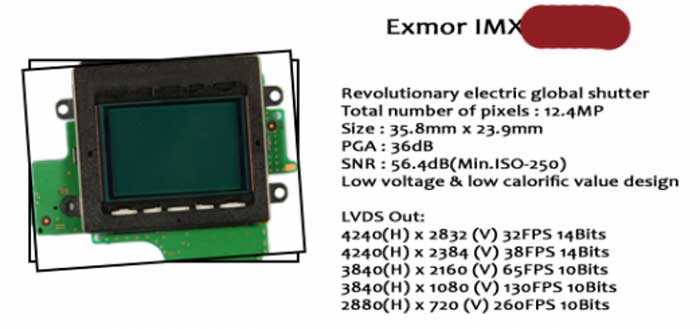
The Chinese site Cnbeta claims to have got that image of a new Sony sensor. It’s a 12 megapixel Full Frame sensor with Global shutter.
While I am absolutely not sure if that’s a true image I am sure Sony will make such kind of FF sensors within the next 1-2 years. Sensors with Global Shutter take a snapshot representing a single instant in time and therefore do not suffer from the motion artifacts caused by rolling shutters.
———
Message to sources: You can send me more info anonymously by using the contact form you see on the very right of your browser. You can also contact me directly at sonyalpharumors@gmail.com.
For readers: Subscribe the RSS feed (Click here) and Twitter (Click here) stream and the Facebook fan page (Click here) in order to not miss any news!
——–
Reminder (SR = Sonyrumor):
SR1=probably fake rumor
SR2=rumor from unknown sources
SR3=50% chance it is correct
SR4=rumor from known sources
SR5=almost certainly correct!
0 Responses
A7S Mark II?
More like new pro FF video camera (F56/F6) or to replace the VG900?
Or an a99s sports shooter doing 60 fps.
Nawww, who am I kiding..
so sad when you even think about it… lol
Looks like similar pixel count as the A7s but they’ve upgraded to 10bit output in video but global shutter would be a huge upgrade, maybe they will reserve this to their Pro video cameras as it will produce more heat.
Global shutter brings some other advantages:
– complete electronic shutter without any mechanical motion or sound without the problems you have now with electronical shutters (banding, extreme rolling shutter effect)
– limitless flash synchronisation
– no rolling shutter in videos or fast motion shot
– no wear of mechanical parts anymore, no lube or oil, no clicking sounds like the 5N had
– no shake from shutter-shock (see A7r)
– maybe higher shutter speeds (since you don’t have to move shutter planes) and therefore maybe the possibility to shoot f/1,4 in bright daylight without ND filter.
I do not like constant APS-C size shrinkage: it is 1.534, not 1.5 for NEX-5n, for example. Now the same story with “FF”: this thing should reach 24×36, not 35.8×23.9. Disappointing.
Shaving off ~0.1mm in the corners is a stroke of genius! It would have been impossible to have A7 series (or the D810) without it.
Impossible? Why?
0.2mm in 36 is only about 0.5%. That’s means you’d have to get 5cm closer to an object 10metres away in order to keep the same FoV. To all intents and purposes it’s utterly and completely irrelevant. It’s not even as if 36mm film was exactly 24 x 36mm. Processors generally cropped prints slightly and the slide mounts I have measure about 23mm x 43mm. I can’t even accurately measure 0.2mm using a normal ruler.
Well, it’s been like that like… always. I remember the first Nikons (D1, D100, D70…) having a 1.53 crop factor, but everyone just used 1.5 for simplicity, like these days. And now you discover this and you are disappointed? LOL in fact! It’s amazing that people with not knowledge on a topic can be vocal about it.
Canon used an even smaller sensor. The EOS 7D sensor is 22.3 x 14.9 mm, equivalent to a crop factor of 1.61.
Of course APS-C was called that as it was, nominally, the same size as the Advanced Photo System “classic” format, which was 25.1 × 16.7. That yields a (24x36mm equivalent) crop factor of 1.43, and no APS-C camera of which I’m aware has a sensor that large. In fact there is no formal relationship between the 24x36mm format and what we call APS-C.
I hope the sensor will be for a A7x, a sports camera with 10fps (or even up to 14fps), huge buffer, good iso performance, good af tracking (a6000’s or better) to compete directly with the 1dx/d4s. Strip away the video functions, less than 10% of E-mount adopters care about video, and price it competitively. Not difficult to be done.
A7x would be a mirrorless camera, it can’t be a sports cam and can’t compete with 1Dx / D4s
Mirrorless users really don’t seem to understand what is the difference between their system and DSLR
“can’t”?! how about currently does not? The A6000 is nipping at the heels of the D4 (check out the Camera Store comparison). The biggest thing holding it back is the software. Sony’s OSPDAF is improving with each generation. I suspect the next full-frame variant may very well rival the 1Dx/D4s.
If next-gen mirrorless AF can touch the AF of any DSLR (say A65, let alone D4), that would mean the beginning of the end for the DSLR. All DSLR systems – A, EF, F, K – would be dead.
But I very much doubt that’s what’s gonna happen, but we’ll see in January.
There seems to be a lot of hints/rumors of disruptive sensor tech coming in the next year. I wonder if this is a sign that Sony are going to make the most from their older sensors and get some video cameras out before the new tech arrives or is it that the new tech doesn’t do well with video.
Wow full frame global shutter!!! can take speed 25 on 25p now, silent shoot up to 1/8000, and imagine you have sync speed for 1/8000 even for cheap speedlight, and do we still need mechanical curtain with this?
@ 1/8000 flash power will be very limited… if full power flash duration is e.g. 1/800 s, at 1/8000 you will catch 1/10 of the light.
in full power yes, but combining multiple flash gun and set at 1/32 you can nail it,
or just pump 4 stop iso then ur catching that light
Multiple flashes – yes. ISO pumping – no – if you can pump ISO, you probably don’t need high speed sync. If you pump ISO, you’ll catch not only light from flash, but also from background, e.g. sun. It’s all about balance between flash and background light… in example above @1/8000 you’ll get darker background, but the flash also “loose” power… so it’s pointless to go above 1/800 and compensate by ISO.
Minimum ISO 250?? This could bring a lot of problems working with fast lenses.
Yeah look at how many problems MFT have
I think videographers are used to having ND filters, it will be ok.
Sorry on first glance I thought this sensor would be for the photography market, on second glance there’s no mention at all…so like other large sensors with global shutter it should be for the videography market.
I’m guessing it is for a 4k video camera that will be able to make good use of the new 28-135mm lens, which, most agree, is not wide enough for a general purpose zoom on a super35/aps-c sensor.
This global shutter may be able to provide much faster shutter speed than what we know now. 1/32000s or 1/64000s perhaps, then the higher base ISO is not an issue.
Those are quite some insane speeds, but indeed nothing was mentioned about its shutter speed.
Saw that too and thought it was a bummer. But on a second thought, if it’s as clean as the A7s when you push up ISO’s (pixels around 6µm probably), it shouldn’t be a problem and be quite noise free at ISO800 or even higher.
Additional wiring is probably required to achieve this, reducing transmission, but I’m willing to trade a reasonable amount of DR and noise for such a critical function.
Global shutter is very nice but there’s a disadvantage too. It takes away space on the sensor that would otherwise be capturing light. But Sony’s doing so well with low light, I think cutting back on that a bit to give a global shutter could be interesting.
At 12MP this is not a problem.
smaller litho processes will fix that.
you refer to the early days of global shutter designs.
Small litho processes will not fix it per-se. The temporary storage area has to be large enough to hold all the electronic charge from the photosite, and it’s that which will define the space required, not how small the lithography is. That places a physical limit on the size of the temporary storage area, although there may be some 3D fabrication techniques which might help (and BSI can help too).
Not if it uses a stacked design .
THE ANSWER for A7s’ rolling shutter problem. Perfect for videographer. If it can do 120fps @ 4k even for 1 sec, I will buy one. Reason – it’s for stills. Record a video, apply video frame stabilization, then “stack” the video frames. 1 second of perfectly stabilized exposure.
The specs say 4K video tops out at 65 fps.
If this is valid even for stills, then this could theoretically allow for up to 60+ FPS Burts modes!!!
Do not forget an additional advantage: you can take multiple shots in short succession and recombine them for lower noise.
It doesn’t depend on global shutter feature at all.
yes it is, with global you can take multiple frame more faster for combining, not with mechanical shutter
You want to do that with 10 fps, i.e. 100ms in between? Then the two images will differ if the object moves.
Do it with 1000 fps, i.e. 1ms in between and that becomes irrelevant.
Global shutter doesn’t work this way. It quickly copies signal into buffer area and then slowly reads it (that’s why it increases readout noise)
And why exactly do you have to read it slowly?
Modern memory reaches 18 GB/s or more, so you could read 63MB RAW data (12 megapixel at 14bit) in 3.5ms.
Provide multiple buffers and you no longer care about the speed it takes to read it.
Because they are analog values and need ADCs. The wish to keep noise down slows down even further.
Now THAT is fantastic! No excuses now to make a high-speed sports camera, no mirrors flopping, no shutters opening and closing! Gimme!
I agree the combination would be deadly. Hopefully the PDAF would be faster than the A77II’s, cause the 1DX, and D4S are very very fast.
The guy who posted this picture claimed that he worked for ITU …..it seems he knows a lot about Sony’s R&D project , but I don’t know if any of that is true.
Don’t expect this in an SLT or NEX any time soon. They’ll drop this in to their mid/high-end pro video cameras for the first couple of years where they can charge $10k to recover R&D costs.
I don’t think it’s the price per unit that matters for profit. You may well be right, but if this tech allows an E-mount camera to sell a tremendous amount of units, and bring more people into the system, that could be a wiser choice. We’ll see…
I could be wrong but doesn’t the F55 & F5 have a global shutter? Someone please correct me if I am wrong?
F55 only.
To explain, people don’t seem to understand the advantages of global shutter, thinking it is just about rolling shutter effects… it is far from that. With proper programming, you can have as low ISO equivalent as you want for example – no need in ND filters, ever, for all lenses. It is ANY X-Sync speed, freedom to use flashes always, in any light. It is lack of a mechanical shutter, it’s weight, cost, energy consumption, warranty costs, noise and vibration, and the space left without a mechanical shutter means that even on E-mound a built-in polarizer will fit. It is very fast sequential shooting, including HDR from a single exposure (you expose 1/1000s, “close” the shutter, readout the data, “open” the shutter, expose another 1/1000s, readout the data for combined 1/500s exposure…). It is lighting-fast shutter speed, 1/100,000s anyone?
A global shutter doesn’t guarantee faster flash sync speed: look at the Panasonic GM1 in global shutter mode (or any of the other cameras that do it), the flash sync speed is actually lower. I’d think the primary advantages right now would be silent shooting and the ability to use simpler mechanical shutters and still get high shutter speeds in bright situations. Those come at a current cost of lower dynamic range.
Eventually the drawbacks will be engineered out of global shutters, sure, but right now we’re still on the front edge of their deployment, and most of that deployment is because the camera companies want to improve VIDEO capabilities.
Well that’s because the GM1 doesn’t really have a global shutter. What it has is a fairly fast sequential readout to allow for a fully electronic shutter. So it’s a (relatively) fast rolling shutter, not a global one (along with all the other CMOS still cameras that are currently available).
Properly speaking, a global shutter would have an instantaneous global read (and reset) function. In practice, all the CMOS sensors I’ve heard that can do this achieve the result by “dumping” all the exposed photosite charges into a temporary (per-pixel) storage area where it can be then read and converted on a more leisurely basis.
Of course even that charge transfer/reset isn’t completely instantaneous, so there will be a limit to what even a true global shutter can achieve in terms of shutter speed, but I’ve no doubt will be notably faster than 1/8000th.
However, to argue that having a very fast shutter speed will eliminate the need for ND filters is a step too far. There are valid reasons why a photographer might still wish for the combination of a slow shutter and bright light at reasonable F-stops. The classic long(ish) exposure waterfall shot is just one.
My bad. True on both counts. However, I’m still not convinced of sync at any speed.
Nor am I, if only because at high power most guns will have flash durations considerably longer than 1/8000th of a second. Flashguns are, after all, mostly designed to work with cameras with flash sync speeds of 1/250th or so (bar the odd leaf shutter).
It’s certainly possible to design flashguns to have much shorter flash duration but to do so would involve dealing with massively higher peak currents in the tube, connectors and discharge circuitry. Even a fairly modest flashgun can discharge 100 joules or more, and to do that in (say) 1/10,000 second would led to peak power rates of about 1MW. At typical flash tube voltages during the discharge that would involve a few hundred amps. The components in a standard flashgun are simply not built to withstand that.
Of course very high speed flash could be achieved with lower output energy, but that would lead to a marked reduction in illumination.
I may be the odd man out but my thoughts are not to speed lights but to studio strobes outdoors. Paul C. Buff’s Einsteins are the perfect mate to a global shutter. Their speeds are crazy fast, as short as 1/13000. My background was MF film so I was spoiled by the leaf shutters. The global shutter is what I’ve been waiting for since no one is going to produce a small format leaf shutter lens.
flash gun are not design to works with 1/250, its the sync that limit most of them, my cheapo younuo can easily reach beyond 1/250 at full power, at 1/64 then can reach about 1/20000 flash duration, for studio strobes they are slower and design for 1/250 maybe yes..
What I mean is that there’s no point in designing portable flash guns with full power flash durations of less than 1/250th as that’s about the limit of DSLR flash synch. It’s clearly possible to do so, but every halving of the flash duration means a doubling of the peak current and components have to be specified to cope with that. It adds cost, bulk and is not worth doing. Of course at low power the flash duration can be much shorter.
Studio strobes are a different matter. They are much larger and are engineered for high power output and short flash duration. Also, they often have to work with MF cameras with leaf shutters so have to be capable of working at the highest relevant shutter speeds.
I’m well aware that flash sync is dictated by the camera. It’s why I mentioned leaf shutters (or did you miss that). There is also HSS of course, but that’s a different thing altogether.
I’ve no idea which model you have, but the Youngo 560 & 565 (for instance) both have a flash duration of 1/200th of a second at full power. That’s pretty consistent with the design parameters you’d choose for a flash engineered to work with a typical focal plane shutter.
http://speedlights.net/2010/07/14/yongnuo-yn-560-speedlite-review/#Tech-Specs-Table
http://speedlights.net/2011/08/28/yongnuo-yn-565-ex-flash-review/#Flash-Duration
>point in designing portable flash guns with full power flash durations of less than 1/250th
THERE IS.
Flashes are for “freezing motion”, too.
Yes but there are no focal plane shutter cameras which sync at a higher speed than 1/250th of a second, so what’s the point for general use? Yes, if it’s very dark you can use a longer exposure time so only the flash provides the sync, but then you are into specialist, large studio strobes (as it’s impossible to fit the required components into a small body).
That also works for lower power flashes and, of course, HSS works by such a string of low power flashes. But they are not full power.
Anyway, the fact is that small flashguns simply don’t do short duration full power flashes. It’s not what they are designed for.
Let me correct something. The way flash head works is this: it puts out full power at initiation and then decays. The way the camera limits flash power is to prematurely shunt the decaying light to zero in order to limit light output.
The Nikon Speedlight sitting on my desk on the moment produces full output in 1/830 second. That’s from initial firing of the head until the head has been completely exhausted. In order to LOWER the output of the flash, it uses shorter durations where the light is active, down to 1/40,000 second. In that first 1/40,000, the output at full power and minimum power is exactly the same. It’s only by letting the flash head continue to produce light (up to that 1/830 duration) that more light gets to the subject.
So it’s not about the amount of energy we actually force through the flash tube, it’s the time we allow the tube to produce energy that creates the difference in light power.
Right. First cards on table. I’m a physicist by training. Let’s get some terminology right first. What flash manufacturers refer to as maximum power is not actually maximum power. It’s the maximum energy dissipated. Power is the rate of energy emission, not the total amount delivered. Unfortunately it’s the terminology that is often used by manufacturers and photographers. So be clear, when I’ve been talking about maximum power, it’s just using the common terminology and not the technically accurate term.
I’m not so familiar with studio lights, but in the case of small flashguns (what is called a “speedlight” in some parts of the world) these work by starting a discharge current and then cutting the supply off at the point where the required amount of energy has been emitted. The power (rate of energy emission) builds up quickly and then decays. However, the circuitry will cut off the power delivery at the point where the required total amount of energy has been emitted. That leads to a cut-off on the decay side or, for very low energy delivery, the cut-off might even occur on the rising curve.
There are some curves here which show the effect.
http://photo.toomastamm.eu/flash-discharge-regular
It follows quite clearly from this that if you want to emit the same amount of energy in a shorter period then the peak currents will have to be higher. However, what is clear from measurements that people have made is that most speedlights are designed so that the flash duration for the maximum energy delivery is somewhere in the 1/200th-1/350th second region. It’s a good engineering compromise for working with DSLRs that typically sync at up to 1/250th. To have shorter “full energy” delivery, they need higher peak power and therefore more robust components able to handle higher peak currents with lower impedances and engineered to suit. Generally higher cost and often bulk.
This confusion between “energy” and “power” is very common. Unfortunately we end up having to adopt common usage.
A speed light like a sb800 has fairly long duration at full power, several milliseconds. That is why hyper sync works with pocket wizards. If you compare flash exposure at 1/100 versus 1/250 shutter you will see a drop in power.
The sb800 flash duration at half power is 1/1000, 1/4 power is 1/2000 and so on.
The d40 will absolutely sync with flash up to its max shutter speed of 1/4000. Of course you only get 1/8 power flash but it still the best high speed sync flash option.
Thom, I don’t know about ANY speeds, but the old Nikon’s could be tricked to syncing higher than they were rated for because CCDs are all global shutter devices. Assuming CMOS works similarly we could see much higher speeds possible. So, stay skeptical but there is evidence suggesting it is possible.
Mostly right. The old 6mp sensor Nikon used was capable of being enabled for electronic shutter (indeed, some cameras relied up on it for shutter speeds about 1/90, which was the max the physical shutter was capable of. But there were multiple limitations that tended to impose a 1/500 or so top end practically. First, the initial sync point of electronic shutter and flash needed some timing room, second, the top Nikon flash at the time did a maximum output at 1/830 of a second. Shorter shutter speeds tended to pull power down and throw off TTL.
But there was a side effect of the electronic shutter: when enabled, very bright light sources (sun in shot, for example) bloomed very badly. Suns became blobs with tendrils.
Mostly right back at you Thom. One “quality” of CCDs is blooming. Digital still cameras (and high end video cameras like the F35) were mostly able to get around that. Regardless they could be used at higher than rated shutter speeds with caveats. I don’t have any industry knowledge on CMOS global shutters but it seems reasonable higher sync speeds would be possible. Notice I’ve always said “higher” not infinite and not as high as some here are speculating. Even the Panny’s and A7S have a shutter speed and a “true” shutter speed (usually around 1/40) when shooting with an electronic shutter. I suspect a global shutter CMOS sensor would work in a similar fashion. Personally even 1/500 would be a nice improvement—not to mention the silence.
Low ISOs for e.g. waterfalls can be emulated entirely in software, like 5D3 multi-exposure feature. Waterfalls pictures can even live with rolling shutter 😀
Using software is a poor substitute. It’s more an artistic styling than a replication of what you get with (say) a 1/5th second exposure. Also, you have to be very careful that the software doesn’t start introduce motion blurring into rocks and other parts that aren’t moving. Doing it in software involves and awful lot of PP work and/or some very specialist software.
It’s also just one example. There are many other circumstances where a bit of motion blur is wanted on selective parts of the subject. It’s incredibly tedious to craft that n exactly the right places to emulate what can easily be done with a longer shutter exposure.
You do not get the point. It just takes multiple normally exposed frames taken with high FPS and averages them.
That’s only one technique and isn’t available on all cameras and neither does it work in all circumstances. For example, it doesn’t work when the exposure time you are trying to simulate is shorter than the time between frames. Try doing 1/10th of a second on a camera that can only do 5fps for instance.
Also, taking two separate short-exposure snapshots and averaging them does not produce an identical effect to an exposure over the same period.
The GM1 doesn’t have a global shutter. It’s still a rolling shutter.
Compare: http://m43photo.blogspot.com/2014/03/gm1-shutters.html
This could be good and have lots of advantages. However, they always say there is no such thing as a free lunch!
These days I feel for the manufacturers who have to develop new products, but it’s only worthwhile if each new device provides a good return. Of course, developing the A7 series would have cost a significant sum, so to pull the rug from under it by releasing something so much better would not make sense.
Having said that, can they stand and wait in case another manufacturer releases something equivalent?
I wouldn’t want to be in electronics these days!
How can we expect global shutter technology to arrive so soon when the A7s suffers from severe rolling shutter as it is currently? Either this rumor is completely false (which is where I’m leaning towards), or this sensor will be designed for a ultra high-specced video cam that will be extremely expensive to all other than professionals.
Alas, the global shutter is ultimately where we need to be for stills one day too, as it will eliminate the need for a mechanical shutter and ND filters completely.
You need slightly more than a global shutter for stills: you also need the side effects of the global shutter to not produce artifacts/noise as do the current generation.
Different design priorities.
global shutter is not new. pro video cameras have it already.
it´s only a matter of time when it dripples down to the DSLR´s
No, not new, but this one is a FF sensor. Most video cameras are APSC/Super 35.
It’s of very limited interest to still photographers, given the decrease in sensitivity that usually goes with a global shutter, so I doubt this will end up in DSLRs at all.
If we get leaf shutters first then its not that interesting. Just cheaper and it works with legacy lenses.
If not – from the high noon snapshot that could use some fill flash to the elaborate fashion or sports project – just because something is to impractical to consider with a curtain shutter it’s not uninteresting.
This probably won’t make its way into the A99IIS… maybe to Mark III 🙂
<>
http://www.sony.net/…/new_pro/december_2013/imx174_e.html
<>
http://www.sony.net/Products/SC-HP/new_pro/december_2013/imx174_e.html
high flash sych speed!!!! i want this!!!
Sounds great- let’s have at it.
this is the main reason I’ve waited to pull the trigger on the going from my NEX7 to the A7 family. Flash synch at any speed. I can’t wait to hook this thing up to a pair of einsteins outdoors.
well you might rusting your trigger for waiting this
This is the camera that I’ve been waiting for. I will be buying this camera. Global shutter was step one. Step two is organic sensor (to emulate film’s ability to capture rays of light at wide angles of incidence), or multichip sensors in order to capture full real-life color information at every photosite (CMOS is interpolated). For now, a global shutter is at the top of my list as I want it for video-making.
Huge, huge feature,..
but it’ll generate massive heat on fullframe even its only 12mp
im not sure it will be on A7s ii but for big A99ii much more possible,
the F55 have only super 35 sensor size and only using 8 mp for 4k video, its phenomenal if it happen at full frame.
maybe for A-mount pro camera?
but please sony DON’T sell it to nikon, let them buy SONY if they want great FF global shutter.
Maybe Sony should sell it for a price Nikon clearly can’t afford in order to force them to sell a camera at a massive loss. If that camera becomes popular, Nikon would lose boat loads of cash, and finally go under.
Because you are going to celebrate when all those people at Nikon are unemployed and Nikon users don’t get any bodies for their lenses?
I had been thinking that maybe a Global shutter was going to be the BIG thing about the 7DmII since Canon is big on video. Alas, not so, but glad to see it on the horizon somewhere…
This one is certainly fake.
Picture is photoshopped D800’s sensor by chipworks.
see this link: https://chipworks.secure.force.com/catalog/ProductDetails?sku=SON-IMX094AQP&viewState=DetailView
And why would he mask of sensor model name? That’s wouldn’t help to hide his identity against sony, but only help to prevent others to find out it is fake.
A correction is needed here Global Shutters do not negate the need for NDs their are plenty of F55s that people use NDs with. NDs both solid and graduated are their to help balance exposure.
No, only if it is supposed to have a very low ISO.
THIS IS FAKE. That image is a D800 sensor.
Barry, are you there? I have a really important question for you that you will like a lot!!!
yes?
Wait for him, Legend…. Barry
check this out guys, its time for sony make it happen in fullframe or they might introducing it at apsc are big upgrade for me
https://www.youtube.com/watch?v=tkh5eWECgbU
Fake.
“Low Calorific Value Design” sounds like Chinese translation gone awry. I don’t think this is the proper usage of the term.
It’s means low heat value design.
Is it me or does the sensor dimension not match the claimed output dimensions. I’m calling that image a fake.
It makes sense. With global shutter you’ll lose DR and ISO since global shutter occupies space that otherwise would be gathering light. So let’s think about the 12MP from the A7s, which has such ISO performance and DR, it would lose part of that but with 12MP it would still be a pretty good sensor. Once global shutter becomes a thing, you can pretty much shoot in complete silence with electronic shutter and for video it’s even more important, since no jello effect. But this news doesn’t really mean much since Sony already has global shutter in their cine cameras, but it’s good to know that they made a FF – for FF and future FF owners.
I’m pretty sure that there’s already a ton of circuitry at the pixel site that’s not collecting light. That’s where the microlenses come into play. This global shutter would require on-site charge storage – might not take much more space nor decrease DR. But with electronic global shutter, you’d see much higher flash sync speeds…
In the words of the great Tychus Findlay
— Hell, Its about time! —
PD
i will take one global shutter to go, please… mmm, can you make it 10mp instead of 12mp???