







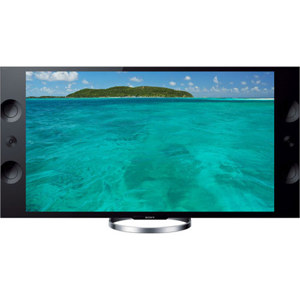
For a couple of years companies market “3D” as the huge future for the television and camera industry. It didn’t really work out fine (at least not on cameras). Nowadays “4K” is the big new marketing trend. And for the first time Sony has now 4k Televisions in Stock and shipping at Amazon (Click here) and Adorama (Click here). As you know the NEX-FS700 (here at BHphoto) can now shoot 4K via the use of the external HXR-IFR5 unit. I think that by end of next year also high end A or E-mount cameras could be able to shoot 4K. That is the “new” future.
74 Responses
Highly doubt 4k will even begin wide adoption in the next 5 years, broadcasters are generally slow to upgrade their infrastructure since the cost is so high, and Sony can’t just rely on their own 4k content. No one is going to spend 5000 dollars on a TV if there aren’t enough content to watch it on.
Every regal cinemas has had 4k projector for years. 1080 is so crappy when compared to 4k. It’s unbelievable how good it looks. Even upscaled content.
I believe you that 4k looks good in a cinema, but I can hardly tell a difference between a BD and a DVD on my 47″ TV when viewed from 8 feet, so can’t see myself needing it at home. I imagine people will want it for projectors or maybe 70″ TVs or something.
The diff. between 720p and 480p is very noticeable on a 42 inch. Even more for 1080.
Not sure I agree, it all depends on the tv as to whether you will notice a difference. I have a 60 inch dlp that you would be hard pressed to tell the difference between DVDs and blurays from 8 feet away. Then again I have a 27 inch that you could see the difference on at any distance. A lot of thing go into the equation.
Actually, I can easily see the difference between VGA (640×480/720×480) and HD (1920×1080). Don’t even need a huge TV to do so.
Whether the 4k rez will become standard or not at our homes depends solely on the prices of TV sets. Five years time seem about right.
SD to HD is an obvious difference since the aspect ratio is different. 4k will only show its advantage with a large screen TV above 60, a person’s eyes can’t resolve that much detail on a small screen anyways. While I don’t doubt the future is 4k, it will take a long time before it is adopted, just look at how long the major networks took to transition from SD to HD
The transition from SD to HD was mostly held up by the change from analoge to digital in all parts of the chain. That’s no longer the issue. Now it’s a matter of bandwidth and efficiency (codecs help a lot here). And that’s still developing fast.
I suggest a visit to an optician.
+10000000 lol you are right!
How can some people claim they cannot see the difference between DVD(640×480) and BluRay(1920×1080)????
When all the new phones with a small 5″ screen already have full HD (1920×1080) resolution!!! Need to go to SpecSavers guys…
hah, you can’t tell the difference between DVD and Blu-ray… that’s pretty sad…
I bet you can’t tell the difference between mono and stereo also right?
Blu Ray is a lot better than DVD. DVD always looks soft and mushy on all size of display, other than handheld devices… 4k should be a step towards the real future, I saw a demo 8k tv from sharp online, it looks awesome just from the pictures.
Hiher resolution id comming across the spectrum.
Naturally it will move faster or slower in different spots but it is moving everywhere.
Super high res still pictures cant happen soon enough for me
3D… 4K… Next big thing will be “5U” or something like that 😛
5 biggest fails in the tech industry in the last 15 years:
5 – 3D TVs
4 – Super Audio CDs
3 – Square, non-rotational magnetic hard drives
2 – Intel’s Larrabee project (for a discrete graphic card)
1 – 4K TVs
I will be called “10U”.. because I would have too much debt just to own it.
The problem companies who are at the cutting edge of technology have found is that they have advanced even before the previous technology is universal, or even widespread.
Consequently, they have to spend a great deal of time (and probably a huge sum of money) building in compatibility, together with effectively criticising their own previous much-lauded products.
It could soon generate a mood of cynicism which will destroy their own market!
To be honest, I’m not sure what the answer will be in the long term, but I’m not envious of those who have to make the decisions!
For an example, look at televisions as a whole:
For 30 years it was B/W, with only gradual increases in screen size and everyone had a similar set. Then comes colour, a huge advance that, from the perspective of trasmission, has barely altered in another 30 years. Again, we all had similar models, with little more than flat screen being the upgrade. The final picture was improved a little over time but, all of a sudden in a few years, we have HD, 4K and the prospect of 8K and beyond!
Many people still have standard CR TVs to which all that is meaningless, so when they look to buying, the fear is they will be out of date again, even before they’ve unpacked the new device.
Without the money to fund endless upgrades, that ‘fear factor’ will stop the market dead in its tracks, if the manufacturers aren’t careful!
Last I checked, HD is widespread. Consequently, Sony is pushing a new technology. It is not about criticism or cynicism, it’s technological progress. And the answer in the long term will be repeating the above with some changes in pace. But maybe you prefer to wait 30 years, just for the sake of feeling comfortable about your purchase.
People with CRTs won’t stop anything in its tracks, as they aren’t the target market.
Good point.
agree HDTVs are wide spread now but I would argue that the adoption of HD content has not been as high. HD cable subscriptions, Blue ray and streaming HD content has not been as widespread (most people still use DVDs and for good reason). Also I would think 1080 is still not as widespread as 720 a lot of people see the most important upgrade from tube tvs to LCD as the flat lightweight tv not better visual content.
I know my parents (and my wife’s parents) are still using at least 2 tube tvs and only one 1080 each, with limited HD cable or streaming content. I myself only own a 720p with the only HD steaming contend from an HTPC. I cant see 4k taking over with out a major overhaul of bandwidth infrastructure.
also as said before content is what matters and in the end story telling matters more than higher rez.
What you are saying is that while there wasn’t enough HD content, HD TVs still sold. And that only proves the point that there is a market for 4K TVs.
no, I am saying there is HD content that even people with HD tvs now do not pay for or use. And saturation of 1080p does not seem to be at a critical mass.
I question what one would watch on 4k. Just like 3d tvs There was/still is very little content. blue planet 4k would be cool but its already nice work. The advantage for consumers to move to a much slimmer/lighter TV is not there unlike the move from tube to lcd. 4k wont even attract the geek gamers anytime soon as 4096×2160 is a lot of pixels to push for console gamers or HTPC users (unlike HD 1080 or 720 TVs).
Transparent window TVs seem very interesting (even if we dont have a price yet) and I think that in the long run is a better selling feature than 4k.
‘Last time I checked HD was widespread’…
Then you must have looked in limited places. Output, which is the important factor, is only a small percentage of the whole, leading to limited demand.
Most of the ‘upgrade’ to HD tv is simply down, as others have mentioned, to the need for replacing a broken TV or the preference for a thinner more efficient screen; the HD capability is looked on as a seondary consideration.
Until the majority of output is HD then the take up of that will be slow, let alone 4K and beyond.
If you doubt my understanding, I suggest that you look at the economic performance of the major TV manufacturers like Sony and Panasonic over recent years…hmmm…lost billions…!!!
They are doomed to fail as long as they consider their cameras connected to their failed TV business!
Where is that hedge fund guy and why is not saying anything about it?!
Will wait untill 8kx8k…
Its more important to improve and add a better IBIS!
It will be a long time before 4K TV is widespread. There is certainly no way at this time to broadcast 4K in the US. Delivered via download is possible but it will be a while before most in the US have the bandwidth to reliably stream it. 4K in the movies makes sense as does shooting 4K originals for final HD output. If a 4K set was a 20 or 30 percent premium over HD I would certainly make the jump, but I expect that will be a while. My last DVD player was a Blue-ray stereo unit, because why not, it was a cheap as a DVD player. At some point the same can be said for 4K. I had a CRT HD TV that was never used for HD material until after it was replaced and regulated to bedroom duty, now it happily plays cable HD.
I am sure 4k looks better in a cinema. Personally I find large TV’s almost unwatchable except for movies – watching a news broadcast for example on a large TV just makes me feel ill. So the S16 Black Magic camera is more interesting than any 4k stuff. I wonder if Sony will produce an S16 NEX.
4K is the NEW BetaMax.
To get 4K from more and more affordable cameras will be nice for videographers who want to keep all options for their footage, that’s for sure!
For TV, I don’t even see reason to upgrade from my 37″ 720p set, though, and I don’t see any need for more than 720p in a camera either, because what little video I do is primarily supposed to run on that TV screen…
While 1080i/p still may be nice, I doubt there will ever be a rational explanation why someone should want 4K on their TV. For really to make a difference, I’m quite sure you would have to sit so close to the screen that it would be no comfortable viewing position anymore.
Once you’ve seen 4k on a large tv, the 1080p model next to it looks sad in comparison.
TV sizes are going up fast, as does the average size. It only makes sense that resolution per axis doubles when tv sizes eventually do too. Despite what others say, I already appreciate 1080p on a 32 inch from 10 feet distance. It’s the same argument we saw with phones. That we won’t see differences past 200ppi. 300ppi. And we are past 400ppi and it still looks better, even if just a small bit. People will buy it.
Agreed. People will obviously complain about content, about technological limitations and it will all get sorted out, as usual.
Well 4 does come after 3 and K does come after D ;~).
As with the other comments: an output mechanism (4K TV) without a deep and wide range of input media (broadcast, cable, stream, disc, whatever), doesn’t really generate the demand interest that allows them to raise prices and sales, which is what Sony and others in the TV business need.
As for 4K in a camera: try it. Go ahead, record some 4K streams. How big are your hard drives? ;~) Oh, wait, you want raw 4K? How many hard drives do you have?
Yes, you are right.
My only footnote is that I remember very similar discussions when 1080P was introduced and even then similar arguments were put forward. (HD space, comp. power and camera sensors not up to the task)
4K is not in doubt, the question is when. I do feel that the current 1080P video output on existing cameras is not good enough to warrant looking at 4K. Lets master current tech properly before looking forward to fast.
HD TV survived because a worldwide standard eventually emerged with the US finally committing from going from analog broadcast to digital. But that process took more than a decade (hey, Congress was involved ;~). There is potential for a mess moving forward if someone like, oh, Dish Network, decides to do 4K “their way” and others follow doing it “other ways.”
While we have a general agreement on 4K capture and display definitions at the moment, the real issue will always be transmission. Until that it defined and standardized, anyone buying 4K media and output devices today is taking a risk, just as happened in the 90’s with HD.
Both 4k and 8k8k were approved as international standards on the same day.
People on sar are always crying dont increase resolution.
In 2011the sar readets unanimously agreed no one needs more than 8mp and many argued that no one needs more than 2 or 3 mp.
GROW UP YOU GUYS!
Thom,
As a photographer, 4K is huge for the capture and production of content for 2K.
I don’t care about the fact that the infrastructure for 4K is not there yet.
To me, 4K means I can achieve lossless digital zooms and pans. 4K in a 2K window brings an enormous advantage: greater sharpness and detail.
Yes storage is a challenge, but I’s do whatever it takes to get me the above.
4K is driven by the photographer/producer.
You write “as a photographer.” I believe you mean “as a videographer,” as the things you’re talking about don’t really apply to still photography.
I do video projects (just did a big event this past weekend). Even in HD I’m dealing with terabytes of data. It’s not just needing more storage: it takes longer to ingest, transcode (you probably don’t want to edit the 4K files directly, you’ll want downsized files that can be RLE’d easily), requires more time to apply corrections/grading, and takes more time to output. If I were being paid big NYC/Hollywood bucks and had an edit staff, maybe I could justify 4K, but I can’t: I shoot in HD even if my camera can shoot 4K at the moment.
Hard drive space has to be the most retarded argument ever.
I’m sure people made the same argument when 1080P was the topic of discussion.
I’ve learned to never bet LONG-TERM against memory or hard drive increases. The problem is short term. At the moment, the costs of doing large-scale productions in 4K are considerable. I have no doubt that will come down and become more manageable. But at present, you’ll be spending a lot of money with no immediate output gain unless you’re going to theatrical release.
I personally like being ahead of the curve, which is why I’ve been experimenting with 4K gear, but the actual sweet spot is still HD.
With that HUGE $1,99 discount, that makes me want to buy TVs for the whole family!
Yes, 4K will be the next big thing.
That is probably not in doubt, just as we moved from 720 to 1080p on cameras.
The more difficult question is when.
My personal preference is that the camera makers make “better” 1080p now and give 4K more time.
Better dynamic range, higher bit rates, better stabilization and color rendering on existing (current) cameras.
Give me 4k OLED tv for 1.500 eur . Sorry but I do not see the point upgrade as long as I use 42 inch tv screen . Of course 4k looks better even on just 42inch 1080p tv . Just check , youtube you can find some samples 4k . It is great , but price of that is too high . Other-hand 4k demands huge screen . Great , I will be able to give my client 4k video which is going looks as good as photo now . The true is ,most people still ask me for dvd video just 40% ask blu-ray . I see long way 4k .
Samsung release 4K TV today too, all the best sony…
4k is here.
Sony can start fresh with tvs and mayby improve thier market share.
SAR cynycs will tell us how no one needs it and it wont sell (being the usual rubish ).
8k has also been approved an is right sriund the corner as soon as they are done selling us 4k.
Higher resolutions are comming across the spectrum.
In 2011 sony patented a system to reduce the diffraction limit.
Sar readets unanimously agreed no one needs more than 8mp. Many said few people need more than 2 or 3 megapixels. That was a 2011 sar post!
Idea is nice, just our regular or not regular PCs have usually full HD as max. Seems place where this content is produced is sorta lagging..
I shoot mostly stills 4k isn’t interesting at all for some of us.
I walked into a Fry’s electronics store a few days ago and they had a Sony 4K playing, I was blown away. I can tell the difference between it and 1080 tvs. I can see every drop of water floating in a fog. It was too real, amazing really. But I would wait till more content comes out and the price comes down.
4k video is approx 4000×2300, ie 9mpix. Imagine extracting the still frames from a video clip…. Even at 24p, that could be quite handy for “catching the moment” in a 4k HDSLR…
And even more so when cameras can shoot 8k movies. Very convenient for extracting still images of sports or birds-in-flight.
meh, not really concerned with 4k video or video in general on my cameras since i dont even use it. i’d much rather they add features for shooting over features for 4k
The only thing that blows you away is the price of 4k! Most folks are happy enough with normal HD, this is just another ploy to grab cash out of your wallet my advice is to ignore it.
Yes we want photo stuff like decent jpegs, no annoying Sony nag screens, proper firmware updates, Not video stuff
If sony wanted to really blow some minds they would offer 4K recording via a firmware update for the higher end models ( a77, a99 ) ect. That would help increase sales now, as many people might be holding off on buying a new camera because they are waiting on 4K video to be included. All the cameras have the sensors to pull it off, its just a matter adding a new encoding option on the software side. Though I am sure 4K video would likely require a top end SD card. It would be great if Sony’s next model would include a slot for a 2.5″ SATA SSD.
Consumers might not be ready for 4K, but content producers are definitely ready. Having a show piece that presents material in 4K can really help build customer confidence. I did some 1080P video recordings of some fireworks for a shop. The HD videos helped to sell many more expensive pieces. a 4K video display would have been even more impressive.
Sony would be foolish to sell thier entertainment division.
They used it to win yhe blue ray / hd dvd war and they will use it to generate 4k sales.
It also lost them the mp3 player market. Walkman was the most successful personal audio player until the ipod eclipsed it. Due to the ATRAC drm failure, the digital walkman failed miserably and the ipod saved Apple Computer. If not for the conflicting motives of creating content (and protecting it) and and producing the best content consumption device possible, the sony mp3 player could have been successful.
Since Apple became a peddler for content, they now restrict their products too. It is for this reason Macs have never had blu-ray drives (they want to sell you downloads). The best content consumption electronics are produces independently of the wishes of the content creators.
I have no doubt in my mind that 4k will eventually become the standard. Unlike 3D, the vast catalog of movies shot on 35mm film can be scanned well above 4k. Although film doesn’t have a resolution per say, I have read that the equivalent is 6k to 10k. Additionally, the proliferation of small high density (“retina”) displays shows there is a market for and an appreciation of higher resolution, which has little downside unlike 3D (headaches, having to wear glasses, gimmicky distractions from the story, etc.,). The march towards higher density display production will invariably affect the manufacture of displays from small to large.
For the present, I’d like to have 4k recording functionality, although I would prefer RAW video recording at 2k.
If the previous rumor being true that there will be no new A mount cameras this year, it seems unlikely that the camera not coming out this year will have 4k by the end of the year.
I don’t believe either the A99, or the A77 has the buffer/processing power for 4k, as they can’t even do decent looking 1080. The A99 can take about 6fps at 6000×4000, so the math just doesn’t work. (equivalent data throughput of about 10fps at 4k which is about what the camera does in crop mode) Unless, of course, they’ve intentionally crippled the camera, which seems possible, but not likely. Besides, I’d still take 10bit 4:2:2, or even raw at 1080p over some over compressed 4k stream. That would be pointless, but true to form from current design principles.
It seems there’s this idea floating out there that some magic firmware fix will address the terrible video of these cameras. I see no evidence supporting this idea. Has any Sony firmware update addressed image quality?
Firmware modification can probably improve the quality by a significant degree.
See: http://www.redsharknews.com/technology/item/713-massive-magic-landern-breakthough-1080p-raw-video-on-canon-eos-dslrs
Canon has a bigger and more robust customer base and among them some users have the skills to produce the custom firmware. Sony would probably fight such a thing anyway (see: PS3 linux).
BTW, 4k video recording = less downsampling/lineskipping. So IQ will go up just by nature of that (resolution aside).
It will be better when viewing those 24MP still pics on a 100″ TV.
It’s so funny how people can only see in the “now”, so many people are talking about how their is no content for 4k or that even with HDTVs cable services or other productions like news etc are still in SD and it will take a long time for them to go 4K.
While that may be true, the way we watch TV is changing since the release of smart TVs where it’s possible to now stream content from the web, cable companies are also adopting this (at least in Australia and we are way behind other parts of the world) as they are only just now starting to offer a NETFLIX type of service where you can stream new and old movies.
4K will be adopted by many in only a few years, prices are dropping drastically and with the ability to stream high quality content more and more every day there isn’t as much to hold it back, in the past maybe there weren’t as many people creating high quality content.. And even if there was maybe there was just no way of getting it into our homes BOTH of those things have changed there’s no reason at all that 4k won’t be a success.
Sony is a major player in the entertainment industry.
I am sure they will soon be coming out with a proprietary sony 4k playback device.
They will then produce all sony titles exclusively for the sony proprietary device and not for any of thier competitors devices.
Thats exactly how they defeated hd dvd in favor of blue ray and they will do it again.
What is killing Sony TV business now is not lack of 4K. By the way 4K now officially known as Ultra HD is not a proprietary technology of Sony. The same problems that are killing Sony right now will still kill its 4K TV business. Cheaper and better 4K Tvs from Samsung and the like will hit Sony hard. The reason why Blu-ray won the Hd war was that Sony managed to pay other production companies to produce specifically for Blu-ray. If sony had only used its production companies, surely we would have seen a repeat of the VHS/Betamax war. 4K will take time to gain ground but that will be some years. 1080P is just gaining ground now so it would be improper to think that 4K is here now.
Actually, it was a combination of the PS3 (being a very good Blu Ray player) and marketing that decided the battle against HD DVD. The fact that AVCHD camcorders could be played back on BD players without having to reencode, helped too. The large companies embracing BD after that, was just a logical business decision when Blu Ray was already outselling HD DVD.
1080P is already widely accepted. The large majority of TV’s and players sold, supports the format. In the US, more than half the households have access to HDTV this year.
4K TV will not fail. It looks gorgeous. Saying 4K will fail at this moment is just as saying DVD would fail when main stream was still VCD. But people discovered soon that VCD quality was crap. So does 2K quality in the coming days.
And Sony’s future is not limited to 4K. The new NFC one touch connection and WiFi transmission will also be popular to all Sony AV and camera devices. Now the new Sony TV lines start to equip with NFC and WiFi receiver. And new Sony cell phones and tablets also equip with NFC and apps to control TV. After connected, we can see cell phones and tablets screens projected on TV. In the future, Sony digital still and video cameras, Sony projectors and amplifiers and mini HI-FIs, will also equip with NFC and WiFi transmission. We don’t need cables any more.
With one touch, we can share videos and photos in camera to TVs and projectors. With one touch, we can control all devices via phones and tablets. The future looks so interesting and exciting to me.
Finally I can use my TV as my editing monitor.. fantastic.
+1000
Photo editing is essential for a 4k tv.
Tv should accept usb flash drive.
Multiple file formats including jpg and tiff.
Zoom, rotate, sharpen etc need to be available.
Since the tv technology is ahead of many input sources these should be native to the tv.
4k tv will provide a venue to view photos full screen in higher resolution and quality than currently a available.
This would be sufficient reason to have one even before content providers catch up.
Acording to the product descriptions i have seen the new sony tv does have photo editing capability thuogh i am not sure how extensive they are.
I have also seen a 4k 3d blue ray player advertised.
Also advertised is a 4k sony projector.
Clearly sony plans a full line of 4k products and they have taken an early lead in the 4k field.
I hope this also means they plan to produce high resolution still cameras.
I want 8k.
Its way to early to adapt 4k. Its sure to come and will be adopted at some point. (unless 8k just over steps it.) But the problem is there is ZERO way to broadcast 4k and not have to actually be over compressed vs HD. It would require FIBRE EVERYWHERE. thats expensive and has been in progress for over a decade with very little progress accept in hi income high density areas. While it works right now on youtube that is only because very few people are doing it. Think about how much network netflix is using in the US. Its like 1/3 of all network traffic. Now increase that size by 4x. Yes double hd is 4x the size Double tall and double wide. Just netflix would annihilate US internet traffic. So until there is a much much better compression created and then adopted as a standard (that usually takes YEARS of arguing among vendors) 4k won’t and can’t look much if any better then HD unless its delivered VIA optical medium like dual/quad layer bluray. It will come but its several years out in any sort of mass way. I think Japan has ONE channel. (not sure)
If anything I welcome that change, it will force us to catch up in the global market as far as internet speed and bandwidth. Tired of having expensive awful internet at this day in age.
For people who complain about:
– bandwidth and space: 4K (when used with the new H.265 codec) will require only 2 times more bandwidth/space than 1080 (with H.264 codec), and the actual TV infrastructure is capable to resolve this. In the same 1080 video, H.265 requires twice less space than H.264.
– no content to watch for 4K: the already existent content in 720/1080, including TV channels, look better upscalled into an 4K TV, than on a 1080 TV (it is strange because the content is the same, but the upscaling tehnology from HD to 4K is already great).
– no difference between 1080 and 4K: acording to the NHK (Japan Broadcasting Corporation) (they already test 8K for several years), 8K will be like looking through a window; I watch 1080 on a 42″ and it is far like looking through a window, and 4K is just a step toward 8K. People have different visual acuity, the average is 20/20, even with my right eye I see much better colors and resolution than with my left eye. Some people with poor visual acuity cannot see any difference between 1080p and 480p, and they will not see any difference between 1080p and 4K.
Wikipedia: “Normal visual acuity is commonly referred to as 20/20 vision, the metric equivalent of which is 6/6 vision. A vision of 20/40 is considered half as good as nominal performance. A vision of 20/10 is considered twice as good as nominal performance.”
1080p is 2MP … so 1080p will look like a 2MP photo. 4K is 8MP … so 4K will look like a 8MP photo. 8K is 32MP. For people who complain about 4K: just shoot photos on your NEX/Alpha cameras at 2MP (if you think that 1080p is enough for you), instead to make photos with 16MP/20MP/24MP.
On a 4K TV, we shall watch our photos, made with NEX/Alpha, in better resolution, than on a HD TV. On a 8K TV, our photos will look stunning (or like “through a window”).
4K TV will also be great for gamers, and also as a monitor for computers/laptops/tablets.
I was in Best Buy last Sunday and I innocently walk past Magnolia Center where they had a Sony rep demoing a 65″ 4k. I resisted but they twisted my arm and drug me in, forcing me to look at it. Unfreak’n believable. The resolution on that was extreme. Granted, those were preselected to show for demo and the rep would direct you to point out the strong points – but the texture on the strawberries, even 6″ away from the screen, was unreal. I did escape with my credut card unscathed, but the mental damage has been done. 🙂