







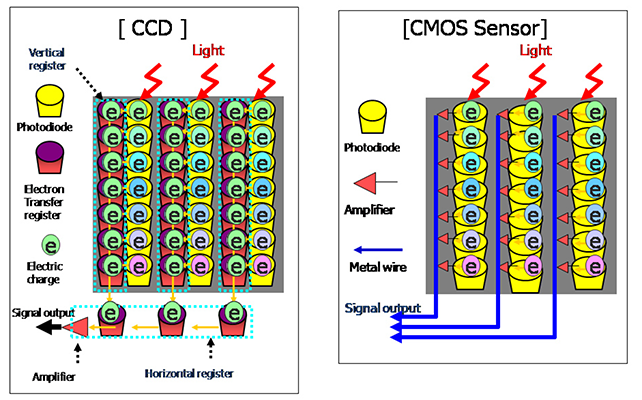
Say goodby to the “old” CCD sensor tech. Sony now officially switched all their effort on CMOS sensor development and production only. The news comes via Allied Vision:
“Many in the industry had expected this to happen sooner or later. As you know, CMOS sensors have become more and more popular in the last couple of years. With greatly improved image quality, sensitivity, dynamic range and speeds, they have outpaced CCD technology of late. Sony’s decision is a logical step in that context to provide further capacity for CMOS growth.”
Found via Image Sensor World.
74 Responses
So we won’t see any more compact cameras with CCD sensors like Nikon S2900, Nikon L32 and Sony H400? It’s the end of an era, but it feels like the end of the world.
He, he, its not that dramatic.
If you’ve ever shot with a CCD sensor, you’d feel similarly. The IQ is really special, even in cameras that are a decade old. I have an old Sony CCD camera. Small sensor, nice Zeiss zoom lens, the lens articulates separately from the body. I forget the model number, but I was shooting it over the winter, and the IQ was more impressive than any of my modern CMOS cameras. My DP Merrills are the only cameras that have a better quality.
F828. Nice cam, I still have mine.
(SR?)
SR is for rumors, this is news.
I guess you’re right!
Also found this link:
http://www.sony.net/Products/SC-HP/cx_news/vol68/pdf/sideview_vol68.pdf
shame, CCD are better IQ in low light
In good light, they do have better IQ. They also have global electronic shutters. But they can experience some odd artifacting in difficult situations. CCD have a better look in optimal conditions, but CMOS are a better jack-of-all-trades type sensor.
Sony is for sharing photography tools with video makers, with live view, evf, high dynamic range, saturation; CCD is pure film like photography: deep colors, 3d tones, low iso, low noise…. sony is coherent with its own market target of consumers/prosumers. cmos are standardizing images and iq. But anybody needs being different!
It doesnt matter if they share them out if they’re able to have a camera that beats all the competiton.
I think CCD could be improved many ways as is CMOS today (BSI in NX1 for example). CCD has its place, I wouldnt mind having FF CCD based camera. On low ISO, it simply looks better than CMOS.. (wonder why tho..).
I agree. But there is a full-frame CCD in the Leica M9.
There is a reason why a lot of Leica shooters still prefer the M9 to the M240. The CCD in the M9 simply has a better look than the CMOS in the M type-240. If I were to buy one today, it would be the M9 or the M-E rerelease in a heartbeat. I wouldn’t even glance at the 240.
Yea, M9 vs M240 “issue” is quite known. Its possible to mimic M9 look with M240, but it takes a lot of work and its still not quite “it”. Like if some part of contrast is missing..
M240 has “advantage” in having very limited LiveView, and sensor thanks to being CMOS is better in those measurable values, just not in that unmeasurable “look”.
Both Zeiss/Leica lenses + CCD simply produce superior results as far as “look” goes (Voigtlaender too, most of their designs).
I know for a fact that CCD is nowhere near its limits in M9 or M-E. It could be much improved, since those are rather old Kodak designs, but problem is that nobody from manufacturers wants it.. only customers do.
Its much like 645D vs 645Z, yea 645Z is superior camera, its CMOS based, but as far as look goes on base ISO, 645D simply trumphs it. Unfortunately especially with MF digital having LiveView really helps.. :/
CCD could be competitor or simply “another option”, if manufacturers were willing to produce them.. I would prefer it in any MF or FF camera. My type of pictures doesnt usually require anything more than ISO 400. Most is base ISO anyway. 🙂
Im not sure we are that small part of photographers world as there is quite a bit of landscape and still life/studio photographers..
And even tho 5Ds is CMOS, its very obvious that its targeted for exactly “my” group. So “niché” FF camera is possible..
Good article I posted above but though you might like it. https://www.teledynedalsa.com/imaging/knowledge-center/appnotes/ccd-vs-cmos/
Yes, it is pretty interesting. 🙂
If Sony could design a full frame Fovean-like (DP Merrill, not Quattro) 1:1 sensor, but with good high-ISO performance (up to ISO 3200), it would likely be far superior to any Bayer sensor. At base ISO, the DP Merrills arguably have better image quality than even the D810, despite being APS-C with only 15 mp.
I agree. I’ve tested the DP Merrill cameras against the A7R, and the Merrills with their Foveon sensors are not only better able to capture fine details and micro contrast, but they are also better able to capture subtle things about a scene. Morning dew haze was a difficult test that the A7R failed and the DP2 succeeded in capturing (during my head to head tests).
could you please post pictures?
https://www.flickr.com/photos/jeffrydemeyer/14038958440/in/photostream/lightbox/
The amount of information is 4x more than what you would get from a bayer sensor, those are basically 13megapixel images
Yep, notice that too. Resolution from Foven (true Foveon, not new with reduced color resolution) is superior to almost every current camera (probably with exception of 5Ds which isnt here yet and MF cameras).
Unfortunately those sensors desperately need someone who can manufacture them with superior tech. At least Sony, if not Samsung.
Even tho its CMOS, it sometimes exhibits similar image qualities as good CCD. Also perfect film-like colors.
The problem with Foveon is fundamental to the technology. The technology only provides colour channel information based on the different silicon penetration characteristics of photons by wavelength. Longer wavelength photons penetrate further than shorter wavelength ones. Unfortunately, it’s a statistical distribution which causes a great deal of overlap in the colour channels. It’s possible to correct for these “common mode” effects, but nevertheless, a great deal of information has been lost. The result is that there are a lot of chroma artifacts at higher ISOs.
As this is down to the basic physics of the way photons of different wavelengths penetrate silicon, then it’s not obvious there’s any way of fundamentally improving this aspect of performance using this method of colour separation.
That’s too bad, because CCD’s offer a nicer image in optimal conditions. But I suppose it doesn’t matter, as both CCD and eventually CMOS are on the way out. Foveon-style sensors will hopefully become the norm as someone has noted before me. The Merrill cameras are true, modern classics.
“Foveon-style” are still CMOS sensors.
Must be a really fun Saturday in Europe for Andrea to have squeezed out this news. My favorite CCD camera is the Nikon 5000 SCANNER!
Epson 850 isnt far behind. 😀
Well I guess that makes it official…. A-mount is dead.
Do you means the Alpha 290/390 are the last of their line? Heavens.
I take A380 as last, A390 was color insult to CCD. 😀 Im still playing with idea of getting A380, that thing has colors and contrast to die for..
Nooooooooooooooo!!!!!!!!!!!!!
Sony advertises 14 bit color but really only delivers 11+7 bit color.
It’s like paying for a gallon of gas and only getting a pint to a quart of gas at best.
https://sonyvnikon.files.wordpress.com/2015/02/sonys-lie.jpg
https://sonyvnikon.files.wordpress.com/2015/02/untitled.jpg
Im not a professional photographer, so i don’t understand what that means, would you kindly explain?
Traditionally, CCD translated colors into 16bits. CMOS does to 14bits. There have been questions that Sony has their cameras store images in a Raw format that compresses 14bits into 11+7. That is why discussions exist about the quality differences of Sony and Nikon raws even when they use the same sensor.
Issues that ass, ghostsbyscary, is unaware of.
It means that certain Sony cameras capture way less color information that they say they capture. 🙂
Its invisible, if someone shoots JPGs or does near zero post-processing in RAW. Its very visible if someone does heavier post-processing in RAW. Also reason why while I wanted A7 I didnt buy it. But not only reason..
It’s so visible in RAW that many spent years trying to display the differences with the A900, which offered both the lossy compression (as mentioned here) and uncompressed.
if it took years to display the differences it could not have been that big?
Thats completely different thing. A900 is true 14-bit camera, which has more than enough color information (one of best ever actually). It used curve to compress 14-bits to 12-bits output (also reason why older Nikons had sooo slow 14-bits, cause they used Sony sensors, which were made only to read 12-bits at once, so they needed to read them twice in order to get 14-bits).
Only downside in A900 was that this curve sacrificed smothness of shadows and bit of shadow region as whole ending in bit more than needed noise in shadows.
A7/r has 14-bit output, but that output doesnt really have enough information to fill them. Its like selling pint of beer, when its full only to half. Sure that glass can hold a pint and you are paying for it, but you are not getting all beer that you ordered. 😀
Its visible, if you have color oriented post-processing.. if you dont notice it, or never saw it, consider yourself happy.
But please, dont be that stupid as Fuji fans and do not deny things that are fact.. This has been tested and proven. Just cause you dont have problem with it doesnt mean it isnt there or it isnt problem for others.
I belive in capturing the best possible image in-camera, so i don’t really see the point in having to do heavy post-processing…
Wouldn’t that just mean you’re not that great a photographer?
Most award winning photographs (I dont mean WPP :D) have a lot of post-processing. Are they not great?
Otherwise, RAW is undeveloped negative (or slide, as you wish). Everything after is development and its not that different to darkroom. Except many today wont have results literally in their hands, but only on screen..
Post-processing wont make bad photo shine, its there to make good photos even better. If you dont post-process, your choice. I do, cause no camera can output what I want directly out of camera. 🙂
Sure, you are right that its good to have most done in camera, but thats only part of result.
I understand. Some times (taking photos of the northern lights with my a6000) i get somewhat gray pictures due to the exposure. But it’s easy to change it to black. I don’t find the a6000 lacking in any aspect. other than maybe bad card placement.
Sony A6000 is native 12-bit camera. This 14 vs 12 bit issue is no concern for A6000 users. 🙂 No problem there.
Ah. Okay. Im happy with the a6000, and that is all that matters to me. 🙂
Some things can’t be done in-camera. We aren’t talking only about exposure and white balance here, but about local adjustments of color tones and contrast, split tones, sophisticated methods of sharpening, retouching etc.
i see. Hmm… I have to agree that you might need to change some colors and such when taking night photos. But sony cameras capture great images, so i do not see any reason to complain.
Any “pro” portrait session will require post-processing. Its standart, no matter how many leagues against using PhotoShop on human beings exist. 😀
And color “durability” is important then.
Only time you really dont need them is when you shoot to win WPP (they have pretty much banned post-processing).
It’s not “very visible”, I’ve yet to see a single real world example from anyone other than a single image with star trails. I’ve also yet to see an example from over 5000 frames I’ve shot with the A7R despite pushing the files around a lot in Photoshop.
Anton Berlin, I presume? Same initials, that sure can’t be a coincidence.
No. You should Google me, before you ask.. its easier.
Sorry for jumping to conclusions.
What are the numbers supposed to represent?
While we are at it what does this have to do with ccd vs cmos?
STFU
go hang out with barry you can repeat your crap at each other for days and never notice because neither of you can see any words other than your own.
If you don’t understand what he’s referring to and how it relates to ccd vs cmos, than you’re the idiot. And ironically such an idiot that you don’t realize how glaringly so when you tell others to STFU when they talk about things that go over your head.
All that matters to me is that when I push the shutter button I get paid. If you don’t like sony as your tool of choice then go choose something else. No one is stopping you. Feel free to buy a canon or nikon. I’m just sick of listening to broken records like anton and barry
#banAntonBerlin #BanAnimalsbyBarry
Yes, we all miss MyContentSites. I’d take him back if it meant that Anton and Barry went away.
It has precisely nothing to do with the difference between CCD and CMOS. It also has nothing to do with colour either. It’s about the way 14 bit raw intensity values are encoded using an adaptive compression algorithm.
In practice, in the overwhelming majority of circumstances no real information is lost as it’s usually just part of the shot noise that’s lost, or high order bits that contain zeroes.
You dumb
Mr Berlin, you are an ill person. Get help, and leave this site out of your stupid campaign. It’s one of the saddest things I’ve seen. I feel for your family.
It only takes me a few minutes a day to post some facts that takes clowns like you months to realize.
http://community.sony.com/t5/Alpha-NEX-Cameras/Sony-when-will-you-step-up-to-fix-A7r-and-lossy-compression/td-p/289769
Sony has a thing about lossy compression I guess. Way back when, Minidisc was the cool new recordable digital format. It used a lossy compression called ATRAC that made it all possible. Maybe they’re determined to keep using the ATRAC algorithm
I was a fan of ATRAC and one of the original mini-disc buyers and supporters. I was sorry to see it lose out to MP3.
No more make?
Engrish speak yes?
Hopefully these means Sony’s hybrid sensor technology makes its way into more of their lineup. Sony hasn’t killed off CCD’s so much as incorporated their strengths into a CMOS type design for better sensitivity and flexibility.
The difference are
https://www.teledynedalsa.com/imaging/knowledge-center/appnotes/ccd-vs-cmos/
I do not think the statement:
“Sony will no more make CCD sensors. Future is CMOS only.”
applies to consumer cameras with FF and APS-C sized sensors. I have been looking for independent verification of this statement and can not find it. This is stated as “NEWS” not a rumor. I’m wondering if it’s true????
They stopped making CCD cameras long time ago, last was A390 (crappy one I might add).
Why was this posted as “news”, or for that matter posted at all?
Because they now will stop production of CCD sensors. As I wrote in my comment above, Sony still uses CCDs in some compact cameras (such as the superzoom H400), and several other companies use them too, for example Nikon in some of their cheaper compacts. It’s true that they stopped making CCDs in larger formats several years ago, but this news is about the small sensors.
Thanks. This new just served to confuse me. I now understand. Thanks
Why would you expect them to use CCDs in those formats in the future? They haven’t used CCD in FF or APS-C cameras for many years. The CCD sensors they currently produce are used in low-end compact cameras, and probably in scientific/industrial equipment.
CCD is the best. Natural and colourful.
Colour had nothing to do with the underlying sensor technology and everything to do with the dyes used in the CFA.
I’ve seen a lot of people discussing the difference in the d810 and a7r. But the a7r is quite a bit cheaper, and most people seem to compare them with a lens designed for the d810, which i find unfair. Hopefully this changes with the new lenses from sony.
Nikon d810 + 35 1,4 = about 4600$
Sony a7r + 35 1,4 = about 3800$
I guess they’re (might be) getting ready to roll out those global shutter CMOS to the world at affordable pricing. LOL
We can dream, cant we?