







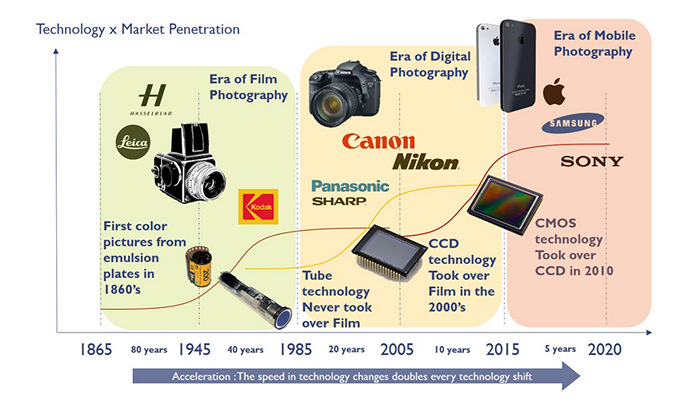
i-Micronews posted a highly interetsing interview with Yasuhiro Ueda (Sony Senior General Manager of Image Sensor Business). Here are some key info:
1) Sony steps out from the CCD sensor business: “As a sensor division it was then just a matter of course to consider our transition to CMOS sensors, as they have much greater speed advantages.”
2) Sony A7s sensor: “Lately academic demonstrations have proven light can still be acquired even when the sensor’s aperture is extremely small. This kind of technology is applied in our bigger cell size α7S SLR digital camera, capable of taking pictures in a pitch dark environment.”
3) Sensor development depends from the customers demand: “Some people ask for greater pixel count as the application range is higher. On the other hand some find it bothersome and just ask for larger sensors. The demand is coming from the customers and we are prepared to answer either way. ”
4) 3D sensor: “We are and also have been interested in supporting the path of Dual cameras and likewise 3D camera to answer our customers’ needs, meaning the demand is coming from customers.”
5) Mobile sensor: “To reach that SLR level work has to be achieved with enabling technologies such as optical, image processing and sensors. We are and will continue challenging the SLR camera quality. Mobile phone cameras also have a bad video quality compared to broadcasting gear and similar to the SLRs we shall be aiming to challenge these quality levels.”
6) The future three new application areas for CMOS sensors: “First, it should be the automotive market. Then we believe the “new mobile imaging” market will grow. This is a field consisting of action cameras, drone cameras and new moving region concepts. The third is an area which we defined as a “sensing region”. Traditionally we defined sensing in respect to imaging to be an enabler in order to enjoy high quality images.”
found via Image Sensor World.
145 Responses
At that rate there will be a new image technology each month before 2025. In fact I think it will then be accelerating so fast we will have new cameras each microsecond before Xmas 2025!
When a new camera will be announced and you run to the next camera store to buy it immediately, it will be discontinued and out of stock when you arrive at the store.
It is time the Minolta team takes over and builts some cameras. The sensors are here yet, nobody complains about that.
Yes, Vectis power FTW!
What is a sensor without a camera system ?
Answer : Sony E-Mount.
What is a camera system without a good sensor?
Answer: Canon
Canons sensors are good enough to feed a lot of pro’s. A good sensor without decent body / lense is useless.
Having fun with a single lens or adapting older ones is not “useless”. Frankly, nowadays the only defence of Cankion is that pros use them, based on the misunderstanding of how and why pros use them.
Qualify and eloborate that statement.
If you have not understood, I can only regret it.
You regret your statement? Thought so.
Whatever. I don’t work for the circus, I’m not a mind reader. You made an unqualified statement and it would seem you don’t want to bother expanding on your seemingly derogatory statement. Great for you, have no regrets 😉
this time is real, gg amount, gg emount, gg canikon
You look like a sea urchin. Approved.
First sane comment. Congratulations!
Are you a moderator?
Why should I?
Pretty vague. Sounds like politicians.
That chart illustrates that the true revolution happening in the market right now, is not the transition from DSLR to mirrorless, but the transition from dedicated cameras to mobile devices.
Mirrorless fans often speak as if the death of the DSLR is a revolution comparable in magnitude to the death of film photography. It’s not; mirrorless cameras and DSLRs are both regular cameras, only with a different approach to focusing and viewfinder technology. Mirrorless cameras aren’t changing the way we think of photography. Mobile devices, on the other hand, do exactly that.
Yes, the transition from film to digital resulted in many more people taking up photography as a casual interest, hobby or profession. The digital market is much larger than the film market ever was.
Likewise, the transition from cameras to mobile devices has resulted in many more people taking photographs every day. The transition from DSLR to mirrorless has not had that effect. It just shifts the balance within the camera market, without expanding the market.
Boring market speech. Disapproved
Yawn
And as the number of people taking photos is rising steadily, the average quality of those photos is decreasing just as steadily. Newer sensors will have improved image quality, but the quality of photos only get worse.
The effect of the smartphone revolution, just as the digital revolution, is diluting the art of photography.
Rubbish! If you’d actually been around long enough and actually be qualified to use that handle you’d know the standards are actually way up. Just go look around the web, then flick open your photo books from the 1980’s!
+1 here.
No, you’re wrong.
Once again, you are clueless, go pick a new hobby bobby.
Spot on. The only 2 reasons I’ve moved from Canon to Sony A7r was for the 36 megapixel sensor and the smaller size. Smaller size was way down the list of importance. If Canon had come out with something similar to the D800, I would’ve stayed with Canon. Bottom line: needed the bigger sensor, not so much the small size and portability.
To your point, I don’t find myself taking more photographs because I have a small mirrorless camera; I take more and varied photographs because I have a mobile camera in my iPhone.
Absolutely spot on! I couldn’t have said that any better.
Size definitely matters here though and can’t just be excluded for no reason.
Please SAR admin, give us SAR addicts a meaty rumor to chew on! 🙂
How about this? Sony and Samsung are joining forces to crush Canon and Nikon, and become the new duopoly. They will share patents with each other and develop cameras together.
This is just SR1 for now, but I’m waiting for confirmation from several trusted sources.
Fan fiction. Approved.
Japanese n Koreans don’t mix. Ur rumor is SR -5. Fail
Replacing one duopoly with another one? What a nightmare.
Acting like a spoiled kid. Disapproved.
It’s all consumer oriented. Appreciatable from a point of view of Business, Investors, Consumer market. Not from poi of view of pro-art. All pro-photo barnads and manufactures and designers will survive by distinctive IQ and PRO-photography cameras, lenses and accessories, less numbers & High crative Quality.
Fuzzy thinking. Disapproved.
Wow. Dumbest. Graph. Ever.
Where do I start pointing out how wrong that is….?
Looking forward to your explanation. Just begin when you’re ready!
He needs a larger audience…
He’s a famous lecturer. Didn’t you know?
Start today, at home.
Ha ha, good one 🙂
Start by registering in the forum, instead of posting anonymous …
Better not. I fear you might be somewhat affiliated with the term “Dumbest”.
Just got some slide film developed and I can still say with ease…still freaking awesome.
2022.5, Graphene sensors?
Now we know it (again) !! Sony is only making big money with the sale of there Sensors, to Nikon and other brands, also to portable devices, funny thing is that all the other brands like Nikon can make those Sony sensor perform more then the same sensor in a Sony camera ??? what a wird world isn’t it, any explanation anyone maybe ???
Sorry, I guess no one will explain that bulls**t you wrote.
I think what Chrisy is alluding to is that nikon’s DxO score is always a bit better than Sony’s with the same sensor.
That’s correct, and it’s no bulls** at all, anyone can confirm that the Sony sensor perform more on other brands, then in a Sony camera !!!!! why, you tell me, but you better come up with a good explanation, the facts are there already.
Simply the Nikon engineers are more dedicated in squeezing out the best out of a sensor focused on stills mainly.
Sony engineers are more dedicated to put new function (gadgets) into the camera and remove them the next time (gps). they promote the potencial of a new sensor in video and stills, if there is no customer for sensor already.
I know most people don’t care about GPS but I’m a bit disappointed about it. A travel size camera without travel features
Anton likes GPS – he can’t remember where he took the photos anymore.
Can anyone after they have taken 300,000+ photographs? I might recognise the country but not the exact location
And out of those 300,000+ pictures, there’s not one you’re willing to share here, either you or your alter ego Anton?
A GPS equipped unit will get your ass-kicked out of certain situations, ask any journalist.
Perform “better” not “more”….
Why don’t you do an accurate research and then you come back here with a proper and clear explanation?
I’d be delighted to know more about this topic…
Sony uses thicker color filters in the Bayer array to achieve better color discrimination. The downside of this is that slightly less light reaches the sensor, leading to slightly lower signal-to-noise ratio.
Yeah… what a “wird” world….
You should explain what you wrote, because it doesn’t make much sense….
You make no sense whatsoever…
Difference may come from the lens
To understand the difference in scores first you need to understand why Nikon reports the base ISO of a d810 as 75 and why sony has a base ISO of 100 in the A7R.
Um…I don’t! Could you enlighten me on this?
The video feed out of Nikon cameras is crap, how bout them oranges. And before you harp-on about video being irrelevant, putting live view on a stills camera makes it a video camera by default!
Who are these customers making these demands?
Um, the a7S is not a SLR!
A digital single-lens reflex camera (also called a digital SLR or DSLR) is a digital camera combining the optics and the mechanisms of a single-lens reflex camera with a digital imaging sensor, as opposed to photographic film. The reflex design scheme is the primary difference between a DSLR and other digital cameras. In the reflex design, light travels through the lens, then to a mirror that alternates to send the image to either the viewfinder or the image sensor. The alternative would be to have a viewfinder with its own lens, hence the term “single lens” for this design. By using only one lens, the viewfinder presents an image that will not perceptibly differ from what is captured by the camera’s sensor. For this reason, the a7 cameras are sometimes referred to as SLR’s because the viewfinder image uses the same lens, it is a single lens camera rather than having a lens in the viewfinder and a lens for the sensor. Although you are technically correct in that there are no mirrors, SLR has become somewhat of a buzzword in itself and most people are able to understand that the a7 cameras have no mirrors. I would prefer they use a different term but I’m also bright enough to understand what they mean by the current one
Copied and pasted text from Wikipedia…..
Most of what is posted is either spun or copied
It’s still wrong, learn to fact-check.
It is not wrong to say the a7 cameras are not SLRs. They have no reflex aspect. Did you even read what was copied from wikipedia? I was hoping if I pasted it here people would be able to see they’re not SLRs.
“optics and the mechanisms of a single-lens reflex camera”
The a7 does NOT have the “mechanisms” of a “single-lens reflex camera” therefore what I wrote is not “wrong”. Learn to fact-check
Whatever…..
You clearly have problems with reading comprehension. Jack Sparrow did not claim that it’s wrong to say that the A7 cameras are not SLRs. What he meant was that, despite your assertion that it sometimes makes sense from a marketing perspective, it is still wrong to say that they are SLRs.
By your definition a Canon M is an SLR too then?
It’s not my definition, half of the text was copied from wikipedia. What I wrote below it is mine. Read what I wrote as a whole, stop hanging on to one sentence or one line.
It’s erroneous to call an a7 an “slr” because there is no reflex aspect to it; however, SLR cameras by definition, are “single lens”, instead of multiple lenses which is why sometimes Sony have referred to the a7 as an “SLR”. Although it is technically incorrect.
I don’t even know why this point is being challenged. I agree that it’s incorrect terminology, but I (unlike you) am bright enough to work out that from a marketing perspective it occasionally makes sense. It makes sense because there are people that associate “SLR”‘s as more “professional” cameras
Mirror-climbing
“I would prefer they use a different term but I’m also bright enough to understand what they mean by the current one” …
Didn’t you know about these?
– ILC = Interchangeable Lens Camera (System)
– CSC = Compact System Camera (with interchangeable lens)
– SLM = Single Lens Mirrorless
Wikipedia:
– MILC = Mirrorless Interchangeable-Lens Camera
– MSC = Mirrorless System Camera
– EVIL = Electronic Viewfinder with Interchangeable Lens
Red herring
Red Salmon, what’s yer point here matey.
He introduced irrelevant facts or arguments to distract from the subject of my post. For example, “The opposition claims that mirrorless cameras leads to less photos being taken because of battery life, but how are poor people supposed to take photographs if they cannot afford an SLR?” It is perfectly valid to ask this question as part of the broader debate, but to pose it as a response to the argument about battery life is fallacious.
To elaborate.
I copied a wikipedia article and below it I wrote that it is incorrect terminology to call the a7 cameras “SLR”s but it makes sense (somewhat) to call them that occasionally (e.g. marketing perspective; slrs are deemed more professional) even though it is technically incorrect. By copying the wikipedia article, people were able to educate themselves as to what a DSLR is, and they are then able to judge for themselves whether the a7 is a DSLR. Clearly it is not as it does not have the “mechanisms” of a single-lens reflex camera
“He introduced irrelevant facts or arguments to distract from the subject of my post.”
He didn’t.
You are paranoid…. This is “psychological projection”…
You accuse people of doing what you normally do to others or what you are afraid people can do to you…
Pitiful.
“Didn’t you know about these?”
Read the above quote
He simply asked you a question…
If, in your opinion, asking you a question means to “introduce irrelevant facts or argument to distract from the subject”, you are not a sane person….
Just my opinion….
“Didn’t you know about these?”
”
Question; arguably rhetoric; rhetorical questions are considered statements.
“- ILC = Interchangeable Lens Camera (System)”
Irrelevant information.
“- CSC = Compact System Camera (with interchangeable lens)”
Irrelevant information.
“- SLM = Single Lens Mirrorless”
Irrelevant information.
“He simply asked you a question…”
You behave like someone with asperger’s, failing to see the bigger picture
OK… you are hopeless…
Let me know when you grow up…
Red herring? LOL
Absolutely not. You use a lot of terms improperly just to prove you are clever… You actually prove the opposite this way…
I was just pointing out that you made a fool of yourself…
I did not and I do not use the terms improperly.
If you comprehended my post as a whole instead of using contextomy and followed by a red herring fallacy, you would see I agree that the terminology was incorrect and I agree there are other more fitting terms.
“I would prefer they use a different term”
Next time, try reading what you’re quoting if you’re going to resort to contextomy
LOL
It’s so amusing the way you are “climbing mirrors” to prove you are always right, to prove you are “unbeatable”….
You do realize that sane people don’t give a sh*t about your logic tricks?
Only madmen and you care about that mental bullsh*t…
I asked you a simple question: “Didn’t you know about these (names)?” because it was obvious to me that you didn’t know about them; you said: “the current one”, so it was pretty clear you knew only the term “SLR”…
You replied: “Red herring”….
Why you didn’t simply reply: “Yes, I did.”, if you knew them?
Why?
Why be so defensive?
Wrong, again!
Wrong
Yes that’s what he said, you’re wrong, glad you figured it out.
I am not wrong
Is it so hard for you to admit you were wrong?
Are you a narcissist?
You are a moron with an 11+7 intellect.
Tu quoque (“you too”) logical fallacy: your argument is fallacious because it does not disprove Anton’s argument.
Tu quoque is the fallacy of defending an error in one’s reasoning by pointing out that one’s opponent has made the same error. It does not mean what you think it means
You clearly didn’t really understand what that means….
I understood, https://en.wikipedia.org/wiki/Tu_quoque
it was irrelevant
The fact you post a link doesn’t prove you have understood…
It appears it proves the opposite…
Anton’s argument: You are wrong
Your argument: You are wrong to say I’m wrong
You didn’t prove you are right and he isn’t…
So your reply was futile and fallacious.
You’re shifting burden of proof
You are.
BUFFOON.
Um, no again! The a7s or any a7 is not referred to as an SLR anywhere except for the erroneous statement in this post. There is no Reflex operation and therefore it is the wrong term. Of course I understand what it meant but it is still wrong and misleading and perhaps even confusing for those not as deeply indoctrinated into camera terminology.
Listen noob, insisting that SLR should only be used for cameras with a mirror is pedantry.
How is that? It is not a Reflex camera and the R stands for Reflex – what is so difficult to understand about that?
‘Compact camera’ is used in the camera industry for all fixed-lens cameras, including many models that are anything but compact.
So why can’t we say ‘SLR’ about any interchangeable lens camera, at least those that are styled like an SLR, even if there is no mirror inside?
There are many words that are used in ways that don’t correspond to their original meaning, or put differently, they denote things that don’t correspond to their original connotation. Just like you can name a person Smith, even if he’s not really a smith. The words have become labels or names without a descriptive function.
Furthermore, “compact camera” sounds less professional than SLR for non photographers. From a marketing strategy, “SLR” makes sense which is why Sony themselves have called an a7 SLR where deemed appropriate to them. Their website has “DSLR-like performance”, so clearly they see that a DSLR is the benchmark for performance so to speak. In addition to this, the term “reflex” itself can be debated.
“an action that is performed without conscious thought as a response to a stimulus.”
You can claim pressing the shutter button and a photograph being captured is a “reflex” of the shutter button. Most people typically think of a “reflex” as being tapped on the knee and your leg flicking up, this is why they assume the mirror action is a “reflex” action, but it is no more of a “reflex” than the shutter button being pressed.
That’s not to say I defend people using the term “SLR” or “DSLR” for a mirrorless camera, but the original term is vague and open for debate in itself.
My only question is why are people saying I am wrong when I am essentially agreeing with them? It really makes no sense
Straw man fallacy…
I always thought that ‘reflex’ in ‘single lens reflex’ was short for ‘light reflex’ (i.e. reflection), and not ‘reflex movement’. In other words, I thought it was a reference to the presence of a mirror in the light path, not specifically to a moving mirror.
Sure you can call it anything you want to but that doesn’t make it accurate. Just like some people call whales and dolphins by the word “fish” – they can call them that but it doesn’t make it right 🙂
No it’s not. It’s being proper. The same with refraining from the use of phrases like “10 times smaller”.
The term was not proper to begin with but I agree with you
That’s not true. Sony even referred to it as an SLR themselves at CP+.
I agree it’s not the correct terminology but it’s somewhat of a marketing strategy. People, even non photographers, have heard of an “SLR”. They won’t know what it means or stands for so it won’t be “confusing” for them
“somewhat of a marketing strategy”…
ROTFL
What a utterly trivial comment…
You always lose the opportunity to shut up…
http://lmgtfy.com/?q=a7+dslr-like
Technically yeah, it’s missing the “R” part.
The whole “Single Lens” thing…when was the last time anybody seen a non Single Lens camera anyway.
Thank you for having stated the obvious….
This depends on how you view a “reflex” action too
… emulsion plates took over painting in 1860. Painting took over stone engraving 70,000 years ago. Stone engraving took over memory 500,000 years ago. Memory took over reality at the dawn of mankind. Reality never took over fantasy.
Sony isn’t straightforward with the facts. First 14 bit color lie, now this.
No mention on 14 bit RAW.
11+7 = 18bit dummy.
In what math world smart boy
Sarcasm – whoosh – way over yer head.
the Sony A7 and A7R and other Sony cameras all use an 11 + 7-bit lossy compression scheme: 11-bit range with 7-bit delta values from 14-bit pipeline (8 bits per pixel in effect). Compare that to a Nikon 14-bit lossless image file. There is a difference, and I am certain it explains some of the not-so-great pixel quality I’ve seen in field images (in localized areas, not in totality), but it has been hard to pin down
You are Anton Berlin. And with your lacking skill set I’d recommend a D810 as you actually need all the extra help those extra bits may bring!
The most likely scenario where you’d see this actually have an effect is if there’s a major brightness change within a 16×2 pixel cell.
I can’t remember if that’s per-color – if the 16×2 cell is 8 adjacent Bayer quads that could be a problem in highly saturated areas, since some pixels would be very dark and others would be very bright. I need to look at darktable’s source code again… 🙂
The losses would manifest themselves as quantization noise in high-contrast areas.
Roughly, the way it works:
14 bits is quantized down to 11 bits (I can’t remember) using a nonlinear quantization scheme – it’s a 1:1 mapping in the shadows, with something like 4:1 or 8:1 quantization in the highlights (a given highlight value would be rounded to the nearest multiple of 4) – pretty similar to mu-law quantization for audio. This takes advantage of the fact that human vision is logarithmic.
Then for each 16×2 pixel block in the image, a minimum and maximum 11-bit value for the block are stored. Each pixel has a 7-bit value that determines where between the min/max for that block its brightness is.
Well folks. It goes down this weekend. Finally, the ultimate showdown. I’m tired of wondering. Here it is. 55mm 1.8 against the 50mm 1.4 Sony Zeiss. Bought time.
That placemat wins hands down.
Be so kind to share some of your results here, it’ll be appreciated.
The graphic: yet another technology giant frantically rewriting their business plan to chase the money of those millions and millions of kids with smartphones.
As if only kids use smartphones. Get real!
A true hipster would never touch a smartphone with a sensor. There’s a huge potential market for smartphones that use film.
Can whoever asked for a 3D sensor please stop attending focus groups?
I see through the association marketing nonsense. What a cheap shot. It’s like the funniest and worst kind of communistic brainwash propaganda possible.
Once again Sony is playing loose withe the facts. The whole story is posted here.
https://sonyvnikon.wordpress.com/2015/03/13/once-again-sony-playing-loose-with-the-facts/
The big picture !
Plenken is a German typographical term for the insertion of inappropriate spaces before a punctuation mark
And the Wikipedia article you quoted goes on like this:
“Its counterpart is Klempen, the incorrect omission of a space after punctuation marks.”
Hey look kids, they found each other at the back of the special needs class, bless em both!
Hey-hey, enough, no bickering bicker ladies, or I’m judging your next camera-club landscape entries with the 11+7 rule. Fools!