







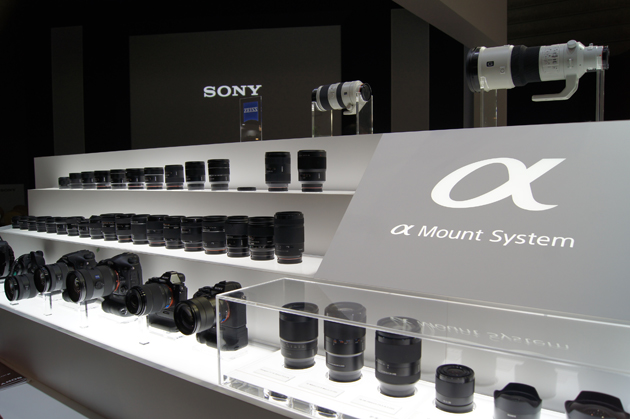
Dpreview shared some interetsing info they got from the Sony booth at CP+:
1) Lenses: Still no word on price or availability, but at least Sony now has working models of the lenses, not just the paperweights we saw at CES. We played around with a number of their lenses and, indeed, they appear to be impressive.
2) Stabilization: We got to play around with the unit, moving the sensor up, down, left, right, and rotating it. We found, however, that the sensor did not tilt at all in this assembly, so we asked how the system corrects for pitch and yaw. We were told by the engineers that measurements are continuously recorded and used to algorithmically correct for pitch and yaw.
3) Focus on 35mm Zeiss: The in-body stabilization (IBIS) technology developed by Sony is used not only for IBIS, but also for autofocus motors in the DXC-RX10 and the new FE mount 35mm F1.4 ZA lens being introduced. Direct Drive SSM is based off of technology used for in-body image stabilization. A piezoelectric element that translates an applied electrical field into mechanical movement is used for precise linear positioning of the focus group.
I am really looking forward to see how fast the focus with the new Zeiss FE 35mm f/1.4 is!
102 Responses
“and used to algorithmically correct for pitch and yaw.”
So this is 3axis IBIS which is made 5axis by clever marketing. So it is really not the Olympus tech.
I think the “this is not the Olympus tech” clues they mentioned several times before gave that away.
Yes, like the Nikon ‘Not a sony sensor’ clues and the Canon ‘Not a Sony sensor’ clues. All of this is marketing speak.
It is totally different tech utilised.the 5-axis stabilization is the combination the IBIS in alpha dslr body and balance optical steady shot (BOSS) which originated from handycam. That is why you can choose to use 3 IBIS + 2 lenses stabilising or 5 IBIS + 0 lenses stabilising in OSS option. It is 2 different mechanism combined. Unlike Olympus 5 axis the whole mechanism works in unison.
The Sony “5-axis” system can work without OIS provided the lens in question provides distance encoding information. (Pitch/yaw can largely be compensated for with just focal length information which is why, without distance encoding, the IBIS system reverts to just 3-axis (that is pitch, yaw and roll).
There is nothing, in principle, stopping Olympus implementing a hybrid OIS/IBIS systems with their existing mechanism. It’s just a firmware issue and having the appropriate lenses and communication protocol defined. But it seems unlikely they will bother.
IF you have a lense with OIS attached, the Sony system uses 3-axis + lens 2-axis to give you 5-axis. If you have a non-OIS lens attached, you get 5-axis IBIS.
This is not what the article says,
“We got to play around with the unit, moving the sensor up, down, left,
right, and rotating it. We found, however, that the sensor did not tilt
at all in this assembly, so we asked how the system corrects for pitch
and yaw. We were told by the engineers that measurements are
continuously recorded and used to algorithmically correct for pitch and yaw. ”
There is only 3axis IBIS and you get 3axis IBIS + 2axis OIS. There is no 5axis IBIS.
Continue reading…”We’re assuming something was a bit lost in translation and, indeed, one of our readers pointed out that the recorded measurements are likely used to try and correct for X and Y components of pitch and yaw corrections. If true, we wonder if stabilization systems in lenses are better suited for such corrections – which might then be part of the reason why pitch and yaw corrections are handed off to the lens if it supports Optical Steady Shot.”
http://www.dpreview.com/articles/3468545272/cp-2015-sony-shows-off-new-technology?slide=2
OIS also can’t deal with the the “tilt” aspect either (as it involves subtle perspective changes among other things). However, what a lens floating element can deal with rather better (at least at moderate to long focal lengths) is the range of movement. An OIS system will be able to deal with that better for two main reasons. Firstly sensor movement is ultimately limited by the constraints of staying within the projected image circle of the lens (as it passes through the lens mount throat). The second is that for long focal lengths especially, the movement is heavily magnified. In contrast, a floating element only has to be moved a very small amount and the fundamental design of the lens means that it doesn’t have to move very much on long focal lengths.
A final reason which may, or may not be important is, theoretically at least, a lens can have it’s own gyro systems and compensation logic for pitch/yaw and take some of the load of the camera processor (although I suspect that this is not done in practice).
It could also be aheating decision. Leveraging some IS to the lens may keep the heat inside the body a bit lower.
There is not such thing as 5 axis anyway. We live in a 3D world with 3 axis. What both the Olympus and Sony mechanisms do is compensate for rotational movement round the x, y & z axis (pitch, yaw and roll) plus movement along the x & y axis (up/down & left/right). Those 5 movements are called “degrees of freedom”. The final degree of freedom is movement along the x axis (fore-aft). There is no compensation system which copes with that (it’s only of significance on very close macro), and it would present serious theoretical problems as such movement involves change of perspective which is fundamentally down to the relative location of the subject and the optical plane.
It also ought to be pointed out that no sensor movement system can fully compensate for all possible movements due to the subtle issues involving perspective change. Fortunately, for anything but very close work these issues are negligible.
The Olympus mechanism also only compensates by movement and rotation in the X-Y plane. There are a number of videos available of it working, including this one
Both the Sony and Olympus mechanisms work using essentially the same principles. The only thing that differs is the detailed physical implementation. The will use pretty well identical algorithms as the optical compensation required is exactly the same.
https://www.youtube.com/watch?v=pxgnE6xY0OA
There was also mentioned in DPREVIEW that the new FE 28/2 with wide angle and fish eye converters were not quite sharp in the corners, hopefully it is without converters; I really count on this lens if it’s really good.
I wouldn’t really expect converters to be sharp across the frame, to be fair…
Ten years ago, I was using an Olympus C-8080WZ compact/”bridge” camera with such a wide-angle converter that turned the 28mm (equiv.), which was the lower end of its zoom lens, into a 22mm (equiv.) super-wide angle, and it was sharp across the frame. That same year I bought my first Olympus DSLR and I soon added the Zuiko 11-22mm super-wide zoom. Even though the 11-22 (I still use it on my E-M1) is a renowned “HQ” lens, at 11mm (22mm equiv.) it wasn’t noticeably sharper than the C-8080 with converter.
While things were happening on 8 MP sensors back then, it at least means that it still might be not completely impossible to design really good converters of that type today, too.
this UZ aperture was FF-equiv to ?? 14 maybe.
But here people want fisheye converter to be sharp at full-frame f/2
9.4 (2/3″ sensor with 3.9x “crop” factor, 7.1-35.6mm f/2.4-3.5 lens). I see your point, though.
Many others said they arent good and have severe distortion. And they only played around a few minutes with it. So dont place your preorders just yet.
yeah people say a lot in the www and most of it is garbage
Isn’t distortion expected from fish-eye lenses?
No. Check Samyang 7.5mm f/3.5 fisheye for m4/3 format. It is best fisheye you can get to any format. It basically has no distortions.
http://www.lenstip.com/317.1-Lens_review-Samyang_7.5_mm_f_3.5_UMC_Fish-eye_MFT-Introduction.html
Fisheye converters always have soft corners, if you want to get the best AF fisheye for your E-mount then get the Sony 16mm f/2.8 with LA-EA4 adapter.
it’s not that much bulky and produces great sharpness for a fisheye lens.
I have the Minolta version and it’s great.
Thanks for the input, I try to avoid the translucent mirror and for me if only the 28/2 alone is very good-it’s great and if it remains very good with the x0.75 wide angle converter- it’s awesome!
Shame the converters are already pretty big.
Did a writer for Dpreview make that statement or just a blogger, if it was Dpreview do you have a link. Sounds interesting. tnx
Read the article linked by Admin in the story. There is a considerable amount of information in it that isn’t summarized above.
Blimey, the corners are not sharp! As if that was the main problem with these cameras, or with photography in general. Sigh.
how about the manual focusing? focus by wire or?
It’s probably like on the a-mount SSM lenses. Manual all time override on af.
So thats what the “newly developed highly responsive actuator” means… Im so much looking forward to this lens. They will price it accordingly though. But this might be the perfect lens for the new A7rII if it resolves the ~50mp. I guess it will do so easily.
Canon only shows off their 5ds with zoom lenses, their primes arent good enough, and zooms are never as sharp, so Sony is more interesting for me with their new modern and sharp primes.
Canon’s new range of zooms can easily outperform many of their dated prime lenses.
Modern zooms outperform dated primes.
Modern primes outperform modern zooms.
Who the hell would buy a 3k$ 50mp FF body that’s crippled in all other aspects (video, low light, DR, fps) just to stick a piece of optical compromise in front of it?
Not speaking in favor of their primes…
Yeah, sure. Have you shot many brick walls today?
Is this the only E-mount lens with Direct Drive SSM so far?
Yes. This is also why it has been advertised as a new AF actuator, a tidbit that has been mostly overlooked until now.
The main advantage of Direct Drive SSM is able to make the lens smaller.
In a-mount, it better have Ring SSM which provide much higher torque than Direct Drive SSM
Holy crap, you’re telling me that this lens is already a shrunken version.
But, my understanding is SSM still is not faster than screwdrive. At least not SSM but what is the difference with SSMII? Looks like I’ll have to read today- which sucks.
All camera IS systems correct for pitch and yaw. It’s the x-y and roll that are unusual. Sensor shift is all that is needed for pitch and yaw, sure there is a small tilt error but it’s negligible.
Exactly. The only slight point is that for extreme macro, the “tilt” aspect does become significant as things go out of focus. However, no manufacturer is going to add all that weight and complexity for what is a very special case (and extreme macro photography requires very special set-up anyway).
Sensor tilt is much more useful. I crave for it every time I shoot macro, or drawing, or a circuit board.
Pitch and yaw correction never involved tilting the sensor. That idea only came about through that rather misleading Sony animation. No IBIS system tilts the sensor. It’s possible to achieve almost all the compensation required by moving the sensor in the X-Y plane as it’s the movement of the image across the sensor that is the vast majority of the problem. The tilt aspect (apart from on very close macro) is relatively insignificant.
Tilt for perspective control is a different issue. For that, it’s likely only a tilt/shift lens will be practical as I doubt any manufacturer is going to go to the expense of a sensor tilt mechanism which will inevitably increase the camera’s depth (it would also have to tilt the shutter mechanism too).
>For that, it’s likely only a tilt/shift lens will be practical
Tilt/shift lens is very impractical and that’s why almost nobody uses it.
>as I doubt any manufacturer is going to go to the expense
Hello! Hello! Let’s just get stuck in 20th century!
>which will inevitably increase the camera’s depth
Yeah! Those huge superlong two millimeters!
The tilt mechanism doesn’t have to tilt shutter, just as IBIS doesn’t have to move shutter.
Use of tilt/shift lenses may be relatively rare, but it’s still an important niche business for architectural photographers. In any event,
Even 2-3 millimetres is a significant increase in depth to impose on a camera where every little extra counts, and that for a feature which very few people are likely to use. For many people geometric correction in PP is good enough provided the
DoF is enough to the relevant part of the image to be in focus.
Another problem is whether there’s enough space in print of the sensor/shutter assembly. On cameras with very short registration distances (like E-mount), there might not be that 2mm available (on a DSLR, especially an FF zone, it could very easily foul the mirror assembly – mirror boxes were originally designed with just enough clearance for an FP shutter, not with the extra required for a tilting sensor. Moving the sensor further away is not an option as it would then lose the ability to focus at infinity (unless the lens in question had a lot of potential movement beyond the infinity setting).
As for not requiring a focal plane shutter to tilt as well, there are some significant downsides (they are called focal plane shutters for a reason – the closer they are to the actual focal plane the better or else effective exposure alters across the shutter travel due to parallax issues). With a non-tilting shutter, the effective width of the exposed slit will change with the distance the FP shutter is from the surface of the sensor. There are already a few issues of a subtly different nature with EFCS as the first curtain is a “true” focal plane implementation whilst the second curtain is a little off the focal plane and you get slightly different exposures across the travel due to parallax issues. (Even longer exposure times suffer a bit, but it’s proportionately less important).
Anyway, it’s all rather theoretical as I doubt any manufacturer is likely to release such a camera, but we’ll see.
>but it’s still an important niche business
because these people have no choice. just like 15 years ago they had no choice but to shoot film. give them sensor tilt, and they’ll abandon manual TS lenses like they abandoned film.
>that for a feature which very few people are likely to use
Very few people are likely to use manual TS lenses because they are unwieldy and slow to operate, requiring many turns to reach desired result. However, when sensor is tilted by micro-motors which work together with AF system, this can be as easy as AF now — users don’t even need to know it’s here.
>DoF is enough to the relevant part of the image to be in focus.
DOF is *NOT* enough, here is why the need for sensor tilt.
>On cameras with very short registration distances
“registration distance” is quite reliable marker that a person says something about they don’t understand.
>Moving the sensor further away is not an option
It is exactly what sensor tilt mechanism is supposed to do: when object is at infinitity, DOF problem does not arose. DOF is problematic when an object is close, and in this case tilt mechanism shifts an edge of sensor AWAY from the lens.
>There are already a few issues of a subtly different nature with
EFCS
They do not occur with shutter speeds slower than 1/1000 of second (unless you have faulty sample) and moreover, they can be fixed with firmware update.
where comes the 5 axis in then, when it doesn’t tilt?
Is that a marketing gage from Sony to enhense a simple steady shot system?
See below. It’s exactly the same movements as on the Olympus system. Tilt is not necessary for all but extreme macro as the effect is negligible.
but it’s still less then 5 axis isn’t? therefore where are the missing axis people are paying for?
The 5-axis refers to the detected motion, NOT the sensor movement.
Yup. It’s “compensation for”, not “compensation by”.
There’s actually no such thing as 5-axis in 3D space. Blame Olympus for that terminology. There are actually 3 axis, with 2 possible motions on each (rotation round an axis and movement along). That makes what’s called 6 degrees of freedom. However, not surprisingly, Olympus marketing decided people weren’t going to understand what that mean, so they called them axis.
Both the Olympus and Sony systems provide correction for rotation round the x, y & z axis (that’s pitch, yaw and roll) and movement along the x & y axis (that’s left/right and up/down). The one neither system can cope with is movement along the z axis (fore-aft).
Without going into the formal geometry of this stuff, no sensor movement system can completely compensate for all possible combinations and subtleties (it’s theoretically impossible due to subtle issues of perspective change). For instance, left/right and up/down can only be exactly compensated for at one distance from the lens (hence the need for distance encoding). However, for the great majority of cases the compensation is good enough and is only limited at the extremes (like very close macro photography).
If you are expecting engineering to be “perfect”, then think again. No engineering is that exact. Everything includes some tolerances. For instance, your car suspension might smooth out bumps, but it won’t eliminate them.
Well in the end I’m prefer that marketing creatives are using strange names such as anti-shake ( Konica-Minolta) or stady shot ( Sony A-mount) rather then using goemtric defined terms like axis to sell something that’s clearly not there. Adding a video which shows exactly what they want you to think what it is is stil worse.
In my part of hemispher that’s called simply cheating. That doesn’t change only because somebody else started using 5 axis to name a 3-axis system.
I hope that’s not the case with Sony otherwise their marketing has reached really the bottom.
Unfortunately once one manufacturer “cheats” in this respect, the others have to use the same misleading terminology or they are at a commercial disadvantage. We had the same thing over MP ratings for the LCD screens on the back of cameras.
Most countries have authorities that will look at misleading marketing terms, but even then they often allow things through which are not wholly accurate.
I’m only thinking it would be nice if apples would be called apples so everybody would know what they pay for with their money they worked hard to earn. It’s really sad.
BTW, I forgot to thank you for your precise explanations. it is always a pleasure to read and learn. 🙂
Thanks. Nice to be appreciated. I spent some time doing the mathematics and geometry on this just to work out what was going on.
Thank you for the clear and concise description SteveGJ, the truth is not difficult to understand when explained correctly.
Thanks for the compliment. Glad to be of service. It’s always nice when things make sense, and it’s not that complicated as you say.
Yes there is. Olympus 5-Axis really tilts and swivel around X and Y axis. Take a magnifying glass and check it yourself. That is the reason why the video footage background “warps” when you radically shake camera because the sensor tilts back and worth and the image plane surface area toward corners grows or get smaller.
Sony does rotation via software, Olympus via hardware.
On the Sony A7 II roll correction is done by rotating the sensor (at least definitely for stills). Electronic still stabilisation doesn’t really work, and it’s not very good for video either, so I don’t see why Sony would use it on the A7 II.
If you doubt that it rotates the sensor, then look at this. Either that sensor mount is broken or it can be rotated (something you could never do on previous generations of Sony IBIS mounts).
https://www.youtube.com/watch?v=ecxIW8vJIXs
As for the “warping”, that’s actually evidence for the sensor not tilting. It’s what you would expect due to the perspective changes away from the centre on relatively high amplitude pitch/yaw movements.
The sensor does not tilt (I’ve felt it in my hands). Pitch and yaw is actually corrected algorithmically with the a7ii and not physical movement although the sensor does physically move for other axis. To simplify, macro is not going to be affected. There is no “tilt shift” going on.
As for your 5 axis claim. Fuji are not to blame, there’s been 5 axis CNC machines for years.
For 5 axis CNC machining equipment, you can take advantage of the extra two axes aside from the x, y, and z planes. If you are making a piece of art, you can rotate the object in two more ways than the usual x, y, and z movements.
The extra axes may be a circular axis, a diagonal axis, or whatever. As long as the extra axes help in the production of the final product, you can always have a 5 axis CNC machining tool handy
Thanks for that great explanation!
Stop spreading FUD.
The Olympus system is tilting,
http://www.thephoblographer.com/2014/12/17/comparison-olympus-sonys-5-axis-stabilization-work/
The Sony system – see DPreview link and Sony comment – is not.
Good grief, it’s not FUD. You seem to be taking a graphic which demonstrates camera axis rotation with sensor rotation. To take a qupte from that very diagram on the link you’ve provided.
“This allows the image sensor to move
freely, so it can be rotated or moved vertically or horizontally
depending on the movement of the camera”
So that states the three types of motion that are available on the sensor. Vertical, horizontal and rotational. That’s what the videos showing the Olympus IBIS assembly in motion also show. It’s what the article says (essentially the mechanisms are equivalent, albeit different in detail).
There’s also this very clear explanation on DPReview on an Olympus thread.
http://www.dpreview.com/forums/post/40558437
The fact is, if you care to sit down with a pencil and paper, do the geometry and the mathematics, you find that for the vast majority of real world situations it’s simply unnecessary to tilt the sensor as the differences are negligible.
How do does a sensor that doesn’t tilt compensate for Yaw and Pitch?
That video is pure marketing bull…nonsense, the sensor movements as shown in the video wont even work!
It’s not simply a case of keeping the sensor in the same place as the camera body moves, because the lens’ optical centre moves with the camera body. So to correct for tilt you actually need to move the sensor, not just tilt it as shown in the video.
Wow, impressive! Thank you for the lesson in inextinguishable patience!
Wow, thanks for the lesson in complete brown nosing! Get a room boys.
I don’t know what that is, but I’m excited!?!
https://www.youtube.com/watch?v=btAPqKf_Au0
Wow.
Didn’t you contradict yourself? Since the a7 AF is subpar, any improvements or compensation on the lens side are bound to help.
I guess you didn’t actually read the article…
“We were able to try out Sony’s ‘4D’ continuous AF with this lens on an A7 II, and it was, frankly, jaw-dropping impressive. As long as our subject stayed within the phase-detect area of the frame, horizontal, vertical, and depth tracking was incredibly accurate, fast, and completely silent for an erratically moving subject. Almost every shot was tack sharp on the intended subject matter at F1.4. In good light, we’d wouldn’t be surprised if this combo gave top-of-the-line DSLRs a run for their money when it comes to continuous AF. ”
“4D AF” on A7II?
If there is anything “vague” about this report is the use of 4D to describe the focus. Sony hasn’t officially given the A7II the 4D label, yet within the PDAF Zone, it appears that this is exactly what you get.
Perhaps the official 4D brand can only be granted when the PD coverage is across the whole sensor as it is in the A5000, A6000 and A77II.
correction A5100, not the A5000
No. Just did. That statement is to vague in my opinion. However, I was impressed by the commentary on the 135mm 2.8 STF technology.
So what you are really saying is yes, you didn’t read it when you made your initial comment.
What is vague about “jaw-dropping impressive”, “incredibly accurate, fast and completely silent”, “tack sharp on the intended subject matter”?
I can’t quantify “jaw-dropping.” Incredibly accurate? Against what..to what degree? In what environment? “Tack sharp”- same terminology used for EVERY lens released this year. Meaningless use of superlatives- canned responses for a lens yet to be released.
They may be hyperbole but given the amount of tech that the DPR guys see day in and out, I’m giving them the benefit of the doubt and trusting their evaluation here. If you need to wait for charts and measurements and whatnot, that’s fine.
Not likely!
What’s not likely?
What I find interesting is that the “jaw-dropping” comment is strictly linked to this lens which, if true would indicate that the focus of the A7x platform is limited by its lens lineup rather than the focus subs systems in the bodies.
Well, each A7 body has a slightly different focus capability with the A7s and A7r the most alike with their contrast detection only focus.
So I don’t think you can generalize too much. What works well on the A7II is very different than the base AF performance of the A7r. By adding this lens, the A7r is never going to have the same PDAF tracking capability that the A7II has.
I don’t find much wrong with native lenses plus the A7II PDAF tracking, which behaves very similar to the A6000 – in character, if not completely in speed. It does sound like this DD SSM could take it to the next level though. We’ll see soon when the production lens is in the hands of users and reviewers. I’ve got one on pre-order at my local camera shop here in Texas.
Yep, you are right of course. I should not have generalized to the A7 line. Thanks for pointing that out. Still interested to see the impact of the DD SSM on the performance.
Me too 🙂
Of course Canon makes crippled bodies all the time, with their fragile mount, shutter vibration, weird colors rendition, mushy corners, small mount that lens designers can’t make f/1.2 to match it. And that’s why it is worth saving the extra money and buy Sony.
Interesting on that slide with the new drive motors they had an ASP-C “Steadyshot INSIDE In-body stabilization”
I think that’s for a-mount, but you can pretty much guarantee it’ll show up in apsc e-mount sooner rather than later.
Don’t listen to Steve the fanboy.
The Olympus system 5axis in the is tilting. The Sony system is 3axis and not tilting.
http://www.thephoblographer.com/2014/12/17/comparison-olympus-sonys-5-axis-stabilization-work/
The Sony system – see DPreview link and Sony comment – is not.
Oly IBIS doesn’t tilt. They are both 3-axis mechanically
“Turning on the OM-D camera energizes a coil and magnet arrangement that causes the image sensor to float in magnetic suspension. This allows the image sensor to move freely, so it can be rotated or moved vertically or horizontally depending on the movement of the camera. It can also be used to compensate for the gentle vibration that occurs when the user is walking, such as when recording video.”
Olympus say that the sensor tilts, it doesn’t just shift but it tilts (rotates X and Y axis)
” it can be rotated or moved vertically or horizontally depending on the movement of the camera.”
It did not say the sensor tilts..
Sony IBIS can also move up, down, left, right, and rotate.
nothing in your quote prove that the sensor pitch. It says that the sensor move vertically and horizontally and can be rotated. Rotate mean it compensate for roll which mean it rotate in the same plan of the sensor like the Sony’s IBIS.
If you post a link to the phoblographer your comment can’t be taken seriously, sorry.
Sorry, the Olympus doesn’t tilt it’s tiny little sensor. And even if it did it would still suck.
You really should listen to Steve as he’s dead right on this. Both the Olympus and Sony systems move the sensor in three ways (up/down, left/right, rotation left/right) to try and counter 5 types of camera movement.
The sensor always stays in the same plane with both systems. Tilting the sensor would be difficult to achieve and provide very little improvement as the camera/subject distance is relatively very large and so the angle of tilt required is tiny and can be ignored (think of a right angle triangle with a 2 meter base that’s only 2mm high, and imagine how small the angle is).
Continue digging.
I cant see how sensor tilting would help to significantly reduce camera shake in whatever axis. It just doesn’t make any sense. I worked with field cameras for many years. Tilting just alters the alignment of the focus plane. Maybe someone with technical knowledge can explain it to me.
yawn…
how is 50mp @ 5fps crippled?
The linear drive is an old Minolta tech, patented but never used in any lenses (as far as I know). Glad to see it finally found its way into a product. Read US patent 6,512,321 for example but there are earlier ones too.