


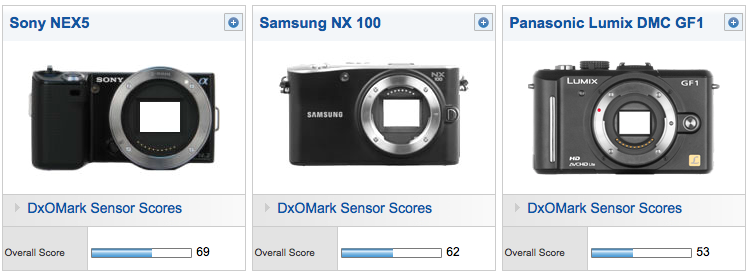
 DxOmark tested the new Samsung NX100

Support our website and buy your NEX camera using those shop links. Thanks!
US: Amazon
Europe: Pixmania (DE, BE, FR, AUT, UK, NL, PL, IT) or Amazon (DE








DxOmark tested the new Samsung NX100
Support our website and buy your NEX camera using those shop links. Thanks!
US: Amazon
Europe: Pixmania (DE, BE, FR, AUT, UK, NL, PL, IT) or Amazon (DE
8 Responses
The GH1 is close enough, so we will see if the GH2 is also behind the NEX-5. My guess is that they’ll be about the same.
Not necessarily, Luis; Panasonic hasn’t created that food a sensor yet. In any case, the GH2 is a subtantially more expensive camera. And 89 to 64 is, while closer than the NX, Oly, or GF1, still a substantial difference. I’m surprised at how poorly the Oly sensors are performing. Unless they can turn that around, they’re finished. Apparently GF2 hasn’t been tested yet.
Remember that these tests are resolutiom-ndependent. That means that a camera sensor that tests better AND has more mpx is substantialy better.
Luis,
In addition to the items Dulaney mentioned, one of the performance indicators for a particular type of sensor technology is the size of the photodiode. (The photodiode is the light sensitive part of a pixel.) So, it is generally related to pixel pitch. Image sensor engineers use the term “Fill Factor” to describe the ratio of photodiode size to the pixel size.
The GH2 has a slightly smaller pitch than the GH1. If the Fill Factor is similar between the GH1 and GH2, then Panasonic has to overcome a smaller photodiode. However, if Panasonic developed/outsourced a new sensor such as a back-illuminated sensor or used a different sensor design to maximize the average effective photodiode size, then that would positively impact the results.
Do you know if Panasonic has a new type of sensor or an improved sensor design that is used in the GH2? That would be a good leading indicator of the DxOMark results.
In general, you should be impressed by the GH1 results. At a *pixel level* it performs similar to the Canon 7D which costs twice as much. Why? The pixel size is almost identical; the 7D uses pixels of 4.29 µm vs 4.31 µm for the GH1. http://www.dxomark.com/index.php/en/Our-publications/DxOMark-reviews/DxOMark-review-for-the-Panasonic-Lumix-DMC-GH1
To understand why Sony is doing fairly well recently, it is worth understanding the benefits of the so called “Back Illuminated Sensor” and how it impacts the fill factor. Moreover, as Dulaney intimated, Sony’s NEX-5 has a larger pixel pitch than the some of the others and the NEX-5 uses a bigger sensor than the 4/3rds. Sony’s APS-C sensor is about 1.6 times larger than GH2’s 4/3 size sensor.
Although I admire the innovation behind the 4/3rds sized sensors, the smaller sensor size handicaps overall sensor performance (all things being equal). In general, I am under the impression that the 4/3rds design is really about cost saving more than improving performance. I don’t know certainly, I could be wrong, it’s just my guess.
Especially GH1, GH2 and coming GFx..?
I find it interesting that in high ISO/sports, the NEX-3 performs better than the NEX-5….
GH2 has not yet been tested by DXO Mark
53 vs 69? Wow…. I can’t wait for A580 test. B)
The article should said compact mirrorless, gh1 score is not listed is probably score higher than other m3/4. but next weakness lack dial button.
One strong point for Olympus is their colors….