







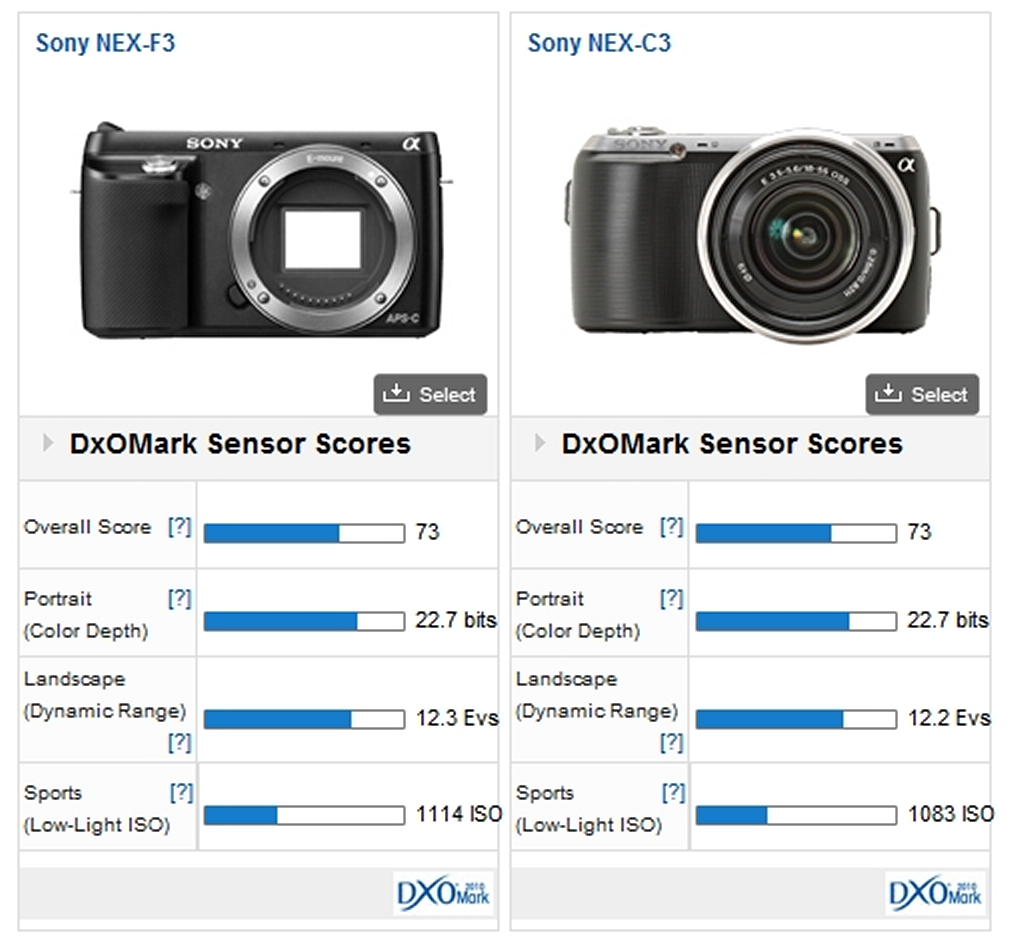
DxOmark (Click here) posted the full NEX-F3 sensor test. And as you see the performance is identical to the previous NEX-C3. This isn’t a bad news, the NEX sensors are already the best on the mirrorless market. The new Panasonic GF5 for example has an overalls core of 50 points only.
Something else. If you are a NEX camera owner you might be interested to buy the 16mm pancake lens which got a $60 price drop over the regular Amazon price. You can find them for $149 at [shoplink 14606 ebay]Bigvalue (Click here)[/shoplink]. The NEX-5N got another small prcie drop and you cna get it with lens included for $479 at Amazon (it’s here on top of the ranking). And to finish there is a 2% off on all Sony cameras and lenses at Amazon (Click here).
24 Responses
73 not bad at all 🙂
They look exactly the same sensor with some minor tweaks! 😀
The F3 is heck of lot better looking camera than the C3. Physically I mean.
true… i like the f3 a lot.. better design than the c3
The F3 is ugly and bulky. The C3 with the new 16-50 pancake is very compact, the way a NEX should be. I would take the C3 anyday over the F3.
I guess they updated it as part of their marketing strategies. Still, 1114 ISO is really good, specially if we compare it with the 830 from the original NEX-3
The difference between 1114 and 830 is only 0.4 stops. Not relevant difference in most real world situations.
While I agree…just to put it in perspective…
You could say the same thing about a FF SLT. It’ll have approximately 1 stop better performance than an APS-C SLT, but lose half a stop due to the mirror.
So the FF SLT will only have the same 0.5 stop benefit over an APS-C NEX. Many people are clamoring for that benefit, and it’s going to cost a LOT more incrementally.
A bit of rounding always adds confusion… but I get your point. 😉
If we were to look at sensor size, the difference between FF and (Sony) APS-C should result in about 1.22 stops difference in light. Substract 0.5 EV (the difference between the A57 and 5N is measured by DXO to be 0.46 EV, the difference between the A77 and NE 7 about 0.34 EV though) and you are left with 0.72 EV. Which is more than 1.7 times the amount discussed here.
Good catch. I tend to forget that FF is indeed 122% bigger than APS-C…and just round off to 2x. Makes the math that much easier, since my medium format is exactly 4x APS-C.
And you’re right. In the rapidly diminishing margin of return world of camera equipment, getting 70% better improvement is significant.
ISO 1114 vs ISO 1083 is WAAAAAAYYYY less than 0.1 fstops, let alone the 0.4 that you cite.
Then someone else goes-to-town on a presumed 0.5 fstop loss on a FF SLT vs APS-C SLT. That number is WAAAAYYYY overblown, as well.
Where do you guys keep your sliderules? Did they get stuck in an autoclave?
He was comparing the NEX 3 and F3, not the C3 and F3.
Why did they make it so ugly?
Which one is ugly, F3 or C3? I personally think F3 looks and handles far better than the tiny C3.
Still asking why the F3 performed that badly her: http://translate.google.com/translate?sl=de&tl=en&u=www.heise.de/-1705014
DxO is a good guide, but not everything. Most all the cameras are decent these days. My old Canon 60D never faired well, but still takes excellent pictures. Same with my A57. The lens quality makes a world of difference. Preaching to the choir…
Some criticized the F3 due to larger size body, but I think the better hand grip (and battery life) and larger frame give it a more substantial and balanced look when attached to the 18-55 lens. It was the correct design decision by Sony.
At $500 US, it’s an excellent camera that is sufficient for many buyers. BTW, he 18-55 I saw in the store said made in Japan. I would recommend to any buyer if they can’t get the 5N for less.
The one amazing thing about the c3 is that the phase detect ea2 adaptor doesnt squish your grip finger unlike the nex 7 i tried and prob the nex f3 by the looks.
ISO beats A77 by >200 marks! A77 ISO performance is speechless! 😀
Since the NEX-6 sensor has already proven to be significantly better than the NEX-5N/C3 sensor when it comes to high ISO (I’ve seen an interesting comparison based on RAW files from a pre-production NEX-6 at ISO 12.800 with a result that seems to hint at a near-one-EV advantage), the NEX-F3 sensor is either substantially different from (and less advanced than) the NEX-6 sensor (which might well be the case, given that the NEX-F3 ISO scale ends at 16.000 whereas the NEX-6 goes up to ISO 25.600), or the DxO figures do, once again, describe some parallel universe’s imaging “reality”…
Given that the F3 doesn’t have the on sensor phase detect sensors that the NEX-6 has, I think it’s safe to assume that they’re different sensors, and that the F3 is probably the same or a very similar sensor to the C3 (and 5N for that matter, which only scores better in DXO’s tests because it goes down to ISO 50 rather than 100).
Highest ISO marking is irrelevant, because such high ISOs are done purely in software (at least on their sensors)
why f3 and 5n had different score? are they not similar in sensor… i dont get it =(
Many of the parameters used to weigh the “score” are measured at the lowest available ISO. The 5n adds a lower minimum ISO, hence higher scores. At the same ISO’s the measurements are near equal. Look at the graphs, not so much the arbitrary score.
This test actually made me realized how good the 5N is and now that it is dirt cheap and that i wont be able to afford the Nex6, the 5N might be the better choice