







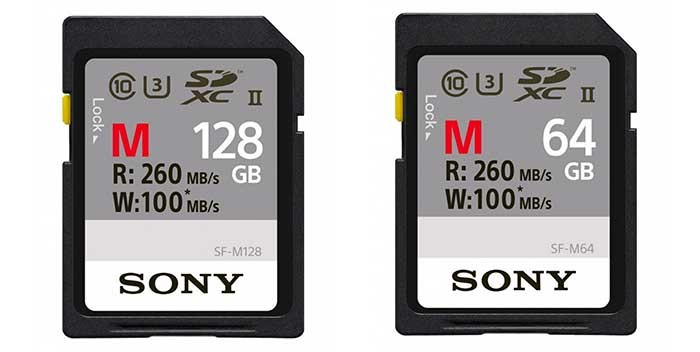
Sony announced new XQD and SD cards. And before we talk about those there is an interesting note on the press text:
“In addition to the new XQD-M series, Sony offers XQD-G series which is able to record up to 200 frames in continuous burst shooting with the latest high-speed cameras including models like Nikon’s D5*.
*(FX format 14bit lossless compressed RAW mode. For details, visit http://imaging.nikon.com/lineup/dslr/index.htm)“
Means of course that Sony was well aware of the Nikon D5 launch and probably even made the sensor for the camera?
And now to the new cards press text:
Park Ridge, N.J., January 6, 2016 – Sony is expanding its lineup of memory card options for professionals to include newer and faster XQD and SD media, as well as card readers for the XQD and SD formats, and an XQD USB adapter, all designed to support the latest high-performance DSLR cameras like Nikon D5 or D500.
Sony’s newest SD cards, SF-M series, are UHS-II supported cards optimized for digital imaging devices including professional, DSLR and mirrorless cameras. With high-speeds up to 260MB/s (read) and 100MB/s (write), SF-M series contributes quick data transfer to and from a PC with Sony’s new UHS-II supporting card reader, which maximizes SF-M series’ performance.
Both new media offerings are extremely dependable and durable, dust-proof, X-Ray proof, anti-static and magnet proof to protect the most sensitive photo and video content. Downloadable File Rescue Software aids in the recovery of photos and videos that may have been deleted, including RAW images, MOV files and 4K XAVC-S video files.
“As digital imaging cameras become more advanced, capturing larger high resolution files, the demand increases for faster and more efficient ways to manage photo and video data, giving shooters peace of mind they’ll never miss a critical shot,” said Darin Scott, President of Sony’s AMEG, Americas Media and Energy Group. “These latest media options allow files to be transferred and backed up even more seamlessly and efficiently, offering users the flexibility and convenience to embrace workflows that frequently require the need for content in real-time.”
102 Responses
Is there ANY reason why Nikon would share information with Sony about upcoming cameras unless Sony made the sensor? Makes no sense to me.
Maybe it’s because Sony makes XQD card?
Or Sony had these cards on their roadmap. Obviously they heard of Nikon’s announcement and tweaked their press release for the faster cards.
XQD is a Sony format, Nikon don’t make the cards either. It’s not a format regularly used in photography, so as a format Nikon are pushing it is a good idea to have card makers on board.
Oh and EVERYONE knew about the D5, considering it was pre-announced a couple months back.
MdB,
Nikon don’t produce cards or sensors that’s right, but perhaps you already know that Nikon, Sony and SanDisk together put forward the XQD standard (although SanDisk then choose to focus on CFast instead).
.
Ya, the timing is too good. Very strange.
…
When will there be any Sony photo cameras that can use either? 🙂
Sony have quite a few cameras that do.
Could this be the sensor developed for the eventual A7Siii?? Did Nikon pay for exclusivity to bring it out in a camera first, like with the D800?
Sony has been leading in sensor design with incredible low light capabilities, yet high resolution enough for stills. It makes sense if this if Sony’s R&D went into this. I REALLY want to know if Sony made the D5 sensor.
Given that the D5’s video has got some important restrictions, like no 4K full-frame mode, I think it unlikely in the extreme that such a sensor would find its way into any A7S iii which would surely major in that area.
A more promising direction is surely using technology from the A7R II sensor but with a lower pixel count. That is a BSI design and could allow an increased read-out rate which is a big advantage in allowing higher fps and reduce the rolling shutter effect. (A global shutter would be the ideal of course but, on a CMOS chip difficult to do without compromising aspects of IQ).
Interesting points.
One way or the other, the future in sensor tech is very exciting.
On a low pixel count, video oriented, FF camera like A7s, global shutter should have been there from the beginning. Slightly smaller DR of GS shutters does not matter for video anyway, as for video 14 bits are not even read out. More expensive sensor for sure, but they could have thrown out the whole FF shutter unit, $50 or more in cost savings right there (not even counting the labor of installing and checking it, and warranty service of failed shutter units).
Renesas. Not Sony. And they aren’t necessarily “leading” in sensor low light design either. They merely mass produce many.
Good to know if true. Where did you find info on Renesas as the sensor maker?
They don’t know, they just get their panties in a bunch about where Nikon gets its sensors from. For all they know Samsung makes this sensor.
wishful thinking
It was designed by Nikon. Who made the sensor isn’t the same as who designed it. People don’t seem to understand this.
Sony a7 fanboy fantasy alert!
Sony wasn’t the only company aware of the D5. All memory card makers were aware. Sandisk have had XQD memory cards since 2012. This isn’t new memory card technoloy. Newsflash, Nikon doesn’t only use Sony either. Nikons D5 sensors were made by Renesas! Not Sony. The emphasis is about the readout and the processor behind Nikon’s sensor design. Capable of delivering up to 200 raw photos at 10-12 fps. (in the rain)
Pretty sure XQD is a Sony format.
Yes, but openly licensed. Sandisk did make them, or said they would, but stopped when they jumped on the CFast bandwagon. Lexar is the only other maker AFAIK.
Not exactly a Sony exclusive format per se. Basically a PCI Express achitecture. It was developed by three executive memebers of the Compact Flash Association before 2010. The Association voted to announce it. Sandisk, Nikon and Sony decided to implement it. I believe that Sony manufactured and released their version first. Nikon to use it in their cameras first. Sandisk soon pulled the trigger on their version. Nothing really new here. Being that Sandisk, Nikon, and Sony were the three originals. USB 3.0 was added to the PCIe portion of the format/achitecture in 2014.
http://www.compactflash.org/assets/docs/cfapress/xqd2_0%20_140213%20.pdf
If only they made a microSD version~
I don’t think such comments are indicative of anything in particular, other than Sony being happy to use the latest tech prominent in the news to sell their own products.
The Nikon D5 is not even remotely a ‘competitor product’ at the moment, either. It’s performance parameter and price put it in a completely different market.
I’m still curious to know whether Sony will attempt to produce a ‘D5 beater’ just for brand recognition and kudos in order to raise their profile, but I can’t see it happening. I suspect it would be far too an expensive exercise with dubious returns.
Clearly, Canon did it successfully, but that was in a time when there was no other way of taking pictures and the SLR market was expanding enormously. Today is entirely different.
Of course, it could be a way to sway the american market but such a Sony camera would have to be virtually perfect in every respect, match or supersede the Nikon performance, as well as being cheaper…I wish them luck with that if they try!
Personally, I hope they are honest about their plans, drop the A mount, and forge ahead with making the E mount series the most phenomenal set of tools yet seen. I know some wouldn’t be happy, but you can be all things to all men. To try is a recipe for disaster.
True
The cold chill of logic…:)
Sony could easily match the D5 at a lower price. If they did it with an a-mount SLT.
They would only need to tweak what they already have.
Trying to do it with FE-mount is just hopeless atm.
It would be the same as asking Tesla to make ICE cars to compete with Ford, “because electrics are just hopeless atm”.
I hope Tesla succeed. But nobody can say their cars knock out petrol cars atm.
By all my standards except price I think they do. If I could afford a Tesla I’d sell my gas burner in a heartbeat.
Your woeful analogy needs work. In this analogy SLT is a hybrid since it allows for the benefits of both SLR & mirrorless. Additionally, Sony already makes these and has a large library of lenses. Tesla does not have any non-EV cars under production or in their production history.
I think it’s safe to say that e-mount is here to stay, people often forget that e-mount is used for their video cameras too and they are really competing head to head against Canon.
Totally disagree!
D5 is for a different market than the D800 and that’s what the A99 successor will aim at! No point for Sony to make a D5 beater of course, Sony doesn’t even have some of the lenses for it (say 200mm 2.0 for example).
But the A-mount and therefore A99 successor have many reasons to exist! Some of Sony’s best lenses would not fit the E-mount well, like the 135mm 1.8, 70-200 2.8 and so on, they would be huge and unbalanced.
Is there a point to have a D810 or 5D mk3 with constant and native live view, that 42MP sensor, as good or better AF (with full frame coverage, face and eye recognition, focus limiter like the A99), with the range of great lenses the A-mount already has plus native support to the Minolta lenses)? -> HELL YES THERE IS A POINT ON KEEPING A-MOUNT!!
Stop bitching about “E-mount, the best thing ever!”. That’s really just talk of Canikon fanboys converted to Sony because of the innovation of their products, NOT because it’s “smaller and lighter”
…whatever!!
?? “native live view”, “face & eye??..”
For still frame shooting conditions and requirements of athletic competitions. All world athletic competitions are the stage for flagship cameras. Sony must produce it or watch it. If there’s a robust A-mount camera delivering 200 raws @14fps that can produce and fit the bill, If they produce it I’ll use it too. It isn’t just good enough to say, “we can do it” look at our smaller camera. If I need a sport utitlity truck with 4×4, don’t tell me that your compact sedan has all I need in it + 4×4. I want the truck. A99 users have been waiting since the last competition. It’s “show time”
I’m not ‘bitching’ about anything; I’m merely being realistic about the financial state of the camera industry as it is now.
Irrespective of which camera you or I might prefer, the simple fact is that the DSLR market is shrinking (for all manufacturers) and the likelihood of Sony somehow expanding its sales numbers in that segment is almost nil.
I’m not saying there won’t be numbers who would buy an A99 replacement, but the idea that, at this point in time, Sony could attract many new buyers or tempt Nikon and Canon owners to switch is fanciful at the very least.
Even if Sony do create a masterpiece that can overshadow the D5, given the investment in lenses needed it would still have to be at a remarkable price to tempt those who use such ‘beasts’ to buy it in preference. The numbers sold would still be relatively small and that would inevitably mean the whole exercise could only be a huge marketing exercise.
All the wishful thinking in the world is not going to change the economics of today.
If Apple ever decide to enter the camera market, we’re all screwed. Apple will offer an easy to use camera, great menus and seamless upload and integration to the cloud. Think iPhone with Lytro technology!
Apple currently dominates the camera market.
Fun with numbers. DSLR sales may be decreasing, but from a relatively much larger share of the market. Mirrorless sales may be increasing but from a relatively minuscule share of the market. In absolute terms (which is all that really matters), DSLR sales far outstrip mirrorless sales, particularly in the most lucrative sectors. Hopes and wishes aside, there is no indication that that paradigm is going to change anytime soon. Sony certainly is aware of that. The real question is, does it care?
The a7r2 is in the same market at the d800. An a99-2 with the 42mp sensor will not match the a7r2 in highest IQ, noise performance nor have the adaptability with all of the high quality lenses of e-mount, EF, F, M or others.
The last remaining reason for a-mount bodies and a high-end a99 successor to exist is for highest achievable (by Sony) performance: AF, coverage, FPS, processing speed/cache. A medium resolution sensor is more suited to these things (and increases sensitivity).
A lot of declarative statements about the capabilities (or lack thereof) of a camera that has not been formally announced and that we know nothing about. One could also speculate that an a99mii will blow the doors off an a7rii in terms of capabilities. That is the fear which permeates many of the posts of the anti a-mount crowd on this site.
I am an a99 owner plus Canon user. I own plenty of a-mount lenses. It is well established that the same sensor behind an SLT loses some IQ and certainly sensitivity
From a superior feature standpoint – I cannot come up (or have heard a compelling case for) the existence of native a-mount versus E-mount beyond AF performance. Ergonomics, larger body size, dual cards & battery life can all be done with an e-mount bracket. Why Sacrifice the modular flexibility of an e-mount body to utilize a-mount or practically any other 135 lens there is unless an a-mount body an outperform what is currently capable by a significant enough margin. AF and speed are the only justifications I can currently come up with.
From an IQ perspective, I prefer to deal in the real world rather than the theoretical. For me the tangible advantages of SLT far outweigh any theoretical IQ impact due to light loss. I don’t shoot fashion. I shoot speed and action. If I need more speed than the light will allow, I shoot wider open and/or I increase ISO. Software takes care of any additional noise.
As for your second point, e-mount might theoretically match the capabilities of your a99, but not today.
Why should Sony continue with a-mount? Why not? If it wants to continue to sell those expensive a-mount lenses to serious photographers, it practically has to.
Finally, as far as the future capabilities of a-mount, let’s see what Sony comes up with in the a99 replacement. It might surprise you!
“For me the tangible advantages of SLT far outweigh any theoretical IQ impact due to light loss. I don’t shoot fashion. I shoot speed and action. If I need more speed than the light will allow, I shoot wider open and/or I increase ISO. Software takes care of any additional noise.”
Your statements seem to be reversing as you are supporting my point. The strength of a-mount over e-mount (currently) is potential AF abilities & speed. I want native a-mount bodies to continue if it brings real performance benefits not possible with e-mount.
Not reversing. Maybe just agreeing. I think I have been pretty consistent about where I stand.
Well, let’s hope the a99 successor is fast – in AF and operation. Whatever the mount, I will not buy one if it is as slow or slightly less slow than the a99 (or lacks full frame coverage).
Me either. I may have to forget Sony and go over to the dark side if that happens.
The recipe you offer consigns Sony to be an increasingly irrelevant player in the market who is only capable of producing variations of one niche product which meets the needs of a very limited category of users. No thanks!
Moreover, Sony’s hegemony in the mirrorless realm is likely to be short-lived once Canon and Nikon enter the mirrorless market and beat Sony because of their superior brand association in the eyes of most consumers. Sony only exacerbates that situation by following your recommended path.
If Sony gets complacent, and is happy to just rest on its a7/e-mount laurels, it will be more than disappointing.
Consumers aren’t interested in ‘Cameras’ unless they make phone-calls and surf the web. The Canikon crowd who shoot upper-level and professionally know, without good >4K (easy to shoot) video they won’t be able to compete. Local newspapers (who are not long for this world) are probably the last place you’ll find photogs (actually reporters with cameras) who buy DSLR’s.
Not at all. If Sony continues to make strides within this technology it will, by definition, lead to a camera that will be superior to the D5 (except for those unwilling to change). I don’t think, under those circumstances, it could be described as a ‘niche product’.
Up to now, Canon’s efforts have been dismal and Nikon’s have been catering to the ‘wrong’ market. I’m not sure they are guaranteed to produce a competitive camera at all. You would tend to think they should, but recent history says otherwise and Nikon spending time in their press conference to dismiss mirrorless speaks volumes.
I did suggest that brand awareness is an issue, but I think it would take a true genius of an oracle to determine whether Sony could alter the market’s preconceptions by launching a flagship camera, especially another SLT.
Possibly the best bet would be to evolve the A mount into an entirely
new beast, pleasing those who want ‘heft and size’, and cramming it with
every conceivable system to make the D5 look like a silly toy.
I say again, it would have to be a breathtaking performer and can’t see it happening, but I would be thrilled if they could pull it off!
Me too! Sign me up yesterday!
And if they gone your desired route this site wouldn’t even exist anymore LOL!
We need somewhere to go to bi^ch!
Sony could never produce a ‘D5 beater’ unless they re-adopt the OVF, dump the compact form-factor and ignore their excellent video functionality that accounts for 50% of the camera cost & processing capacity. You’re looking at this all wrong!
You want Sony to kick Canikons collective rears? That’s easy, buy RED camera, mature ‘RED’s’ tech, fit that into a DSLR sized body and they’d rule the world. The stills being pulled from RED RAW ‘right now’ would make most D4s owners jump with joy, and at what frame-rate are they doing that (hint, its a lot faster than 12FPS).
There are two issues here.
The first is the assertion that you would need an OVF. Come back in 3 years and read this again and I doubt opinion would be on your side! Don’t get me wrong, I do love a good OVF, but EVF offers so much already that I’m gasping with anticipation of what is to come.
And also, ‘It’s easy…”?
I think it safe to say that if Sony, or anyone come to that, were to put together all the parts at the price of any ‘Red’ then it would be expected to be an astonishing performer. Only about three people in the world would buy it, but it would be astonishing…plus, nothing about such technology is ‘easy’.
Glad you could spot the irony in my statement…… Like I’ve said before, the A7x series is a ‘multi-media’ camera, and its the very best ‘compromise’ between a professional ‘135’ still shooter and video camera. It’s not going to compete with the mature ‘still shooting’ technology of the D5 anytime soon!
RED is privately owned and not for sale. Sony already does what RED does (see Sony f55 camera). It would be like buying Nikon.
Never say never. I think you are overlooking the advantages of Sony’s SLT technology. Or perhaps there could be a mirrorless D5 killer
RED RAW isn’t RAW. So it’s not exactly competitive with a true RAW product.
This cooperation is probably why new Sony cameras were not announced at CES …let Nikon have thier moment of fame without Sony interference.
Not too bad that they work together…
Sony did not announce any ILC cameras at CES last year or the year before. Around November has been Sony’s most popular time for announcements followed by June and February.
Really? Thank you SONY very much for allowing Nikon to introduce new cameras. Cheech!
Sony didn’t let Nikon have anything. The D5 sensor is not a Sony designed sensor. This is a Nikon stage alone. Sony has to watch
Maybe, just maybe, Sony has come to the realization that in this era of mass communication, it is counterproductive to make product announcements in connection with one of these shows at the same time that there are many other product announcements. Why share the stage when you can have it all to yourself between shows? I’m too lazy to check my memory, but didn’t the a7rII announcement come out of the blue in between one of these product expositions?
Sony also seems to have been able to corral most leaks about its product announcements lately.
Sony can’t say that the cards were made for unannounced products. It’s a good thing that Sony is working with other companies. While I like Sony cameras, other manufacturers have good products as well. Competition drives innovation.
I like the transparency and openness about working with other brands like it is something valued, a collaboration, rather than something to be secretive about.
Would this new SD card be suitable for the A7r mk2 or an overkill ? I find that these cards are full of symbols, designations, etc… which opacify their relative value to others.
it states the read and write speeds in MB/s how does that obfuscate anything?
Agreed, this is one of the easiest to understand cards versus putting speeds in X’s or UHS’s.
Overkill. This is for fast cameras, like the D5. The a7rII is not in the same category. I would also check to see if your camera was UHS-II capable before even considering this card.
The improved read speed helps with importing for photographers in a rush.
Good point, but I think he was asking about benefits for the actual process of shooting pictures, not downloading to a computer. You can probably find cards that will do the same for much cheaper.
And he would need a UHS-II capable memory card reader.
I think this make pretty clear why Sony didn’t announce any new photography related product on the Keynote.
Be nice when we have a Sony camera that can make full use of cards with these write speeds … it’s the one area where Sony is lagging quite a long way.
I cannot believe this is happening again.
Sony have never made a sensor for a flagship Nikon camera. The D3, D3s, D4, D4s and D5 all have Nikon sensors. They are designed in-house and tabbed by other companies (just as Apple do for their custom chips).
The noise performance of Nikon designs is equal to Sony, despite not having BSI tech. In short, Nikon designs are extremely good and Sony’s only real challenger. Look at the output of the D4s compared to the Sony A7S (which is the same generation, the SII is newer). They are about equal.
The D5 is doubtless the best chip Nikon have ever made and may be the lowest note sensor on the market. It’s unlikely Sony fabbed it – there’s nothing for Nikon to gain in sharing their tech with a competitor.
Also Sony the chip company are not the same as Sony the camera company. The cards are made by another Sony altogether. Just because the names are the same doesn’t mean anything. Rolls Royce cars and Rolls Royce plane engines aren’t made by the same teams.
You should submit this to Huff Post!
So what can you not believe is happening again?
A guy from Nikon Rumors getting here to whine, what a joke…
they are not designed in house. Aptina made the design for the D4’s sensor and Rhenesa probably produce it. Nikon, like for the 36mpx sensor, is the final client who ordered the product and defined the spec.
Nikon is not in the game of the sensor industry so having a team able to design a complete sensor is not profitable because this is a very specialized job.
Aptina does that, but they are a spin-off of a giant semi-conductor company. So even though they are fabless, they are kind of linked to a founder.
The expertise of Nikon is not how to create the parts that make a camera but how to select the good ones and make them work together.
By the way your analogy with Rolls Royce is off. Sony is one giant company with different divisions with some kind of independancy but still one company. If the head of the company want them to work in the same direction they can.
Rolls Royce motors is a british company of it’s own, while rolls Royce (the car makers) is a subsidiarie of BMW which pay the Rolls Royce heirs (Whom own Rolls Royce Motors) for the name usage.
More complicated, the original factory of Rolls Royce cars is own by WV groups in which they produce the Bentley’s car.
You are wrong on both counts.
Nikon do design sensors – as do Apple. If it was simply a case of providing a spec and taking delivery why is there no sensor in the world, outside Sony, with the D4’s noise performance? Why don’t Canon or Toshiba just call Aptina and ask for a similar part?
Answer? It’s Nikon tech. This is also why Nikon get some Sony sensors first. Sony license technology from Nikon and in return get exclusivity for a period. Sony then get to include Nikon tech in their own parts. Hence the market leading performance of both brands. Remember – Sony is only competitive for noise with Nikon even despite having BSI.
If Nikon weren’t using their own designs why aren’t they using the best sensors in the world – outside Nikon – in their Flagships? If Aptina could produce a design like the one in the Nikon D series why aren’t Nikon using it elsewhere?
Sony is also not one giant company. Nor is Rolls Royce. Sony Semiconductor Solutions will be fully independent as of April 1st. They don’t care who they make sensors for and thus all this horse-race talk which suggests they are competing with Nikon and Apple is nonsense. Anyone can buy a Sony sensor.
Apple doesn’t design sensor they buy a stock sensor from Sony and then tweak the output with heavily cooked files to make them specific. Their expertise is in the image processing.
Canon and Toshiba doesn’t used Aptina service simply because they are or was in the sensor business unlike Nikon. They produce and sold sensors like Sony so having a fully integrated sensor designers team make sense economically.
Aptina is a hired for design company. They act as an outsourced design R&D for client. They create a sensor for a specific client which pay the R&D so the final client have the economic control over it hence why you don’t see the D4’s sensor in another body simply because of Nikon’s will.
Aptina can’t sold them but they indeed create it.
The 36mpx is Sony tech, no license design from Nikon. If it was design by Nikon then Sony would act as a simple manufacturer and Nikon would be able to keep the exclusivity on the sensor without having to share it with Sony. You don’t see Foxconn making a copycat of the Iphone.
Furthermore Sony wouldn’t be able to sell it to other like Pentax if it was a Nikon design patent.
I’m pretty sure that the alpha 7s has a better noise control over the D4 and it’s not a BSI sensor.
The D5 seem to be the new king in town but 3M max iso mean nothing. We don’t know what is the usable iso limit of this cam yet, so wait and see.
Sony is one giant company. Semiconductor being independant doesn’t mean it not a part of Sony Corp. The independancy is more of an accounting stunt to prevent the profitable Semiconductor to be impacted by the loss of other divisions. Sony is still the main shareholder and the spin-off of the division doesn’t mean the policy put in place one year ago still remain (Specific high end sensor to Sony first, older tech for client and stock sensors for everyone)
I didn’t say Apple designed sensors. They design chips. The A9 etc.
You’re wrong on your other points. Why don’t anyone else match Nikon if a bunch of third parties can do it? Care to explain Nikon’s leading noise performance without BSI if there’s no special tech involved?
If you insist on believing Nikon don’t do sensor design then you simply don’t read. The design is 100% done in-house.
http://translate.google.com.au/translate?u=http%3A%2F%2Fwww.focus-numerique.com%2Fnews_id-1725.html&sl=fr&tl=en&hl=&ie=UTF-8
Tetsuro Goto: “The sensor we use in the Nikon D3s, D3 and D700 are designed by Nikon, manufactured by someone else.”
“We want to use our own sensors in SLRs most popular (APS-C based cameras like the D7000 and D3000) as the performance of our sensors are better (than Sony’s). However, it will take some time as it takes to achieve economies of scale.”
“Sony is a major company that sells many sensors to camera manufacturers. The Alpha DSLR use Sony sensors and we also use Sony sensors in the Nikon D3000 and D5000, for example. In our D300, we use a basic Sony sensor and ours have the same definition, but they are quite different, because we make many changes.”
The link isn’t working for me, but it doesn’t say what’s new about these xqd cards, and the sd cards seem only marginally faster than current cards.
Pricing for these new SDXC card??
What card speed can you cameras handle again sony?
They should fix that first.
Sony why can’t you make cameras that use your own high-speed cards already?! Sony card interface speeds make Canon sensor tech look next-gen.
FS7?
It doesn’t necessarily mean any of that, Nikon could had simply said, we are going to make a camera that needs an XQD card with these specs, just like they could had told other manufacturers that. From that to knowing so much about the camera itself and making the sensor is a whole completely different thing.
Sony never made sensor for their flagship… and I’m quite sure Nikon is aware of the damage Sony is doing to their sales when people started saying Nikon success was because of Sony sensors so I doubt they would seek for help from Sony for their sensor.
Most consumers don’t care about who the manufacturer is of the internal components of their electronics. All that matters is the capability of the complete product, whether the sensor is made by company a, b or c.
It seems you are not in a photgraphy club or dont meet with other photographers. Lately, mirrorless users who come to greet and meet events are basically preaching for Sony and they tell others out loud that Sony is the greatest company ever because the best cameras in the world have Sony sensors including Nikon. And since in photography club there are a lot of new people getting into photography, what other people say about x or y brand matters.
Even on social media groups, when someone asks about which camera they should buy and only say ”nikon or canon?”, people come over and say ”Sony: because their sensor are better than Canon and because Nikon are using Sony sensors”.
So it REALLY DOES MATTER if the sensor supplier is a competitor. Since most people are now asking for advice on which camera brand they should get into on social media, this is becoming more and more critical.
I said most consumers not photography club members. I am not a member of any club (thought I do attend conferences occasionally). I am around many other pro photographers all the time, frequently press photographers – I cannot recall having a conversation about who manufactures components for anyone’s specific Canon or Nikon body. Have compared features, speed and – the actual images, which is ultimately what matters.
Like I said, on many circles, there is always new member, people getting into photography and they ask ”what camera should I buy” and it seems the only thing Sony users know to say is, Nikon is using Sony sensors and Sony sensors are better than Canon’s ones (which isn’t a lie, but doesn’t tell the whole story).
And since that is probably the thing most newbies will hear (aka consumers) that will hurt Nikon sales a lot.
Come on…what percentage of consumers, around the world, do you think are influenced by photography clubs?
Uggghhh…do I have to re-write everything I wrote on earlier comments? I also wrote social media. Not only photography club.
This wasn’t kind of obvious? Since D4s been the only dslr to use XQD, for me was very clear that was part of the contract between Nikon and Sony, probably some disccounts on the final price of the sensors! Very clever marketing from Sony, i was just hopping to see XQD cards earlier on Alpha series.
This a clever move for them overall because lower the cost of making bigger buffers inside the camera, you acctualy is buying a secondary buffer and more expensive card, that will became obsolete faster too… Anyway at least selling at higher volumes will reduce the price of them quickly if it ever happens.
100MB/s is nothing to write home about these days. Nikon would be better off switching to UHS-II SDXC everywhere and forget it.
Some of the Lexar XQD cards have write speeds up to 400MB/s:
http://www.lexar.com/pro-2933x-xqd
And for year and a half, they make SD cards with write speed of 260MB/s:
http://www.lexar.com/about/newsroom/press-releases/lexar-introduces-world-s-fastest-sd-uhs-ii-cards
I guess it is time to up it.
Sony should be coming out with a myriad of 4K 60fps cameras this year using the UHS-II SDXC cards. I use three 2000x Lexar UHS-II SDXC cards with my Samsung NX1 for shooting 4K videos and it has UHS-II support along with ultra fast uploads using the UHS-II USB 3.0 reader.
Finally, (SD) cards stating unambiguously the read/write speeds on themselves. I hope that they become popular and affordable enought to be a worthwhile choice over Sandisk cards.