







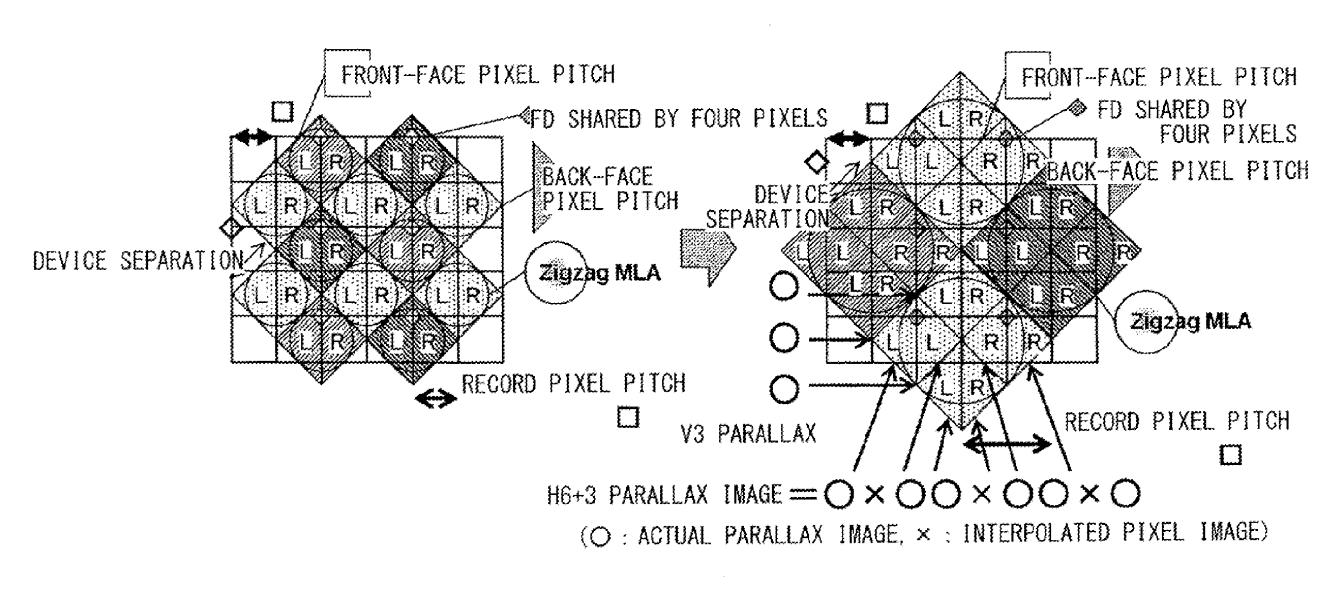
The complex image on top shows you a new Sony Light Field sensor that has been patented by Sony (United States Application US20140071244). Basically it’s a Sony version of the famous new Lytro Illum (here on Amazon). As you know a Light field camera can take the entire light field instead of a pure 2D image. It means you can refocus in post production and even change the perspective. Try it out here:
Click to refocus. Click and drag for Perspective Shift. (Source: Pictures Lytro).
Well, the drawback of such cameras is that the resolution is very low. And that’s exactly what Sony claims to have fixed in this patent:
“a camera system that have no useless pixel arrangement and are capable of suppressing decrease in resolution which may be caused by adopting stereo function.“
The sensor tech is very complicated and we have to see how long it will take for Sony to get this into a real mass-produced camera. But now imagine for a second to have a Full Frame camera with such a sensor. Damn, that would be amazing …or not?
0 Responses
This calls for a lot of computing power. How about enabling uncompressed RAW in their existing cameras and how about fixing the shutter problem before trying yet another half baked adventure?
Breathe!
theres no camera manufacturer without there draw backs, but i rather look at the
bright side and enjoy the positive innovations by sony in recent years.
I do as well. I applaud their new cybershot with an EVF and tilt LCD (I am not in the market for P&S cams). 🙂
You prob won’t like this either that here in Australia you can get the A7S for about US$2150. http://www.digidirect.com.au/slr_cameras/sony/sony_a7s_full-frame_mirrorless_camera_body-_ilce-7sb At that price it’s tempting for me but I got suckered into a deal with my wife and have to wait.
Wait a while, Slingers. Prices will plummet. Steve Huff is always enthusiastic about anything new. remember that 7 star rating for RX1. 🙂
I see your leaning in life is to wait and watch on the sidelines without ever riding a wave. Jump in sometimes. It’s nice to play.
Come on! I can only do so much without a visible preorder link. 🙂
I am hoping you would buy this. Who wouldn’t want a light field camera?
Not any light field camera but a Sony one. One needs to encourage “innovation”. 🙂
That’s a bit harsh isnt it? 🙂
The raw being compressed is nothing more than a psychological issue. It retains the smoothest transitions anyway. The Bayer design itself does much worse to the image quality than Sony’s raw compression.
It would be if I am one of the “reviewers”. I am just an ordinary customer who pays real cash to buy these. 🙂
It would be very nice if it could be used with post processing to get say perfectly focused macro shots.
That would be nice, but that’s not the reality unfortunately. It’s a consumer-level gimmick.
The problem with lytro is it sacrifices too much resolution in return for not enough depth information. At best you can choose, from a pre-determined range, which area to be vaguely more in focus that another. For focus critical applications, it’s useless. You’ll get better results by slightly missing focus with a traditional camera than you will by using this and trying to focus after the fact with lytro, and still miss focus while being much softer.
I hope Sony don’t waste too much effort on this.
It’s so amazing, that I would change my entire set of optics, if the resolution of such a camera will be 8 Mp or more. The only thing, that stops me from bying Lytro Illum, is that resolution of output is somewhat about XGA … blurred XGA.
Just learn to focus
Plus one. Between current AF advancements and EVF/LCD manual focus convenience, it really shouldn’t be difficult.
precisely… people are still following the stigmas of mid 1900s
Interesting possibility fo dof critical situations such as macro.
I do not see from these drawings how this sensor deals with color?
I also am skepticsl about the ability to make this high resolution even though Sony is claiming to have done so.
If this same technology can be built into a display device such as a tv the potential for practical 3D video without glasses would exist.
Not being rude but no, it wouldn’t.
Explain
Do you understand how convention 3D displays work? Are you aware of the bandwidth required for 3D displays? Are you aware of the specialist equipment required to capture 3D? The entire chain would need to be light field. That’s before you even add the massive problem of how such a display would know what the viewer is focused on, and forget multiple viewers.
Come on Barry, think about it.
I am indeed very familiar with 3D having been commercially involved with 3D and lenticular imaging fo several years.
What we currently think of as 3D is really only a stereo image..as it only contains 2 images.
The biggest limitation to glassesless 3D is viewing distance and angle. A system like this if it is introduced would probably debut in specialty applications first such as theatres or medical imaging where the added cost and difficulty could be justified.
I do not know …nor have I claimed that we will see this system in common usage..only that it can be done.
Certainly detecting by accurate 3D high res imaging…a medical condition that would be missed otherwise would justify the cost.
You clearly have no grasp of the bandwidth or processing power required for such a system, and have not addressed the very obvious problem of how the display would track what the viewer was looking at, or how it could be scaled to multiple viewers in say, your theatre example.
You ask for an explanation, yet offer no insight as to how such a display would work yourself. I too am very familiar with how current 3D imaging works, and really don’t require your simplistic ‘explanation’.
Give it up Barry. I’m not a Barry basher, and have great respect for your skill as an artist, but you really don’t know what you are talking about in this instance.
Medical imaging would probably be the most practical first use of suth a system.
In this application a single viewer would eliminate angle and viewing distance concerns.
Bandwith would not be an issue since it would be a closed system and not necessarily require real time playback.
Personal devices such as gaming consoles could work where single viewer devices could be used…but the cost may be prohibitive for such a device.
Again I only see limited use for such a system but by arranging the pixels of the output/viewing device in the same configuration as the input device/camera/recorder a true 3D devece would be possible enabling 3D viewing along both the x and y axis which current 3D or stereo devices cannot do.
Again, no explanation of how it would work, and another iteration of an example application you did not mention in your original post.
Quote “If this same technology can be built into a display device such as a tv the potential for practical 3D video without glasses would exist”. Now I’ve illustrated the insurmountable problem of multiple viewers, you’ve stopped mentioning TV and moved the goalposts. Not the first time I’ve observed this tactic when you are quizzed on your posts.
Please Barry, stop now. You’re digging one of those holes you often find yourself in. As I said before, I respect your skill as an artist, but your grasp of this subject and debating skills are not up to this task.
This is not a DEBATE we are discussing a device that we are seing for the first time.
I have incorporated input from you into my later comments..that is why they are changing.In fact I currently agree with some of your comments that differ from my original comment.
I also notice no indication of color so this may be a monochromatic devive..possibly used with various filters and illumination sources to increase the information gathered..again leaning towards a medical imaging device.
I do at this point agree with you that we are not likely to see this used on consumer devices or theatrical use in the predictable future.
I’m glad our discussion has cleared up why this could not be used to make a 3D TV. There are more technical reasons why this technology could not be reversed to create a display, based on how light field imaging works, but lets leave it at that.
If it came across as too personal, I apologise. I can get carried away when discussing/debating something.
I post on sar both to share my views and to learn stuff.
I cant be rite all the time or I wont be able to learn anything.
When you tell me stuff I dont know I value that.
You’re making things personal here when Barry hasn’t. Not fair play.
I have no wish to make it personal, but I will always call it as I see it. As I said, I have respect for Barry as an artist, but I won’t couch my words when discussing something.
More barryhaviour, talking out his asz. Just ignore him like many of us now do. His posts are not worth discussing.
“Explain”, lol
The explanation for this comment is, as usual, that you have no idea what you’re talking about.
I don’t get this tech. Take that squirrel pic above. When the squirrel is OOF, the picture just looks like garbage. It’s the case with most of the pics on the lytro website. I find that in most of those pics, there’s really only one point of proper focus OR they need more DOF for everything to be in focus, for the pic to look good. What’s the point to be able to create a crappy photo by focusing on some non-subject within the frame?
I guess that this technology solves the problem of inaccurate focus. With it, you can’t misfocus any more. That’s cool…
OK. So it allows us to be lazier 😉
Well, Photoshop does that too. It’s not necessarily a bad thing. Anyway, I guess street photographers, photo journalists, people taking photos of their kids – they all could be eased by knowing that they do not have to make artistic choices in the moment of taking a photo.
Solves the problem of requiring photographers having to make any artistic choices when creating a photograph! As if auto-iso, auto-aperture, auto-shutter, and even auto-focus weren’t enough, even high-res cameras so you can frame in post! Now you can just shoot wildly and not even have to look at your viewfinder!
Don’t forget smile shutter.
Im all for new tech… lets people focus on better things 😉 Or you can do it yourself using a camera with less automation… do I see you shooting with a home made camera to say others dont put the effort in? 🙂
Well, it is actually quite easy to focus properly (or well enough) with today’s cameras, so this feature isn’t a huge help, while being limited, of limited use and a huge tradeoff. At the moment, of course.
There are limited steps of focusing. You do not have an infinite amount of “focus fields” or a fine tune ability…if you are slightly off, the focus field next to the one you missed may be worse off. Try it with any photo from lytro and attempt to fine tune focus. You can’t. Its always big steps behind and in front.
Well, Kodak DCS100 was 1.3Mpx camera producing awful pictures. Some quarter of the century later, we’re talking about 75Mpx sensors, ISOs of 409,600… Give it some time, and technology will find its way.
Like Lytro pictures, it’s just a gimmik, since you can only “play” with the focus on the proprietary program..
Are raw files gimmicks too?
While basically true, your comment doesn’t have anything to do with practical reality. DCRAW which is the core of most editing software is an open source project.
Exactly what I was thinking. And above I replied with the only advantage I see for such tech.
Softwares improve when technoly improves. Photoshop alone cannot properly process raws? What do u do? U add support for it.
dcraw came about as it was a good idea and there was a need. If there are lightfield cameras everywhere they will also have more support.
I agree with gintony below. Personally, I can see it useful to recover a misfocused shot, but honestly I don’t see myself buying and using such a camera just to be sure my photos are correctly focused.
I’m sure people said the exact same thing about autofocus.
People or some people? I have never said that, for example. I’m sorry if my personal thought doesn’t match yours.
People of the past, during the time AF slrs came about.
You should be sorry for not being able to discuss something without blowing your rape whistle.
No, I’m sorry because you don’t accept people having different opinions/needs than you. You love this idea? That’s great. I don’t see it so useful to me, and write it here. Have a nice day!
Perfect response to all this negativity. I dont see this as a gimmick at all. It is an evolutionary step forward for more control of your image.
This is a gimmick. It’s just many cameras built into one. Each camera focuses on a different subject. Take picture and voila. Different focus and angle. Using 1/X of the sensor to snap X pictures at the same time? That’s just ridiculous. Want to take 4 pictures at the same time? Good way to turn a full-frame into a 4/3. The latest Lytro has a 40 MP sensor that is divided into many parts, thus takes more than one picture at the same time. The lens is also divided into more parts. Because of the lens you get different focus on the different pictures and because of the sensor you get different angle on the different pictures. Pure gimmick.
It’s a lot more complex than that. I suggest you read about it, even if you can’t appreciate it.
What about high-speed frame burst with each shot with different focal point and merge it with software stuff thingy? So that images will all be at full res…
Nice idea, but people are actually doing it for years already 😉
It’s called focus stacking and I believe some cameras have it already built into their firmware. Would be a useful addition for Sony cameras.
Ah, you reminded me on wjhat most macro shooters does~ It will definitely come in handy for the macro fans if they have this feature since there are already exposure bracket, WB brackets, why not focus shift bracket~!?
As I said, some cameras already have it and it’s actually a simple firmware thing.
Well, I know what you mean and are just say~=(
There’s a name for that… it’s called “yuck” 😀
It doesn’t work for motion and typical lenses also breathe when refocused.
This type of tech is less useful in an FF camera, though having less mis-focused shots is a plus. I think the better application for this is to give cameras of 1″ sensors or smaller a way to have shallow DoF.
I don’t think it works that way. You’ll see in many of the examples, the forground and background have to be VERY far apart. This tech is not providing shallower DOF, it’s simply allow refocus in existing shallow DOF situations. In FF, you could more easily find shallower DOF situations, whereas with these tiny sensors, you have to create extreme separation to find it.
Yes, with very limited choice. The “steps” from going to one “field of focus” to another seem rather apart that fine tuning may be not an option.
Once you have depth info of every pixel, you can increase/decrease DOF realistically. This is how the Lytro camera does not need to focus at all.
If I´m not mistaken, the Lytro refocus nature limits the useful pixel count of the final image? In that case, this tech is more suited for cellphones.
Agreed.
Its an early tech. It might not be good now but tech gets better and this one can also.
You’re missing my point. I meant the nature of Lytro means it will always have far less pixel output than contemporary cameras.
I wouldn’t see any benefit with this… It would be better if they develop a sensor that are much more sensitive to light. Curved sensors are also a great concept.
Seriously, Sony doesn’t know what it’s doing. Curved sensors are an amazing step forward in mainstream photography (something that has been done before with single shots on film emulsion, however). Light field cameras seem like a waste of effort and processing time. Get it right in camera.
I’m coincident in opinion with you!
I don’t need this feature and for user who need this gives lytro.
Sony better comes with a new sensor technology like the graphene sensor or organic sensor with extreme sensitive to light. But i search for hours in the internet for a patent for a graphene sensor- i found not one patent for a graphene photo sensor 🙁
Refocussing an image is not a great interaction with photography, IMO. I, as a photographer, choose what is important for my image. There’s no need to adjust the focus-point on any image, as long as it is not wrong focussed. How would you display such images? In a exhibition? On a wall? On your screen? On you tablet? Are your viewers supposed to refocus all of your dozens photographs?
The only advantage of a LF-camera is to proper adjust the focus in post-production if it’s misaligned. But it’s rarely the case and I would rather invest in a better AF system. The trade-off is also (today) the absence of long aperture values.
I’d rather like to see a proper 3D camera for stills. Maybe that’s where LF is going to.
I dont think u are thinking correctly. The point is to adding more tools for processing. If your image is out of focus then u can refocus it. You cannn let your viewers do all that but thats not point. Comments like yours make me shake my head for being so close minded.
That’s the point~!!! When I shoot FF and on some occasion I miss-focused the model/subject I want just ever so slightly and , it gets very irritated and I wish I can do some minor focus shifts~
By the samples I have ever seen from Lytro and others, the amount of re-focusing is not infinite…but rather limited. It would appear to be that if you want to refocus, you can only do so many steps and not an infinite amount of variations. So, the “fields of focus” may be very limited which means that being “slightly off” will still be “slightly off” anyways since your choices are very narrow.
As I said, refocusing in post-production would be the only advantage. However, that is not the selling point Lytro is advertising. And, frankly, correct focusing is not my issue in photography.
This would be a macro-shooters dream come true. A total game-changer. To control the amount of depth of field inmacro-pictures would make the hell of the difference for picture taking. I found it laughble that some people can’t find benefits for technology like this.
The only thing about this technology is that the bokeh doesn’t looks good
Over the weekend another patent emerged fora Canon 5 layer sensor.
I do not think this will be the new tech announced in Se
Deep DOF is usually required for landscape and macro. For the former, focus stacking is already a good solution with some headroom for improvement in firmware and processing software. In macro you usually have a priority in getting very high res results because that reveals the interesting things, so lowering res is not an option.
Focus accuracy is just a matter of having a good AF system and skills.
What does this thing offer besides that “explore a photo”-gimmick?
To me it seems that all advantages of Lytro can be realized by just improving existing technology. Combine a fast frame-rate video camera with a fast focusing motor and you can capture just same data as a Lytro camera. And much more.
To me, that sounds like saying, “Who needs RAW when it is possible to get a professional picture straight out of the camera given careful technique and conditions?”
Who knows what innovations we could see in processing to create new styles of photos that we have not seen before? Maybe these cameras will provide benefits in areas where it is not feasible to do focus stacking. I also imagine that this technology would treat background compression differently in outdoors shots if changing the focal position affects compression.
It’s “like” not “alike” : “Sony is working on a Lyttro-like patent.”
thank god you are here
It’s been like this here for years…
But you spelled Lytro wrong.
“It’s been alike this here for years”.
And we love it.
Its interesting and I’d like to see this technology mature – especially data processing.
It is interesting to me that ‘Rack Focusing’ is now available in still photography. So, I’m wondering if the end-game is really a Light Field Video Camera and a still camera is just an early step in their business plan.
I think a Light Field Video Camera might would have appeal because it would allow for more flexibility in post production of films.
How does it help in the low light situations? That’s where I miss focus.
When perfected this could be the way to do follow focus in movies.
Exactly.
Anyone who is familiar with post production will know the kind of exquisite lens specific “Rack Focussing”: achievable in post with the “Rack Focus ” plug ins.
So, as your earlier comment states it’s just a matter of data processing.ability that will bring this technology to film making.
I imagine this would be a lot of data.
Agreed. But the process can be subdivided and the algorithms may improve and the computing technology itself may undergo radical transformation. We do not know yet how we will be computing in 10 years time. All we can say is, our processing power now may look very basic when viewed from the future.
The link below this drawing is for Dexela.
A low dose 3D xray imaging devive with a choice of 1mp and 2mp resolutions.
Unless this link has nothing to do with the drawing…..this drawing has absolutely nothing to do with a camera but represents a medical xray imaging device.
I also see no indication that this is a Sony patent but rather a Dexela patent.
Does anyone have any additional info about this drawing? Otherwise I would conclude that this entire rumor is incorrect.
Dexela produces…” a family of flat panel cmos x-ray detectors”.
It is a sony patent and it is not a rumor!
http://www.freepatentsonline.com/20140071244.pdf
I found a more complete version of the description and it does as you say list Sony as the owner and describe this as a light field device.
It then goes on to describe it as a Dexela xray device.
Could you share the link to the ‘more complete version’? I’m curious, because the inventory, Isao Hirota, has always worked for Sony – At least since 2008.
I am unable to copy links from my phone…when I googled new sony sensor patent ..it sent me to slrlouunge.com/sony-patents……tha article resembled what sar says but when I clicked on the link for more detailed written description…I saw that this seems to be described ,after some sony info, as a Dexela xray imaging device.
I am somewhat confused by these postings but I think this is a type of low dose 3D xray imaging device to be made by Dexella with 2 resolution settings of 1 and 2mp.
If you can clarify this any please do so…I suspect the various rumor side administrators may also be as confused as me and that this rumor may actually be a medical device..not a camera.
Vivek – In one of the embodiments, (see Figure 37 of the patent) it includes multi-layer photo-diodes. So, even if it’s not used to capture the vectors of the light, it can potentially be used for other things – potentially increase sensitivity, potentially increase DR, etc… depending upon how they implement it. … all very interesting.
Thanks for pointing that out. 🙂 Even if it is a X-ray sensor, it is interesting and (even if) none have anything to do Lytro. The post from admin is meant as a provocation, I suppose. 🙂
I’m guessing this is for video.
Sony have shown a prototype of this camera around the industry a coupe of years ago but it never came out.
It was an ENG style camera.
Maybe it is finally ready for market?
For video this could be amazing as you can do stabilisation, slight reframes or slight camera moves and focus pulls in post.
For stills it is a bit of a gimmick, but once the technology catches up such that many more image points are added to the grid, it could be pretty useful for stills.
Actually this sensor looks similar to the sensor in the Sony F65 which has the same zig-zag (rotated 45 degree) pixel array.