







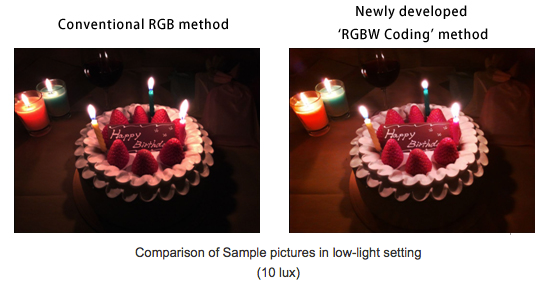
While this news is not directly related to the Alpha World it’s still interesting to hear about Sony’s future sensor tech. Feng.com reports that the next generation of Apple iPhones will use a brand new 12 Megapixel RGBW Sony sensor. The “W” stands for “White” pixels and it allows to increase the sensitivity which is a weak point of current smartphone photocameras. Usually those RGBW sensors have as a consequence that the pixels size decreased and therefore the image quality gets poorer. But Sony claims they solved this with a new kind of technology (not explained yet):
While the individual pixels of the Sony models are extremely minute at 1.12μm, the incorporation of the “RBGW Coding” function has realized a SN ratio (signal-to-noise ratio) equivalent to that of a unit pixel size of 1.4μm under conventional methods, which in turn has enables the image sensors to achieve a higher resolution at a more compact size.
Don’t know if that RGBW sensor tech will be applied on future APS-C or FF sensors too.
34 Responses
That picture is like 3 years old lol
If it’s a 12MP sensor, this might mean 4k is coming to the new generation of the iPhone.
I think you might be right
Logic would indicate that white sensors would collect more photons (simply because there’s no filtration level). As such, the sensor, overall, will have more total luminance information. However, that very reduction in filtration will mean that there is some loss of chromatic data. In principle, the result of this will be a sensor able to work better in lower light but it will be rather less able to distinguish colour and be prone to more chromatic noise. Very probably it would then require “sophisticated” processing to try and reduce the impact of the loss of chromatic information.
There is no magic solution to things like this. It’s all a matter of trade-offs. For the cellphone market, I’ll make an inspired guess that what matters is being able to get a tolerable image in low light and that little matters of chromatic accuracy are of less importance than the sort of visual impact that can be achieved with a bit of processing. I’m rather less inclined to think this approach would transfer over to the world of “serious” cameras where IQ gets micro-analysed.
in world of serious camera, they care more of camera being big and black.
you’re confusing accuracy vs. precision. while chromatic noise is going to be bigger, color accuracy might even increase because there’s one more degree of freedom
I had the difference between precision and accuracy drilled into me in my physics undergraduate course. You can add as many levels of precision into the the measurement of colour as you like, but if the accuracy is compromised because you are just measuring inherent noise more accurately, it adds nothing. This is simply a trade-off between the colour discrimination and luminance measurement.
so having 2 green pixels versus 1 just “measures noise more accurately” but does not give more accuracy
Of course not. The noise from the two pixels adds in quadrature. In consequence, there’s and increased signal-to-noise ratio so the DR is better.
However, there is a philosophical point in that the definition of accuracy in science is normally taken as how close the result is to the “true” value. In the case of light, at medium to high levels the noise is dominated by photon shot noise. In other words the fundamental random nature of the emission of photons. An “accurate” measurement would reflect that random variation of emission whilst the application of noise reduction might more closely match the appearance of the scene in a particular area when integrated over a longer period.
So, this idea of accuracy can be a bit misleading.
apart from noise, there’s a systematic color error because sensor response curves don’t match human eye, and this is how usually “color accuracy” is defined.
The way the human eye responds to colour is vastly more complicated than a matter of response curves. Human colour perception is as much in the visual system of the brain as it is in the system of cones in the retina. (There are lots of articles on that matter).
In any event, it’s not the job of the camera sensor to recreate the way the eye and visual cortex capture images. The camera sensor just has to capture the image as it actually is and it’s then the job of rendering systems to create and image which can be appreciated by the eye.
However, there is one sense in which camera sensors have to approximate to the eye’s characteristic, and that’s in the system of colour filtering. As no camera sensor is yet capable of measuring wavelength directly, it has to use a system of colour channels chosen to be reasonably compatible with human’s tricolour reception system. (If a sensor could measure wavelength directly, then this would be unnecessary). As such, camera sensors are compromised have a reasonable facsimile of the human eye’s chromatic sensing capabilities. The same is true of rendering devices, like screens and printers. Some creatures have tetrochromatic colour sensing, and what our systems capture and render will probably appear a little strange to them.
Going back to the actual news item, it’s notably that the human eye is also an RGBW device. The rods in the eye are sensitive to all wavelengths and come into play at low light levels. Then we tend to lose our colour vision. However, camera’s aren’t allowed this. We still expect them to have reasonable colour discrimination, even at low light levels.
I’d like to see Olympus produce a 64MP (?) sensor with an RGBW CFA and utilise 2×2 sampling to output a full RGB 16MP image. A large Panchromatic photocell would likely blow out too often to be useful but the pitch might be small enough on a 64MP 4/3 sensor — and really differentiate Olympus from the rest of the market. The current rumour is that they’ll use a new 20MP Sony sensor but unless it’s BSI and Sony don’t implement it at APS-C… they’re chasing their tails.
Chromatic resolution is actually not very important. For example, most playback video is encoded keeping color information on one in four pixels. Heck you can try it on photoshop, duplicate an image, set the top image blending mode to color and start blurring it. You can blur it alot before it becomes noticeable.
For video that’s certainly true. Indeed, there are other aspects of video where IQ can be compromised due to they way we interpret moving images. Video compression algorithms make use of this.
However, with people “pixel-peeping” on still images where they have rather more than a 20ms duration frame to perceive, they will start noticing how areas of similar colour start losing definition. You see this on some of those coloured feathers whereby the fine detail gets lost.
In any event, RGBW sensors are not a new idea. No camera manufacturer has yet seen fit to develop a serious camera. (Similarly, there have been have sensors with two different size photosites to increase DR, but that lead to compromises in other areas. It always seem we end up with the Bayer filter pattern, or a close cousin.)
Agreed. The theoretical improvements are also quite small. A strictly monochrome sensor improves light sensitivity by 1 to 1.5 stops. So the possible gains from going from RGGB to RGBW are very low – but so are the losses in colour information…
IMHO it’s like trading 4 quarters for a dollar. It’s probably never been done in a dedicated camera as the possible gains are too low to justify the possible loss of colour information but more importantly the need for new demosaicing algorithms in RAW converters. Just look at how much of a pain in the ass the Fuji x-trans files have been…
Again this sensor? It’s been years I’ve seen news about this sensor (or similar sensors like the one from Kodak) and no actual thing.
Let’s see this time.
Huawei already uses a Sony RGBW sensor in the P8.
I’d be interested to know how or if they solved the issue, that basically killed off the launch a month after official announcement back in 2012:
http://www.sony.net/SonyInfo/News/Press/201209/12-0921E/
Really? I didn’t know that!
Thanks for the info!
So the new iPhone will have internal 4k video 🙂
OH~! But I still prefer my Xperia Phone 😛
OK, maths:
The W photo-sites should be 3x more sensitive than a color photo-site.
But by adding a W site, each RGB site is 25% smaller (so 25% less sensitive).
So if your RAW processing can apply the W luminance to every RGB pixel, each of those pixels is x2.25 more sensitive. So basically you get a stop better ISO performance.
Rough maths, making lots of assumptions!
It’s not quite that simple because by shrinking the RGB sites and ‘boosting’ sensitivity with luminance rather than color data, I guess there’s a greater risk of blowing out a specific color. And, of course, a greater risk of chroma noise.
Would be interesting if they can make a RGBW back illuminated sensor for a7s II.
I wish Fuji did not stopped the development of Super CCD SR Pro with its R-pixels.
Today would be Super CMOS SR Pro 🙂
http://www.guillermoluijk.com/article/superccd/
https://www.flickr.com/groups/fujis5/pool/
Recently there was a patent from Canon describing similar principle to achieve high DR on CMOS sensors. So the idea lives on and might come to fruition in their sensors in future.
Lol… when other phones like iPhone, Galaxy or even some chinese phone using the latest and the most cutting edge Sony image sensor.
Sony smartphone XPERIA keep using the same old sensor from Xperia Z1 and the same crappy low grade Sony G Lens.
Dear Sony just kill your mobile division because from the way i look it you don’t want your mobile division to be successful and prefer becoming Apple b****h.
The lens has been greatly improved since the Z1, which results in much better corner performance on the Z3 for example.
The sensor isn’t bad either, the main remaining issue is processing. Time for a new engine and/or IP.
I’m not an expert that is for sure but as far as i know the 6 elements lens on some phone is better than 5 elements G lens on Z series.
I never said that the sensor is bad but when the others put PDAF or some sort of AF system Sony keep using the same old sensor.
Like it or not the camera on Xperia is a crap considering the BIG WORD in their marketing ads.
Like “the best of Sony or the best camera”
The best of Sony is when i can find the latest and the most cutting edge Exmor sensor, High Grade G Lens, 3 axis hardware stabilization (minimum) in Xperia Camera.
The number of elements tells us next to nothing about the quality of a lens. Also keep in mind that the lens is wider than most (25mm equiv.).
RGBW has been around for years. As I recall the real world advantage was small. Perhaps it has improved since then?
No it hasn’t. It was announced for release in august 2012 and the release was canceled a month later.
http://www.sony.net/SonyInfo/News/Press/201209/12-0921E/
The first product using a Sony RGBW sensor is the just announced Huawei P8.
The correct term is LRGB, not RGBW
Really? There are many more hits on RGBW sensor that LRGB. The astrophotography community are quite hot on using the term LRGB for combining separate luminance and RGB images, but that’s not quite the same as a single sensor which has Red, Green, Blues and “White” colour channels. Of course it’s utterly ridiculous to talk about a “white” filter (which I carefully didn’t), as the actual filter will be transparent. So the filter matrix might better be termed RGBT.
However, this is all rather unimportant. RGBW now seems to be an accepted term for photographic sensors of this type. The term has been used on patents (like this on), and it seems Kodak used RGBW as a description.
http://www.google.co.uk/patents/US8264576
In short, there’s no “correct” term until such times as it’s established. What really matters is whether it’s accurate or not. As an example of which, look at Sony’s use of the term translucent in SLT – which it is not. Alternatively, there’s the so-called 5-axis stabilisation systems (which is difficult, given that there are only 3 axis in 3D space – they are really 5 degree of freedom correction systems; 3 roll, 2 translation).
If I understand correctly, this white pixel would mostly affect black noise. Dont know about you guys, but i care less about liminance noise, than i do about chroma noise and its weird color blotches, patters, errors, etc.
Chroma noise is much more disturbing to the eye. Even the most noisy image, still looks ok when converted to B&W, and Black noise isnt something photographers usually complain about.
I’f they would come up with a way to improve color noise handling, then it would be news worthy.
The new Motorola phones have a rgbw sensor…nothing new.
Why is it my post never make the cut??? What’s going on here?